   A systematic and independent examination to
    determine whether quality activities and related
    results comply with planned arrangements, and
    whether these arrangements are implemented
    effectively and are suitable to achieve objectives


                                                         2
   To collect objective evidence to permit an informed
    judgment about the status of the systems or product
    being audited


                                                          3
   Internal (First Party, Self)

     This type includes audits by company employees,
      consultants and contractors


                                                        5
   External
    i. Supplier Audit
      ○ Second Party
         Customer employee(s) audit your company
                              or
         Your employee(s) audit a company which
          supplies your company with a product or
          service


                                                    6
ii.       Independent Organization

           Third Party Audit

           ○ A customer wants an audit of your company


                                                         7
1.   Compliance (do we comply with the standard)
        Example: Desk audit of high level systems
2.   System (the theory)
        Example: Audit of Document Control
3.   Process (the practice)
        Example: Audit of any process (manufacturing)
4.   Product (the result)
        Example: Audit of finished products to fulfil
         technical specifications


                                                         8
1.   Auditor: A person who has appropriate qualifications
     and performs audits.

2.   Client: A person or organization requesting the audit.
     For internal audits, this is the Management
     Representative.

3.   Auditee: An organization, facility or person being
     audited.


                                                              9
4.   Quality System: The organizational structure,
     responsibilities, procedures, processes and
     resources for implementing quality management.

5.   Observation: A statement of fact made during an
     audit and substantiated by objective evidence.

6.   Nonconformity: The non-fulfillment of specified
     requirements.


                                                       10
7.   Objective Evidence: Qualitative or quantitative
     information, records or statements of fact pertaining
     to the quality of an item or service or to the
     existence and implementation of a quality system
     element, which is based on observation,
     measurement or test and which can be verified.


                                                             11
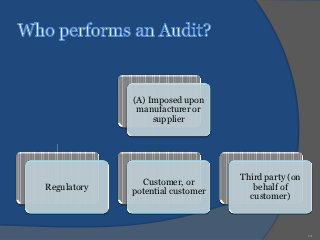
(A) Imposed upon
              manufacturer or
                  supplier


                                  Third party (on
               Customer, or
Regulatory                           behalf of
             potential customer
                                    customer)


                                                    12
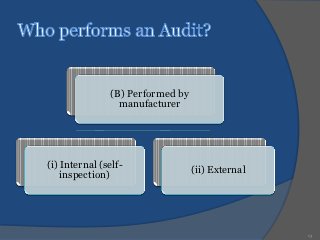
(B) Performed by
                  manufacturer


(i) Internal (self-
                                   (ii) External
    inspection)


                                                   13
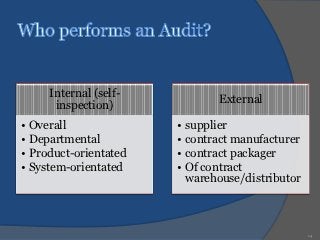
Internal (self-
                              External
      inspection)
• Overall              • supplier
• Departmental         • contract manufacturer
• Product-orientated   • contract packager
• System-orientated    • Of contract
                         warehouse/distributor


                                                 14
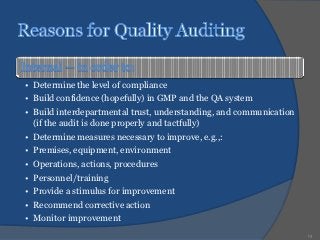
• Determine the level of compliance
• Build confidence (hopefully) in GMP and the QA system
• Build interdepartmental trust, understanding, and communication
  (if the audit is done properly and tactfully)
• Determine measures necessary to improve, e.g.,:
• Premises, equipment, environment
• Operations, actions, procedures
• Personnel/training
• Provide a stimulus for improvement
• Recommend corrective action
• Monitor improvement
                                                                    15
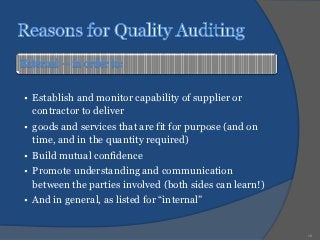
• Establish and monitor capability of supplier or
  contractor to deliver
• goods and services that are fit for purpose (and on
  time, and in the quantity required)
• Build mutual confidence
• Promote understanding and communication
  between the parties involved (both sides can learn!)
• And in general, as listed for “internal”


                                                         16
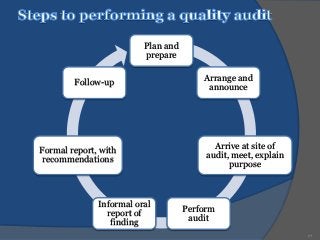
Plan and
                         prepare

                                        Arrange and
        Follow-up
                                         announce


                                           Arrive at site of
Formal report, with
                                         audit, meet, explain
 recommendations
                                               purpose


              Informal oral
                                    Perform
                report of
                                     audit
                 finding
                                                                17
18
examination of

1.   established methods

2.   instructions

3.   work flow for processes

4.   maintenance programs for production equipment

5.   material handling

6.   housekeeping around the work area


                                                     19
   Here company’s procedures are validated
   Processes are sub-parts of a system.
     Process audits are generally a part of larger system(s)
      audit.
     However , they can be performed independently
      ○ An internal audit may indicate need to perform a specific
        process audit
   Almost always, one or more other process(es) will interact
    with any given process.
   One very important issue to consider is the effectiveness of
    communications between systems and/or processes.
                                                                   20
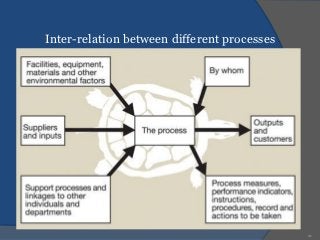
Inter-relation between different processes


                                             21
1.   Documents
       a.       Quality and GMP regulations, standards, and guidelines
                (local, national, and international)
       b.       Previous audit and follow-up reports
       c.       Auditee’s own documents and records
       d.       Audit checklists
                 requires that auditor evaluates a certain number of
                  procedures, plans and documents
2.   The auditors own eyes, ears, brain, words, character, etc.
3.   The auditing plan
                                                                         22
1.   Is there a documented sanitation program?
2.   Are the specifics of the program followed?
3.   Are there standard operating procedures (SSOPs)?
4.   Is a pre-operational audit conducted prior to production?
5.   Are corrective actions taken in response to pre-op
     findings?
6.   What are the general conditions in the plant?
7.   Are the floors, walls and ceilings in good condition?
8.   Are the exterior structure and grounds maintained in a
     condition to prevent contamination?

                                                                 23
Quality audit
Quality audit

Quality audit

  • 2.
    A systematic and independent examination to determine whether quality activities and related results comply with planned arrangements, and whether these arrangements are implemented effectively and are suitable to achieve objectives 2
  • 3.
    To collect objective evidence to permit an informed judgment about the status of the systems or product being audited 3
  • 4.
    Internal (First Party, Self)  This type includes audits by company employees, consultants and contractors 5
  • 5.
    External i. Supplier Audit ○ Second Party  Customer employee(s) audit your company or  Your employee(s) audit a company which supplies your company with a product or service 6
  • 6.
    ii. Independent Organization  Third Party Audit ○ A customer wants an audit of your company 7
  • 7.
    1. Compliance (do we comply with the standard)  Example: Desk audit of high level systems 2. System (the theory)  Example: Audit of Document Control 3. Process (the practice)  Example: Audit of any process (manufacturing) 4. Product (the result)  Example: Audit of finished products to fulfil technical specifications 8
  • 8.
    1. Auditor: A person who has appropriate qualifications and performs audits. 2. Client: A person or organization requesting the audit. For internal audits, this is the Management Representative. 3. Auditee: An organization, facility or person being audited. 9
  • 9.
    4. Quality System: The organizational structure, responsibilities, procedures, processes and resources for implementing quality management. 5. Observation: A statement of fact made during an audit and substantiated by objective evidence. 6. Nonconformity: The non-fulfillment of specified requirements. 10
  • 10.
    7. Objective Evidence: Qualitative or quantitative information, records or statements of fact pertaining to the quality of an item or service or to the existence and implementation of a quality system element, which is based on observation, measurement or test and which can be verified. 11
  • 11.
    (A) Imposed upon manufacturer or supplier Third party (on Customer, or Regulatory behalf of potential customer customer) 12
  • 12.
    (B) Performed by manufacturer (i) Internal (self- (ii) External inspection) 13
  • 13.
    Internal (self- External inspection) • Overall • supplier • Departmental • contract manufacturer • Product-orientated • contract packager • System-orientated • Of contract warehouse/distributor 14
  • 14.
    • Determine thelevel of compliance • Build confidence (hopefully) in GMP and the QA system • Build interdepartmental trust, understanding, and communication (if the audit is done properly and tactfully) • Determine measures necessary to improve, e.g.,: • Premises, equipment, environment • Operations, actions, procedures • Personnel/training • Provide a stimulus for improvement • Recommend corrective action • Monitor improvement 15
  • 15.
    • Establish andmonitor capability of supplier or contractor to deliver • goods and services that are fit for purpose (and on time, and in the quantity required) • Build mutual confidence • Promote understanding and communication between the parties involved (both sides can learn!) • And in general, as listed for “internal” 16
  • 16.
    Plan and prepare Arrange and Follow-up announce Arrive at site of Formal report, with audit, meet, explain recommendations purpose Informal oral Perform report of audit finding 17
  • 17.
  • 18.
    examination of 1. established methods 2. instructions 3. work flow for processes 4. maintenance programs for production equipment 5. material handling 6. housekeeping around the work area 19
  • 19.
    Here company’s procedures are validated  Processes are sub-parts of a system.  Process audits are generally a part of larger system(s) audit.  However , they can be performed independently ○ An internal audit may indicate need to perform a specific process audit  Almost always, one or more other process(es) will interact with any given process.  One very important issue to consider is the effectiveness of communications between systems and/or processes. 20
  • 20.
  • 21.
    1. Documents a. Quality and GMP regulations, standards, and guidelines (local, national, and international) b. Previous audit and follow-up reports c. Auditee’s own documents and records d. Audit checklists  requires that auditor evaluates a certain number of procedures, plans and documents 2. The auditors own eyes, ears, brain, words, character, etc. 3. The auditing plan 22
  • 22.
    1. Is there a documented sanitation program? 2. Are the specifics of the program followed? 3. Are there standard operating procedures (SSOPs)? 4. Is a pre-operational audit conducted prior to production? 5. Are corrective actions taken in response to pre-op findings? 6. What are the general conditions in the plant? 7. Are the floors, walls and ceilings in good condition? 8. Are the exterior structure and grounds maintained in a condition to prevent contamination? 23