International
Project Appraisal

By: Somya Agrawal
Sonam Agrawal
Laxmi Nandwani
Introduction
• The fundamental goal of the finance
manager is to maximize shareholder’s
wealth.
• This can be done if the firm selects those
projects that maximize the company’s value.
• The selection process involves a detailed
analysis of every project on every aspect.
• International projects involve more factors
to be analyzed as compared to the domestic
projects.
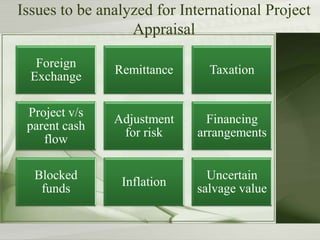
Issues to be analyzed for International Project
Appraisal
Foreign
Exchange

Remittance

Taxation

Project v/s
parent cash
flow

Adjustment
for risk

Financing
arrangements

Inflation

Uncertain
salvage value

Blocked
funds
Foreign Exchange Risk
• Risk that the currency will appreciate or
depreciate over a period of time.
• It help in understanding the cash flows
generated by the project over its life cycle.
• To made the estimates, the manager should
–
–
–
–

Estimate the inflation rate in host country
The cash flows in terms of local currency
Adjust the cash flows for inflation
Convert the cash flows into parent country currency
according to the expected depreciation or
appreciation rate calculated on the basis of PPP.
Remittance Restrictions
• Many countries impose a variety of restriction on
transfer of profits, depreciation and other fees
accruing to the parent company.
• Normally the project cash flow includes profits and
depreciation but parent’s CF consist of the amount
that can be legally transformed.
• There are some techniques to curtail the restrictions
like transfer pricing, overhead payment, etc.
• To obtain a conservative estimate of the
contribution by the project the financial manager
can include only the income which is remittable by
law in the host country.
Tax Issues
• For a project evaluation only cash flows after
tax are relevant.
• In international projects, there exists two taxing
jurisdiction.
• There exists the differences in dividend
management fees, royalties, etc.,
• To calculate the actual after tax cash flow, the
higher tax rate are used.
• This shows a conservative scenario that if the
project is acceptable under this condition then
it will be necessarily acceptable under more
favorable tax scenario.
Project Versus Parent Cash Flows
• Substantial differences can exist between
the project and parent cash flows because
of tax regulations and exchange control.
• Also, expenses such as management fees
and royalties are returns to the parent
company.
• Project Evaluation should be done on the
basis of:
– Its own cash flows?
– Cash flows accruing to the parent company?
– Both?
Basis of its own cash flows
• The project must be able to compete
successfully with other domestic firms &
also earn a rate of return in excess of its
locally based competitors.
• If not, then it is better for parent company
to invest in the equity/ government bonds of
local firms.
Contd..
• Evaluating projects on the basis of local cash
flows has the advantage of avoiding
currency conversion & hence eliminating
problems
involved
with
fluctuating/
forecasting exchange rates changes for the
life of the projects.
From the viewpoint of parent company
• Cash flows which are actually remitted to
the parent are the ultimate yardstick for
company performance.
• This helps in determining the financial
viability of the project from the viewpoint of
the MNC as a whole.
• Cash flows include both operating &
financial like fees, royalties and interest on
loans given by parent company.
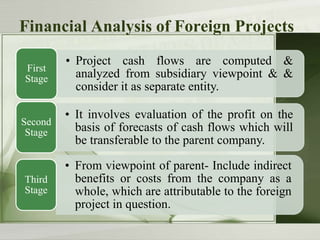
Financial Analysis of Foreign Projects
First
Stage

• Project cash flows are computed &
analyzed from subsidiary viewpoint & &
consider it as separate entity.

Second
Stage

• It involves evaluation of the profit on the
basis of forecasts of cash flows which will
be transferable to the parent company.

Third
Stage

• From viewpoint of parent- Include indirect
benefits or costs from the company as a
whole, which are attributable to the foreign
project in question.
Financing Arrangements
• The value of the project will be determined
by the manner in which it is financed.
• For example: many times, international
agencies in order to promote cross border
trade finance at below market rates.
• In case of subsidized financing, determine
whether subsidized financing is separable or
not from the project.
Contd..
• When the subsidized financing is
inseparable then the value of loan should
be added to that of the project in making
investment decision.
• But, if it is separable, then there is no need
to allocate the value of loan in the project.
Blocked Funds
• Blocked funds are the cash flows generate by
a foreign project that cannot be immediately
transferred to the parent, usually because of
exchange controls imposed by the govt. of the
country in which the funds are held.
Contd..
• Some countries require that the earnings
generated by the subsidiary be reinvested
locally for at least a certain period of time
before they can be remitted to the parent
company.
• Blocked funds cause a discrepancy b/w the
project value from parent’s and local
perspective.
• Also, this can possibly affect the accept/ reject
decision for a project.
INFLATION
 The impact of inflation on the parent’s &
subsidiary’s cash flow can be quite volatile
from year to year some countries. It may
cause currency to weaken & hence influence
a project’s cash flow
 Inaccurate inflation forecast by a
country, can lead to inaccurate cash flow
forecast. Thus MNCs cannot afford to
ignore the impact of inflation in the cash
flow
Uncertain salvage value
• The salvage value of a project has an important
impact on the NPV of the project. When the salvage
value is uncertain, the cash flow will not be accurate
& the MNC may need to calculate various possible
outcome for the salvage value & estimate the NPV
based on each possible outcome. The feasibility of
the project may then depend upon the present value
of the salvage value.
Adjustment for risk
Cash flow v/s Discount rate adjustment:
• Another important dimension in multinational
capital budgeting is whether to adjust cash flow or
the discount rate to account for the additional risk
arises from the foreign location of the project.
• Traditionally, MNCs have adjusted the discount
rate by moving it upwards for riskier projects to
reflect the political and foreign exchanged
uncertainties
• Adjusting the discount rate is quite a popular
method with MNCs mainly because of its
simplicity and the rule that the required rate of
return of a project should be in accordance with
the degree of risk which it is exposed to.
• However, combining all risk into a single discount
rate has several drawbacks.
• The annual cash flow are discounted using the applicable
rate for that type of project either at the host country or at
the parent country. Probability and certainty equivalent
techniques like decision tree analysis are used in economic
and financial forecasting. Cash flows generated by the
project and remitted to the parent during each time period
are adjusted for political risk, exchange rate and other
uncertainties by converting them into certainty equivalent.
The method of adjusting the cash flows rather than
discount rate is generally the more popular method and is
usually recommended by finance managers. There is
generally more information on the specific impact of a
given risk on a projects’ cash flow than on its discount
rate.
THANK - YOU

International project appraisal

  • 1.
    International Project Appraisal By: SomyaAgrawal Sonam Agrawal Laxmi Nandwani
  • 2.
    Introduction • The fundamentalgoal of the finance manager is to maximize shareholder’s wealth. • This can be done if the firm selects those projects that maximize the company’s value. • The selection process involves a detailed analysis of every project on every aspect. • International projects involve more factors to be analyzed as compared to the domestic projects.
  • 3.
    Issues to beanalyzed for International Project Appraisal Foreign Exchange Remittance Taxation Project v/s parent cash flow Adjustment for risk Financing arrangements Inflation Uncertain salvage value Blocked funds
  • 4.
    Foreign Exchange Risk •Risk that the currency will appreciate or depreciate over a period of time. • It help in understanding the cash flows generated by the project over its life cycle. • To made the estimates, the manager should – – – – Estimate the inflation rate in host country The cash flows in terms of local currency Adjust the cash flows for inflation Convert the cash flows into parent country currency according to the expected depreciation or appreciation rate calculated on the basis of PPP.
  • 5.
    Remittance Restrictions • Manycountries impose a variety of restriction on transfer of profits, depreciation and other fees accruing to the parent company. • Normally the project cash flow includes profits and depreciation but parent’s CF consist of the amount that can be legally transformed. • There are some techniques to curtail the restrictions like transfer pricing, overhead payment, etc. • To obtain a conservative estimate of the contribution by the project the financial manager can include only the income which is remittable by law in the host country.
  • 6.
    Tax Issues • Fora project evaluation only cash flows after tax are relevant. • In international projects, there exists two taxing jurisdiction. • There exists the differences in dividend management fees, royalties, etc., • To calculate the actual after tax cash flow, the higher tax rate are used. • This shows a conservative scenario that if the project is acceptable under this condition then it will be necessarily acceptable under more favorable tax scenario.
  • 7.
    Project Versus ParentCash Flows • Substantial differences can exist between the project and parent cash flows because of tax regulations and exchange control. • Also, expenses such as management fees and royalties are returns to the parent company. • Project Evaluation should be done on the basis of: – Its own cash flows? – Cash flows accruing to the parent company? – Both?
  • 8.
    Basis of itsown cash flows • The project must be able to compete successfully with other domestic firms & also earn a rate of return in excess of its locally based competitors. • If not, then it is better for parent company to invest in the equity/ government bonds of local firms.
  • 9.
    Contd.. • Evaluating projectson the basis of local cash flows has the advantage of avoiding currency conversion & hence eliminating problems involved with fluctuating/ forecasting exchange rates changes for the life of the projects.
  • 10.
    From the viewpointof parent company • Cash flows which are actually remitted to the parent are the ultimate yardstick for company performance. • This helps in determining the financial viability of the project from the viewpoint of the MNC as a whole. • Cash flows include both operating & financial like fees, royalties and interest on loans given by parent company.
  • 11.
    Financial Analysis ofForeign Projects First Stage • Project cash flows are computed & analyzed from subsidiary viewpoint & & consider it as separate entity. Second Stage • It involves evaluation of the profit on the basis of forecasts of cash flows which will be transferable to the parent company. Third Stage • From viewpoint of parent- Include indirect benefits or costs from the company as a whole, which are attributable to the foreign project in question.
  • 12.
    Financing Arrangements • Thevalue of the project will be determined by the manner in which it is financed. • For example: many times, international agencies in order to promote cross border trade finance at below market rates. • In case of subsidized financing, determine whether subsidized financing is separable or not from the project.
  • 13.
    Contd.. • When thesubsidized financing is inseparable then the value of loan should be added to that of the project in making investment decision. • But, if it is separable, then there is no need to allocate the value of loan in the project.
  • 14.
    Blocked Funds • Blockedfunds are the cash flows generate by a foreign project that cannot be immediately transferred to the parent, usually because of exchange controls imposed by the govt. of the country in which the funds are held.
  • 15.
    Contd.. • Some countriesrequire that the earnings generated by the subsidiary be reinvested locally for at least a certain period of time before they can be remitted to the parent company. • Blocked funds cause a discrepancy b/w the project value from parent’s and local perspective. • Also, this can possibly affect the accept/ reject decision for a project.
  • 16.
    INFLATION  The impactof inflation on the parent’s & subsidiary’s cash flow can be quite volatile from year to year some countries. It may cause currency to weaken & hence influence a project’s cash flow  Inaccurate inflation forecast by a country, can lead to inaccurate cash flow forecast. Thus MNCs cannot afford to ignore the impact of inflation in the cash flow
  • 17.
    Uncertain salvage value •The salvage value of a project has an important impact on the NPV of the project. When the salvage value is uncertain, the cash flow will not be accurate & the MNC may need to calculate various possible outcome for the salvage value & estimate the NPV based on each possible outcome. The feasibility of the project may then depend upon the present value of the salvage value.
  • 18.
    Adjustment for risk Cashflow v/s Discount rate adjustment: • Another important dimension in multinational capital budgeting is whether to adjust cash flow or the discount rate to account for the additional risk arises from the foreign location of the project. • Traditionally, MNCs have adjusted the discount rate by moving it upwards for riskier projects to reflect the political and foreign exchanged uncertainties
  • 19.
    • Adjusting thediscount rate is quite a popular method with MNCs mainly because of its simplicity and the rule that the required rate of return of a project should be in accordance with the degree of risk which it is exposed to. • However, combining all risk into a single discount rate has several drawbacks.
  • 20.
    • The annualcash flow are discounted using the applicable rate for that type of project either at the host country or at the parent country. Probability and certainty equivalent techniques like decision tree analysis are used in economic and financial forecasting. Cash flows generated by the project and remitted to the parent during each time period are adjusted for political risk, exchange rate and other uncertainties by converting them into certainty equivalent. The method of adjusting the cash flows rather than discount rate is generally the more popular method and is usually recommended by finance managers. There is generally more information on the specific impact of a given risk on a projects’ cash flow than on its discount rate.
  • 21.