ISO 26000 Guidance on Social Responsibility:
       What it means for your company
Peter Hall, MACTEC / Carolyn Schmidt, ECOLOGIA
“ISO 26000:     What it Means for Your Company”
                 Ted Freeman, Session Moderator
             Principal, Praxis Consulting Group (Philadelphia)

     Peter Hall, Panelist              Carolyn Schmidt, Panelist
     Principal                         Program Director
     Sustainability Practice Leader    ECOLOGIA (Middlebury, Vermont)
     EHS Management                    Expert Member, ISO WGSR (Working
     MACTEC (Portland, Maine)             Group on Social Responsibility)
     Member of US TAG for ISO 26000       ECOLOGIA is a D Liaison (NGO)
                     Framework for the Session
1.   Introduction (5 minutes)
2.   Background on ISO 26000 (15 minutes)
3.   Ways ISO 26000 is already being used globally (15 minutes)
4.   Suggestions for use of ISO 26000 by US companies (15 minutes)
5.   Issues and questions raised by the audience (40 minutes)
2. Background on ISO 26000

What is ISO?

        ISO : International Organization for Standardization

 - Private, not-for-profit organization established in 1947 (Geneva, Switzerland)

 - Promotes the development of international standards

 - Voluntary standards: positive contribution to our world; encourage global trade

 - Worldwide collaboration (WTO, UN, ILO, WHO…)

 - 157 country members, representing 98% of the world economy and 97% of its
  population. (ISO-Annual Report 2008)


                                                                                    3
What is the purpose and scope of ISO 26000?
•   To assist organizations in addressing their SR;

•   To provide practical guidance related to operationalizing SR, identifying and engaging
    with stakeholders, and enhancing credibility of reports and claims made about SR;

•   To emphasize performance results and improvement;

•   To increase confidence and satisfaction in organizations among their customers and
    other stakeholders;

•   To be consistent with and not in conflict with existing documents, international treaties
    and conventions and existing ISO standards;

•   To promote common terminology in the SR field and broaden awareness of SR.

•   It is not intended to reduce any government's authority to address the SR of
    organizations; it is not intended to be a “non-tariff barrier to trade” (WTO)

•   It is not intended or appropriate for certification purposes. Any offer to certify, or claims
    to be certified to ISO 26000 would be a misrepresentation of the intent and purpose of
    this International Standard.


                                                                               Std Pres Kit   4
Timeline, Goals and Applicability

•   Initial ISO SR meeting 2001
•   First Working Group meeting 2005
•   DIS (Draft International Standard) approved by vote of ISO member bodies,
    February 2010
•   Final Draft International Standard approved by Working Group, May 2010
•   Planned publication = December 2010
•   “ISO 26000 provides guidance on the principles of SR, core subjects and
    issues, and guidance on SR implementation”
•   Likely recognized as universal and international SR standard
•   Standard that can link many of the existing global SR standards / initiatives
•   Global benchmark across all organizations in any industry, including
    outsourcing
How does ISO 26000 define
                     “social responsibility”?
•   2.16 social responsibility

•   responsibility of an organization for the impacts of its decisions and activities on
    society and the environment, through transparent and ethical behaviour that

•   contributes to sustainable development, including health and the welfare of society;

•   takes into account the expectations of stakeholders;

•   is in compliance with applicable law and consistent with international norms of
    behaviour; and

•   is integrated throughout the organization and practiced in its relationships.

•   Note 1 Activities include products, services and processes

•   Note 2 Relationships refer to an organization’s activities within its sphere of influence
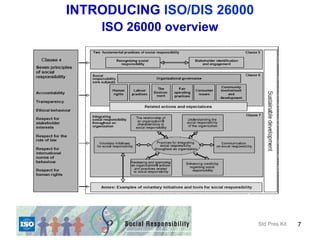
INTRODUCING ISO/DIS 26000
    ISO 26000 overview


                            Std Pres Kit   7
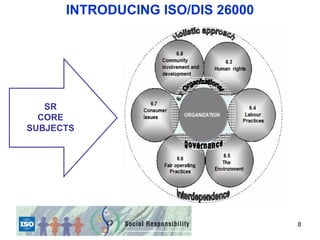
INTRODUCING ISO/DIS 26000


   SR
  CORE
SUBJECTS


                                  8
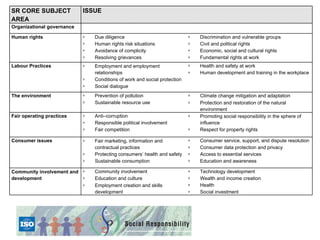
SR CORE SUBJECT             ISSUE
AREA
Organizational governance

Human rights                   Due diligence                              Discrimination and vulnerable groups
                               Human rights risk situations               Civil and political rights
                               Avoidance of complicity                    Economic, social and cultural rights
                               Resolving grievances                       Fundamental rights at work
Labour Practices               Employment and employment                  Health and safety at work
                               relationships                              Human development and training in the workplace
                               Conditions of work and social protection
                               Social dialogue
The environment                Prevention of pollution                    Climate change mitigation and adaptation
                               Sustainable resource use                   Protection and restoration of the natural
                                                                          environment
Fair operating practices       Anti–corruption                            Promoting social responsibility in the sphere of
                               Responsible political involvement          influence
                               Fair competition                           Respect for property rights

Consumer issues                Fair marketing, information and            Consumer service, support, and dispute resolution
                               contractual practices                      Consumer data protection and privacy
                               Protecting consumers’ health and safety    Access to essential services
                               Sustainable consumption                    Education and awareness

Community involvement and      Community involvement                      Technology development
development                    Education and culture                      Wealth and income creation
                               Employment creation and skills             Health
                               development                                Social investment
3. Ways ISO 26000 is already being used
     globally – Carolyn Schmidt, ECOLOGIA
          “trial runs” / “early implementer” efforts + publicity
          (Netherlands; Denmark; Germany; Canada; China; Japan;
          South Africa . . .)
          Stakeholder engagement using the ISO 26000 “multi-
          stakeholder” consensus process
      Industry, Consumer, NGO, Government, Labor, SSRO* [+ Finance ?]
     DIFFERENT AND COMPLEMENTARY APPROACHES
         Validate existing beliefs in and strengthen implementation of “SR
         principles” – accountability, transparency, ethical behavior, etc.; use
         in choice of business partners; build SR networks
         Use specific recommendations in ISO 26000 to document CSR–
         strengthen your negotiating hand and marketing efforts
         Follow the structure of ISO 26000, work through principles, core
         subjects, stakeholder engagement, reporting, improvement plans etc.
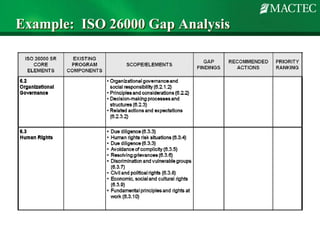
         (ex. MACTEC’s “gap analysis”; ECOLOGIA’s “handbook”, others)

     NHBSR Spring 2010 Conference - ECOLOGIA /
10   ISO 26000
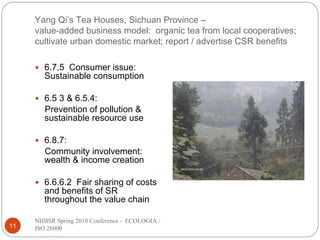
Yang Qi’s Tea Houses, Sichuan Province –
     value-added business model: organic tea from local cooperatives;
     cultivate urban domestic market; report / advertise CSR benefits

        6.7.5 Consumer issue:
        Sustainable consumption

        6.5 3 & 6.5.4:
        Prevention of pollution &
        sustainable resource use

        6.8.7:
        Community involvement:
        wealth & income creation

        6.6.6.2 Fair sharing of costs
        and benefits of SR
        throughout the value chain

     NHBSR Spring 2010 Conference - ECOLOGIA /
11   ISO 26000
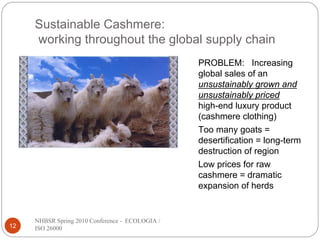
Sustainable Cashmere:
     working throughout the global supply chain
                                                 PROBLEM: Increasing
                                                 global sales of an
                                                 unsustainably grown and
                                                 unsustainably priced
                                                 high-end luxury product
                                                 (cashmere clothing)
                                                 Too many goats =
                                                 desertification = long-term
                                                 destruction of region
                                                 Low prices for raw
                                                 cashmere = dramatic
                                                 expansion of herds


     NHBSR Spring 2010 Conference - ECOLOGIA /
12   ISO 26000
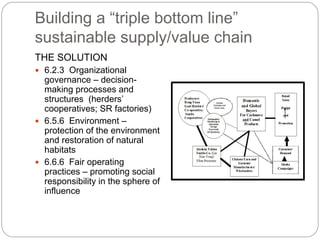
Building a “triple bottom line”
sustainable supply/value chain
THE SOLUTION
 6.2.3 Organizational
 governance – decision-
 making processes and
 structures (herders’
 cooperatives; SR factories)
 6.5.6 Environment –
 protection of the environment
 and restoration of natural
 habitats
 6.6.6 Fair operating
 practices – promoting social
 responsibility in the sphere of
 influence
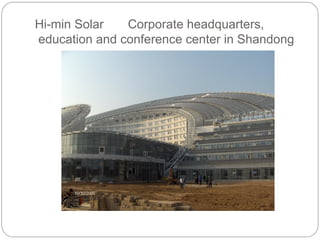
Hi-min Solar   Corporate headquarters,
education and conference center in Shandong
Hi-min Solar
  World class high tech alternative energy company aspiring
  to go global ( recent $100,000,000 FDI from Goldman
  Sachs + British Ministry of Trade)
  What kinds of questions will they need to address, to reach
  global market?
  ISO 26000 as guide to international expectations

Most relevant:
 7.5 Communication on social responsibility (reporting) and
     stakeholder dialogue
               and
    Clause 6 (the 7 core subjects)
Priorities when implementing ISO 26000-
ECOLOGIA’s focus
ECOLOGIA’s WORK IN CHINA:
  Strengthen existing Chinese SR entrepreneurs’ competitiveness and
  brand appeal; expand into local, national and global SR markets
  Show how ISO 26000 guidance supports current Chinese national
  government policy to promote sustainable development and quality of
  life (economic, human health, environment)

GENERAL – APPLIES TO ANY SIZE COMPANY AND ANY LOCATION
  Attention to each of the 7 core subjects (Clause 6)
  Stakeholder involvement, two-way communication (Clause 5, Clause 7)
  Reporting; independent verification; marketing (Clause 7)
  Fair sharing of costs and benefits of implementing social responsibility
  throughout the value chain / supply chain (Clause 6.6.6.2)
  FLEXIBILITY - TAILOR YOUR USE OF ISO 26000 TO YOUR OWN
  CONTEXT, NEEDS, SIZE, ETC.
4. Suggestions for use of ISO 26000 by
  US companies - Peter Hall, MACTEC
• Implementation Strategies
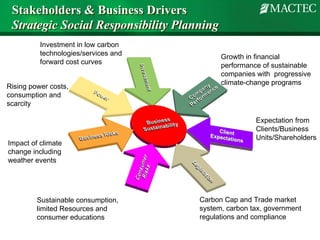
Stakeholders & Business Drivers
 Strategic Social Responsibility Planning
          Investment in low carbon
          technologies/services and         Growth in financial
          forward cost curves               performance of sustainable
                                            companies with progressive
                                            climate-change programs
Rising power costs,
consumption and
scarcity

                                                      Expectation from
                                                      Clients/Business
                                                      Units/Shareholders
Impact of climate
change including
weather events


         Sustainable consumption,     Carbon Cap and Trade market
         limited Resources and        system, carbon tax, government
         consumer educations          regulations and compliance
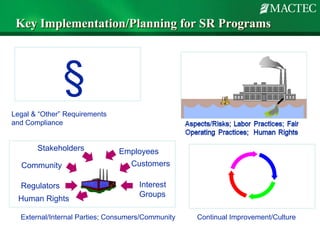
Key Implementation/Planning for SR Programs


               §
Legal & “Other” Requirements
and Compliance


       Stakeholders            Employees
  Community                       Customers

  Regulators                         Interest
                                     Groups
  Human Rights

  External/Internal Parties; Consumers/Community   Continual Improvement/Culture
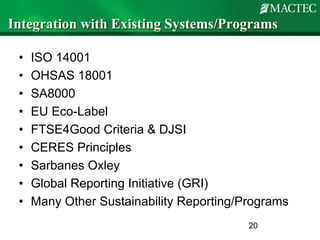
Integration with Existing Systems/Programs

 •   ISO 14001
 •   OHSAS 18001
 •   SA8000
 •   EU Eco-Label
 •   FTSE4Good Criteria & DJSI
 •   CERES Principles
 •   Sarbanes Oxley
 •   Global Reporting Initiative (GRI)
 •   Many Other Sustainability Reporting/Programs
                                          20
Examples of Implementation Tips

•   Spend Time Understanding “Stakeholders”
•   Use Established Management Practices & Programs
•   Prioritize Core Issues within SR Core Subject Areas
•   Set Specific Short-Term Targets (with Long-Range in Mind) & Establish
    Responsibilities
•   Leverage Cross-functional Teams
•   Top Management and Respected Company Leaders is Key
•   Allocate Sufficient Resources to Allow Targets and Goals to be Met
•   Revise/Develop Operating Procedures/Training/Norms Consistent with the
    SR Program
•   Internal and then External Communication
•   Incorporate SR into Purchasing and Investment Practices
•   Build Issues of SR into HR Management and other Key
    organization/business areas (Integrate!)


                                                             21
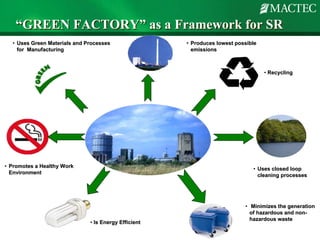
“GREEN FACTORY” as a Framework for SR
  • Uses Green Materials and Processes                • Produces lowest possible
    for Manufacturing                                   emissions


                                                                                   • Recycling


• Promotes a Healthy Work                                                     • Uses closed loop
  Environment                                                                   cleaning processes


                                                                           • Minimizes the generation
                                                                             of hazardous and non-
                                                                                              non-
                                                                             hazardous waste
                              • Is Energy Efficient
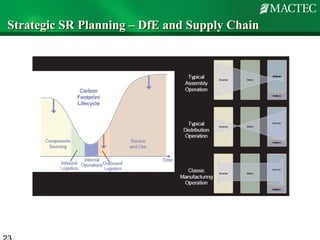
Strategic SR Planning – DfE and Supply Chain
Observations of ISO 26000 by SMEs
•   Many Small & Medium Sized Enterprises (SMEs) see ISO 26000 as
    more designed for large multi-national companies (broad-based
    international standard)
•   Labor practices in less developed countries still a concern
•   SMEs that are linked to international value chains are more
    interested
•   Many SMEs lack expertise/resources to understand the SR agenda,
    prioritize with business, estimate resources/costs to implement
•   Need to communicate internally how SR activities contribute to
    business
•   Personal values of owner/Sr. managers are a key driver of SR at
    SMEs
•   Many SMEs approach SR issues in a “non-integrated” manner
•   SMEs financed by SR investors more likely to address SR programs
    (2008 IISD Survey)
                                                       24
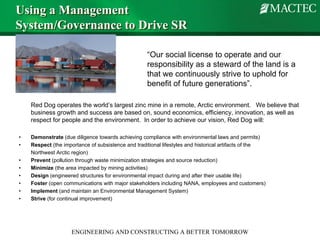
Using a Management
System/Governance to Drive SR

                                                    “Our social license to operate and our
                                                    responsibility as a steward of the land is a
    trust                                           that we continuously strive to uphold for
    the                                             benefit of future generations”.

    Red Dog operates the world’s largest zinc mine in a remote, Arctic environment. We believe that
    business growth and success are based on, sound economics, efficiency, innovation, as well as
    respect for people and the environment. In order to achieve our vision, Red Dog will:

•   Demonstrate (due diligence towards achieving compliance with environmental laws and permits)
•   Respect (the importance of subsistence and traditional lifestyles and historical artifacts of the
    Northwest Arctic region)
•   Prevent (pollution through waste minimization strategies and source reduction)
•   Minimize (the area impacted by mining activities)
•   Design (engineered structures for environmental impact during and after their usable life)
•   Foster (open communications with major stakeholders including NANA, employees and customers)
•   Implement (and maintain an Environmental Management System)
•   Strive (for continual improvement)


                    ENGINEERING AND CONSTRUCTING A BETTER TOMORROW
Example: ISO 26000 Gap Analysis
5.Open discussion –
   Ted Freeman, Praxis Consulting Group


questions, comments, ideas…

cschmidt@ecologia.org
pjhall@mactec.com
www.iso.org/sr

                                    Std Pres Kit   27
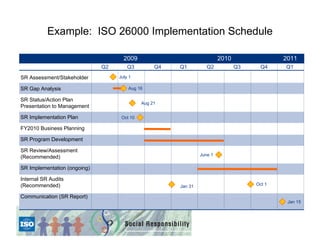
Example: ISO 26000 Implementation Schedule

                                     2009                                2010                2011
                              Q2       Q3         Q4   Q1          Q2           Q3     Q4    Q1
SR Assessment/Stakeholder          July 1

SR Gap Analysis                        Aug 16

SR Status/Action Plan
                                             Aug 21
Presentation to Management

SR Implementation Plan              Oct 10

FY2010 Business Planning

SR Program Development

SR Review/Assessment
                                                                June 1
(Recommended)

SR Implementation (ongoing)

Internal SR Audits
(Recommended)                                          Jan 31                        Oct 1

Communication (SR Report)
                                                                                              Jan 15
Communication of ISO 26000
• Part of existing system/program
• Integrated in “Legal and Other
  Requirements” for an organization
• “[Organization] has implemented or
  developed a Social Responsibility (SR)
  program consistent with ISO 26000”


                                   29

Iso 26000

  • 1.
    ISO 26000 Guidanceon Social Responsibility: What it means for your company Peter Hall, MACTEC / Carolyn Schmidt, ECOLOGIA
  • 2.
    “ISO 26000: What it Means for Your Company” Ted Freeman, Session Moderator Principal, Praxis Consulting Group (Philadelphia) Peter Hall, Panelist Carolyn Schmidt, Panelist Principal Program Director Sustainability Practice Leader ECOLOGIA (Middlebury, Vermont) EHS Management Expert Member, ISO WGSR (Working MACTEC (Portland, Maine) Group on Social Responsibility) Member of US TAG for ISO 26000 ECOLOGIA is a D Liaison (NGO) Framework for the Session 1. Introduction (5 minutes) 2. Background on ISO 26000 (15 minutes) 3. Ways ISO 26000 is already being used globally (15 minutes) 4. Suggestions for use of ISO 26000 by US companies (15 minutes) 5. Issues and questions raised by the audience (40 minutes)
  • 3.
    2. Background onISO 26000 What is ISO? ISO : International Organization for Standardization - Private, not-for-profit organization established in 1947 (Geneva, Switzerland) - Promotes the development of international standards - Voluntary standards: positive contribution to our world; encourage global trade - Worldwide collaboration (WTO, UN, ILO, WHO…) - 157 country members, representing 98% of the world economy and 97% of its population. (ISO-Annual Report 2008) 3
  • 4.
    What is thepurpose and scope of ISO 26000? • To assist organizations in addressing their SR; • To provide practical guidance related to operationalizing SR, identifying and engaging with stakeholders, and enhancing credibility of reports and claims made about SR; • To emphasize performance results and improvement; • To increase confidence and satisfaction in organizations among their customers and other stakeholders; • To be consistent with and not in conflict with existing documents, international treaties and conventions and existing ISO standards; • To promote common terminology in the SR field and broaden awareness of SR. • It is not intended to reduce any government's authority to address the SR of organizations; it is not intended to be a “non-tariff barrier to trade” (WTO) • It is not intended or appropriate for certification purposes. Any offer to certify, or claims to be certified to ISO 26000 would be a misrepresentation of the intent and purpose of this International Standard. Std Pres Kit 4
  • 5.
    Timeline, Goals andApplicability • Initial ISO SR meeting 2001 • First Working Group meeting 2005 • DIS (Draft International Standard) approved by vote of ISO member bodies, February 2010 • Final Draft International Standard approved by Working Group, May 2010 • Planned publication = December 2010 • “ISO 26000 provides guidance on the principles of SR, core subjects and issues, and guidance on SR implementation” • Likely recognized as universal and international SR standard • Standard that can link many of the existing global SR standards / initiatives • Global benchmark across all organizations in any industry, including outsourcing
  • 6.
    How does ISO26000 define “social responsibility”? • 2.16 social responsibility • responsibility of an organization for the impacts of its decisions and activities on society and the environment, through transparent and ethical behaviour that • contributes to sustainable development, including health and the welfare of society; • takes into account the expectations of stakeholders; • is in compliance with applicable law and consistent with international norms of behaviour; and • is integrated throughout the organization and practiced in its relationships. • Note 1 Activities include products, services and processes • Note 2 Relationships refer to an organization’s activities within its sphere of influence
  • 7.
    INTRODUCING ISO/DIS 26000 ISO 26000 overview Std Pres Kit 7
  • 8.
    INTRODUCING ISO/DIS 26000 SR CORE SUBJECTS 8
  • 9.
    SR CORE SUBJECT ISSUE AREA Organizational governance Human rights Due diligence Discrimination and vulnerable groups Human rights risk situations Civil and political rights Avoidance of complicity Economic, social and cultural rights Resolving grievances Fundamental rights at work Labour Practices Employment and employment Health and safety at work relationships Human development and training in the workplace Conditions of work and social protection Social dialogue The environment Prevention of pollution Climate change mitigation and adaptation Sustainable resource use Protection and restoration of the natural environment Fair operating practices Anti–corruption Promoting social responsibility in the sphere of Responsible political involvement influence Fair competition Respect for property rights Consumer issues Fair marketing, information and Consumer service, support, and dispute resolution contractual practices Consumer data protection and privacy Protecting consumers’ health and safety Access to essential services Sustainable consumption Education and awareness Community involvement and Community involvement Technology development development Education and culture Wealth and income creation Employment creation and skills Health development Social investment
  • 10.
    3. Ways ISO26000 is already being used globally – Carolyn Schmidt, ECOLOGIA “trial runs” / “early implementer” efforts + publicity (Netherlands; Denmark; Germany; Canada; China; Japan; South Africa . . .) Stakeholder engagement using the ISO 26000 “multi- stakeholder” consensus process Industry, Consumer, NGO, Government, Labor, SSRO* [+ Finance ?] DIFFERENT AND COMPLEMENTARY APPROACHES Validate existing beliefs in and strengthen implementation of “SR principles” – accountability, transparency, ethical behavior, etc.; use in choice of business partners; build SR networks Use specific recommendations in ISO 26000 to document CSR– strengthen your negotiating hand and marketing efforts Follow the structure of ISO 26000, work through principles, core subjects, stakeholder engagement, reporting, improvement plans etc. (ex. MACTEC’s “gap analysis”; ECOLOGIA’s “handbook”, others) NHBSR Spring 2010 Conference - ECOLOGIA / 10 ISO 26000
  • 11.
    Yang Qi’s TeaHouses, Sichuan Province – value-added business model: organic tea from local cooperatives; cultivate urban domestic market; report / advertise CSR benefits 6.7.5 Consumer issue: Sustainable consumption 6.5 3 & 6.5.4: Prevention of pollution & sustainable resource use 6.8.7: Community involvement: wealth & income creation 6.6.6.2 Fair sharing of costs and benefits of SR throughout the value chain NHBSR Spring 2010 Conference - ECOLOGIA / 11 ISO 26000
  • 12.
    Sustainable Cashmere: working throughout the global supply chain PROBLEM: Increasing global sales of an unsustainably grown and unsustainably priced high-end luxury product (cashmere clothing) Too many goats = desertification = long-term destruction of region Low prices for raw cashmere = dramatic expansion of herds NHBSR Spring 2010 Conference - ECOLOGIA / 12 ISO 26000
  • 13.
    Building a “triplebottom line” sustainable supply/value chain THE SOLUTION 6.2.3 Organizational governance – decision- making processes and structures (herders’ cooperatives; SR factories) 6.5.6 Environment – protection of the environment and restoration of natural habitats 6.6.6 Fair operating practices – promoting social responsibility in the sphere of influence
  • 14.
    Hi-min Solar Corporate headquarters, education and conference center in Shandong
  • 15.
    Hi-min Solar World class high tech alternative energy company aspiring to go global ( recent $100,000,000 FDI from Goldman Sachs + British Ministry of Trade) What kinds of questions will they need to address, to reach global market? ISO 26000 as guide to international expectations Most relevant: 7.5 Communication on social responsibility (reporting) and stakeholder dialogue and Clause 6 (the 7 core subjects)
  • 16.
    Priorities when implementingISO 26000- ECOLOGIA’s focus ECOLOGIA’s WORK IN CHINA: Strengthen existing Chinese SR entrepreneurs’ competitiveness and brand appeal; expand into local, national and global SR markets Show how ISO 26000 guidance supports current Chinese national government policy to promote sustainable development and quality of life (economic, human health, environment) GENERAL – APPLIES TO ANY SIZE COMPANY AND ANY LOCATION Attention to each of the 7 core subjects (Clause 6) Stakeholder involvement, two-way communication (Clause 5, Clause 7) Reporting; independent verification; marketing (Clause 7) Fair sharing of costs and benefits of implementing social responsibility throughout the value chain / supply chain (Clause 6.6.6.2) FLEXIBILITY - TAILOR YOUR USE OF ISO 26000 TO YOUR OWN CONTEXT, NEEDS, SIZE, ETC.
  • 17.
    4. Suggestions foruse of ISO 26000 by US companies - Peter Hall, MACTEC • Implementation Strategies
  • 18.
    Stakeholders & BusinessDrivers Strategic Social Responsibility Planning Investment in low carbon technologies/services and Growth in financial forward cost curves performance of sustainable companies with progressive climate-change programs Rising power costs, consumption and scarcity Expectation from Clients/Business Units/Shareholders Impact of climate change including weather events Sustainable consumption, Carbon Cap and Trade market limited Resources and system, carbon tax, government consumer educations regulations and compliance
  • 19.
    Key Implementation/Planning forSR Programs § Legal & “Other” Requirements and Compliance Stakeholders Employees Community Customers Regulators Interest Groups Human Rights External/Internal Parties; Consumers/Community Continual Improvement/Culture
  • 20.
    Integration with ExistingSystems/Programs • ISO 14001 • OHSAS 18001 • SA8000 • EU Eco-Label • FTSE4Good Criteria & DJSI • CERES Principles • Sarbanes Oxley • Global Reporting Initiative (GRI) • Many Other Sustainability Reporting/Programs 20
  • 21.
    Examples of ImplementationTips • Spend Time Understanding “Stakeholders” • Use Established Management Practices & Programs • Prioritize Core Issues within SR Core Subject Areas • Set Specific Short-Term Targets (with Long-Range in Mind) & Establish Responsibilities • Leverage Cross-functional Teams • Top Management and Respected Company Leaders is Key • Allocate Sufficient Resources to Allow Targets and Goals to be Met • Revise/Develop Operating Procedures/Training/Norms Consistent with the SR Program • Internal and then External Communication • Incorporate SR into Purchasing and Investment Practices • Build Issues of SR into HR Management and other Key organization/business areas (Integrate!) 21
  • 22.
    “GREEN FACTORY” asa Framework for SR • Uses Green Materials and Processes • Produces lowest possible for Manufacturing emissions • Recycling • Promotes a Healthy Work • Uses closed loop Environment cleaning processes • Minimizes the generation of hazardous and non- non- hazardous waste • Is Energy Efficient
  • 23.
    Strategic SR Planning– DfE and Supply Chain
  • 24.
    Observations of ISO26000 by SMEs • Many Small & Medium Sized Enterprises (SMEs) see ISO 26000 as more designed for large multi-national companies (broad-based international standard) • Labor practices in less developed countries still a concern • SMEs that are linked to international value chains are more interested • Many SMEs lack expertise/resources to understand the SR agenda, prioritize with business, estimate resources/costs to implement • Need to communicate internally how SR activities contribute to business • Personal values of owner/Sr. managers are a key driver of SR at SMEs • Many SMEs approach SR issues in a “non-integrated” manner • SMEs financed by SR investors more likely to address SR programs (2008 IISD Survey) 24
  • 25.
    Using a Management System/Governanceto Drive SR “Our social license to operate and our responsibility as a steward of the land is a trust that we continuously strive to uphold for the benefit of future generations”. Red Dog operates the world’s largest zinc mine in a remote, Arctic environment. We believe that business growth and success are based on, sound economics, efficiency, innovation, as well as respect for people and the environment. In order to achieve our vision, Red Dog will: • Demonstrate (due diligence towards achieving compliance with environmental laws and permits) • Respect (the importance of subsistence and traditional lifestyles and historical artifacts of the Northwest Arctic region) • Prevent (pollution through waste minimization strategies and source reduction) • Minimize (the area impacted by mining activities) • Design (engineered structures for environmental impact during and after their usable life) • Foster (open communications with major stakeholders including NANA, employees and customers) • Implement (and maintain an Environmental Management System) • Strive (for continual improvement) ENGINEERING AND CONSTRUCTING A BETTER TOMORROW
  • 26.
    Example: ISO 26000Gap Analysis
  • 27.
    5.Open discussion – Ted Freeman, Praxis Consulting Group questions, comments, ideas… cschmidt@ecologia.org pjhall@mactec.com www.iso.org/sr Std Pres Kit 27
  • 28.
    Example: ISO 26000Implementation Schedule 2009 2010 2011 Q2 Q3 Q4 Q1 Q2 Q3 Q4 Q1 SR Assessment/Stakeholder July 1 SR Gap Analysis Aug 16 SR Status/Action Plan Aug 21 Presentation to Management SR Implementation Plan Oct 10 FY2010 Business Planning SR Program Development SR Review/Assessment June 1 (Recommended) SR Implementation (ongoing) Internal SR Audits (Recommended) Jan 31 Oct 1 Communication (SR Report) Jan 15
  • 29.
    Communication of ISO26000 • Part of existing system/program • Integrated in “Legal and Other Requirements” for an organization • “[Organization] has implemented or developed a Social Responsibility (SR) program consistent with ISO 26000” 29