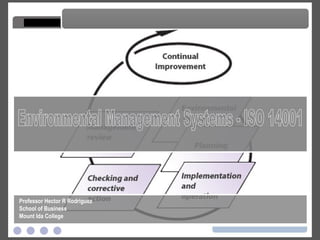
Environmental Management Systems - ISO 14001 Environmental Management Systems - ISO 14001 Professor Hector R Rodriguez School of Business Mount Ida College
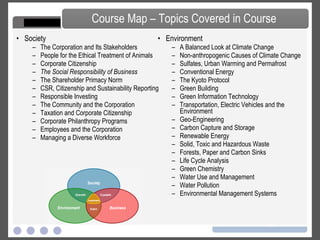
Society The Corporation and Its Stakeholders People for the Ethical Treatment of Animals Corporate Citizenship The Social Responsibility of Business The Shareholder Primacy Norm CSR, Citizenship and Sustainability Reporting Responsible Investing The Community and the Corporation Taxation and Corporate Citizenship Corporate Philanthropy Programs Employees and the Corporation Managing a Diverse Workforce Environment A Balanced Look at Climate Change Non-anthropogenic Causes of Climate Change Sulfates, Urban Warming and Permafrost Conventional Energy The Kyoto Protocol Green Building Green Information Technology Transportation, Electric Vehicles and the Environment Geo-Engineering Carbon Capture and Storage Renewable Energy Solid, Toxic and Hazardous Waste Forests, Paper and Carbon Sinks Life Cycle Analysis Green Chemistry Water Use and Management Water Pollution Environmental Management Systems Course Map – Topics Covered in Course
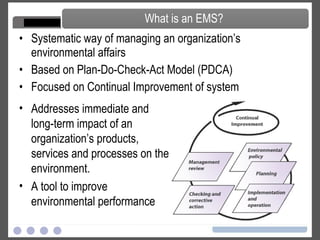
Systematic way of managing an organization’s environmental affairs Based on Plan-Do-Check-Act Model (PDCA) Focused on Continual Improvement of system What is an EMS? Addresses immediate and long-term impact of an organization’s products, services and processes on the environment.  A tool to improve environmental performance
Created by the International Organization of Standardization, a non-governmental organization (NGO) established in 1947, located in Switzerland ISO is a worldwide federation of national standards bodies from over 100 countries; American National Standards Institute (ANSI) is US representative They have created many standards: ISO 9000, film speeds A series of guidance documents and standards to help organizations address environmental issues.  Ones below deal with EMS. 14001: Environmental Management Systems 14004: EMS general guidelines 14012: Auditing - Qualification criteria ISO 14000: A series of standards
ISO 14001 is the only certification standard Registration body examines EMS for conformity to the ISO 14001 standard Not a compliance audit, an EMS audit Facility awarded registration Does NOT mean that products are more environmentally friendly Does mean have a documented EMS that is fully implemented and consistently followed Becoming ISO 14001 certified
Policy Statement  Identification of Significant Environmental Aspects and Impacts Development of Objectives and Targets Implementation Plan to Meet Objectives and Targets Training Management Review How you meet the elements is up to you ISO 14001 Key Elements
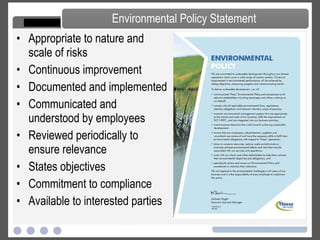
Appropriate to nature and scale of risks Continuous improvement Documented and implemented Communicated and understood by employees Reviewed periodically to ensure relevance States objectives Commitment to compliance Available to interested parties Environmental Policy Statement
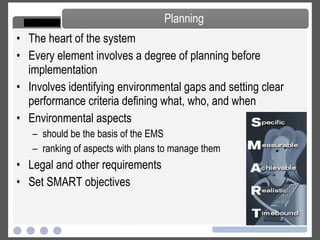
The heart of the system Every element involves a degree of planning before implementation Involves identifying environmental gaps and setting clear performance criteria defining what, who, and when Environmental aspects should be the basis of the EMS ranking of aspects with plans to manage them Legal and other requirements Set SMART objectives Planning
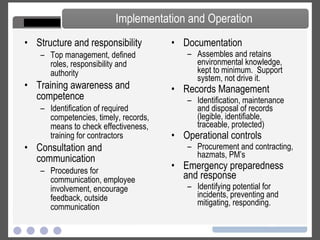
Structure and responsibility Top management, defined roles, responsibility and authority Training awareness and competence   Identification of required competencies, timely, records, means to check effectiveness, training for contractors Consultation and communication   Procedures for communication, employee involvement, encourage feedback, outside communication Documentation   Assembles and retains environmental knowledge, kept to minimum.  Support system, not drive it. Records Management   Identification, maintenance and disposal of records (legible, identifiable, traceable, protected) Operational controls   Procurement and contracting, hazmats, PM’s Emergency preparedness and response   Identifying potential for incidents, preventing and mitigating, responding. Implementation and Operation
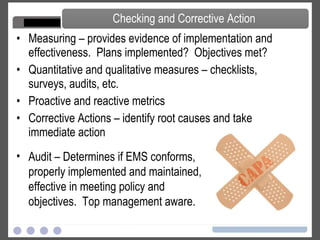
Measuring – provides evidence of implementation and effectiveness.  Plans implemented?  Objectives met? Quantitative and qualitative measures – checklists, surveys, audits, etc. Proactive and reactive metrics Corrective Actions – identify root causes and take immediate action Checking and Corrective Action Audit – Determines if EMS conforms, properly implemented and maintained, effective in meeting policy and objectives.  Top management aware.
Ensures MS continuing suitability adequacy and effectiveness Foundation for continuous improvement Significant issues addressed Set goals and objectives Identifies resources and organizational structure Management Review
Conduct 3 rd  party assessment to verify implementation  Registrar submits proposal Auditee submits formal application Optional pre-assessment by Registrar Audits 1 st  phase (1-3 days) – aspect identification and assessment, setting of objectives, policies and programs 2 nd  phase (3-7 days) – implementation assessment Certification granted Periodic reviews (every 6 months-year) Recertification every 3 years Part II - Certification Process
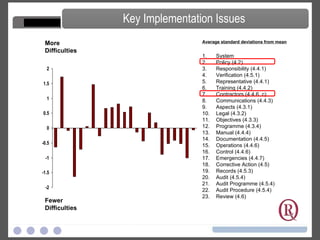
Average standard deviations from mean 1. System 2. Policy (4.2) 3. Responsibility (4.4.1) 4. Verification (4.5.1) 5. Representative (4.4.1) 6. Training (4.4.2) 7. Contractors (4.4.6. c) 8. Communications (4.4.3) 9. Aspects (4.3.1) 10. Legal (4.3.2) 11. Objectives (4.3.3) 12. Programme (4.3.4) 13. Manual (4.4.4) 14. Documentation (4.4.5) 15. Operations (4.4.6) 16. Control (4.4.6) 17. Emergencies (4.4.7) 18. Corrective Action (4.5) 19. Records (4.5.3) 20. Audit (4.5.4) 21. Audit Programme (4.5.4) 22. Audit Procedure (4.5.4) 23. Review (4.6) More Difficulties Fewer Difficulties Key Implementation Issues
Benefits  More reliable performance and compliance Document reporting requirements more efficiently Better procedures resulting in less incidents Better response to incidents Easier to identify opportunities to improve performance, resulting in lower cost and less liability Less risk to surrounding community Means not only doing the right thing, but be seen doing the right thing Helps you demonstrate your responsibility to employees, clients, stakeholders and society Part III – Business Value
University of North Carolina (1/03) studied 83 facilities in 17 states for 3 years Introduction of an EMS can be expected to be somewhat beneficial to the environmental performance of most facilities The existence or certification of an EMS per se does not necessarily provide any clear information about the facility’s actual environmental performance EMS Study by the Environmental Agency in Bristol, England EMS associated with an increased level of operator performance Restricted to procedural aspects of performance Sites neither more nor less likely to suffer from incidents, complaints or non-compliance than those without Sites neither more nor less likely to be subject to enforcement action Management Systems Studies
Management systems teams get mired in paperwork Goal may be to implement system, not to improve performance “ All’s well because we’re certified” Focus on continuous improvement, not on performance vs benchmarks Pitfalls to Avoid
ISO 14001 is not a thing you install, it’s just a protocol you can use to evaluate your management system. It may give you guidance on how to improve your management system The key is to: Improve your management system by… Developing the correct strategy, and… Setting appropriate goals Conclusion

Environmental Management Systems - ISO 14001

  • 1.
    Environmental Management Systems- ISO 14001 Environmental Management Systems - ISO 14001 Professor Hector R Rodriguez School of Business Mount Ida College
  • 2.
    Society The Corporationand Its Stakeholders People for the Ethical Treatment of Animals Corporate Citizenship The Social Responsibility of Business The Shareholder Primacy Norm CSR, Citizenship and Sustainability Reporting Responsible Investing The Community and the Corporation Taxation and Corporate Citizenship Corporate Philanthropy Programs Employees and the Corporation Managing a Diverse Workforce Environment A Balanced Look at Climate Change Non-anthropogenic Causes of Climate Change Sulfates, Urban Warming and Permafrost Conventional Energy The Kyoto Protocol Green Building Green Information Technology Transportation, Electric Vehicles and the Environment Geo-Engineering Carbon Capture and Storage Renewable Energy Solid, Toxic and Hazardous Waste Forests, Paper and Carbon Sinks Life Cycle Analysis Green Chemistry Water Use and Management Water Pollution Environmental Management Systems Course Map – Topics Covered in Course
  • 3.
    Systematic way ofmanaging an organization’s environmental affairs Based on Plan-Do-Check-Act Model (PDCA) Focused on Continual Improvement of system What is an EMS? Addresses immediate and long-term impact of an organization’s products, services and processes on the environment. A tool to improve environmental performance
  • 4.
    Created by theInternational Organization of Standardization, a non-governmental organization (NGO) established in 1947, located in Switzerland ISO is a worldwide federation of national standards bodies from over 100 countries; American National Standards Institute (ANSI) is US representative They have created many standards: ISO 9000, film speeds A series of guidance documents and standards to help organizations address environmental issues. Ones below deal with EMS. 14001: Environmental Management Systems 14004: EMS general guidelines 14012: Auditing - Qualification criteria ISO 14000: A series of standards
  • 5.
    ISO 14001 isthe only certification standard Registration body examines EMS for conformity to the ISO 14001 standard Not a compliance audit, an EMS audit Facility awarded registration Does NOT mean that products are more environmentally friendly Does mean have a documented EMS that is fully implemented and consistently followed Becoming ISO 14001 certified
  • 6.
    Policy Statement Identification of Significant Environmental Aspects and Impacts Development of Objectives and Targets Implementation Plan to Meet Objectives and Targets Training Management Review How you meet the elements is up to you ISO 14001 Key Elements
  • 7.
    Appropriate to natureand scale of risks Continuous improvement Documented and implemented Communicated and understood by employees Reviewed periodically to ensure relevance States objectives Commitment to compliance Available to interested parties Environmental Policy Statement
  • 8.
    The heart ofthe system Every element involves a degree of planning before implementation Involves identifying environmental gaps and setting clear performance criteria defining what, who, and when Environmental aspects should be the basis of the EMS ranking of aspects with plans to manage them Legal and other requirements Set SMART objectives Planning
  • 9.
    Structure and responsibilityTop management, defined roles, responsibility and authority Training awareness and competence Identification of required competencies, timely, records, means to check effectiveness, training for contractors Consultation and communication Procedures for communication, employee involvement, encourage feedback, outside communication Documentation Assembles and retains environmental knowledge, kept to minimum. Support system, not drive it. Records Management Identification, maintenance and disposal of records (legible, identifiable, traceable, protected) Operational controls Procurement and contracting, hazmats, PM’s Emergency preparedness and response Identifying potential for incidents, preventing and mitigating, responding. Implementation and Operation
  • 10.
    Measuring – providesevidence of implementation and effectiveness. Plans implemented? Objectives met? Quantitative and qualitative measures – checklists, surveys, audits, etc. Proactive and reactive metrics Corrective Actions – identify root causes and take immediate action Checking and Corrective Action Audit – Determines if EMS conforms, properly implemented and maintained, effective in meeting policy and objectives. Top management aware.
  • 11.
    Ensures MS continuingsuitability adequacy and effectiveness Foundation for continuous improvement Significant issues addressed Set goals and objectives Identifies resources and organizational structure Management Review
  • 12.
    Conduct 3 rd party assessment to verify implementation Registrar submits proposal Auditee submits formal application Optional pre-assessment by Registrar Audits 1 st phase (1-3 days) – aspect identification and assessment, setting of objectives, policies and programs 2 nd phase (3-7 days) – implementation assessment Certification granted Periodic reviews (every 6 months-year) Recertification every 3 years Part II - Certification Process
  • 13.
    Average standard deviationsfrom mean 1. System 2. Policy (4.2) 3. Responsibility (4.4.1) 4. Verification (4.5.1) 5. Representative (4.4.1) 6. Training (4.4.2) 7. Contractors (4.4.6. c) 8. Communications (4.4.3) 9. Aspects (4.3.1) 10. Legal (4.3.2) 11. Objectives (4.3.3) 12. Programme (4.3.4) 13. Manual (4.4.4) 14. Documentation (4.4.5) 15. Operations (4.4.6) 16. Control (4.4.6) 17. Emergencies (4.4.7) 18. Corrective Action (4.5) 19. Records (4.5.3) 20. Audit (4.5.4) 21. Audit Programme (4.5.4) 22. Audit Procedure (4.5.4) 23. Review (4.6) More Difficulties Fewer Difficulties Key Implementation Issues
  • 14.
    Benefits Morereliable performance and compliance Document reporting requirements more efficiently Better procedures resulting in less incidents Better response to incidents Easier to identify opportunities to improve performance, resulting in lower cost and less liability Less risk to surrounding community Means not only doing the right thing, but be seen doing the right thing Helps you demonstrate your responsibility to employees, clients, stakeholders and society Part III – Business Value
  • 15.
    University of NorthCarolina (1/03) studied 83 facilities in 17 states for 3 years Introduction of an EMS can be expected to be somewhat beneficial to the environmental performance of most facilities The existence or certification of an EMS per se does not necessarily provide any clear information about the facility’s actual environmental performance EMS Study by the Environmental Agency in Bristol, England EMS associated with an increased level of operator performance Restricted to procedural aspects of performance Sites neither more nor less likely to suffer from incidents, complaints or non-compliance than those without Sites neither more nor less likely to be subject to enforcement action Management Systems Studies
  • 16.
    Management systems teamsget mired in paperwork Goal may be to implement system, not to improve performance “ All’s well because we’re certified” Focus on continuous improvement, not on performance vs benchmarks Pitfalls to Avoid
  • 17.
    ISO 14001 isnot a thing you install, it’s just a protocol you can use to evaluate your management system. It may give you guidance on how to improve your management system The key is to: Improve your management system by… Developing the correct strategy, and… Setting appropriate goals Conclusion

Editor's Notes

  • #4 I introduce the term “PDCA” here I often use the term “activities, products, and services” here and reference the standard’s use of these terms
  • #6 I typically read this whole slide – very important
  • #9 Risk assessment – similar to environmental aspects. Should address routine and non-routine activities. Methodology should be proactive. S – specific M- measurable A – achievable R – relevant T – time based
  • #11 Proactive – interviews, done on a routine basis, independent of any event Reactive – in response to event Print and handout Leading Indicators File CA – system to handle, investigate (procedures and root cause analysis), and mitigate acc, incidents and non-conformances Audit – need to know where you’re going.
  • #12 This does not mean signing off a document saying he/she reviewed it. Means actual documented involvement with walkthroughs and employee interviews. Actual verification that the system functions as intended.
  • #13 Pre-assessment - It is a risk-free, dry run before the main assessment and provides a number of benefits: test your management system with an assessor in a relaxed atmosphere. Identify areas that may still require some work, and enables you to plan a realistic time-scale for full assessment. 1 st Phase - At this time, a "site tour" will be conducted, an examination of the environmental/health & safety aspects/effects legislative requirements review takes place a review of the policy statement, specific objectives, targets, internal audits and management review. 2 nd Phase - carried out in accordance with the assessment programme to establish the effectiveness of the management systems compliance with the requirements of the Standards. sampling the Management System and policy requirements review any corrective actions from the Stage 1 the approval outcome is made. Periodic reviews - A typical programme for the surveillance activities will include: review internal audit and management review reports review outstanding observations and improvement notes review corrective and preventive action systems including customer complaints review system changes and the effectiveness of their implementation review use of Registrar and accreditation logos
  • #14 39 below the line system elements well addressed
  • #16 There’s nothing more tragic than the murder of a beautiful theory by a gang of brutal facts
  • #17 Auditing paper is good, but value comes in providing strategies to change behavior and improve performance
  • #18 Every company has a management system… (don’t tell mgmt to go and buy one) the idea is to improve it. Cultural change, management commitment, employee involvement, etc. You need to get from A to B, you can do it by bicycle, Yugo, or Ferrari (This is your MS) make sure you’re headed in the right direction (strategy) and that you’re moving at the right speed (goals) A Ferrari at low speed (top system without right goals) will not get you anywhere. A bicycle at at higher speed may be better. Set your system by using the right strategy and setting SMART goals, and your OHS program will prosper. Those who don’t have their programs end in stagnation.