IRRIGATION ENGINEERING
INTRODUCTION
1Chapter-1
Course Outline
• Basic Soil-Plant-Water Relations.
• Irrigation Water Requirements,
• Sources, quantity and quality of irrigation water:
• Irrigation planning, scheduling and efficiencies.
• Design of irrigation systems and structures.
2Chapter-1
Course Objectives
On Completion of this course, students should be able to:
(i) Understand the basic soil-plant-water parameters
related to irrigation
(ii) Understand how to estimate the quantity of water
required by crops.
(iii) Be able to plan and design irrigation structures.
(iv) Design channels and other irrigation structures required
for irrigation, soil conservation, flood control and other water-
management projects.
3Chapter-1
SYLLABUS
1-Introduction
Definition. Necessity of irrigation. Planning of irrigation projects. Scope of irrigation
engineering. Benefits and ill effects of irrigation.
2-Soil-Water Crop Relationship
Soil and its physical and chemical properties. Root zone soil water. Crops of Pakistan
and crop rotation.
3-Methods of Irrigation
Irrigation methods. Factors affecting irrigation methods. Surface methods. Sprinkler
irrigation method and Sub-surface irrigation methods.
4-Water Requirement of Crops
Functions of irrigation water. Preparation of Irrigation land. Crop base period.
Commanded areas. Intensity of irrigation. Duty and Delta of crop. Relationship
between duty and delta. Factors on which duty depends, depth and frequencies of
irrigation. Kharif-Rabi ratio, Optimization of irrigation water. Uniformity coefficient.
Consumptive use of water. Estimation of consumptive use. Irrigation efficiencies. Net
irrigation requirements.
4Chapter-1
5-Canal Irrigation System
Alluvial and Non-alluvial canals. Alignment of canals. Distribution system for canal
irrigation: basic definitions, determination of canal capacity, canal losses, empirical
formula for channel losses and channel section for minimum seepage loss.
6-Design of Irrigation Channels
Design of stable channel. Regime channels. Kennedy's theory. Critical velocity ratio.
Kutter's formula. Manning's formula. Lacey's theory. Design procedure for Lacey's
theory. Estimation of transported sediment. Bed load equation. Meyer-Peter's and
Einstein's formula. Design procedure for irrigation channel and maintenance of
irrigation canals.
7-Diversion Head Works
Difference between a Weir and Barrage, layout of diversion head works. Diversion
weir, types and components of diversion weir. Head regulator and cross regulator,
canal regulation and silt control at the head works.
8-Irrigation Outlets
Definition. Essential requirements of an outlet. Types of outlets. Characteristics of
outlets and description of each type of outlet.
5Chapter-1
9-Theories of Seepage and Design of Weir and Barrage
Causes of failure by piping and direct uplift, safety against piping and uplift, Khosla's
theory and concept of flow net, stream lines and equipotential lines, critical gradient,
Khosla's method of independent variables for determination of pressure and exit
gradient below a weir or barrage, Khosla's simple standard profiles. Design examples
of barrage, head regulator, cross regulator.
10-River training works: Methods to control bank erosion
11-Reservoir Planning and Dams in General
Types of reservoirs, flood control reservoir, multipurpose reservoir. capacity of
reservoirs. Storage zones of reservoirs. Reservoir yield. Distribution reservoir,
Estimation of demands and optimal reservoir operation. Flood routing or flood
adsorption, reservoir sedimentation, silt control in reservoir. Selection of suitable site
for reservoir. Economic height of dam. Economics of combined project, cost benefit
consideration and general principle of optimizing capital budget, various types of dam
problems in dam construction. Factors governing the selection of particular type of
dam, selection of darn site and environ mental impacts assessment of dams.
12-Environmental Impact of Irrigation Engineering/Sea Water Intrusion
13-Introduction to Related Soft wares 6Chapter-1
Books Recommended
Irrigation Engineering and Hydraulic Structures, 12th edition or latest
Santosh Kumar Garg
Khanna Publishers
Irrigation and Water Power Engineering, 7th edition
Dr. B. C. Punmia and Pande B. B. Lal
Standard Publishers, Delhi
Irrigation and Hydraulic Structures: Theory, Design and Practice
Dr. Iqbal Ali
Institute of environmental Engineering Research, N.E.D. University, Karachi.
Irrigation and Drainage Engineering
Iqtidar Hussain Siddiqui
Oxford University Press
7Chapter-1
IRRIGATION ENGINEERING
Irrigation is the application of water to the soil to supplement
natural precipitation and provide an environment that is
optimum for crop production.
8Chapter-1
Types of Irrigation
Supplementary irrigation: in areas with rainfall is for a
part of the season or year
Total irrigation: in areas of no rainfall
9Chapter-1
Necessity of Irrigation
1.Less rainfall
2.Non-uniform rainfall
3.Commercial crops with additional water
4.Controlled water supply
10Chapter-1
PLANNING OF IRRIGATION PROJECTS
Agricultural establishments capable of applying controlled amounts of
water to lands to produce crops are termed irrigation projects.
These projects mainly consist of engineering (or hydraulic) structures
which collect, convey and deliver water to areas on which crops are
grown.
Irrigation projects may range from a small farm unit to those serving
extensive areas of millions of hectares.
A small irrigation project may consist of a low diversion weir or an
inexpensive pumping plant along with small ditches (channels) and
some minor control structures.
A large irrigation project includes a large storage reservoir, a huge
dam, hundreds of kilometres of canals, branches and distributaries,
control structures and other works.
11Chapter-1
Irrigation project mainly includes the following works:
(i) Storage (or intake) and diversion works,
(ii) Conveyance and distribution channels,
(iii) Control and other hydraulic structures,
(iv) Farm distribution, and
(v) Drainage works.
Every irrigation project undergo following stages:
1.Development of an Irrigation Project
2.Feasibility of an Irrigation Project
3.Planning of an Irrigation Project
12Chapter-1
1. Development of an Irrigation Project
A small irrigation project can be developed in a relatively short time.
Farmers having land suitable for agriculture, source of adequate water
supply, and necessary finance can plan their own irrigation system and
get the engineering works constructed without any delay.
On the other hand, development of a large irrigation project is more
complicated and time-consuming. Complexity and the time required for
completion of a large project increase with the size of the project.
This is due to the organizational, legal, financial, administrative,
environmental and engineering problems; all of which must be given
detailed consideration prior to the construction of the irrigation works.
The principal stages of a large irrigation project are:
1.Promotional stage,
2.Planning stage,
3.Construction stage, and
4.Settlement stage.
13Chapter-1
The planning stage itself consists of three sub stages:
(i) preliminary planning including feasibility studies,
(ii) detailed planning of water and land use, and
(iii) the design of irrigation structures and canals.
2. Feasibility of an Irrigation Project
A proposed irrigation project is considered feasible only when the total
estimated benefits of the project exceed its total estimated cost.
However, from the farmer's viewpoint, an irrigation project is feasible
only if his annual returns exceed his annual costs by sufficient amount.
The feasibility of an irrigation project is determined on the basis of:
•preliminary estimates of area of land suitable for irrigation,
•water requirements,
•available water supplies,
•productivity of irrigated land, and 14Chapter-1
3. Planning of an Irrigation Project
Once the project is considered feasible, the process of planning starts.
Sufficient planning of all aspects (organizational, technical, agricultural,
legal, environmental and financial) is essential in all irrigation projects.
The process of planning of an irrigation project can be divided into the
following two stages:
(i) Preliminary planning, and
(ii) Detailed planning.
15Chapter-1
The following are the main factors which must be determined
accurately during the planning stage of an irrigation project:
(i) Type of project and general plan of irrigation works,
(ii) Location, extent and type of irrigable lands,
(iii) Irrigation requirements for profitable crop production,
(iv) Available water supplies for the project,
(v) Irrigable areas which can be economically supplied with
water,
(vi) Types and locations of necessary engineering works,
(vii) Needs for immediate and future drainage,
(viii) Feasibility of hydroelectric power development,
(ix) Cost of storage, irrigation, power and drainage features,
(x) Evaluation of probable power, income and indirect
benefits,
(xi) Method of financing the project construction,
(xii) Desirable type of construction and development, 16Chapter-1
(xiv) Cost of land preparations and farm distribution systems, and
(xv) Feasible crops, costs of crop production, and probable crop returns.
17Chapter-1
Types of Irrigation w.r.to Source
Irrigation may broadly be classified into :
1.Surface irrigation [(a) Flow irrigation; and (b) Lift irrigation.]
When the water is available at a higher level, and it is supplied to
lower level, by the mere action of gravity, then it is called Flow Irrigation.
But, if
The water is lifted up by some mechanical or manual means, such as
pumps, etc. and then supplied for irrigation, then it is called Lift Irrigation.
2. Sub-surface irrigation
18Chapter-1
Types of Flow irrigation
(i) Perennial irrigation, (ii) Flood irrigation.
(i) Perennial Irrigation.
In perennial system of irrigation, constant and continuous water supply is assured to
the crops in accordance with the requirements of the crop, throughout the crop
period.
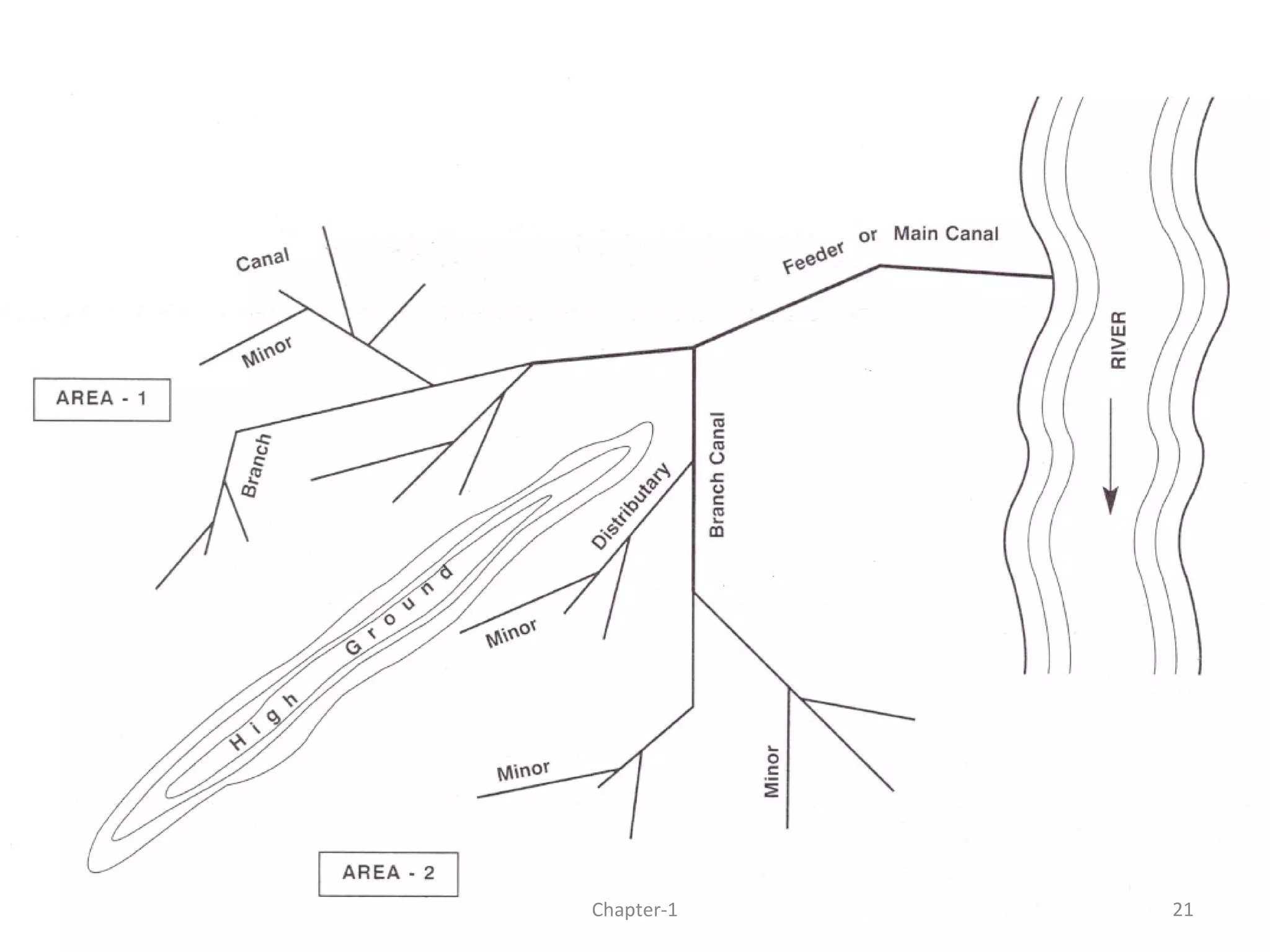
In this system of irrigation, water is supplied through storage, canal head works and
canal distribution system.
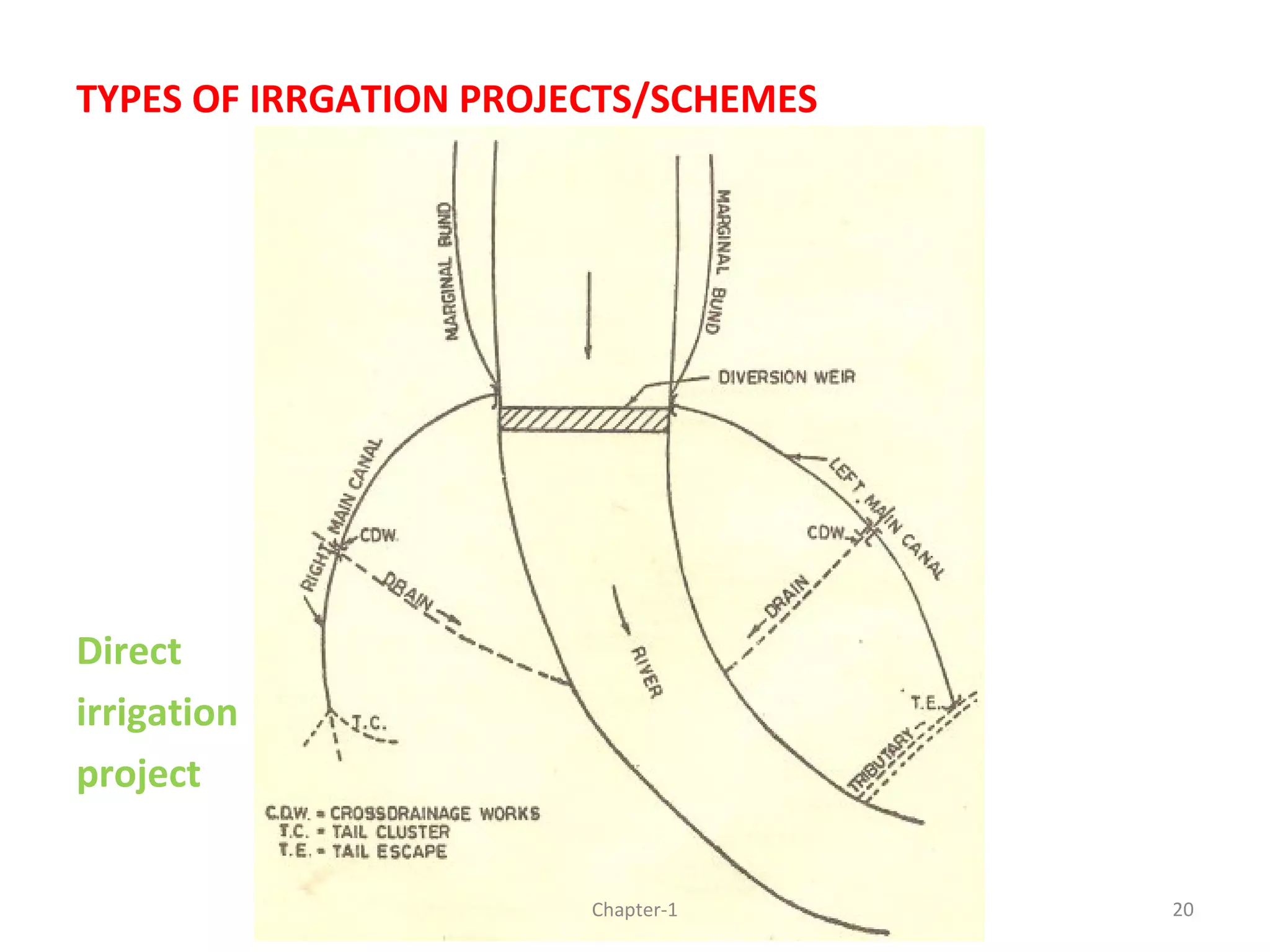
When the water is directed into the canal by constructing a weir or a barrage across
the river, it is called Direct Irrigation.
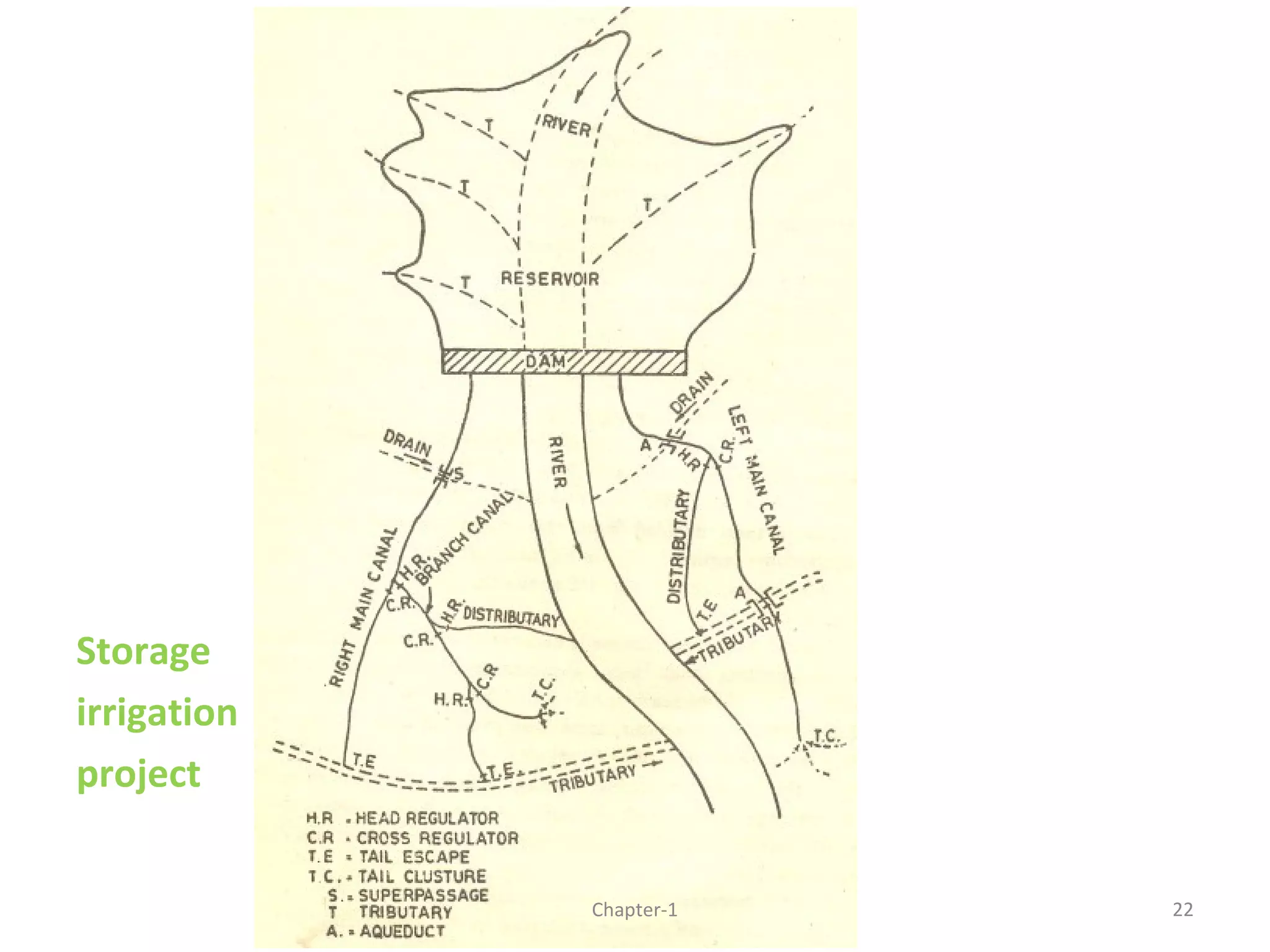
But, if a dam is constructed across a river to store water during monsoons, so as to
supply water in the off-taking channels during periods of low flow, then it is termed
as Storage Irrigation. This perennial system of irrigation, is most important and is
mostly practiced in Pakistan.
(ii) Flood Irrigation.
This kind of irrigation, is sometimes called as inundation irrigation. In this method of
irrigation, soil is kept submerged and thoroughly flooded with water, so as to cause
thorough saturation of the land. 19Chapter-1
TYPES OF IRRGATION PROJECTS/SCHEMES
Direct
irrigation
project
20Chapter-1
21Chapter-1
Storage
irrigation
project
22Chapter-1
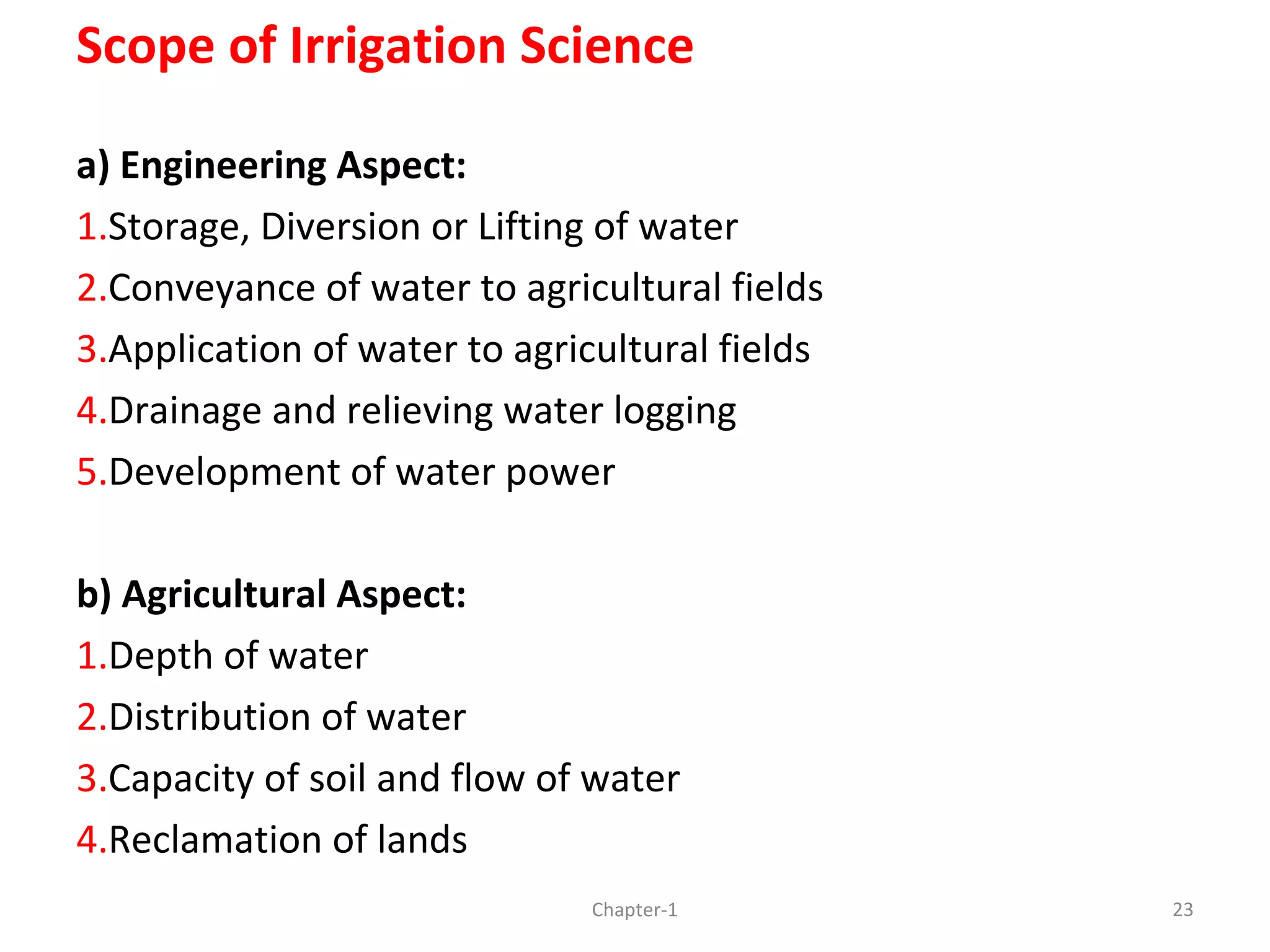
Scope of Irrigation Science
a) Engineering Aspect:
1.Storage, Diversion or Lifting of water
2.Conveyance of water to agricultural fields
3.Application of water to agricultural fields
4.Drainage and relieving water logging
5.Development of water power
b) Agricultural Aspect:
1.Depth of water
2.Distribution of water
3.Capacity of soil and flow of water
4.Reclamation of lands
23Chapter-1
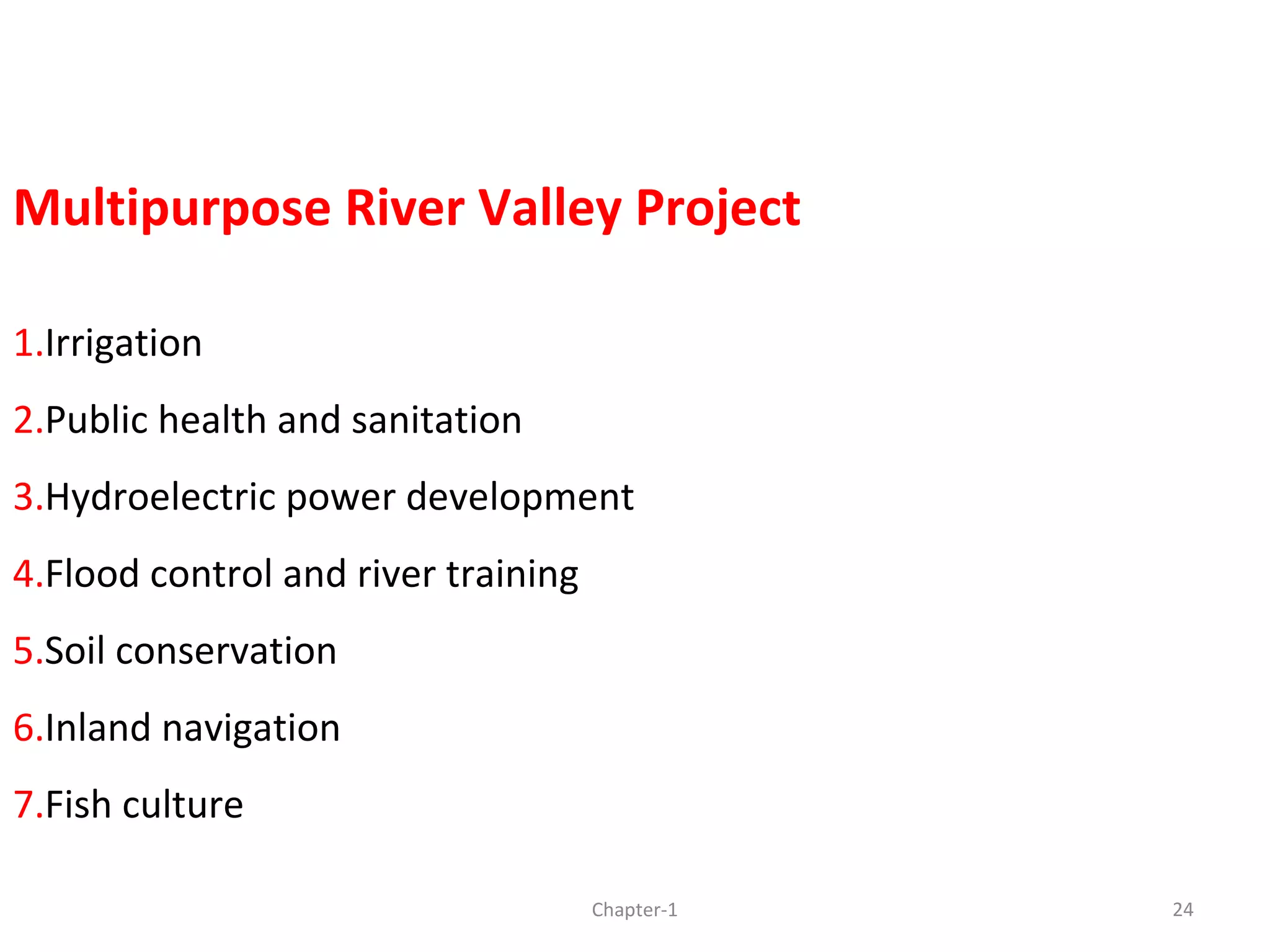
Multipurpose River Valley Project
1.Irrigation
2.Public health and sanitation
3.Hydroelectric power development
4.Flood control and river training
5.Soil conservation
6.Inland navigation
7.Fish culture
24Chapter-1
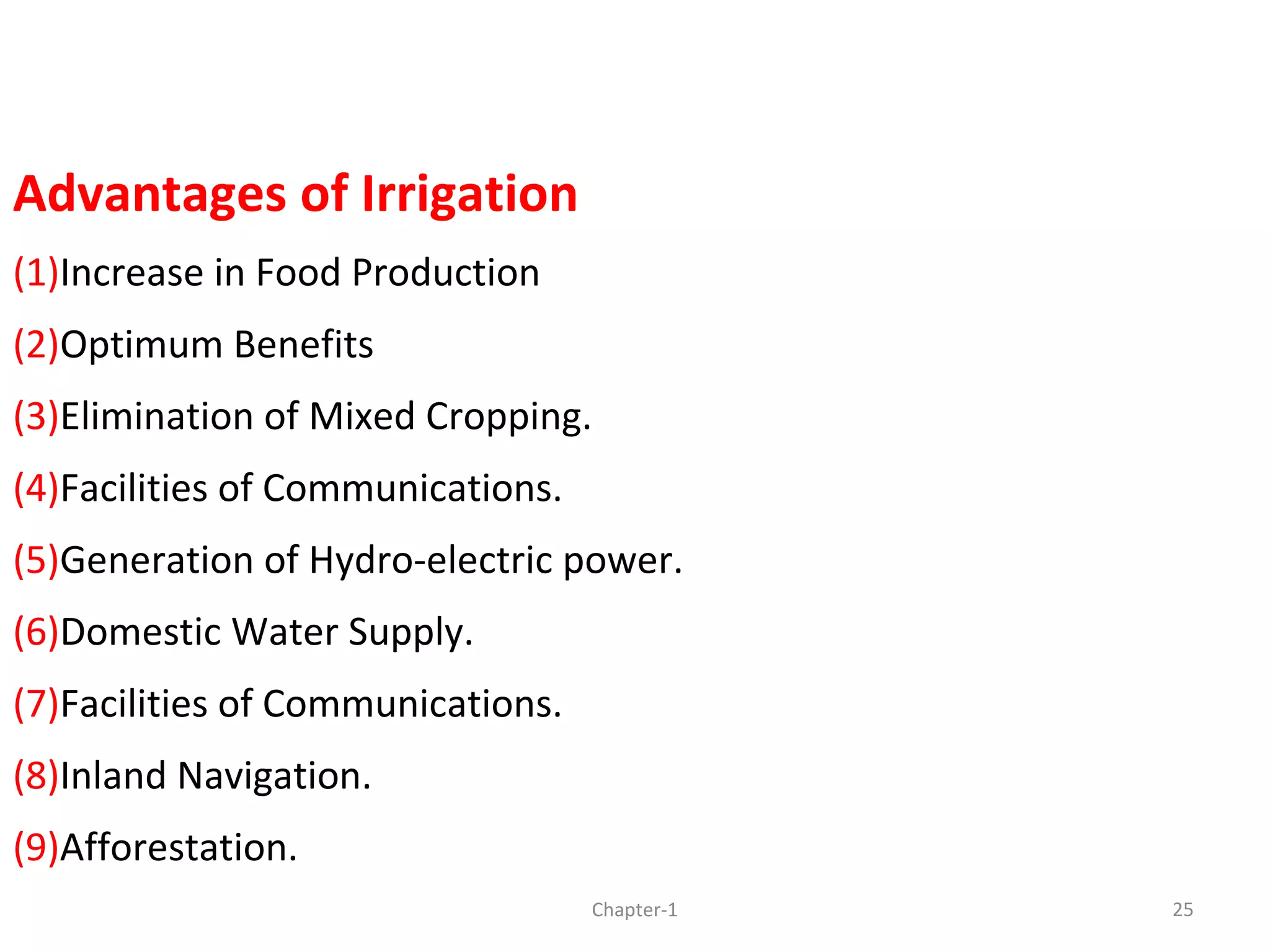
Advantages of Irrigation
(1)Increase in Food Production
(2)Optimum Benefits
(3)Elimination of Mixed Cropping.
(4)Facilities of Communications.
(5)Generation of Hydro-electric power.
(6)Domestic Water Supply.
(7)Facilities of Communications.
(8)Inland Navigation.
(9)Afforestation.
25Chapter-1
Disadvantages and Ill-Effects of Irrigation
(1) Water pollution: seepage of nitrates (when applied as
fertilizer) into the ground water – groundwater polluted – causes
anemia disease (when consumed by people through wells ). May
affect the fishing, as the tides carry the polluted water out into the
ocean.
(2) Colder and damper climate: causing outbreak of diseases
like malaria.
(3) Water-logging: due to over-irrigation - reduces crop yields.
(4) Complex and expensive to government: provision of
cheaper water vs. low revenue returns
26Chapter-1

Irrigation Enineering Introduction

  • 1.
  • 2.
    Course Outline • BasicSoil-Plant-Water Relations. • Irrigation Water Requirements, • Sources, quantity and quality of irrigation water: • Irrigation planning, scheduling and efficiencies. • Design of irrigation systems and structures. 2Chapter-1
  • 3.
    Course Objectives On Completionof this course, students should be able to: (i) Understand the basic soil-plant-water parameters related to irrigation (ii) Understand how to estimate the quantity of water required by crops. (iii) Be able to plan and design irrigation structures. (iv) Design channels and other irrigation structures required for irrigation, soil conservation, flood control and other water- management projects. 3Chapter-1
  • 4.
    SYLLABUS 1-Introduction Definition. Necessity ofirrigation. Planning of irrigation projects. Scope of irrigation engineering. Benefits and ill effects of irrigation. 2-Soil-Water Crop Relationship Soil and its physical and chemical properties. Root zone soil water. Crops of Pakistan and crop rotation. 3-Methods of Irrigation Irrigation methods. Factors affecting irrigation methods. Surface methods. Sprinkler irrigation method and Sub-surface irrigation methods. 4-Water Requirement of Crops Functions of irrigation water. Preparation of Irrigation land. Crop base period. Commanded areas. Intensity of irrigation. Duty and Delta of crop. Relationship between duty and delta. Factors on which duty depends, depth and frequencies of irrigation. Kharif-Rabi ratio, Optimization of irrigation water. Uniformity coefficient. Consumptive use of water. Estimation of consumptive use. Irrigation efficiencies. Net irrigation requirements. 4Chapter-1
  • 5.
    5-Canal Irrigation System Alluvialand Non-alluvial canals. Alignment of canals. Distribution system for canal irrigation: basic definitions, determination of canal capacity, canal losses, empirical formula for channel losses and channel section for minimum seepage loss. 6-Design of Irrigation Channels Design of stable channel. Regime channels. Kennedy's theory. Critical velocity ratio. Kutter's formula. Manning's formula. Lacey's theory. Design procedure for Lacey's theory. Estimation of transported sediment. Bed load equation. Meyer-Peter's and Einstein's formula. Design procedure for irrigation channel and maintenance of irrigation canals. 7-Diversion Head Works Difference between a Weir and Barrage, layout of diversion head works. Diversion weir, types and components of diversion weir. Head regulator and cross regulator, canal regulation and silt control at the head works. 8-Irrigation Outlets Definition. Essential requirements of an outlet. Types of outlets. Characteristics of outlets and description of each type of outlet. 5Chapter-1
  • 6.
    9-Theories of Seepageand Design of Weir and Barrage Causes of failure by piping and direct uplift, safety against piping and uplift, Khosla's theory and concept of flow net, stream lines and equipotential lines, critical gradient, Khosla's method of independent variables for determination of pressure and exit gradient below a weir or barrage, Khosla's simple standard profiles. Design examples of barrage, head regulator, cross regulator. 10-River training works: Methods to control bank erosion 11-Reservoir Planning and Dams in General Types of reservoirs, flood control reservoir, multipurpose reservoir. capacity of reservoirs. Storage zones of reservoirs. Reservoir yield. Distribution reservoir, Estimation of demands and optimal reservoir operation. Flood routing or flood adsorption, reservoir sedimentation, silt control in reservoir. Selection of suitable site for reservoir. Economic height of dam. Economics of combined project, cost benefit consideration and general principle of optimizing capital budget, various types of dam problems in dam construction. Factors governing the selection of particular type of dam, selection of darn site and environ mental impacts assessment of dams. 12-Environmental Impact of Irrigation Engineering/Sea Water Intrusion 13-Introduction to Related Soft wares 6Chapter-1
  • 7.
    Books Recommended Irrigation Engineeringand Hydraulic Structures, 12th edition or latest Santosh Kumar Garg Khanna Publishers Irrigation and Water Power Engineering, 7th edition Dr. B. C. Punmia and Pande B. B. Lal Standard Publishers, Delhi Irrigation and Hydraulic Structures: Theory, Design and Practice Dr. Iqbal Ali Institute of environmental Engineering Research, N.E.D. University, Karachi. Irrigation and Drainage Engineering Iqtidar Hussain Siddiqui Oxford University Press 7Chapter-1
  • 8.
    IRRIGATION ENGINEERING Irrigation isthe application of water to the soil to supplement natural precipitation and provide an environment that is optimum for crop production. 8Chapter-1
  • 9.
    Types of Irrigation Supplementaryirrigation: in areas with rainfall is for a part of the season or year Total irrigation: in areas of no rainfall 9Chapter-1
  • 10.
    Necessity of Irrigation 1.Lessrainfall 2.Non-uniform rainfall 3.Commercial crops with additional water 4.Controlled water supply 10Chapter-1
  • 11.
    PLANNING OF IRRIGATIONPROJECTS Agricultural establishments capable of applying controlled amounts of water to lands to produce crops are termed irrigation projects. These projects mainly consist of engineering (or hydraulic) structures which collect, convey and deliver water to areas on which crops are grown. Irrigation projects may range from a small farm unit to those serving extensive areas of millions of hectares. A small irrigation project may consist of a low diversion weir or an inexpensive pumping plant along with small ditches (channels) and some minor control structures. A large irrigation project includes a large storage reservoir, a huge dam, hundreds of kilometres of canals, branches and distributaries, control structures and other works. 11Chapter-1
  • 12.
    Irrigation project mainlyincludes the following works: (i) Storage (or intake) and diversion works, (ii) Conveyance and distribution channels, (iii) Control and other hydraulic structures, (iv) Farm distribution, and (v) Drainage works. Every irrigation project undergo following stages: 1.Development of an Irrigation Project 2.Feasibility of an Irrigation Project 3.Planning of an Irrigation Project 12Chapter-1
  • 13.
    1. Development ofan Irrigation Project A small irrigation project can be developed in a relatively short time. Farmers having land suitable for agriculture, source of adequate water supply, and necessary finance can plan their own irrigation system and get the engineering works constructed without any delay. On the other hand, development of a large irrigation project is more complicated and time-consuming. Complexity and the time required for completion of a large project increase with the size of the project. This is due to the organizational, legal, financial, administrative, environmental and engineering problems; all of which must be given detailed consideration prior to the construction of the irrigation works. The principal stages of a large irrigation project are: 1.Promotional stage, 2.Planning stage, 3.Construction stage, and 4.Settlement stage. 13Chapter-1
  • 14.
    The planning stageitself consists of three sub stages: (i) preliminary planning including feasibility studies, (ii) detailed planning of water and land use, and (iii) the design of irrigation structures and canals. 2. Feasibility of an Irrigation Project A proposed irrigation project is considered feasible only when the total estimated benefits of the project exceed its total estimated cost. However, from the farmer's viewpoint, an irrigation project is feasible only if his annual returns exceed his annual costs by sufficient amount. The feasibility of an irrigation project is determined on the basis of: •preliminary estimates of area of land suitable for irrigation, •water requirements, •available water supplies, •productivity of irrigated land, and 14Chapter-1
  • 15.
    3. Planning ofan Irrigation Project Once the project is considered feasible, the process of planning starts. Sufficient planning of all aspects (organizational, technical, agricultural, legal, environmental and financial) is essential in all irrigation projects. The process of planning of an irrigation project can be divided into the following two stages: (i) Preliminary planning, and (ii) Detailed planning. 15Chapter-1
  • 16.
    The following arethe main factors which must be determined accurately during the planning stage of an irrigation project: (i) Type of project and general plan of irrigation works, (ii) Location, extent and type of irrigable lands, (iii) Irrigation requirements for profitable crop production, (iv) Available water supplies for the project, (v) Irrigable areas which can be economically supplied with water, (vi) Types and locations of necessary engineering works, (vii) Needs for immediate and future drainage, (viii) Feasibility of hydroelectric power development, (ix) Cost of storage, irrigation, power and drainage features, (x) Evaluation of probable power, income and indirect benefits, (xi) Method of financing the project construction, (xii) Desirable type of construction and development, 16Chapter-1
  • 17.
    (xiv) Cost ofland preparations and farm distribution systems, and (xv) Feasible crops, costs of crop production, and probable crop returns. 17Chapter-1
  • 18.
    Types of Irrigationw.r.to Source Irrigation may broadly be classified into : 1.Surface irrigation [(a) Flow irrigation; and (b) Lift irrigation.] When the water is available at a higher level, and it is supplied to lower level, by the mere action of gravity, then it is called Flow Irrigation. But, if The water is lifted up by some mechanical or manual means, such as pumps, etc. and then supplied for irrigation, then it is called Lift Irrigation. 2. Sub-surface irrigation 18Chapter-1
  • 19.
    Types of Flowirrigation (i) Perennial irrigation, (ii) Flood irrigation. (i) Perennial Irrigation. In perennial system of irrigation, constant and continuous water supply is assured to the crops in accordance with the requirements of the crop, throughout the crop period. In this system of irrigation, water is supplied through storage, canal head works and canal distribution system. When the water is directed into the canal by constructing a weir or a barrage across the river, it is called Direct Irrigation. But, if a dam is constructed across a river to store water during monsoons, so as to supply water in the off-taking channels during periods of low flow, then it is termed as Storage Irrigation. This perennial system of irrigation, is most important and is mostly practiced in Pakistan. (ii) Flood Irrigation. This kind of irrigation, is sometimes called as inundation irrigation. In this method of irrigation, soil is kept submerged and thoroughly flooded with water, so as to cause thorough saturation of the land. 19Chapter-1
  • 20.
    TYPES OF IRRGATIONPROJECTS/SCHEMES Direct irrigation project 20Chapter-1
  • 21.
  • 22.
  • 23.
    Scope of IrrigationScience a) Engineering Aspect: 1.Storage, Diversion or Lifting of water 2.Conveyance of water to agricultural fields 3.Application of water to agricultural fields 4.Drainage and relieving water logging 5.Development of water power b) Agricultural Aspect: 1.Depth of water 2.Distribution of water 3.Capacity of soil and flow of water 4.Reclamation of lands 23Chapter-1
  • 24.
    Multipurpose River ValleyProject 1.Irrigation 2.Public health and sanitation 3.Hydroelectric power development 4.Flood control and river training 5.Soil conservation 6.Inland navigation 7.Fish culture 24Chapter-1
  • 25.
    Advantages of Irrigation (1)Increasein Food Production (2)Optimum Benefits (3)Elimination of Mixed Cropping. (4)Facilities of Communications. (5)Generation of Hydro-electric power. (6)Domestic Water Supply. (7)Facilities of Communications. (8)Inland Navigation. (9)Afforestation. 25Chapter-1
  • 26.
    Disadvantages and Ill-Effectsof Irrigation (1) Water pollution: seepage of nitrates (when applied as fertilizer) into the ground water – groundwater polluted – causes anemia disease (when consumed by people through wells ). May affect the fishing, as the tides carry the polluted water out into the ocean. (2) Colder and damper climate: causing outbreak of diseases like malaria. (3) Water-logging: due to over-irrigation - reduces crop yields. (4) Complex and expensive to government: provision of cheaper water vs. low revenue returns 26Chapter-1