WATER RESOURSE ENGINEERING
SYLLABUS:-
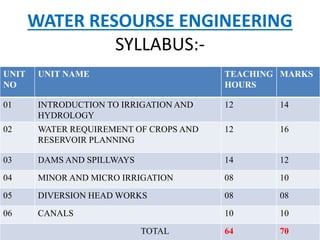
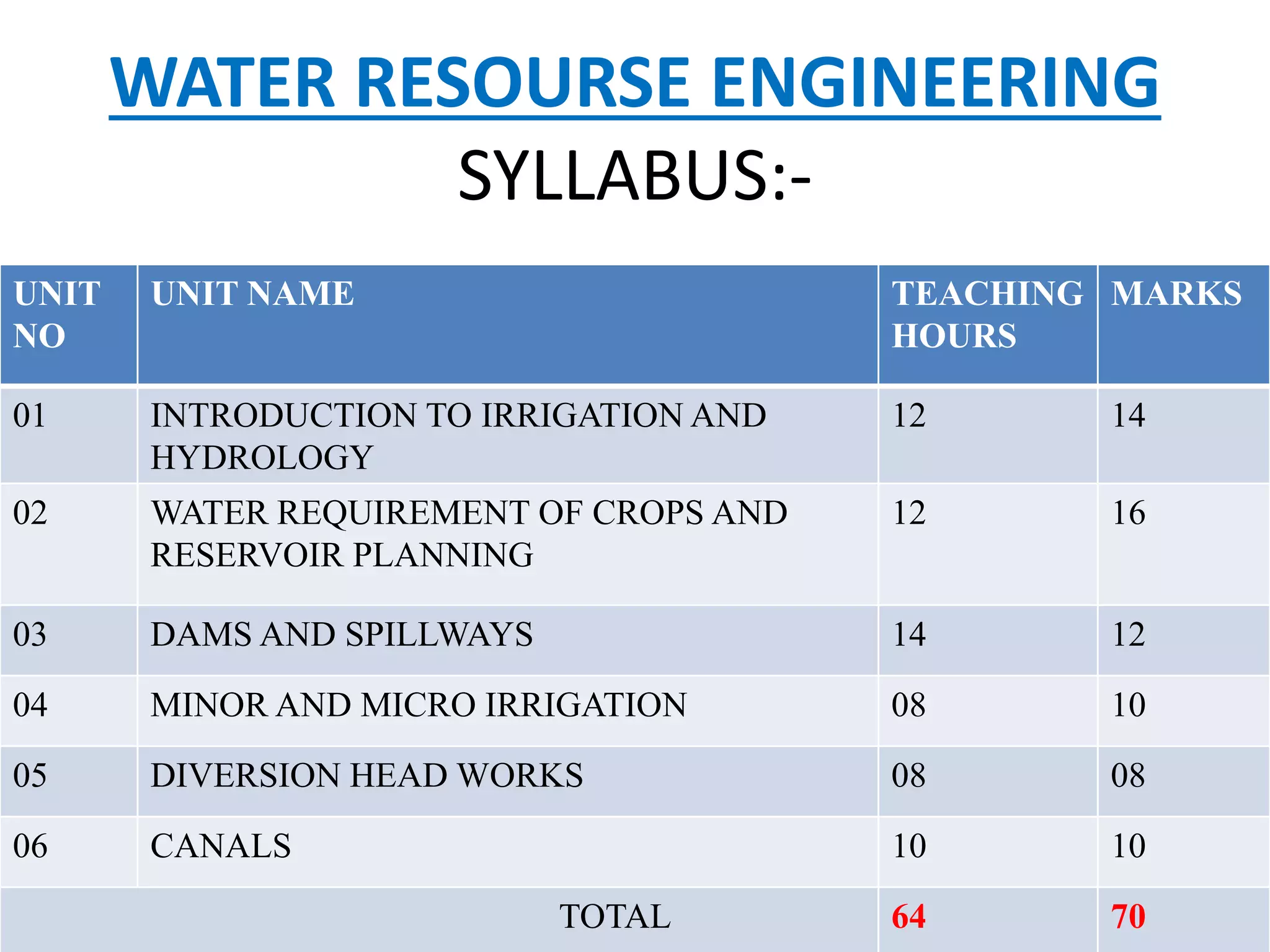
UNIT
NO
UNIT NAME TEACHING
HOURS
MARKS
01 INTRODUCTION TO IRRIGATION AND
HYDROLOGY
12 14
02 WATER REQUIREMENT OF CROPS AND
RESERVOIR PLANNING
12 16
03 DAMS AND SPILLWAYS 14 12
04 MINOR AND MICRO IRRIGATION 08 10
05 DIVERSION HEAD WORKS 08 08
06 CANALS 10 10
TOTAL 64 70
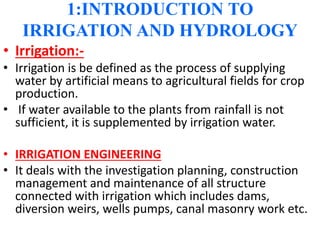
1:INTRODUCTION TO
IRRIGATION AND HYDROLOGY
• Irrigation:-
• Irrigation is be defined as the process of supplying
water by artificial means to agricultural fields for crop
production.
• If water available to the plants from rainfall is not
sufficient, it is supplemented by irrigation water.
• IRRIGATION ENGINEERING
• It deals with the investigation planning, construction
management and maintenance of all structure
connected with irrigation which includes dams,
diversion weirs, wells pumps, canal masonry work etc.
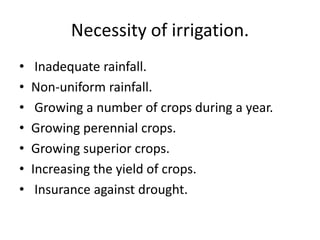
Necessity of irrigation.
• Inadequate rainfall.
• Non-uniform rainfall.
• Growing a number of crops during a year.
• Growing perennial crops.
• Growing superior crops.
• Increasing the yield of crops.
• Insurance against drought.
ADVANTAGES OF IRRIGATION
• Protection from Famine: Food production is
increased due to irrigation by producing more
crops used as food. This protects a country from
famine situation.
• Increase of Groundwater Level. Due to constant
seepage and percolation of water from canal,
groundwater level in the nearby area is increased.
• Social and Cultural Improvement. If increases the
cultural and social level of population living nearby
canals and reservoirs. Tourists interest in the area
of newely constructed reservoir may be enhanced.
Yields of crops
• Yield of crop can be increased by irrigation even in
the period of low rainfall.
• Optimum benefits Optimum use of water is
possible by irrigation to obtain maximum output.
• • Elimination of mixed cropping The areas where
irrigation is not assured, mixed cropping is adopted.
Mixed cropping means sowing different crops to-
geather in the same field. Mixed cropping is not
desirable as different amount of water and field
conditions. Farmers are not benefitted. If irrigation
water is assured, mixed cropping may be
eliminated and single superior crop may be grown
to get the maximum benefits.
Prosperity of farmers
• If irrigation water is assured throughout the year,
farmers can grow two or more crops in a year which
adds to their prosperity.
• Sources of Revenue When water tax is taken from
farmers for supplying water, it adds to the revenue
of the country.
• Hydro-Electric Power Generation The reservoir from
which irrigation water is supplied, may be used for
generation of power. Besides, the canals in field
have some canal falls or drops in which mini hydro-
projects may be installed.
• Water Supply:
• Irrigation water may be used as source for domestic
and industrial water supply.
• General Communication: The inspection road
beside the canal bank may serve as communication
link in remote village areas.
• • Navigation: If the irrigation canals are big and
deep, they may be used as navigable water way.
• Aesthetic View: New man-made lake if preserved
carefully, may increase aesthetic view of the
surroundings.
Development of fishery
• Reservoir and canals may be utilized for
development of fishery.
• Tree Plantation: Trees can be grown along the bank
of the canal, which increase the wealth from timber
and help in controlling soil erosion of the bank.
• Aid to Civilization. Irrigation water is normally
available from river valley project. Some tribes
living near the valley, adopt irrigation as their
profession, increase production, live peacefully
which leads to the general civilization of the
country.
Nutrition of Population •
• Due to irrigation, increased agricultural production
takes place and this production improves the
nutrition of the people.
• • Recreation Recreation facilities like parks,
restaurants may be developed near the canal banks
or reservoir sites.
• • Social and Cultural Improvement. If increases the
cultural and social level of population living nearby
canals and reservoirs. Tourists interest in the area
of newly constructed reservoir may be enhanced.
• • Self-Sufficiency in Food Irrigation makes the
country self-sufficient in food by improving the
production.
DISADVANTAGES OF IRRIGATION
• Effects on Raising Water Table.
• In unlined irrigation canal, excessive seepage of
water through bed and sides takes place which
raises the water table of the surrounding areas. Soil
in the root zone of the crop is saturated and
become alkaline which is harmful to the crops and
plants. Thus the nearby area may be waterlogged.
• Damp Climate.
• Temperature of the command area of an irrigation
projects may be lowered and damp climate prevails,
which adversely affect the health of the community
living in this area.
Breeding Places of Mosquitoes
• Due to excess application of water, seepage and
leakage from canal, marshy land may be formed
leading to breeding place of mosquitos.
• Loss of Valuable Land :- Valuable land may be
submerged due to construction of reservoir by dam,
weir and barrages.
• Return of Revenue Irrigation projects are complex
and expensive. If project fails due to absence of
regular maintenance, return of revenue to the
government becomes low compared to its cost of
construction. Maintenance cost is quite high for
normal functioning of the project.
OTHER
• Salt efflorescence- due to water logging salt
efflorescence occurs which may damage land
permanently.
• Tendency towards over irrigation.
• Excess humidity.
CLASSIFICATION OF IRRIGATION
IRRIGATION
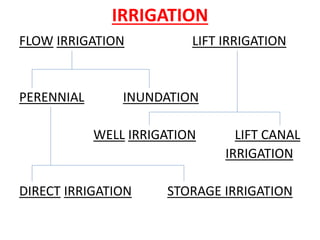
FLOW IRRIGATION LIFT IRRIGATION
PERENNIAL INUNDATION
WELL IRRIGATION LIFT CANAL
IRRIGATION
DIRECT IRRIGATION STORAGE IRRIGATION
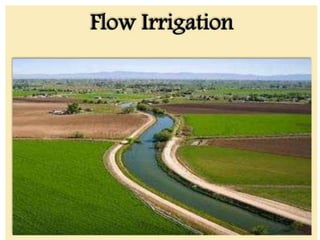
Flow Irrigation:
• Flow irrigation is that type of in which flow of water
to crop field from the source takes place due to
component of gravity force. This flow Irrigation may
be further classified into
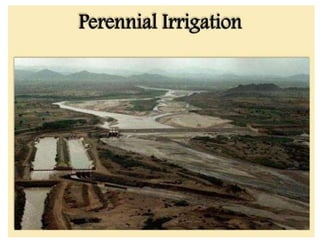
• Perennial Irrigation: In this type of source of water
is from a river which is perennial. A weir or barrage
is constructed across this river. Sometimes dam may
be constructed to form a reservoir upstream. Main
canal with a regulator is constructed where one or
both banks supply water to the crop field. This type
is reliable as water is available during the whole
period of the year.
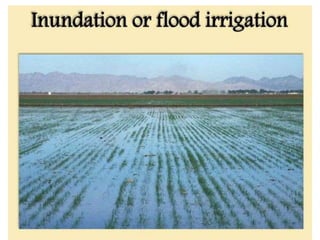
Inundation or flood irrigation
• It is that type of irrigation in which no control
structures like weir, barrage, regulator, etc are
constructed. During rainy season, water level in the
river rises and canal bed level is kept below High
Flood Level (HFL) of the river. The portion of water
above the canal bed is diverted to inundate the
crop field.
• • This inundation water is drained off or allowed to
absorb in the crop field prior to planting the crop.
The whole system depends on the water level in the
river. Although no such expenditure is involved in
this system, over-irrigation may damage the crops.
Therefore, this system is not popular.
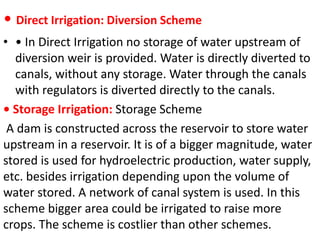
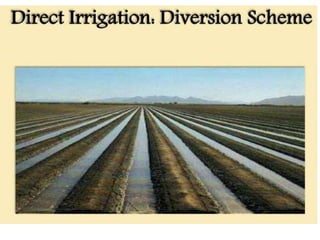
• Direct Irrigation: Diversion Scheme
• • In Direct Irrigation no storage of water upstream of
diversion weir is provided. Water is directly diverted to
canals, without any storage. Water through the canals
with regulators is diverted directly to the canals.
• Storage Irrigation: Storage Scheme
A dam is constructed across the reservoir to store water
upstream in a reservoir. It is of a bigger magnitude, water
stored is used for hydroelectric production, water supply,
etc. besides irrigation depending upon the volume of
water stored. A network of canal system is used. In this
scheme bigger area could be irrigated to raise more
crops. The scheme is costlier than other schemes.
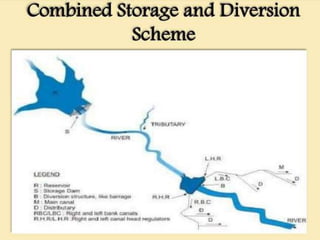
Combined Storage and Diversion Scheme.
• In this system, a dam is constructed across a
river to form a reservoir. This stored water is
used to produce electricity. A powerhouse is
constructed just downstream of the dam. The
discharge from the lower house is fed back
into river downstream of the dam, a pickup
weir at a suitable side is constructed to divert
this available water to the crop field by the
canals.
.
• This type of scheme and the combined storage and
diversion scheme, along with main aim of irrigation,
following aims and purposes may be served
• • Hydroelectric power generation
• • Water supply
• • Flood Control in the river valley
• • Fishery
• • Recreation
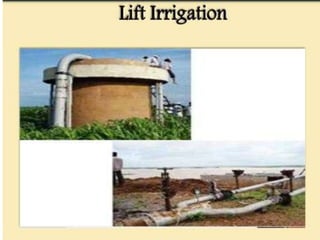
Lift Irrigation:
• Lift Irrigation is the process of lifting water
normally from underground sources and
sometimes from surface source by pump, i.e.
mechanical power or man or animal power
and then direct this lifted water is supplied to
the agricultural field. In remote villages, if
electric energy is not available in open well,
shallow and deep tube wells.
Factors affecting choice of irrigation
method
• The selection of the irrigation method is based on
the following factors.
• 1. Soil characteristics of the land to be irrigated.
• 2. Topography of the area.
• 3. The available water supply.
• 4. Type of crop and its requirements.
• 5. Size of the stream supplying irrigation water.
• 6. Amount of water required in each irrigation.
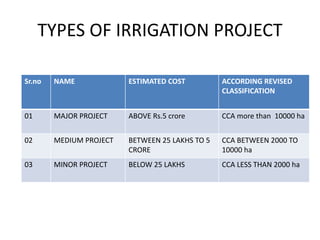
TYPES OF IRRIGATION PROJECT
Sr.no NAME ESTIMATED COST ACCORDING REVISED
CLASSIFICATION
01 MAJOR PROJECT ABOVE Rs.5 crore CCA more than 10000 ha
02 MEDIUM PROJECT BETWEEN 25 LAKHS TO 5
CRORE
CCA BETWEEN 2000 TO
10000 ha
03 MINOR PROJECT BELOW 25 LAKHS CCA LESS THAN 2000 ha
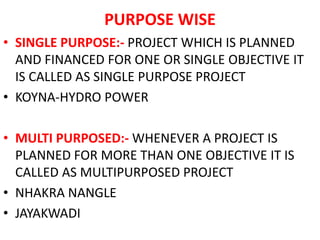
PURPOSE WISE
• SINGLE PURPOSE:- PROJECT WHICH IS PLANNED
AND FINANCED FOR ONE OR SINGLE OBJECTIVE IT
IS CALLED AS SINGLE PURPOSE PROJECT
• KOYNA-HYDRO POWER
• MULTI PURPOSED:- WHENEVER A PROJECT IS
PLANNED FOR MORE THAN ONE OBJECTIVE IT IS
CALLED AS MULTIPURPOSED PROJECT
• NHAKRA NANGLE
• JAYAKWADI
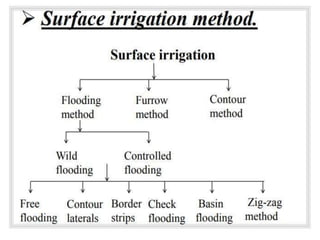
In surface irrigation methods,
• the irrigation water is applied by spreading in the
form of sheet or small streams on the lands to be
irrigated.
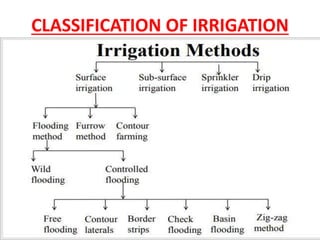
• The surface irrigation is further divided as follows:
• 1) Flooding method.
• 2) Furrow method .
• 3) Contour farming.
• All the above methods of the surface irrigation are
adopted for the perennial irrigation system.
• The inundation irrigation system adopts only the
wild or uncontrolled flooding method of irrigation.
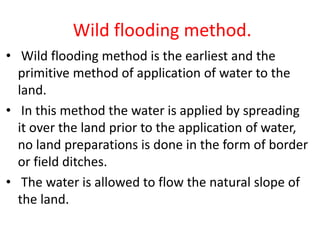
Wild flooding method.
• Wild flooding method is the earliest and the
primitive method of application of water to the
land.
• In this method the water is applied by spreading
it over the land prior to the application of water,
no land preparations is done in the form of border
or field ditches.
• The water is allowed to flow the natural slope of
the land.
Controlled flooding.
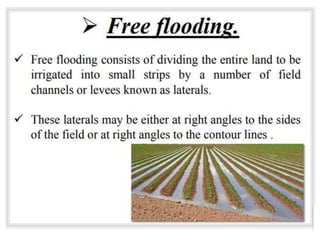
• In controlled flooding methods irrigation
water is applied by spreading it over the land
to be irrigated with proper control on the flow
of water as well as the quantity of water
applied.
• All the methods of control flooding require
prior preparation of the land.
• The land is properly graded & agricultural
fields are divided into small units by levees .
Controlled flooding.
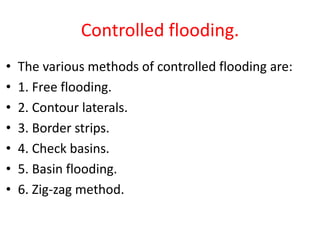
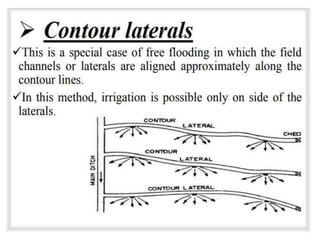
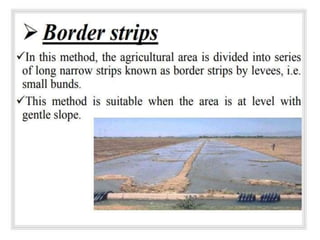
• The various methods of controlled flooding are:
• 1. Free flooding.
• 2. Contour laterals.
• 3. Border strips.
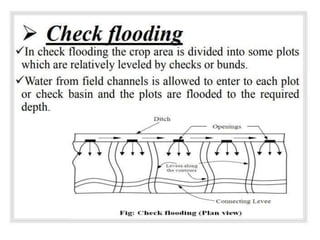
• 4. Check basins.
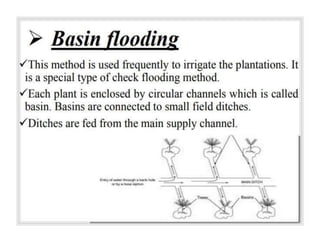
• 5. Basin flooding.
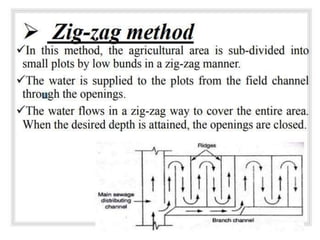
• 6. Zig-zag method.
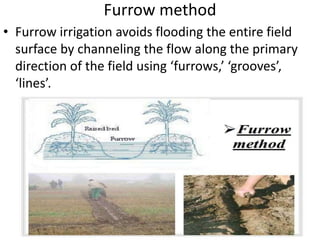
Furrow method
• Furrow irrigation avoids flooding the entire field
surface by channeling the flow along the primary
direction of the field using ‘furrows,’ ‘grooves’,
‘lines’.
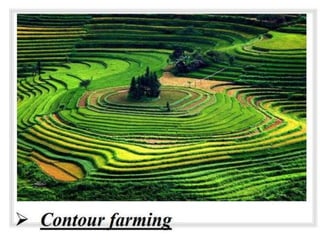
Contour farming
• Contour farming is practiced in hilly areas with
slopes and with falling contour.
• The land is divided into series of horizontal
strips called terraces.
• Small bunds are constructed at the end of
each terrace to hold water up to equal height.
Sub-Surface irrigation method.
• Subsurface drip irrigation (SDI) is the irrigation of
crops through buried plastic tubes containing
embedded emitters located at regular spacing's.
• The sub surface irrigation method consists of
supplying water directly to the root zone of the
plants.
• The favorable conditions for sub surface irrigation:
1. Moderate slope.
• 2. Uniform topographic condition.
• 3. Good quality of irrigation water .
• 4. Impervious sub-soil at reasonable depth. (i.e. 2-3
m depth).
The subsurface irrigation methods can
be classified as follows:
• 1. Natural sub-surface irrigation .
• 2. Artificial sub-surface irrigation.
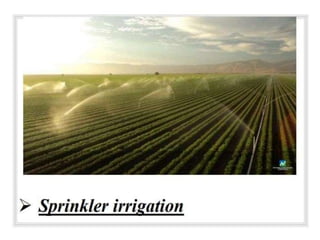
• Sprinkler irrigation is a method of applying
irrigation water which is similar to natural rainfall.
• Water is distributed through a system of pipes
usually by pumping. It is then sprayed into the air
through sprinklers so that it breaks up into small
water drops which fall to the ground.
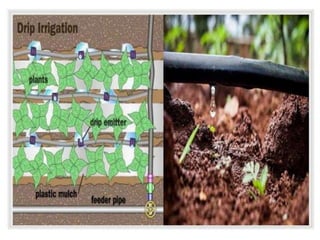
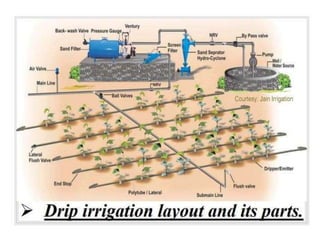
Drip irrigation.
• Drip irrigation is also known as trickle irrigation .
• It is one of the latest developed methods of
irrigation which is more popular in the regions
facing scarcity of water.
• This method was first introduced in Israel.
• In India this method is more useful in areas in
Gujarat, Maharashtra, Kerala, & Karnataka.
HYDROLOGY
• What is Hydrology???
• It is the science which deals with occurrence,
distribution and movement of water on the earth
including that in the atmosphere and below the
surface of the earth.
• Water occurs in the atmosphere in the form of
water vapor, on the surface as water, snow or ice
and below the surface as ground water occupying
all the voids within a geological stratum.
HYDROLOGY
• Except for the deep ground water , the total
water supply of earth is in constant circulation
from earth to atmosphere and back to earth.
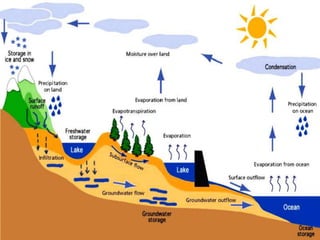
• The earth’s water circulatory system is known
as hydrological cycle.
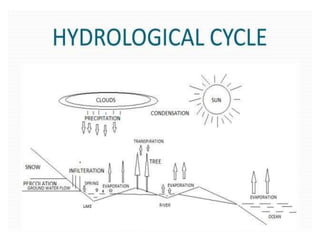
HYDROLOGICAL CYCLE
• Hydrological cycle is the process of transfer of
moisture from the atmosphere to the earth in
the form of precipitation, conveyance of
precipitin water by streams and rivers to the
oceans and lakes etc. and evaporation of
water back to the atmosphere complete the
hydrological cycle.
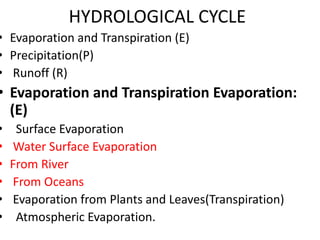
HYDROLOGICAL CYCLE
• Evaporation and Transpiration (E)
• Precipitation(P)
• Runoff (R)
• Evaporation and Transpiration Evaporation:
(E)
• Surface Evaporation
• Water Surface Evaporation
• From River
• From Oceans
• Evaporation from Plants and Leaves(Transpiration)
• Atmospheric Evaporation.
RAINFALL
• Rainfall is depth in mm or cm of water stand on the
surface of earth if it is not lost in any manner like
evaporation absorption etc.
• Terms related to Rainfall
• Intensity of Rainfall: It is rain fall in unit of time e.g if
18 cm rain fall in 3 hours, Intensity of rain fall= 6 cm
• Daily rainfall: Rain fall in 24 hours at any rain gauge
St.
• Annual rain fall: Rain fall in 1 year at any rain gauge
St.
• Mean annual rainfall: Rain fall in 35 year at any rain
gauge St.
rain-gauge.
• Rainfall Measurement
• Rain fall is source of all water used for irrigation
purpose and therefore the knowledge of its amount
character season or period the effects produced by
it is of prime importance to irrigation engineer to
design, carry out, improve or maintain irrigation
works.
• The amount of precipitation is expressed as the
depth in cm or inches which fall on the level
surface, and is measure by rain-gauge.
Rain gauge:
• The measurement of rainfall at a place is measured
by instrument and the instrument which measures
rainfall is called as rain gauge.
• RAIN GAUGE STATION:
• the place at which rain gauge are installed for
measurement of rainfall is called as rain gauge
station.
• SITE SELECTION FOR RAINGAUGE STATION:-
• Site should be in open space having at least an area
of 5.5mx5.5m
.• The distance of instrument from nearest
obstruction should not be less than 30m or twice
the height of obstruction.
• The gauge should have level horizontal catch
surface.
• It should be set near the ground surface but at the
same time to prevent splashing of water into it.
• Fence should be erected around rain gauge station.
To protect rain gauge from cattle, dogs etc.
• the distance of fence should not be less than twice
of its height.
• A site that is sheltered from high wing should be
chosen
.• The rain gauge should not be installed on top or
side of hill , then the site should be selected such
that it should be protected from high wind.
• The gauge must be mounted firmly so that it can
not be disturbed even by strong wind.
Types of Rain gauge
• Non –Automatic or Non-recording rain gauge. e.g.
-Symon’s Rain-gauge.
• Automatic or Recording rain gauge.
e.g. (1) Weighing bucket rain gauge.
(2) Tipping Bucket rain gauge.
(3) Float type rain gauge.
NON RECORDING TYPE
• In non recording type of rain gauge it does not
record rain but it only collect the rain and this
collected rain is measured by means of graduated
cylinders.
.
• Symon’s rain gauge.
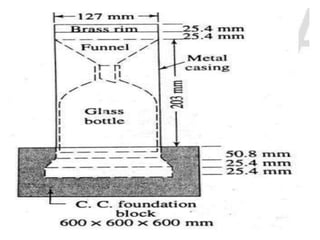
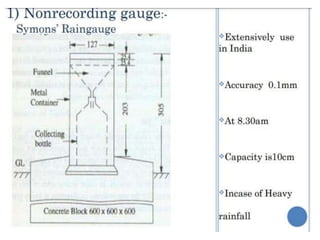
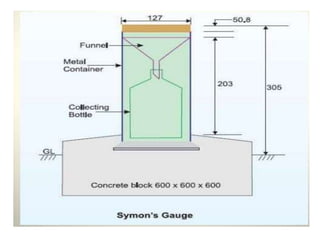
• I. Simon’s rain gauge is a non recording type of rain
gauge which is most commonly used.
• II. It consists of metal casing of diameter 127mm which
is set on a concrete foundation.
• III. A glass bottle of capacity about 100mm of rainfall is
placed within the casing.
• IV. A funnel with brass rim is placed on the top of the
bottle.
• V. The rainfall is recorded at every 24 hours.
• VI. To measure the amount of rainfall. the glass bottle is
taken off and the collected water is measured in a
measuring glass and recorded in rain gauge record
book
.• Inclination of Gauge may cause lesser
collection. (10 % inclination = 1.5 % low catch)
• Tipping of bucket may be affected due to
rusting or accumulation of dirt at the pivot.
• No rainfall is recorded during tipping of the
bucket
Recording Rain-gauge
• Advantages over non recording rain-gauge:
• Rainfall recorded automatically.
• Also gives the intensity of rain fall at any
time, while non recording type rain gauge
gives total rain fall in particular interval of
time.
• As no attendant required can be installed in
far-off places.
• Possibilities of human error is obviated.
Recording Rain-gauge Disadvantages:
• Costly
• Fault may be developed in
electrical/mechanical mechanism/ recording
rain fall.
Sources of Error in recording the
Measurement
• Mistake in reading the scale of gauge.
• Some amount of water displaced by measuring
stick. (this may increase error by 1%)
• Dent in the collector rim may change its receiving
area.
• Funnel and inside surface required about 2.5 mm
of rain to get moistened when gauge is initially dry.
( this may extent of amt of 25mm/yr in some areas)
• Deficiency of measurement due to wind.
SOURCES OF ERRORS IN RECORDING
RAINFALL
• Improper reading of scale of gauge.
• Some water may splash out from collector which
may leads flash reading.
• Gauge if placed at an inclination may result in
incorrect reading.
• Some amount of water is displaced by measuring
stick.
• Initially when gauge is dry it required 2.5mm of rain
to get moistened due to which also error may
occure
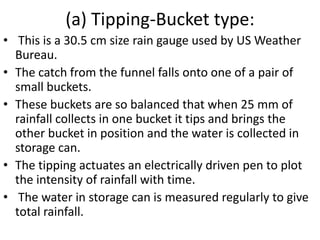
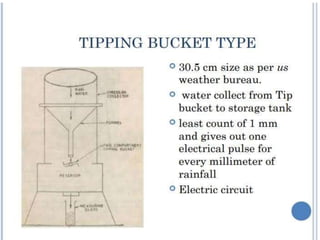
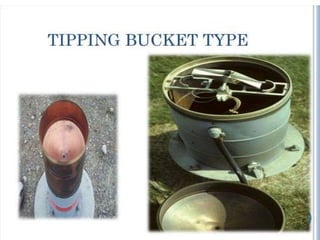
(a) Tipping-Bucket type:
• This is a 30.5 cm size rain gauge used by US Weather
Bureau.
• The catch from the funnel falls onto one of a pair of
small buckets.
• These buckets are so balanced that when 25 mm of
rainfall collects in one bucket it tips and brings the
other bucket in position and the water is collected in
storage can.
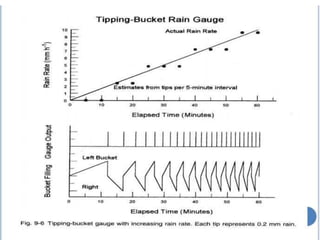
• The tipping actuates an electrically driven pen to plot
the intensity of rainfall with time.
• The water in storage can is measured regularly to give
total rainfall.
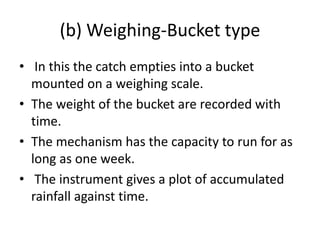
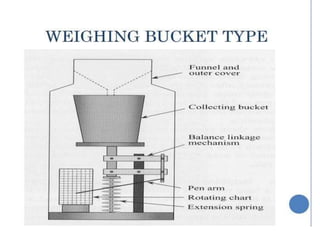
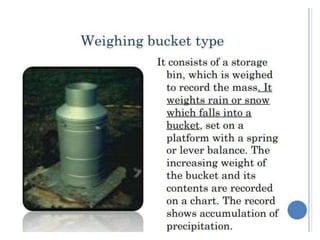
(b) Weighing-Bucket type
• In this the catch empties into a bucket
mounted on a weighing scale.
• The weight of the bucket are recorded with
time.
• The mechanism has the capacity to run for as
long as one week.
• The instrument gives a plot of accumulated
rainfall against time.
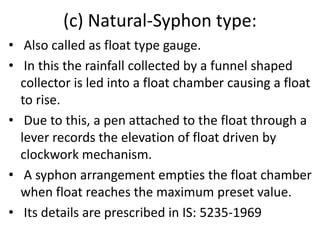
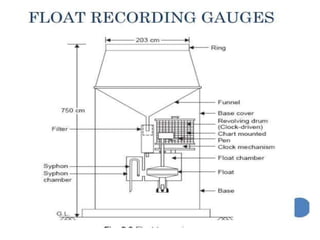
(c) Natural-Syphon type:
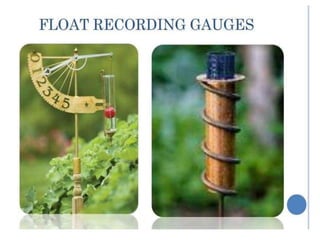
• Also called as float type gauge.
• In this the rainfall collected by a funnel shaped
collector is led into a float chamber causing a float
to rise.
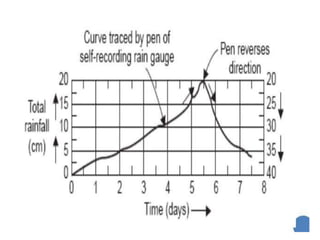
• Due to this, a pen attached to the float through a
lever records the elevation of float driven by
clockwork mechanism.
• A syphon arrangement empties the float chamber
when float reaches the maximum preset value.
• Its details are prescribed in IS: 5235-1969
TERMINOLOGY USED IN HYDROLOGY:
• AVERAGE RAINFALL:
• It is the arithmetic time average of rainfall means it is
total rainfall divided by time period.
• RAINFALL INTENSITY:
• it is the maximum rainfall during a short period
measured in mm/hr is called rainfall intensity.
• ANNUAL RAINFALL:
• The total rainfall at a station in the period of on year is
called as annual rainfall.
• AVERAGE ANNUAL RAINFALL(P):- it is the average value
obtained by adding up the annual rainfall of a station
for 35 years or more and dividing sum by number of
years .
monsoon rainfall:
• It is the total quantity of rainfall during monsoon
season – from 15th June to 14th Oct. is called average
monsoon rainfall.
• AVERAGE MONSOON RAINFALL:
• It is the arithmetical mean of monsoon rainfall over a
period of 35 years or more
• AVERAGE,GOOD AND BAD YEARS:-
• GOOD: If rainfall is more than 120% of avg annual
rainfall
• BAD: if rainfall is less than 80% of avg annual rainfall
• AVERAGE OR NORMAL: if rain fall is +- 20% of the
average rainfall it is called average rainfall
Average Rainfall over an area
• To convert the point rainfall values measured
by various rain gauge stations into an average
value over a catchment, following methods
are used.
1) Arithmetic Mean Method
2) Thiessen Polygon Method
3) Isohytel Method
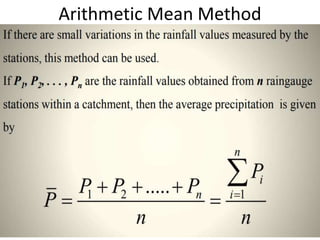
Arithmetic Mean Method
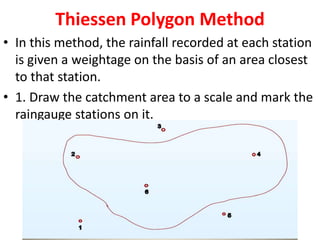
Thiessen Polygon Method
• In this method, the rainfall recorded at each station
is given a weightage on the basis of an area closest
to that station.
• 1. Draw the catchment area to a scale and mark the
raingauge stations on it.
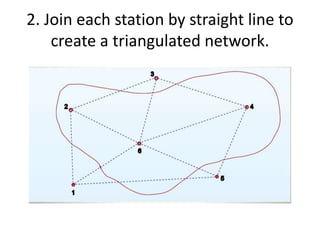
2. Join each station by straight line to
create a triangulated network.
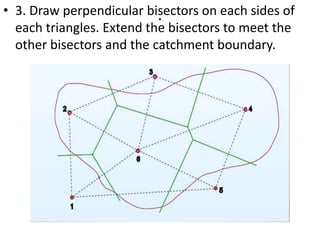
.• 3. Draw perpendicular bisectors on each sides of
each triangles. Extend the bisectors to meet the
other bisectors and the catchment boundary.
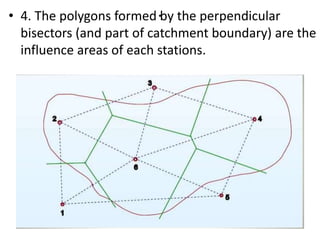
.• 4. The polygons formed by the perpendicular
bisectors (and part of catchment boundary) are the
influence areas of each stations.
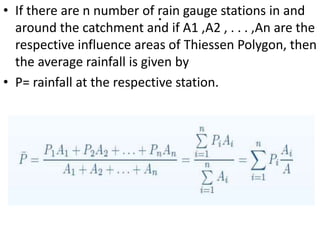
.• If there are n number of rain gauge stations in and
around the catchment and if A1 ,A2 , . . . ,An are the
respective influence areas of Thiessen Polygon, then
the average rainfall is given by
• P= rainfall at the respective station.
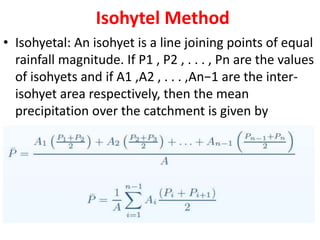
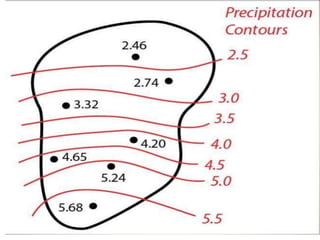
Isohytel Method
• Isohyetal: An isohyet is a line joining points of equal
rainfall magnitude. If P1 , P2 , . . . , Pn are the values
of isohyets and if A1 ,A2 , . . . ,An−1 are the inter-
isohyet area respectively, then the mean
precipitation over the catchment is given by
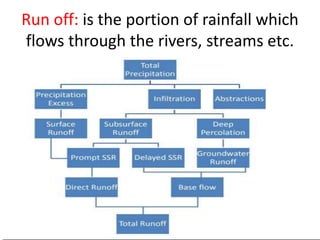
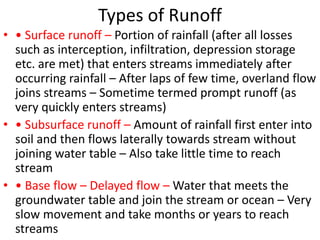
Run off: is the portion of rainfall which
flows through the rivers, streams etc.
Types of Runoff
• • Surface runoff – Portion of rainfall (after all losses
such as interception, infiltration, depression storage
etc. are met) that enters streams immediately after
occurring rainfall – After laps of few time, overland flow
joins streams – Sometime termed prompt runoff (as
very quickly enters streams)
• • Subsurface runoff – Amount of rainfall first enter into
soil and then flows laterally towards stream without
joining water table – Also take little time to reach
stream
• • Base flow – Delayed flow – Water that meets the
groundwater table and join the stream or ocean – Very
slow movement and take months or years to reach
streams
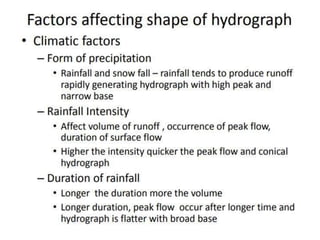
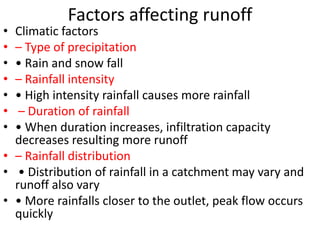
Factors affecting runoff
• Climatic factors
• – Type of precipitation
• • Rain and snow fall
• – Rainfall intensity
• • High intensity rainfall causes more rainfall
• – Duration of rainfall
• • When duration increases, infiltration capacity
decreases resulting more runoff
• – Rainfall distribution
• • Distribution of rainfall in a catchment may vary and
runoff also vary
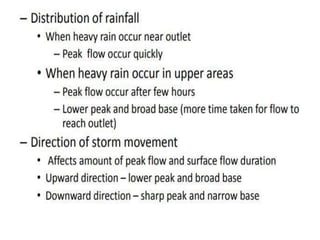
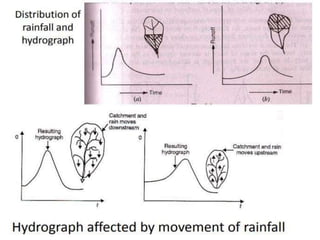
• • More rainfalls closer to the outlet, peak flow occurs
quickly
.• Direction of prevailing wind
• – If the wind direction is towards the flow
direction, peak flow will occur quickly
• Other climatic factors – Temperature, wind
velocity, relative humidity, annual rainfall etc.
affect initial loss of precipitation and thereby
affecting runoff
.
• • Physiographic factors –
• Physiographic characteristics of watershed and
channel both
• – Size of watershed
• • Larger the watershed, longer time needed to
deliver runoff to the outlet
• • Small watersheds dominated by overland flow
and larger watersheds by runoff
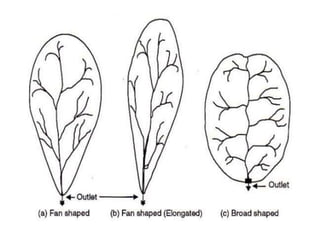
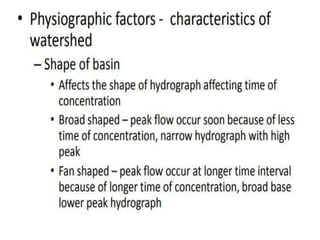
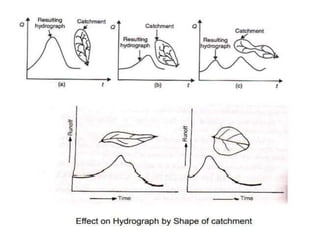
• – Shape of watershed
• • Fan shaped, fan shaped (elongated) and broad
shaped
.• Fan shaped – runoff from the nearest tributaries
drained out before the floods of farthest
tributaries. Peak runoff is less • Broad shaped – all
tributaries contribute runoff almost at the same
time so that peak flow is more
• – Orientation of watershed • Windward side of
mountains get more rainfall than leeward side
• – Landuse
• • Forest – thick layer of organic matter and
undercover – huge amounts absorbed to soil – less
runoff and high resistance to flow
• • barren lands – high runoff
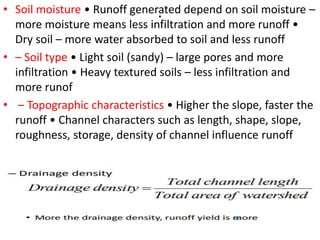
.• Soil moisture • Runoff generated depend on soil moisture –
more moisture means less infiltration and more runoff •
Dry soil – more water absorbed to soil and less runoff
• – Soil type • Light soil (sandy) – large pores and more
infiltration • Heavy textured soils – less infiltration and
more runof
• – Topographic characteristics • Higher the slope, faster the
runoff • Channel characters such as length, shape, slope,
roughness, storage, density of channel influence runoff
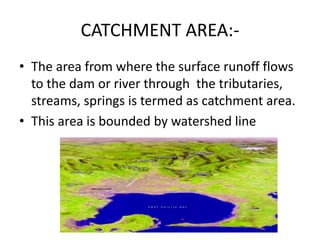
CATCHMENT AREA:-
• The area from where the surface runoff flows
to the dam or river through the tributaries,
streams, springs is termed as catchment area.
• This area is bounded by watershed line
CALCULATION OF RUNOFF:-
• 1)INGLIS METHOD
• 2)STRANGE’S METHOD
• 3)BINNIE’S METHOD
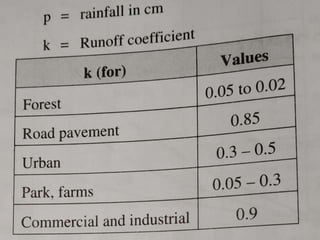
• 4)RUNOFF COEFFICIENT METHOD
INGLIS METHOD
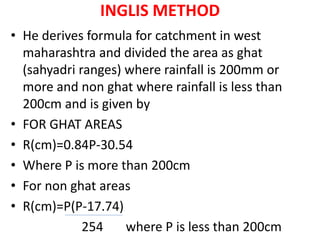
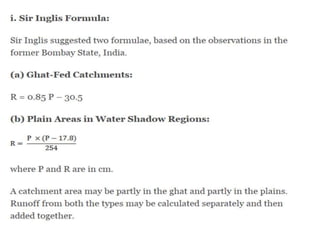
• He derives formula for catchment in west
maharashtra and divided the area as ghat
(sahyadri ranges) where rainfall is 200mm or
more and non ghat where rainfall is less than
200cm and is given by
• FOR GHAT AREAS
• R(cm)=0.84P-30.54
• Where P is more than 200cm
• For non ghat areas
• R(cm)=P(P-17.74)
254 where P is less than 200cm
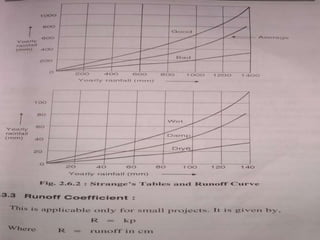
STRANGE CURVES:
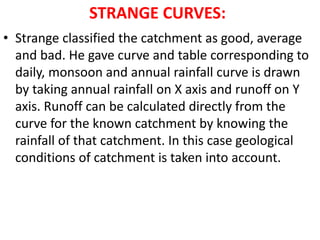
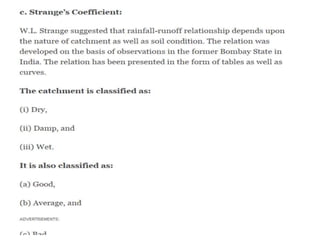
• Strange classified the catchment as good, average
and bad. He gave curve and table corresponding to
daily, monsoon and annual rainfall curve is drawn
by taking annual rainfall on X axis and runoff on Y
axis. Runoff can be calculated directly from the
curve for the known catchment by knowing the
rainfall of that catchment. In this case geological
conditions of catchment is taken into account.
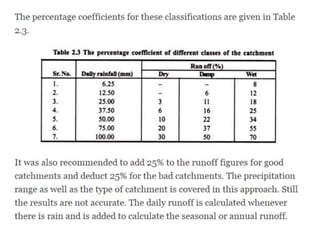
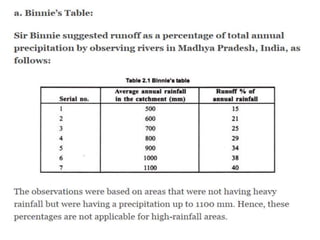
BINNIE’S PERCENTAGE:
• Sir alexander binnie based his result on observation
in wainganga basin in east maharashtra and
establish certain percentages of runoff from rain fall
which are given below.
• In this method the condition of catchment and
other geological and hydrological factors are taken
into account.
• Binnie’s table and curves gives the idea of
percentage runoff and from that yield can be
compute. From binnie’s table if the topography is
having same features then it can be correlated with
the standard chart and from that runoff can be
calculated
MAXIMUM FLOOD DISCHARGE(MFD)
• Maximum flood discharge is maximum
concentration of flow from a catchment area at the
outlet in small period.
• It is expressed as volume per-unit time i.e. m3/s.
cumecs or cubic meter per seconds.
• Maximum flood discharge gives maximum
discharge of river during flood which is useful for
safety of reservoir.
Factors affecting maximum value of
MFD:
The various factors affecting maximum value of
MFD are as follows,
• High intensity of rainfall.
• Late in rainy season.
• Uniformly spread rainfall in large extent of CA.
• Fan/fern shaped catchment area.
• Steep slope.
• Rockey soil.
• Downstream (D/S) direction of the wind.
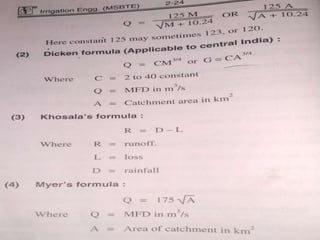
METHODS OF ESTIMATION OF MFD
• 1) inglis formula:
It is applicable to western maharashtra and gujrat for fan
shaped catchment.
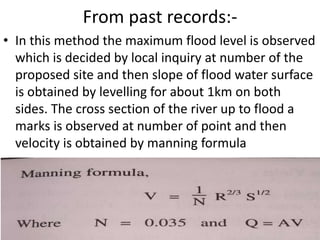
From past records:-
• In this method the maximum flood level is observed
which is decided by local inquiry at number of the
proposed site and then slope of flood water surface
is obtained by levelling for about 1km on both
sides. The cross section of the river up to flood a
marks is observed at number of point and then
velocity is obtained by manning formula
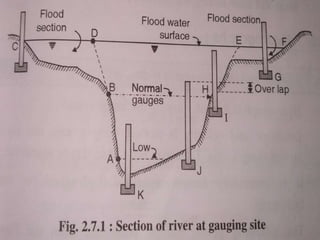
RIVER GAUGING
• It is observation of flood water level and velocity by
current meter. The cross section of the stream is
plotted up to flood level and discharge is obtained
by
• Q=AV
• But the record for highest likely flood may not be
available and hence it is customary to base the
design on empirical formulae and subsequently
verify the results by steam gauging.
YIELD
• It is the total quantity of water available from a
catchment area at the outlet in period of one year.
It is expressed in mm3 (million cubic meters).
or ha.m is called as yield.
DEPENDABLE YIELD:-
It is an assured yield. It is the quantity of water
available for a given number of years per rainfall
cycle.
Yield calculation is important as storage capacity is
depend upon the yield.
Yield can also be calculated from analysis of rainfall
but it gives only approximate values.
.• Now suppose at perticular site minumum and
maximum yield is 50 and 400 Mm3 in recorded
gauging for 35 years it means that the every 35
years only once yield reached maximum of
400Mm3 if it is planned for 400Mm3 but if is
planned for 50 Mm3 it will be filled up to design
capacity every year that is its dependability is 100
. On the other hand for 400Mm3 its dependability is
3%. so we adopt for minium yield a small and low
cost dam is possible but we can not utilize resources
fully and if we design it for maximum yield the
height of dam will be large and more money will be
kept blocked unnecessarily.
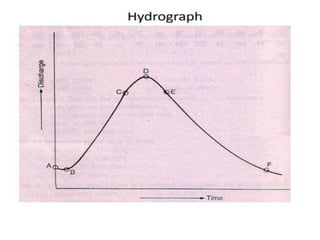
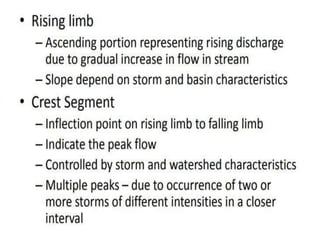
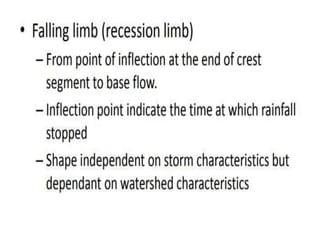
HYDROGRAPHS:
• Hydrograph is a graph showing discharge velocity.
• Discharge and velocity is plotted along Y axis and
time is plotted on X axis. Time may be in hour,day
or months etc.
• It is commonly known as flood hydrograph or runoff
hydrograph.
• The following points an be point out from the flow
of hydrograph.
• Rate of flood at site and at any time.
• Total volume of flood flow.
• The maximum rate of flow caused by flood.
• The rise and fall of the flood.
Introduction to irrigation and hydrology

Introduction to irrigation and hydrology

  • 1.
    WATER RESOURSE ENGINEERING SYLLABUS:- UNIT NO UNITNAME TEACHING HOURS MARKS 01 INTRODUCTION TO IRRIGATION AND HYDROLOGY 12 14 02 WATER REQUIREMENT OF CROPS AND RESERVOIR PLANNING 12 16 03 DAMS AND SPILLWAYS 14 12 04 MINOR AND MICRO IRRIGATION 08 10 05 DIVERSION HEAD WORKS 08 08 06 CANALS 10 10 TOTAL 64 70
  • 2.
    1:INTRODUCTION TO IRRIGATION ANDHYDROLOGY • Irrigation:- • Irrigation is be defined as the process of supplying water by artificial means to agricultural fields for crop production. • If water available to the plants from rainfall is not sufficient, it is supplemented by irrigation water. • IRRIGATION ENGINEERING • It deals with the investigation planning, construction management and maintenance of all structure connected with irrigation which includes dams, diversion weirs, wells pumps, canal masonry work etc.
  • 3.
    Necessity of irrigation. •Inadequate rainfall. • Non-uniform rainfall. • Growing a number of crops during a year. • Growing perennial crops. • Growing superior crops. • Increasing the yield of crops. • Insurance against drought.
  • 4.
    ADVANTAGES OF IRRIGATION •Protection from Famine: Food production is increased due to irrigation by producing more crops used as food. This protects a country from famine situation. • Increase of Groundwater Level. Due to constant seepage and percolation of water from canal, groundwater level in the nearby area is increased. • Social and Cultural Improvement. If increases the cultural and social level of population living nearby canals and reservoirs. Tourists interest in the area of newely constructed reservoir may be enhanced.
  • 5.
    Yields of crops •Yield of crop can be increased by irrigation even in the period of low rainfall. • Optimum benefits Optimum use of water is possible by irrigation to obtain maximum output. • • Elimination of mixed cropping The areas where irrigation is not assured, mixed cropping is adopted. Mixed cropping means sowing different crops to- geather in the same field. Mixed cropping is not desirable as different amount of water and field conditions. Farmers are not benefitted. If irrigation water is assured, mixed cropping may be eliminated and single superior crop may be grown to get the maximum benefits.
  • 6.
    Prosperity of farmers •If irrigation water is assured throughout the year, farmers can grow two or more crops in a year which adds to their prosperity. • Sources of Revenue When water tax is taken from farmers for supplying water, it adds to the revenue of the country. • Hydro-Electric Power Generation The reservoir from which irrigation water is supplied, may be used for generation of power. Besides, the canals in field have some canal falls or drops in which mini hydro- projects may be installed.
  • 7.
    • Water Supply: •Irrigation water may be used as source for domestic and industrial water supply. • General Communication: The inspection road beside the canal bank may serve as communication link in remote village areas. • • Navigation: If the irrigation canals are big and deep, they may be used as navigable water way. • Aesthetic View: New man-made lake if preserved carefully, may increase aesthetic view of the surroundings.
  • 8.
    Development of fishery •Reservoir and canals may be utilized for development of fishery. • Tree Plantation: Trees can be grown along the bank of the canal, which increase the wealth from timber and help in controlling soil erosion of the bank. • Aid to Civilization. Irrigation water is normally available from river valley project. Some tribes living near the valley, adopt irrigation as their profession, increase production, live peacefully which leads to the general civilization of the country.
  • 9.
    Nutrition of Population• • Due to irrigation, increased agricultural production takes place and this production improves the nutrition of the people. • • Recreation Recreation facilities like parks, restaurants may be developed near the canal banks or reservoir sites. • • Social and Cultural Improvement. If increases the cultural and social level of population living nearby canals and reservoirs. Tourists interest in the area of newly constructed reservoir may be enhanced. • • Self-Sufficiency in Food Irrigation makes the country self-sufficient in food by improving the production.
  • 10.
    DISADVANTAGES OF IRRIGATION •Effects on Raising Water Table. • In unlined irrigation canal, excessive seepage of water through bed and sides takes place which raises the water table of the surrounding areas. Soil in the root zone of the crop is saturated and become alkaline which is harmful to the crops and plants. Thus the nearby area may be waterlogged. • Damp Climate. • Temperature of the command area of an irrigation projects may be lowered and damp climate prevails, which adversely affect the health of the community living in this area.
  • 11.
    Breeding Places ofMosquitoes • Due to excess application of water, seepage and leakage from canal, marshy land may be formed leading to breeding place of mosquitos. • Loss of Valuable Land :- Valuable land may be submerged due to construction of reservoir by dam, weir and barrages. • Return of Revenue Irrigation projects are complex and expensive. If project fails due to absence of regular maintenance, return of revenue to the government becomes low compared to its cost of construction. Maintenance cost is quite high for normal functioning of the project.
  • 13.
    OTHER • Salt efflorescence-due to water logging salt efflorescence occurs which may damage land permanently. • Tendency towards over irrigation. • Excess humidity.
  • 14.
  • 15.
    IRRIGATION FLOW IRRIGATION LIFTIRRIGATION PERENNIAL INUNDATION WELL IRRIGATION LIFT CANAL IRRIGATION DIRECT IRRIGATION STORAGE IRRIGATION
  • 16.
    Flow Irrigation: • Flowirrigation is that type of in which flow of water to crop field from the source takes place due to component of gravity force. This flow Irrigation may be further classified into • Perennial Irrigation: In this type of source of water is from a river which is perennial. A weir or barrage is constructed across this river. Sometimes dam may be constructed to form a reservoir upstream. Main canal with a regulator is constructed where one or both banks supply water to the crop field. This type is reliable as water is available during the whole period of the year.
  • 19.
    Inundation or floodirrigation • It is that type of irrigation in which no control structures like weir, barrage, regulator, etc are constructed. During rainy season, water level in the river rises and canal bed level is kept below High Flood Level (HFL) of the river. The portion of water above the canal bed is diverted to inundate the crop field. • • This inundation water is drained off or allowed to absorb in the crop field prior to planting the crop. The whole system depends on the water level in the river. Although no such expenditure is involved in this system, over-irrigation may damage the crops. Therefore, this system is not popular.
  • 21.
    • Direct Irrigation:Diversion Scheme • • In Direct Irrigation no storage of water upstream of diversion weir is provided. Water is directly diverted to canals, without any storage. Water through the canals with regulators is diverted directly to the canals. • Storage Irrigation: Storage Scheme A dam is constructed across the reservoir to store water upstream in a reservoir. It is of a bigger magnitude, water stored is used for hydroelectric production, water supply, etc. besides irrigation depending upon the volume of water stored. A network of canal system is used. In this scheme bigger area could be irrigated to raise more crops. The scheme is costlier than other schemes.
  • 23.
    Combined Storage andDiversion Scheme. • In this system, a dam is constructed across a river to form a reservoir. This stored water is used to produce electricity. A powerhouse is constructed just downstream of the dam. The discharge from the lower house is fed back into river downstream of the dam, a pickup weir at a suitable side is constructed to divert this available water to the crop field by the canals.
  • 24.
    . • This typeof scheme and the combined storage and diversion scheme, along with main aim of irrigation, following aims and purposes may be served • • Hydroelectric power generation • • Water supply • • Flood Control in the river valley • • Fishery • • Recreation
  • 26.
    Lift Irrigation: • LiftIrrigation is the process of lifting water normally from underground sources and sometimes from surface source by pump, i.e. mechanical power or man or animal power and then direct this lifted water is supplied to the agricultural field. In remote villages, if electric energy is not available in open well, shallow and deep tube wells.
  • 29.
    Factors affecting choiceof irrigation method • The selection of the irrigation method is based on the following factors. • 1. Soil characteristics of the land to be irrigated. • 2. Topography of the area. • 3. The available water supply. • 4. Type of crop and its requirements. • 5. Size of the stream supplying irrigation water. • 6. Amount of water required in each irrigation.
  • 30.
    TYPES OF IRRIGATIONPROJECT Sr.no NAME ESTIMATED COST ACCORDING REVISED CLASSIFICATION 01 MAJOR PROJECT ABOVE Rs.5 crore CCA more than 10000 ha 02 MEDIUM PROJECT BETWEEN 25 LAKHS TO 5 CRORE CCA BETWEEN 2000 TO 10000 ha 03 MINOR PROJECT BELOW 25 LAKHS CCA LESS THAN 2000 ha
  • 31.
    PURPOSE WISE • SINGLEPURPOSE:- PROJECT WHICH IS PLANNED AND FINANCED FOR ONE OR SINGLE OBJECTIVE IT IS CALLED AS SINGLE PURPOSE PROJECT • KOYNA-HYDRO POWER • MULTI PURPOSED:- WHENEVER A PROJECT IS PLANNED FOR MORE THAN ONE OBJECTIVE IT IS CALLED AS MULTIPURPOSED PROJECT • NHAKRA NANGLE • JAYAKWADI
  • 32.
    In surface irrigationmethods, • the irrigation water is applied by spreading in the form of sheet or small streams on the lands to be irrigated. • The surface irrigation is further divided as follows: • 1) Flooding method. • 2) Furrow method . • 3) Contour farming. • All the above methods of the surface irrigation are adopted for the perennial irrigation system. • The inundation irrigation system adopts only the wild or uncontrolled flooding method of irrigation.
  • 33.
    Wild flooding method. •Wild flooding method is the earliest and the primitive method of application of water to the land. • In this method the water is applied by spreading it over the land prior to the application of water, no land preparations is done in the form of border or field ditches. • The water is allowed to flow the natural slope of the land.
  • 34.
    Controlled flooding. • Incontrolled flooding methods irrigation water is applied by spreading it over the land to be irrigated with proper control on the flow of water as well as the quantity of water applied. • All the methods of control flooding require prior preparation of the land. • The land is properly graded & agricultural fields are divided into small units by levees .
  • 35.
    Controlled flooding. • Thevarious methods of controlled flooding are: • 1. Free flooding. • 2. Contour laterals. • 3. Border strips. • 4. Check basins. • 5. Basin flooding. • 6. Zig-zag method.
  • 42.
    Furrow method • Furrowirrigation avoids flooding the entire field surface by channeling the flow along the primary direction of the field using ‘furrows,’ ‘grooves’, ‘lines’.
  • 43.
    Contour farming • Contourfarming is practiced in hilly areas with slopes and with falling contour. • The land is divided into series of horizontal strips called terraces. • Small bunds are constructed at the end of each terrace to hold water up to equal height.
  • 45.
    Sub-Surface irrigation method. •Subsurface drip irrigation (SDI) is the irrigation of crops through buried plastic tubes containing embedded emitters located at regular spacing's. • The sub surface irrigation method consists of supplying water directly to the root zone of the plants. • The favorable conditions for sub surface irrigation: 1. Moderate slope. • 2. Uniform topographic condition. • 3. Good quality of irrigation water . • 4. Impervious sub-soil at reasonable depth. (i.e. 2-3 m depth).
  • 46.
    The subsurface irrigationmethods can be classified as follows: • 1. Natural sub-surface irrigation . • 2. Artificial sub-surface irrigation. • Sprinkler irrigation is a method of applying irrigation water which is similar to natural rainfall. • Water is distributed through a system of pipes usually by pumping. It is then sprayed into the air through sprinklers so that it breaks up into small water drops which fall to the ground.
  • 48.
    Drip irrigation. • Dripirrigation is also known as trickle irrigation . • It is one of the latest developed methods of irrigation which is more popular in the regions facing scarcity of water. • This method was first introduced in Israel. • In India this method is more useful in areas in Gujarat, Maharashtra, Kerala, & Karnataka.
  • 51.
    HYDROLOGY • What isHydrology??? • It is the science which deals with occurrence, distribution and movement of water on the earth including that in the atmosphere and below the surface of the earth. • Water occurs in the atmosphere in the form of water vapor, on the surface as water, snow or ice and below the surface as ground water occupying all the voids within a geological stratum.
  • 52.
    HYDROLOGY • Except forthe deep ground water , the total water supply of earth is in constant circulation from earth to atmosphere and back to earth. • The earth’s water circulatory system is known as hydrological cycle.
  • 53.
    HYDROLOGICAL CYCLE • Hydrologicalcycle is the process of transfer of moisture from the atmosphere to the earth in the form of precipitation, conveyance of precipitin water by streams and rivers to the oceans and lakes etc. and evaporation of water back to the atmosphere complete the hydrological cycle.
  • 56.
    HYDROLOGICAL CYCLE • Evaporationand Transpiration (E) • Precipitation(P) • Runoff (R) • Evaporation and Transpiration Evaporation: (E) • Surface Evaporation • Water Surface Evaporation • From River • From Oceans • Evaporation from Plants and Leaves(Transpiration) • Atmospheric Evaporation.
  • 58.
    RAINFALL • Rainfall isdepth in mm or cm of water stand on the surface of earth if it is not lost in any manner like evaporation absorption etc. • Terms related to Rainfall • Intensity of Rainfall: It is rain fall in unit of time e.g if 18 cm rain fall in 3 hours, Intensity of rain fall= 6 cm • Daily rainfall: Rain fall in 24 hours at any rain gauge St. • Annual rain fall: Rain fall in 1 year at any rain gauge St. • Mean annual rainfall: Rain fall in 35 year at any rain gauge St.
  • 59.
    rain-gauge. • Rainfall Measurement •Rain fall is source of all water used for irrigation purpose and therefore the knowledge of its amount character season or period the effects produced by it is of prime importance to irrigation engineer to design, carry out, improve or maintain irrigation works. • The amount of precipitation is expressed as the depth in cm or inches which fall on the level surface, and is measure by rain-gauge.
  • 60.
    Rain gauge: • Themeasurement of rainfall at a place is measured by instrument and the instrument which measures rainfall is called as rain gauge. • RAIN GAUGE STATION: • the place at which rain gauge are installed for measurement of rainfall is called as rain gauge station. • SITE SELECTION FOR RAINGAUGE STATION:- • Site should be in open space having at least an area of 5.5mx5.5m
  • 61.
    .• The distanceof instrument from nearest obstruction should not be less than 30m or twice the height of obstruction. • The gauge should have level horizontal catch surface. • It should be set near the ground surface but at the same time to prevent splashing of water into it. • Fence should be erected around rain gauge station. To protect rain gauge from cattle, dogs etc. • the distance of fence should not be less than twice of its height. • A site that is sheltered from high wing should be chosen
  • 62.
    .• The raingauge should not be installed on top or side of hill , then the site should be selected such that it should be protected from high wind. • The gauge must be mounted firmly so that it can not be disturbed even by strong wind.
  • 63.
    Types of Raingauge • Non –Automatic or Non-recording rain gauge. e.g. -Symon’s Rain-gauge. • Automatic or Recording rain gauge. e.g. (1) Weighing bucket rain gauge. (2) Tipping Bucket rain gauge. (3) Float type rain gauge.
  • 64.
    NON RECORDING TYPE •In non recording type of rain gauge it does not record rain but it only collect the rain and this collected rain is measured by means of graduated cylinders.
  • 65.
    . • Symon’s raingauge. • I. Simon’s rain gauge is a non recording type of rain gauge which is most commonly used. • II. It consists of metal casing of diameter 127mm which is set on a concrete foundation. • III. A glass bottle of capacity about 100mm of rainfall is placed within the casing. • IV. A funnel with brass rim is placed on the top of the bottle. • V. The rainfall is recorded at every 24 hours. • VI. To measure the amount of rainfall. the glass bottle is taken off and the collected water is measured in a measuring glass and recorded in rain gauge record book
  • 69.
    .• Inclination ofGauge may cause lesser collection. (10 % inclination = 1.5 % low catch) • Tipping of bucket may be affected due to rusting or accumulation of dirt at the pivot. • No rainfall is recorded during tipping of the bucket
  • 70.
    Recording Rain-gauge • Advantagesover non recording rain-gauge: • Rainfall recorded automatically. • Also gives the intensity of rain fall at any time, while non recording type rain gauge gives total rain fall in particular interval of time. • As no attendant required can be installed in far-off places. • Possibilities of human error is obviated.
  • 71.
    Recording Rain-gauge Disadvantages: •Costly • Fault may be developed in electrical/mechanical mechanism/ recording rain fall.
  • 72.
    Sources of Errorin recording the Measurement • Mistake in reading the scale of gauge. • Some amount of water displaced by measuring stick. (this may increase error by 1%) • Dent in the collector rim may change its receiving area. • Funnel and inside surface required about 2.5 mm of rain to get moistened when gauge is initially dry. ( this may extent of amt of 25mm/yr in some areas) • Deficiency of measurement due to wind.
  • 73.
    SOURCES OF ERRORSIN RECORDING RAINFALL • Improper reading of scale of gauge. • Some water may splash out from collector which may leads flash reading. • Gauge if placed at an inclination may result in incorrect reading. • Some amount of water is displaced by measuring stick. • Initially when gauge is dry it required 2.5mm of rain to get moistened due to which also error may occure
  • 74.
    (a) Tipping-Bucket type: •This is a 30.5 cm size rain gauge used by US Weather Bureau. • The catch from the funnel falls onto one of a pair of small buckets. • These buckets are so balanced that when 25 mm of rainfall collects in one bucket it tips and brings the other bucket in position and the water is collected in storage can. • The tipping actuates an electrically driven pen to plot the intensity of rainfall with time. • The water in storage can is measured regularly to give total rainfall.
  • 78.
    (b) Weighing-Bucket type •In this the catch empties into a bucket mounted on a weighing scale. • The weight of the bucket are recorded with time. • The mechanism has the capacity to run for as long as one week. • The instrument gives a plot of accumulated rainfall against time.
  • 81.
    (c) Natural-Syphon type: •Also called as float type gauge. • In this the rainfall collected by a funnel shaped collector is led into a float chamber causing a float to rise. • Due to this, a pen attached to the float through a lever records the elevation of float driven by clockwork mechanism. • A syphon arrangement empties the float chamber when float reaches the maximum preset value. • Its details are prescribed in IS: 5235-1969
  • 85.
    TERMINOLOGY USED INHYDROLOGY: • AVERAGE RAINFALL: • It is the arithmetic time average of rainfall means it is total rainfall divided by time period. • RAINFALL INTENSITY: • it is the maximum rainfall during a short period measured in mm/hr is called rainfall intensity. • ANNUAL RAINFALL: • The total rainfall at a station in the period of on year is called as annual rainfall. • AVERAGE ANNUAL RAINFALL(P):- it is the average value obtained by adding up the annual rainfall of a station for 35 years or more and dividing sum by number of years .
  • 86.
    monsoon rainfall: • Itis the total quantity of rainfall during monsoon season – from 15th June to 14th Oct. is called average monsoon rainfall. • AVERAGE MONSOON RAINFALL: • It is the arithmetical mean of monsoon rainfall over a period of 35 years or more • AVERAGE,GOOD AND BAD YEARS:- • GOOD: If rainfall is more than 120% of avg annual rainfall • BAD: if rainfall is less than 80% of avg annual rainfall • AVERAGE OR NORMAL: if rain fall is +- 20% of the average rainfall it is called average rainfall
  • 87.
    Average Rainfall overan area • To convert the point rainfall values measured by various rain gauge stations into an average value over a catchment, following methods are used. 1) Arithmetic Mean Method 2) Thiessen Polygon Method 3) Isohytel Method
  • 88.
  • 89.
    Thiessen Polygon Method •In this method, the rainfall recorded at each station is given a weightage on the basis of an area closest to that station. • 1. Draw the catchment area to a scale and mark the raingauge stations on it.
  • 90.
    2. Join eachstation by straight line to create a triangulated network.
  • 91.
    .• 3. Drawperpendicular bisectors on each sides of each triangles. Extend the bisectors to meet the other bisectors and the catchment boundary.
  • 92.
    .• 4. Thepolygons formed by the perpendicular bisectors (and part of catchment boundary) are the influence areas of each stations.
  • 93.
    .• If thereare n number of rain gauge stations in and around the catchment and if A1 ,A2 , . . . ,An are the respective influence areas of Thiessen Polygon, then the average rainfall is given by • P= rainfall at the respective station.
  • 94.
    Isohytel Method • Isohyetal:An isohyet is a line joining points of equal rainfall magnitude. If P1 , P2 , . . . , Pn are the values of isohyets and if A1 ,A2 , . . . ,An−1 are the inter- isohyet area respectively, then the mean precipitation over the catchment is given by
  • 96.
    Run off: isthe portion of rainfall which flows through the rivers, streams etc.
  • 97.
    Types of Runoff •• Surface runoff – Portion of rainfall (after all losses such as interception, infiltration, depression storage etc. are met) that enters streams immediately after occurring rainfall – After laps of few time, overland flow joins streams – Sometime termed prompt runoff (as very quickly enters streams) • • Subsurface runoff – Amount of rainfall first enter into soil and then flows laterally towards stream without joining water table – Also take little time to reach stream • • Base flow – Delayed flow – Water that meets the groundwater table and join the stream or ocean – Very slow movement and take months or years to reach streams
  • 98.
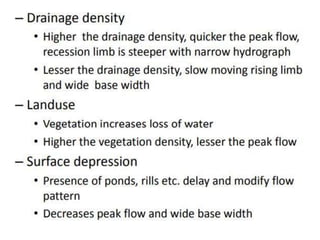
    Factors affecting runoff •Climatic factors • – Type of precipitation • • Rain and snow fall • – Rainfall intensity • • High intensity rainfall causes more rainfall • – Duration of rainfall • • When duration increases, infiltration capacity decreases resulting more runoff • – Rainfall distribution • • Distribution of rainfall in a catchment may vary and runoff also vary • • More rainfalls closer to the outlet, peak flow occurs quickly
  • 99.
    .• Direction ofprevailing wind • – If the wind direction is towards the flow direction, peak flow will occur quickly • Other climatic factors – Temperature, wind velocity, relative humidity, annual rainfall etc. affect initial loss of precipitation and thereby affecting runoff
  • 100.
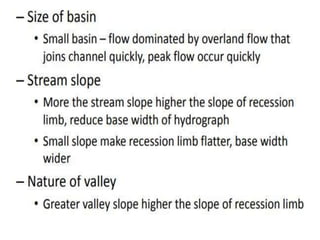
    . • • Physiographicfactors – • Physiographic characteristics of watershed and channel both • – Size of watershed • • Larger the watershed, longer time needed to deliver runoff to the outlet • • Small watersheds dominated by overland flow and larger watersheds by runoff • – Shape of watershed • • Fan shaped, fan shaped (elongated) and broad shaped
  • 102.
    .• Fan shaped– runoff from the nearest tributaries drained out before the floods of farthest tributaries. Peak runoff is less • Broad shaped – all tributaries contribute runoff almost at the same time so that peak flow is more • – Orientation of watershed • Windward side of mountains get more rainfall than leeward side • – Landuse • • Forest – thick layer of organic matter and undercover – huge amounts absorbed to soil – less runoff and high resistance to flow • • barren lands – high runoff
  • 103.
    .• Soil moisture• Runoff generated depend on soil moisture – more moisture means less infiltration and more runoff • Dry soil – more water absorbed to soil and less runoff • – Soil type • Light soil (sandy) – large pores and more infiltration • Heavy textured soils – less infiltration and more runof • – Topographic characteristics • Higher the slope, faster the runoff • Channel characters such as length, shape, slope, roughness, storage, density of channel influence runoff
  • 104.
    CATCHMENT AREA:- • Thearea from where the surface runoff flows to the dam or river through the tributaries, streams, springs is termed as catchment area. • This area is bounded by watershed line
  • 105.
    CALCULATION OF RUNOFF:- •1)INGLIS METHOD • 2)STRANGE’S METHOD • 3)BINNIE’S METHOD • 4)RUNOFF COEFFICIENT METHOD
  • 106.
    INGLIS METHOD • Hederives formula for catchment in west maharashtra and divided the area as ghat (sahyadri ranges) where rainfall is 200mm or more and non ghat where rainfall is less than 200cm and is given by • FOR GHAT AREAS • R(cm)=0.84P-30.54 • Where P is more than 200cm • For non ghat areas • R(cm)=P(P-17.74) 254 where P is less than 200cm
  • 108.
    STRANGE CURVES: • Strangeclassified the catchment as good, average and bad. He gave curve and table corresponding to daily, monsoon and annual rainfall curve is drawn by taking annual rainfall on X axis and runoff on Y axis. Runoff can be calculated directly from the curve for the known catchment by knowing the rainfall of that catchment. In this case geological conditions of catchment is taken into account.
  • 113.
    BINNIE’S PERCENTAGE: • Siralexander binnie based his result on observation in wainganga basin in east maharashtra and establish certain percentages of runoff from rain fall which are given below. • In this method the condition of catchment and other geological and hydrological factors are taken into account. • Binnie’s table and curves gives the idea of percentage runoff and from that yield can be compute. From binnie’s table if the topography is having same features then it can be correlated with the standard chart and from that runoff can be calculated
  • 115.
    MAXIMUM FLOOD DISCHARGE(MFD) •Maximum flood discharge is maximum concentration of flow from a catchment area at the outlet in small period. • It is expressed as volume per-unit time i.e. m3/s. cumecs or cubic meter per seconds. • Maximum flood discharge gives maximum discharge of river during flood which is useful for safety of reservoir.
  • 116.
    Factors affecting maximumvalue of MFD: The various factors affecting maximum value of MFD are as follows, • High intensity of rainfall. • Late in rainy season. • Uniformly spread rainfall in large extent of CA. • Fan/fern shaped catchment area. • Steep slope. • Rockey soil. • Downstream (D/S) direction of the wind.
  • 117.
    METHODS OF ESTIMATIONOF MFD • 1) inglis formula: It is applicable to western maharashtra and gujrat for fan shaped catchment.
  • 119.
    From past records:- •In this method the maximum flood level is observed which is decided by local inquiry at number of the proposed site and then slope of flood water surface is obtained by levelling for about 1km on both sides. The cross section of the river up to flood a marks is observed at number of point and then velocity is obtained by manning formula
  • 120.
    RIVER GAUGING • Itis observation of flood water level and velocity by current meter. The cross section of the stream is plotted up to flood level and discharge is obtained by • Q=AV • But the record for highest likely flood may not be available and hence it is customary to base the design on empirical formulae and subsequently verify the results by steam gauging.
  • 122.
    YIELD • It isthe total quantity of water available from a catchment area at the outlet in period of one year. It is expressed in mm3 (million cubic meters). or ha.m is called as yield. DEPENDABLE YIELD:- It is an assured yield. It is the quantity of water available for a given number of years per rainfall cycle. Yield calculation is important as storage capacity is depend upon the yield. Yield can also be calculated from analysis of rainfall but it gives only approximate values.
  • 123.
    .• Now supposeat perticular site minumum and maximum yield is 50 and 400 Mm3 in recorded gauging for 35 years it means that the every 35 years only once yield reached maximum of 400Mm3 if it is planned for 400Mm3 but if is planned for 50 Mm3 it will be filled up to design capacity every year that is its dependability is 100 . On the other hand for 400Mm3 its dependability is 3%. so we adopt for minium yield a small and low cost dam is possible but we can not utilize resources fully and if we design it for maximum yield the height of dam will be large and more money will be kept blocked unnecessarily.
  • 124.
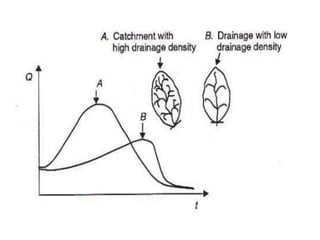
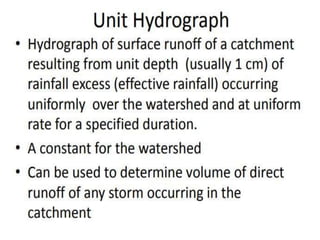
    HYDROGRAPHS: • Hydrograph isa graph showing discharge velocity. • Discharge and velocity is plotted along Y axis and time is plotted on X axis. Time may be in hour,day or months etc. • It is commonly known as flood hydrograph or runoff hydrograph. • The following points an be point out from the flow of hydrograph. • Rate of flood at site and at any time. • Total volume of flood flow. • The maximum rate of flow caused by flood. • The rise and fall of the flood.