PRESENTATION
ON
“Agronomic Evaluation of Irrigation Projects, Case Studies and
Strategies for Enhancing Irrigation Productivity”
COURSE TITLE - ADVANCES IN IRRIGATION MANAGEMENT
COURSE NO. - AGRO-605
CREDIT HOURS - 3( 2+1)
SESSION - 2022-23
Submitted To:
Dr. Sanjay K. Dwivedi Submitted by
Principal Scientist Swati Shukla
Department of Agronomy Ph.D. (previous year)
IGKV, Raipur Deptt. of Fruit Science
ID- 20220622
CONTENT
 Introduction
 Irrigation Project
 Feasibility of an irrigation project
 Types of Irrigation Project
 Considerations for design of irrigation projects
 Agronomic Considerations in the Design and Operation of
irrigation Projects
 Development of Indicators to Monitor and Evaluate the
Performance of Irrigation Schemes
 Case Studies (India & Abroad)
 Major Findings for Low Water Use Efficiency
 Strategies for enhancing irrigation productivity
 Conclusion
 References
Introduction
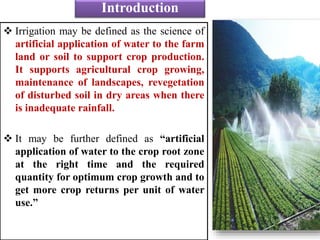
 Irrigation may be defined as the science of
artificial application of water to the farm
land or soil to support crop production.
It supports agricultural crop growing,
maintenance of landscapes, revegetation
of disturbed soil in dry areas when there
is inadequate rainfall.
 It may be further defined as “artificial
application of water to the crop root zone
at the right time and the required
quantity for optimum crop growth and to
get more crop returns per unit of water
use.”
Irrigation Project
 Agricultural establishments capable of applying controlled amounts
of water to land to produce crops are called irrigation project.
 It mainly consists of engineering structures which collect, convey,
delivery of water to areas on which crops are grown.
 Ex: Ballar Medium Irrigation Project (Mahanadi).
Essential conditions for success of irrigation project
• Suitability of land for agriculture.
• Favourable climatic conditions for proper growth and yield of crop.
• Adequate and economic supply of suitable quality of water Good site
conditions for hydraulic structures for operations.
Feasibility of an irrigation project:
 The feasibility of an irrigation project is decided on the
basis of preliminary estimates of:
1. Area of land suitable for irrigation,
2. Water requirements,
3. Available water supplies,
4. Productivity of irrigated land, and
5. Required engineering works.
 An irrigation project is considered feasible if the total
estimated benefits of the project exceed its total estimated
cost. Adequate planning of all aspects is always essential for
a feasible irrigation project.
Types of Irrigation Project
A. Based on culturable command area
• Major irrigation projects: projects which have a culturable command area
(CCA) of more than 10,000 ha.
• Medium irrigation projects: projects which have CCA of 2000ha to
10,000 ha.
• Minor irrigation projects: projects with CCA less than or equal to 2,000
ha. utilizes both ground water and local surface water resources.
B. Based on flow of water
• Gravity irrigation projects: where the irrigation water is conveyed by
gravity for growing to the irrigated land.
• Lift irrigation project: The water is lifted up by pumps or by other
mechanical devices for lifting water and conveyed to the agricultural land
through channels flowing under gravity.
CONSIDERATIONS FOR DESIGN OF IRRIGATION PROJECTS
 Design of irrigation systems is a very important topic in the process
to improve water application, efficiency and economical return in
the production process.
 To develop adequate engineering design, the use of well known
criteria it is a basic component; this can only be obtained with deep
knowledge on irrigation, and the technical parameters associated
with crop, soil water characteristics, energy and environment.
 Pereira (1999) reported that to improve the irrigation systems
requires the consideration of the factors influencing the hydraulic
processes, the water infiltration and the uniformity of water
application to the entire field.
 The consideration of all these aspects makes irrigation management a
complex decision making and field practice process.
Agronomic Considerations in the Design and Operation of irrigation
Projects
1. Soil- Suitability of a land for design of irrigation projects depends
on soil characteristics, soil profile, geological deposits, and surface
texture.
 Certain soil conditions are needed for profitable, diversified crop
production under sustained irrigation.
 These include the following:
a. Adequate moisture holding capacity for the proposed irrigation and
cropping pattern.
a. Adequate infiltration rate to facilitate replenishment of soil-water lost
through evapo-transpiration, to minimize erosion, to prevent
excessive deep percolation under the proposed method.
2. Climate
• Crops have their optimum climatic requirements for normal growth and
development, and fruiting.
• Beyond the desired limit, crops cannot grow properly and produce flower.
Some of the important climatic elements are maximum temperature,
minimum temperature, night temperature, and day length.
• Atmospheric water demand or crop evapo-transpiration should also be taken
into account for irrigation planning.
3. Topography
• Topography, vegetation, biological activity, and time give a soil its
characteristics or soil profile.
• Suitability of a land for design irrigation project depends largely on its
topography as it determines the choice of irrigation method.
• It can also affect labour requirement, irrigation efficiency, drainage, erosion,
size and shape of fields, range of possible crops, and land development.
Operational expenses increase with the surface feature, field size, stoniness
or bush/tree cover, and surface drainage requirement.
4. Water Source
In water resource development, harmonization of the different demands for
water, establishment of irrigation priority rights between upstream and
downstream users, and consideration of the rights of the existing users of
water from flood, which may be modified by dams, is essential.
5. Crops to be Cultivated
• water resources should be planned on the basis of the major crops and
cropping pattern.
• The factors influencing the choice of crop are the local/national demand (to
ensure self sufficiency or to discourage import), profitability factor (to
export, in response to foreign demand), ease of marketing and market
demand, etc.
• The materialization of the planned cropping pattern is a must for protecting
the soil (against salinity, alkalinity, aridity, etc.) and for feeding sufficient
water to irrigation network areas.
6. Energy
• If water is to be pumped from the source to the irrigated area/field,
then the energy source for the pumping is a major consideration.
• If an electric transmission line is to be constructed, it will require an
investment.
• If the pump is to operate with a diesel engine, it will certainly create
an environmental problem.
7. Labour
• For the implementation of irrigation projects, a huge amount of human
labour will be required depending on whether the project will be
human labour based, or a mechanized one.
• This point should be taken into account while planning for an
irrigation project.
Objectives of evaluation of Irrigation projects
 Objective of evaluation of any irrigation system are to determine
if the purpose for which the system has been set up, is achieved or
not. It is necessary to know,
 If the planned irrigated area has received required water supplies at
the proper time and the distribution has been equitable.
 If the system components are capable of delivering the required
quantity of water, whether each component is being maintained and
operated properly, that the canals run properly.
 If the crops as per original (or revised plan) are being produced and
that the yields are appropriate.
 If investments made by the farmer or by the state are achieving
desired roles of return.
Development of Indicators to Monitor and Evaluate the
Performance of Irrigation Schemes
The following six areas of M&E are important for irrigation
schemes:
1. Technical performance
2. Agronomic performance
3. Financial performance
4. Socio-economic performance
5. Environmental and health performance
6. Managerial performance
 To be able to carry out M&E, indicators have to be developed for each
of the six areas.
 Indicators are designed to provide a standard against which to
measure, assess or show the progress of an activity against stated
targets
Case Studies (India & Abroad)
1. Case study on “Modernization and optimization of irrigation
systems to increase water productivity”
(Mateos et al., 2006, Spain)
 Found that population increase and the improvement of living
standards brought about by development will result in a sharp
increase in food demand during the next decades.
 The water input per unit irrigated area will have to be reduced in
response to water scarcity and environmental concerns.
 Water productivity is projected to increase through gains in crop yield
and reductions in irrigation water.
 Water productivity can be defined in a number of ways, although it
always represents the output of a given activity (in economic terms, if
possible) divided by some expression of water input.
 The authors identified five expressions for this indicator, using
different approaches to water input.
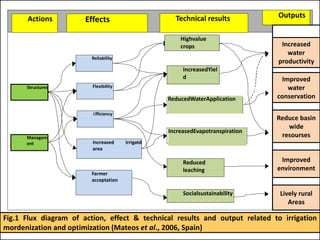
 Particular attention is paid to the improvement of irrigation
management, which shows much better economic return than the
improvement of the irrigation structures.
 In closed basins the hydrological effects of these improvements may
be deceiving, since they will be accompanied by larger crop evapo-
transpiration and even increased cropping intensity.
 As a consequence, less water will be available for alternative uses
ReducedWaterApplication
IncreasedEvapotranspiration
Socialsustainability
Farmer
acceptation
Reduced
leaching
Increased irrigatd
area
Managem
ent
Efficiency
Structures Flexibility
IncreasedYiel
d
Reliability
Highvalue
crops
Outputs
Technical results
Effects
Actions
Increased
water
productivity
Improved
water
conservation
Reduce basin
wide
resourses
Improved
environment
Lively rural
Areas
Fig.1 Flux diagram of action, effect & technical results and output related to irrigation
mordenization and optimization (Mateos et al., 2006, Spain)
2. Case Study on assessing the impact of rehabilitation and irrigation
management transfer in minor irrigation projects in Orissa, India
conducted by Water Technology Centre for Eastern Region (ICAR),
Bhubaneswar.
 The case study on the impact of rehabilitation and irrigation
management transfer (IMT) on irrigation, agriculture and functioning
of a water user association (WUA) from farmers’ perspectives.
 The study was carried out in three selected minor irrigation projects
(MIPs) in Orissa, India, which were rehabilitated by the state
government obtaining financial assistance from European
Commission during 1995–2005. A total number of 207 farmers were
selected as respondents for this study following the probability
proportionate random sampling method.
3. Chandrabhaga Medium Project
 Chandrabhaga Medium Project is located in Tapi river basin in Amaravati
District of Maharashtra State.
 Open channel gravity flow irrigation network up to the Minors were
established and pipe out lets were provided over the Minor as per
conventional practices.
 The discharging capacity of the pipe out let is kept as 30 lps.
4. A case study of the Rajasthan canal
 The study deals with the policy issues relevant to agriculture development
in arid regions where water has a very high economic value.
 The issues relevant for such a study are the level of technology, the
cropping pattern, the area under cultivation and the size of the holdings.
 The study concludes that agriculture and irrigation technology of a high
level should be used to maximum benefits and production, which would
also generate more employment.
5. Performance Evaluation of Irrigation Projects - A Case Study of Lift
Irrigation Scheme Sirsa Manjholi in Solan area of Shivalik Himalayas
 The construction of this scheme has not induced any change neither in
cropped area nor in the cropping pattern of the command area.
 The study has shown that the involvement of the farmers in planning and
management of scheme is minimal as the KVS is non-functional.
 The 22.6% of CCA is not getting any water from the scheme. The
remaining area i.e 141.81 hectare is getting water only in July to
December months because the water level in river goes down in other
months and it is not possible to lift water for the scheme.
 The cropping intensity was found 198.90%, 203.28% and 187.34% during
1990 (almost after a decade of construction of irrigation scheme), 2000 and
2010 respectively.
 It was also noticed that the water tariff rates being charged in Himachal
Pradesh are very low and that too are not being collected by the
Government.
Major Findings for Low Water Use Efficiency
The following major reasons have been identified for low Water Use Efficiency of
Irrigation projects Mahato (2013):
• Poor or no-maintenance of canals/distributaries/minors of irrigation systems
resulting in growth of weed & vegetation, siltation, damages in lining etc.
• Distortion of canal sections due to siltation or collapse of slopes resulting in some
channels carrying much less and some other channels carrying much more than their
design discharges;
• Non Provision of lining in canal reaches passing through permeable soil strata;
• Leakages in gates and shutters;
• Damaged structures;
• No regulation gates on head regulators of minors causing uneven distribution of
water;
• Over irrigation due to non-availability of control structures and facilities for
volumetric supply of irrigation water to farmers;
Strategies for enhancing irrigation productivity
 Water-saving technologies could successfully be implemented in farmers’ fields
under shallow pump irrigation and in the large-scale surface irrigation scheme
UPRIIS under the prevailing water delivery schedules.
 Although, in most experiments care was taken to try to hydraulically separate the
experimental plots from their surroundings (by using plastic sheets), lateral
subsurface flow could not be fully prevented when groundwater tables were shallow,
and this may have affected the results of the water-saving irrigation treatments.
 However, these are typically the conditions farmers actually experience in irrigated
lowlands and our results are representative for such situations. Saturated soil culture
reduced water inputs substantially from traditional continuous flooding without
significantly decreasing yield.
 Keeping the soil continuously around saturation resulted on average in a 5% yield
reduction, 35% water input reduction and 45% increase in water productivity.
Strategies for enhancing irrigation productivity
 Avoid over-irrigation
 Schedule irrigations based on evapo transpiration (ET)
 Schedule irrigations based on soil water content or soil water tension
 Use deficit irrigation
 Plan your acreage under irrigation
 Practice conservation tillage
 Carefully manage surface irrigation
Conclusion
 The evaluation of irrigation projects offers the farmers a number of
possibilities to expand the economic productivity of water.
 However , the problem of feeding the world’s increasing demands
does not have an easy solution from the irrigation point of view.
 In irrigated agriculture the production of dry matter & yield are
determined by plant genetics and number of environmental factors,
including plant water status.
 Adequate irrigation scheduling can be used to optimise crop yield for
a given level of crop evapotranspiration, therefore leading to more
yield per unit of evapotranspirated water.
 Research will be required in the next years to assess the quantitative
effect of irrigation modernization and optimization plans on water use
REFERENCES
1. Abu-Zeid M, and Hamdy A (2002). Water vision for the twenty-first century in the
Arab World, World Water Council, International Policy Think Tank. Arab
countries vision consultations, Marseille, France.
2. Allan T (1997). "Virtual water": a long term solution for water short Middle East
economies? British Association Festival of Science, water and development
session, University of Leeds.
3. Allan T (1999). Productive efficiency and allocative efficiency: why better
management may not solve the problem. Agricultural water management 40, 7
1-75.
4. Amoah LKS, Gowing JW (2001). The experience of irrigation management
transfer in Ghana: a case study of Dawhenya Irrigation Scheme, Irrigation and
Drainage Syst., 15: 21-38.
5. Devi PI (2003). Pricing of Irrigation Water in Kerala with Special Reference to
Environmental Management, Environmental Economics Research Committee
Under The World Bank Aided “India: Environmental Management Capacity
Building Technical Assistance Project”. Water Institutions and Sustainable
Use, EERC Working Paper Series: WIS-2.
REFERENCES
6. Howarth SE, Lal NK. 2002. Irrigation and participation: rehabilitation
of the Rajapur project in Nepal. Irrigation and Drainage Systems
16: 111–138.
7.Yercan M, Dorsan F, Ul MA. 2004. Comparative analysis of
performance criteria in irrigation schemes: a case study of Gediz
River Basin in Turkey. Agricultural Water Management 66: 259–
266.
8. Mahto,S.2013. Present Status of Water Use Efficiency on Irrigation
Projects in India and Action taken for its improvement including
role of role of farmers, Training Program on Increasing Water
Use Efficiency (WUE) in irrigation Sector, NWA, Pune. 09-19.
THANK-YOU

Advance in irrigation management, irrigation project

  • 1.
    PRESENTATION ON “Agronomic Evaluation ofIrrigation Projects, Case Studies and Strategies for Enhancing Irrigation Productivity” COURSE TITLE - ADVANCES IN IRRIGATION MANAGEMENT COURSE NO. - AGRO-605 CREDIT HOURS - 3( 2+1) SESSION - 2022-23 Submitted To: Dr. Sanjay K. Dwivedi Submitted by Principal Scientist Swati Shukla Department of Agronomy Ph.D. (previous year) IGKV, Raipur Deptt. of Fruit Science ID- 20220622
  • 2.
    CONTENT  Introduction  IrrigationProject  Feasibility of an irrigation project  Types of Irrigation Project  Considerations for design of irrigation projects  Agronomic Considerations in the Design and Operation of irrigation Projects  Development of Indicators to Monitor and Evaluate the Performance of Irrigation Schemes  Case Studies (India & Abroad)  Major Findings for Low Water Use Efficiency  Strategies for enhancing irrigation productivity  Conclusion  References
  • 3.
    Introduction  Irrigation maybe defined as the science of artificial application of water to the farm land or soil to support crop production. It supports agricultural crop growing, maintenance of landscapes, revegetation of disturbed soil in dry areas when there is inadequate rainfall.  It may be further defined as “artificial application of water to the crop root zone at the right time and the required quantity for optimum crop growth and to get more crop returns per unit of water use.”
  • 4.
    Irrigation Project  Agriculturalestablishments capable of applying controlled amounts of water to land to produce crops are called irrigation project.  It mainly consists of engineering structures which collect, convey, delivery of water to areas on which crops are grown.  Ex: Ballar Medium Irrigation Project (Mahanadi). Essential conditions for success of irrigation project • Suitability of land for agriculture. • Favourable climatic conditions for proper growth and yield of crop. • Adequate and economic supply of suitable quality of water Good site conditions for hydraulic structures for operations.
  • 5.
    Feasibility of anirrigation project:  The feasibility of an irrigation project is decided on the basis of preliminary estimates of: 1. Area of land suitable for irrigation, 2. Water requirements, 3. Available water supplies, 4. Productivity of irrigated land, and 5. Required engineering works.  An irrigation project is considered feasible if the total estimated benefits of the project exceed its total estimated cost. Adequate planning of all aspects is always essential for a feasible irrigation project.
  • 6.
    Types of IrrigationProject A. Based on culturable command area • Major irrigation projects: projects which have a culturable command area (CCA) of more than 10,000 ha. • Medium irrigation projects: projects which have CCA of 2000ha to 10,000 ha. • Minor irrigation projects: projects with CCA less than or equal to 2,000 ha. utilizes both ground water and local surface water resources. B. Based on flow of water • Gravity irrigation projects: where the irrigation water is conveyed by gravity for growing to the irrigated land. • Lift irrigation project: The water is lifted up by pumps or by other mechanical devices for lifting water and conveyed to the agricultural land through channels flowing under gravity.
  • 7.
    CONSIDERATIONS FOR DESIGNOF IRRIGATION PROJECTS  Design of irrigation systems is a very important topic in the process to improve water application, efficiency and economical return in the production process.  To develop adequate engineering design, the use of well known criteria it is a basic component; this can only be obtained with deep knowledge on irrigation, and the technical parameters associated with crop, soil water characteristics, energy and environment.  Pereira (1999) reported that to improve the irrigation systems requires the consideration of the factors influencing the hydraulic processes, the water infiltration and the uniformity of water application to the entire field.  The consideration of all these aspects makes irrigation management a complex decision making and field practice process.
  • 8.
    Agronomic Considerations inthe Design and Operation of irrigation Projects 1. Soil- Suitability of a land for design of irrigation projects depends on soil characteristics, soil profile, geological deposits, and surface texture.  Certain soil conditions are needed for profitable, diversified crop production under sustained irrigation.  These include the following: a. Adequate moisture holding capacity for the proposed irrigation and cropping pattern. a. Adequate infiltration rate to facilitate replenishment of soil-water lost through evapo-transpiration, to minimize erosion, to prevent excessive deep percolation under the proposed method.
  • 9.
    2. Climate • Cropshave their optimum climatic requirements for normal growth and development, and fruiting. • Beyond the desired limit, crops cannot grow properly and produce flower. Some of the important climatic elements are maximum temperature, minimum temperature, night temperature, and day length. • Atmospheric water demand or crop evapo-transpiration should also be taken into account for irrigation planning. 3. Topography • Topography, vegetation, biological activity, and time give a soil its characteristics or soil profile. • Suitability of a land for design irrigation project depends largely on its topography as it determines the choice of irrigation method. • It can also affect labour requirement, irrigation efficiency, drainage, erosion, size and shape of fields, range of possible crops, and land development. Operational expenses increase with the surface feature, field size, stoniness or bush/tree cover, and surface drainage requirement.
  • 10.
    4. Water Source Inwater resource development, harmonization of the different demands for water, establishment of irrigation priority rights between upstream and downstream users, and consideration of the rights of the existing users of water from flood, which may be modified by dams, is essential. 5. Crops to be Cultivated • water resources should be planned on the basis of the major crops and cropping pattern. • The factors influencing the choice of crop are the local/national demand (to ensure self sufficiency or to discourage import), profitability factor (to export, in response to foreign demand), ease of marketing and market demand, etc. • The materialization of the planned cropping pattern is a must for protecting the soil (against salinity, alkalinity, aridity, etc.) and for feeding sufficient water to irrigation network areas.
  • 11.
    6. Energy • Ifwater is to be pumped from the source to the irrigated area/field, then the energy source for the pumping is a major consideration. • If an electric transmission line is to be constructed, it will require an investment. • If the pump is to operate with a diesel engine, it will certainly create an environmental problem. 7. Labour • For the implementation of irrigation projects, a huge amount of human labour will be required depending on whether the project will be human labour based, or a mechanized one. • This point should be taken into account while planning for an irrigation project.
  • 12.
    Objectives of evaluationof Irrigation projects  Objective of evaluation of any irrigation system are to determine if the purpose for which the system has been set up, is achieved or not. It is necessary to know,  If the planned irrigated area has received required water supplies at the proper time and the distribution has been equitable.  If the system components are capable of delivering the required quantity of water, whether each component is being maintained and operated properly, that the canals run properly.  If the crops as per original (or revised plan) are being produced and that the yields are appropriate.  If investments made by the farmer or by the state are achieving desired roles of return.
  • 13.
    Development of Indicatorsto Monitor and Evaluate the Performance of Irrigation Schemes The following six areas of M&E are important for irrigation schemes: 1. Technical performance 2. Agronomic performance 3. Financial performance 4. Socio-economic performance 5. Environmental and health performance 6. Managerial performance  To be able to carry out M&E, indicators have to be developed for each of the six areas.  Indicators are designed to provide a standard against which to measure, assess or show the progress of an activity against stated targets
  • 14.
    Case Studies (India& Abroad) 1. Case study on “Modernization and optimization of irrigation systems to increase water productivity” (Mateos et al., 2006, Spain)  Found that population increase and the improvement of living standards brought about by development will result in a sharp increase in food demand during the next decades.  The water input per unit irrigated area will have to be reduced in response to water scarcity and environmental concerns.  Water productivity is projected to increase through gains in crop yield and reductions in irrigation water.
  • 15.
     Water productivitycan be defined in a number of ways, although it always represents the output of a given activity (in economic terms, if possible) divided by some expression of water input.  The authors identified five expressions for this indicator, using different approaches to water input.  Particular attention is paid to the improvement of irrigation management, which shows much better economic return than the improvement of the irrigation structures.  In closed basins the hydrological effects of these improvements may be deceiving, since they will be accompanied by larger crop evapo- transpiration and even increased cropping intensity.  As a consequence, less water will be available for alternative uses
  • 16.
    ReducedWaterApplication IncreasedEvapotranspiration Socialsustainability Farmer acceptation Reduced leaching Increased irrigatd area Managem ent Efficiency Structures Flexibility IncreasedYiel d Reliability Highvalue crops Outputs Technicalresults Effects Actions Increased water productivity Improved water conservation Reduce basin wide resourses Improved environment Lively rural Areas Fig.1 Flux diagram of action, effect & technical results and output related to irrigation mordenization and optimization (Mateos et al., 2006, Spain)
  • 17.
    2. Case Studyon assessing the impact of rehabilitation and irrigation management transfer in minor irrigation projects in Orissa, India conducted by Water Technology Centre for Eastern Region (ICAR), Bhubaneswar.  The case study on the impact of rehabilitation and irrigation management transfer (IMT) on irrigation, agriculture and functioning of a water user association (WUA) from farmers’ perspectives.  The study was carried out in three selected minor irrigation projects (MIPs) in Orissa, India, which were rehabilitated by the state government obtaining financial assistance from European Commission during 1995–2005. A total number of 207 farmers were selected as respondents for this study following the probability proportionate random sampling method.
  • 18.
    3. Chandrabhaga MediumProject  Chandrabhaga Medium Project is located in Tapi river basin in Amaravati District of Maharashtra State.  Open channel gravity flow irrigation network up to the Minors were established and pipe out lets were provided over the Minor as per conventional practices.  The discharging capacity of the pipe out let is kept as 30 lps. 4. A case study of the Rajasthan canal  The study deals with the policy issues relevant to agriculture development in arid regions where water has a very high economic value.  The issues relevant for such a study are the level of technology, the cropping pattern, the area under cultivation and the size of the holdings.  The study concludes that agriculture and irrigation technology of a high level should be used to maximum benefits and production, which would also generate more employment.
  • 19.
    5. Performance Evaluationof Irrigation Projects - A Case Study of Lift Irrigation Scheme Sirsa Manjholi in Solan area of Shivalik Himalayas  The construction of this scheme has not induced any change neither in cropped area nor in the cropping pattern of the command area.  The study has shown that the involvement of the farmers in planning and management of scheme is minimal as the KVS is non-functional.  The 22.6% of CCA is not getting any water from the scheme. The remaining area i.e 141.81 hectare is getting water only in July to December months because the water level in river goes down in other months and it is not possible to lift water for the scheme.  The cropping intensity was found 198.90%, 203.28% and 187.34% during 1990 (almost after a decade of construction of irrigation scheme), 2000 and 2010 respectively.  It was also noticed that the water tariff rates being charged in Himachal Pradesh are very low and that too are not being collected by the Government.
  • 20.
    Major Findings forLow Water Use Efficiency The following major reasons have been identified for low Water Use Efficiency of Irrigation projects Mahato (2013): • Poor or no-maintenance of canals/distributaries/minors of irrigation systems resulting in growth of weed & vegetation, siltation, damages in lining etc. • Distortion of canal sections due to siltation or collapse of slopes resulting in some channels carrying much less and some other channels carrying much more than their design discharges; • Non Provision of lining in canal reaches passing through permeable soil strata; • Leakages in gates and shutters; • Damaged structures; • No regulation gates on head regulators of minors causing uneven distribution of water; • Over irrigation due to non-availability of control structures and facilities for volumetric supply of irrigation water to farmers;
  • 21.
    Strategies for enhancingirrigation productivity  Water-saving technologies could successfully be implemented in farmers’ fields under shallow pump irrigation and in the large-scale surface irrigation scheme UPRIIS under the prevailing water delivery schedules.  Although, in most experiments care was taken to try to hydraulically separate the experimental plots from their surroundings (by using plastic sheets), lateral subsurface flow could not be fully prevented when groundwater tables were shallow, and this may have affected the results of the water-saving irrigation treatments.  However, these are typically the conditions farmers actually experience in irrigated lowlands and our results are representative for such situations. Saturated soil culture reduced water inputs substantially from traditional continuous flooding without significantly decreasing yield.  Keeping the soil continuously around saturation resulted on average in a 5% yield reduction, 35% water input reduction and 45% increase in water productivity.
  • 22.
    Strategies for enhancingirrigation productivity  Avoid over-irrigation  Schedule irrigations based on evapo transpiration (ET)  Schedule irrigations based on soil water content or soil water tension  Use deficit irrigation  Plan your acreage under irrigation  Practice conservation tillage  Carefully manage surface irrigation
  • 23.
    Conclusion  The evaluationof irrigation projects offers the farmers a number of possibilities to expand the economic productivity of water.  However , the problem of feeding the world’s increasing demands does not have an easy solution from the irrigation point of view.  In irrigated agriculture the production of dry matter & yield are determined by plant genetics and number of environmental factors, including plant water status.  Adequate irrigation scheduling can be used to optimise crop yield for a given level of crop evapotranspiration, therefore leading to more yield per unit of evapotranspirated water.  Research will be required in the next years to assess the quantitative effect of irrigation modernization and optimization plans on water use
  • 24.
    REFERENCES 1. Abu-Zeid M,and Hamdy A (2002). Water vision for the twenty-first century in the Arab World, World Water Council, International Policy Think Tank. Arab countries vision consultations, Marseille, France. 2. Allan T (1997). "Virtual water": a long term solution for water short Middle East economies? British Association Festival of Science, water and development session, University of Leeds. 3. Allan T (1999). Productive efficiency and allocative efficiency: why better management may not solve the problem. Agricultural water management 40, 7 1-75. 4. Amoah LKS, Gowing JW (2001). The experience of irrigation management transfer in Ghana: a case study of Dawhenya Irrigation Scheme, Irrigation and Drainage Syst., 15: 21-38. 5. Devi PI (2003). Pricing of Irrigation Water in Kerala with Special Reference to Environmental Management, Environmental Economics Research Committee Under The World Bank Aided “India: Environmental Management Capacity Building Technical Assistance Project”. Water Institutions and Sustainable Use, EERC Working Paper Series: WIS-2.
  • 25.
    REFERENCES 6. Howarth SE,Lal NK. 2002. Irrigation and participation: rehabilitation of the Rajapur project in Nepal. Irrigation and Drainage Systems 16: 111–138. 7.Yercan M, Dorsan F, Ul MA. 2004. Comparative analysis of performance criteria in irrigation schemes: a case study of Gediz River Basin in Turkey. Agricultural Water Management 66: 259– 266. 8. Mahto,S.2013. Present Status of Water Use Efficiency on Irrigation Projects in India and Action taken for its improvement including role of role of farmers, Training Program on Increasing Water Use Efficiency (WUE) in irrigation Sector, NWA, Pune. 09-19.
  • 26.