International Research Journal of Engineering and Technology (IRJET) e-ISSN: 2395-0056
Volume: 06 Issue: 04 | Apr 2019 www.irjet.net p-ISSN: 2395-0072
© 2019, IRJET | Impact Factor value: 7.211 | ISO 9001:2008 Certified Journal | Page 1886
Robot Car Controlled By Using Google Assistant
Arun Shinde1, Rutuja Shirke2, Ajit Singh3, Mayur Singh4, Prof. Dhanashri Bhopatrao5
1,2,3,4Student, Dept. of Computer Engineering, L.E.S. G.V.Acharya Institute of Engineering and Technology, Shelu,
Maharashtra, India
5Asst. Professor, Dept. of Computer Engineering, L.E.S. G.V.Acharya Institute of Engineering and Technology, Shelu,
Maharashtra, India
---------------------------------------------------------------------***----------------------------------------------------------------------
Abstract - Today human-machine interaction is moving
away from mouse and pen and is becoming worldwide and
much more suitable with the physical world. The existing
system has used the robot car that will receive the
commands via Bluetooth and move accordingly. This system
cannot be used for security purpose and any such
application as it doesn’t have camera installed on it. In
proposed system, the robot car can be easily moved from
one place to another just by giving commands to Google
assistant. The advantage of using robot-controlled car is
that it can be used for various purposes like it can be
modified quite easily to include spy cameras that can be
used in fire accidents where it’s not possible for firemen to
reach and it will stream live videos.
Key Words: Internet of Things(IoT), If This Then
That(IFTTT), General Purpose Input Output(GPIO)
1. INTRODUCTION
The modern definition of a robots can be an elector-
mechanical device which follows a set of instructions
to carry out certain jobs. Automation is a prime
attribute in robotics. Robots are known to work
automatically without human intervention, except
for initial programming and instruction set being
provided to them.
A network that provides variety of information and
communication facilities is known as internet. The
main benefit of internet is that it helps us to send
messages quickly between computers around the
world. The concept in which day to day objects are
connected through wired and wireless network
without human intervention is IoT.
2. PROPOSED SYSTEM
The proposed solution to the problem statement
includes a Robot car controlled using Google
assistance we have implemented system using
Google assistance, raspberry pi, Wi-Fi module, motor
driver. Google assistant will help us move our robot
to a particular direction. Our mission is to build a
robot that can be controlled using Google Assistant.
3. COMPONENTS
3.1 Raspberry Pi
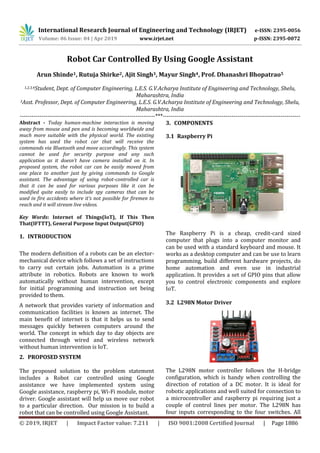
The Raspberry Pi is a cheap, credit-card sized
computer that plugs into a computer monitor and
can be used with a standard keyboard and mouse. It
works as a desktop computer and can be use to learn
programming, build different hardware projects, do
home automation and even use in industrial
application. It provides a set of GPIO pins that allow
you to control electronic components and explore
IoT.
3.2 L298N Motor Driver
The L298N motor controller follows the H-bridge
configuration, which is handy when controlling the
direction of rotation of a DC motor. It is ideal for
robotic applications and well suited for connection to
a microcontroller and raspberry pi requiring just a
couple of control lines per motor. The L298N has
four inputs corresponding to the four switches. All
International Research Journal of Engineering and Technology (IRJET) e-ISSN: 2395-0056
Volume: 06 Issue: 04 | Apr 2019 www.irjet.net p-ISSN: 2395-0072
© 2019, IRJET | Impact Factor value: 7.211 | ISO 9001:2008 Certified Journal | Page 1887
you need to do is apply signals to the inputs to make
the motors rotate to a any direction.
3.3 USB Camera
USB Cameras are designed to easily interface with
dedicated computer systems. USB Cameras are
imaging cameras that use USB 2.0 or USB 3.0
technology to transfer image data. An increasing
selection of USB 3.0 Cameras is also available with
data transfer rates of up to 5 Gb/s. The accessibility
of USB technology in computer systems as well as the
480 Mb/s transfer rate of USB 2.0 makes USB
Cameras ideal for many imaging applications.
3.4 Google Assistant
Google Assistant is virtual assistant developed by
Google. The "OK Google" or "Hey, Google" covers
voice commands, voice searching, and voice-
activated device control, letting you do things like
send messages, check appointments and so on your
Android device.
4. SYSTEM ARCHITECTURE
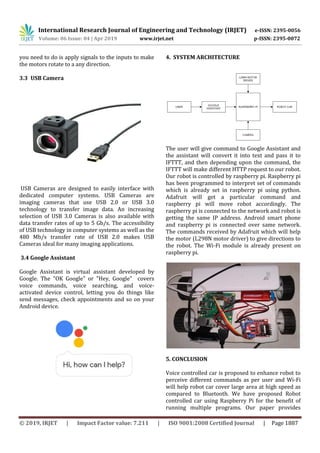
The user will give command to Google Assistant and
the assistant will convert it into text and pass it to
IFTTT, and then depending upon the command, the
IFTTT will make different HTTP request to our robot.
Our robot is controlled by raspberry pi. Raspberry pi
has been programmed to interpret set of commands
which is already set in raspberry pi using python.
Adafruit will get a particular command and
raspberry pi will move robot accordingly. The
raspberry pi is connected to the network and robot is
getting the same IP address. Android smart phone
and raspberry pi is connected over same network.
The commands received by Adafruit which will help
the motor (L298N motor driver) to give directions to
the robot. The Wi-Fi module is already present on
raspberry pi.
5. CONCLUSION
Voice controlled car is proposed to enhance robot to
perceive different commands as per user and Wi-Fi
will help robot car cover large area at high speed as
compared to Bluetooth. We have proposed Robot
controlled car using Raspberry Pi for the benefit of
running multiple programs. Our paper provides
International Research Journal of Engineering and Technology (IRJET) e-ISSN: 2395-0056
Volume: 06 Issue: 04 | Apr 2019 www.irjet.net p-ISSN: 2395-0072
© 2019, IRJET | Impact Factor value: 7.211 | ISO 9001:2008 Certified Journal | Page 1888
application of video streaming as well as ease of
making robot car perform various operations by
using Google assistant. We are using portable device
like android phone so implementation cost is
lowered.
ACKNOWLEDGEMENT
We are very grateful to our project guide Prof.
Dhanashri Bhopatrao who always supported and
guided us . We express our immense pleasure and
thankfulness to all faculty members of the
Department of Computer Engineering of G. V.
Acharya Institute of Engineering and Technology.
REFERENCES
[1] “Paper on Android Controlled Arduino Based
Robot Car” 1 Namita Shinde, 2 Shreya Srivastava,
3 Vineet Sharma, 4 Samarth Kumar 1,2,3,4
Department of Electronics and
Telecommunications Engineering, Bharati
Vidyapeeth (Deemed to be) University College of
Engineering, Pune, International Journal of
Industrial Electronics and Electrical Engineering,
ISSN(p): 2347-6982, ISSN(e): 2349-204X
Volume-6, Issue-3, Mar.-2018.
[2] “Smart Robotic Assistant Using IoT” Mr.
Ananthapadmanabhan J1, Ms. Annu Mariam
Abraham 2, Mr. Libin M George3, Ms. Vineetha
Anna Saji4, Prof. Anil A R5, International
Research Journal of Engineering and Technology
(IRJET) Volume: 04 Issue: 06 | June -2017.
[3] “Voice Control Robot Using Android Application”
Soniya Zope1, Preeti Muluk 2, Rupali Mohite3,
Aishwarya Lanke4, Megha Bamankar5
Department of Computer Engineering All India
Shri Shivaji Memorial College of Engineering,
Pune, Maharashtra, India, Imperial Journal of
Interdisciplinary Research (IJIR) Vol-3, Issue-2,
2017 ISSN: 2454-1362.
[4] “Robot Controlled Car Using Wi-Fi Module” S R
Madkar (Assistant Professor), Vipul Mehta, Nitin
Bhuwania, Maitri Parida Electronics Department,
BVDU College of Engineering, Pune-Satara Road,
Pune, Maharashtra, India, International Journal of
Advanced Research in Computer Science and
Software Engineering, Volume 6, Issue 5,May
2016.
[5] “Android Mobile Phone Controlled Wi-Fi Robot”
Manisha B. Bansode, Prof.J.K. Singh International
Journal of Advanced Research in Electronics and
Communication Engineering (IJARECE) Volume
4, Issue 6, June 2015

IRJET- Robot Car Controlled by using Google Assistant

  • 1.
    International Research Journalof Engineering and Technology (IRJET) e-ISSN: 2395-0056 Volume: 06 Issue: 04 | Apr 2019 www.irjet.net p-ISSN: 2395-0072 © 2019, IRJET | Impact Factor value: 7.211 | ISO 9001:2008 Certified Journal | Page 1886 Robot Car Controlled By Using Google Assistant Arun Shinde1, Rutuja Shirke2, Ajit Singh3, Mayur Singh4, Prof. Dhanashri Bhopatrao5 1,2,3,4Student, Dept. of Computer Engineering, L.E.S. G.V.Acharya Institute of Engineering and Technology, Shelu, Maharashtra, India 5Asst. Professor, Dept. of Computer Engineering, L.E.S. G.V.Acharya Institute of Engineering and Technology, Shelu, Maharashtra, India ---------------------------------------------------------------------***---------------------------------------------------------------------- Abstract - Today human-machine interaction is moving away from mouse and pen and is becoming worldwide and much more suitable with the physical world. The existing system has used the robot car that will receive the commands via Bluetooth and move accordingly. This system cannot be used for security purpose and any such application as it doesn’t have camera installed on it. In proposed system, the robot car can be easily moved from one place to another just by giving commands to Google assistant. The advantage of using robot-controlled car is that it can be used for various purposes like it can be modified quite easily to include spy cameras that can be used in fire accidents where it’s not possible for firemen to reach and it will stream live videos. Key Words: Internet of Things(IoT), If This Then That(IFTTT), General Purpose Input Output(GPIO) 1. INTRODUCTION The modern definition of a robots can be an elector- mechanical device which follows a set of instructions to carry out certain jobs. Automation is a prime attribute in robotics. Robots are known to work automatically without human intervention, except for initial programming and instruction set being provided to them. A network that provides variety of information and communication facilities is known as internet. The main benefit of internet is that it helps us to send messages quickly between computers around the world. The concept in which day to day objects are connected through wired and wireless network without human intervention is IoT. 2. PROPOSED SYSTEM The proposed solution to the problem statement includes a Robot car controlled using Google assistance we have implemented system using Google assistance, raspberry pi, Wi-Fi module, motor driver. Google assistant will help us move our robot to a particular direction. Our mission is to build a robot that can be controlled using Google Assistant. 3. COMPONENTS 3.1 Raspberry Pi The Raspberry Pi is a cheap, credit-card sized computer that plugs into a computer monitor and can be used with a standard keyboard and mouse. It works as a desktop computer and can be use to learn programming, build different hardware projects, do home automation and even use in industrial application. It provides a set of GPIO pins that allow you to control electronic components and explore IoT. 3.2 L298N Motor Driver The L298N motor controller follows the H-bridge configuration, which is handy when controlling the direction of rotation of a DC motor. It is ideal for robotic applications and well suited for connection to a microcontroller and raspberry pi requiring just a couple of control lines per motor. The L298N has four inputs corresponding to the four switches. All
  • 2.
    International Research Journalof Engineering and Technology (IRJET) e-ISSN: 2395-0056 Volume: 06 Issue: 04 | Apr 2019 www.irjet.net p-ISSN: 2395-0072 © 2019, IRJET | Impact Factor value: 7.211 | ISO 9001:2008 Certified Journal | Page 1887 you need to do is apply signals to the inputs to make the motors rotate to a any direction. 3.3 USB Camera USB Cameras are designed to easily interface with dedicated computer systems. USB Cameras are imaging cameras that use USB 2.0 or USB 3.0 technology to transfer image data. An increasing selection of USB 3.0 Cameras is also available with data transfer rates of up to 5 Gb/s. The accessibility of USB technology in computer systems as well as the 480 Mb/s transfer rate of USB 2.0 makes USB Cameras ideal for many imaging applications. 3.4 Google Assistant Google Assistant is virtual assistant developed by Google. The "OK Google" or "Hey, Google" covers voice commands, voice searching, and voice- activated device control, letting you do things like send messages, check appointments and so on your Android device. 4. SYSTEM ARCHITECTURE The user will give command to Google Assistant and the assistant will convert it into text and pass it to IFTTT, and then depending upon the command, the IFTTT will make different HTTP request to our robot. Our robot is controlled by raspberry pi. Raspberry pi has been programmed to interpret set of commands which is already set in raspberry pi using python. Adafruit will get a particular command and raspberry pi will move robot accordingly. The raspberry pi is connected to the network and robot is getting the same IP address. Android smart phone and raspberry pi is connected over same network. The commands received by Adafruit which will help the motor (L298N motor driver) to give directions to the robot. The Wi-Fi module is already present on raspberry pi. 5. CONCLUSION Voice controlled car is proposed to enhance robot to perceive different commands as per user and Wi-Fi will help robot car cover large area at high speed as compared to Bluetooth. We have proposed Robot controlled car using Raspberry Pi for the benefit of running multiple programs. Our paper provides
  • 3.
    International Research Journalof Engineering and Technology (IRJET) e-ISSN: 2395-0056 Volume: 06 Issue: 04 | Apr 2019 www.irjet.net p-ISSN: 2395-0072 © 2019, IRJET | Impact Factor value: 7.211 | ISO 9001:2008 Certified Journal | Page 1888 application of video streaming as well as ease of making robot car perform various operations by using Google assistant. We are using portable device like android phone so implementation cost is lowered. ACKNOWLEDGEMENT We are very grateful to our project guide Prof. Dhanashri Bhopatrao who always supported and guided us . We express our immense pleasure and thankfulness to all faculty members of the Department of Computer Engineering of G. V. Acharya Institute of Engineering and Technology. REFERENCES [1] “Paper on Android Controlled Arduino Based Robot Car” 1 Namita Shinde, 2 Shreya Srivastava, 3 Vineet Sharma, 4 Samarth Kumar 1,2,3,4 Department of Electronics and Telecommunications Engineering, Bharati Vidyapeeth (Deemed to be) University College of Engineering, Pune, International Journal of Industrial Electronics and Electrical Engineering, ISSN(p): 2347-6982, ISSN(e): 2349-204X Volume-6, Issue-3, Mar.-2018. [2] “Smart Robotic Assistant Using IoT” Mr. Ananthapadmanabhan J1, Ms. Annu Mariam Abraham 2, Mr. Libin M George3, Ms. Vineetha Anna Saji4, Prof. Anil A R5, International Research Journal of Engineering and Technology (IRJET) Volume: 04 Issue: 06 | June -2017. [3] “Voice Control Robot Using Android Application” Soniya Zope1, Preeti Muluk 2, Rupali Mohite3, Aishwarya Lanke4, Megha Bamankar5 Department of Computer Engineering All India Shri Shivaji Memorial College of Engineering, Pune, Maharashtra, India, Imperial Journal of Interdisciplinary Research (IJIR) Vol-3, Issue-2, 2017 ISSN: 2454-1362. [4] “Robot Controlled Car Using Wi-Fi Module” S R Madkar (Assistant Professor), Vipul Mehta, Nitin Bhuwania, Maitri Parida Electronics Department, BVDU College of Engineering, Pune-Satara Road, Pune, Maharashtra, India, International Journal of Advanced Research in Computer Science and Software Engineering, Volume 6, Issue 5,May 2016. [5] “Android Mobile Phone Controlled Wi-Fi Robot” Manisha B. Bansode, Prof.J.K. Singh International Journal of Advanced Research in Electronics and Communication Engineering (IJARECE) Volume 4, Issue 6, June 2015