International Research Journal of Engineering and Technology (IRJET) e-ISSN: 2395-0056
Volume: 09 Issue: 06 | Jun 2022 www.irjet.net p-ISSN: 2395-0072
© 2022, IRJET | Impact Factor value: 7.529 | ISO 9001:2008 Certified Journal | Page 2926
ROBOT ARM WITH SMARTPHONE CONTROL
Susmitsingh Pawade, Bharat Bhalerao, Mr. Prashant Pal
1Student at NIELIT, Aurangabad, Maharashtra, India
2 Student at NIELIT, Aurangabad, Maharashtra, India
3Scientiest “B” at NIELIT, Aurangabad, Maharashtra, India
---------------------------------------------------------------------***---------------------------------------------------------------------
Abstract – With the rise of technology and innovationatits
top, construction of systems and techniques resembling to
human skills are increasingly integrated into working task to
cater the rapid surge of people’s needs. Such revolutions are
made with the aspirations of making peoples livesimpler. This
article focuses on the development of the electro-mechanical
robotic arm which’s practical try to do a pick and place and
guided or controlled by using a cell-phone application via
Android smartphone. Designed to figure pre-decided
commands, the electro-mechanical robot arm has potentialto
maneuver especially in four directional axis; left, upward,
downward and right control at a stated angles with six servo
motors and stated by the cell-phoneapplicationspecifications.
Designed and realized, the robotic arm control is through the
utilization of a cell-phone application via Bluetooth module,
that has been programmed through Arduino UNO controller.
1. INTRODUCTION
Robotic Arm is an Electro-Mechanical model in which
electrical components, electronic components and
mechanical components are used. Mechanical parts of the
arm are connected by servo joints. A Robotic Arm is
programmable, with similar relation to human arm. The
rotation servo motors controlled with smartphone using
android application.
Now a days the automation industry is rapidly growing in
India. Automation may not be new, but with the integration
of robotic technology with automation, it has become
productive, easy and cost effective. It has also eliminated
potential efforts or risk and dangerous to human lives, this
making production process safer.
1.1 Projected Method
Research on possibledesignsandbasicinformationabout
the robotic arm was initially made. Using SolidWorks - a
desktop software used for planning, visual ideation and
feasibility assessment, in finalizing the design. Using 6 servo
motors, the robotic arm could move in different directions
and could hold or release things with its gripper. For the
proper control of the arm, the Arduino UNO controller is
used. This microcontroller was preferablyusedsinceitislow
cost and good for beginners especially in writing the
program. The program code was written in Embedded C
language which is one of the most popular and fundamental
programming language. We also created smartphone
application that will be linked to the Arduino UNO
microcontrollerviaBluetoothmodule.Controllingtherobotic
arm will be achievable by make a use of the smartphone
application.
1.2 Recommendation
The result of tests indicatestheinabilityoftheservo
to perform complex operations due to certain limiting
factors. Successful benchmarks during pre-assembly show
that the communication between the robotic arm and the
smartphone is without issue. It is, however, failing when it
comes to post assembly tests duetotheunderpoweredservo
motor. To increase the performance, a torque not less than
that of a MG995 servo motor is recommended. Reducing the
prototype’s density may also improve overall usability. PLA
(Polylactic Acid) is a material with excellent rigidity to
weight ratio and can be manufactured easily with 3-D
printing. Saving operations greater than five directions may
also pose a problem to the Arduino board.Althoughthecode
only occupies 60%, simultaneousprocedureprovestobe too
taxing for the processor. Continuous operating module like
the HC-05 also adds to the performance losses of theCPU. As
such, an Arduino MEGA is recommended since it also offers
UART and a faster processor than the UNO R3.
2. LITERATURE REVIEW
Industry 4.0 is a new area where the Internet of things
alongside cyber-physical systems interconnect in a way
where the combination of software, sensor, processor, and
communication technology plays a huge role in making
“things” to have the potential to feed information into it and
eventually adds value to manufacturing processes. (Mohd.
Aiman et al., 2016).
Today technology is developing in the same direction in line
with rapidly increasing human needs. The work done to
meet these needs makes life easier every day, and these
studies are concentratedonroboticarmstudies.(Rajashekar
K et al., 2020).
Recently, designing a robot along with a navigation-
computing platform is not a problem anymore. In robotics,
navigation guides to the way a robot finds its way into the
environment and is a common requirement for almost any
mobile robot. (G. N. Coelho, 2008).
International Research Journal of Engineering and Technology (IRJET) e-ISSN: 2395-0056
Volume: 09 Issue: 06 | Jun 2022 www.irjet.net p-ISSN: 2395-0072
© 2022, IRJET | Impact Factor value: 7.529 | ISO 9001:2008 Certified Journal | Page 2927
“Today's smartphone is already equipped with multiple
built-in sensors for navigation purposes like accelerometer,
gyroscope, camera, GPS, and Wi-Fi transceiver plus most of
them embedded with fast processors. (W.-W. Kao and B. Q.
Huy, 2013).
The designers have wide options to choose any built-in
sensors to create the navigation platformoftheirrobots.It is
like using the smartphone as a “brain” for the robots. (R. V
Aroca et al., 2012).
In this project, by using an android application, the robots
could be controlled with a Bluetoothdevice,interfacedto the
control unit on the robot for sensing the signals transmitted
by the android application in the wide range area. Normal
practice for the past few years ago, robots are controlled by
using RF circuits, which have several limitations like
working range, frequency range, and control range. These
limitations could be vanished by using smartphones for
robotic control, it has more advantages like robust control,
large working range coverage and the biggest advantage is
long-lasting controlled. (Nik Firdaus, 2015).
For comparison, from the definition; “Wi-Fi is a cheap
solution aimed to cover short distances such as airport,
hotels, and conference areas”. From this, Wi-Fi has some
limitations in providing a wide coverage solution, while the
Infrared, WLAN, and Bluetooth technology only able to
remote some equipment in the coverage less than Wi-Fi. (S.
Tang, 2011).
3.ElectronicCircuitDesignandHardwareSelection
3.1 Arduino UNO R3
Although microcontroller is usually used in programming
and software fields, it is an open-source controller,
ATmega328P based microcontroller.
Arduino UNO is single board controller which means the
board equipped with analog and digital Input or Outputpins
that may be connected with various circuits and expansion
boards. Processing is written for non-programming users.
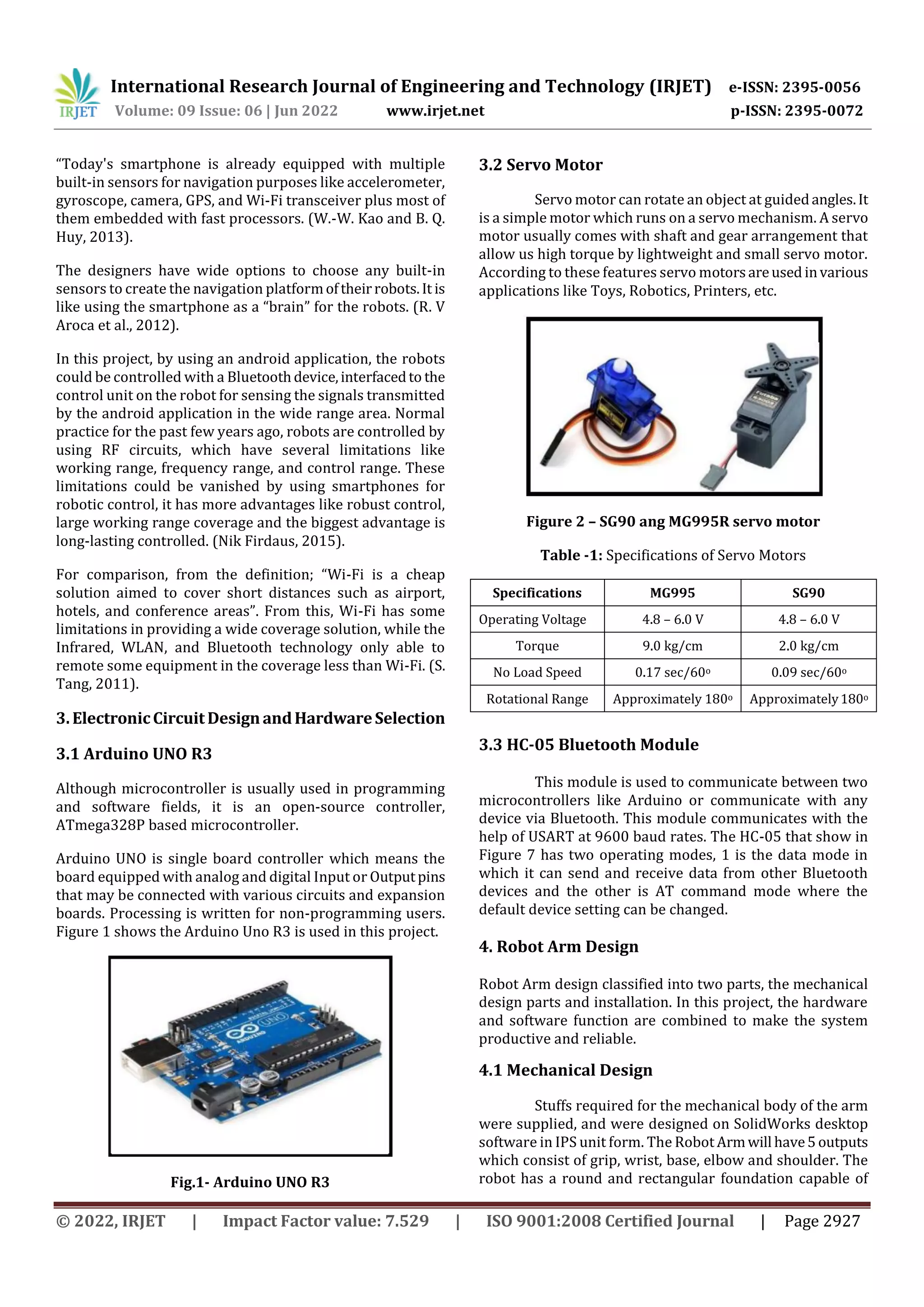
Figure 1 shows the Arduino Uno R3 is used in this project.
Fig.1- Arduino UNO R3
3.2 Servo Motor
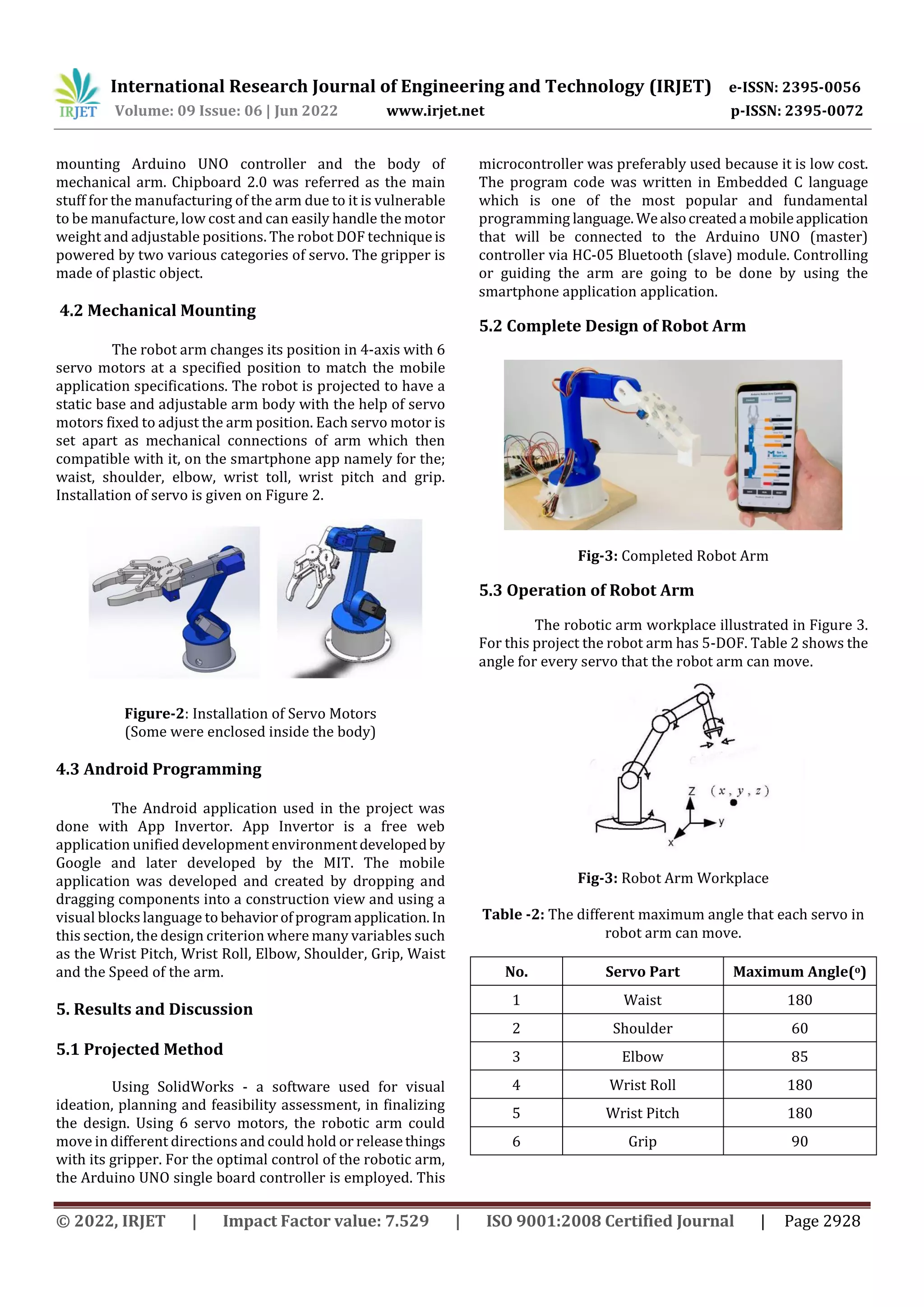
Servo motor can rotate an object at guidedangles.It
is a simple motor which runs on a servo mechanism. A servo
motor usually comes with shaft and gear arrangement that
allow us high torque by lightweight and small servo motor.
According to these features servo motorsareused invarious
applications like Toys, Robotics, Printers, etc.
Figure 2 – SG90 ang MG995R servo motor
Table -1: Specifications of Servo Motors
Specifications MG995 SG90
Operating Voltage 4.8 – 6.0 V 4.8 – 6.0 V
Torque 9.0 kg/cm 2.0 kg/cm
No Load Speed 0.17 sec/60o 0.09 sec/60o
Rotational Range Approximately 180o Approximately180o
3.3 HC-05 Bluetooth Module
This module is used to communicate between two
microcontrollers like Arduino or communicate with any
device via Bluetooth. This module communicates with the
help of USART at 9600 baud rates. The HC-05 that show in
Figure 7 has two operating modes, 1 is the data mode in
which it can send and receive data from other Bluetooth
devices and the other is AT command mode where the
default device setting can be changed.
4. Robot Arm Design
Robot Arm design classified into two parts, the mechanical
design parts and installation. In this project, the hardware
and software function are combined to make the system
productive and reliable.
4.1 Mechanical Design
Stuffs required for the mechanical body of the arm
were supplied, and were designed on SolidWorks desktop
software in IPS unit form. The Robot Armwill have5outputs
which consist of grip, wrist, base, elbow and shoulder. The
robot has a round and rectangular foundation capable of
International Research Journal of Engineering and Technology (IRJET) e-ISSN: 2395-0056
Volume: 09 Issue: 06 | Jun 2022 www.irjet.net p-ISSN: 2395-0072
© 2022, IRJET | Impact Factor value: 7.529 | ISO 9001:2008 Certified Journal | Page 2928
mounting Arduino UNO controller and the body of
mechanical arm. Chipboard 2.0 was referred as the main
stuff for the manufacturing of the arm due to it is vulnerable
to be manufacture, low cost and can easily handle the motor
weight and adjustable positions. The robot DOF techniqueis
powered by two various categories of servo. The gripper is
made of plastic object.
4.2 Mechanical Mounting
The robot arm changes its position in 4-axis with 6
servo motors at a specified position to match the mobile
application specifications. The robot is projected to have a
static base and adjustable arm body with the help of servo
motors fixed to adjust the arm position. Each servo motor is
set apart as mechanical connections of arm which then
compatible with it, on the smartphone app namely for the;
waist, shoulder, elbow, wrist toll, wrist pitch and grip.
Installation of servo is given on Figure 2.
Figure-2: Installation of Servo Motors
(Some were enclosed inside the body)
4.3 Android Programming
The Android application used in the project was
done with App Invertor. App Invertor is a free web
application unified development environmentdevelopedby
Google and later developed by the MIT. The mobile
application was developed and created by dropping and
dragging components into a construction view and using a
visual blocks language to behaviorofprogramapplication. In
this section, the design criterion where many variables such
as the Wrist Pitch, Wrist Roll, Elbow, Shoulder, Grip, Waist
and the Speed of the arm.
5. Results and Discussion
5.1 Projected Method
Using SolidWorks - a software used for visual
ideation, planning and feasibility assessment, in finalizing
the design. Using 6 servo motors, the robotic arm could
move in different directions and could hold or releasethings
with its gripper. For the optimal control of the robotic arm,
the Arduino UNO single board controller is employed. This
microcontroller was preferably used because it is low cost.
The program code was written in Embedded C language
which is one of the most popular and fundamental
programming language. Wealsocreateda mobileapplication
that will be connected to the Arduino UNO (master)
controller via HC-05 Bluetooth (slave) module. Controlling
or guiding the arm are going to be done by using the
smartphone application application.
5.2 Complete Design of Robot Arm
Fig-3: Completed Robot Arm
5.3 Operation of Robot Arm
The robotic arm workplace illustrated in Figure 3.
For this project the robot arm has 5-DOF. Table 2 shows the
angle for every servo that the robot arm can move.
Fig-3: Robot Arm Workplace
Table -2: The different maximum angle that each servo in
robot arm can move.
No. Servo Part Maximum Angle(o)
1 Waist 180
2 Shoulder 60
3 Elbow 85
4 Wrist Roll 180
5 Wrist Pitch 180
6 Grip 90
International Research Journal of Engineering and Technology (IRJET) e-ISSN: 2395-0056
Volume: 09 Issue: 06 | Jun 2022 www.irjet.net p-ISSN: 2395-0072
© 2022, IRJET | Impact Factor value: 7.529 | ISO 9001:2008 Certified Journal | Page 2929
6. Conclusion
Overall, the objectives of this project are achieved which are
developing the hardware and software for wireless mobile
robotic arm, implementing the pick and place system
operation and testing the robot that meets the standards of
purpose project. From the analysis that has been made, it’s
clearly shows that its movement is accurate, simple to
control and user friendly. The mobile robot has been
developed successfully because the movement of the robot
including mobile and arm robot canbecontrolledwirelessly.
This robot is expected to beat the problem like placing or
picking object that away from the user, pick and place
hazardous object in the fastest and easiest way. The
development of this system has wide area of applications
like in industry.
REFERENCES
[1] G. N. Coelho (2008), Mobile Robot Navigationusing
Smartphones Extended Abstract.
[2] Harish K, Megha D, Shuklambari M, Amit K, and
Chaitanya K Jambotkar (2017), Pick and Place
Robotic Arm Using Arduino.International Journal of
Science, Engineering and Technology Research
(IJSETR) Volume 6, Issue 12, December 2017, ISSN:
2278 - 7798 pp 1569
[3] Industry4WRD: The National PolicyonIndustry4.0.
Shaping The Future of Industry, (2018). Ministry of
International Trade and Industry. Retrieve from
https://www.miti.gov.my/miti/resources/Media%
20Release/Media_Release__Industry4WRD_The_Nat
ional_Policy_on_Industry_4.0_.pdf
[4] Nik Firdaus (2015), Smartphone-Based Robot
Control for Localisation. Master’s thesis, Universiti
Tun Hussein Onn Malaysia
[5] Rajashekar K, Hanumantha Reddy,RuksarBegumT,
Shaheena Begum, Syeda Ziya Fathima, Saba Kauser
(2020), Robotic Arm Control UsingArduino.Journal
of Emerging Technologies and Innovative Research
(JETIR) June 2020, Volume 7, Issue 6 pp, 453- 455
[6] R. V. Aroca, A. P. B. S. de Oliveira, and L. M. G.
Gonçalves (2012), Towards Smarter Robots with
Smartphones in Robocontrol: Proc. 5th Workshop
Appl. Robot. Autom., Bauru, Brazil, pp. 1–6
[7] S. Tang (2011), Performance analysis of an
integrated wireless network using WiMAX as
backhaul support for WiFi traffic,” - MILCOM 2011
Mil. Commun. Conf., pp. 1833–1837, Nov. 2011.
BIOGRAPHIES
Susmitsingh Pawade
Student at NIELIT, Aurangabad
Maharashtra, India
Bharat Bhalerao
Student at NIELIT, Aurangabad,
Maharashtra, India
Mr. Prashant Pal
Scientist ‘B’ NIELIT, Aurangabad,
Maharashtra, India

ROBOT ARM WITH SMARTPHONE CONTROL

  • 1.
    International Research Journalof Engineering and Technology (IRJET) e-ISSN: 2395-0056 Volume: 09 Issue: 06 | Jun 2022 www.irjet.net p-ISSN: 2395-0072 © 2022, IRJET | Impact Factor value: 7.529 | ISO 9001:2008 Certified Journal | Page 2926 ROBOT ARM WITH SMARTPHONE CONTROL Susmitsingh Pawade, Bharat Bhalerao, Mr. Prashant Pal 1Student at NIELIT, Aurangabad, Maharashtra, India 2 Student at NIELIT, Aurangabad, Maharashtra, India 3Scientiest “B” at NIELIT, Aurangabad, Maharashtra, India ---------------------------------------------------------------------***--------------------------------------------------------------------- Abstract – With the rise of technology and innovationatits top, construction of systems and techniques resembling to human skills are increasingly integrated into working task to cater the rapid surge of people’s needs. Such revolutions are made with the aspirations of making peoples livesimpler. This article focuses on the development of the electro-mechanical robotic arm which’s practical try to do a pick and place and guided or controlled by using a cell-phone application via Android smartphone. Designed to figure pre-decided commands, the electro-mechanical robot arm has potentialto maneuver especially in four directional axis; left, upward, downward and right control at a stated angles with six servo motors and stated by the cell-phoneapplicationspecifications. Designed and realized, the robotic arm control is through the utilization of a cell-phone application via Bluetooth module, that has been programmed through Arduino UNO controller. 1. INTRODUCTION Robotic Arm is an Electro-Mechanical model in which electrical components, electronic components and mechanical components are used. Mechanical parts of the arm are connected by servo joints. A Robotic Arm is programmable, with similar relation to human arm. The rotation servo motors controlled with smartphone using android application. Now a days the automation industry is rapidly growing in India. Automation may not be new, but with the integration of robotic technology with automation, it has become productive, easy and cost effective. It has also eliminated potential efforts or risk and dangerous to human lives, this making production process safer. 1.1 Projected Method Research on possibledesignsandbasicinformationabout the robotic arm was initially made. Using SolidWorks - a desktop software used for planning, visual ideation and feasibility assessment, in finalizing the design. Using 6 servo motors, the robotic arm could move in different directions and could hold or release things with its gripper. For the proper control of the arm, the Arduino UNO controller is used. This microcontroller was preferablyusedsinceitislow cost and good for beginners especially in writing the program. The program code was written in Embedded C language which is one of the most popular and fundamental programming language. We also created smartphone application that will be linked to the Arduino UNO microcontrollerviaBluetoothmodule.Controllingtherobotic arm will be achievable by make a use of the smartphone application. 1.2 Recommendation The result of tests indicatestheinabilityoftheservo to perform complex operations due to certain limiting factors. Successful benchmarks during pre-assembly show that the communication between the robotic arm and the smartphone is without issue. It is, however, failing when it comes to post assembly tests duetotheunderpoweredservo motor. To increase the performance, a torque not less than that of a MG995 servo motor is recommended. Reducing the prototype’s density may also improve overall usability. PLA (Polylactic Acid) is a material with excellent rigidity to weight ratio and can be manufactured easily with 3-D printing. Saving operations greater than five directions may also pose a problem to the Arduino board.Althoughthecode only occupies 60%, simultaneousprocedureprovestobe too taxing for the processor. Continuous operating module like the HC-05 also adds to the performance losses of theCPU. As such, an Arduino MEGA is recommended since it also offers UART and a faster processor than the UNO R3. 2. LITERATURE REVIEW Industry 4.0 is a new area where the Internet of things alongside cyber-physical systems interconnect in a way where the combination of software, sensor, processor, and communication technology plays a huge role in making “things” to have the potential to feed information into it and eventually adds value to manufacturing processes. (Mohd. Aiman et al., 2016). Today technology is developing in the same direction in line with rapidly increasing human needs. The work done to meet these needs makes life easier every day, and these studies are concentratedonroboticarmstudies.(Rajashekar K et al., 2020). Recently, designing a robot along with a navigation- computing platform is not a problem anymore. In robotics, navigation guides to the way a robot finds its way into the environment and is a common requirement for almost any mobile robot. (G. N. Coelho, 2008).
  • 2.
    International Research Journalof Engineering and Technology (IRJET) e-ISSN: 2395-0056 Volume: 09 Issue: 06 | Jun 2022 www.irjet.net p-ISSN: 2395-0072 © 2022, IRJET | Impact Factor value: 7.529 | ISO 9001:2008 Certified Journal | Page 2927 “Today's smartphone is already equipped with multiple built-in sensors for navigation purposes like accelerometer, gyroscope, camera, GPS, and Wi-Fi transceiver plus most of them embedded with fast processors. (W.-W. Kao and B. Q. Huy, 2013). The designers have wide options to choose any built-in sensors to create the navigation platformoftheirrobots.It is like using the smartphone as a “brain” for the robots. (R. V Aroca et al., 2012). In this project, by using an android application, the robots could be controlled with a Bluetoothdevice,interfacedto the control unit on the robot for sensing the signals transmitted by the android application in the wide range area. Normal practice for the past few years ago, robots are controlled by using RF circuits, which have several limitations like working range, frequency range, and control range. These limitations could be vanished by using smartphones for robotic control, it has more advantages like robust control, large working range coverage and the biggest advantage is long-lasting controlled. (Nik Firdaus, 2015). For comparison, from the definition; “Wi-Fi is a cheap solution aimed to cover short distances such as airport, hotels, and conference areas”. From this, Wi-Fi has some limitations in providing a wide coverage solution, while the Infrared, WLAN, and Bluetooth technology only able to remote some equipment in the coverage less than Wi-Fi. (S. Tang, 2011). 3.ElectronicCircuitDesignandHardwareSelection 3.1 Arduino UNO R3 Although microcontroller is usually used in programming and software fields, it is an open-source controller, ATmega328P based microcontroller. Arduino UNO is single board controller which means the board equipped with analog and digital Input or Outputpins that may be connected with various circuits and expansion boards. Processing is written for non-programming users. Figure 1 shows the Arduino Uno R3 is used in this project. Fig.1- Arduino UNO R3 3.2 Servo Motor Servo motor can rotate an object at guidedangles.It is a simple motor which runs on a servo mechanism. A servo motor usually comes with shaft and gear arrangement that allow us high torque by lightweight and small servo motor. According to these features servo motorsareused invarious applications like Toys, Robotics, Printers, etc. Figure 2 – SG90 ang MG995R servo motor Table -1: Specifications of Servo Motors Specifications MG995 SG90 Operating Voltage 4.8 – 6.0 V 4.8 – 6.0 V Torque 9.0 kg/cm 2.0 kg/cm No Load Speed 0.17 sec/60o 0.09 sec/60o Rotational Range Approximately 180o Approximately180o 3.3 HC-05 Bluetooth Module This module is used to communicate between two microcontrollers like Arduino or communicate with any device via Bluetooth. This module communicates with the help of USART at 9600 baud rates. The HC-05 that show in Figure 7 has two operating modes, 1 is the data mode in which it can send and receive data from other Bluetooth devices and the other is AT command mode where the default device setting can be changed. 4. Robot Arm Design Robot Arm design classified into two parts, the mechanical design parts and installation. In this project, the hardware and software function are combined to make the system productive and reliable. 4.1 Mechanical Design Stuffs required for the mechanical body of the arm were supplied, and were designed on SolidWorks desktop software in IPS unit form. The Robot Armwill have5outputs which consist of grip, wrist, base, elbow and shoulder. The robot has a round and rectangular foundation capable of
  • 3.
    International Research Journalof Engineering and Technology (IRJET) e-ISSN: 2395-0056 Volume: 09 Issue: 06 | Jun 2022 www.irjet.net p-ISSN: 2395-0072 © 2022, IRJET | Impact Factor value: 7.529 | ISO 9001:2008 Certified Journal | Page 2928 mounting Arduino UNO controller and the body of mechanical arm. Chipboard 2.0 was referred as the main stuff for the manufacturing of the arm due to it is vulnerable to be manufacture, low cost and can easily handle the motor weight and adjustable positions. The robot DOF techniqueis powered by two various categories of servo. The gripper is made of plastic object. 4.2 Mechanical Mounting The robot arm changes its position in 4-axis with 6 servo motors at a specified position to match the mobile application specifications. The robot is projected to have a static base and adjustable arm body with the help of servo motors fixed to adjust the arm position. Each servo motor is set apart as mechanical connections of arm which then compatible with it, on the smartphone app namely for the; waist, shoulder, elbow, wrist toll, wrist pitch and grip. Installation of servo is given on Figure 2. Figure-2: Installation of Servo Motors (Some were enclosed inside the body) 4.3 Android Programming The Android application used in the project was done with App Invertor. App Invertor is a free web application unified development environmentdevelopedby Google and later developed by the MIT. The mobile application was developed and created by dropping and dragging components into a construction view and using a visual blocks language to behaviorofprogramapplication. In this section, the design criterion where many variables such as the Wrist Pitch, Wrist Roll, Elbow, Shoulder, Grip, Waist and the Speed of the arm. 5. Results and Discussion 5.1 Projected Method Using SolidWorks - a software used for visual ideation, planning and feasibility assessment, in finalizing the design. Using 6 servo motors, the robotic arm could move in different directions and could hold or releasethings with its gripper. For the optimal control of the robotic arm, the Arduino UNO single board controller is employed. This microcontroller was preferably used because it is low cost. The program code was written in Embedded C language which is one of the most popular and fundamental programming language. Wealsocreateda mobileapplication that will be connected to the Arduino UNO (master) controller via HC-05 Bluetooth (slave) module. Controlling or guiding the arm are going to be done by using the smartphone application application. 5.2 Complete Design of Robot Arm Fig-3: Completed Robot Arm 5.3 Operation of Robot Arm The robotic arm workplace illustrated in Figure 3. For this project the robot arm has 5-DOF. Table 2 shows the angle for every servo that the robot arm can move. Fig-3: Robot Arm Workplace Table -2: The different maximum angle that each servo in robot arm can move. No. Servo Part Maximum Angle(o) 1 Waist 180 2 Shoulder 60 3 Elbow 85 4 Wrist Roll 180 5 Wrist Pitch 180 6 Grip 90
  • 4.
    International Research Journalof Engineering and Technology (IRJET) e-ISSN: 2395-0056 Volume: 09 Issue: 06 | Jun 2022 www.irjet.net p-ISSN: 2395-0072 © 2022, IRJET | Impact Factor value: 7.529 | ISO 9001:2008 Certified Journal | Page 2929 6. Conclusion Overall, the objectives of this project are achieved which are developing the hardware and software for wireless mobile robotic arm, implementing the pick and place system operation and testing the robot that meets the standards of purpose project. From the analysis that has been made, it’s clearly shows that its movement is accurate, simple to control and user friendly. The mobile robot has been developed successfully because the movement of the robot including mobile and arm robot canbecontrolledwirelessly. This robot is expected to beat the problem like placing or picking object that away from the user, pick and place hazardous object in the fastest and easiest way. The development of this system has wide area of applications like in industry. REFERENCES [1] G. N. Coelho (2008), Mobile Robot Navigationusing Smartphones Extended Abstract. [2] Harish K, Megha D, Shuklambari M, Amit K, and Chaitanya K Jambotkar (2017), Pick and Place Robotic Arm Using Arduino.International Journal of Science, Engineering and Technology Research (IJSETR) Volume 6, Issue 12, December 2017, ISSN: 2278 - 7798 pp 1569 [3] Industry4WRD: The National PolicyonIndustry4.0. Shaping The Future of Industry, (2018). Ministry of International Trade and Industry. Retrieve from https://www.miti.gov.my/miti/resources/Media% 20Release/Media_Release__Industry4WRD_The_Nat ional_Policy_on_Industry_4.0_.pdf [4] Nik Firdaus (2015), Smartphone-Based Robot Control for Localisation. Master’s thesis, Universiti Tun Hussein Onn Malaysia [5] Rajashekar K, Hanumantha Reddy,RuksarBegumT, Shaheena Begum, Syeda Ziya Fathima, Saba Kauser (2020), Robotic Arm Control UsingArduino.Journal of Emerging Technologies and Innovative Research (JETIR) June 2020, Volume 7, Issue 6 pp, 453- 455 [6] R. V. Aroca, A. P. B. S. de Oliveira, and L. M. G. Gonçalves (2012), Towards Smarter Robots with Smartphones in Robocontrol: Proc. 5th Workshop Appl. Robot. Autom., Bauru, Brazil, pp. 1–6 [7] S. Tang (2011), Performance analysis of an integrated wireless network using WiMAX as backhaul support for WiFi traffic,” - MILCOM 2011 Mil. Commun. Conf., pp. 1833–1837, Nov. 2011. BIOGRAPHIES Susmitsingh Pawade Student at NIELIT, Aurangabad Maharashtra, India Bharat Bhalerao Student at NIELIT, Aurangabad, Maharashtra, India Mr. Prashant Pal Scientist ‘B’ NIELIT, Aurangabad, Maharashtra, India