International Research Journal of Engineering and Technology (IRJET) e-ISSN: 2395-0056
Volume: 06 Issue: 06 | June 2019 www.irjet.net p-ISSN: 2395-0072
© 2019, IRJET | Impact Factor value: 7.211 | ISO 9001:2008 Certified Journal | Page 702
IoT Based Dual-ARM Tele Robotic System
Shivani Gawade1, Manoj Sonune2
1ME Student, Dept. of Electronics & Telecommunication Engineering, Dhole Patil College of Engineering, Pune,
Maharashtra, India
2Asst. Professor, Dept. of Electronics & Telecommunication Engineering, Dhole Patil College of Engineering, Pune,
Maharashtra, India
---------------------------------------------------------------------***----------------------------------------------------------------------
Abstract - The proposed robotic unit is designed to develop a pick and place dual arm tele robotic vehicle with online video
surveillance in remote places with wifi as a medium. A soft catching gripper is designed to avoid extra pressure on the suspected
object (for eg. Bombs) for safety reasons. The robotic vehicle is controlled by the Blynk application used in android cellphones. At
the transmitting end commands are sent to the receiver to control the movement of the robot either to move forward, backward,
left, right, stop by the android application. Arduino serve the purpose of microprocessor as wellasserverforthesystem. TheBlynk
software acts as a remote control that has the advantage of adequate range, while the receiver end ESP8266 Wi-Fi device is
connected to the processor to drive DC motor through motor driver IC for required operation. Robotic movement is contolled by
the user by seeing the live video streaming. This module works on the concept of IoT which is Internet of Things, where the digital
system are connected to all the physical devices. The proposed unit can be used in military applications.
Key Words: Arduino, Wi-Fi, Surveillance, IoT, tele-robot, Blynk
1. INTRODUCTION
The advancement of technology and rapid growth of industry has resulted in reduction of human efforts, the main reason for
which being machines!! Machines play an important role in our life. A machine might be anything, be it a bikeorlaptoporeven
a robot. Application of Robots in our life have being increased in a wide range. Robots use in defence has increased bytheday.
Our paper includes of how a robot can be of use to human race in general. Previously robots were not controlled by electronic
circuitry or computer programs. After then they were built using principle of mechanics by improving over time with the
coming of electronic age. In today’s world, robots find use in various places be it in robotic components usedinchildren’s toys,
in industrial applications or even be it to detonate buried bombs. Dependingonhowdifficulttherobots task arethe complexity
of computer software depends. In this project we use IoT to establish communication between the user and a robotic vehicle.
This is a reliable communication as a continuous video feedback is available to control theroboticvehicle. Duetothe IoT,there
is no limitation on range or distance between the user and the robotic vehicle. Internet of Things robotics has opened up a
completely new range of real-world applications namely tele-surgery,tele-training,tele-manufacturing,disasterrescue,health
care, traffic control, , space exploration, etc., and the list is supposed to increase further in the coming years.
An embedded web server creates an easy way for controlling & monitoring any device which is at remote place. For
designing the system we require a cell phone along with the internet facility at the remote locations. If we don’t have internet
connectivity still we can use the unit using Wi-Fi modem. We implement a system which is low cost, portable, & having less
maintenance. The reporting of this real-time data corresponding to the process plants is therefore of great use. Robots are
becoming more and more advanced as technology increments in the areasofmemories,CPUspeed,sensors,etc. Withtherapid
growth of the Internet, highly advanced devices or sensors have been embedded into it forperformance.Theproposedsystem
consist of two units mainly a robotic module and a remotely control unit. The robotic unit is consisting of the pick and place
gripper, webcam, Wi-Fi dongle, and the heart of the project arduino along with the PCB containingmotordrivenICandvoltage
regulator circuitry.
1.1 PROBLEM STATEMENT:
The pick and place robot being implemented to ease the process of moving heavy materials, process of sorting etc.
Usually the transfer process of the heavy materials is being carried out,usingman powerandifthetransferprocessisrepeated
for a period of time, it can cause injuries to the operator. By using this particular robot the operator,will nolongerhavetobent
and lift up heavy loads thus increasing the efficiency of the work and preventing injuries. Human beings canmakemistakes.In
the industrial world, the industry cannot afford to take any kindofmistakes.As everymistakeiscostlywhetherinternsoftime,
money and material. Online video streaming can be implemented using IP camera for the security purpose.
International Research Journal of Engineering and Technology (IRJET) e-ISSN: 2395-0056
Volume: 06 Issue: 06 | June 2019 www.irjet.net p-ISSN: 2395-0072
© 2019, IRJET | Impact Factor value: 7.211 | ISO 9001:2008 Certified Journal | Page 703
1.2 OBJECTIVE:
1. The robot is used in multipurpose military application so it must work in real time.
2. If there is any obstacle in the route, it must be able to move it aside so pick and place application can be implemented.
3. For the security purpose video streaming can be implemented using IP camera.
4. The robot should fully be based on IOT.
5. To avoid the obstacles ultrasonic distance sensor should be implemented.
6. To implement the GPS system to trace the location of Robot.
2. SYSTEM OVERVIEW
The Internet of Things (IoT) is a technology rapidly spreadinginmodernwirelessTelecommunications.Thebasicidea
of IoT is connectivity of variety of things or objects – such as Radio-Frequency Identifications (RFID) tags, sensors, actuators,
mobile phones, etc.
In this project, here one can control the robot from remote end say laptop or mobile with the use of Wi-Fi as well as
Internet and we can get the live streaming of video from the robot for the purposeofsurveillance,thisvideoisobtainedonweb
browser of the remote device from where we are operating the device also we are able to control the robotic movement. DC
motors are used for the movement of robotic wheels. Arduino is used for video processing and sending the processedvideoto
user PC with the help of Wi-Fi as well as internet.
The Arduino is a minicomputer, computer which can be used in electronicapplicationsorprojects,andformanyofthe
things that your desktop PC does, like browsing, text editing and games. It also plays high-definition video and it has a built in
Ethernet Connection so one get easy connectivity, at least for the most common boards. And we can easily add Wi-Fi
connectivity by plug in a Wi-Fi dongle on one of the USB port.
The robotic unit consists of Wi-Fi dongle, a USB web cam, a PCB consisting motor driven IC and voltage regulator
circuitry. The User unit consists of a PC or laptop within the Wi-Fi range. The live video streaming of the environment can be
seen.
3. METHODOLOGY:
Arduino is used to control and monitor the robotic unit. A webcam is connected to one of its USBports.A Wi-Fidongle
is provided so as arduino can communicate over Wi-Fi. Internet can be provided to the arduino through this. The webcamwill
capture live data with regards to its surroundings and then send it to a desired device through internet. The user will be
observing this data on the monitor at the user end. According to the desired movement,theuserwill control theroboticvehicle
and the robotic arm through the webpage or keyboard available at the user end. The input given through the webpage or the
keyboard is then sent through the internet and the desired movement occurs at the robot end.
4. BLOCK DIAGRAM:
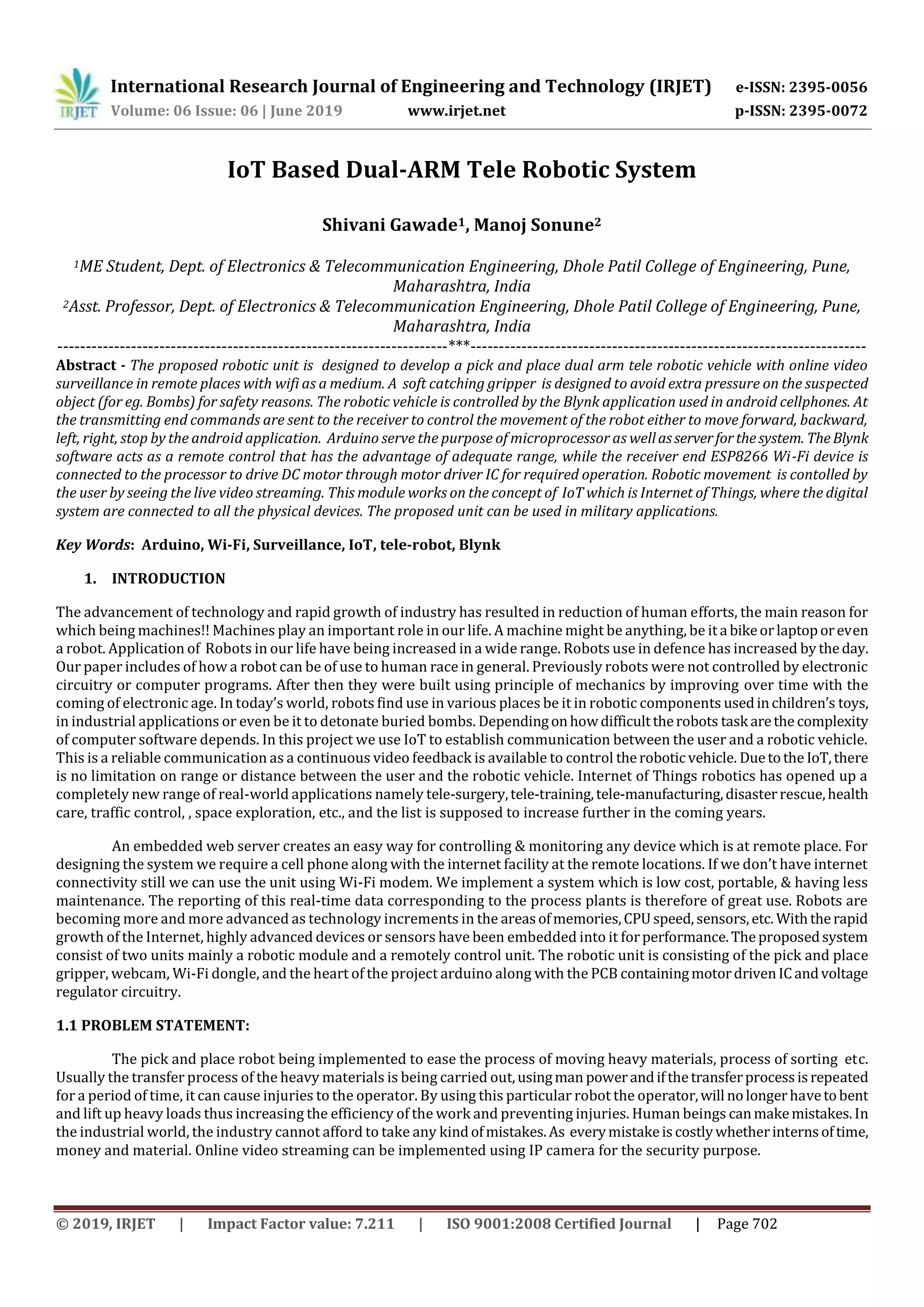
4.1 Proposed block diagram:
Fig 1: BLOCK DIAGRAM OF PROPOSED SYSTEM
International Research Journal of Engineering and Technology (IRJET) e-ISSN: 2395-0056
Volume: 06 Issue: 06 | June 2019 www.irjet.net p-ISSN: 2395-0072
© 2019, IRJET | Impact Factor value: 7.211 | ISO 9001:2008 Certified Journal | Page 704
4.2. Components:
 Arduino
 L298N motor driver
 DC motors
 ESP8266
 IP Camera
 Ultrasonic Sensor
 Robotic Arm
 GPS
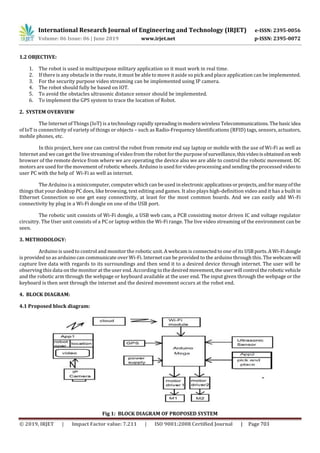
 Arduino:
Fig 2: Arduino
Arduino is an open-source computer software and hardware company, user community and work that designs and
manufactures kits for building interactive objects and digital devices that can sense and control the physical world. These
systems provide sets of digital and analog I/O pins that can be interfaced to various extension board stand other circuits. The
boards feature USB on same board, includingserial communicationsinterfaces,forloadingprogramsfrom personal computers.
For programming the ICs the microcontrollers, the Arduino platform provides an integrated development environment(IDE)
based on the Processing work, which includes support for C++ and C programming languages.
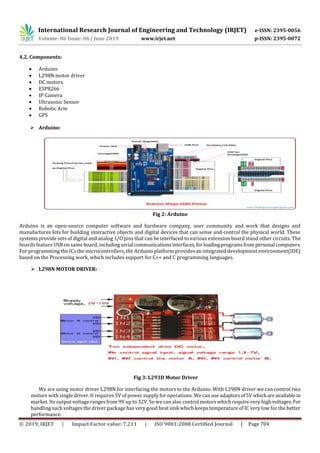
 L298N MOTOR DRIVER:
Fig 3: L293D Motor Driver
We are using motor driver L298N for interfacing the motors to the Arduino. With L298N driver we can control two
motors with single driver. It requires 5V of power supply for operations. We can use adaptorsof5V whichareavailablein
market. Its output voltage ranges from 9V up to 32V. So we can also control motors which require very high voltages.For
handling such voltages the driver package has very good heat sink which keeps temperature of IC very low for the better
performance.
International Research Journal of Engineering and Technology (IRJET) e-ISSN: 2395-0056
Volume: 06 Issue: 06 | June 2019 www.irjet.net p-ISSN: 2395-0072
© 2019, IRJET | Impact Factor value: 7.211 | ISO 9001:2008 Certified Journal | Page 705
 DC MOTORS:
DC motors with built in gearing Arrangement is used in this work. It is because it is simple to control and have higher
torque compared to servomotors. The motor driver IC is needed to use DC motor. To drive the motor simply connect the
one wire to one of the driver terminals and the other to other terminal.
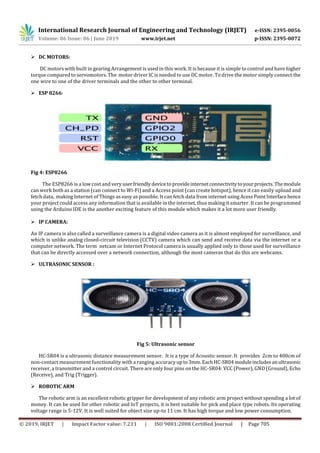
 ESP 8266:
Fig 4: ESP8266
The ESP8266 is a low cost and veryuserfriendlydevicetoprovideinternetconnectivitytoyourprojects.Themodule
can work both as a station (can connect to Wi-Fi) and a Access point (can create hotspot), hence it can easily upload and
fetch data, making Internet of Things as easy as possible. It can fetch data from internet usingAcessPointInterfacehence
your project could access any information that is available in the internet, thus making it smarter. It can be programmed
using the Arduino IDE is the another exciting feature of this module which makes it a lot more user friendly.
 IP CAMERA:
An IP camera is also called a surveillance camera is a digital video camera as it is almost employed for surveillance, and
which is unlike analog closed-circuit television (CCTV) camera which can send and receive data via the internet or a
computer network. The term netcam or Internet Protocol camera is usually applied only to those used for surveillance
that can be directly accessed over a network connection, although the most cameras that do this are webcams.
 ULTRASONIC SENSOR :
Fig 5: Ultrasonic sensor
HC-SR04 is a ultrasonic distance measurement sensor. It is a type of Acoustic sensor. It provides 2cm to 400cm of
non-contact measurement functionality with a ranging accuracy upto3mm.EachHC-SR04moduleincludesanultrasonic
receiver, a transmitter and a control circuit. There are only four pins on the HC-SR04: VCC (Power), GND (Ground), Echo
(Receive), and Trig (Trigger).
 ROBOTIC ARM
The robotic arm is an excellent robotic gripper for development of any robotic arm project without spending a lot of
money. It can be used for other robotic and IoT projects, it is best suitable for pick and place type robots. Its operating
voltage range is 5-12V. It is well suited for object size up-to 11 cm. It has high torque and low power consumption.
International Research Journal of Engineering and Technology (IRJET) e-ISSN: 2395-0056
Volume: 06 Issue: 06 | June 2019 www.irjet.net p-ISSN: 2395-0072
© 2019, IRJET | Impact Factor value: 7.211 | ISO 9001:2008 Certified Journal | Page 706
 GPS:
A GPS tracking unit is a navigation device that uses the Global PositioningSystem (GPS)todetermineitslocationand
track the device’s movements. It is normally carried by a moving person or vehicle. The recorded data of location can
either be transmitted to an Internet connected device using the cellular (GPRS or SMS) , satellite modem or radio
embedded in the unit or stored within the tracking unit. This allows the asset's location to be displayed on a map when
analysing the track later map backdrop or either in real time, using GPS tracking software.
5. RESULT AND CONCLUSION:
Fig 6: Dual Arm Tele-Robotic System Hardware
In this paper an efficient IoT based dual arm tele-robotic system is implemented. The memory load of the system is
reduced due to the use of cloud service. The control commands are successfully transmitted via Wi-Fi and on reception the
desired operations successfully take place. Such systems can be brought into use at places such as military, defense, industry
and research purposes, etc.
6. FUTURE SCOPE:
6.1 As we place robot instead of human soldier it is necessary that the robot will defence himself and protect our nation from
the enemy. To make robot self defence it can be implemented with a laser gun. The laser gun with the help of IP camera will
detect the enemy and shoot according to mode of operation i.e. automatic and manual mode. It will be a good application of
surveillance robot to protect the nation from enemy.
6.2 This security robot also need an Artificial Intelligence that would allow it to recognize the world around it and be able to
detect the intruders and alert the human operator.
REFERENCES:
[1] http://www.robotics.org
[2] SGS Thomson Microelectronics L293N - L293N[DATASHEET]
[3] Mcgraw Hil, Pic Robotics- A Beginners Guide to Robotics Project byJohn Iovine
[4] Arduino Cookbook, Second Edition by Micheal Margolis
International Research Journal of Engineering and Technology (IRJET) e-ISSN: 2395-0056
Volume: 06 Issue: 06 | June 2019 www.irjet.net p-ISSN: 2395-0072
© 2019, IRJET | Impact Factor value: 7.211 | ISO 9001:2008 Certified Journal | Page 707
[5] Supantha Mandal, Suraj Kumar Saw, Shilpi Maji,Vivek Das,Sravanth kumar Ramakuri , Sanjay kumar” Low Cost Arduino
WIFI Wifi integrated path following with wireless GUI remote control”, Birla institute of Technology Mesra ranchi Jharkhand
Indi, IRJET, March 2018
[6] Raspberry pi based voice operated Robot, International Journal ofRecentEngineeringResearchandDevelopment(IJRERD)
ISSN: 2455-8761 www.ijrerd.com || Volume 02 – Issue 12 || December 2017 || PP. 69-76
[7] Multiple Motion Control System of Robotic Car Based on IoT to Produce Cloud Service, International Conference on
Electrical, Computer and Communication Engineering (ECCE), February 16-18, 2017,IEEE
[8] Nikesh. R. Vange, Atul .V. Nar, Dhananjay .B. Surve, Anita. P. Trimukhe, Manisha .M. Patil, Rajesh .A. Patil, Object Sorting
Robotic Arm Based on Color Sensing Mechanism , International Journal of Emerging Technology and Advanced Engineering ,
(ISSN 2250-2459, ISO 9001:2008 Certified Journal, Volume 5, Issue 5, May 2015)
[9] http://en.wikipedia.org/wiki/Arduino Programmer. April 2015.
[10] “Controlled Surveillance Robot”, International Journal ofAdvanceResearchinComputerScienceandManagementStudies,
February 2014,IEEE
[11] Er. R.K.Rajput, „Robotics and Industrial Automation‟, S. Chand Publications, 2nd edition 2014
[12] Dhanabal R, Bh.S.R. Phanindra Varma & Bharathi, “Remote Acess ofFPGARobotvia Internet”,International Conferenceon
Electronics and communication System, 2014, IEEE
[13] Kunal Borker , Ajaysingh Rajput & Rohan Gaikwad, “Wireless Controlled Surveillance Robot”, February 2014, IEEE
[14] Da Xu, Li, Wu He, and Shancang, “Internet of Things in Industries: A survey." Industrial Informatics, IEEE transaction on
10.4(2014):2233-2243
[15] R. A. Kassim, M. S. Bin Bahrudin, and N. Buniyamin and, “Development of Fire alarm system using Raspberry pi and
Arduino Uno,” 2013 Int.Conf. Electr. Electron. Syst. Eng. ICEESE 2013, pp. 43–48, 2013.
[16] Wi-Fi Robot for Surveillance System & Video Monitoring by Dr. B. Sivakumar and Pavan C., International Journal of
Scientific & Engineering Research Volume 3, Issue 8, August- 2012
BIOGRAPHY
Pursuing M.E. in VLSI & Embedded System, Dhole Patil College of
Engineering, Wagholi, Pune

IRJET- IoT based Dual-ARM Tele Robotic System

  • 1.
    International Research Journalof Engineering and Technology (IRJET) e-ISSN: 2395-0056 Volume: 06 Issue: 06 | June 2019 www.irjet.net p-ISSN: 2395-0072 © 2019, IRJET | Impact Factor value: 7.211 | ISO 9001:2008 Certified Journal | Page 702 IoT Based Dual-ARM Tele Robotic System Shivani Gawade1, Manoj Sonune2 1ME Student, Dept. of Electronics & Telecommunication Engineering, Dhole Patil College of Engineering, Pune, Maharashtra, India 2Asst. Professor, Dept. of Electronics & Telecommunication Engineering, Dhole Patil College of Engineering, Pune, Maharashtra, India ---------------------------------------------------------------------***---------------------------------------------------------------------- Abstract - The proposed robotic unit is designed to develop a pick and place dual arm tele robotic vehicle with online video surveillance in remote places with wifi as a medium. A soft catching gripper is designed to avoid extra pressure on the suspected object (for eg. Bombs) for safety reasons. The robotic vehicle is controlled by the Blynk application used in android cellphones. At the transmitting end commands are sent to the receiver to control the movement of the robot either to move forward, backward, left, right, stop by the android application. Arduino serve the purpose of microprocessor as wellasserverforthesystem. TheBlynk software acts as a remote control that has the advantage of adequate range, while the receiver end ESP8266 Wi-Fi device is connected to the processor to drive DC motor through motor driver IC for required operation. Robotic movement is contolled by the user by seeing the live video streaming. This module works on the concept of IoT which is Internet of Things, where the digital system are connected to all the physical devices. The proposed unit can be used in military applications. Key Words: Arduino, Wi-Fi, Surveillance, IoT, tele-robot, Blynk 1. INTRODUCTION The advancement of technology and rapid growth of industry has resulted in reduction of human efforts, the main reason for which being machines!! Machines play an important role in our life. A machine might be anything, be it a bikeorlaptoporeven a robot. Application of Robots in our life have being increased in a wide range. Robots use in defence has increased bytheday. Our paper includes of how a robot can be of use to human race in general. Previously robots were not controlled by electronic circuitry or computer programs. After then they were built using principle of mechanics by improving over time with the coming of electronic age. In today’s world, robots find use in various places be it in robotic components usedinchildren’s toys, in industrial applications or even be it to detonate buried bombs. Dependingonhowdifficulttherobots task arethe complexity of computer software depends. In this project we use IoT to establish communication between the user and a robotic vehicle. This is a reliable communication as a continuous video feedback is available to control theroboticvehicle. Duetothe IoT,there is no limitation on range or distance between the user and the robotic vehicle. Internet of Things robotics has opened up a completely new range of real-world applications namely tele-surgery,tele-training,tele-manufacturing,disasterrescue,health care, traffic control, , space exploration, etc., and the list is supposed to increase further in the coming years. An embedded web server creates an easy way for controlling & monitoring any device which is at remote place. For designing the system we require a cell phone along with the internet facility at the remote locations. If we don’t have internet connectivity still we can use the unit using Wi-Fi modem. We implement a system which is low cost, portable, & having less maintenance. The reporting of this real-time data corresponding to the process plants is therefore of great use. Robots are becoming more and more advanced as technology increments in the areasofmemories,CPUspeed,sensors,etc. Withtherapid growth of the Internet, highly advanced devices or sensors have been embedded into it forperformance.Theproposedsystem consist of two units mainly a robotic module and a remotely control unit. The robotic unit is consisting of the pick and place gripper, webcam, Wi-Fi dongle, and the heart of the project arduino along with the PCB containingmotordrivenICandvoltage regulator circuitry. 1.1 PROBLEM STATEMENT: The pick and place robot being implemented to ease the process of moving heavy materials, process of sorting etc. Usually the transfer process of the heavy materials is being carried out,usingman powerandifthetransferprocessisrepeated for a period of time, it can cause injuries to the operator. By using this particular robot the operator,will nolongerhavetobent and lift up heavy loads thus increasing the efficiency of the work and preventing injuries. Human beings canmakemistakes.In the industrial world, the industry cannot afford to take any kindofmistakes.As everymistakeiscostlywhetherinternsoftime, money and material. Online video streaming can be implemented using IP camera for the security purpose.
  • 2.
    International Research Journalof Engineering and Technology (IRJET) e-ISSN: 2395-0056 Volume: 06 Issue: 06 | June 2019 www.irjet.net p-ISSN: 2395-0072 © 2019, IRJET | Impact Factor value: 7.211 | ISO 9001:2008 Certified Journal | Page 703 1.2 OBJECTIVE: 1. The robot is used in multipurpose military application so it must work in real time. 2. If there is any obstacle in the route, it must be able to move it aside so pick and place application can be implemented. 3. For the security purpose video streaming can be implemented using IP camera. 4. The robot should fully be based on IOT. 5. To avoid the obstacles ultrasonic distance sensor should be implemented. 6. To implement the GPS system to trace the location of Robot. 2. SYSTEM OVERVIEW The Internet of Things (IoT) is a technology rapidly spreadinginmodernwirelessTelecommunications.Thebasicidea of IoT is connectivity of variety of things or objects – such as Radio-Frequency Identifications (RFID) tags, sensors, actuators, mobile phones, etc. In this project, here one can control the robot from remote end say laptop or mobile with the use of Wi-Fi as well as Internet and we can get the live streaming of video from the robot for the purposeofsurveillance,thisvideoisobtainedonweb browser of the remote device from where we are operating the device also we are able to control the robotic movement. DC motors are used for the movement of robotic wheels. Arduino is used for video processing and sending the processedvideoto user PC with the help of Wi-Fi as well as internet. The Arduino is a minicomputer, computer which can be used in electronicapplicationsorprojects,andformanyofthe things that your desktop PC does, like browsing, text editing and games. It also plays high-definition video and it has a built in Ethernet Connection so one get easy connectivity, at least for the most common boards. And we can easily add Wi-Fi connectivity by plug in a Wi-Fi dongle on one of the USB port. The robotic unit consists of Wi-Fi dongle, a USB web cam, a PCB consisting motor driven IC and voltage regulator circuitry. The User unit consists of a PC or laptop within the Wi-Fi range. The live video streaming of the environment can be seen. 3. METHODOLOGY: Arduino is used to control and monitor the robotic unit. A webcam is connected to one of its USBports.A Wi-Fidongle is provided so as arduino can communicate over Wi-Fi. Internet can be provided to the arduino through this. The webcamwill capture live data with regards to its surroundings and then send it to a desired device through internet. The user will be observing this data on the monitor at the user end. According to the desired movement,theuserwill control theroboticvehicle and the robotic arm through the webpage or keyboard available at the user end. The input given through the webpage or the keyboard is then sent through the internet and the desired movement occurs at the robot end. 4. BLOCK DIAGRAM: 4.1 Proposed block diagram: Fig 1: BLOCK DIAGRAM OF PROPOSED SYSTEM
  • 3.
    International Research Journalof Engineering and Technology (IRJET) e-ISSN: 2395-0056 Volume: 06 Issue: 06 | June 2019 www.irjet.net p-ISSN: 2395-0072 © 2019, IRJET | Impact Factor value: 7.211 | ISO 9001:2008 Certified Journal | Page 704 4.2. Components:  Arduino  L298N motor driver  DC motors  ESP8266  IP Camera  Ultrasonic Sensor  Robotic Arm  GPS  Arduino: Fig 2: Arduino Arduino is an open-source computer software and hardware company, user community and work that designs and manufactures kits for building interactive objects and digital devices that can sense and control the physical world. These systems provide sets of digital and analog I/O pins that can be interfaced to various extension board stand other circuits. The boards feature USB on same board, includingserial communicationsinterfaces,forloadingprogramsfrom personal computers. For programming the ICs the microcontrollers, the Arduino platform provides an integrated development environment(IDE) based on the Processing work, which includes support for C++ and C programming languages.  L298N MOTOR DRIVER: Fig 3: L293D Motor Driver We are using motor driver L298N for interfacing the motors to the Arduino. With L298N driver we can control two motors with single driver. It requires 5V of power supply for operations. We can use adaptorsof5V whichareavailablein market. Its output voltage ranges from 9V up to 32V. So we can also control motors which require very high voltages.For handling such voltages the driver package has very good heat sink which keeps temperature of IC very low for the better performance.
  • 4.
    International Research Journalof Engineering and Technology (IRJET) e-ISSN: 2395-0056 Volume: 06 Issue: 06 | June 2019 www.irjet.net p-ISSN: 2395-0072 © 2019, IRJET | Impact Factor value: 7.211 | ISO 9001:2008 Certified Journal | Page 705  DC MOTORS: DC motors with built in gearing Arrangement is used in this work. It is because it is simple to control and have higher torque compared to servomotors. The motor driver IC is needed to use DC motor. To drive the motor simply connect the one wire to one of the driver terminals and the other to other terminal.  ESP 8266: Fig 4: ESP8266 The ESP8266 is a low cost and veryuserfriendlydevicetoprovideinternetconnectivitytoyourprojects.Themodule can work both as a station (can connect to Wi-Fi) and a Access point (can create hotspot), hence it can easily upload and fetch data, making Internet of Things as easy as possible. It can fetch data from internet usingAcessPointInterfacehence your project could access any information that is available in the internet, thus making it smarter. It can be programmed using the Arduino IDE is the another exciting feature of this module which makes it a lot more user friendly.  IP CAMERA: An IP camera is also called a surveillance camera is a digital video camera as it is almost employed for surveillance, and which is unlike analog closed-circuit television (CCTV) camera which can send and receive data via the internet or a computer network. The term netcam or Internet Protocol camera is usually applied only to those used for surveillance that can be directly accessed over a network connection, although the most cameras that do this are webcams.  ULTRASONIC SENSOR : Fig 5: Ultrasonic sensor HC-SR04 is a ultrasonic distance measurement sensor. It is a type of Acoustic sensor. It provides 2cm to 400cm of non-contact measurement functionality with a ranging accuracy upto3mm.EachHC-SR04moduleincludesanultrasonic receiver, a transmitter and a control circuit. There are only four pins on the HC-SR04: VCC (Power), GND (Ground), Echo (Receive), and Trig (Trigger).  ROBOTIC ARM The robotic arm is an excellent robotic gripper for development of any robotic arm project without spending a lot of money. It can be used for other robotic and IoT projects, it is best suitable for pick and place type robots. Its operating voltage range is 5-12V. It is well suited for object size up-to 11 cm. It has high torque and low power consumption.
  • 5.
    International Research Journalof Engineering and Technology (IRJET) e-ISSN: 2395-0056 Volume: 06 Issue: 06 | June 2019 www.irjet.net p-ISSN: 2395-0072 © 2019, IRJET | Impact Factor value: 7.211 | ISO 9001:2008 Certified Journal | Page 706  GPS: A GPS tracking unit is a navigation device that uses the Global PositioningSystem (GPS)todetermineitslocationand track the device’s movements. It is normally carried by a moving person or vehicle. The recorded data of location can either be transmitted to an Internet connected device using the cellular (GPRS or SMS) , satellite modem or radio embedded in the unit or stored within the tracking unit. This allows the asset's location to be displayed on a map when analysing the track later map backdrop or either in real time, using GPS tracking software. 5. RESULT AND CONCLUSION: Fig 6: Dual Arm Tele-Robotic System Hardware In this paper an efficient IoT based dual arm tele-robotic system is implemented. The memory load of the system is reduced due to the use of cloud service. The control commands are successfully transmitted via Wi-Fi and on reception the desired operations successfully take place. Such systems can be brought into use at places such as military, defense, industry and research purposes, etc. 6. FUTURE SCOPE: 6.1 As we place robot instead of human soldier it is necessary that the robot will defence himself and protect our nation from the enemy. To make robot self defence it can be implemented with a laser gun. The laser gun with the help of IP camera will detect the enemy and shoot according to mode of operation i.e. automatic and manual mode. It will be a good application of surveillance robot to protect the nation from enemy. 6.2 This security robot also need an Artificial Intelligence that would allow it to recognize the world around it and be able to detect the intruders and alert the human operator. REFERENCES: [1] http://www.robotics.org [2] SGS Thomson Microelectronics L293N - L293N[DATASHEET] [3] Mcgraw Hil, Pic Robotics- A Beginners Guide to Robotics Project byJohn Iovine [4] Arduino Cookbook, Second Edition by Micheal Margolis
  • 6.
    International Research Journalof Engineering and Technology (IRJET) e-ISSN: 2395-0056 Volume: 06 Issue: 06 | June 2019 www.irjet.net p-ISSN: 2395-0072 © 2019, IRJET | Impact Factor value: 7.211 | ISO 9001:2008 Certified Journal | Page 707 [5] Supantha Mandal, Suraj Kumar Saw, Shilpi Maji,Vivek Das,Sravanth kumar Ramakuri , Sanjay kumar” Low Cost Arduino WIFI Wifi integrated path following with wireless GUI remote control”, Birla institute of Technology Mesra ranchi Jharkhand Indi, IRJET, March 2018 [6] Raspberry pi based voice operated Robot, International Journal ofRecentEngineeringResearchandDevelopment(IJRERD) ISSN: 2455-8761 www.ijrerd.com || Volume 02 – Issue 12 || December 2017 || PP. 69-76 [7] Multiple Motion Control System of Robotic Car Based on IoT to Produce Cloud Service, International Conference on Electrical, Computer and Communication Engineering (ECCE), February 16-18, 2017,IEEE [8] Nikesh. R. Vange, Atul .V. Nar, Dhananjay .B. Surve, Anita. P. Trimukhe, Manisha .M. Patil, Rajesh .A. Patil, Object Sorting Robotic Arm Based on Color Sensing Mechanism , International Journal of Emerging Technology and Advanced Engineering , (ISSN 2250-2459, ISO 9001:2008 Certified Journal, Volume 5, Issue 5, May 2015) [9] http://en.wikipedia.org/wiki/Arduino Programmer. April 2015. [10] “Controlled Surveillance Robot”, International Journal ofAdvanceResearchinComputerScienceandManagementStudies, February 2014,IEEE [11] Er. R.K.Rajput, „Robotics and Industrial Automation‟, S. Chand Publications, 2nd edition 2014 [12] Dhanabal R, Bh.S.R. Phanindra Varma & Bharathi, “Remote Acess ofFPGARobotvia Internet”,International Conferenceon Electronics and communication System, 2014, IEEE [13] Kunal Borker , Ajaysingh Rajput & Rohan Gaikwad, “Wireless Controlled Surveillance Robot”, February 2014, IEEE [14] Da Xu, Li, Wu He, and Shancang, “Internet of Things in Industries: A survey." Industrial Informatics, IEEE transaction on 10.4(2014):2233-2243 [15] R. A. Kassim, M. S. Bin Bahrudin, and N. Buniyamin and, “Development of Fire alarm system using Raspberry pi and Arduino Uno,” 2013 Int.Conf. Electr. Electron. Syst. Eng. ICEESE 2013, pp. 43–48, 2013. [16] Wi-Fi Robot for Surveillance System & Video Monitoring by Dr. B. Sivakumar and Pavan C., International Journal of Scientific & Engineering Research Volume 3, Issue 8, August- 2012 BIOGRAPHY Pursuing M.E. in VLSI & Embedded System, Dhole Patil College of Engineering, Wagholi, Pune