International Research Journal of Engineering and Technology (IRJET) e-ISSN: 2395 -0056
Volume: 04 Issue: 01 | Jan -2017 www.irjet.net p-ISSN: 2395-0072
© 2016, IRJET | Impact Factor value: 4.45 | ISO 9001:2008 Certified Journal | Page 1580
Density Based Traffic Management System
Dhere Shubham1, Phapale Ajay2, Sakure Sumit3, Ghuge Ganesh4
1,2,3Student, Department of Computer technology, Amrutvahini Polytechnic, Sangamner, INDIA
4Lecturer, Department of Computer technology, Amrutvahini Polytechnic, Sangamner, INDIA
---------------------------------------------------------------------***----------------------------------------------------------------------
Abstract - This project is designed and developed for
density based traffic control system. The signal timing
increased or decreased on the basis of detected traffic
count. Traffic congestion is biggest problem in many major
cities and high traffic places across the world and it has
become a nightmare for the commuters in these cities. The
current system has fixed time given to each side of
junction which cannot be varied as per varying traffic
density. Junction timings allotted are fixed. When higher
traffic density at which side then that side has longer
green signal is allotted. The IR sensors are placed at the
every 5 meters of road side which can sense the object i.e.
vehicles in this order if 1sr sensor detect the vehicle and
other return 0 i.e. no detected then that distance is get
counted as 5 meters. If 2nd sensor detect then distance
counted as 10 meters traffic density is there. By using this
procedure we count the distance at which traffic is there.
After calculating the distance of available vehicles we will
came to know in which side the distance is high based on
which signals will be allotted for a particular side. Arduino
mega is used as a microcontroller which provides the
signal timing based on the traffic density.
1. INTRODUCTION
One of the important things in the Internet of things in
smart cities is the Intelligent Transportation System (ITS)
ITS ameliorates Conveyance to conveyance and
Conveyance to Infrastructure communication for
ameliorating road facilities rather than incrementing road
capacities or developing incipient roads.. This is possible
because of ITS, it utilizes advanced information and
communication, and this communication will be helpful
for decreasing traffic congestion and to reduce the
accidents on the road, which is dangerous in the urban
areas. Managing the time of traffic signal is one of the key
thing in many major cities. Managing to time on the road
will decrement the waiting time of the drivers on the road,
and that will avail to truncate the fuel consumption. This is
done with the help of the ITS.” In this system, we are going
to use
IR Sensors. IR sensor is additionally called as an Infra-Red
spectrum. IR sensors have 2 parts in it, one is the
transmitter and second is a receiver. The transmitter is
used to transmit the light and receiver keeps on receiving
the light. When this connection is interrupted, the
counting process is started, i.e., when the receiver does not
receive the light transmitted by the transmitter it is said
that the object is there in between transmitter and
receiver. The line of optical discernment concept is
utilized in this approach.”
1.1 User based problem
1.2.1 Heavy Traffic Jams With incrementing number of
conveyances on road, cumbersomely hefty traffic
congestion has substantially incremented in major cities.
This transpired conventionally at the main junctions
commonly in the morning, afore office hour and in the
evening, after office hours. The main effect of this matter is
incremented time wasting of the people on the road. The
solution for this quandary is by developing the program
which different setting delays for different junctions.
1.2.2 No traffic, but still need to wait At particular side,
sometimes even if there is zero traffic, people have to wait.
Because the traffic light remains red for the preset
duration, the road users should wait until the light turn to
green. The solution of this quandary is by developing a
system which detects traffic flow on each road and set
timings of signals accordingly. Moreover, synchronization
of traffic signals in adjacent junctions is withal obligatory
2. List of acronyms
SMC secure multiparty computation
PPDM privacy preserving data mining
MRAR Multi-relational association rules
PRBAC Privacy Preserving Role based access control
ISL Increase Support of LHS
DSR Decrease Support of RHS
3. Problem Definition
Traffic congestion is a main quandary with foremost cities.
In current traffic system the traffic lights are founded on
timing system i.e. whether the conveyances are present or
not the timing will remain constant which makes people to
wait unnecessarily for longer time. The key characteristic
of the traffic in cities categorically for developing the
geographies is that even if the geographies are explicitly
mentioned/marked on the roads it doesn’t move through
the lanes. In Emergency cases (VIP’s) the signals are
precise manually, which is a hard-hitting task and can’t be
executed prosperously. Due to this man power is required
in substantial amount and is a waste of time
International Research Journal of Engineering and Technology (IRJET) e-ISSN: 2395 -0056
Volume: 04 Issue: 01 | Jan -2017 www.irjet.net p-ISSN: 2395-0072
© 2016, IRJET | Impact Factor value: 4.45 | ISO 9001:2008 Certified Journal | Page 1581
4. Literature review
In this paper , review on different object detection, traffic
management, signal controlling using microcontroller and
signal allotment methods which is based on detected
objects count. This approach used towards increase the
object detection with new ideas. Furthermore, detecting
the object using the IR sensors with theoretical
explanation is provided in bibliography content. The
bibliography content is the most significant contribution
of research since it will lead to a new area of research. We
have identified and discussed the limitation/future scope
of various methods. Also, we have noted some features
and information about other sensors and microcontroller
but have high cost and computational complexity.
Specifically, the IR sensors are used for object detection
and Arduino mega microcontroller is used for allotment of
signal The sensors was able to detect the vehicles and
microcontroller also able to manage the signal timing and
based on detected vehicle count signal allotment is also
done. This research can be further developed and used for
traffic management in urban cities and high traffic density
places.
5. System requirements
5.1 Hardware requirements
1. Primary component:
• Microcontroller
• LCD Display
• INFRARED LED Sensor
• Transformer
2. Secondary Component:
• Diode
• Resistor
• LED
Capacitor
5.2 Software requirements
Vision Keil
 Proteus
 Protel 98
 Eagle
6. Purposed Methodology
From present situation, an efficient solution to the
quandary is not yet obtained. Hence in order to provide
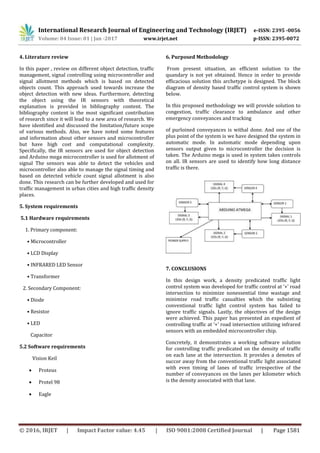
efficacious solution this archetype is designed. The block
diagram of density based traffic control system is shown
below.
In this proposed methodology we will provide solution to
congestion, traffic clearance to ambulance and other
emergency conveyances and tracking
of purloined conveyances is withal done. And one of the
plus point of the system is we have designed the system in
automatic mode. In automatic mode depending upon
sensors output given to microcontroller the decision is
taken. The Arduino mega is used in system takes controls
on all. IR sensors are used to identify how long distance
traffic is there.
7. CONCLUSIONS
In this design work, a density predicated traffic light
control system was developed for traffic control at ‘+’ road
intersection to minimize nonessential time wastage and
minimize road traffic casualties which the subsisting
conventional traffic light control system has failed to
ignore traffic signals. Lastly, the objectives of the design
were achieved. This paper has presented an expedient of
controlling traffic at ‘+’ road intersection utilizing infrared
sensors with an embedded microcontroller chip.
Concretely, it demonstrates a working software solution
for controlling traffic predicated on the density of traffic
on each lane at the intersection. It provides a denotes of
succor away from the conventional traffic light associated
with even timing of lanes of traffic irrespective of the
number of conveyances on the lanes per kilometer which
is the density associated with that lane.
International Research Journal of Engineering and Technology (IRJET) e-ISSN: 2395 -0056
Volume: 04 Issue: 01 | Jan -2017 www.irjet.net p-ISSN: 2395-0072
© 2016, IRJET | Impact Factor value: 4.45 | ISO 9001:2008 Certified Journal | Page 1582
REFERENCES
1. https://www.google.com/search?ei=MvqEXb7cO
5rd9QOg4ZrQBg&q=what+is+the+work+plan+of+
automated+traffic+signal+project+in+iot&oq=wh
at+is+the+work+plan+of+automated+traffic+sign
+project+in+iot&gs_l=psy-
ab.3...71688.77653..78053...0.2..0.343.3858.0j13j5
j1......0....1..gws-wiz.......0i71j33i10.q0ac4-
ohrC4&ved=0ahUKEwivfGV5d_kAhWabn0KHaCw
BmoQ4dUDCAs&uact=5
2. https://pdfs.semanticscholar.org/e747/4ef21d4a
4b5cbfc8f0d2e5f565c3b7d7468a.pdf

IRJET - Density based Traffic Management System

  • 1.
    International Research Journalof Engineering and Technology (IRJET) e-ISSN: 2395 -0056 Volume: 04 Issue: 01 | Jan -2017 www.irjet.net p-ISSN: 2395-0072 © 2016, IRJET | Impact Factor value: 4.45 | ISO 9001:2008 Certified Journal | Page 1580 Density Based Traffic Management System Dhere Shubham1, Phapale Ajay2, Sakure Sumit3, Ghuge Ganesh4 1,2,3Student, Department of Computer technology, Amrutvahini Polytechnic, Sangamner, INDIA 4Lecturer, Department of Computer technology, Amrutvahini Polytechnic, Sangamner, INDIA ---------------------------------------------------------------------***---------------------------------------------------------------------- Abstract - This project is designed and developed for density based traffic control system. The signal timing increased or decreased on the basis of detected traffic count. Traffic congestion is biggest problem in many major cities and high traffic places across the world and it has become a nightmare for the commuters in these cities. The current system has fixed time given to each side of junction which cannot be varied as per varying traffic density. Junction timings allotted are fixed. When higher traffic density at which side then that side has longer green signal is allotted. The IR sensors are placed at the every 5 meters of road side which can sense the object i.e. vehicles in this order if 1sr sensor detect the vehicle and other return 0 i.e. no detected then that distance is get counted as 5 meters. If 2nd sensor detect then distance counted as 10 meters traffic density is there. By using this procedure we count the distance at which traffic is there. After calculating the distance of available vehicles we will came to know in which side the distance is high based on which signals will be allotted for a particular side. Arduino mega is used as a microcontroller which provides the signal timing based on the traffic density. 1. INTRODUCTION One of the important things in the Internet of things in smart cities is the Intelligent Transportation System (ITS) ITS ameliorates Conveyance to conveyance and Conveyance to Infrastructure communication for ameliorating road facilities rather than incrementing road capacities or developing incipient roads.. This is possible because of ITS, it utilizes advanced information and communication, and this communication will be helpful for decreasing traffic congestion and to reduce the accidents on the road, which is dangerous in the urban areas. Managing the time of traffic signal is one of the key thing in many major cities. Managing to time on the road will decrement the waiting time of the drivers on the road, and that will avail to truncate the fuel consumption. This is done with the help of the ITS.” In this system, we are going to use IR Sensors. IR sensor is additionally called as an Infra-Red spectrum. IR sensors have 2 parts in it, one is the transmitter and second is a receiver. The transmitter is used to transmit the light and receiver keeps on receiving the light. When this connection is interrupted, the counting process is started, i.e., when the receiver does not receive the light transmitted by the transmitter it is said that the object is there in between transmitter and receiver. The line of optical discernment concept is utilized in this approach.” 1.1 User based problem 1.2.1 Heavy Traffic Jams With incrementing number of conveyances on road, cumbersomely hefty traffic congestion has substantially incremented in major cities. This transpired conventionally at the main junctions commonly in the morning, afore office hour and in the evening, after office hours. The main effect of this matter is incremented time wasting of the people on the road. The solution for this quandary is by developing the program which different setting delays for different junctions. 1.2.2 No traffic, but still need to wait At particular side, sometimes even if there is zero traffic, people have to wait. Because the traffic light remains red for the preset duration, the road users should wait until the light turn to green. The solution of this quandary is by developing a system which detects traffic flow on each road and set timings of signals accordingly. Moreover, synchronization of traffic signals in adjacent junctions is withal obligatory 2. List of acronyms SMC secure multiparty computation PPDM privacy preserving data mining MRAR Multi-relational association rules PRBAC Privacy Preserving Role based access control ISL Increase Support of LHS DSR Decrease Support of RHS 3. Problem Definition Traffic congestion is a main quandary with foremost cities. In current traffic system the traffic lights are founded on timing system i.e. whether the conveyances are present or not the timing will remain constant which makes people to wait unnecessarily for longer time. The key characteristic of the traffic in cities categorically for developing the geographies is that even if the geographies are explicitly mentioned/marked on the roads it doesn’t move through the lanes. In Emergency cases (VIP’s) the signals are precise manually, which is a hard-hitting task and can’t be executed prosperously. Due to this man power is required in substantial amount and is a waste of time
  • 2.
    International Research Journalof Engineering and Technology (IRJET) e-ISSN: 2395 -0056 Volume: 04 Issue: 01 | Jan -2017 www.irjet.net p-ISSN: 2395-0072 © 2016, IRJET | Impact Factor value: 4.45 | ISO 9001:2008 Certified Journal | Page 1581 4. Literature review In this paper , review on different object detection, traffic management, signal controlling using microcontroller and signal allotment methods which is based on detected objects count. This approach used towards increase the object detection with new ideas. Furthermore, detecting the object using the IR sensors with theoretical explanation is provided in bibliography content. The bibliography content is the most significant contribution of research since it will lead to a new area of research. We have identified and discussed the limitation/future scope of various methods. Also, we have noted some features and information about other sensors and microcontroller but have high cost and computational complexity. Specifically, the IR sensors are used for object detection and Arduino mega microcontroller is used for allotment of signal The sensors was able to detect the vehicles and microcontroller also able to manage the signal timing and based on detected vehicle count signal allotment is also done. This research can be further developed and used for traffic management in urban cities and high traffic density places. 5. System requirements 5.1 Hardware requirements 1. Primary component: • Microcontroller • LCD Display • INFRARED LED Sensor • Transformer 2. Secondary Component: • Diode • Resistor • LED Capacitor 5.2 Software requirements Vision Keil  Proteus  Protel 98  Eagle 6. Purposed Methodology From present situation, an efficient solution to the quandary is not yet obtained. Hence in order to provide efficacious solution this archetype is designed. The block diagram of density based traffic control system is shown below. In this proposed methodology we will provide solution to congestion, traffic clearance to ambulance and other emergency conveyances and tracking of purloined conveyances is withal done. And one of the plus point of the system is we have designed the system in automatic mode. In automatic mode depending upon sensors output given to microcontroller the decision is taken. The Arduino mega is used in system takes controls on all. IR sensors are used to identify how long distance traffic is there. 7. CONCLUSIONS In this design work, a density predicated traffic light control system was developed for traffic control at ‘+’ road intersection to minimize nonessential time wastage and minimize road traffic casualties which the subsisting conventional traffic light control system has failed to ignore traffic signals. Lastly, the objectives of the design were achieved. This paper has presented an expedient of controlling traffic at ‘+’ road intersection utilizing infrared sensors with an embedded microcontroller chip. Concretely, it demonstrates a working software solution for controlling traffic predicated on the density of traffic on each lane at the intersection. It provides a denotes of succor away from the conventional traffic light associated with even timing of lanes of traffic irrespective of the number of conveyances on the lanes per kilometer which is the density associated with that lane.
  • 3.
    International Research Journalof Engineering and Technology (IRJET) e-ISSN: 2395 -0056 Volume: 04 Issue: 01 | Jan -2017 www.irjet.net p-ISSN: 2395-0072 © 2016, IRJET | Impact Factor value: 4.45 | ISO 9001:2008 Certified Journal | Page 1582 REFERENCES 1. https://www.google.com/search?ei=MvqEXb7cO 5rd9QOg4ZrQBg&q=what+is+the+work+plan+of+ automated+traffic+signal+project+in+iot&oq=wh at+is+the+work+plan+of+automated+traffic+sign +project+in+iot&gs_l=psy- ab.3...71688.77653..78053...0.2..0.343.3858.0j13j5 j1......0....1..gws-wiz.......0i71j33i10.q0ac4- ohrC4&ved=0ahUKEwivfGV5d_kAhWabn0KHaCw BmoQ4dUDCAs&uact=5 2. https://pdfs.semanticscholar.org/e747/4ef21d4a 4b5cbfc8f0d2e5f565c3b7d7468a.pdf