International Research Journal of Engineering and Technology (IRJET) e-ISSN: 2395-0056
Volume: 05 Issue: 12 | Dec 2018 www.irjet.net p-ISSN: 2395-0072
© 2018, IRJET | Impact Factor value: 7.211 | ISO 9001:2008 Certified Journal | Page 671
A Survey on Various Location Tracking Systems
Gaurav Chindhe1, Akshay Javali2, Prasad Patil3, Pratiksha Budhawant4
1,2,3,4Dept. of Computer Engineering, JSPM’s ICOER, Pune, Maharashtra, India.
---------------------------------------------------------------------***----------------------------------------------------------------------
Abstract – Today we are using different Location Based
Services like Google Maps, Live vehicle tracking & other
applications. The tracking system is a main part of today’slife.
The location tracking system playsa crucialroleinmanyfields
like cab services, security systems, industrial purposes and
many other fields. So in this paper we studied different
location tracking system with their working, advantages. Also
we did a comparative study of such tracking system.
Key Words: Google Map Services, GPS, GSM, RFID, GPRS.
1. INTRODUCTION
Tracking system is widely used in our day-to-day life.
Tracking system helps us by many purposes like track
nearby shops, tracking location of buses-trains or any other
vehicle. Also this system is helpful for many security
purposes. Facility of Real Time Location Tracking is a
important of transportation system. We can also share
locations among our friends or other people.
1.1Technologies Related to Location Tracking System:
1. GLOBAL POSITIONING SYSTEMS (GPS)
The Global Positioning System (GPS) is an operational
system comprising of earth orbiting satellite built routing
system. It provides it users all around the world with 24
hours a day accurate positioning and time observable to the
standard global time in the three dimensions.Itcomprisesof
three “segments” namely, the Control Segment, the Space
Segment and the User Segment. Correct functioning of these
three segments leads to the precise and consistent working
of the whole system. The Control Segment is also known as
the main control centre as it is involved in the transmission
to the satellites. The Space Segment is composed of a
collection of satellites that orbits about 20,000 km beyond
the Earth. The User Segment is composed of the receivers
that listen to the satellites at any given time. The User
Segment involves the receiver that is currently functioning
and its linked antenna. GPS does not work efficiently in
indoor environment as GPS satellites possess weak signals
which cannot cross the walls of buildings. Hence, GPS is not
effective for indoor localization. Indoor localizationrequires
high None Line of Sight (NLOS) and efficient positioning
system.
2. Global System for Mobile communications (GSM )
GSM (Global System for Mobile communications) is a
standard developed by the European Telecommunications
Standards Institute (ETSI). GSM describe the protocols for
second-generation digital cellular networks used by mobile
devices. It was first deployed in Finland in December 1991.
Till 2014, it has become the global standard for mobile
communications. The 2G networks replaced the first
generation(1G) analog cellular networks.
3. Radio-frequency identification (RFID)
RFID uses electromagneticfieldtoautomaticallyidentifyand
track tags attached to objects. The tags contain
electronically-storedinformation.Passivetagscollectenergy
from a nearby RFID reader's detector radio waves. Active
tags have a local power source (such as a battery) and may
operate hundreds of meters from the RFID reader. Unlike a
barcode, the tag need not be within the line of sight of the
reader, so it may be embedded in the tracked object.
4. General Packet Radio Service (GPRS)
GPRS is a packet oriented mobile data standard on the 2G
and 3G cellular communication network's global system for
mobile communications (GSM). GPRS was established by
European TelecommunicationsStandardsInstitute(ETSI) in
response to the earlier CDPD and i-mode packet-switched
cellular technologies. GPRS is typically sold according to the
total volume of data transferred during the billing cycle, in
contrast with circuit switched data, which is usually billed
per minute of connection time, or sometimes by one-third
minute increments. Usage above the GPRS bundled data cap
may be charged per Mb of data, speed limited, or disallowed.
5. Google Maps
Google Maps is a web mapping service developed by Google.
It offers satellite imagery, street maps, 360° panoramic
views of streets (Street View), real-time traffic conditions
(Google Traffic), and route planningfortravelingbyfoot,car,
bicycle and air (in beta), or public transportation. Google
Maps began as a C++ desktop program at Where 2
Technologies. In October 2004, the company was acquired
by Google, which converted it into a web application. After
additional acquisitions of a geospatial data visualization
company and a real time traffic analyzer, Google Maps was
launched in February 2005. The service's front end utilizes
JavaScript, XML, and Ajax. Google Maps offers an API that
allows maps to be embedded on third-party websites, and
offers a locator for urban businessesandotherorganizations
in numerous countries around the world.
1.2 Need of Tracking System:
 Tracking location of person.
 Tracking and monitoring movement of moving
objects.
 Tracking is useful for security purpose.
International Research Journal of Engineering and Technology (IRJET) e-ISSN: 2395-0056
Volume: 05 Issue: 12 | Dec 2018 www.irjet.net p-ISSN: 2395-0072
© 2018, IRJET | Impact Factor value: 7.211 | ISO 9001:2008 Certified Journal | Page 672
 Finding location co-ordinates.
2. Literature Survey
2.1 A real time GSM/GPS based trackingsystembased on
GSM mobile phone:
In this paper, GPS based tracking system is used for tracking
the location of the vehicle and speed of the vehicle using
mobile phone text messaging system. This system provides
the real time text alert for the speed and location of the
vehicle. In this system first the present location locked and
send via mobile text message to owner of the vehicle. If the
vehicle moved from present location along with the location
of the vehicle and if the speed of the vehicle exceeds system
send alert text message.
Working Steps:
1. Add the number of owner of vehicle to the system
having features to add one more number.
2. System provide GPS Lock/Unlock. System
Lock/Unlock present GPSlocationofthevehicleand
send mobile phone text message to owner of the
vehicle.
3. The system also provide feature to Lock/Unlock
speed of vehicle. If the vehicle speed exceeds than
limits, system get alert message to ownerofvehicle.
4. At any time this system provides current locationof
the vehicle.
2.2 Android based energy aware Real time location
tracking system:
In this paper proposed system is android based energy
aware real time location tracking (EWAREL) using GPS
Sensor. Its hybrid positioning technique employs other
inertial sensors and data sending mechanism for saving
sufficient energy. This system introduced EWAREL a
lifesaving application for real timemonitoringofpeoplewho
suffering from Alzheimer’s. AWEARL used for giving
direction, health monitoring and prevented from being lost.
Working Steps:
1. EWAREL based client server architecture. User
having android application that perform real time
background tracking and synchronization toserver
when internet connection is present.
2. Store the change in location when internet
connection is absent and update the location when
internet access is present.
3. Monitoring client also contain android application
to track people.
4. Monitoring application alerts when the client does
not send location information at predefined time to
server and when unreachable.
5. If the client’s device battery is nearby empty,
monitoring application alerts the monitoring user
about client last location and time.
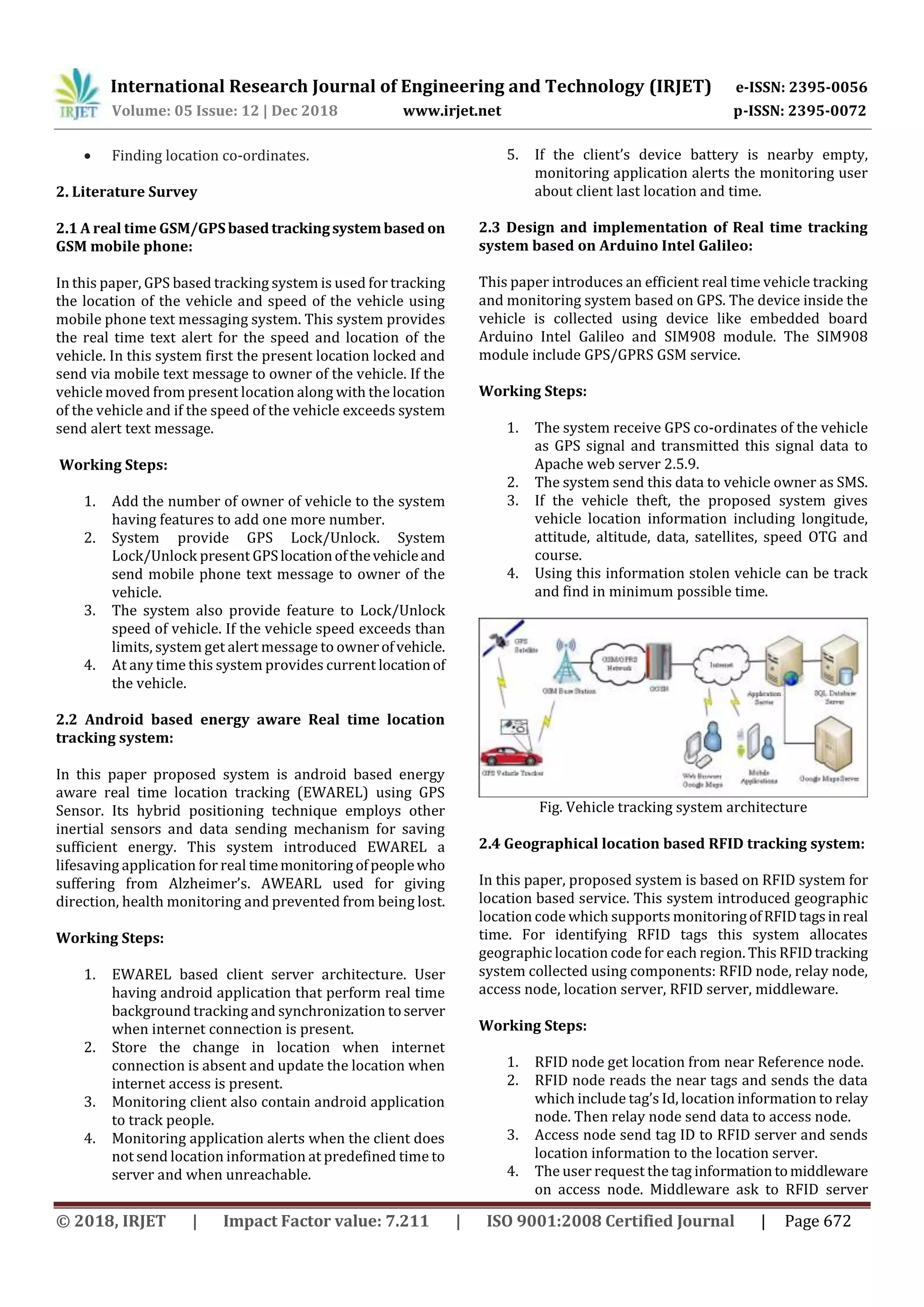
2.3 Design and implementation of Real time tracking
system based on Arduino Intel Galileo:
This paper introduces an efficient real time vehicle tracking
and monitoring system based on GPS. The device inside the
vehicle is collected using device like embedded board
Arduino Intel Galileo and SIM908 module. The SIM908
module include GPS/GPRS GSM service.
Working Steps:
1. The system receive GPS co-ordinates of the vehicle
as GPS signal and transmitted this signal data to
Apache web server 2.5.9.
2. The system send this data to vehicle owner as SMS.
3. If the vehicle theft, the proposed system gives
vehicle location information including longitude,
attitude, altitude, data, satellites, speed OTG and
course.
4. Using this information stolen vehicle can be track
and find in minimum possible time.
Fig. Vehicle tracking system architecture
2.4 Geographical location based RFID tracking system:
In this paper, proposed system is based on RFID system for
location based service. This system introduced geographic
location code which supports monitoringofRFIDtagsinreal
time. For identifying RFID tags this system allocates
geographic location code for each region. This RFIDtracking
system collected using components: RFID node, relay node,
access node, location server, RFID server, middleware.
Working Steps:
1. RFID node get location from near Reference node.
2. RFID node reads the near tags and sends the data
which include tag’s Id, location information to relay
node. Then relay node send data to access node.
3. Access node send tag ID to RFID server and sends
location information to the location server.
4. The user request the tag informationtomiddleware
on access node. Middleware ask to RFID server
International Research Journal of Engineering and Technology (IRJET) e-ISSN: 2395-0056
Volume: 05 Issue: 12 | Dec 2018 www.irjet.net p-ISSN: 2395-0072
© 2018, IRJET | Impact Factor value: 7.211 | ISO 9001:2008 Certified Journal | Page 673
about tag information and ask locationserverabout
tag’s location information simultaneously.
5. Each server response to middlewareonaccessnode
and middleware sends data user’s application
program.
6. The program display tag’s location and information
on map.
7. Client’s application program can show history of
RFID tag mobility.
Fig. RFID system architecture
2.5Implementation of vehicle tracking system using
smartphone and SMS service:
In this paper the proposed system, trackingthereal time bus
location using GPS and mobile based services. The system
contains two parts server side and client side. The server
device provides exact location of bus to the server or user in
case of SMS based query from client’s device. The client
device can find bus location either using SMS service or
using SMS service. If client used smart phone he can used
application to track bus location using internet service.
Working Steps:
1. The proposed system contain Android application
which has two modules.
2. First module is server module which install into an
Android phone which will be in the bus.
3. This module find out the GPS co-ordinates of bus
using location service of the android phone i.e. GPS.
This server module also includes a SMS gateway
service.
4. Second module is client module which installed in
client’s android phone.
5. Client module has three sub-modules: Location
Module, SMS alert, SMS tracker.
6. Location module: Using google map this module
shows the partial location of bus with time.
7. SMS alert: It sends location informationtotheclient
as text message.
8. SMS tracker: This module gives information of
location without using internet access and Android
device.
Fig. System Diagram of location Tracking
2.6 GPS based tracking system for transit object:
In this paper A mobile application addresses the safety
threat to people during travel. Proposed model is smart
mobility tracker and it trackstheuserlocationusingGPSand
inform same to their preferred contact depending upon
travelling distance. The desired contacts are cautioned with
high priority alert when user is found to go desired route. A
secondary GPS devicelocatestheuserduringunprecedented
situations.
Working Steps:
1. The user feeds start and end point of his journey to
application based on which location marked route
display.
2. When user start journey then location of user sent
to SMT (smart mobile tracker) server with respect
to distance between source and destination.
3. This information notify to the preferred contact
selected by user.
4. Path travelled by user monitor bySMTserver.Ifany
changes in course, the server notify to preferred
contact with alert message with high priority.
Fig. Architecture Diagram
2.7 GPS Locator: An application for location tracking
and sharing using GPS for java enabled Handhelds:
This paper gives details in field of location based service for
java enabled mobile deviceequipped withGPS receptor.This
system presents a technique to send GPS co-ordinates to
other mobile through short message service based onglobal
positioning system. This system application enablestheuser
International Research Journal of Engineering and Technology (IRJET) e-ISSN: 2395-0056
Volume: 05 Issue: 12 | Dec 2018 www.irjet.net p-ISSN: 2395-0072
© 2018, IRJET | Impact Factor value: 7.211 | ISO 9001:2008 Certified Journal | Page 674
to get their current location co-ordinates and also can view
their location on google maps. This application shares the
user’s location with their friends via web server through
internet connectivity in their devices.
Working Steps:
1. The system built portable and run on any mobile
phone that support J2ME.
2. The system can run on mobile that have builtinGPS
receiver.
3. User’s current location shows in google map.
4. User can share their location with friend and
contacts.
Fig. GPS locator Requirements
2.8 Design and implementation of an accurate real time
GSP tracking system:
This paper present and accurate and reliable real time
tracking system using global positioning system and global
system for mobile communication services. GPS tracking
system contains portable tracked device attach to person,
vehicle or any moving object and provides tracking center
where portable device location monitored. The mobile
tracked device receives its co-ordinate from GPS and send
these co-ordinates as SMS via GSM modem to tracking
center. The tracking center is personal computer with many
interface programs to display location on google mapsusing
free version of google map API’s.
fig. The overall tracking centre data flow
2.9Location based service in Android with Google Maps
integration:
LBS uses technology like GPS, mobile network, wifi
module to provide services like location tracking, navigating
to particular location, etc. Android application provide
services to implementlocationbasedapplication.Application
like location API, direction API, Google map which helps in
making location aware application under android platform.
Working steps:
1. User send request for service server using LBS
application on mobile device.
2. The service request of user and user’s current
location retrieve form GPS component and send to
service server using communication network.
3. Service server analyse the geo-specific information
as the request of user.
4. Requested information send back to mobile device
via communication network.
2.10 Real time tracking system using Google Maps API
V3
In this system the GPS chip gives the output of positioning
information which is further transferred over GPRS link to
mobile operator’s GGSN and then to a remote server over a
TCP connection. That server stores the incoming positional
data. When user clicks on tracking page, user will give input
using an HTML page with embedded JavaScript code. Then
International Research Journal of Engineering and Technology (IRJET) e-ISSN: 2395-0056
Volume: 05 Issue: 12 | Dec 2018 www.irjet.net p-ISSN: 2395-0072
© 2018, IRJET | Impact Factor value: 7.211 | ISO 9001:2008 Certified Journal | Page 675
JavaScript retrieve the positional information into Google
Maps through Google Maps API V3 which displays the
position on map. The positional Information is retrieved
every second. The general concept is described below.
Fig. User Perspective
This system represents a significantly novel deployment
scenario, considerably different from more traditional
tracking systems.
3. Comparative Analysis:
From the above papers, all the locations tracking system
based on wireless technology. Smartphones or Android
devices plays vital role in this system. All the location
tracking system based on GPS (Global positioning system)
which gives accurate positioning and time. [1,6] track the
location and Android application notify the location
information with alert text message. [2,5,7,8,9] Android
application to track location using internet connectivity. [3]
Apache web server receives location information through
GPS and send SMS to user. [4] RFID system to display
location on user application program. [8] portable track
device attached to person, vehicle or object and location of
device is monitored. [10] Android application inventor and
development kit which attached to android device for
transfer data between device and external peripheral.
4. CONCLUSION:
Various kind of techniques have been adopted for location
tracking system have been survey. Different author gives
many techniques with flow diagram flow charts and their
explanation with successful execution with the system
advantages and disadvantage.All the Proposeddesignedand
implementation is done in surveyed
REFERENCES
[1] M. A. Al Rashed, Ousmane Abdoulaye Oumar, Damanjit
Singh, “A real time GSM/GPS based tracking system
based on GSM mobile phone”, 2013.
[2] Yunus Ozen, Oguzhan Ozdemir, Necla Bandirmali,
“Android Based Energy Aware Real-time Location
Tracking System”, 2015.
[3] Omar Abdulwahabe Mohamad, Rasha Talal Hameed,
Nicolae Tapus, “Design and Implementation of Real
Time Tracking System Based on Arduino Intel Galileo”,
2016.
[4] Sungjun Kim, Doohyun Ko, Sunshin An, “ Geographical
Location Based RFID Tracking System”, 2008.
[5] Nusrath Jahan, Kamal Hossen, Muhammad Kamrul
Hossain Patwary, “Implementationofa VehicleTracking
System using Smartphone and SMS service”, 2017.
[6] DHINAKARAN K, SRINATH S, SRIRAM S,
VENKATESHWAR R, “GPS BASED TRACKING SYSTEM
FOR TRANSIT OBJECTS”, 2017.
[7] Ankur Chandra, Shashank Jain, Mohammed Abdul
Qadeer, “GPS Locator: An Application for Location
Tracking and Sharing using GPS for JAVA Enabled
Handhelds”, 2011.
[8] Hind Abdalsalam Abdallah Dafallah, “Design and
implementation of an accurate real time GPS tracking
system”, 2014.
[9] Aditya Nath Jha, Rahul Chourasia, “Location Based
Services in Android with Google maps integration”,
2014.
[10] Mihir Garude, Nirmal Haldikar, “Real Time Position
Tracking System Using Google Maps API V3”,
International Journal of Scientific and Research
Publications, Volume 4, Issue 9, September 2014.
[11] Manav Singhal, Anupam Shukla, “Implementation of
Location based Services in Android using GPS and Web
Services ”, IJCSI International Journal of Computer
Science Issues, Vol. 9, Issue 1, January 2012.
[12] Aditya Nath Jha, Rahul Chourasia, “Location Based
Services in Android with Google maps integration”,
2014.
[13] Aditya Nath Jha, Rahul Chourasia, “Location Based
Services in Android with Google maps integration”,
2014.

IRJET- A Survey on Various Location Tracking Systems

  • 1.
    International Research Journalof Engineering and Technology (IRJET) e-ISSN: 2395-0056 Volume: 05 Issue: 12 | Dec 2018 www.irjet.net p-ISSN: 2395-0072 © 2018, IRJET | Impact Factor value: 7.211 | ISO 9001:2008 Certified Journal | Page 671 A Survey on Various Location Tracking Systems Gaurav Chindhe1, Akshay Javali2, Prasad Patil3, Pratiksha Budhawant4 1,2,3,4Dept. of Computer Engineering, JSPM’s ICOER, Pune, Maharashtra, India. ---------------------------------------------------------------------***---------------------------------------------------------------------- Abstract – Today we are using different Location Based Services like Google Maps, Live vehicle tracking & other applications. The tracking system is a main part of today’slife. The location tracking system playsa crucialroleinmanyfields like cab services, security systems, industrial purposes and many other fields. So in this paper we studied different location tracking system with their working, advantages. Also we did a comparative study of such tracking system. Key Words: Google Map Services, GPS, GSM, RFID, GPRS. 1. INTRODUCTION Tracking system is widely used in our day-to-day life. Tracking system helps us by many purposes like track nearby shops, tracking location of buses-trains or any other vehicle. Also this system is helpful for many security purposes. Facility of Real Time Location Tracking is a important of transportation system. We can also share locations among our friends or other people. 1.1Technologies Related to Location Tracking System: 1. GLOBAL POSITIONING SYSTEMS (GPS) The Global Positioning System (GPS) is an operational system comprising of earth orbiting satellite built routing system. It provides it users all around the world with 24 hours a day accurate positioning and time observable to the standard global time in the three dimensions.Itcomprisesof three “segments” namely, the Control Segment, the Space Segment and the User Segment. Correct functioning of these three segments leads to the precise and consistent working of the whole system. The Control Segment is also known as the main control centre as it is involved in the transmission to the satellites. The Space Segment is composed of a collection of satellites that orbits about 20,000 km beyond the Earth. The User Segment is composed of the receivers that listen to the satellites at any given time. The User Segment involves the receiver that is currently functioning and its linked antenna. GPS does not work efficiently in indoor environment as GPS satellites possess weak signals which cannot cross the walls of buildings. Hence, GPS is not effective for indoor localization. Indoor localizationrequires high None Line of Sight (NLOS) and efficient positioning system. 2. Global System for Mobile communications (GSM ) GSM (Global System for Mobile communications) is a standard developed by the European Telecommunications Standards Institute (ETSI). GSM describe the protocols for second-generation digital cellular networks used by mobile devices. It was first deployed in Finland in December 1991. Till 2014, it has become the global standard for mobile communications. The 2G networks replaced the first generation(1G) analog cellular networks. 3. Radio-frequency identification (RFID) RFID uses electromagneticfieldtoautomaticallyidentifyand track tags attached to objects. The tags contain electronically-storedinformation.Passivetagscollectenergy from a nearby RFID reader's detector radio waves. Active tags have a local power source (such as a battery) and may operate hundreds of meters from the RFID reader. Unlike a barcode, the tag need not be within the line of sight of the reader, so it may be embedded in the tracked object. 4. General Packet Radio Service (GPRS) GPRS is a packet oriented mobile data standard on the 2G and 3G cellular communication network's global system for mobile communications (GSM). GPRS was established by European TelecommunicationsStandardsInstitute(ETSI) in response to the earlier CDPD and i-mode packet-switched cellular technologies. GPRS is typically sold according to the total volume of data transferred during the billing cycle, in contrast with circuit switched data, which is usually billed per minute of connection time, or sometimes by one-third minute increments. Usage above the GPRS bundled data cap may be charged per Mb of data, speed limited, or disallowed. 5. Google Maps Google Maps is a web mapping service developed by Google. It offers satellite imagery, street maps, 360° panoramic views of streets (Street View), real-time traffic conditions (Google Traffic), and route planningfortravelingbyfoot,car, bicycle and air (in beta), or public transportation. Google Maps began as a C++ desktop program at Where 2 Technologies. In October 2004, the company was acquired by Google, which converted it into a web application. After additional acquisitions of a geospatial data visualization company and a real time traffic analyzer, Google Maps was launched in February 2005. The service's front end utilizes JavaScript, XML, and Ajax. Google Maps offers an API that allows maps to be embedded on third-party websites, and offers a locator for urban businessesandotherorganizations in numerous countries around the world. 1.2 Need of Tracking System:  Tracking location of person.  Tracking and monitoring movement of moving objects.  Tracking is useful for security purpose.
  • 2.
    International Research Journalof Engineering and Technology (IRJET) e-ISSN: 2395-0056 Volume: 05 Issue: 12 | Dec 2018 www.irjet.net p-ISSN: 2395-0072 © 2018, IRJET | Impact Factor value: 7.211 | ISO 9001:2008 Certified Journal | Page 672  Finding location co-ordinates. 2. Literature Survey 2.1 A real time GSM/GPS based trackingsystembased on GSM mobile phone: In this paper, GPS based tracking system is used for tracking the location of the vehicle and speed of the vehicle using mobile phone text messaging system. This system provides the real time text alert for the speed and location of the vehicle. In this system first the present location locked and send via mobile text message to owner of the vehicle. If the vehicle moved from present location along with the location of the vehicle and if the speed of the vehicle exceeds system send alert text message. Working Steps: 1. Add the number of owner of vehicle to the system having features to add one more number. 2. System provide GPS Lock/Unlock. System Lock/Unlock present GPSlocationofthevehicleand send mobile phone text message to owner of the vehicle. 3. The system also provide feature to Lock/Unlock speed of vehicle. If the vehicle speed exceeds than limits, system get alert message to ownerofvehicle. 4. At any time this system provides current locationof the vehicle. 2.2 Android based energy aware Real time location tracking system: In this paper proposed system is android based energy aware real time location tracking (EWAREL) using GPS Sensor. Its hybrid positioning technique employs other inertial sensors and data sending mechanism for saving sufficient energy. This system introduced EWAREL a lifesaving application for real timemonitoringofpeoplewho suffering from Alzheimer’s. AWEARL used for giving direction, health monitoring and prevented from being lost. Working Steps: 1. EWAREL based client server architecture. User having android application that perform real time background tracking and synchronization toserver when internet connection is present. 2. Store the change in location when internet connection is absent and update the location when internet access is present. 3. Monitoring client also contain android application to track people. 4. Monitoring application alerts when the client does not send location information at predefined time to server and when unreachable. 5. If the client’s device battery is nearby empty, monitoring application alerts the monitoring user about client last location and time. 2.3 Design and implementation of Real time tracking system based on Arduino Intel Galileo: This paper introduces an efficient real time vehicle tracking and monitoring system based on GPS. The device inside the vehicle is collected using device like embedded board Arduino Intel Galileo and SIM908 module. The SIM908 module include GPS/GPRS GSM service. Working Steps: 1. The system receive GPS co-ordinates of the vehicle as GPS signal and transmitted this signal data to Apache web server 2.5.9. 2. The system send this data to vehicle owner as SMS. 3. If the vehicle theft, the proposed system gives vehicle location information including longitude, attitude, altitude, data, satellites, speed OTG and course. 4. Using this information stolen vehicle can be track and find in minimum possible time. Fig. Vehicle tracking system architecture 2.4 Geographical location based RFID tracking system: In this paper, proposed system is based on RFID system for location based service. This system introduced geographic location code which supports monitoringofRFIDtagsinreal time. For identifying RFID tags this system allocates geographic location code for each region. This RFIDtracking system collected using components: RFID node, relay node, access node, location server, RFID server, middleware. Working Steps: 1. RFID node get location from near Reference node. 2. RFID node reads the near tags and sends the data which include tag’s Id, location information to relay node. Then relay node send data to access node. 3. Access node send tag ID to RFID server and sends location information to the location server. 4. The user request the tag informationtomiddleware on access node. Middleware ask to RFID server
  • 3.
    International Research Journalof Engineering and Technology (IRJET) e-ISSN: 2395-0056 Volume: 05 Issue: 12 | Dec 2018 www.irjet.net p-ISSN: 2395-0072 © 2018, IRJET | Impact Factor value: 7.211 | ISO 9001:2008 Certified Journal | Page 673 about tag information and ask locationserverabout tag’s location information simultaneously. 5. Each server response to middlewareonaccessnode and middleware sends data user’s application program. 6. The program display tag’s location and information on map. 7. Client’s application program can show history of RFID tag mobility. Fig. RFID system architecture 2.5Implementation of vehicle tracking system using smartphone and SMS service: In this paper the proposed system, trackingthereal time bus location using GPS and mobile based services. The system contains two parts server side and client side. The server device provides exact location of bus to the server or user in case of SMS based query from client’s device. The client device can find bus location either using SMS service or using SMS service. If client used smart phone he can used application to track bus location using internet service. Working Steps: 1. The proposed system contain Android application which has two modules. 2. First module is server module which install into an Android phone which will be in the bus. 3. This module find out the GPS co-ordinates of bus using location service of the android phone i.e. GPS. This server module also includes a SMS gateway service. 4. Second module is client module which installed in client’s android phone. 5. Client module has three sub-modules: Location Module, SMS alert, SMS tracker. 6. Location module: Using google map this module shows the partial location of bus with time. 7. SMS alert: It sends location informationtotheclient as text message. 8. SMS tracker: This module gives information of location without using internet access and Android device. Fig. System Diagram of location Tracking 2.6 GPS based tracking system for transit object: In this paper A mobile application addresses the safety threat to people during travel. Proposed model is smart mobility tracker and it trackstheuserlocationusingGPSand inform same to their preferred contact depending upon travelling distance. The desired contacts are cautioned with high priority alert when user is found to go desired route. A secondary GPS devicelocatestheuserduringunprecedented situations. Working Steps: 1. The user feeds start and end point of his journey to application based on which location marked route display. 2. When user start journey then location of user sent to SMT (smart mobile tracker) server with respect to distance between source and destination. 3. This information notify to the preferred contact selected by user. 4. Path travelled by user monitor bySMTserver.Ifany changes in course, the server notify to preferred contact with alert message with high priority. Fig. Architecture Diagram 2.7 GPS Locator: An application for location tracking and sharing using GPS for java enabled Handhelds: This paper gives details in field of location based service for java enabled mobile deviceequipped withGPS receptor.This system presents a technique to send GPS co-ordinates to other mobile through short message service based onglobal positioning system. This system application enablestheuser
  • 4.
    International Research Journalof Engineering and Technology (IRJET) e-ISSN: 2395-0056 Volume: 05 Issue: 12 | Dec 2018 www.irjet.net p-ISSN: 2395-0072 © 2018, IRJET | Impact Factor value: 7.211 | ISO 9001:2008 Certified Journal | Page 674 to get their current location co-ordinates and also can view their location on google maps. This application shares the user’s location with their friends via web server through internet connectivity in their devices. Working Steps: 1. The system built portable and run on any mobile phone that support J2ME. 2. The system can run on mobile that have builtinGPS receiver. 3. User’s current location shows in google map. 4. User can share their location with friend and contacts. Fig. GPS locator Requirements 2.8 Design and implementation of an accurate real time GSP tracking system: This paper present and accurate and reliable real time tracking system using global positioning system and global system for mobile communication services. GPS tracking system contains portable tracked device attach to person, vehicle or any moving object and provides tracking center where portable device location monitored. The mobile tracked device receives its co-ordinate from GPS and send these co-ordinates as SMS via GSM modem to tracking center. The tracking center is personal computer with many interface programs to display location on google mapsusing free version of google map API’s. fig. The overall tracking centre data flow 2.9Location based service in Android with Google Maps integration: LBS uses technology like GPS, mobile network, wifi module to provide services like location tracking, navigating to particular location, etc. Android application provide services to implementlocationbasedapplication.Application like location API, direction API, Google map which helps in making location aware application under android platform. Working steps: 1. User send request for service server using LBS application on mobile device. 2. The service request of user and user’s current location retrieve form GPS component and send to service server using communication network. 3. Service server analyse the geo-specific information as the request of user. 4. Requested information send back to mobile device via communication network. 2.10 Real time tracking system using Google Maps API V3 In this system the GPS chip gives the output of positioning information which is further transferred over GPRS link to mobile operator’s GGSN and then to a remote server over a TCP connection. That server stores the incoming positional data. When user clicks on tracking page, user will give input using an HTML page with embedded JavaScript code. Then
  • 5.
    International Research Journalof Engineering and Technology (IRJET) e-ISSN: 2395-0056 Volume: 05 Issue: 12 | Dec 2018 www.irjet.net p-ISSN: 2395-0072 © 2018, IRJET | Impact Factor value: 7.211 | ISO 9001:2008 Certified Journal | Page 675 JavaScript retrieve the positional information into Google Maps through Google Maps API V3 which displays the position on map. The positional Information is retrieved every second. The general concept is described below. Fig. User Perspective This system represents a significantly novel deployment scenario, considerably different from more traditional tracking systems. 3. Comparative Analysis: From the above papers, all the locations tracking system based on wireless technology. Smartphones or Android devices plays vital role in this system. All the location tracking system based on GPS (Global positioning system) which gives accurate positioning and time. [1,6] track the location and Android application notify the location information with alert text message. [2,5,7,8,9] Android application to track location using internet connectivity. [3] Apache web server receives location information through GPS and send SMS to user. [4] RFID system to display location on user application program. [8] portable track device attached to person, vehicle or object and location of device is monitored. [10] Android application inventor and development kit which attached to android device for transfer data between device and external peripheral. 4. CONCLUSION: Various kind of techniques have been adopted for location tracking system have been survey. Different author gives many techniques with flow diagram flow charts and their explanation with successful execution with the system advantages and disadvantage.All the Proposeddesignedand implementation is done in surveyed REFERENCES [1] M. A. Al Rashed, Ousmane Abdoulaye Oumar, Damanjit Singh, “A real time GSM/GPS based tracking system based on GSM mobile phone”, 2013. [2] Yunus Ozen, Oguzhan Ozdemir, Necla Bandirmali, “Android Based Energy Aware Real-time Location Tracking System”, 2015. [3] Omar Abdulwahabe Mohamad, Rasha Talal Hameed, Nicolae Tapus, “Design and Implementation of Real Time Tracking System Based on Arduino Intel Galileo”, 2016. [4] Sungjun Kim, Doohyun Ko, Sunshin An, “ Geographical Location Based RFID Tracking System”, 2008. [5] Nusrath Jahan, Kamal Hossen, Muhammad Kamrul Hossain Patwary, “Implementationofa VehicleTracking System using Smartphone and SMS service”, 2017. [6] DHINAKARAN K, SRINATH S, SRIRAM S, VENKATESHWAR R, “GPS BASED TRACKING SYSTEM FOR TRANSIT OBJECTS”, 2017. [7] Ankur Chandra, Shashank Jain, Mohammed Abdul Qadeer, “GPS Locator: An Application for Location Tracking and Sharing using GPS for JAVA Enabled Handhelds”, 2011. [8] Hind Abdalsalam Abdallah Dafallah, “Design and implementation of an accurate real time GPS tracking system”, 2014. [9] Aditya Nath Jha, Rahul Chourasia, “Location Based Services in Android with Google maps integration”, 2014. [10] Mihir Garude, Nirmal Haldikar, “Real Time Position Tracking System Using Google Maps API V3”, International Journal of Scientific and Research Publications, Volume 4, Issue 9, September 2014. [11] Manav Singhal, Anupam Shukla, “Implementation of Location based Services in Android using GPS and Web Services ”, IJCSI International Journal of Computer Science Issues, Vol. 9, Issue 1, January 2012. [12] Aditya Nath Jha, Rahul Chourasia, “Location Based Services in Android with Google maps integration”, 2014. [13] Aditya Nath Jha, Rahul Chourasia, “Location Based Services in Android with Google maps integration”, 2014.