International Research Journal of Engineering and Technology (IRJET) e-ISSN: 2395-0056
Volume: 07 Issue: 01 | Jan 2020 www.irjet.net p-ISSN: 2395-0072
© 2020, IRJET | Impact Factor value: 7.34 | ISO 9001:2008 Certified Journal | Page 875
INTELLIGENT TRAFFIC MANAGEMENT SYSTEM
Avinash Biradar1, Prashant Deore2, Shreyash Pimple3, Prof. Amruta Nikam4
1,2,3Final year, Department of E&TC, DYPIEMR, Akurdi
4Professor, Department of E&TC, DYPIEMR, Akurdi, Maharashtra, India
---------------------------------------------------------------------***----------------------------------------------------------------------
Abstract – In today’s world managing the increasing traffic
system is a big problem. Intelligent traffic system provides a
solution to these problems with the help of new technologies.
Intelligent traffic management system is an integratedsystem
and this system have broad range communication, control,
electronic technologies to solve this traffic management
problem. Intelligent traffic management system is being used
in the developed countries since past some decades, but it still
new concept for some developing countries like India , China,
Brazil, etc. Right now we are study four major parts of the
system i.e., Emergency Management System, AdvancedTraffic
Management System,, Advance Public TransportationSystem
and Advanced Traveler Information System. Objective of our
paper is to study Various intelligent traffic management
system architecture and model and review such models to get
complete knowledge of architecture .
Key Words:(ProcessingSpeed,Cloud Computing,Parallel
Computing, Grid Computing, Cluster Computing)
1. INTRODUCTION
This Paper PresentsTheImplementationOfIntelligenttraffic
management System . In this paper different Intelligent
Traffic management system architecture and model
developed by various researchers all over the world has
been studied and review to get complete knowledge of this
architecture. Inintelligenttraffic managementsystemweare
divided into four main branches based on their
implementation in different aspects of transportation
management i.e. Emergency managementsystem,Advanced
Public Transportation, Advance Traffic Managementsystem
and Advanced Traveler Information System. Complete
comparison analysis of all the models developed in for all
branches have been done to highlights the plus and minus
points of these developed managementsystemandbased on
their gaps in the literature have been highlighted.
2. PROBLEM STATEMENT
Over several decades, trafficcongestionhasbecomeaserious
problem in the major cities. Congestion is particularly
associated with motorization and the diffusion of the
automobile, which has increased the demand for
transportation infrastructure. However, the supply of the
transportation infrastructure has often not been able to
keep up with the growth of mobility. Traffic congestion
problems consist of incremental delay, vehicle operating
costs such as fuel consumption, pollution emissions and
stress that result from interference among vehicles in the
traffic stream, particularly as traffic volumes approach a
road’s capacity. Acrosscities more people arespendingmore
timesitting in traffic jams than ever beforeTrafficcongestion
occurs when the demand is greater than the available road
capacity. Therearemanyreasonsthatcausecongestion;most
of them reduce the capacity of the road at a given point or
over a certain length, for example people parking on the
roads or increase in the number of vehicles. Traffic
congestion also occurs due to traffic signal. At traffic signal
when road traffic density is low signal still shows the same
traffic time due to which other lane traffic increases which
result in traffic congestion. Sometimes due this problem the
ambulance, police vans, fire-fighting vehicle are not reaching
at their destination on time.
3. OBJECTIVE
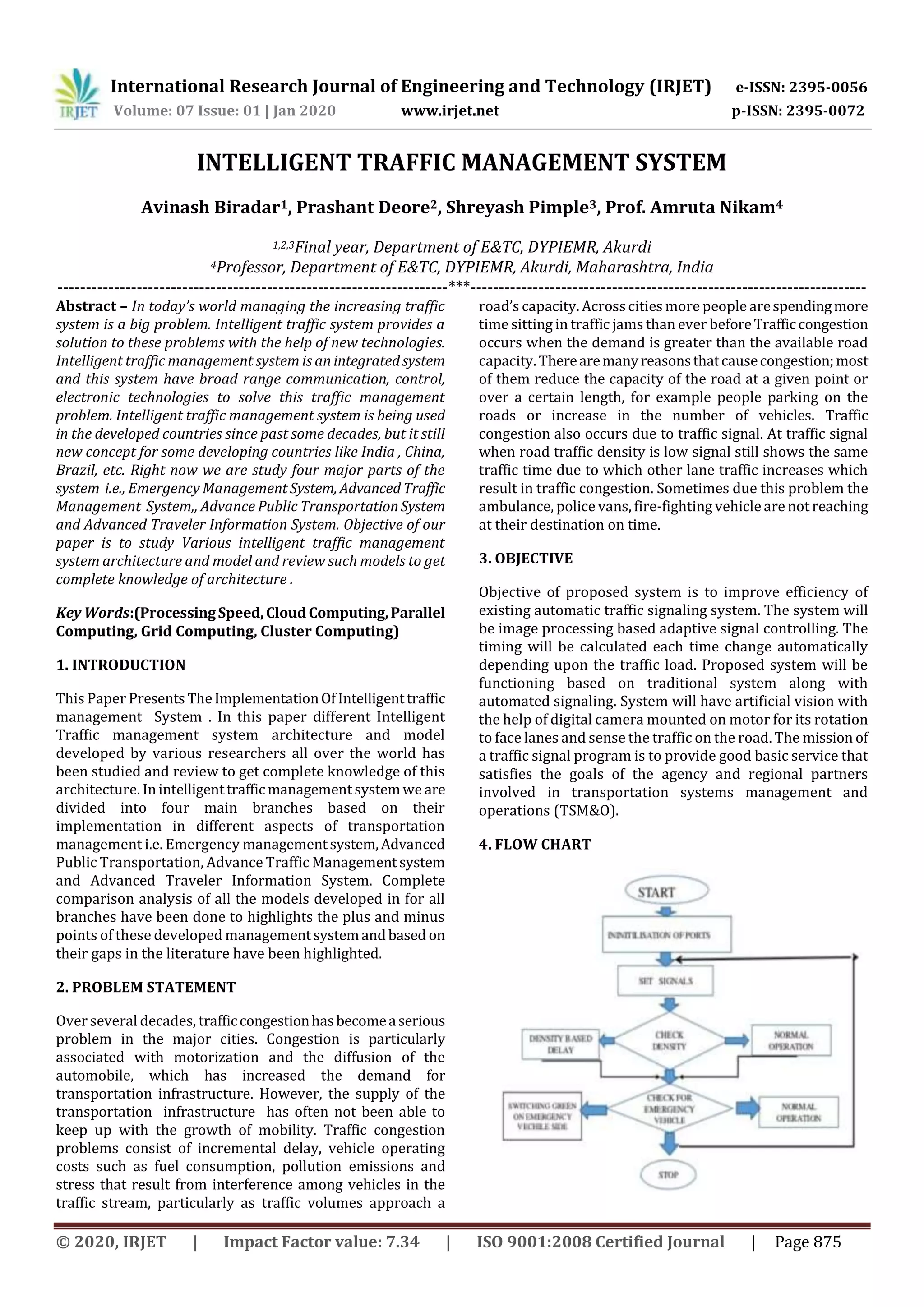
Objective of proposed system is to improve efficiency of
existing automatic traffic signaling system. The system will
be image processing based adaptive signal controlling. The
timing will be calculated each time change automatically
depending upon the traffic load. Proposed system will be
functioning based on traditional system along with
automated signaling. System will have artificial vision with
the help of digital camera mounted on motor for its rotation
to face lanes and sense the traffic on the road. The mission of
a traffic signal program is to provide good basic service that
satisfies the goals of the agency and regional partners
involved in transportation systems management and
operations (TSM&O).
4. FLOW CHART
International Research Journal of Engineering and Technology (IRJET) e-ISSN: 2395-0056
Volume: 07 Issue: 01 | Jan 2020 www.irjet.net p-ISSN: 2395-0072
© 2020, IRJET | Impact Factor value: 7.34 | ISO 9001:2008 Certified Journal | Page 876
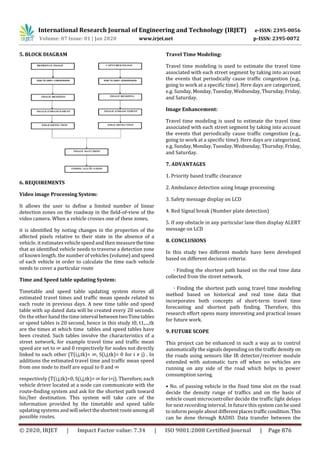
5. BLOCK DIAGRAM
6. REQUIREMENTS
Video image Processing System:
It allows the user to define a limited number of linear
detection zones on the roadway in the field-of-view of the
video camera. When a vehicle crosses one of these zones,
it is identified by noting changes in the properties of the
affected pixels relative to their state in the absence of a
vehicle. it estimates vehicle speed and then measurethetime
that an identified vehicle needs to traverse a detection zone
of known length. the number of vehicles (volume) and speed
of each vehicle in order to calculate the time each vehicle
needs to cover a particular route
Time and Speed table updating System:
Timetable and speed table updating system stores all
estimated travel times and traffic mean speeds related to
each route in previous days. A new time table and speed
table with up dated data will be created every 20 seconds.
On the other hand the time interval betweentwoTimetables
or speed tables is 20 second, hence in this study t0, t1,...,tk
are the times at which time tables and speed tables have
been created. Such tables involve the characteristics of a
street network, for example travel time and traffic mean
speed are set to ∞ and 0 respectively for nodes not directly
linked to each other (T(i,j,tk)= ∞, S(i,j,tk)= 0 for i ≠ j) . In
additions the estimated travel time and traffic mean speed
from one node to itself are equal to 0 and ∞
respectively (T(i,j,tk)=0, S(i,j,tk)= ∞ for i=j). Therefore, each
vehicle driver located at a node can communicate with the
route-finding system and ask for the shortest path toward
his/her destination. This system will take care of the
information provided by the timetable and speed table
updating systems andwill selecttheshortestrouteamongall
possible routes.
Travel Time Modeling:
Travel time modeling is used to estimate the travel time
associated with each street segment by taking into account
the events that periodically cause traffic congestion (e.g.,
going to work at a specific time). Here days are categorized,
e.g. Sunday,Monday,Tuesday,Wednesday,Thursday,Friday,
and Saturday.
Image Enhancement:
Travel time modeling is used to estimate the travel time
associated with each street segment by taking into account
the events that periodically cause traffic congestion (e.g.,
going to work at a specific time). Here days are categorized,
e.g. Sunday,Monday,Tuesday,Wednesday,Thursday,Friday,
and Saturday.
7. ADVANTAGES
1. Priority based traffic clearance
2. Ambulance detection using Image processing
3. Safety message display on LCD
4. Red Signal break (Number plate detection)
5. If any obstacle in any particular lane then display ALERT
message on LCD
8. CONCLUSIONS
In this study two different models have been developed
based on different decision criteria:
∙ Finding the shortest path based on the real time data
collected from the street network.
∙ Finding the shortest path using travel time modeling
method based on historical and real time data that
incorporates both concepts of short-term travel time
forecasting and shortest path finding. Therefore, this
research effort opens many interesting and practical issues
for future work.
9. FUTURE SCOPE
This project can be enhanced in such a way as to control
automatically the signals depending on the trafficdensity on
the roads using sensors like IR detector/receiver module
extended with automatic turn off when no vehicles are
running on any side of the road which helps in power
consumption saving.
• No. of passing vehicle in the fixed time slot on the road
decide the density range of traffics and on the basis of
vehicle count microcontroller decide the traffic light delays
for next recording interval. In future this system can beused
to inform people about differentplaces trafficcondition.This
can be done through RADIO. Data transfer between the
International Research Journal of Engineering and Technology (IRJET) e-ISSN: 2395-0056
Volume: 07 Issue: 01 | Jan 2020 www.irjet.net p-ISSN: 2395-0072
© 2020, IRJET | Impact Factor value: 7.34 | ISO 9001:2008 Certified Journal | Page 877
microcontroller and computer can also be done through
telephone network, data call activated SIM This technique
allows the operator to gather the recorded data from a far
end to his home computer without going there
• Traffic lights can be increased to N number and traffic light
control can be done for whole city by sitting on a single
place.
• In ambulance system, the data of the patient in the
ambulance can be sent to the Hospitals via GSM technology.
Thus, it can provide early and fast treatment of the patient.
10. REFERENCES
[1] Ahn, W.C., Ramakrishna, R.S., 2002. “Genetic Algorithm
for Shortest Path Routing Problem and the Sizing of
Populations.” In IEEE Transactions on Evolutionary
Computation. 6(6), pp. 566-579.
[2] Bellman, R.E., 1957. “Dynamic Programming.”Princeton
University Press, Princeton, NJ.
[3] Bertsekas, D.P., Tsitsiklis, J.J., 1991. “An Analysis of
Stochastic Shortest Path Problems.”
[4] In Mathematics of Operations Research. 16(3), pp. 580-
595.
[5] Bertsimas D.J. and Van Ryzin G., 1991. “A Stochastic and
Dynamic Vehicle Routing Problem in the Euclidean
Plan.” In Operations Research, 39(4), pp. 601-615.
[6] Bonet, B., Geffner, H., 2002. “Solving Stochastic Shortest-
path Problems with Real Time Dynamic Programming.”
Online publication accessed on October 2011 at
http://ldc.usb.ve/~bonet/reports/rtdp.pdf.
[7] Chinneck, W., 2010. “Practical Optimization: A Gentle
Introduction.” Carleton University, Ottawa, Canada.
[8] Chitra, C., Subbaraj. C., 2010. “A Nondominated Sorting
Genetic Algorithm for Shortest Path Routing Problem.”
In International Journal of Electrical and Computer
Engineering, 5(1), pp. 53-63.
[9] Dear, M., Fulton, W., Wolch, J., 2001. “Sprawl Hits the
Wall.” Southern California Studies Center, University of
Southern California, Los Angeles, CA.
[10] Frank, H., 2009. “Shortest Paths inProbabilistic Graphs.”
In Operations Research, 17(4), pp. 583-599.
[11] Gendreau, M., Guertin, F., Potvin, J.Y., Seguin, R., 2006.
“Neighborhood Search Heuristics for Dynamic Vehicle
Dispatching Problem with Pick-ups and Deliveries.” In
Transportation Research Part C, Emerging Technology,
14(3), pp. 157–174.
[12] Loui, R.P., 1983. “Optimal Paths in Graphs with
Stochastic or Multidimensional Weights.”
[13] In Communications of the ACM, 26(9), pp. 670-676.

IRJET- Intelligent Traffic Management System

  • 1.
    International Research Journalof Engineering and Technology (IRJET) e-ISSN: 2395-0056 Volume: 07 Issue: 01 | Jan 2020 www.irjet.net p-ISSN: 2395-0072 © 2020, IRJET | Impact Factor value: 7.34 | ISO 9001:2008 Certified Journal | Page 875 INTELLIGENT TRAFFIC MANAGEMENT SYSTEM Avinash Biradar1, Prashant Deore2, Shreyash Pimple3, Prof. Amruta Nikam4 1,2,3Final year, Department of E&TC, DYPIEMR, Akurdi 4Professor, Department of E&TC, DYPIEMR, Akurdi, Maharashtra, India ---------------------------------------------------------------------***---------------------------------------------------------------------- Abstract – In today’s world managing the increasing traffic system is a big problem. Intelligent traffic system provides a solution to these problems with the help of new technologies. Intelligent traffic management system is an integratedsystem and this system have broad range communication, control, electronic technologies to solve this traffic management problem. Intelligent traffic management system is being used in the developed countries since past some decades, but it still new concept for some developing countries like India , China, Brazil, etc. Right now we are study four major parts of the system i.e., Emergency Management System, AdvancedTraffic Management System,, Advance Public TransportationSystem and Advanced Traveler Information System. Objective of our paper is to study Various intelligent traffic management system architecture and model and review such models to get complete knowledge of architecture . Key Words:(ProcessingSpeed,Cloud Computing,Parallel Computing, Grid Computing, Cluster Computing) 1. INTRODUCTION This Paper PresentsTheImplementationOfIntelligenttraffic management System . In this paper different Intelligent Traffic management system architecture and model developed by various researchers all over the world has been studied and review to get complete knowledge of this architecture. Inintelligenttraffic managementsystemweare divided into four main branches based on their implementation in different aspects of transportation management i.e. Emergency managementsystem,Advanced Public Transportation, Advance Traffic Managementsystem and Advanced Traveler Information System. Complete comparison analysis of all the models developed in for all branches have been done to highlights the plus and minus points of these developed managementsystemandbased on their gaps in the literature have been highlighted. 2. PROBLEM STATEMENT Over several decades, trafficcongestionhasbecomeaserious problem in the major cities. Congestion is particularly associated with motorization and the diffusion of the automobile, which has increased the demand for transportation infrastructure. However, the supply of the transportation infrastructure has often not been able to keep up with the growth of mobility. Traffic congestion problems consist of incremental delay, vehicle operating costs such as fuel consumption, pollution emissions and stress that result from interference among vehicles in the traffic stream, particularly as traffic volumes approach a road’s capacity. Acrosscities more people arespendingmore timesitting in traffic jams than ever beforeTrafficcongestion occurs when the demand is greater than the available road capacity. Therearemanyreasonsthatcausecongestion;most of them reduce the capacity of the road at a given point or over a certain length, for example people parking on the roads or increase in the number of vehicles. Traffic congestion also occurs due to traffic signal. At traffic signal when road traffic density is low signal still shows the same traffic time due to which other lane traffic increases which result in traffic congestion. Sometimes due this problem the ambulance, police vans, fire-fighting vehicle are not reaching at their destination on time. 3. OBJECTIVE Objective of proposed system is to improve efficiency of existing automatic traffic signaling system. The system will be image processing based adaptive signal controlling. The timing will be calculated each time change automatically depending upon the traffic load. Proposed system will be functioning based on traditional system along with automated signaling. System will have artificial vision with the help of digital camera mounted on motor for its rotation to face lanes and sense the traffic on the road. The mission of a traffic signal program is to provide good basic service that satisfies the goals of the agency and regional partners involved in transportation systems management and operations (TSM&O). 4. FLOW CHART
  • 2.
    International Research Journalof Engineering and Technology (IRJET) e-ISSN: 2395-0056 Volume: 07 Issue: 01 | Jan 2020 www.irjet.net p-ISSN: 2395-0072 © 2020, IRJET | Impact Factor value: 7.34 | ISO 9001:2008 Certified Journal | Page 876 5. BLOCK DIAGRAM 6. REQUIREMENTS Video image Processing System: It allows the user to define a limited number of linear detection zones on the roadway in the field-of-view of the video camera. When a vehicle crosses one of these zones, it is identified by noting changes in the properties of the affected pixels relative to their state in the absence of a vehicle. it estimates vehicle speed and then measurethetime that an identified vehicle needs to traverse a detection zone of known length. the number of vehicles (volume) and speed of each vehicle in order to calculate the time each vehicle needs to cover a particular route Time and Speed table updating System: Timetable and speed table updating system stores all estimated travel times and traffic mean speeds related to each route in previous days. A new time table and speed table with up dated data will be created every 20 seconds. On the other hand the time interval betweentwoTimetables or speed tables is 20 second, hence in this study t0, t1,...,tk are the times at which time tables and speed tables have been created. Such tables involve the characteristics of a street network, for example travel time and traffic mean speed are set to ∞ and 0 respectively for nodes not directly linked to each other (T(i,j,tk)= ∞, S(i,j,tk)= 0 for i ≠ j) . In additions the estimated travel time and traffic mean speed from one node to itself are equal to 0 and ∞ respectively (T(i,j,tk)=0, S(i,j,tk)= ∞ for i=j). Therefore, each vehicle driver located at a node can communicate with the route-finding system and ask for the shortest path toward his/her destination. This system will take care of the information provided by the timetable and speed table updating systems andwill selecttheshortestrouteamongall possible routes. Travel Time Modeling: Travel time modeling is used to estimate the travel time associated with each street segment by taking into account the events that periodically cause traffic congestion (e.g., going to work at a specific time). Here days are categorized, e.g. Sunday,Monday,Tuesday,Wednesday,Thursday,Friday, and Saturday. Image Enhancement: Travel time modeling is used to estimate the travel time associated with each street segment by taking into account the events that periodically cause traffic congestion (e.g., going to work at a specific time). Here days are categorized, e.g. Sunday,Monday,Tuesday,Wednesday,Thursday,Friday, and Saturday. 7. ADVANTAGES 1. Priority based traffic clearance 2. Ambulance detection using Image processing 3. Safety message display on LCD 4. Red Signal break (Number plate detection) 5. If any obstacle in any particular lane then display ALERT message on LCD 8. CONCLUSIONS In this study two different models have been developed based on different decision criteria: ∙ Finding the shortest path based on the real time data collected from the street network. ∙ Finding the shortest path using travel time modeling method based on historical and real time data that incorporates both concepts of short-term travel time forecasting and shortest path finding. Therefore, this research effort opens many interesting and practical issues for future work. 9. FUTURE SCOPE This project can be enhanced in such a way as to control automatically the signals depending on the trafficdensity on the roads using sensors like IR detector/receiver module extended with automatic turn off when no vehicles are running on any side of the road which helps in power consumption saving. • No. of passing vehicle in the fixed time slot on the road decide the density range of traffics and on the basis of vehicle count microcontroller decide the traffic light delays for next recording interval. In future this system can beused to inform people about differentplaces trafficcondition.This can be done through RADIO. Data transfer between the
  • 3.
    International Research Journalof Engineering and Technology (IRJET) e-ISSN: 2395-0056 Volume: 07 Issue: 01 | Jan 2020 www.irjet.net p-ISSN: 2395-0072 © 2020, IRJET | Impact Factor value: 7.34 | ISO 9001:2008 Certified Journal | Page 877 microcontroller and computer can also be done through telephone network, data call activated SIM This technique allows the operator to gather the recorded data from a far end to his home computer without going there • Traffic lights can be increased to N number and traffic light control can be done for whole city by sitting on a single place. • In ambulance system, the data of the patient in the ambulance can be sent to the Hospitals via GSM technology. Thus, it can provide early and fast treatment of the patient. 10. REFERENCES [1] Ahn, W.C., Ramakrishna, R.S., 2002. “Genetic Algorithm for Shortest Path Routing Problem and the Sizing of Populations.” In IEEE Transactions on Evolutionary Computation. 6(6), pp. 566-579. [2] Bellman, R.E., 1957. “Dynamic Programming.”Princeton University Press, Princeton, NJ. [3] Bertsekas, D.P., Tsitsiklis, J.J., 1991. “An Analysis of Stochastic Shortest Path Problems.” [4] In Mathematics of Operations Research. 16(3), pp. 580- 595. [5] Bertsimas D.J. and Van Ryzin G., 1991. “A Stochastic and Dynamic Vehicle Routing Problem in the Euclidean Plan.” In Operations Research, 39(4), pp. 601-615. [6] Bonet, B., Geffner, H., 2002. “Solving Stochastic Shortest- path Problems with Real Time Dynamic Programming.” Online publication accessed on October 2011 at http://ldc.usb.ve/~bonet/reports/rtdp.pdf. [7] Chinneck, W., 2010. “Practical Optimization: A Gentle Introduction.” Carleton University, Ottawa, Canada. [8] Chitra, C., Subbaraj. C., 2010. “A Nondominated Sorting Genetic Algorithm for Shortest Path Routing Problem.” In International Journal of Electrical and Computer Engineering, 5(1), pp. 53-63. [9] Dear, M., Fulton, W., Wolch, J., 2001. “Sprawl Hits the Wall.” Southern California Studies Center, University of Southern California, Los Angeles, CA. [10] Frank, H., 2009. “Shortest Paths inProbabilistic Graphs.” In Operations Research, 17(4), pp. 583-599. [11] Gendreau, M., Guertin, F., Potvin, J.Y., Seguin, R., 2006. “Neighborhood Search Heuristics for Dynamic Vehicle Dispatching Problem with Pick-ups and Deliveries.” In Transportation Research Part C, Emerging Technology, 14(3), pp. 157–174. [12] Loui, R.P., 1983. “Optimal Paths in Graphs with Stochastic or Multidimensional Weights.” [13] In Communications of the ACM, 26(9), pp. 670-676.