International Research Journal of Engineering and Technology (IRJET) e-ISSN: 2395-0056
Volume: 05 Issue: 04 | Apr-2018 www.irjet.net p-ISSN: 2395-0072
© 2018, IRJET | Impact Factor value: 6.171 | ISO 9001:2008 Certified Journal | Page 1924
A SYSTEM FOR DETERMINING SARCASM IN TWEETS: SARCASM DETECTOR
Shweta Gupta1, Malav Shah2, Sanket Shah3, Ashwini Deshmukh4
1,2,3 Department of Information Technology, Shah and Anchor Kutchhi Engineering College, Mumbai, India.
4AssistantProfessor Department of Information Technology, Shah and Anchor Kutchhi Engineering College,
Mumbai, India.
---------------------------------------------------------------------***---------------------------------------------------------------------
Abstract - Sarcasm is form of irony which conveys an
opinion or a sentiment about a particular target object.
Feedback of the customers are more essential for a
particular product to know about the flaws and the criteria
in which they need to improve. It is basically identified by a
user’s tone of speech and certain gestures which indirectly
expresses sarcasm.
Since the conventional approaches of collecting feedbacks
through interviews and questionnaires was too time
consuming, so we propose an approach of a desktop
application which would help in analyzing the product
reviews and further help in improving the products. A
dictionary of words will be created in the basis of sentiment
analysis and polarity of a statement. Based on the dictionary
the tweet is classified as sarcastic or non-sarcastic.
Key Words: PBGLA, POS Tagging, Parse Tree, Sentiment
Analysis.
1.INTRODUCTION
Twitter has become one of the biggest web destinations for
users to express their opinions and thoughts. Many
companies and organizations have been interested in these
data for the purpose of studying the opinion of people
towards political events, popular products or movies.
Throughout the last few years, Twitter content continued
to increase: hundreds of millions of tweets are sent
everyday by more than 285 million active users.
Furthermore, presence of sarcasm makes the task even
more challenging: sarcasm is when a person says
something different from what he means. However, due to
the informal language used in Twitter and the limitation in
terms of characters (i.e., 140 characters per tweet),
understanding the opinions of users and performing such
analysis is quite difficult. Some people are more sarcastic
than others, in general, sarcasm is very common, though,
difficult to recognize.
2.SARCASM DETECTION
Sarcasm can be manifested in many different ways, but
recognizing sarcasm is important for natural language
processing to avoid misinterpreting sarcastic statements as
literal. Sarcasm is generally characterized as ironic wit that
is moreover intended to insult, amuse or mock. For
example, sentiment analysis can be easily misled by the
presence of words that have a strong polarity but are used
sarcastically, which means that the opposite polarity was
intended. Consider the following tweet on Twitter, which
includes the words “yay” and “thrilled” but actually
expresses a negative sentiment: “yay! it’s a holiday weekend
and I’m on call for work! couldn’t be more thrilled!”-
Sarcastic statement. In this case, it reveals the intended
sarcasm, but we don’t always have the benefit of an explicit
sarcasm label.
(a) Yes, let's all cheer on the glorified shameless point-
farming bitch of this site.
(b) I love how you are using violence to threaten
people. when, your argument is disputing violence.
(c) I love how scum barge doesn't give a rebuttal to
this. he knows you have him by the balls.
The sarcasm in these tweets arises from the juxtaposition
of a positive sentiment word (e.g., love, cheer) with a
negative activity or state (e.g. Rebuttal, shameless,
violence).
2.1 Part-of-Speech (POS) Tagging
It is a python-based package working on NLTK (Natural
Language Toolkit), and freely available on the internet.
Penn Treebank Tag Set notations such as JJ-adjective, NN-
noun, RB-adverb, VB-verb, and UH-interjection, etc. were
used. It is a process of taking a word from text (corpus) as
input and assign corresponding part-of-speech to each
word as output based on its definition and context i.e.
relationship with adjacent and related words in a phrase,
sentence, or paragraph. In this paper, TEXTBLOB was
deployed to calculate POS tagging and parsing of the given
text.
2.2 Parsing and parse tree
The term parse tree itself in computational linguistics is
primarily used in theoretical syntax, the term syntax tree is
more common. A parse tree or parsing tree or derivation
tree or concrete syntax tree is an ordered, rooted tree that
represents the syntactic structure of a string according to
some context-free grammar.
International Research Journal of Engineering and Technology (IRJET) e-ISSN: 2395-0056
Volume: 05 Issue: 04 | Apr-2018 www.irjet.net p-ISSN: 2395-0072
© 2018, IRJET | Impact Factor value: 6.171 | ISO 9001:2008 Certified Journal | Page 1925
Parse trees are usually constructed based on either the
constituency relation of constituency grammars (phrase
structure grammars) or the dependency relation
of dependency grammars. Parse trees may be generated
for sentences in natural languages (see natural language
processing), as well as during processing of computer
languages, such as programming languages.
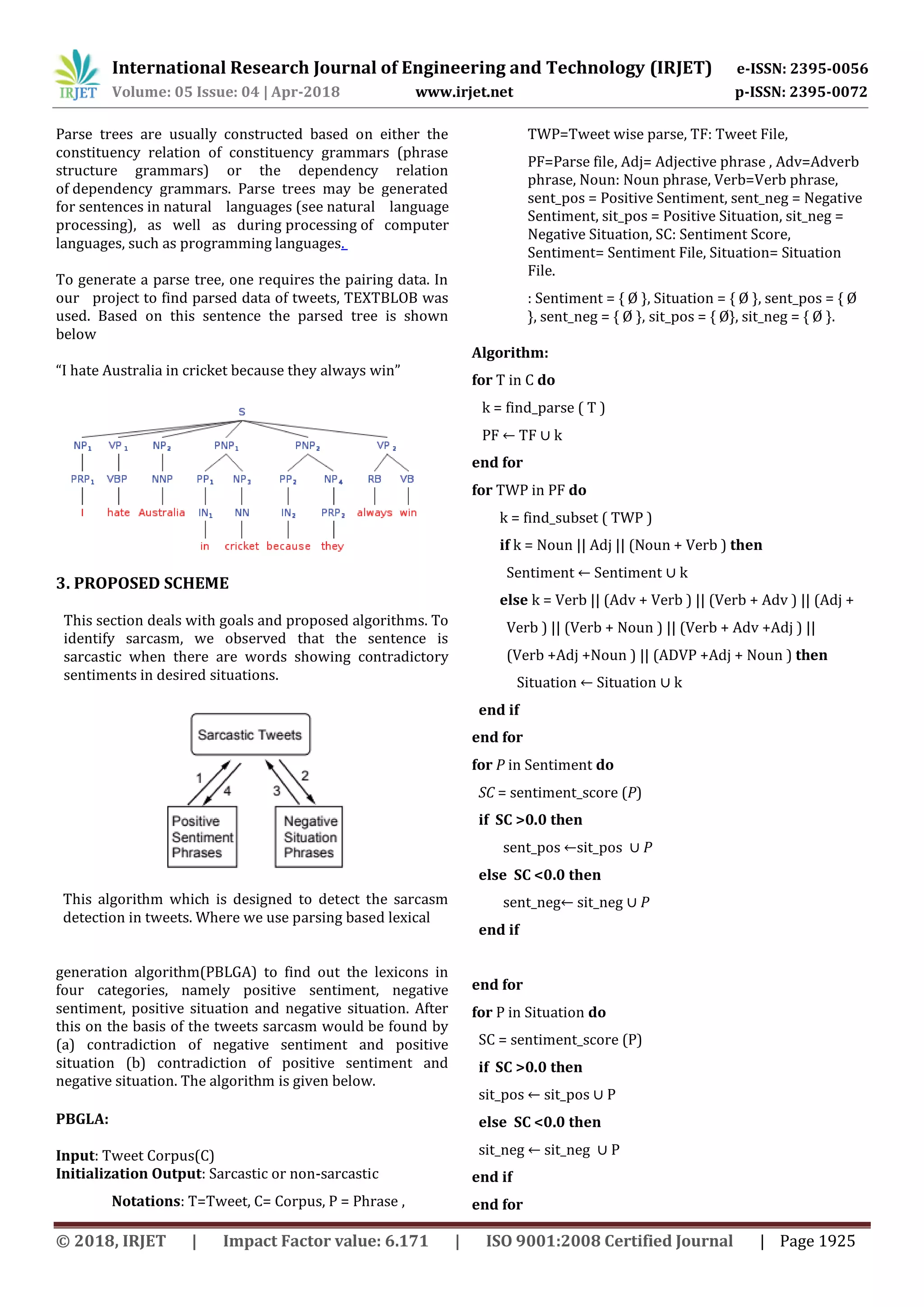
To generate a parse tree, one requires the pairing data. In
our project to find parsed data of tweets, TEXTBLOB was
used. Based on this sentence the parsed tree is shown
below
“I hate Australia in cricket because they always win”
3. PROPOSED SCHEME
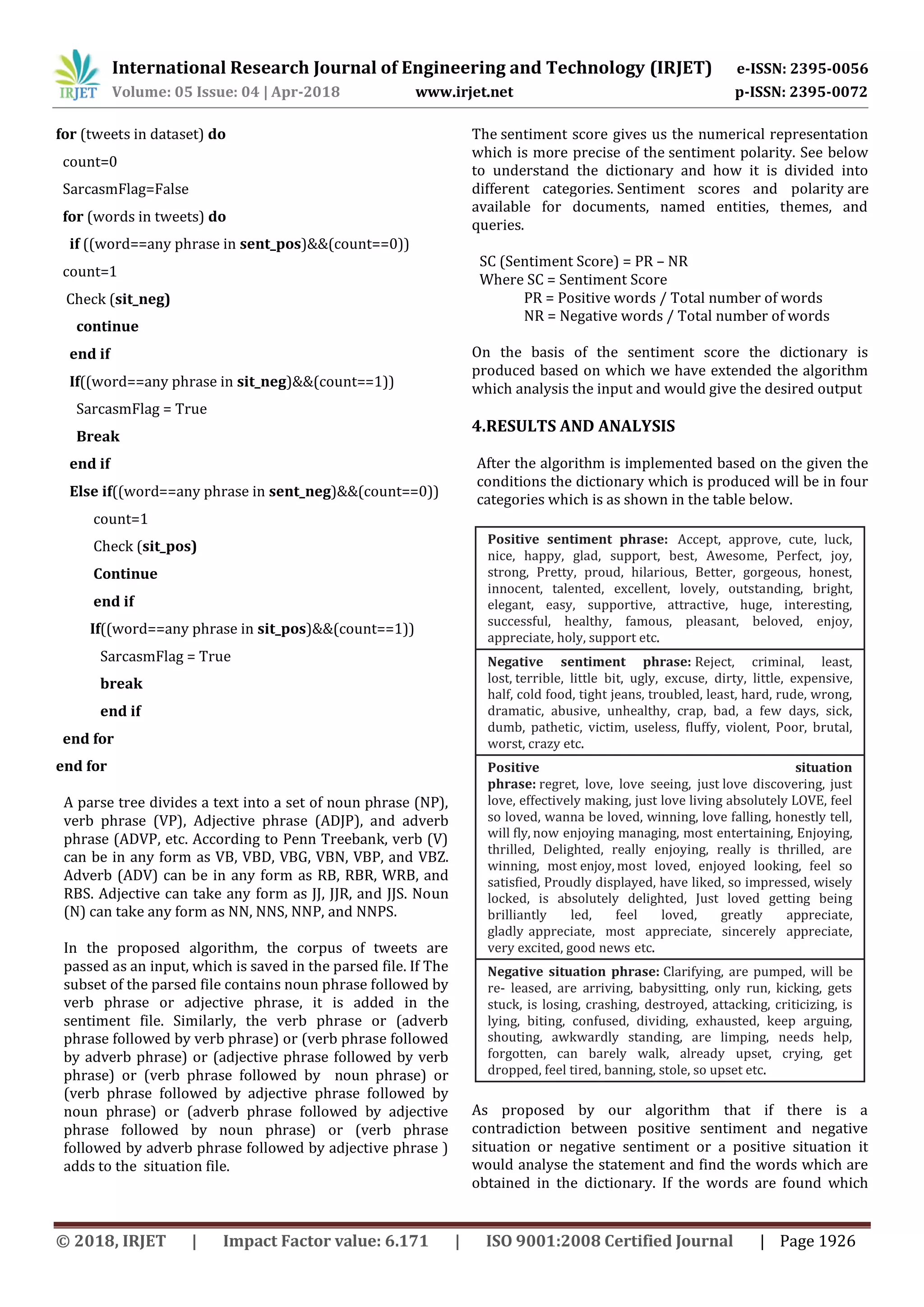
This section deals with goals and proposed algorithms. To
identify sarcasm, we observed that the sentence is
sarcastic when there are words showing contradictory
sentiments in desired situations.
This algorithm which is designed to detect the sarcasm
detection in tweets. Where we use parsing based lexical
generation algorithm(PBLGA) to find out the lexicons in
four categories, namely positive sentiment, negative
sentiment, positive situation and negative situation. After
this on the basis of the tweets sarcasm would be found by
(a) contradiction of negative sentiment and positive
situation (b) contradiction of positive sentiment and
negative situation. The algorithm is given below.
PBGLA:
Input: Tweet Corpus(C)
Initialization Output: Sarcastic or non-sarcastic
Notations: T=Tweet, C= Corpus, P = Phrase ,
TWP=Tweet wise parse, TF: Tweet File,
PF=Parse file, Adj= Adjective phrase , Adv=Adverb
phrase, Noun: Noun phrase, Verb=Verb phrase,
sent_pos = Positive Sentiment, sent_neg = Negative
Sentiment, sit_pos = Positive Situation, sit_neg =
Negative Situation, SC: Sentiment Score,
Sentiment= Sentiment File, Situation= Situation
File.
: Sentiment = { Ø }, Situation = { Ø }, sent_pos = { Ø
}, sent_neg = { Ø }, sit_pos = { Ø}, sit_neg = { Ø }.
Algorithm:
for T in C do
k = find_parse ( T )
PF ← TF ∪ k
end for
for TWP in PF do
k = find_subset ( TWP )
if k = Noun || Adj || (Noun + Verb ) then
Sentiment ← Sentiment ∪ k
else k = Verb || (Adv + Verb ) || (Verb + Adv ) || (Adj +
Verb ) || (Verb + Noun ) || (Verb + Adv +Adj ) ||
(Verb +Adj +Noun ) || (ADVP +Adj + Noun ) then
Situation ← Situation ∪ k
end if
end for
for P in Sentiment do
SC = sentiment_score (P)
if SC >0.0 then
sent_pos ←sit_pos ∪ P
else SC <0.0 then
sent_neg← sit_neg ∪ P
end if
end for
for P in Situation do
SC = sentiment_score (P)
if SC >0.0 then
sit_pos ← sit_pos ∪ P
else SC <0.0 then
sit_neg ← sit_neg ∪ P
end if
end for
International Research Journal of Engineering and Technology (IRJET) e-ISSN: 2395-0056
Volume: 05 Issue: 04 | Apr-2018 www.irjet.net p-ISSN: 2395-0072
© 2018, IRJET | Impact Factor value: 6.171 | ISO 9001:2008 Certified Journal | Page 1926
for (tweets in dataset) do
count=0
SarcasmFlag=False
for (words in tweets) do
if ((word==any phrase in sent_pos)&&(count==0))
count=1
Check (sit_neg)
continue
end if
If((word==any phrase in sit_neg)&&(count==1))
SarcasmFlag = True
Break
end if
Else if((word==any phrase in sent_neg)&&(count==0))
count=1
Check (sit_pos)
Continue
end if
If((word==any phrase in sit_pos)&&(count==1))
SarcasmFlag = True
break
end if
end for
end for
A parse tree divides a text into a set of noun phrase (NP),
verb phrase (VP), Adjective phrase (ADJP), and adverb
phrase (ADVP, etc. According to Penn Treebank, verb (V)
can be in any form as VB, VBD, VBG, VBN, VBP, and VBZ.
Adverb (ADV) can be in any form as RB, RBR, WRB, and
RBS. Adjective can take any form as JJ, JJR, and JJS. Noun
(N) can take any form as NN, NNS, NNP, and NNPS.
In the proposed algorithm, the corpus of tweets are
passed as an input, which is saved in the parsed file. If The
subset of the parsed file contains noun phrase followed by
verb phrase or adjective phrase, it is added in the
sentiment file. Similarly, the verb phrase or (adverb
phrase followed by verb phrase) or (verb phrase followed
by adverb phrase) or (adjective phrase followed by verb
phrase) or (verb phrase followed by noun phrase) or
(verb phrase followed by adjective phrase followed by
noun phrase) or (adverb phrase followed by adjective
phrase followed by noun phrase) or (verb phrase
followed by adverb phrase followed by adjective phrase )
adds to the situation file.
The sentiment score gives us the numerical representation
which is more precise of the sentiment polarity. See below
to understand the dictionary and how it is divided into
different categories. Sentiment scores and polarity are
available for documents, named entities, themes, and
queries.
SC (Sentiment Score) = PR – NR
Where SC = Sentiment Score
PR = Positive words / Total number of words
NR = Negative words / Total number of words
On the basis of the sentiment score the dictionary is
produced based on which we have extended the algorithm
which analysis the input and would give the desired output
4.RESULTS AND ANALYSIS
After the algorithm is implemented based on the given the
conditions the dictionary which is produced will be in four
categories which is as shown in the table below.
Positive sentiment phrase: Accept, approve, cute, luck,
nice, happy, glad, support, best, Awesome, Perfect, joy,
strong, Pretty, proud, hilarious, Better, gorgeous, honest,
innocent, talented, excellent, lovely, outstanding, bright,
elegant, easy, supportive, attractive, huge, interesting,
successful, healthy, famous, pleasant, beloved, enjoy,
appreciate, holy, support etc.
Negative sentiment phrase: Reject, criminal, least,
lost, terrible, little bit, ugly, excuse, dirty, little, expensive,
half, cold food, tight jeans, troubled, least, hard, rude, wrong,
dramatic, abusive, unhealthy, crap, bad, a few days, sick,
dumb, pathetic, victim, useless, fluffy, violent, Poor, brutal,
worst, crazy etc.
Positive situation
phrase: regret, love, love seeing, just love discovering, just
love, effectively making, just love living absolutely LOVE, feel
so loved, wanna be loved, winning, love falling, honestly tell,
will fly, now enjoying managing, most entertaining, Enjoying,
thrilled, Delighted, really enjoying, really is thrilled, are
winning, most enjoy, most loved, enjoyed looking, feel so
satisfied, Proudly displayed, have liked, so impressed, wisely
locked, is absolutely delighted, Just loved getting being
brilliantly led, feel loved, greatly appreciate,
gladly appreciate, most appreciate, sincerely appreciate,
very excited, good news etc.
Negative situation phrase: Clarifying, are pumped, will be
re- leased, are arriving, babysitting, only run, kicking, gets
stuck, is losing, crashing, destroyed, attacking, criticizing, is
lying, biting, confused, dividing, exhausted, keep arguing,
shouting, awkwardly standing, are limping, needs help,
forgotten, can barely walk, already upset, crying, get
dropped, feel tired, banning, stole, so upset etc.
As proposed by our algorithm that if there is a
contradiction between positive sentiment and negative
situation or negative sentiment or a positive situation it
would analyse the statement and find the words which are
obtained in the dictionary. If the words are found which
International Research Journal of Engineering and Technology (IRJET) e-ISSN: 2395-0056
Volume: 05 Issue: 04 | Apr-2018 www.irjet.net p-ISSN: 2395-0072
© 2018, IRJET | Impact Factor value: 6.171 | ISO 9001:2008 Certified Journal | Page 1927
matches the condition, it will give an output as the
sentence sarcastic or else the sentence is non- sarcastic.
5. IMPLEMENTATION
The working of Sarcasm Detection is quite simple. The user
has to give a tweet after which it will analyze and detect
the
sarcasm in the given tweet. The GUI will be displayed as
shown below:
Now, the user can enter a tweet in the Textbox below. Here
the sentence is “ I love how you are using violence to
threaten people. When, your argument is disputing
violence.” The words love (Positive Sentiment) and
threaten (negative situation) contradicts the statement, so
the output is sarcastic.
Here the input given is “You blame others for your failure
to understand the basics.” This tweet is a normal sentence
so it is detected as non-sarcastic statement.
6. CONCLUSION
In this analysis, we considered various reviews which were
given about different products which will help in extracting
the concerned tweets of the respective products.
The lexicon approach provided with the polarity of the
words with positive or negative words are distinguished
accordingly. The Natural Language Toolkit(NLTK) deals
with the various problems faced in differentiating between
the words, i.e., noun or adverbs, adjectives which helped us
to improve total accuracy of the results obtained. A number
of works has been done for informal reviews and blogs. But
we look forward to product services and help those
services to obtain genuine reviews on their products. The
previous stages comprised of developing the system
features a working on the core product which will fulfill all
the essential features. This application interface to gain
results for the application developers with the ability to
make it easier for the product companies to utilize this
feature of the system.
7.ACKNOWLEDGEMENTS
We sincerely express our deepest gratitude to our Principal
Dr. Bhavesh Patel, our Head of Department Prof. Swati
Deshpande and project supervisor Prof. Ashwini
Deshmukh. We were fortunate to have met such
supervisors. We like to express our thankfulness for their
kind supervision and offering unfailing support, invaluable
advices and comments and helpful and useful discussions in
selecting the interesting point and during the preparation
of this BIG project. We owe A special acknowledgment to
them for giving us a lot of their time during the period of
preparing this project. We could never had done it without
their support, technical advice and suggestions, thorough
reading of all our work.
7. REFERENCES
[1] Tomoaki Ohtsuki --Sarcasm Detection in Twitter “All
your products are incredibly amazing!!!” – Are They Really?
IEEE, December 2014.
[2] Ellen Riloff --Sarcasm as Contrast between a Positive
Sentiment and Negative Situation. ACL,pp. 704-714,2013.
[3] Ashwin Rajadesingan --Sarcasm Detection on Twitter: A
Behavioral Modeling Approach. ACM, pp. 97-106, February
2015.
[4] Santosh Kumar Bharti --Parsing-based Sarcasm
Sentiment Recognition in Twitter Data. IEEE/ACM, pp.
1373-1380, August 2015.
[5] Satoshi Hiai --A Sarcasm Extraction Method Based on
Patterns of Evaluation Expressions. IEEE, pp. 31 - 36, July
2016.

IRJET- A System for Determining Sarcasm in Tweets: Sarcasm Detector

  • 1.
    International Research Journalof Engineering and Technology (IRJET) e-ISSN: 2395-0056 Volume: 05 Issue: 04 | Apr-2018 www.irjet.net p-ISSN: 2395-0072 © 2018, IRJET | Impact Factor value: 6.171 | ISO 9001:2008 Certified Journal | Page 1924 A SYSTEM FOR DETERMINING SARCASM IN TWEETS: SARCASM DETECTOR Shweta Gupta1, Malav Shah2, Sanket Shah3, Ashwini Deshmukh4 1,2,3 Department of Information Technology, Shah and Anchor Kutchhi Engineering College, Mumbai, India. 4AssistantProfessor Department of Information Technology, Shah and Anchor Kutchhi Engineering College, Mumbai, India. ---------------------------------------------------------------------***--------------------------------------------------------------------- Abstract - Sarcasm is form of irony which conveys an opinion or a sentiment about a particular target object. Feedback of the customers are more essential for a particular product to know about the flaws and the criteria in which they need to improve. It is basically identified by a user’s tone of speech and certain gestures which indirectly expresses sarcasm. Since the conventional approaches of collecting feedbacks through interviews and questionnaires was too time consuming, so we propose an approach of a desktop application which would help in analyzing the product reviews and further help in improving the products. A dictionary of words will be created in the basis of sentiment analysis and polarity of a statement. Based on the dictionary the tweet is classified as sarcastic or non-sarcastic. Key Words: PBGLA, POS Tagging, Parse Tree, Sentiment Analysis. 1.INTRODUCTION Twitter has become one of the biggest web destinations for users to express their opinions and thoughts. Many companies and organizations have been interested in these data for the purpose of studying the opinion of people towards political events, popular products or movies. Throughout the last few years, Twitter content continued to increase: hundreds of millions of tweets are sent everyday by more than 285 million active users. Furthermore, presence of sarcasm makes the task even more challenging: sarcasm is when a person says something different from what he means. However, due to the informal language used in Twitter and the limitation in terms of characters (i.e., 140 characters per tweet), understanding the opinions of users and performing such analysis is quite difficult. Some people are more sarcastic than others, in general, sarcasm is very common, though, difficult to recognize. 2.SARCASM DETECTION Sarcasm can be manifested in many different ways, but recognizing sarcasm is important for natural language processing to avoid misinterpreting sarcastic statements as literal. Sarcasm is generally characterized as ironic wit that is moreover intended to insult, amuse or mock. For example, sentiment analysis can be easily misled by the presence of words that have a strong polarity but are used sarcastically, which means that the opposite polarity was intended. Consider the following tweet on Twitter, which includes the words “yay” and “thrilled” but actually expresses a negative sentiment: “yay! it’s a holiday weekend and I’m on call for work! couldn’t be more thrilled!”- Sarcastic statement. In this case, it reveals the intended sarcasm, but we don’t always have the benefit of an explicit sarcasm label. (a) Yes, let's all cheer on the glorified shameless point- farming bitch of this site. (b) I love how you are using violence to threaten people. when, your argument is disputing violence. (c) I love how scum barge doesn't give a rebuttal to this. he knows you have him by the balls. The sarcasm in these tweets arises from the juxtaposition of a positive sentiment word (e.g., love, cheer) with a negative activity or state (e.g. Rebuttal, shameless, violence). 2.1 Part-of-Speech (POS) Tagging It is a python-based package working on NLTK (Natural Language Toolkit), and freely available on the internet. Penn Treebank Tag Set notations such as JJ-adjective, NN- noun, RB-adverb, VB-verb, and UH-interjection, etc. were used. It is a process of taking a word from text (corpus) as input and assign corresponding part-of-speech to each word as output based on its definition and context i.e. relationship with adjacent and related words in a phrase, sentence, or paragraph. In this paper, TEXTBLOB was deployed to calculate POS tagging and parsing of the given text. 2.2 Parsing and parse tree The term parse tree itself in computational linguistics is primarily used in theoretical syntax, the term syntax tree is more common. A parse tree or parsing tree or derivation tree or concrete syntax tree is an ordered, rooted tree that represents the syntactic structure of a string according to some context-free grammar.
  • 2.
    International Research Journalof Engineering and Technology (IRJET) e-ISSN: 2395-0056 Volume: 05 Issue: 04 | Apr-2018 www.irjet.net p-ISSN: 2395-0072 © 2018, IRJET | Impact Factor value: 6.171 | ISO 9001:2008 Certified Journal | Page 1925 Parse trees are usually constructed based on either the constituency relation of constituency grammars (phrase structure grammars) or the dependency relation of dependency grammars. Parse trees may be generated for sentences in natural languages (see natural language processing), as well as during processing of computer languages, such as programming languages. To generate a parse tree, one requires the pairing data. In our project to find parsed data of tweets, TEXTBLOB was used. Based on this sentence the parsed tree is shown below “I hate Australia in cricket because they always win” 3. PROPOSED SCHEME This section deals with goals and proposed algorithms. To identify sarcasm, we observed that the sentence is sarcastic when there are words showing contradictory sentiments in desired situations. This algorithm which is designed to detect the sarcasm detection in tweets. Where we use parsing based lexical generation algorithm(PBLGA) to find out the lexicons in four categories, namely positive sentiment, negative sentiment, positive situation and negative situation. After this on the basis of the tweets sarcasm would be found by (a) contradiction of negative sentiment and positive situation (b) contradiction of positive sentiment and negative situation. The algorithm is given below. PBGLA: Input: Tweet Corpus(C) Initialization Output: Sarcastic or non-sarcastic Notations: T=Tweet, C= Corpus, P = Phrase , TWP=Tweet wise parse, TF: Tweet File, PF=Parse file, Adj= Adjective phrase , Adv=Adverb phrase, Noun: Noun phrase, Verb=Verb phrase, sent_pos = Positive Sentiment, sent_neg = Negative Sentiment, sit_pos = Positive Situation, sit_neg = Negative Situation, SC: Sentiment Score, Sentiment= Sentiment File, Situation= Situation File. : Sentiment = { Ø }, Situation = { Ø }, sent_pos = { Ø }, sent_neg = { Ø }, sit_pos = { Ø}, sit_neg = { Ø }. Algorithm: for T in C do k = find_parse ( T ) PF ← TF ∪ k end for for TWP in PF do k = find_subset ( TWP ) if k = Noun || Adj || (Noun + Verb ) then Sentiment ← Sentiment ∪ k else k = Verb || (Adv + Verb ) || (Verb + Adv ) || (Adj + Verb ) || (Verb + Noun ) || (Verb + Adv +Adj ) || (Verb +Adj +Noun ) || (ADVP +Adj + Noun ) then Situation ← Situation ∪ k end if end for for P in Sentiment do SC = sentiment_score (P) if SC >0.0 then sent_pos ←sit_pos ∪ P else SC <0.0 then sent_neg← sit_neg ∪ P end if end for for P in Situation do SC = sentiment_score (P) if SC >0.0 then sit_pos ← sit_pos ∪ P else SC <0.0 then sit_neg ← sit_neg ∪ P end if end for
  • 3.
    International Research Journalof Engineering and Technology (IRJET) e-ISSN: 2395-0056 Volume: 05 Issue: 04 | Apr-2018 www.irjet.net p-ISSN: 2395-0072 © 2018, IRJET | Impact Factor value: 6.171 | ISO 9001:2008 Certified Journal | Page 1926 for (tweets in dataset) do count=0 SarcasmFlag=False for (words in tweets) do if ((word==any phrase in sent_pos)&&(count==0)) count=1 Check (sit_neg) continue end if If((word==any phrase in sit_neg)&&(count==1)) SarcasmFlag = True Break end if Else if((word==any phrase in sent_neg)&&(count==0)) count=1 Check (sit_pos) Continue end if If((word==any phrase in sit_pos)&&(count==1)) SarcasmFlag = True break end if end for end for A parse tree divides a text into a set of noun phrase (NP), verb phrase (VP), Adjective phrase (ADJP), and adverb phrase (ADVP, etc. According to Penn Treebank, verb (V) can be in any form as VB, VBD, VBG, VBN, VBP, and VBZ. Adverb (ADV) can be in any form as RB, RBR, WRB, and RBS. Adjective can take any form as JJ, JJR, and JJS. Noun (N) can take any form as NN, NNS, NNP, and NNPS. In the proposed algorithm, the corpus of tweets are passed as an input, which is saved in the parsed file. If The subset of the parsed file contains noun phrase followed by verb phrase or adjective phrase, it is added in the sentiment file. Similarly, the verb phrase or (adverb phrase followed by verb phrase) or (verb phrase followed by adverb phrase) or (adjective phrase followed by verb phrase) or (verb phrase followed by noun phrase) or (verb phrase followed by adjective phrase followed by noun phrase) or (adverb phrase followed by adjective phrase followed by noun phrase) or (verb phrase followed by adverb phrase followed by adjective phrase ) adds to the situation file. The sentiment score gives us the numerical representation which is more precise of the sentiment polarity. See below to understand the dictionary and how it is divided into different categories. Sentiment scores and polarity are available for documents, named entities, themes, and queries. SC (Sentiment Score) = PR – NR Where SC = Sentiment Score PR = Positive words / Total number of words NR = Negative words / Total number of words On the basis of the sentiment score the dictionary is produced based on which we have extended the algorithm which analysis the input and would give the desired output 4.RESULTS AND ANALYSIS After the algorithm is implemented based on the given the conditions the dictionary which is produced will be in four categories which is as shown in the table below. Positive sentiment phrase: Accept, approve, cute, luck, nice, happy, glad, support, best, Awesome, Perfect, joy, strong, Pretty, proud, hilarious, Better, gorgeous, honest, innocent, talented, excellent, lovely, outstanding, bright, elegant, easy, supportive, attractive, huge, interesting, successful, healthy, famous, pleasant, beloved, enjoy, appreciate, holy, support etc. Negative sentiment phrase: Reject, criminal, least, lost, terrible, little bit, ugly, excuse, dirty, little, expensive, half, cold food, tight jeans, troubled, least, hard, rude, wrong, dramatic, abusive, unhealthy, crap, bad, a few days, sick, dumb, pathetic, victim, useless, fluffy, violent, Poor, brutal, worst, crazy etc. Positive situation phrase: regret, love, love seeing, just love discovering, just love, effectively making, just love living absolutely LOVE, feel so loved, wanna be loved, winning, love falling, honestly tell, will fly, now enjoying managing, most entertaining, Enjoying, thrilled, Delighted, really enjoying, really is thrilled, are winning, most enjoy, most loved, enjoyed looking, feel so satisfied, Proudly displayed, have liked, so impressed, wisely locked, is absolutely delighted, Just loved getting being brilliantly led, feel loved, greatly appreciate, gladly appreciate, most appreciate, sincerely appreciate, very excited, good news etc. Negative situation phrase: Clarifying, are pumped, will be re- leased, are arriving, babysitting, only run, kicking, gets stuck, is losing, crashing, destroyed, attacking, criticizing, is lying, biting, confused, dividing, exhausted, keep arguing, shouting, awkwardly standing, are limping, needs help, forgotten, can barely walk, already upset, crying, get dropped, feel tired, banning, stole, so upset etc. As proposed by our algorithm that if there is a contradiction between positive sentiment and negative situation or negative sentiment or a positive situation it would analyse the statement and find the words which are obtained in the dictionary. If the words are found which
  • 4.
    International Research Journalof Engineering and Technology (IRJET) e-ISSN: 2395-0056 Volume: 05 Issue: 04 | Apr-2018 www.irjet.net p-ISSN: 2395-0072 © 2018, IRJET | Impact Factor value: 6.171 | ISO 9001:2008 Certified Journal | Page 1927 matches the condition, it will give an output as the sentence sarcastic or else the sentence is non- sarcastic. 5. IMPLEMENTATION The working of Sarcasm Detection is quite simple. The user has to give a tweet after which it will analyze and detect the sarcasm in the given tweet. The GUI will be displayed as shown below: Now, the user can enter a tweet in the Textbox below. Here the sentence is “ I love how you are using violence to threaten people. When, your argument is disputing violence.” The words love (Positive Sentiment) and threaten (negative situation) contradicts the statement, so the output is sarcastic. Here the input given is “You blame others for your failure to understand the basics.” This tweet is a normal sentence so it is detected as non-sarcastic statement. 6. CONCLUSION In this analysis, we considered various reviews which were given about different products which will help in extracting the concerned tweets of the respective products. The lexicon approach provided with the polarity of the words with positive or negative words are distinguished accordingly. The Natural Language Toolkit(NLTK) deals with the various problems faced in differentiating between the words, i.e., noun or adverbs, adjectives which helped us to improve total accuracy of the results obtained. A number of works has been done for informal reviews and blogs. But we look forward to product services and help those services to obtain genuine reviews on their products. The previous stages comprised of developing the system features a working on the core product which will fulfill all the essential features. This application interface to gain results for the application developers with the ability to make it easier for the product companies to utilize this feature of the system. 7.ACKNOWLEDGEMENTS We sincerely express our deepest gratitude to our Principal Dr. Bhavesh Patel, our Head of Department Prof. Swati Deshpande and project supervisor Prof. Ashwini Deshmukh. We were fortunate to have met such supervisors. We like to express our thankfulness for their kind supervision and offering unfailing support, invaluable advices and comments and helpful and useful discussions in selecting the interesting point and during the preparation of this BIG project. We owe A special acknowledgment to them for giving us a lot of their time during the period of preparing this project. We could never had done it without their support, technical advice and suggestions, thorough reading of all our work. 7. REFERENCES [1] Tomoaki Ohtsuki --Sarcasm Detection in Twitter “All your products are incredibly amazing!!!” – Are They Really? IEEE, December 2014. [2] Ellen Riloff --Sarcasm as Contrast between a Positive Sentiment and Negative Situation. ACL,pp. 704-714,2013. [3] Ashwin Rajadesingan --Sarcasm Detection on Twitter: A Behavioral Modeling Approach. ACM, pp. 97-106, February 2015. [4] Santosh Kumar Bharti --Parsing-based Sarcasm Sentiment Recognition in Twitter Data. IEEE/ACM, pp. 1373-1380, August 2015. [5] Satoshi Hiai --A Sarcasm Extraction Method Based on Patterns of Evaluation Expressions. IEEE, pp. 31 - 36, July 2016.