Research Methodology
Unit-II
By:
Dr. Parveen Vashisth
Assistant Professor
Department of Business Administration
CDLU, Sirsa
Research Design:
A research design is the arrangement of conditions for collection
and analysis of data in a manner that aims to combine relevance
to the research purpose with economy in procedure.
The research design is the conceptual structure within which
research is conducted. It constitutes the blueprint for collection,
measurement and analysis of data.
As such the design includes an outline of what the researcher
will do from writing the hypothesis and its operational
implications to final analysis of data.
The research design happens in respect of:
1. What is the study about?
2. Why is the study being made?
3. Where will the study be carried out?
4. What type of data is required?
5. Where can the required data be found?
6. What period of time will the study include?
7. What will be the sample design?
8. What technique of data collection will be used?
9. How will the data be analyzed?
10. In what style will the report be prepared?
Need for research design:
1. For facilitate the smooth sailing of various research operations.
2. For reducing the research cost.
3. For yielding the maximum information about objective.
4. For better qualitative data collection.
5. For better data analysis.
6. For better report preparation.
7. For easily removing the research problems.
8. For efficient and appropriate research.
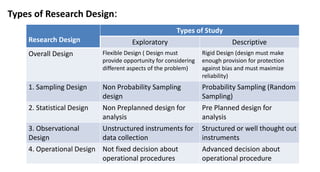
Types of Research Design:
Research Design
Types of Study
Exploratory Descriptive
Overall Design Flexible Design ( Design must
provide opportunity for considering
different aspects of the problem)
Rigid Design (design must make
enough provision for protection
against bias and must maximize
reliability)
1. Sampling Design Non Probability Sampling
design
Probability Sampling (Random
Sampling)
2. Statistical Design Non Preplanned design for
analysis
Pre Planned design for
analysis
3. Observational
Design
Unstructured instruments for
data collection
Structured or well thought out
instruments
4. Operational Design Not fixed decision about
operational procedures
Advanced decision about
operational procedure
Universe/ Population: All the items in any field of inquiry is Universe or Population.
Survey:
• To collect information from the Universe is called Survey.
Census Survey
• A complete enumeration of all items in the population is known as Census Survey.
• It is obvious that for any study or investigation census is rather infeasible. It is
impossible in the situation when population is infinite.
• In some cases when population is finite but the units are destroyed while
inspected, survey is not at all desirable.
Sample Survey:
• When only subpart of total population is selected for survey is called Sample
Survey.
• When having shortage of time and money such survey is conducted.
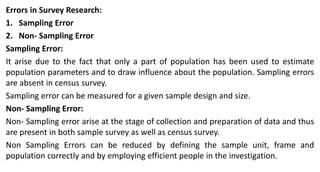
Errors in Survey Research:
1. Sampling Error
2. Non- Sampling Error
Sampling Error:
It arise due to the fact that only a part of population has been used to estimate
population parameters and to draw influence about the population. Sampling errors
are absent in census survey.
Sampling error can be measured for a given sample design and size.
Non- Sampling Error:
Non- Sampling error arise at the stage of collection and preparation of data and thus
are present in both sample survey as well as census survey.
Non Sampling Errors can be reduced by defining the sample unit, frame and
population correctly and by employing efficient people in the investigation.
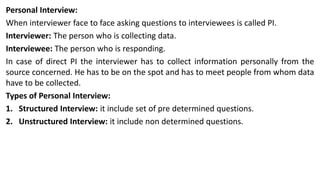
Personal Interview:
When interviewer face to face asking questions to interviewees is called PI.
Interviewer: The person who is collecting data.
Interviewee: The person who is responding.
In case of direct PI the interviewer has to collect information personally from the
source concerned. He has to be on the spot and has to meet people from whom data
have to be collected.
Types of Personal Interview:
1. Structured Interview: it include set of pre determined questions.
2. Unstructured Interview: it include non determined questions.
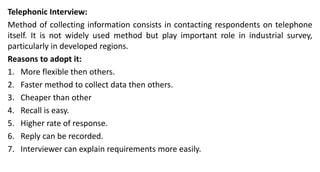
Telephonic Interview:
Method of collecting information consists in contacting respondents on telephone
itself. It is not widely used method but play important role in industrial survey,
particularly in developed regions.
Reasons to adopt it:
1. More flexible then others.
2. Faster method to collect data then others.
3. Cheaper than other
4. Recall is easy.
5. Higher rate of response.
6. Reply can be recorded.
7. Interviewer can explain requirements more easily.
Questionnaire:
A designed set of questions for respondents through which thee will response.
It is used because:
1. It is free from biased.
2. Respondents have adequate time to response.
3. Respondents, who are not easily approachable, can also be reached
conveniently.
4. Large sample can be made use of and results can be more dependable and
reliable.
It includes mainly:
1. General form i.e. Yes/No, Agree/Disagree
2. Question sequence.
3. Question formulation & Wording.
Observation Method:
The most commonly used in behavioral Science. It include, a scientific tool and the
method of data collection for the researcher, when it is serves a formulated research
purpose, is a systematically planned and recorded and is subjected to check and
controls on validity and reliability.
Under this method, the information is sought by way of investigator’s own direct
observation without asking from the respondents.
For example: Respondent asking to brand of wrist watch used by respondent, may
himself look at the watch.
Experimental Research
Experimental research is a study that strictly adheres to a scientific
research design. It includes a hypothesis, a variable that can be
manipulated by the researcher, and variables that can be measured,
calculated and compared. Most importantly, experimental research is
completed in a controlled environment. The researcher collects data and
results will either support or reject the hypothesis. This method of
research is referred to a hypothesis testing or a deductive research
method.
Purpose of Experimental Research
Experimental research seeks to determine a relationship between two (2)
variables—the dependent variable and the independent variable.
After completing an experimental research study, a correlation between a
specific aspect of an entity and the variable being studied is either
supported or rejected.

Research methodology u ii

  • 1.
    Research Methodology Unit-II By: Dr. ParveenVashisth Assistant Professor Department of Business Administration CDLU, Sirsa
  • 2.
    Research Design: A researchdesign is the arrangement of conditions for collection and analysis of data in a manner that aims to combine relevance to the research purpose with economy in procedure. The research design is the conceptual structure within which research is conducted. It constitutes the blueprint for collection, measurement and analysis of data. As such the design includes an outline of what the researcher will do from writing the hypothesis and its operational implications to final analysis of data.
  • 3.
    The research designhappens in respect of: 1. What is the study about? 2. Why is the study being made? 3. Where will the study be carried out? 4. What type of data is required? 5. Where can the required data be found? 6. What period of time will the study include? 7. What will be the sample design? 8. What technique of data collection will be used? 9. How will the data be analyzed? 10. In what style will the report be prepared?
  • 4.
    Need for researchdesign: 1. For facilitate the smooth sailing of various research operations. 2. For reducing the research cost. 3. For yielding the maximum information about objective. 4. For better qualitative data collection. 5. For better data analysis. 6. For better report preparation. 7. For easily removing the research problems. 8. For efficient and appropriate research.
  • 5.
    Types of ResearchDesign: Research Design Types of Study Exploratory Descriptive Overall Design Flexible Design ( Design must provide opportunity for considering different aspects of the problem) Rigid Design (design must make enough provision for protection against bias and must maximize reliability) 1. Sampling Design Non Probability Sampling design Probability Sampling (Random Sampling) 2. Statistical Design Non Preplanned design for analysis Pre Planned design for analysis 3. Observational Design Unstructured instruments for data collection Structured or well thought out instruments 4. Operational Design Not fixed decision about operational procedures Advanced decision about operational procedure
  • 6.
    Universe/ Population: Allthe items in any field of inquiry is Universe or Population. Survey: • To collect information from the Universe is called Survey. Census Survey • A complete enumeration of all items in the population is known as Census Survey. • It is obvious that for any study or investigation census is rather infeasible. It is impossible in the situation when population is infinite. • In some cases when population is finite but the units are destroyed while inspected, survey is not at all desirable. Sample Survey: • When only subpart of total population is selected for survey is called Sample Survey. • When having shortage of time and money such survey is conducted.
  • 7.
    Errors in SurveyResearch: 1. Sampling Error 2. Non- Sampling Error Sampling Error: It arise due to the fact that only a part of population has been used to estimate population parameters and to draw influence about the population. Sampling errors are absent in census survey. Sampling error can be measured for a given sample design and size. Non- Sampling Error: Non- Sampling error arise at the stage of collection and preparation of data and thus are present in both sample survey as well as census survey. Non Sampling Errors can be reduced by defining the sample unit, frame and population correctly and by employing efficient people in the investigation.
  • 8.
    Personal Interview: When interviewerface to face asking questions to interviewees is called PI. Interviewer: The person who is collecting data. Interviewee: The person who is responding. In case of direct PI the interviewer has to collect information personally from the source concerned. He has to be on the spot and has to meet people from whom data have to be collected. Types of Personal Interview: 1. Structured Interview: it include set of pre determined questions. 2. Unstructured Interview: it include non determined questions.
  • 9.
    Telephonic Interview: Method ofcollecting information consists in contacting respondents on telephone itself. It is not widely used method but play important role in industrial survey, particularly in developed regions. Reasons to adopt it: 1. More flexible then others. 2. Faster method to collect data then others. 3. Cheaper than other 4. Recall is easy. 5. Higher rate of response. 6. Reply can be recorded. 7. Interviewer can explain requirements more easily.
  • 10.
    Questionnaire: A designed setof questions for respondents through which thee will response. It is used because: 1. It is free from biased. 2. Respondents have adequate time to response. 3. Respondents, who are not easily approachable, can also be reached conveniently. 4. Large sample can be made use of and results can be more dependable and reliable. It includes mainly: 1. General form i.e. Yes/No, Agree/Disagree 2. Question sequence. 3. Question formulation & Wording.
  • 11.
    Observation Method: The mostcommonly used in behavioral Science. It include, a scientific tool and the method of data collection for the researcher, when it is serves a formulated research purpose, is a systematically planned and recorded and is subjected to check and controls on validity and reliability. Under this method, the information is sought by way of investigator’s own direct observation without asking from the respondents. For example: Respondent asking to brand of wrist watch used by respondent, may himself look at the watch.
  • 12.
    Experimental Research Experimental researchis a study that strictly adheres to a scientific research design. It includes a hypothesis, a variable that can be manipulated by the researcher, and variables that can be measured, calculated and compared. Most importantly, experimental research is completed in a controlled environment. The researcher collects data and results will either support or reject the hypothesis. This method of research is referred to a hypothesis testing or a deductive research method. Purpose of Experimental Research Experimental research seeks to determine a relationship between two (2) variables—the dependent variable and the independent variable. After completing an experimental research study, a correlation between a specific aspect of an entity and the variable being studied is either supported or rejected.