Chapter – 3
Research Problem –
Identification and Formulation
2
Contents
 Research Problem – Meaning
 Selecting a Research Problem – A Point of
Caution
 Research Problem – Sources of
identification
 Defining the Research Problem – Steps
Involved
3
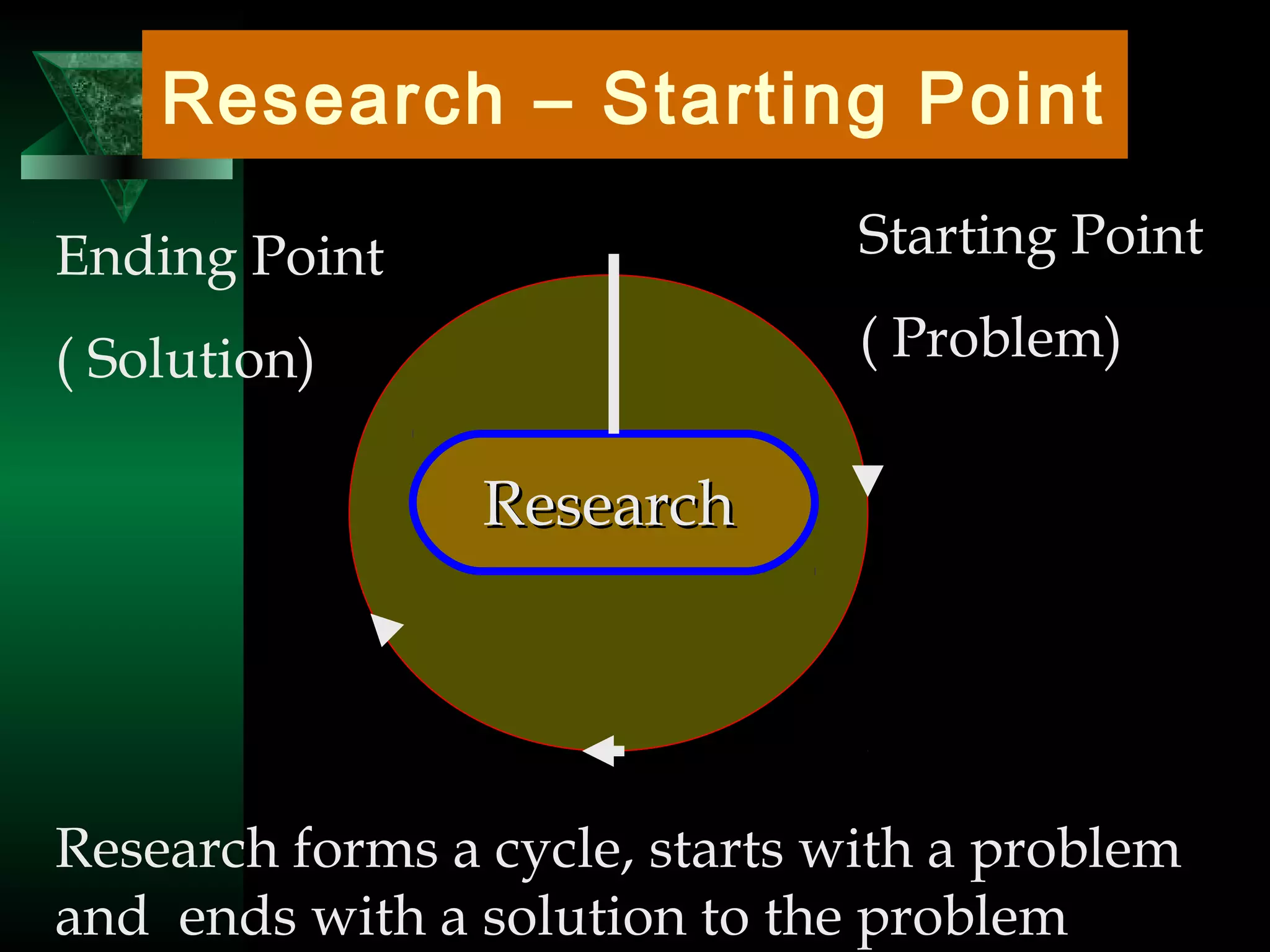
Research – Starting Point
Ending Point
( Solution)
Starting Point
( Problem)
Research forms a cycle, starts with a problem
and ends with a solution to the problem
ResearchResearch
4
A research problem is the demarcation
of a problem area within a certain
context involving the WHO or WHAT,
the WHERE, the WHEN and the WHY
of the problem situation.
Research Problem - Meaning
5
Selecting a Research Problem
– A Point of Caution
 Subject/theme which is overdone should
not be normally chosen (difficult to add any
new light).
 Too narrow problem/theme should be
avoided.
 Subject without any relevance to the field
of research should not be considered.
6
 Subject familiar to the researcher should
be selected.
 Sources of research material are within
the reach of the researcher.
 Background of the researcher, costs
involved and time factor should be
considered.
7
Research Problem – Sources
of Identification
Problems can be conceptualized at a
number of levels
- Research problem from reading the literature
(Research problems capture the interest of the
researcher while reading).
- Research problem from a conflicting results
- Research problem from own observation/
experience/insight.
8
- Research problem from experience of
others.
- Research problem from informal
discussion with others.
- Research problem from the ideas of
experts.
- Research problem from own knowledge of
the researcher.
9
Defining the Research
Problem
“A problem clearly stated is a problem half
solved”
 Formulation of a problem is often more
essential than its solution.
 Researcher needs to work directly on an
explicitly identified problem.
 Unless the researcher is working directly on the
problem, he is not doing research, but is simply
gathering information.
10
Defining Research Problem
 Defining a problem involves the task of
laying down boundaries within which a
researcher shall study the problem with a
pre-determined objective in view.
11
Benefits of a well defined
Research Problem
 Helps in developing the research design
properly.
- What data are to be collected?
- What sample size is to be decided?
- How to identify the sample units?
- What relations are to be explored?
- What techniques are to be used to analyze the data?
etc.
12
Steps involved in Defining a
Research Problem
 State the problem in a general way.
 Understand the nature of the problem.
 Survey the available literature.
 Develop the ideas through discussions.
 Finalize the research problem.
13
State the Problem in a
General Way
 Problem should be stated in a broad
general way.
 Undertake some sort of preliminary survey
(pilot survey).
 Narrow the problem to specific issues.
 Thinking and rethinking over the problem
will clear several ambiguities.
14
Understand the Nature of the
Problem
 Understand the origin and nature of the
problem.
 Discuss the problem with others having a
good knowledge of the problem concerned.
15
Survey the Available
Literature
 Must be well-conversant with relevant theories in
the field.
 Reports and records be surveyed.
 Review research already undertaken on related
problems.
 Find out the data and materials available for
operational purposes.
 Assess gaps in theories and how far the existing
theories applicable to the problem.
16
Develop the Ideas through
Discussions
 Discuss about the problem with others
having enough experience in the same
area – experience survey.
 Focus attention on specific aspects.
 Discussions should also be on the
techniques and possible solutions, etc.
17
Finalize the Research
Problem
 Finalize the research problem into working
proposition.
 Develop the problem in as specific terms
as possible for developing working
hypotheses.
18
Additional Points in Defining
Problem
 Basic assumptions relating to the problem should be
clearly stated.
 Criteria for the selection of the problem should be
provided.
 Suitability of the time-period and sources of data
must be considered.
 Scope of the investigation must be mentioned.
 Limitations within which the problem is to be studied
must be stated in defining research problem.
19
Setting objectives and framing
research questions
Group Activity

Chapter – 3 (research problem)

  • 1.
    Chapter – 3 ResearchProblem – Identification and Formulation
  • 2.
    2 Contents  Research Problem– Meaning  Selecting a Research Problem – A Point of Caution  Research Problem – Sources of identification  Defining the Research Problem – Steps Involved
  • 3.
    3 Research – StartingPoint Ending Point ( Solution) Starting Point ( Problem) Research forms a cycle, starts with a problem and ends with a solution to the problem ResearchResearch
  • 4.
    4 A research problemis the demarcation of a problem area within a certain context involving the WHO or WHAT, the WHERE, the WHEN and the WHY of the problem situation. Research Problem - Meaning
  • 5.
    5 Selecting a ResearchProblem – A Point of Caution  Subject/theme which is overdone should not be normally chosen (difficult to add any new light).  Too narrow problem/theme should be avoided.  Subject without any relevance to the field of research should not be considered.
  • 6.
    6  Subject familiarto the researcher should be selected.  Sources of research material are within the reach of the researcher.  Background of the researcher, costs involved and time factor should be considered.
  • 7.
    7 Research Problem –Sources of Identification Problems can be conceptualized at a number of levels - Research problem from reading the literature (Research problems capture the interest of the researcher while reading). - Research problem from a conflicting results - Research problem from own observation/ experience/insight.
  • 8.
    8 - Research problemfrom experience of others. - Research problem from informal discussion with others. - Research problem from the ideas of experts. - Research problem from own knowledge of the researcher.
  • 9.
    9 Defining the Research Problem “Aproblem clearly stated is a problem half solved”  Formulation of a problem is often more essential than its solution.  Researcher needs to work directly on an explicitly identified problem.  Unless the researcher is working directly on the problem, he is not doing research, but is simply gathering information.
  • 10.
    10 Defining Research Problem Defining a problem involves the task of laying down boundaries within which a researcher shall study the problem with a pre-determined objective in view.
  • 11.
    11 Benefits of awell defined Research Problem  Helps in developing the research design properly. - What data are to be collected? - What sample size is to be decided? - How to identify the sample units? - What relations are to be explored? - What techniques are to be used to analyze the data? etc.
  • 12.
    12 Steps involved inDefining a Research Problem  State the problem in a general way.  Understand the nature of the problem.  Survey the available literature.  Develop the ideas through discussions.  Finalize the research problem.
  • 13.
    13 State the Problemin a General Way  Problem should be stated in a broad general way.  Undertake some sort of preliminary survey (pilot survey).  Narrow the problem to specific issues.  Thinking and rethinking over the problem will clear several ambiguities.
  • 14.
    14 Understand the Natureof the Problem  Understand the origin and nature of the problem.  Discuss the problem with others having a good knowledge of the problem concerned.
  • 15.
    15 Survey the Available Literature Must be well-conversant with relevant theories in the field.  Reports and records be surveyed.  Review research already undertaken on related problems.  Find out the data and materials available for operational purposes.  Assess gaps in theories and how far the existing theories applicable to the problem.
  • 16.
    16 Develop the Ideasthrough Discussions  Discuss about the problem with others having enough experience in the same area – experience survey.  Focus attention on specific aspects.  Discussions should also be on the techniques and possible solutions, etc.
  • 17.
    17 Finalize the Research Problem Finalize the research problem into working proposition.  Develop the problem in as specific terms as possible for developing working hypotheses.
  • 18.
    18 Additional Points inDefining Problem  Basic assumptions relating to the problem should be clearly stated.  Criteria for the selection of the problem should be provided.  Suitability of the time-period and sources of data must be considered.  Scope of the investigation must be mentioned.  Limitations within which the problem is to be studied must be stated in defining research problem.
  • 19.
    19 Setting objectives andframing research questions Group Activity