



TEAM  FACILITATION Presented To: Miss Hafsa Javid
Sameera Dar   1542 Nasiba Waris   139 Salma Bashir   126 Sana Khalid     127 Sobia Ikhlaq   1548
O UTLINE What is facilitation? Barriers of facilitation What facilitators do Skills for appropriate facilitation Benefits of facilitation Strategies & steps to improve team facilitation
O BJECTIVES Team  refers to a group that has decided to work together for the purpose of accomplishing a task. Every time the team members work together, there is a need for someone to help the team work efficiently.The main task of the facilitator is to help a team / group to work as efficiently as possible to accomplish the proposed tasks
What is Team Facilitation?
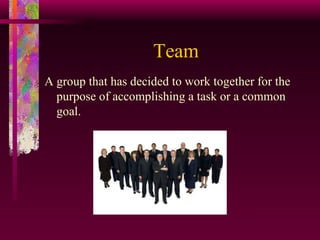
Team A group that has decided to work together for the purpose of accomplishing a task or a common goal.
FACILITATION “ Helping  the team to work efficiently, so that it obtains the desired results as soon as possible.”  ‘ OR’ “ Facilitation is the art of leadership in group communication.”
Team  Facilitation “  A process in which a neutral person (who is  accepted by all group members and has no decision authority) helps the group identifies, solve problems and identify in an effective way.” (Roger Schwarz)
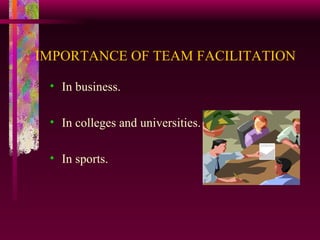
IMPORTANCE OF TEAM FACILITATION In business. In colleges and universities. In sports.
Skills, Knowledge & Capabilities for Team Facilitation Being able to commit to a shared goal. Being able to listen and respond to others. Being open and honest with one’s ideas, concerns and values. Not carrying hidden agendas into team meeting. Being able to be a leader as well as a follower.
Barriers to Facilitation Problems, difficulties or obstacles to facilitate the team members to work smoothly. ‘ OR’ The environment in which people find it difficult to work, to achieve their shared goals .
BARRIERS/PROBLEMS Fears, Expectations, Motivations Mission and Activities Work Rules and Procedures Adjouring Not Knowing Oneself and the Members of the Team Lack of Communication Ambiguous Responsibilities
PROBLEM CREATING SITUATIONS   Working with unknown people Difficulty to cope up with others Difficulty in deciding what to say No or lack of surety about the subject Inability to comment No opportunity to express one’s views Controversial opinion/Difference in opinion
CAUSES OF BARRIERS Competition over scarce resources, time Ambiguity over responsibility and authority Differences in perceptions, work styles, attitudes, communication problems, individual differences  Increasing interdependence as boundaries between individuals and groups become increasingly blurred
Reward systems: we work in situations with complex and often contradictory incentive systems
What   Facilitators Do ? Nasiba Waris - 139
Facilitator “ Facilitator is someone who skillfully helps a group of people understand their common objective and assists them to plan to achieve them without taking a particular position in the discussion.”
Understanding What Facilitators Really Do:  Most people associate the word "facilitator” with training environment. Often, that person at the front of the room leading a training sessions, is referred to as the course facilitator. For example, the chairperson at a meeting often takes on the responsibility for facilitating the meeting, rather than "running it".
Types of Facilitator Business facilitator Training facilitator
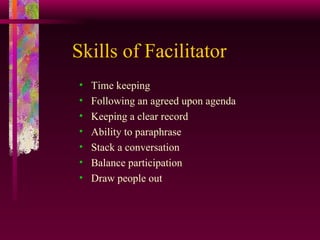
Skills of Facilitator Time keeping Following an agreed upon agenda Keeping a clear record Ability to paraphrase Stack a conversation Balance participation  Draw people out
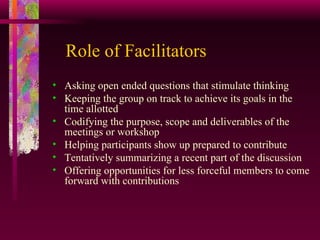
Role of Facilitators Asking open ended questions that stimulate thinking Keeping the group on track to achieve its goals in the time allotted Codifying the purpose, scope and deliverables of the meetings or workshop Helping participants show up prepared to contribute Tentatively summarizing a recent part of the discussion  Offering opportunities for less forceful members to come forward with contributions
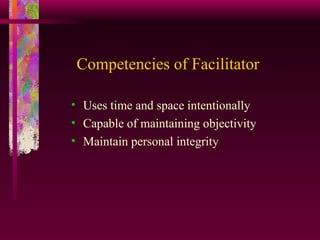
Competencies of Facilitator Uses time and space intentionally Capable of maintaining objectivity Maintain personal integrity
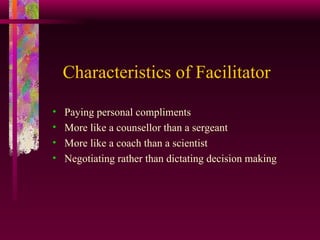
Characteristics of Facilitator Paying personal compliments More like a counsellor than a sergeant More like a coach than a scientist Negotiating rather than dictating decision making
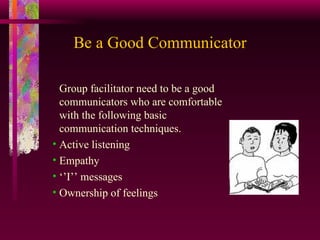
Be a Good Communicator Group facilitator need to be a good communicators who are comfortable with the following basic communication techniques. Active listening Empathy ‘’ I’’ messages Ownership of feelings
Look for a Crime Facilitators Physical facilitator Social facilitator Chemical facilitator
Independent Facilitator “ An independent facilitator respond directly to your dreams desires and personal goals. The facilitator coordinates the planning process and assures that the plan is clear to all planning participants and is ready for implementation”.
Skills For Appropriate Facilitation Salma Bashir-126
Term Facilitation Skills Include Probing without provoking defensiveness Reframing issues and positions Focusing on the meeting Keeping the meeting on track
Key Facilitation Skills Include Probing without provoking defensiveness Reframing issues and positions “ Reframing  is the process of changing the way a   thought is presented so that it maintains its  fundamental meaning but is more likely to support   resolution efforts”
Facilitation Skills Include Focusing the meeting review the charter with the participants review the purpose and outcomes, if no charter is formed review the ground rules to reinforce review the items of discussion and time line
Facilitation Skills  Include Keeping the meeting on track “ Process intervention-  is the interruption  by the facilitator in the meeting process & in conversation in order to refocus the participant or to rebalance group interaction”
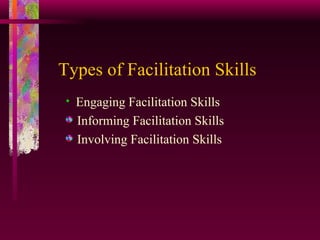
Types of Facilitation Skills Engaging Facilitation Skills Informing Facilitation Skills Involving Facilitation Skills
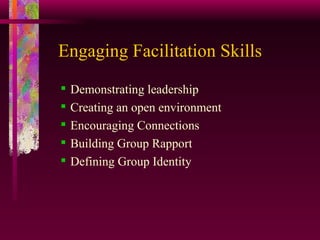
Engaging Facilitation Skills Demonstrating leadership  Creating an open environment  Encouraging Connections Building Group Rapport Defining Group Identity
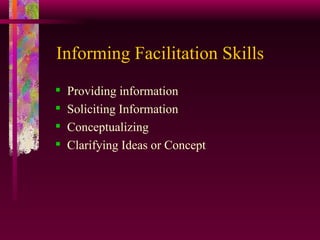
Informing Facilitation Skills Providing information Soliciting Information Conceptualizing Clarifying Ideas or Concept
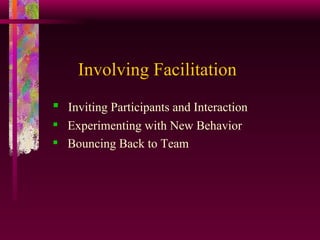
Involving Facilitation Inviting Participants and Interaction Experimenting with New Behavior  Bouncing Back to Team
Ground Rules “ Ground rules are the rules of conduct or behavioral guidelines that members of the group agree on before proceeding with their meeting”.
Ground Rule  -  Characteristics: Participants are expected to attend all meetings Meeting roles will rotate among team members All ideas will be considered Participants are expected to complete action onetime A group list will be set-up for team document
Benefits of   Facilitation     Sana  Khalid - 127
Develop Interpersonal Skills Ability to listen well Flexibility, competitiveness, security and  inclusiveness Ability to participate and contribution Ability to present their own area of expertise Meeting facilitation
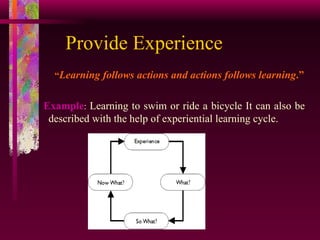
Provide Experience “ Learning follows actions and actions follows learning .” Example :  Learning to swim or ride a bicycle It can also be described with the help of experiential learning cycle.
Eliminate Conflicts Save resources in a longer term Make team positive, clear and skillful Defuse conflicts and move them forward Protect the team from risk Eliminate demotivation Improve communication and understanding Improved individual performance
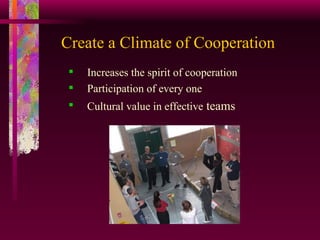
Create a Climate of Cooperation Increases the spirit of cooperation Participation of every one Cultural value in effective  teams
Create Trust Very high levels of commitment  Trustworthy yourself Natural outcome of a culture     Quick Decisions   Less negative dissension  High quality team processing Spirit of cooperation
Development of the Whole Team Identifying and optimizing the talents within a team Setting clear and exciting responsibilities Clarifying ways of working together Building constructive interpersonal relationships Developing recognition systems Creating constructive external team relationships
Easy Solution to Problems Because two or three heads are better than one  higher the level of participant, the greater the productivity    Reduce Time and Cost Have more time to work on high priority issues Improve the overall quality of interactions
Superior Results Extraordinary teams produce superior results  Get super to superior Clear Sense of Direction Clarification and setting of  personal, team goals Coaching the team through the “how” of achieving goals and overcoming potential barriers
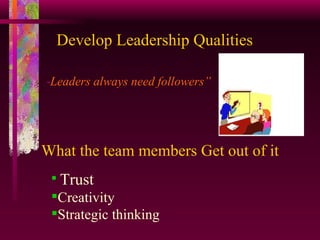
Develop Leadership Qualities “ Leaders always need followers” What the team members Get out of it Trust Creativity Strategic thinking
Strategies to Improve  Team Facilitation Sobia  Ikhlaq - 1548
Appreciative Intelligence Use the power of appreciation   Colleagues have to handle each other with positivity and care .  Expectations By knowing what your colleague expects from you, one can really enhance the performance Realize the negatives which exist in teams  Developing and showing a positive attitude.
Communication Identifying personal communication style  Sharpening verbal and nonverbal Behaviors and skills Relationship Building Brainstorming Group Nominal technique
Brainstorming “ It is a method to stimulate creative thinking based on channeling the energies of a group toward the generation of ideas. The Nominal Group Technique   “ Teamwork technique that allows participants  work together in a structured manner,without  inhibitions or temptations to issue premature  judgments”
Separating Personality Differences from Group Giving And Receiving Feedback: Conflict Resolution Conducting meeting Every team member should add strategic value
High Performance Teams fit naturally into the spectrum of change strategies. As with any change strategy, they have corresponding challenges and opportunities. Successful HPT implementation is dependent upon appropriate organizational timing, placement, and support.  Every team member should add strategic value: “ O brave new world, That has such people in´t !” ( By SHAKESPEAR )
Conclusion
REFRENCES www.google.com www.lycose.com www.ask.com www.intractability.com
Its Your Turn
THANKS

Team Facilitation

  • 1.
    TEAM FACILITATIONPresented To: Miss Hafsa Javid
  • 2.
    Sameera Dar 1542 Nasiba Waris 139 Salma Bashir 126 Sana Khalid 127 Sobia Ikhlaq 1548
  • 3.
    O UTLINE Whatis facilitation? Barriers of facilitation What facilitators do Skills for appropriate facilitation Benefits of facilitation Strategies & steps to improve team facilitation
  • 4.
    O BJECTIVES Team refers to a group that has decided to work together for the purpose of accomplishing a task. Every time the team members work together, there is a need for someone to help the team work efficiently.The main task of the facilitator is to help a team / group to work as efficiently as possible to accomplish the proposed tasks
  • 5.
    What is TeamFacilitation?
  • 6.
    Team A groupthat has decided to work together for the purpose of accomplishing a task or a common goal.
  • 7.
    FACILITATION “ Helping the team to work efficiently, so that it obtains the desired results as soon as possible.” ‘ OR’ “ Facilitation is the art of leadership in group communication.”
  • 8.
    Team Facilitation“ A process in which a neutral person (who is accepted by all group members and has no decision authority) helps the group identifies, solve problems and identify in an effective way.” (Roger Schwarz)
  • 9.
    IMPORTANCE OF TEAMFACILITATION In business. In colleges and universities. In sports.
  • 10.
    Skills, Knowledge &Capabilities for Team Facilitation Being able to commit to a shared goal. Being able to listen and respond to others. Being open and honest with one’s ideas, concerns and values. Not carrying hidden agendas into team meeting. Being able to be a leader as well as a follower.
  • 11.
    Barriers to FacilitationProblems, difficulties or obstacles to facilitate the team members to work smoothly. ‘ OR’ The environment in which people find it difficult to work, to achieve their shared goals .
  • 12.
    BARRIERS/PROBLEMS Fears, Expectations,Motivations Mission and Activities Work Rules and Procedures Adjouring Not Knowing Oneself and the Members of the Team Lack of Communication Ambiguous Responsibilities
  • 13.
    PROBLEM CREATING SITUATIONS Working with unknown people Difficulty to cope up with others Difficulty in deciding what to say No or lack of surety about the subject Inability to comment No opportunity to express one’s views Controversial opinion/Difference in opinion
  • 14.
    CAUSES OF BARRIERSCompetition over scarce resources, time Ambiguity over responsibility and authority Differences in perceptions, work styles, attitudes, communication problems, individual differences Increasing interdependence as boundaries between individuals and groups become increasingly blurred
  • 15.
    Reward systems: wework in situations with complex and often contradictory incentive systems
  • 16.
    What Facilitators Do ? Nasiba Waris - 139
  • 17.
    Facilitator “ Facilitatoris someone who skillfully helps a group of people understand their common objective and assists them to plan to achieve them without taking a particular position in the discussion.”
  • 18.
    Understanding What FacilitatorsReally Do: Most people associate the word "facilitator” with training environment. Often, that person at the front of the room leading a training sessions, is referred to as the course facilitator. For example, the chairperson at a meeting often takes on the responsibility for facilitating the meeting, rather than "running it".
  • 19.
    Types of FacilitatorBusiness facilitator Training facilitator
  • 20.
    Skills of FacilitatorTime keeping Following an agreed upon agenda Keeping a clear record Ability to paraphrase Stack a conversation Balance participation Draw people out
  • 21.
    Role of FacilitatorsAsking open ended questions that stimulate thinking Keeping the group on track to achieve its goals in the time allotted Codifying the purpose, scope and deliverables of the meetings or workshop Helping participants show up prepared to contribute Tentatively summarizing a recent part of the discussion Offering opportunities for less forceful members to come forward with contributions
  • 22.
    Competencies of FacilitatorUses time and space intentionally Capable of maintaining objectivity Maintain personal integrity
  • 23.
    Characteristics of FacilitatorPaying personal compliments More like a counsellor than a sergeant More like a coach than a scientist Negotiating rather than dictating decision making
  • 24.
    Be a GoodCommunicator Group facilitator need to be a good communicators who are comfortable with the following basic communication techniques. Active listening Empathy ‘’ I’’ messages Ownership of feelings
  • 25.
    Look for aCrime Facilitators Physical facilitator Social facilitator Chemical facilitator
  • 26.
    Independent Facilitator “An independent facilitator respond directly to your dreams desires and personal goals. The facilitator coordinates the planning process and assures that the plan is clear to all planning participants and is ready for implementation”.
  • 27.
    Skills For AppropriateFacilitation Salma Bashir-126
  • 28.
    Term Facilitation SkillsInclude Probing without provoking defensiveness Reframing issues and positions Focusing on the meeting Keeping the meeting on track
  • 29.
    Key Facilitation SkillsInclude Probing without provoking defensiveness Reframing issues and positions “ Reframing is the process of changing the way a thought is presented so that it maintains its fundamental meaning but is more likely to support resolution efforts”
  • 30.
    Facilitation Skills IncludeFocusing the meeting review the charter with the participants review the purpose and outcomes, if no charter is formed review the ground rules to reinforce review the items of discussion and time line
  • 31.
    Facilitation Skills Include Keeping the meeting on track “ Process intervention- is the interruption by the facilitator in the meeting process & in conversation in order to refocus the participant or to rebalance group interaction”
  • 32.
    Types of FacilitationSkills Engaging Facilitation Skills Informing Facilitation Skills Involving Facilitation Skills
  • 33.
    Engaging Facilitation SkillsDemonstrating leadership Creating an open environment Encouraging Connections Building Group Rapport Defining Group Identity
  • 34.
    Informing Facilitation SkillsProviding information Soliciting Information Conceptualizing Clarifying Ideas or Concept
  • 35.
    Involving Facilitation InvitingParticipants and Interaction Experimenting with New Behavior Bouncing Back to Team
  • 36.
    Ground Rules “Ground rules are the rules of conduct or behavioral guidelines that members of the group agree on before proceeding with their meeting”.
  • 37.
    Ground Rule - Characteristics: Participants are expected to attend all meetings Meeting roles will rotate among team members All ideas will be considered Participants are expected to complete action onetime A group list will be set-up for team document
  • 38.
    Benefits of Facilitation Sana Khalid - 127
  • 39.
    Develop Interpersonal SkillsAbility to listen well Flexibility, competitiveness, security and inclusiveness Ability to participate and contribution Ability to present their own area of expertise Meeting facilitation
  • 40.
    Provide Experience “Learning follows actions and actions follows learning .” Example : Learning to swim or ride a bicycle It can also be described with the help of experiential learning cycle.
  • 41.
    Eliminate Conflicts Saveresources in a longer term Make team positive, clear and skillful Defuse conflicts and move them forward Protect the team from risk Eliminate demotivation Improve communication and understanding Improved individual performance
  • 42.
    Create a Climateof Cooperation Increases the spirit of cooperation Participation of every one Cultural value in effective teams
  • 43.
    Create Trust Veryhigh levels of commitment Trustworthy yourself Natural outcome of a culture Quick Decisions Less negative dissension High quality team processing Spirit of cooperation
  • 44.
    Development of theWhole Team Identifying and optimizing the talents within a team Setting clear and exciting responsibilities Clarifying ways of working together Building constructive interpersonal relationships Developing recognition systems Creating constructive external team relationships
  • 45.
    Easy Solution toProblems Because two or three heads are better than one higher the level of participant, the greater the productivity Reduce Time and Cost Have more time to work on high priority issues Improve the overall quality of interactions
  • 46.
    Superior Results Extraordinaryteams produce superior results Get super to superior Clear Sense of Direction Clarification and setting of personal, team goals Coaching the team through the “how” of achieving goals and overcoming potential barriers
  • 47.
    Develop Leadership Qualities“ Leaders always need followers” What the team members Get out of it Trust Creativity Strategic thinking
  • 48.
    Strategies to Improve Team Facilitation Sobia Ikhlaq - 1548
  • 49.
    Appreciative Intelligence Usethe power of appreciation Colleagues have to handle each other with positivity and care . Expectations By knowing what your colleague expects from you, one can really enhance the performance Realize the negatives which exist in teams Developing and showing a positive attitude.
  • 50.
    Communication Identifying personalcommunication style Sharpening verbal and nonverbal Behaviors and skills Relationship Building Brainstorming Group Nominal technique
  • 51.
    Brainstorming “ Itis a method to stimulate creative thinking based on channeling the energies of a group toward the generation of ideas. The Nominal Group Technique “ Teamwork technique that allows participants work together in a structured manner,without inhibitions or temptations to issue premature judgments”
  • 52.
    Separating Personality Differencesfrom Group Giving And Receiving Feedback: Conflict Resolution Conducting meeting Every team member should add strategic value
  • 53.
    High Performance Teamsfit naturally into the spectrum of change strategies. As with any change strategy, they have corresponding challenges and opportunities. Successful HPT implementation is dependent upon appropriate organizational timing, placement, and support. Every team member should add strategic value: “ O brave new world, That has such people in´t !” ( By SHAKESPEAR )
  • 54.
  • 55.
    REFRENCES www.google.com www.lycose.comwww.ask.com www.intractability.com
  • 56.
  • 57.