FACILITATION
Facilitation is the process where a facilitator
guide the group members in meeting to share
ideas, opinions, experiences and expertise in
order to achieve a common goal and
agreeable action plan.
FACILITATION SKILLS
A successful meeting has purpose, organization, direction, and supportive guidance from an
unbiased leader–or a facilitator. Facilitation skills are an essential component of effective
meetings because they supply teams with the expertise they need to hone in on the problem
or topic at hand and achieve creative solutions and consensus.
A skilled facilitator can supercharge a team’s performance by functioning as a process guide
for navigating complicated business challenges. Facilitators are experts at leading groups
through key meetings and gatherings. You might have encountered a facilitator if you have
participated in a design thinking-style workshop or a Design Sprint. Incorporate facilitation
skills in your meeting culture to achieve more productive and effective meetings.
Why is it important?
• Reduce Burden
• Higher level of thinking & planning
• Discover the wisdom of your team
o Ideas, experience, advise
o Hight commitment
• Develop People
“I REFLECT MY TEAM
&
MY TEAM REFLECTS ME”
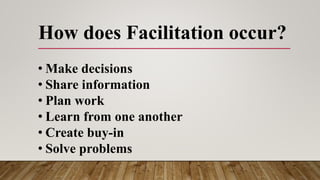
How does Facilitation occur?
• Make decisions
• Share information
• Plan work
• Learn from one another
• Create buy-in
• Solve problems
What is your facilitating experience?
Have you come across a skill facilitators?
“Global”
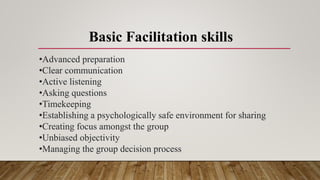
Basic Facilitation skills
•Advanced preparation
•Clear communication
•Active listening
•Asking questions
•Timekeeping
•Establishing a psychologically safe environment for sharing
•Creating focus amongst the group
•Unbiased objectivity
•Managing the group decision process
A skilled facilitator is like the sails of a ship. They guide the team
onboard where they need to go, with no objective other than to
lead the team to their destination. A team can navigate a meeting
without sails, but it is much easier and more effective if they have
facilitation skills to guide them.
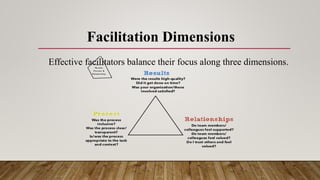
Facilitation Dimensions
Effective facilitators balance their focus along three dimensions.
• Making everyone feel comfortable
• and valued
• Encouraging participation
• Preventing and managing conflict
• Listening and observing
• Guiding the group
• Ensuring quality decisions
• Ensuring outcome-based meetings
Feel Comfortable
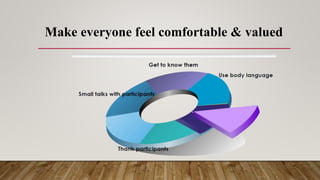
Skill: Make everyone feel comfortable
and valued
• Get to know them
• Use body language
• Thank the organization, then check
understanding
• Thank participants
Make everyone feel comfortable & valued
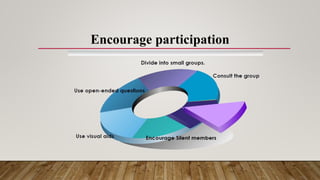
Encourage participation
Increase Understanding
• Use team-building activities.
• Set ground rules.
• Search for agreement.
• Agree to disagree.
Listen and observe
• Listen actively.
• Scan the room.
• Do not make assumption
• Check for understanding
• Rephrase their responses
• Summary
• Reap
• Write it down
Guide the group
• Delegate a timekeeper.
• Refer back to the meeting objectives and agenda.
• Stray from the agenda when necessary.
• Challenge their assumption
• Encourage them to go beyond (creative tension)
• Instill the concept of Effectiveness
• Instill the concept of Initiative
• Ask about Plan B and even Plan C
• Ask them about short term, long term, milestone
• and continuity plan
Ensure quality decisions
• Remind the group of decision deadlines.
• Review criteria and supporting information.
• Review the decision-making process.
• Poll the group before major decisions.
• Review the decision.
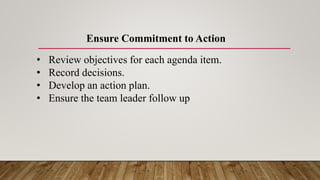
Ensure Commitment to Action
• Review objectives for each agenda item.
• Record decisions.
• Develop an action plan.
• Ensure the team leader follow up
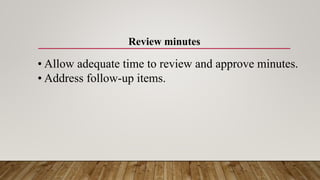
Review minutes
• Allow adequate time to review and approve minutes.
• Address follow-up items.
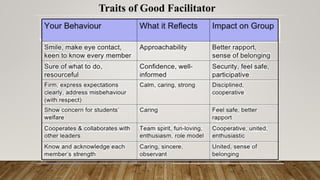
Traits of Good Facilitator
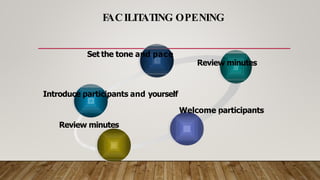
F
ACILIT
ATING OPENING
Set the tone and pace
Review minutes
Introduce participants and yourself
Welcome participants
Review minutes
WELCOME PARTICIPANT
• Formally startthe meeting.
• Welcome everyone officially.
• Use body language
INTRODUCE PARTICIPANTS AND YOURSELF
• Consider an icebreaker.
• Give precise instructions.
• Allow brief announcements.
• Check in
SET THE TONE AND PACE
• Help the group develop ground rules.
• Setthe stage foragreement.
• Clarify the role of members.
• Postmeeting objectives
• Ask forinputon the objectives and
agenda.
• Pointoutany changes to the agenda.
Go over and approve meeting objectives
and agenda
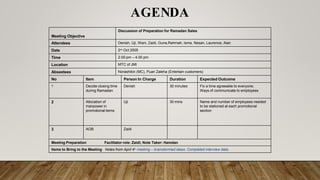
AGENDA
Meeting Objective
Discussion of Preparation for Ramadan Sales
Attendees Denish, Uji, Wani, Zaidi, Guna,Rahmah, Isma, Nesan, Laurence, Alan
Date 2nd Oct 2005
Time 2.00 pm – 4.00 pm
Location MTC of JMI
Abseetees Norashikin (MC), Puan Zaleha (Entertain customers)
No Item Person In Charge Duration Expected Outcome
1 Decide closing time
during Ramadan
Denish 30 minutes Fix a time agreeable to everyone;
Ways of communicate to employees
2 Allocation of
manpower in
promotional items
Uji 30 mins Name and number of employees needed
to be stationed at each promotional
section
3 AOB Zaidi
Meeting Preparation Facilitator role: Zaidi; Note Taker: Hamdan
Items to Bring to the Meeting Notes from April 4th meeting – brainstormed ideas. Completed interview data.
REVIEWMINUTES
• Allow adequate time to review and
approve minutes.
• Address follow-up items.
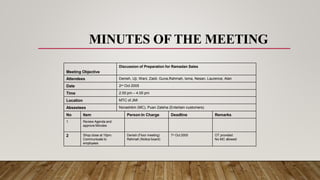
MINUTES OF THE MEETING
Meeting Objective
Discussion of Preparation for Ramadan Sales
Attendees Denish, Uji, Wani, Zaidi, Guna,Rahmah, Isma, Nesan, Laurence, Alan
Date 2nd Oct 2005
Time 2.00 pm – 4.00 pm
Location MTC of JMI
Abseetees Norashikin (MC), Puan Zaleha (Entertain customers)
No Item Person In Charge Deadline Remarks
1 Review Agenda and
approve Minutes
2 Shop close at 10pm.
Communicate to
employees
Denish (Floor meeting)
Rahmah (Notice board)
7th Oct 2005 OT provided
No MC allowed
â–  Keep the group on task
■ Assess the group’s concentration and
engagement
â–  Clarify confusing discussions
â–  Provide feedback to the group
â–  Enforce ground rules
Facilitating Discussions &Decisions
KEEP THE GROUP ON T
ASK
â—Ź Determine if you have enough time to
complete the agenda and the closing
tasks.
â—Ź Extend the meeting.
â—Ź Help the group set priorities and
decide which remaining agenda items
to address in the time remaining.
ASSESS THE GROUP’S CONCENTRATION AND ENGAGEMENT
• Read the group’s energy level.
• Check involvement.
• Avoid presentations after lunch.
• Give them a break.
• Provide snacks.
â–  Keep the group on task
■ Assess the group’s concentration and
engagement
â–  Clarify confusing discussions
â–  Provide feedback to the group
â–  Enforce ground rules
Facilitating Discussions &Decisions
CLARIFY CONFUSING DISCUSSIONS
• Listen for unfamiliar terms.
• Restate the issue before a decision.
• Check your personal biases.
• Be specific in describing what you observe.
• Describe or probe the impact of what you observe.
• Ask for and summarize suggestions.
• Point out consensus.
• Point out similarities between members’
statements.
• Use conflict to improve decisions.
Provide feedback to the group when necessary or appropriate
ENFORCE GROUND RULES
• Know the ground rules.
• Create non threatening mechanisms to
enforce the rules.
• Correct violations the first time — and
as soon as — they occur.
• Be fair and consistent in enforcing
rules.
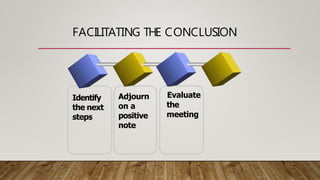
FACILITATING THE CONCLUSION
Identify
the next
steps
Evaluate
the
meeting
Adjourn
on a
positive
note
I
D
E
N
T
I
F
YT
H
EN
E
X
TS
T
E
P
S
• Complete an action plan.
• Visit your parking lot.
• Update the Team calendar.
EVALUATE THE MEETING
• Do a group evaluation.
• Debrief after the meeting.
ADJOURN ON A POSITIVE NOTE
• Thank members for their perseverance
and hard work.
• Recall agreement.
• Remind participants of decisions that
received strong support.
• Make it official.
GENERAL GUIDELINE
• Always look for the positive.
• Go easy.
• Put prevention before intervention.
• Look to the group for support.
• Seek outside assistance
CHALLENGING BEHAVIORS
â–  Side conversations
â–  Conversation domination
â–  Repeaters, parrots, and ramblers
â–  Verbal attackers
â–  Disruptive audience
â–  Absolute silence
â–  Inability to reach consensus
â–  Revisiting of decisions
â–  Charges of being culturally incompetent
EVALUATE THE MEETING
• Do a group evaluation.
• Debrief after the meeting.
Facilitation s kills

Facilitation s kills

  • 2.
    FACILITATION Facilitation is theprocess where a facilitator guide the group members in meeting to share ideas, opinions, experiences and expertise in order to achieve a common goal and agreeable action plan.
  • 3.
    FACILITATION SKILLS A successfulmeeting has purpose, organization, direction, and supportive guidance from an unbiased leader–or a facilitator. Facilitation skills are an essential component of effective meetings because they supply teams with the expertise they need to hone in on the problem or topic at hand and achieve creative solutions and consensus. A skilled facilitator can supercharge a team’s performance by functioning as a process guide for navigating complicated business challenges. Facilitators are experts at leading groups through key meetings and gatherings. You might have encountered a facilitator if you have participated in a design thinking-style workshop or a Design Sprint. Incorporate facilitation skills in your meeting culture to achieve more productive and effective meetings.
  • 4.
    Why is itimportant? • Reduce Burden • Higher level of thinking & planning • Discover the wisdom of your team o Ideas, experience, advise o Hight commitment • Develop People
  • 5.
    “I REFLECT MYTEAM & MY TEAM REFLECTS ME”
  • 6.
    How does Facilitationoccur? • Make decisions • Share information • Plan work • Learn from one another • Create buy-in • Solve problems
  • 7.
    What is yourfacilitating experience? Have you come across a skill facilitators? “Global”
  • 8.
    Basic Facilitation skills •Advancedpreparation •Clear communication •Active listening •Asking questions •Timekeeping •Establishing a psychologically safe environment for sharing •Creating focus amongst the group •Unbiased objectivity •Managing the group decision process
  • 9.
    A skilled facilitatoris like the sails of a ship. They guide the team onboard where they need to go, with no objective other than to lead the team to their destination. A team can navigate a meeting without sails, but it is much easier and more effective if they have facilitation skills to guide them.
  • 10.
    Facilitation Dimensions Effective facilitatorsbalance their focus along three dimensions.
  • 11.
    • Making everyonefeel comfortable • and valued • Encouraging participation • Preventing and managing conflict • Listening and observing • Guiding the group • Ensuring quality decisions • Ensuring outcome-based meetings
  • 12.
    Feel Comfortable Skill: Makeeveryone feel comfortable and valued • Get to know them • Use body language • Thank the organization, then check understanding • Thank participants
  • 13.
    Make everyone feelcomfortable & valued
  • 14.
  • 15.
    Increase Understanding • Useteam-building activities. • Set ground rules. • Search for agreement. • Agree to disagree.
  • 16.
    Listen and observe •Listen actively. • Scan the room. • Do not make assumption • Check for understanding • Rephrase their responses • Summary • Reap • Write it down
  • 17.
    Guide the group •Delegate a timekeeper. • Refer back to the meeting objectives and agenda. • Stray from the agenda when necessary. • Challenge their assumption • Encourage them to go beyond (creative tension) • Instill the concept of Effectiveness • Instill the concept of Initiative • Ask about Plan B and even Plan C • Ask them about short term, long term, milestone • and continuity plan
  • 18.
    Ensure quality decisions •Remind the group of decision deadlines. • Review criteria and supporting information. • Review the decision-making process. • Poll the group before major decisions. • Review the decision.
  • 19.
    Ensure Commitment toAction • Review objectives for each agenda item. • Record decisions. • Develop an action plan. • Ensure the team leader follow up
  • 20.
    Review minutes • Allowadequate time to review and approve minutes. • Address follow-up items.
  • 21.
    Traits of GoodFacilitator
  • 23.
    F ACILIT ATING OPENING Set thetone and pace Review minutes Introduce participants and yourself Welcome participants Review minutes
  • 24.
    WELCOME PARTICIPANT • Formallystartthe meeting. • Welcome everyone officially. • Use body language
  • 25.
    INTRODUCE PARTICIPANTS ANDYOURSELF • Consider an icebreaker. • Give precise instructions. • Allow brief announcements. • Check in
  • 26.
    SET THE TONEAND PACE • Help the group develop ground rules. • Setthe stage foragreement. • Clarify the role of members.
  • 27.
    • Postmeeting objectives •Ask forinputon the objectives and agenda. • Pointoutany changes to the agenda. Go over and approve meeting objectives and agenda
  • 28.
    AGENDA Meeting Objective Discussion ofPreparation for Ramadan Sales Attendees Denish, Uji, Wani, Zaidi, Guna,Rahmah, Isma, Nesan, Laurence, Alan Date 2nd Oct 2005 Time 2.00 pm – 4.00 pm Location MTC of JMI Abseetees Norashikin (MC), Puan Zaleha (Entertain customers) No Item Person In Charge Duration Expected Outcome 1 Decide closing time during Ramadan Denish 30 minutes Fix a time agreeable to everyone; Ways of communicate to employees 2 Allocation of manpower in promotional items Uji 30 mins Name and number of employees needed to be stationed at each promotional section 3 AOB Zaidi Meeting Preparation Facilitator role: Zaidi; Note Taker: Hamdan Items to Bring to the Meeting Notes from April 4th meeting – brainstormed ideas. Completed interview data.
  • 29.
    REVIEWMINUTES • Allow adequatetime to review and approve minutes. • Address follow-up items.
  • 30.
    MINUTES OF THEMEETING Meeting Objective Discussion of Preparation for Ramadan Sales Attendees Denish, Uji, Wani, Zaidi, Guna,Rahmah, Isma, Nesan, Laurence, Alan Date 2nd Oct 2005 Time 2.00 pm – 4.00 pm Location MTC of JMI Abseetees Norashikin (MC), Puan Zaleha (Entertain customers) No Item Person In Charge Deadline Remarks 1 Review Agenda and approve Minutes 2 Shop close at 10pm. Communicate to employees Denish (Floor meeting) Rahmah (Notice board) 7th Oct 2005 OT provided No MC allowed
  • 31.
    ■ Keep thegroup on task ■ Assess the group’s concentration and engagement ■ Clarify confusing discussions ■ Provide feedback to the group ■ Enforce ground rules Facilitating Discussions &Decisions
  • 32.
    KEEP THE GROUPON T ASK â—Ź Determine if you have enough time to complete the agenda and the closing tasks. â—Ź Extend the meeting. â—Ź Help the group set priorities and decide which remaining agenda items to address in the time remaining.
  • 33.
    ASSESS THE GROUP’SCONCENTRATION AND ENGAGEMENT • Read the group’s energy level. • Check involvement. • Avoid presentations after lunch. • Give them a break. • Provide snacks.
  • 34.
    ■ Keep thegroup on task ■ Assess the group’s concentration and engagement ■ Clarify confusing discussions ■ Provide feedback to the group ■ Enforce ground rules Facilitating Discussions &Decisions
  • 35.
    CLARIFY CONFUSING DISCUSSIONS •Listen for unfamiliar terms. • Restate the issue before a decision.
  • 36.
    • Check yourpersonal biases. • Be specific in describing what you observe. • Describe or probe the impact of what you observe. • Ask for and summarize suggestions. • Point out consensus. • Point out similarities between members’ statements. • Use conflict to improve decisions. Provide feedback to the group when necessary or appropriate
  • 37.
    ENFORCE GROUND RULES •Know the ground rules. • Create non threatening mechanisms to enforce the rules. • Correct violations the first time — and as soon as — they occur. • Be fair and consistent in enforcing rules.
  • 38.
    FACILITATING THE CONCLUSION Identify thenext steps Evaluate the meeting Adjourn on a positive note
  • 39.
    I D E N T I F YT H EN E X TS T E P S • Complete anaction plan. • Visit your parking lot. • Update the Team calendar.
  • 40.
    EVALUATE THE MEETING •Do a group evaluation. • Debrief after the meeting.
  • 41.
    ADJOURN ON APOSITIVE NOTE • Thank members for their perseverance and hard work. • Recall agreement. • Remind participants of decisions that received strong support. • Make it official.
  • 42.
    GENERAL GUIDELINE • Alwayslook for the positive. • Go easy. • Put prevention before intervention. • Look to the group for support. • Seek outside assistance
  • 43.
    CHALLENGING BEHAVIORS â–  Sideconversations â–  Conversation domination â–  Repeaters, parrots, and ramblers â–  Verbal attackers â–  Disruptive audience â–  Absolute silence â–  Inability to reach consensus â–  Revisiting of decisions â–  Charges of being culturally incompetent
  • 44.
    EVALUATE THE MEETING •Do a group evaluation. • Debrief after the meeting.