


 It is not likely that one person alone can posses all the 
skills and knowledge to solve all problems whatever their 
nature 
 Teams consistently outperform individuals acting alone 
 Teamwork allows the sharing of knowledge, life 
experiences and insight of their members. 
 Small as they could be, teams respond quickly to new 
challenges.
•Facilitates better communication 
•Motivates employees 
•Promotes creativity 
•Develops problem-solving skills 
•Breaks the barrier
Project team: A project team is pretty much what it sounds 
like — a is the group responsible for planning and executing 
the project. It consists of a Project Manager and a variable 
number of Team members, who are brought in to deliver 
their tasks according to the project schedule. (Sometimes 
project teams are referred to as steering committees or task 
forces.) Typically, when the project ends, the team ends. 
Cross-functional team: A cross-functional team is made up 
of employees from different departments or areas of the 
business. 
Self-directed work team: Like a project team, a self-directed 
work team is just what it sounds like — a team that 
determines how it will get a job done and has the authority, 
and often the budget, to carry out decisions.
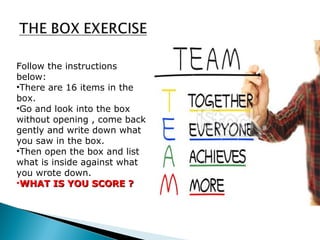
Follow the instructions 
below: 
•There are 16 items in the 
box. 
•Go and look into the box 
without opening , come back 
gently and write down what 
you saw in the box. 
•Then open the box and list 
what is inside against what 
you wrote down. 
•WWHHAATT IISS YYOOUU SSCCOORREE ??
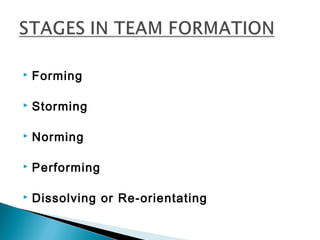
 Forming 
 Storming 
 Norming 
 Performing 
 Dissolving or Re-orientating
 This is the “genesis 
 Group is undeveloped and unsure about what and 
how to achieve its goals 
 Members do not know each other well and are 
concerned with 'who fits where'.
 This is the experimenting stage 
 Members begin to find their place 
 Intra-group conflicts will be evident as well as 
lively debates and discussions 
 Not much is being achieved at this stage.
 Group is settling down. 
 Members begin to use their past experiences to 
solve the team’s challenges. 
 They feel more comfortable working with each 
other and form a cohesive group. 
 Much is being achieved at this stage and here is 
always room for improvement.
 The group is mature 
 Has achieved harmony plus a relaxed and 
purposeful atmosphere 
 Defined its tasks, worked out its relationships 
 Has started producing results.
 Team dissolves when the team has completed the 
project 
 May be reoriented to continue on a next phase of 
the project.
 Establish a team charter 
 Define Roles and Responsibility 
 Communication 
 Participation 
 Conflict Management 
 Effective Meetings 
 Motivation & Rewards 
 Delegate 
 Reviews 
 Discipline
 Sharing Workload 
 Building Mutual Associations 
 Increased Work Pace 
 Learning Opportunities 
 Healthy Competition 
 Mutual Creativity
WHAT SKILLS DO I NEED? 
After fair assessment of ourselves, there is need for us 
to take a step forward by identifying the basic skills that 
will help us increase our productivity either as a leader or 
as a follower.
Delegating Effectively 
 Having the right people with the right skills isn't sufficient for a 
team's success. Managers must also know how to get the job 
done efficiently. Delegation is the key to this 
Motivating People 
 Another necessary management skill is motivating others. Its 
one thing to motivate yourself, but it's quite another to 
motivate someone else. The key thing to remember is that 
motivation is personal.
Managing Discipline and Dealing with differences 
 Team performance will also suffer when differences between 
individual team members turn into outright conflict, and it's your job 
as team manager to facilitate a resolution. 
Communicating 
 You need to let your team know what's happening and keep them 
informed as much as possible. Team briefing is a specific 
communication skill that managers should improve. 
Avoiding Common Managerial Mistakes 
 . Some of these common mistakes are thinking that you can rely on 
your technical skills alone, asking your boss to solve your problems, 
putting your boss in the awkward position of having to defend you, 
and not keeping your boss informed.
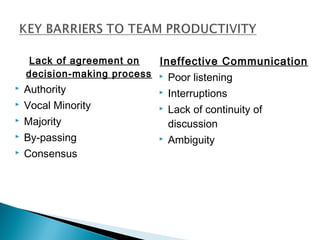
Lack of agreement on 
decision-making process 
 Authority 
 Vocal Minority 
 Majority 
 By-passing 
 Consensus 
Ineffective Communication 
 Poor listening 
 Interruptions 
 Lack of continuity of 
discussion 
 Ambiguity
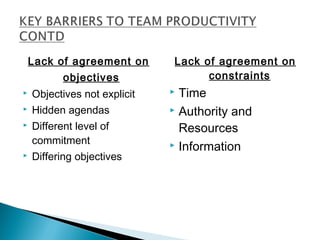
Lack of agreement on 
objectives 
 Objectives not explicit 
 Hidden agendas 
 Different level of 
commitment 
 Differing objectives 
Lack of agreement on 
constraints 
 Time 
 Authority and 
Resources 
 Information
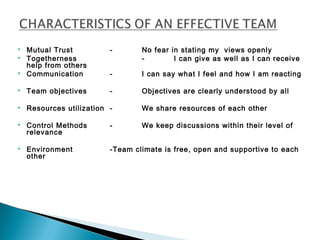
 Mutual Trust - No fear in stating my views openly 
 Togetherness - I can give as well as I can receive 
help from others 
 Communication - I can say what I feel and how I am reacting 
 Team objectives - Objectives are clearly understood by all 
 Resources utilization - We share resources of each other 
 Control Methods - We keep discussions within their level of 
relevance 
 Environment -Team climate is free, open and supportive to each 
other
Questions !!!
Thank You

Building and managing high performance teams

  • 2.
     It isnot likely that one person alone can posses all the skills and knowledge to solve all problems whatever their nature  Teams consistently outperform individuals acting alone  Teamwork allows the sharing of knowledge, life experiences and insight of their members.  Small as they could be, teams respond quickly to new challenges.
  • 3.
    •Facilitates better communication •Motivates employees •Promotes creativity •Develops problem-solving skills •Breaks the barrier
  • 4.
    Project team: Aproject team is pretty much what it sounds like — a is the group responsible for planning and executing the project. It consists of a Project Manager and a variable number of Team members, who are brought in to deliver their tasks according to the project schedule. (Sometimes project teams are referred to as steering committees or task forces.) Typically, when the project ends, the team ends. Cross-functional team: A cross-functional team is made up of employees from different departments or areas of the business. Self-directed work team: Like a project team, a self-directed work team is just what it sounds like — a team that determines how it will get a job done and has the authority, and often the budget, to carry out decisions.
  • 5.
    Follow the instructions below: •There are 16 items in the box. •Go and look into the box without opening , come back gently and write down what you saw in the box. •Then open the box and list what is inside against what you wrote down. •WWHHAATT IISS YYOOUU SSCCOORREE ??
  • 6.
     Forming Storming  Norming  Performing  Dissolving or Re-orientating
  • 7.
     This isthe “genesis  Group is undeveloped and unsure about what and how to achieve its goals  Members do not know each other well and are concerned with 'who fits where'.
  • 8.
     This isthe experimenting stage  Members begin to find their place  Intra-group conflicts will be evident as well as lively debates and discussions  Not much is being achieved at this stage.
  • 9.
     Group issettling down.  Members begin to use their past experiences to solve the team’s challenges.  They feel more comfortable working with each other and form a cohesive group.  Much is being achieved at this stage and here is always room for improvement.
  • 10.
     The groupis mature  Has achieved harmony plus a relaxed and purposeful atmosphere  Defined its tasks, worked out its relationships  Has started producing results.
  • 11.
     Team dissolveswhen the team has completed the project  May be reoriented to continue on a next phase of the project.
  • 12.
     Establish ateam charter  Define Roles and Responsibility  Communication  Participation  Conflict Management  Effective Meetings  Motivation & Rewards  Delegate  Reviews  Discipline
  • 13.
     Sharing Workload  Building Mutual Associations  Increased Work Pace  Learning Opportunities  Healthy Competition  Mutual Creativity
  • 14.
    WHAT SKILLS DOI NEED? After fair assessment of ourselves, there is need for us to take a step forward by identifying the basic skills that will help us increase our productivity either as a leader or as a follower.
  • 15.
    Delegating Effectively Having the right people with the right skills isn't sufficient for a team's success. Managers must also know how to get the job done efficiently. Delegation is the key to this Motivating People  Another necessary management skill is motivating others. Its one thing to motivate yourself, but it's quite another to motivate someone else. The key thing to remember is that motivation is personal.
  • 16.
    Managing Discipline andDealing with differences  Team performance will also suffer when differences between individual team members turn into outright conflict, and it's your job as team manager to facilitate a resolution. Communicating  You need to let your team know what's happening and keep them informed as much as possible. Team briefing is a specific communication skill that managers should improve. Avoiding Common Managerial Mistakes  . Some of these common mistakes are thinking that you can rely on your technical skills alone, asking your boss to solve your problems, putting your boss in the awkward position of having to defend you, and not keeping your boss informed.
  • 17.
    Lack of agreementon decision-making process  Authority  Vocal Minority  Majority  By-passing  Consensus Ineffective Communication  Poor listening  Interruptions  Lack of continuity of discussion  Ambiguity
  • 18.
    Lack of agreementon objectives  Objectives not explicit  Hidden agendas  Different level of commitment  Differing objectives Lack of agreement on constraints  Time  Authority and Resources  Information
  • 19.
     Mutual Trust- No fear in stating my views openly  Togetherness - I can give as well as I can receive help from others  Communication - I can say what I feel and how I am reacting  Team objectives - Objectives are clearly understood by all  Resources utilization - We share resources of each other  Control Methods - We keep discussions within their level of relevance  Environment -Team climate is free, open and supportive to each other
  • 20.
  • 21.