Developing an Effective Mentoring Program:  The Key to Future Success by Dr. H. Lee Mathews
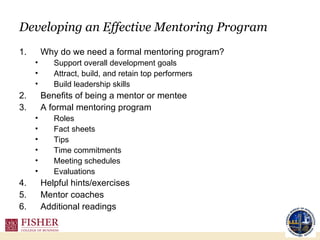
Developing an Effective Mentoring Program Why do we need a formal mentoring program? Support overall development goals Attract, build, and retain top performers Build leadership skills Benefits of being a mentor or mentee A formal mentoring program Roles Fact sheets Tips Time commitments Meeting schedules Evaluations Helpful hints/exercises Mentor coaches Additional readings
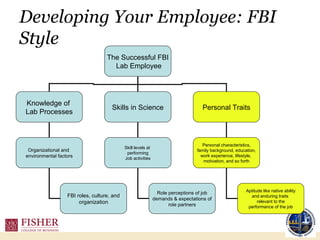
Developing Your Employee: FBI Style The Successful FBI Lab Employee Knowledge of  Lab Processes Skills in Science Personal Traits Organizational and  environmental factors Personal characteristics, family background, education, work experience, lifestyle,  motivation, and so forth Skill levels at  performing Job activities Aptitude like native ability and enduring traits  relevant to the performance of the job Role perceptions of job demands & expectations of role partners FBI roles, culture, and organization
MENTOR  TRAINING
Mentoring is a personal enhancement strategy through which one person facilitates the development of another by sharing known resources, expertise, values, skills, perspectives, attitudes and proficiencies.  What is it?
Organizations that provide career development opportunities are projected to save four percent of revenues that are typically lost in turnover costs.*  Mentoring builds and strengthens the talent pool of an organization.  Why do we need it?  * 2001 Hay Group Survey
To support overall development goals  To attract, build and retain top performers To build leadership skills  What is the purpose?
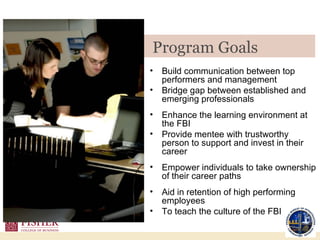
Build communication between top performers and management Bridge gap between established and emerging professionals Enhance the learning environment at the FBI Provide mentee with trustworthy person to support and invest in their career Empower individuals to take ownership of their career paths Aid in retention of high performing employees  To teach the culture of the FBI Program Goals
Benefits of being a Mentor Improve your communication and leadership skills Ability to inspire others Ability to persuade and encourage others to move in a desired direction Feel re-energized through working with enthusiastic mentees Opportunity to help others grow and develop in their careers
Characteristics of an FBI Mentor Communication skills and leadership skills Team players with interest in developing others Understanding of the FBI culture
Benefits of being a Mentee Improve particular career areas Expand their leadership abilities Learn about other departments or areas at the FBI Make valuable contacts and relationship with the FBI Enhance opportunities for career development Increased confidence Expand communication skills
Characteristics of a mentee Desire to enhance opportunities for career development Interest in multiple areas of the business Looking to expand leadership abilities
The mentor’s role Provide guidance of mentee based on his/her needs and development areas Share personal experiences, successes, and failures Keep commitments Ask mentee to set meeting agendas Provide encouragement and feedback Ask “what if?, how?, and why? Keep all information confidential Be available and accessible Help mentee find access to experts who can improve skill levels
The mentee’s role Take ownership of personal learning and development needs Access areas of strength and development to establish a mentoring relationship Take initiative to drive agendas for mentoring meetings Be open about yourself Ask for specific feedback What could I have done differently? How else could I  have responded? What group dynamics should I be aware of? Establish need for confidentiality Learn about mentor’s experiences, background, and perspectives Take responsibility for initiating contact
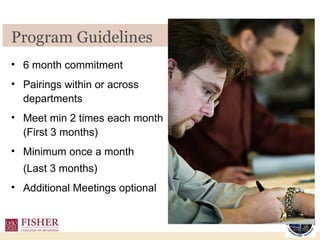
6 month commitment  Pairings within or across departments Meet min 2 times each month (First 3 months) Minimum once a month  (Last 3 months) Additional Meetings optional Program Guidelines
Mentor and mentee reflect on strengths and goals  Mentee sets 1-3 developmental goals during mentorship Read through Mentoring Guidebook Complete required forms and turn in Preparing for Mentoring
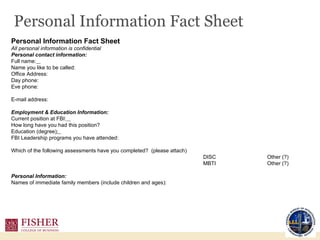
Personal Information Fact Sheet  Personal Information Fact Sheet All personal information is confidential  Personal contact information: Full name:   Name you like to be called:  Office Address:  Day phone:  Eve phone: E-mail address:  Employment & Education Information: Current position at FBI:   How long have you had this position?    Education (degree) :  FBI Leadership programs you have attended:  Which of the following assessments have you completed?  (please attach) DISC Other (?) MBTI  Other (?) Personal Information: Names of immediate family members (include children and ages):
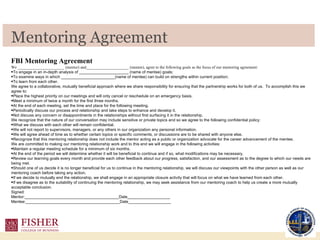
Mentoring Agreement FBI Mentoring Agreement We _______________________ (mentor) and_____________________ (mentee), agree to the following goals as the focus of our mentoring agreement: To engage in an in-depth analysis of ______________________ (name of mentee) goals; To examine ways in which ________________________(name of mentee) can build on strengths within current position;  To learn from each other. We agree to a collaborative, mutually beneficial approach where we share responsibility for ensuring that the partnership works for both of us.  To accomplish this we agree to: Place the highest priority on our meetings and will only cancel or reschedule on an emergency basis. Meet a minimum of twice a month for the first three months. At the end of each meeting, set the time and place for the following meeting. Periodically discuss our process and relationship and take steps to enhance and develop it. Not discuss any concern or disappointments in the relationships without first surfacing it in the relationship. We recognize that the nature of our conversation may include sensitive or private topics and so we agree to the following confidential policy: What we discuss with each other will remain confidential. We will not report to supervisors, managers, or any others in our organization any personal information. We will agree ahead of time as to whether certain topics or specific comments, or discussions are to be shared with anyone else. Recognize that this mentoring relationship does not include the mentor acting as a public or organization advocate for the career advancement of the mentee. We are committed to making our mentoring relationship work and to this end we will engage in the following activities: Maintain a regular meeting schedule for a minimum of six months. At the end of the period we will determine whether it will be beneficial to continue and if so, what modifications may be necessary. Review our learning goals every month and provide each other feedback about our progress, satisfaction, and our assessment as to the degree to which our needs are being met. Should one of us decide it is no longer beneficial for us to continue in the mentoring relationship, we will discuss our viewpoints with the other person as well as our mentoring coach before taking any action. If we decide to mutually end the relationship, we shall engage in an appropriate closure activity that will focus on what we have learned from each other. If we disagree as to the suitability of continuing the mentoring relationship, we may seek assistance from our mentoring coach to help us create a more mutually acceptable conclusion. Signed: Mentor:__________________________________________Date___________________ Mentee:__________________________________________Date___________________
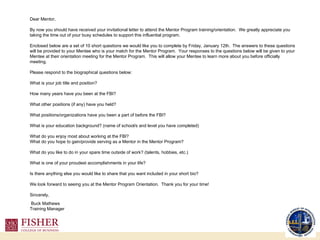
Dear Mentor,   By now you should have received your invitational letter to attend the Mentor Program training/orientation.  We greatly appreciate you taking the time out of your busy schedules to support this influential program.      Enclosed below are a set of 10 short questions we would like you to complete by Friday, January 12th.  The answers to these questions will be provided to your Mentee who is your match for the Mentor Program.  Your responses to the questions below will be given to your Mentee at their orientation meeting for the Mentor Program.  This will allow your Mentee to learn more about you before officially meeting.     Please respond to the biographical questions below:      What is your job title and position?   How many years have you been at the FBI?   What other positions (if any) have you held?   What positions/organizations have you been a part of before the FBI?   What is your education background? (name of school/s and level you have completed)   What do you enjoy most about working at the FBI? What do you hope to gain/provide serving as a Mentor in the Mentor Program?   What do you like to do in your spare time outside of work? (talents, hobbies, etc.)   What is one of your proudest accomplishments in your life?   Is there anything else you would like to share that you want included in your short bio?   We look forward to seeing you at the Mentor Program Orientation.  Thank you for your time!   Sincerely,   Buck Mathews Training Manager
Meeting Plan/Agenda  (PG 12) Mentor Program Feedback  (PG 14) Final Mentor’s Evaluation  (PG 16) Career Development Plan  (PG 18-20) Mentee Program Feedback  (PG 21-22) Mentee Final Evaluation  (PG 23-24) Personal Mentoring Journal  (PG 25) Mentoring Journal  (PG 26) Forms
Program Timeline 1/15/07 – Mentee Orientation  1/16/07 – Mentor Training  1/22/07 – Meetings begin (pairs meet twice a month) 2/22/07 – Debrief meeting/checkpoint with Mentors 3/30/07 – Complete 1st feedback form  6/1/07 – Complete 2nd feedback form  7/30/07 – Conclude program/Mentee completes final evaluation 7/31/07 – Final debrief with Mentors
Effective Tips For Mentors : Set the tone Listen and be present Ask effective questions Agree on next steps
Set the Tone Share your background (professional and personal) Be open to how the mentee and yourself might be feeling (i.e. excitement, nervousness, inquisitive) Share past experiences of being mentored and what you gained from this Talk about your future goals Clarify expectations of the mentor relationship
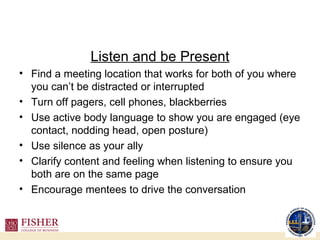
Listen and be Present Find a meeting location that works for both of you where you can’t be distracted or interrupted Turn off pagers, cell phones, blackberries Use active body language to show you are engaged (eye contact, nodding head, open posture) Use silence as your ally Clarify content and feeling when listening to ensure you both are on the same page Encourage mentees to drive the conversation
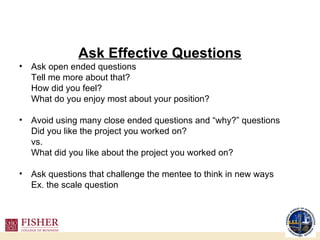
Ask Effective Questions Ask open ended questions Tell me more about that? How did you feel? What do you enjoy most about your position? Avoid using many close ended questions and “why?” questions Did you like the project you worked on? vs. What did you like about the project you worked on? Ask questions that challenge the mentee to think in new ways Ex. the scale question
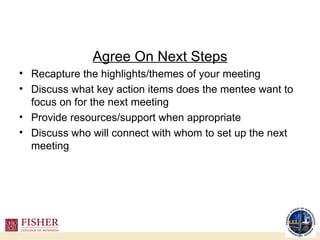
Agree On Next Steps Recapture the highlights/themes of your meeting Discuss what key action items does the mentee want to focus on for the next meeting Provide resources/support when appropriate Discuss who will connect with whom to set up the next meeting
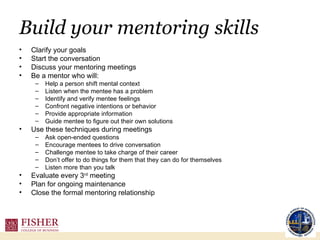
Build your mentoring skills Clarify your goals Start the conversation Discuss your mentoring meetings Be a mentor who will: Help a person shift mental context Listen when the mentee has a problem Identify and verify mentee feelings Confront negative intentions or behavior Provide appropriate information Guide mentee to figure out their own solutions Use these techniques during meetings Ask open-ended questions Encourage mentees to drive conversation Challenge mentee to take charge of their career Don’t offer to do things for them that they can do for themselves Listen more than you talk Evaluate every 3 rd  meeting Plan for ongoing maintenance Close the formal mentoring relationship
Key strategies of great mentors Expect mentee to drive the outcomes of mentoring relationships Build on strengths and expertise Encourage mentee to seek multiple career mentors Reinforce that mentee is responsible for actions and accountable Share your career story and key lessons learned Keep abreast of mentee’s new developments and implications View mentoring as an evolving skill Network with other mentors Be a role model – ask for feedback
Ideas for topics of discussion Build your leadership perspective  Value diversity Scholarly pursuits Develop a career vision Inventory of experiences Define priorities Think strategically Act with integrity Importance of a network Review a book Follow up on previous sessons
What is Your Experience of Being Mentored? Recall a time in your life when you might have experienced some major change.  Consider for a moment what events were driving the change.  Think about some of the developmental changes that occurred within you and answer the questions below relative to the way you might have seen yourself, others, and the events. Was there anyone who helped provide an “aha” experience that allowed you to see an event, person, situation or something in yourself in a different light?  Briefly describe the experience. Has anyone ever shared with you a personal experience or story that helped shape their outlook on life, work, relationships, co-workers, etc?  If so, what about it influenced your own thinking or behavior?  Briefly describe below. Recall someone who has been influential in assisting you in the discovery of an ability, skill, quality or talent that you had not yet recognized.  What did that discovery do for you?
10 tips for thinking strategically Read business magazines Avoid the temptation for a quick fix Learn to play chess Volunteer to serve on a strategic planning committee Take a course in creative thinking Research architectural firms. Challenge the paradigms Engage in “what if” thinking
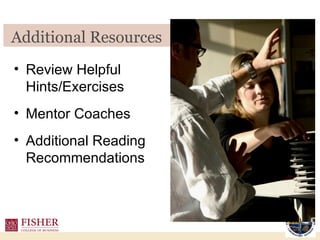
Review Helpful Hints/Exercises Mentor Coaches Additional Reading Recommendations Additional Resources
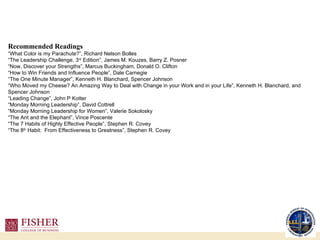
Recommended Readings “ What Color is my Parachute?”, Richard Nelson Bolles “ The Leadership Challenge, 3 rd  Edition”, James M. Kouzes, Barry Z. Posner “ Now, Discover your Strengths”, Marcus Buckingham, Donald O. Clifton “ How to Win Friends and Influence People”, Dale Carnegie “ The One Minute Manager”, Kenneth H. Blanchard, Spencer Johnson “ Who Moved my Cheese? An Amazing Way to Deal with Change in your Work and in your Life”, Kenneth H. Blanchard, and Spencer Johnson “ Leading Change”, John P Kotter “ Monday Morning Leadership”, David Cottrell “ Monday Morning Leadership for Women”, Valerie Sokolosky “ The Ant and the Elephant”, Vince Poscente “ The 7 Habits of Highly Effective People”, Stephen R. Covey “ The 8 th  Habit:  From Effectiveness to Greatness”, Stephen R. Covey

Mentoring Slides

  • 1.
    Developing an EffectiveMentoring Program: The Key to Future Success by Dr. H. Lee Mathews
  • 2.
    Developing an EffectiveMentoring Program Why do we need a formal mentoring program? Support overall development goals Attract, build, and retain top performers Build leadership skills Benefits of being a mentor or mentee A formal mentoring program Roles Fact sheets Tips Time commitments Meeting schedules Evaluations Helpful hints/exercises Mentor coaches Additional readings
  • 3.
    Developing Your Employee:FBI Style The Successful FBI Lab Employee Knowledge of Lab Processes Skills in Science Personal Traits Organizational and environmental factors Personal characteristics, family background, education, work experience, lifestyle, motivation, and so forth Skill levels at performing Job activities Aptitude like native ability and enduring traits relevant to the performance of the job Role perceptions of job demands & expectations of role partners FBI roles, culture, and organization
  • 4.
  • 5.
    Mentoring is apersonal enhancement strategy through which one person facilitates the development of another by sharing known resources, expertise, values, skills, perspectives, attitudes and proficiencies. What is it?
  • 6.
    Organizations that providecareer development opportunities are projected to save four percent of revenues that are typically lost in turnover costs.* Mentoring builds and strengthens the talent pool of an organization. Why do we need it? * 2001 Hay Group Survey
  • 7.
    To support overalldevelopment goals To attract, build and retain top performers To build leadership skills What is the purpose?
  • 8.
    Build communication betweentop performers and management Bridge gap between established and emerging professionals Enhance the learning environment at the FBI Provide mentee with trustworthy person to support and invest in their career Empower individuals to take ownership of their career paths Aid in retention of high performing employees To teach the culture of the FBI Program Goals
  • 9.
    Benefits of beinga Mentor Improve your communication and leadership skills Ability to inspire others Ability to persuade and encourage others to move in a desired direction Feel re-energized through working with enthusiastic mentees Opportunity to help others grow and develop in their careers
  • 10.
    Characteristics of anFBI Mentor Communication skills and leadership skills Team players with interest in developing others Understanding of the FBI culture
  • 11.
    Benefits of beinga Mentee Improve particular career areas Expand their leadership abilities Learn about other departments or areas at the FBI Make valuable contacts and relationship with the FBI Enhance opportunities for career development Increased confidence Expand communication skills
  • 12.
    Characteristics of amentee Desire to enhance opportunities for career development Interest in multiple areas of the business Looking to expand leadership abilities
  • 13.
    The mentor’s roleProvide guidance of mentee based on his/her needs and development areas Share personal experiences, successes, and failures Keep commitments Ask mentee to set meeting agendas Provide encouragement and feedback Ask “what if?, how?, and why? Keep all information confidential Be available and accessible Help mentee find access to experts who can improve skill levels
  • 14.
    The mentee’s roleTake ownership of personal learning and development needs Access areas of strength and development to establish a mentoring relationship Take initiative to drive agendas for mentoring meetings Be open about yourself Ask for specific feedback What could I have done differently? How else could I have responded? What group dynamics should I be aware of? Establish need for confidentiality Learn about mentor’s experiences, background, and perspectives Take responsibility for initiating contact
  • 15.
    6 month commitment Pairings within or across departments Meet min 2 times each month (First 3 months) Minimum once a month (Last 3 months) Additional Meetings optional Program Guidelines
  • 16.
    Mentor and menteereflect on strengths and goals Mentee sets 1-3 developmental goals during mentorship Read through Mentoring Guidebook Complete required forms and turn in Preparing for Mentoring
  • 17.
    Personal Information FactSheet Personal Information Fact Sheet All personal information is confidential Personal contact information: Full name: Name you like to be called: Office Address: Day phone: Eve phone: E-mail address: Employment & Education Information: Current position at FBI: How long have you had this position? Education (degree) : FBI Leadership programs you have attended: Which of the following assessments have you completed? (please attach) DISC Other (?) MBTI Other (?) Personal Information: Names of immediate family members (include children and ages):
  • 18.
    Mentoring Agreement FBIMentoring Agreement We _______________________ (mentor) and_____________________ (mentee), agree to the following goals as the focus of our mentoring agreement: To engage in an in-depth analysis of ______________________ (name of mentee) goals; To examine ways in which ________________________(name of mentee) can build on strengths within current position; To learn from each other. We agree to a collaborative, mutually beneficial approach where we share responsibility for ensuring that the partnership works for both of us. To accomplish this we agree to: Place the highest priority on our meetings and will only cancel or reschedule on an emergency basis. Meet a minimum of twice a month for the first three months. At the end of each meeting, set the time and place for the following meeting. Periodically discuss our process and relationship and take steps to enhance and develop it. Not discuss any concern or disappointments in the relationships without first surfacing it in the relationship. We recognize that the nature of our conversation may include sensitive or private topics and so we agree to the following confidential policy: What we discuss with each other will remain confidential. We will not report to supervisors, managers, or any others in our organization any personal information. We will agree ahead of time as to whether certain topics or specific comments, or discussions are to be shared with anyone else. Recognize that this mentoring relationship does not include the mentor acting as a public or organization advocate for the career advancement of the mentee. We are committed to making our mentoring relationship work and to this end we will engage in the following activities: Maintain a regular meeting schedule for a minimum of six months. At the end of the period we will determine whether it will be beneficial to continue and if so, what modifications may be necessary. Review our learning goals every month and provide each other feedback about our progress, satisfaction, and our assessment as to the degree to which our needs are being met. Should one of us decide it is no longer beneficial for us to continue in the mentoring relationship, we will discuss our viewpoints with the other person as well as our mentoring coach before taking any action. If we decide to mutually end the relationship, we shall engage in an appropriate closure activity that will focus on what we have learned from each other. If we disagree as to the suitability of continuing the mentoring relationship, we may seek assistance from our mentoring coach to help us create a more mutually acceptable conclusion. Signed: Mentor:__________________________________________Date___________________ Mentee:__________________________________________Date___________________
  • 19.
    Dear Mentor,  By now you should have received your invitational letter to attend the Mentor Program training/orientation.  We greatly appreciate you taking the time out of your busy schedules to support this influential program.      Enclosed below are a set of 10 short questions we would like you to complete by Friday, January 12th.  The answers to these questions will be provided to your Mentee who is your match for the Mentor Program.  Your responses to the questions below will be given to your Mentee at their orientation meeting for the Mentor Program.  This will allow your Mentee to learn more about you before officially meeting.    Please respond to the biographical questions below:      What is your job title and position?   How many years have you been at the FBI?   What other positions (if any) have you held?   What positions/organizations have you been a part of before the FBI?   What is your education background? (name of school/s and level you have completed)   What do you enjoy most about working at the FBI? What do you hope to gain/provide serving as a Mentor in the Mentor Program?   What do you like to do in your spare time outside of work? (talents, hobbies, etc.)   What is one of your proudest accomplishments in your life?   Is there anything else you would like to share that you want included in your short bio?   We look forward to seeing you at the Mentor Program Orientation.  Thank you for your time!   Sincerely,   Buck Mathews Training Manager
  • 20.
    Meeting Plan/Agenda (PG 12) Mentor Program Feedback (PG 14) Final Mentor’s Evaluation (PG 16) Career Development Plan (PG 18-20) Mentee Program Feedback (PG 21-22) Mentee Final Evaluation (PG 23-24) Personal Mentoring Journal (PG 25) Mentoring Journal (PG 26) Forms
  • 21.
    Program Timeline 1/15/07– Mentee Orientation 1/16/07 – Mentor Training 1/22/07 – Meetings begin (pairs meet twice a month) 2/22/07 – Debrief meeting/checkpoint with Mentors 3/30/07 – Complete 1st feedback form 6/1/07 – Complete 2nd feedback form 7/30/07 – Conclude program/Mentee completes final evaluation 7/31/07 – Final debrief with Mentors
  • 22.
    Effective Tips ForMentors : Set the tone Listen and be present Ask effective questions Agree on next steps
  • 23.
    Set the ToneShare your background (professional and personal) Be open to how the mentee and yourself might be feeling (i.e. excitement, nervousness, inquisitive) Share past experiences of being mentored and what you gained from this Talk about your future goals Clarify expectations of the mentor relationship
  • 24.
    Listen and bePresent Find a meeting location that works for both of you where you can’t be distracted or interrupted Turn off pagers, cell phones, blackberries Use active body language to show you are engaged (eye contact, nodding head, open posture) Use silence as your ally Clarify content and feeling when listening to ensure you both are on the same page Encourage mentees to drive the conversation
  • 25.
    Ask Effective QuestionsAsk open ended questions Tell me more about that? How did you feel? What do you enjoy most about your position? Avoid using many close ended questions and “why?” questions Did you like the project you worked on? vs. What did you like about the project you worked on? Ask questions that challenge the mentee to think in new ways Ex. the scale question
  • 26.
    Agree On NextSteps Recapture the highlights/themes of your meeting Discuss what key action items does the mentee want to focus on for the next meeting Provide resources/support when appropriate Discuss who will connect with whom to set up the next meeting
  • 27.
    Build your mentoringskills Clarify your goals Start the conversation Discuss your mentoring meetings Be a mentor who will: Help a person shift mental context Listen when the mentee has a problem Identify and verify mentee feelings Confront negative intentions or behavior Provide appropriate information Guide mentee to figure out their own solutions Use these techniques during meetings Ask open-ended questions Encourage mentees to drive conversation Challenge mentee to take charge of their career Don’t offer to do things for them that they can do for themselves Listen more than you talk Evaluate every 3 rd meeting Plan for ongoing maintenance Close the formal mentoring relationship
  • 28.
    Key strategies ofgreat mentors Expect mentee to drive the outcomes of mentoring relationships Build on strengths and expertise Encourage mentee to seek multiple career mentors Reinforce that mentee is responsible for actions and accountable Share your career story and key lessons learned Keep abreast of mentee’s new developments and implications View mentoring as an evolving skill Network with other mentors Be a role model – ask for feedback
  • 29.
    Ideas for topicsof discussion Build your leadership perspective Value diversity Scholarly pursuits Develop a career vision Inventory of experiences Define priorities Think strategically Act with integrity Importance of a network Review a book Follow up on previous sessons
  • 30.
    What is YourExperience of Being Mentored? Recall a time in your life when you might have experienced some major change. Consider for a moment what events were driving the change. Think about some of the developmental changes that occurred within you and answer the questions below relative to the way you might have seen yourself, others, and the events. Was there anyone who helped provide an “aha” experience that allowed you to see an event, person, situation or something in yourself in a different light? Briefly describe the experience. Has anyone ever shared with you a personal experience or story that helped shape their outlook on life, work, relationships, co-workers, etc? If so, what about it influenced your own thinking or behavior? Briefly describe below. Recall someone who has been influential in assisting you in the discovery of an ability, skill, quality or talent that you had not yet recognized. What did that discovery do for you?
  • 31.
    10 tips forthinking strategically Read business magazines Avoid the temptation for a quick fix Learn to play chess Volunteer to serve on a strategic planning committee Take a course in creative thinking Research architectural firms. Challenge the paradigms Engage in “what if” thinking
  • 32.
    Review Helpful Hints/ExercisesMentor Coaches Additional Reading Recommendations Additional Resources
  • 33.
    Recommended Readings “What Color is my Parachute?”, Richard Nelson Bolles “ The Leadership Challenge, 3 rd Edition”, James M. Kouzes, Barry Z. Posner “ Now, Discover your Strengths”, Marcus Buckingham, Donald O. Clifton “ How to Win Friends and Influence People”, Dale Carnegie “ The One Minute Manager”, Kenneth H. Blanchard, Spencer Johnson “ Who Moved my Cheese? An Amazing Way to Deal with Change in your Work and in your Life”, Kenneth H. Blanchard, and Spencer Johnson “ Leading Change”, John P Kotter “ Monday Morning Leadership”, David Cottrell “ Monday Morning Leadership for Women”, Valerie Sokolosky “ The Ant and the Elephant”, Vince Poscente “ The 7 Habits of Highly Effective People”, Stephen R. Covey “ The 8 th Habit: From Effectiveness to Greatness”, Stephen R. Covey