Strategic Training
Chapter 2

6th Edition
Raymond A. Noe
McGraw-Hill/Irwin

Copyright © 2013 by The McGraw-Hill Companies, Inc. All rights reserved.
Learning Objectives
 Discuss how business strategy influences the type

and amount of training in a company
 Describe the strategic training and development
process
 Discuss how a company’s staffing and human
resource planning strategies influence training
 Explain the training needs created by concentration,
internal growth external growth, and disinvestment
business strategies

> E. Satriyo

2-2
Learning Objectives
 Discuss the advantages and disadvantages of

centralizing the training function
 Discuss the strengths of the business embedded
model for organizing the training function
 Explain a corporate university and its benefits

> E. Satriyo

2-3
Introduction
 Business strategy
 Integrates the company's goals, policies, and actions

 Influences how the company uses:
 Physical capital, financial capital, and human capital

 Goals- What the company hopes to achieve in the

medium- and long-term future

> E. Satriyo

2-4
Introduction
 Strategy determines:
 Amount of training required for current or future job

skills
 Extent to which training should be customized for
particular needs
 Extent to which training is restricted to specific groups
of employees or open to all
 Extent to which training is planned and systematically
administered
 Importance placed on training compared to other HR
practices
> E. Satriyo

2-5
Learning as a Strategic Focus
 Learning organization: A company that has:
 An enhanced capacity to learn, adapt, and change

 Carefully scrutinized and aligned training processes

with company goals
 Training as a part of system designed to create human
capital

> E. Satriyo

2-6
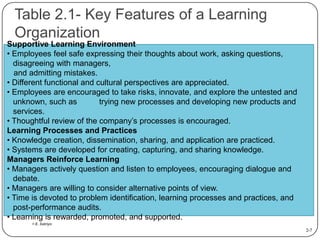
Table 2.1- Key Features of a Learning
Organization
Supportive Learning Environment
• Employees feel safe expressing their thoughts about work, asking questions,
disagreeing with managers,
and admitting mistakes.
• Different functional and cultural perspectives are appreciated.
• Employees are encouraged to take risks, innovate, and explore the untested and
unknown, such as
trying new processes and developing new products and
services.
• Thoughtful review of the company’s processes is encouraged.
Learning Processes and Practices
• Knowledge creation, dissemination, sharing, and application are practiced.
• Systems are developed for creating, capturing, and sharing knowledge.
Managers Reinforce Learning
• Managers actively question and listen to employees, encouraging dialogue and
debate.
• Managers are willing to consider alternative points of view.
• Time is devoted to problem identification, learning processes and practices, and
post-performance audits.
• Learning is rewarded, promoted, and supported.
> E. Satriyo

2-7
Implications of Learning for Human
Capital Development
 Recognition that learning should help:
 Employees improve performance

 Achieve business goals

 Learning should occur on as needed basis
 Need to support informal learning
 Learning should be supported psychologically

> E. Satriyo

2-8
Implications of Learning for Human
Capital Development
 Key capabilities
 Aligning learning goals to business goals

 Measuring of business impact of learning
 Movement of learning outside the company
 Developing competencies for critical jobs
 Integrating learning with other human resource

functions
 Including classroom as well as e-learning
 Designing and delivering leadership development
courses
> E. Satriyo

2-9
Figure 2.1- The Strategic Training and
Development Process

Business
Strategy

Strategic
Training &
Development
Initiatives
• Diversify the
Learning Portfolio
• Improve Customer
Service
• Accelerate the
Pace of Employee
Learning
• Capture and Share
Knowledge

Training &
Development
Activities
• Use Web-Based Training
• Make Development
Planning Mandatory
• Develop Web Sites for
Knowledge Sharing
• Increase Amount of
Customer Service
Training

Metrics That
Show Value
of Training
• Learning
• Performance Improvement
• Reduced Customer
Complaints
• Reduced Turnover
• Employee Engagement

> E. Satriyo

2-10
The Strategic Training and Development
Process
 Mission: Company's reason for existing
 Vision: Is the picture of the future that the company

wants to achieve
 Values: What the company stands for
 SWOT analysis
 Internal analysis of strengths and weaknesses
 External analysis of opportunities and threats

 External analysis: Examining the operating

environment to identify opportunities and threats
> E. Satriyo

2-11
The Strategic Training and Development
Process
 Internal analysis
 Identifies the company’s strength and weaknesses

 Examines the available quantity and quality of financial,

physical, and human capital
 Strategic choice: The strategy believed to be the

best alternative to achieve the company goals

> E. Satriyo

2-12
Figure 2.2- Formulating the Business
Strategy
External
Analysis

Opportunities
Threats

Goals

Strategic Choice

Mission
Why does the
Company Exist?

Company
Objectives

How will we
Compete?

Internal
Analysis
Strengths
Weaknesses

> E. Satriyo

2-13
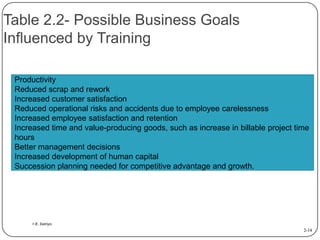
Table 2.2- Possible Business Goals
Influenced by Training
Productivity
Reduced scrap and rework
Increased customer satisfaction
Reduced operational risks and accidents due to employee carelessness
Increased employee satisfaction and retention
Increased time and value-producing goods, such as increase in billable project time
hours
Better management decisions
Increased development of human capital
Succession planning needed for competitive advantage and growth.

> E. Satriyo

2-14
Table 2.3- Decisions a Company Must Make
About How to Compete to Reach its Goals
1. Where to compete?
In what markets (industries, products, etc.) will we compete?
2. How to compete?
On what outcome or differentiating characteristic will we compete?
Cost? Quality?
Reliability? Delivery? Innovativeness?
3. With what will we compete?
What resources will allow us to beat the competition? How will we
acquire, develop,
and deploy those resources to compete?

> E. Satriyo

2-15
The Strategic Training and Development
Process
 Strategic training and development initiatives:

Learning-related actions that help to achieve
business strategy

> E. Satriyo

2-16
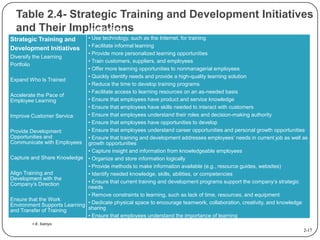
Table 2.4- Strategic Training and Development Initiatives
and Their Implications
Implications
• Use technology, such as the Internet, for training
• Facilitate informal learning
• Provide more personalized learning opportunities
Diversify the Learning
• Train customers, suppliers, and employees
Portfolio
• Offer more learning opportunities to nonmanagerial employees
• Quickly identify needs and provide a high-quality learning solution
Expand Who Is Trained
• Reduce the time to develop training programs
• Facilitate access to learning resources on an as-needed basis
Accelerate the Pace of
• Ensure that employees have product and service knowledge
Employee Learning
• Ensure that employees have skills needed to interact with customers
• Ensure that employees understand their roles and decision-making authority
Improve Customer Service
• Ensure that employees have opportunities to develop
• Ensure that employees understand career opportunities and personal growth opportunities
Provide Development
Opportunities and
• Ensure that training and development addresses employees’ needs in current job as well as
Communicate with Employees growth opportunities
• Capture insight and information from knowledgeable employees
Capture and Share Knowledge • Organize and store information logically
• Provide methods to make information available (e.g., resource guides, websites)
Align Training and
• Identify needed knowledge, skills, abilities, or competencies
Development with the
• Ensure that current training and development programs support the company’s strategic
Company’s Direction
needs
• Remove constraints to learning, such as lack of time, resources, and equipment
Ensure that the Work
Environment Supports Learning • Dedicate physical space to encourage teamwork, collaboration, creativity, and knowledge
sharing
and Transfer of Training
• Ensure that employees understand the importance of learning
• Ensure that managers and peers are supportive of training, development, and learning
> E. Satriyo

Strategic Training and
Development Initiatives

2-17
Table 2.5 - Questions to Ask to Develop
Strategic Training and Development
1. What is the vision and mission of the company? Identify the strategic
Initiatives
drivers of the
business strategy.
2. What capabilities does the company need as a result of the business
strategy and
business environment challenges?
3. What types of training and development will best attract, retain, and
develop the
talent needed for success?
4. Which competencies are critical for company success and the business
strategy?
5. Does the company have a plan for making the link between training and
development
and the business strategy understood by executives, managers, and
employees or
customers?
6. Will the senior management team publicly support and champion training
and
development?
7. Does the company provide opportunities for training and developing not
> E. Satriyo
only
individuals but also teams?

2-18
The Strategic Training and Development
Process
 Metrics
 Business-level outcomes chosen to measure the

overall value of training or learning
 Strategic business related measures not linked to one
course or program
 Balance scorecard
 Means of measurement for:
 Overall company performance
 Performance of departments or functions

> E. Satriyo

2-19
The Strategic Training and Development
Process (cont.)
 Considers four perspectives
 Customer
 Internal innovation
 Learning
 Financial

> E. Satriyo

2-20
Organizational Characteristics That
Influence Training
 Role of employees and managers
 Employees- Responsible for quality of goods and

services
 Managers must:
 Manage individual and performance
 Develop employees and encourage continuous learning
 Plan and allocate resources
 Coordinate activities and interdependent team
 Facilitate decision making
 Create and maintain trust
 Represent one’s work unit

> E. Satriyo

2-21
Organizational Characteristics That
Influence Training
 Top management support
 The CEO is responsible for
 Setting a clear direction for learning
 Providing encouragement, resources and commitment for
strategic learning
 Governing learning and reviewing objectives
 Developing new learning programs for the company
 Teaching program or providing online resources
 Serving as role model for learning
 Promoting the companies commitment to learning

> E. Satriyo

2-22
Organizational Characteristics That
Influence Training
 Integration of business units
 Training likely includes rotating employees between

jobs in different businesses
 Global presence
 Training helps prepare employees for temporary or

long-term overseas assignments
 Business conditions
 Impact the ability to find employees with necessary

skills, and retain current employees

> E. Satriyo

2-23
Organizational Characteristics That
Influence Training
 Other HRM practices
 Human resource management (HRM) practices:

Activities related to:
 Investments
 Staffing
 Performance management
 Training
 Compensation and benefits

> E. Satriyo

2-24
Organizational Characteristics That
Influence Training
 Staffing strategy: Company's decisions regarding:
 Where to find employees
 How to select them
 The desired mix of employee skills and statuses

> E. Satriyo

2-25
Figure 2.4 - Implications of Staffing
Strategy for Training

> E. Satriyo

2-26
Organizational Characteristics That
Influence Training
 Strategic value of Job and employee uniqueness
 Uniqueness: Extent to which employees are rare and

specialized and not highly available
 Strategic value
 Employee potential to improve company effectiveness and

efficiency
 Results in four types of employees
 Knowledge-based workers
 Job-based employees
 Contract employees
 Alliance/partnerships

> E. Satriyo

2-27
Organizational Characteristics That
Influence Training
 Human resource planning
 Identification, analysis, forecasting, and planning of changes to
help meet changing business conditions

> E. Satriyo

2-28
Organizational Characteristics That
Influence Training
 Extent of unionization
 Joint union-management programs help employees

prepare for new jobs
 Staff involvement in training and development
 Effectiveness of the training program depends on the

level of involvement of:
 Managers
 Employees
 Specialized development staff

> E. Satriyo

2-29
Organizational Characteristics That
Influence Training (cont.)
 Staff involvement in training and development
 If line managers are aware of what development

activity can achieve, they will be more willing to
become involved in it.
 They will also become more involved in the training process if

they are rewarded for participating.

 An emerging trend is that companies expect

employees to initiate the training process.

> E. Satriyo

2-30
Table 2.7 Implications of
Business
Strategy for
Training

> E. Satriyo

2-31
Training Needs in Different Strategies
 Internal growth strategy
 Focuses on new market and product development,

innovation, and joint ventures
 External growth strategy
 Emphasizes acquiring vendors and suppliers or buying

businesses to expand into new markets
 Disinvestment strategy: Emphasizes liquidation

and divestiture of businesses

> E. Satriyo

2-32
Models of Organizing the Training
Department
 Centralized training
 Training and development resources, and

professionals are housed in one location
 Training investment and delivery methods decisions
are made from one department
 Advantages- Helps integrate programs for developing
leaders and managing talent

> E. Satriyo

2-33
Figure 2.5- The Corporate University
Model

> E. Satriyo

2-34
Table 2.9- Features of Training Function
Organized by the BE Model
Strategic Direction
Broadly disseminates a clearly articulated mission
Recognizes that its customer base is segmented
Provides customized solutions to its clients’ needs
Understands product life cycles
Organizes its offerings by competencies
Competes for internal customers
Product Design
Uses benchmarking and other innovative design
Implements strategies to develop products quickly
Involves suppliers strategically
Structural Versatility
Employs professionals who serve as product and classroom instructors, managers, and internal
consultants
Uses resources from many areas
Involves line managers in determining the direction of the department’s offerings and content
Product Delivery
Offers a menu of learning options
Delivers training at the work site
Accountability for Results
Believes that individual employees must take responsibility for their personal growth
Provides follow-up on the job to ensure that learning takes place
Considers the manager the key player in supporting learning
Evaluates the strategic effects of training and it’s bottom-line results
Guarantees that training will improve performance
> E. Satriyo
2-35
Models of Organizing the Training
Department
 The BE model with Centralized training
 Allows the company to gain the benefits of centralized

training
 Ensures that training content and delivery methods that
are business specific

> E. Satriyo

2-36
Figure 2.6- A Change Model

> E. Satriyo

2-37
Models of Organizing the Training
Department
 Resistance to change: Managers’ and employees’

unwillingness to change
 Control: Managers’ and employees’ ability to obtain
and distribute valuable resources
 Power: Ability to influence others
 Task redefinition: Creating changes in managers’
and employees’ roles and job responsibilities

> E. Satriyo

2-38
Table 2.10 Steps in a change process
 Steps in a change process
Clarify the request for change
Make the vision clear
Design the solution
Communicate and market for buy- in
Choose and announce action as soon as
possible
Execute and create short term wins
Follow up , reevaluate and modify

> E. Satriyo

2-39
Marketing the Training and Creating A
Brand
 Internal marketing-Making employees and managers

excited about training
 Internal marketing tactics
 Involve the target audience in developing the training

program
 Demonstrate how a training program can be used to
solve specific business needs
 Identify a “champion” who actively supports training
 Listen and act on feedback received

> E. Satriyo

2-40
Marketing the Training and Creating A
Brand
 Advertise on e-mail, on company websites, and in

employee break areas
 Designate someone to interact between the training
designer and the business unit
 Determine the financial gains top- level executives are
concerned with
 Don’t use jargon

> E. Satriyo

2-41
Table 2.11- How to Build Training
Brand
• Ask current “customers” of training, including managers who purchase or ask for
training and employees who participate in training what their perceptions are of
the brand. For example, what emotions describe how they feel about the training
brand? What words summarize their feelings? What conclusions have they made
about doing business with you? Answers to these questions provide information
regarding the strength of the training brand and if it is being perceived positively or
as intended.
• Define how you want to be perceived by current and future customers.
• Identify factors that influence your customer’s perceptions of the training function.
• Review each of the factors to determine if it is supporting and communicating the
brand to your customers in a way that you intended.
• Make changes so that each factor is supporting the brand.
• Get customers feedback at each step of this process (define the brand, identify
factors, suggest changes, etc.).
• When interacting with customers, create an experience that supports and
identifies the brand.
> E. Satriyo

2-42
Outsourcing Training
 Outsourcing: Use of an outside company that

takes:
 Complete responsibility and control of some or all

training or development activities including
 Administration
 Design
 Delivery
 Development

 Business process outsourcing
 Outsourcing of any business process, such as HRM,

production, or training
> E. Satriyo

2-43
Outsourcing Training
 Advantages of outsourcing training:
 Cost savings

 Time savings
 Improvements in compliance with training mandates
 Access best training practices

 Reasons companies do not outsource their training
 Inability of outsourcing providers to meet company

needs
 Desire to maintain control over all aspects of training
and development
> E. Satriyo

2-44
Table 2.12- Questions to Ask When
Considering Outsourcing
1. What are the capabilities of your in-house training function? Does the staff
know enough that you can grow the training skills you need, or do you need
to hire training skills from the outside?
2. Can your in-house training function take on additional training
responsibilities?
3. Is training key to your company’s strategy? Is it proprietary?
4. Does your company value its training organization?
5. Does the training content change rapidly?
6. Are outsourced trainers viewed as experts, or are they viewed with
cynicism?
7. Do you understand the strengths and weaknesses of your current training
programs?
8. Do you want to outsource the entire training function?
9. Are executive trying to minimize training’s impact on your company? Does
your company accept responsibility for building skills and talent?
10. Is a combination of internal and external training the best solution?
> E. Satriyo

2-45

Employee Training & Development Ch 02

  • 1.
    Strategic Training Chapter 2 6thEdition Raymond A. Noe McGraw-Hill/Irwin Copyright © 2013 by The McGraw-Hill Companies, Inc. All rights reserved.
  • 2.
    Learning Objectives  Discusshow business strategy influences the type and amount of training in a company  Describe the strategic training and development process  Discuss how a company’s staffing and human resource planning strategies influence training  Explain the training needs created by concentration, internal growth external growth, and disinvestment business strategies > E. Satriyo 2-2
  • 3.
    Learning Objectives  Discussthe advantages and disadvantages of centralizing the training function  Discuss the strengths of the business embedded model for organizing the training function  Explain a corporate university and its benefits > E. Satriyo 2-3
  • 4.
    Introduction  Business strategy Integrates the company's goals, policies, and actions  Influences how the company uses:  Physical capital, financial capital, and human capital  Goals- What the company hopes to achieve in the medium- and long-term future > E. Satriyo 2-4
  • 5.
    Introduction  Strategy determines: Amount of training required for current or future job skills  Extent to which training should be customized for particular needs  Extent to which training is restricted to specific groups of employees or open to all  Extent to which training is planned and systematically administered  Importance placed on training compared to other HR practices > E. Satriyo 2-5
  • 6.
    Learning as aStrategic Focus  Learning organization: A company that has:  An enhanced capacity to learn, adapt, and change  Carefully scrutinized and aligned training processes with company goals  Training as a part of system designed to create human capital > E. Satriyo 2-6
  • 7.
    Table 2.1- KeyFeatures of a Learning Organization Supportive Learning Environment • Employees feel safe expressing their thoughts about work, asking questions, disagreeing with managers, and admitting mistakes. • Different functional and cultural perspectives are appreciated. • Employees are encouraged to take risks, innovate, and explore the untested and unknown, such as trying new processes and developing new products and services. • Thoughtful review of the company’s processes is encouraged. Learning Processes and Practices • Knowledge creation, dissemination, sharing, and application are practiced. • Systems are developed for creating, capturing, and sharing knowledge. Managers Reinforce Learning • Managers actively question and listen to employees, encouraging dialogue and debate. • Managers are willing to consider alternative points of view. • Time is devoted to problem identification, learning processes and practices, and post-performance audits. • Learning is rewarded, promoted, and supported. > E. Satriyo 2-7
  • 8.
    Implications of Learningfor Human Capital Development  Recognition that learning should help:  Employees improve performance  Achieve business goals  Learning should occur on as needed basis  Need to support informal learning  Learning should be supported psychologically > E. Satriyo 2-8
  • 9.
    Implications of Learningfor Human Capital Development  Key capabilities  Aligning learning goals to business goals  Measuring of business impact of learning  Movement of learning outside the company  Developing competencies for critical jobs  Integrating learning with other human resource functions  Including classroom as well as e-learning  Designing and delivering leadership development courses > E. Satriyo 2-9
  • 10.
    Figure 2.1- TheStrategic Training and Development Process Business Strategy Strategic Training & Development Initiatives • Diversify the Learning Portfolio • Improve Customer Service • Accelerate the Pace of Employee Learning • Capture and Share Knowledge Training & Development Activities • Use Web-Based Training • Make Development Planning Mandatory • Develop Web Sites for Knowledge Sharing • Increase Amount of Customer Service Training Metrics That Show Value of Training • Learning • Performance Improvement • Reduced Customer Complaints • Reduced Turnover • Employee Engagement > E. Satriyo 2-10
  • 11.
    The Strategic Trainingand Development Process  Mission: Company's reason for existing  Vision: Is the picture of the future that the company wants to achieve  Values: What the company stands for  SWOT analysis  Internal analysis of strengths and weaknesses  External analysis of opportunities and threats  External analysis: Examining the operating environment to identify opportunities and threats > E. Satriyo 2-11
  • 12.
    The Strategic Trainingand Development Process  Internal analysis  Identifies the company’s strength and weaknesses  Examines the available quantity and quality of financial, physical, and human capital  Strategic choice: The strategy believed to be the best alternative to achieve the company goals > E. Satriyo 2-12
  • 13.
    Figure 2.2- Formulatingthe Business Strategy External Analysis Opportunities Threats Goals Strategic Choice Mission Why does the Company Exist? Company Objectives How will we Compete? Internal Analysis Strengths Weaknesses > E. Satriyo 2-13
  • 14.
    Table 2.2- PossibleBusiness Goals Influenced by Training Productivity Reduced scrap and rework Increased customer satisfaction Reduced operational risks and accidents due to employee carelessness Increased employee satisfaction and retention Increased time and value-producing goods, such as increase in billable project time hours Better management decisions Increased development of human capital Succession planning needed for competitive advantage and growth. > E. Satriyo 2-14
  • 15.
    Table 2.3- Decisionsa Company Must Make About How to Compete to Reach its Goals 1. Where to compete? In what markets (industries, products, etc.) will we compete? 2. How to compete? On what outcome or differentiating characteristic will we compete? Cost? Quality? Reliability? Delivery? Innovativeness? 3. With what will we compete? What resources will allow us to beat the competition? How will we acquire, develop, and deploy those resources to compete? > E. Satriyo 2-15
  • 16.
    The Strategic Trainingand Development Process  Strategic training and development initiatives: Learning-related actions that help to achieve business strategy > E. Satriyo 2-16
  • 17.
    Table 2.4- StrategicTraining and Development Initiatives and Their Implications Implications • Use technology, such as the Internet, for training • Facilitate informal learning • Provide more personalized learning opportunities Diversify the Learning • Train customers, suppliers, and employees Portfolio • Offer more learning opportunities to nonmanagerial employees • Quickly identify needs and provide a high-quality learning solution Expand Who Is Trained • Reduce the time to develop training programs • Facilitate access to learning resources on an as-needed basis Accelerate the Pace of • Ensure that employees have product and service knowledge Employee Learning • Ensure that employees have skills needed to interact with customers • Ensure that employees understand their roles and decision-making authority Improve Customer Service • Ensure that employees have opportunities to develop • Ensure that employees understand career opportunities and personal growth opportunities Provide Development Opportunities and • Ensure that training and development addresses employees’ needs in current job as well as Communicate with Employees growth opportunities • Capture insight and information from knowledgeable employees Capture and Share Knowledge • Organize and store information logically • Provide methods to make information available (e.g., resource guides, websites) Align Training and • Identify needed knowledge, skills, abilities, or competencies Development with the • Ensure that current training and development programs support the company’s strategic Company’s Direction needs • Remove constraints to learning, such as lack of time, resources, and equipment Ensure that the Work Environment Supports Learning • Dedicate physical space to encourage teamwork, collaboration, creativity, and knowledge sharing and Transfer of Training • Ensure that employees understand the importance of learning • Ensure that managers and peers are supportive of training, development, and learning > E. Satriyo Strategic Training and Development Initiatives 2-17
  • 18.
    Table 2.5 -Questions to Ask to Develop Strategic Training and Development 1. What is the vision and mission of the company? Identify the strategic Initiatives drivers of the business strategy. 2. What capabilities does the company need as a result of the business strategy and business environment challenges? 3. What types of training and development will best attract, retain, and develop the talent needed for success? 4. Which competencies are critical for company success and the business strategy? 5. Does the company have a plan for making the link between training and development and the business strategy understood by executives, managers, and employees or customers? 6. Will the senior management team publicly support and champion training and development? 7. Does the company provide opportunities for training and developing not > E. Satriyo only individuals but also teams? 2-18
  • 19.
    The Strategic Trainingand Development Process  Metrics  Business-level outcomes chosen to measure the overall value of training or learning  Strategic business related measures not linked to one course or program  Balance scorecard  Means of measurement for:  Overall company performance  Performance of departments or functions > E. Satriyo 2-19
  • 20.
    The Strategic Trainingand Development Process (cont.)  Considers four perspectives  Customer  Internal innovation  Learning  Financial > E. Satriyo 2-20
  • 21.
    Organizational Characteristics That InfluenceTraining  Role of employees and managers  Employees- Responsible for quality of goods and services  Managers must:  Manage individual and performance  Develop employees and encourage continuous learning  Plan and allocate resources  Coordinate activities and interdependent team  Facilitate decision making  Create and maintain trust  Represent one’s work unit > E. Satriyo 2-21
  • 22.
    Organizational Characteristics That InfluenceTraining  Top management support  The CEO is responsible for  Setting a clear direction for learning  Providing encouragement, resources and commitment for strategic learning  Governing learning and reviewing objectives  Developing new learning programs for the company  Teaching program or providing online resources  Serving as role model for learning  Promoting the companies commitment to learning > E. Satriyo 2-22
  • 23.
    Organizational Characteristics That InfluenceTraining  Integration of business units  Training likely includes rotating employees between jobs in different businesses  Global presence  Training helps prepare employees for temporary or long-term overseas assignments  Business conditions  Impact the ability to find employees with necessary skills, and retain current employees > E. Satriyo 2-23
  • 24.
    Organizational Characteristics That InfluenceTraining  Other HRM practices  Human resource management (HRM) practices: Activities related to:  Investments  Staffing  Performance management  Training  Compensation and benefits > E. Satriyo 2-24
  • 25.
    Organizational Characteristics That InfluenceTraining  Staffing strategy: Company's decisions regarding:  Where to find employees  How to select them  The desired mix of employee skills and statuses > E. Satriyo 2-25
  • 26.
    Figure 2.4 -Implications of Staffing Strategy for Training > E. Satriyo 2-26
  • 27.
    Organizational Characteristics That InfluenceTraining  Strategic value of Job and employee uniqueness  Uniqueness: Extent to which employees are rare and specialized and not highly available  Strategic value  Employee potential to improve company effectiveness and efficiency  Results in four types of employees  Knowledge-based workers  Job-based employees  Contract employees  Alliance/partnerships > E. Satriyo 2-27
  • 28.
    Organizational Characteristics That InfluenceTraining  Human resource planning  Identification, analysis, forecasting, and planning of changes to help meet changing business conditions > E. Satriyo 2-28
  • 29.
    Organizational Characteristics That InfluenceTraining  Extent of unionization  Joint union-management programs help employees prepare for new jobs  Staff involvement in training and development  Effectiveness of the training program depends on the level of involvement of:  Managers  Employees  Specialized development staff > E. Satriyo 2-29
  • 30.
    Organizational Characteristics That InfluenceTraining (cont.)  Staff involvement in training and development  If line managers are aware of what development activity can achieve, they will be more willing to become involved in it.  They will also become more involved in the training process if they are rewarded for participating.  An emerging trend is that companies expect employees to initiate the training process. > E. Satriyo 2-30
  • 31.
    Table 2.7 Implicationsof Business Strategy for Training > E. Satriyo 2-31
  • 32.
    Training Needs inDifferent Strategies  Internal growth strategy  Focuses on new market and product development, innovation, and joint ventures  External growth strategy  Emphasizes acquiring vendors and suppliers or buying businesses to expand into new markets  Disinvestment strategy: Emphasizes liquidation and divestiture of businesses > E. Satriyo 2-32
  • 33.
    Models of Organizingthe Training Department  Centralized training  Training and development resources, and professionals are housed in one location  Training investment and delivery methods decisions are made from one department  Advantages- Helps integrate programs for developing leaders and managing talent > E. Satriyo 2-33
  • 34.
    Figure 2.5- TheCorporate University Model > E. Satriyo 2-34
  • 35.
    Table 2.9- Featuresof Training Function Organized by the BE Model Strategic Direction Broadly disseminates a clearly articulated mission Recognizes that its customer base is segmented Provides customized solutions to its clients’ needs Understands product life cycles Organizes its offerings by competencies Competes for internal customers Product Design Uses benchmarking and other innovative design Implements strategies to develop products quickly Involves suppliers strategically Structural Versatility Employs professionals who serve as product and classroom instructors, managers, and internal consultants Uses resources from many areas Involves line managers in determining the direction of the department’s offerings and content Product Delivery Offers a menu of learning options Delivers training at the work site Accountability for Results Believes that individual employees must take responsibility for their personal growth Provides follow-up on the job to ensure that learning takes place Considers the manager the key player in supporting learning Evaluates the strategic effects of training and it’s bottom-line results Guarantees that training will improve performance > E. Satriyo 2-35
  • 36.
    Models of Organizingthe Training Department  The BE model with Centralized training  Allows the company to gain the benefits of centralized training  Ensures that training content and delivery methods that are business specific > E. Satriyo 2-36
  • 37.
    Figure 2.6- AChange Model > E. Satriyo 2-37
  • 38.
    Models of Organizingthe Training Department  Resistance to change: Managers’ and employees’ unwillingness to change  Control: Managers’ and employees’ ability to obtain and distribute valuable resources  Power: Ability to influence others  Task redefinition: Creating changes in managers’ and employees’ roles and job responsibilities > E. Satriyo 2-38
  • 39.
    Table 2.10 Stepsin a change process  Steps in a change process Clarify the request for change Make the vision clear Design the solution Communicate and market for buy- in Choose and announce action as soon as possible Execute and create short term wins Follow up , reevaluate and modify > E. Satriyo 2-39
  • 40.
    Marketing the Trainingand Creating A Brand  Internal marketing-Making employees and managers excited about training  Internal marketing tactics  Involve the target audience in developing the training program  Demonstrate how a training program can be used to solve specific business needs  Identify a “champion” who actively supports training  Listen and act on feedback received > E. Satriyo 2-40
  • 41.
    Marketing the Trainingand Creating A Brand  Advertise on e-mail, on company websites, and in employee break areas  Designate someone to interact between the training designer and the business unit  Determine the financial gains top- level executives are concerned with  Don’t use jargon > E. Satriyo 2-41
  • 42.
    Table 2.11- Howto Build Training Brand • Ask current “customers” of training, including managers who purchase or ask for training and employees who participate in training what their perceptions are of the brand. For example, what emotions describe how they feel about the training brand? What words summarize their feelings? What conclusions have they made about doing business with you? Answers to these questions provide information regarding the strength of the training brand and if it is being perceived positively or as intended. • Define how you want to be perceived by current and future customers. • Identify factors that influence your customer’s perceptions of the training function. • Review each of the factors to determine if it is supporting and communicating the brand to your customers in a way that you intended. • Make changes so that each factor is supporting the brand. • Get customers feedback at each step of this process (define the brand, identify factors, suggest changes, etc.). • When interacting with customers, create an experience that supports and identifies the brand. > E. Satriyo 2-42
  • 43.
    Outsourcing Training  Outsourcing:Use of an outside company that takes:  Complete responsibility and control of some or all training or development activities including  Administration  Design  Delivery  Development  Business process outsourcing  Outsourcing of any business process, such as HRM, production, or training > E. Satriyo 2-43
  • 44.
    Outsourcing Training  Advantagesof outsourcing training:  Cost savings  Time savings  Improvements in compliance with training mandates  Access best training practices  Reasons companies do not outsource their training  Inability of outsourcing providers to meet company needs  Desire to maintain control over all aspects of training and development > E. Satriyo 2-44
  • 45.
    Table 2.12- Questionsto Ask When Considering Outsourcing 1. What are the capabilities of your in-house training function? Does the staff know enough that you can grow the training skills you need, or do you need to hire training skills from the outside? 2. Can your in-house training function take on additional training responsibilities? 3. Is training key to your company’s strategy? Is it proprietary? 4. Does your company value its training organization? 5. Does the training content change rapidly? 6. Are outsourced trainers viewed as experts, or are they viewed with cynicism? 7. Do you understand the strengths and weaknesses of your current training programs? 8. Do you want to outsource the entire training function? 9. Are executive trying to minimize training’s impact on your company? Does your company accept responsibility for building skills and talent? 10. Is a combination of internal and external training the best solution? > E. Satriyo 2-45