Chapter 4
Learning: Theories and Program Design
Copyright © 2010 by the McGraw-Hill Companies, Inc. All rights reserved.
McGraw-Hill/Irwin
4-2
What is Learning? What is
Learned?
Learning
Learning -
- a relatively permanent
change in human capabilities that is not a
result of growth processes.
These capabilities are related to specific
learning outcomes.
4-3
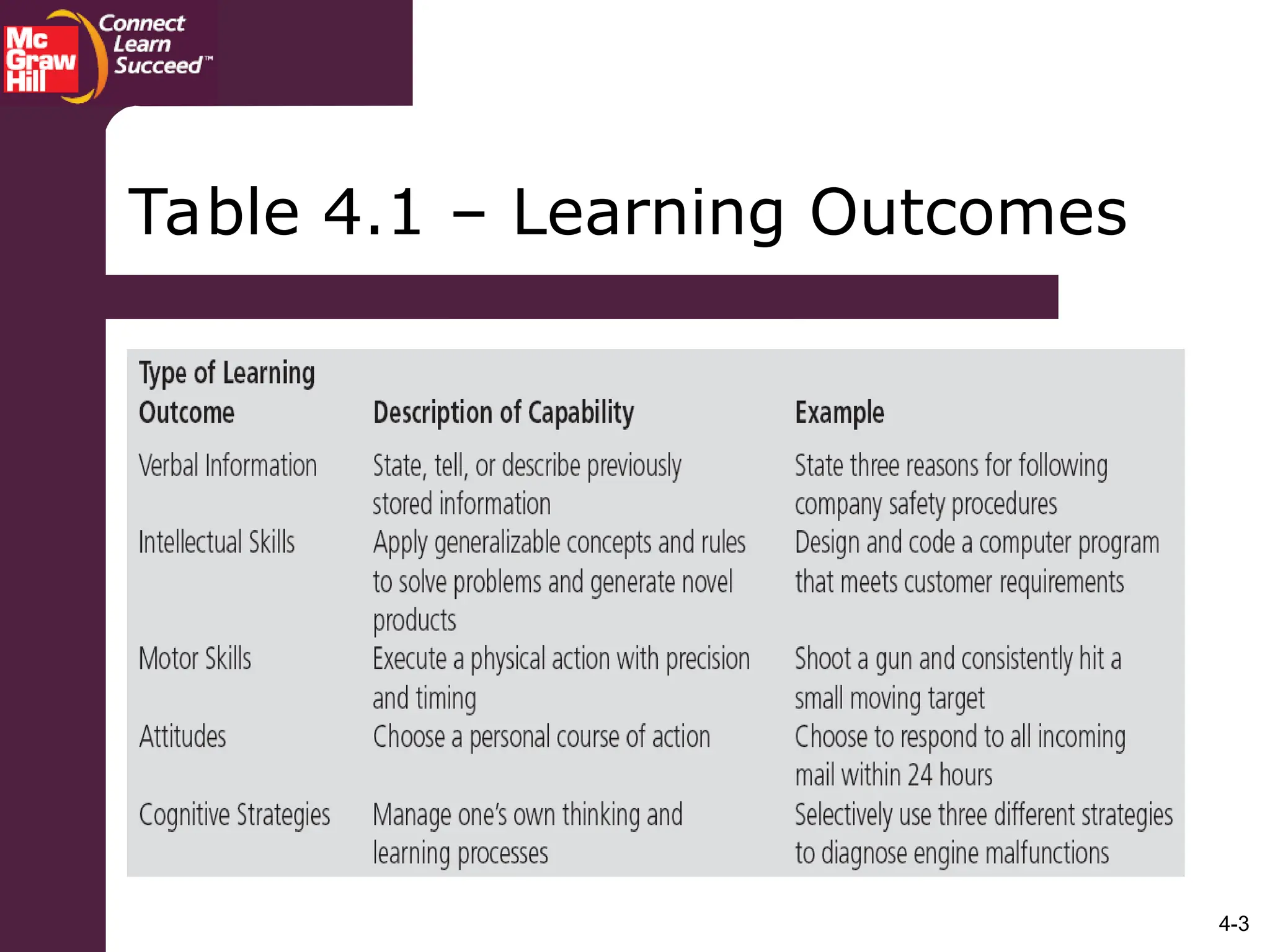
Table 4.1 – Learning Outcomes
4-4
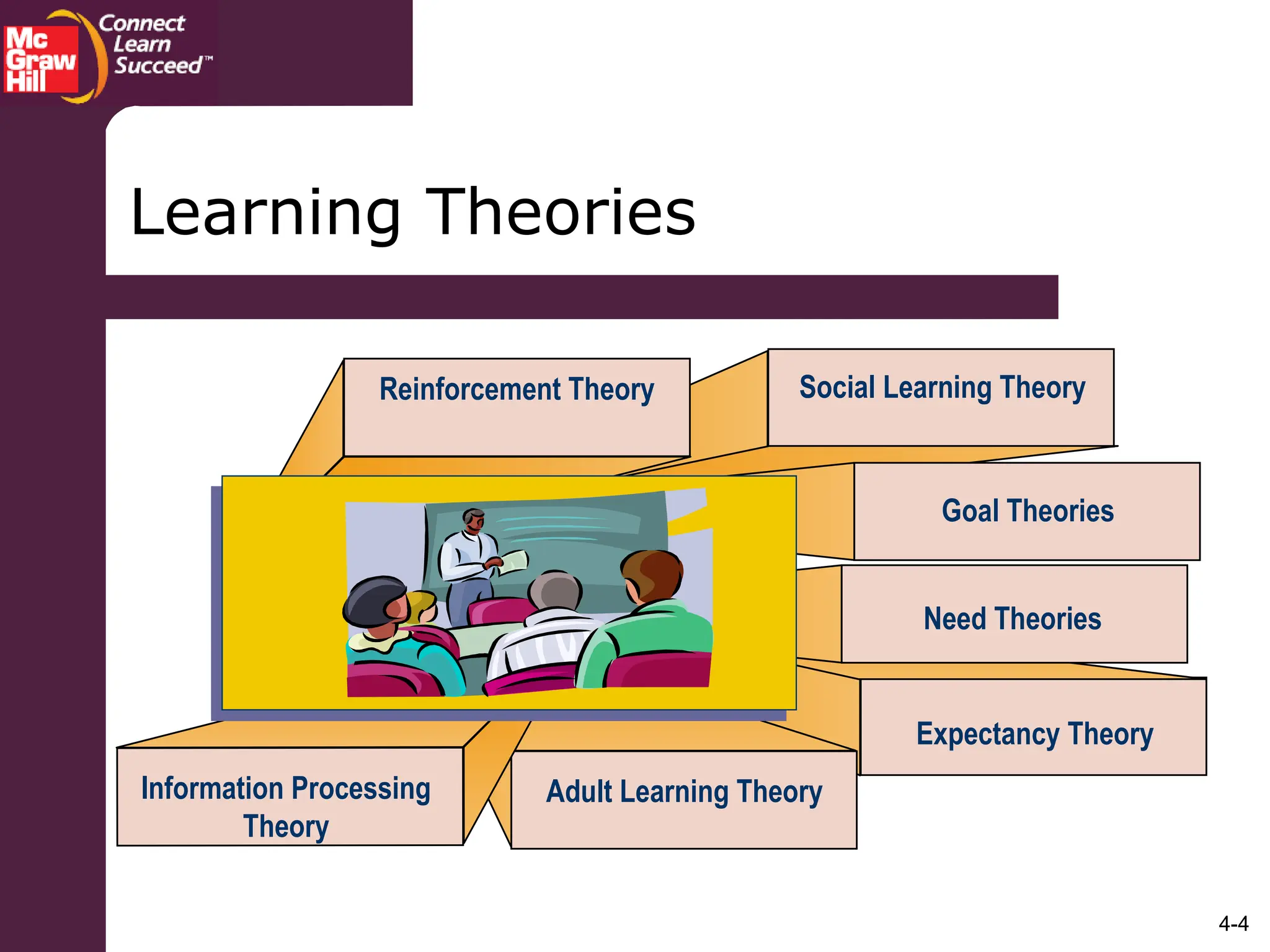
Reinforcement Theory Social Learning Theory
Goal Theories
Need Theories
Expectancy Theory
Adult Learning Theory
Information Processing
Theory
Learning Theories
4-5
Reinforcement theory - emphasizes
that people are motivated to perform or
avoid certain behaviors because of past
outcomes that have resulted from those
behaviors.
Several processes in reinforcement theory are
positive reinforcement, negative
reinforcement, extinction, and punishment.
Learning Theories (cont.)
4-6
Reinforcement theory
The trainer needs to identify what outcomes
the learner finds most positive and negative.
Trainers then need to link these outcomes to
learners acquiring knowledge, skills, or
changing behaviors.
Trainers can withhold or provide job-related,
personal, and career-related benefits to
learners who master program content.
Learning Theories (cont.)
4-7
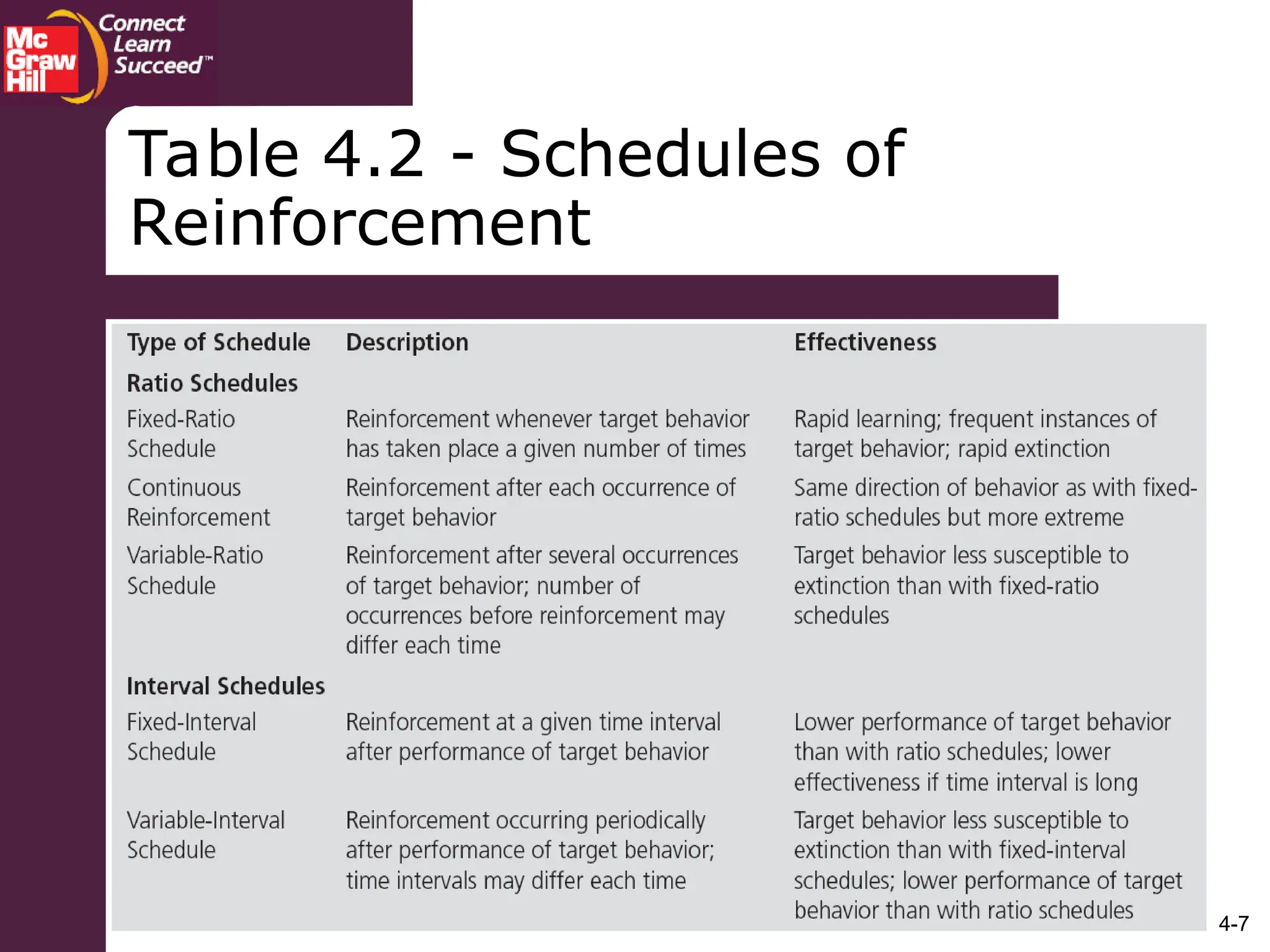
Table 4.2 - Schedules of
Reinforcement
4-8
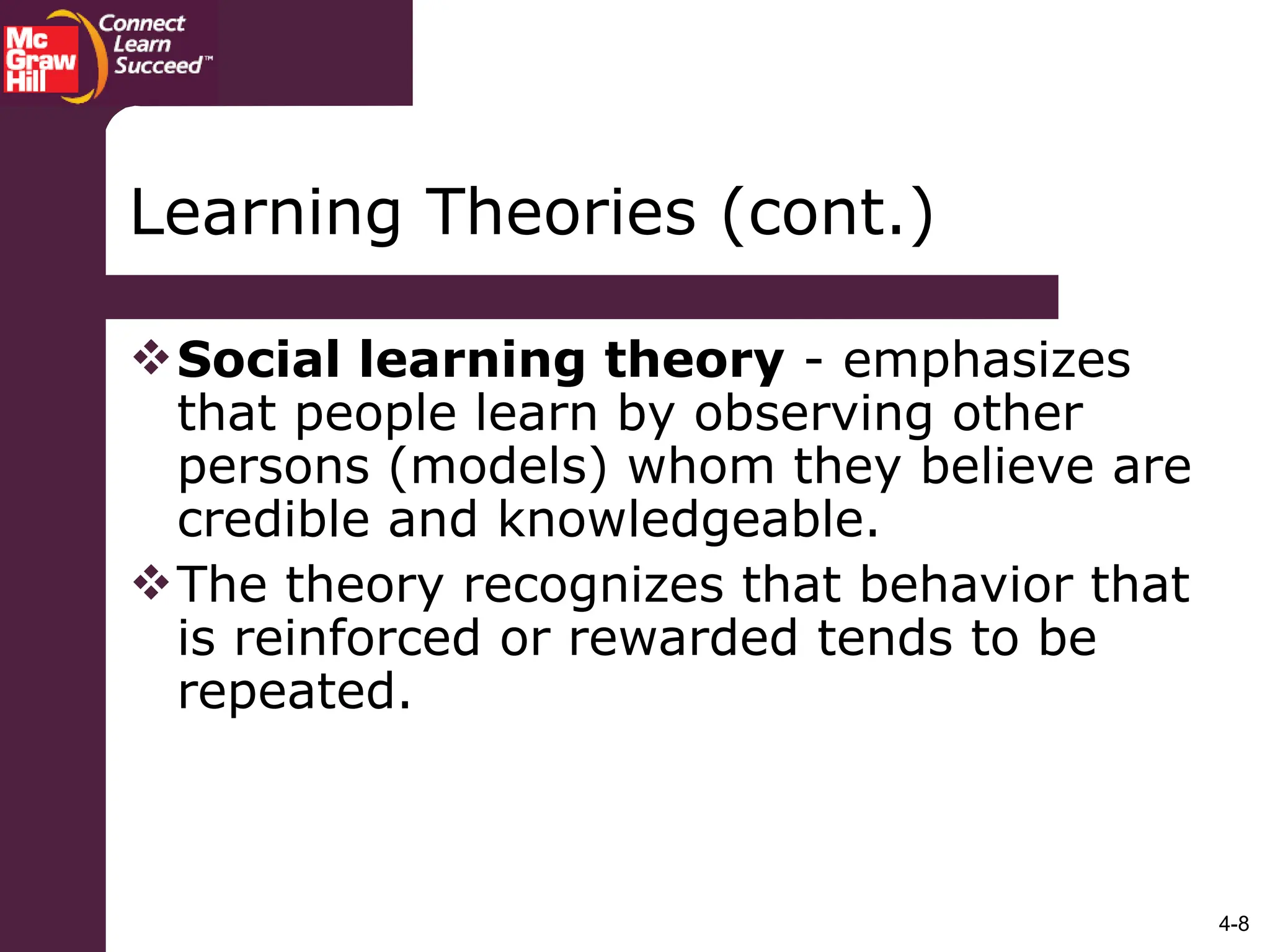
Social learning theory - emphasizes
that people learn by observing other
persons (models) whom they believe are
credible and knowledgeable.
The theory recognizes that behavior that
is reinforced or rewarded tends to be
repeated.
Learning Theories (cont.)
4-9
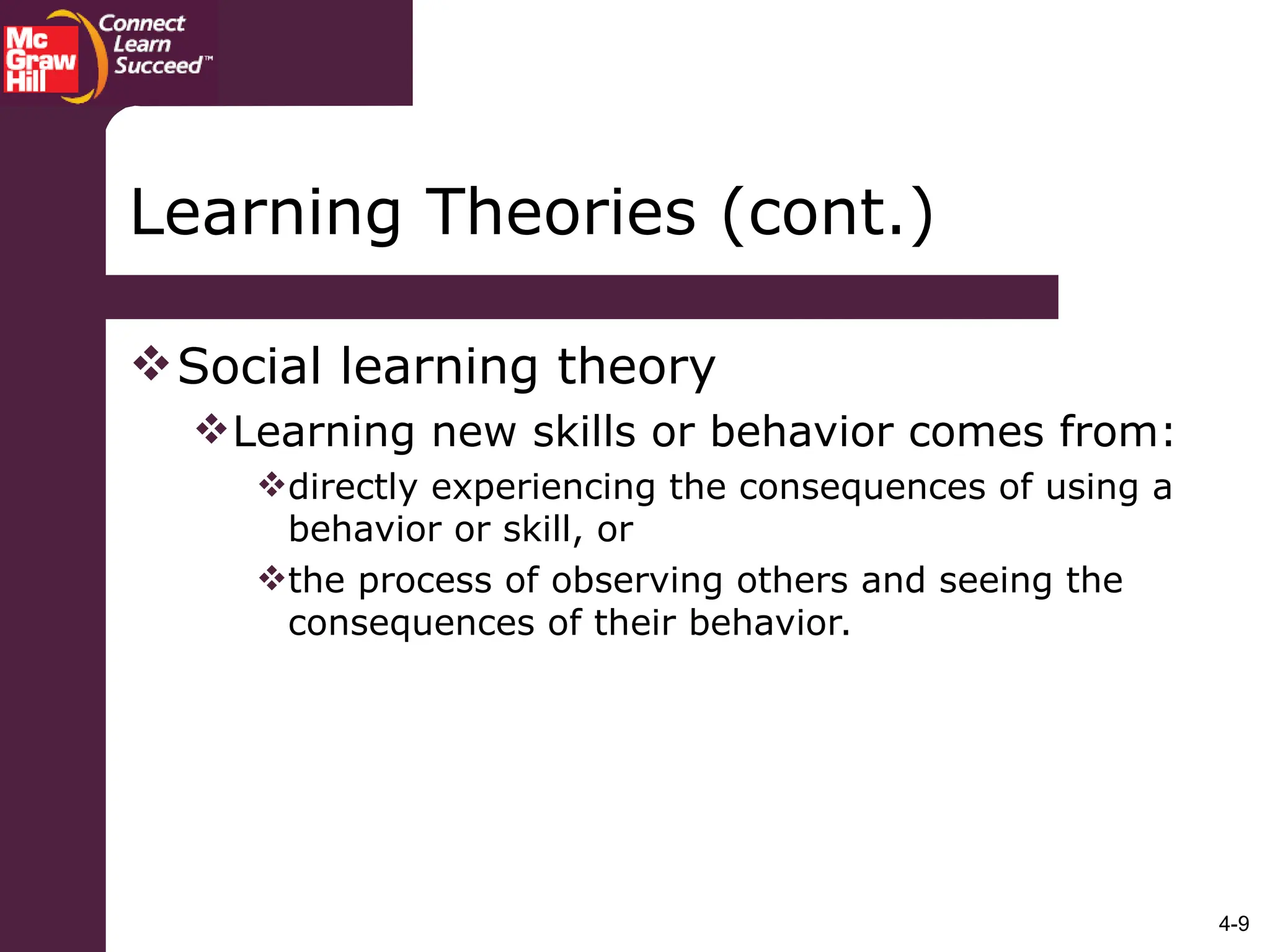
Social learning theory
Learning new skills or behavior comes from:
directly experiencing the consequences of using a
behavior or skill, or
the process of observing others and seeing the
consequences of their behavior.
Learning Theories (cont.)
4-10
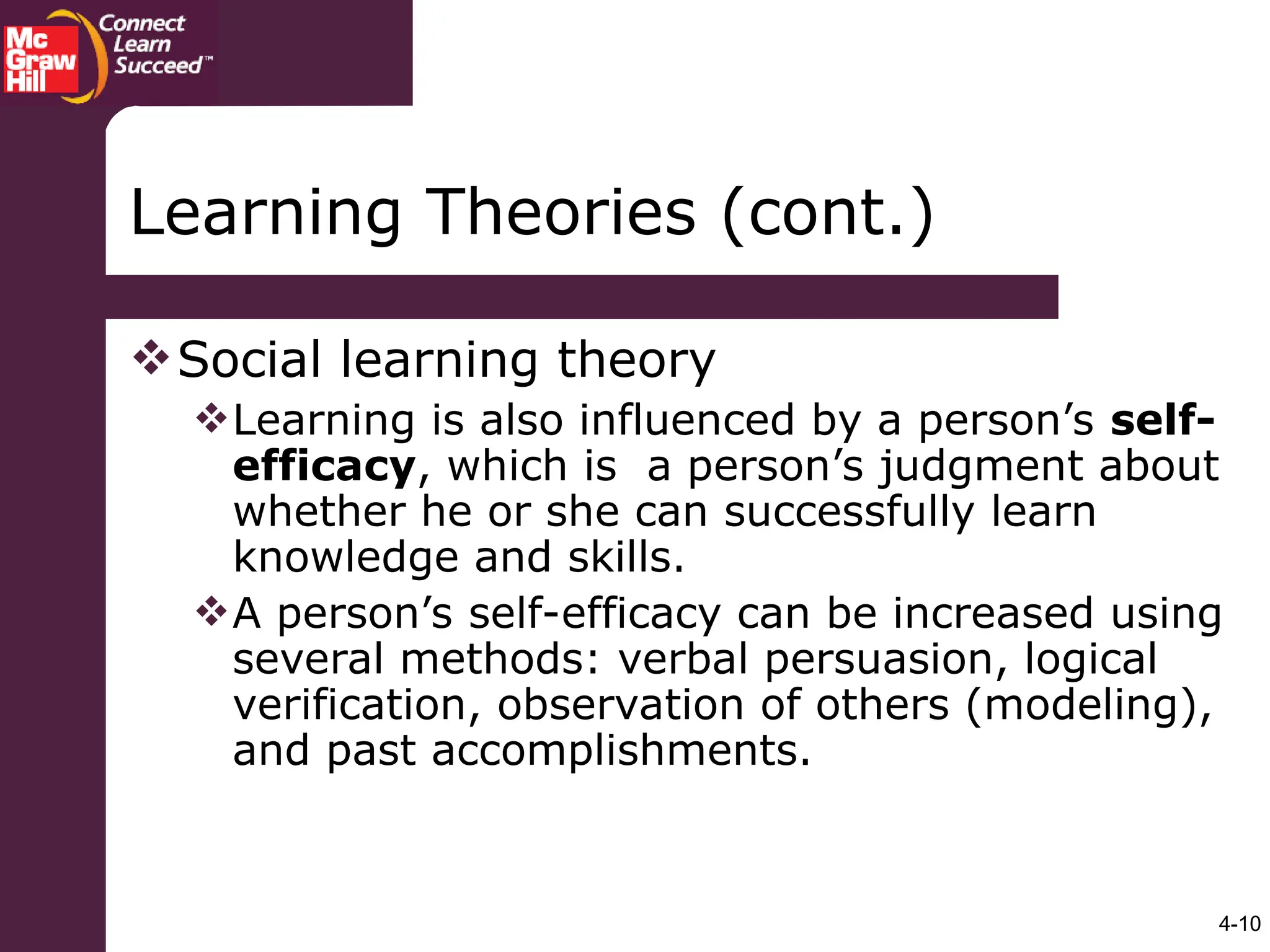
Social learning theory
Learning is also influenced by a person’s self-
efficacy, which is a person’s judgment about
whether he or she can successfully learn
knowledge and skills.
A person’s self-efficacy can be increased using
several methods: verbal persuasion, logical
verification, observation of others (modeling),
and past accomplishments.
Learning Theories (cont.)
4-11
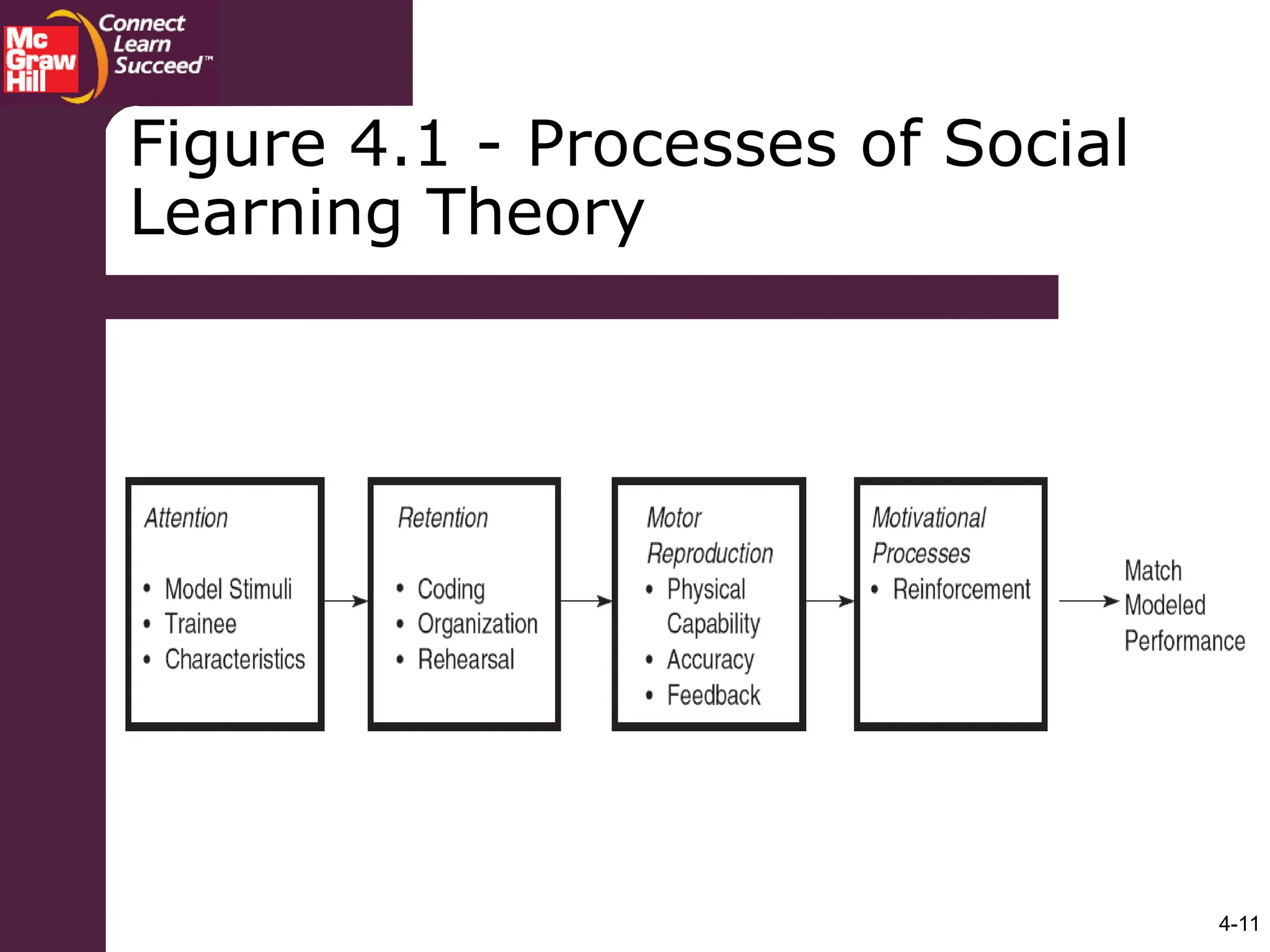
Figure 4.1 - Processes of Social
Learning Theory
4-12
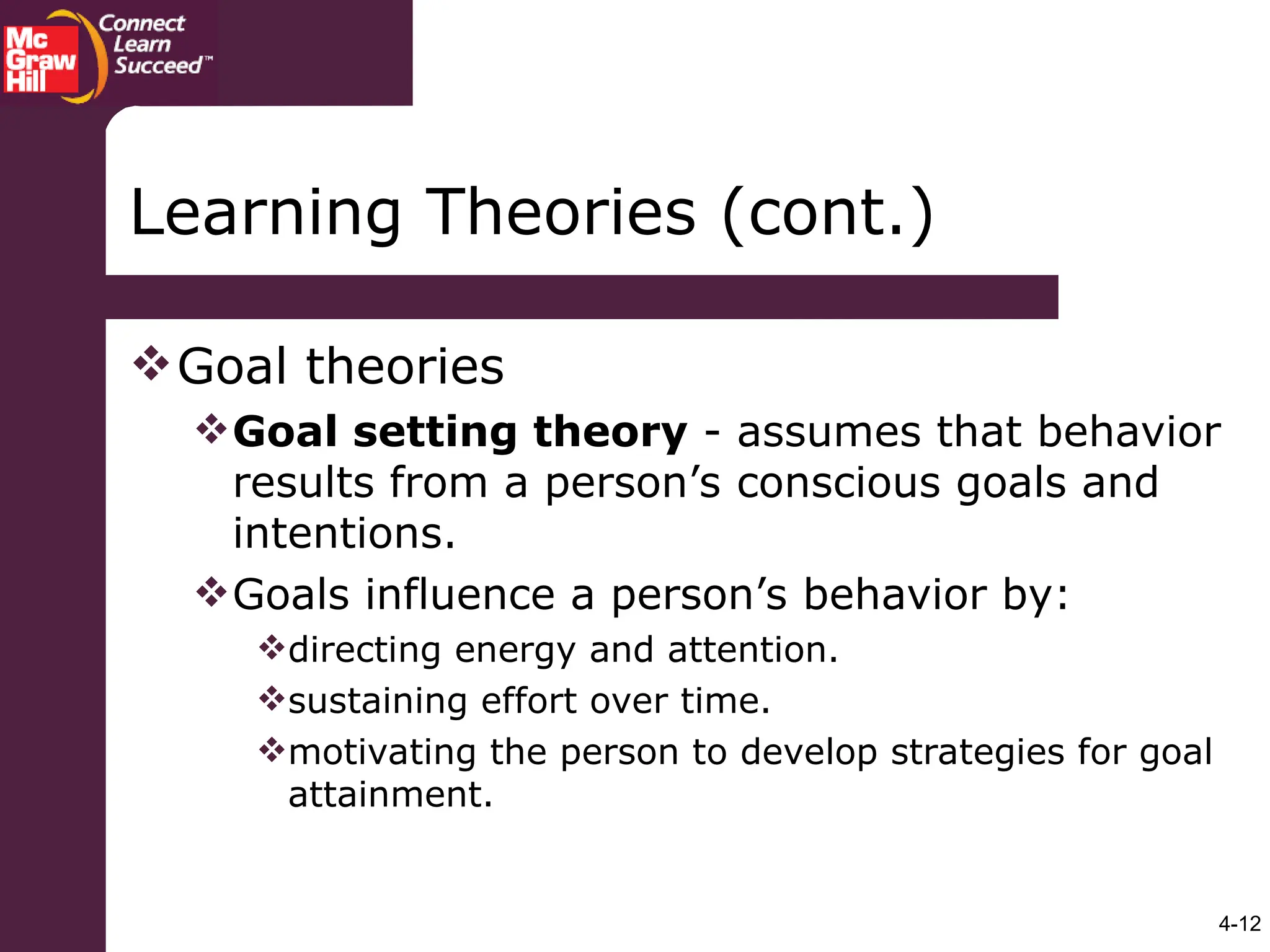
Goal theories
Goal setting theory - assumes that behavior
results from a person’s conscious goals and
intentions.
Goals influence a person’s behavior by:
directing energy and attention.
sustaining effort over time.
motivating the person to develop strategies for goal
attainment.
Learning Theories (cont.)
4-13
Goal theories
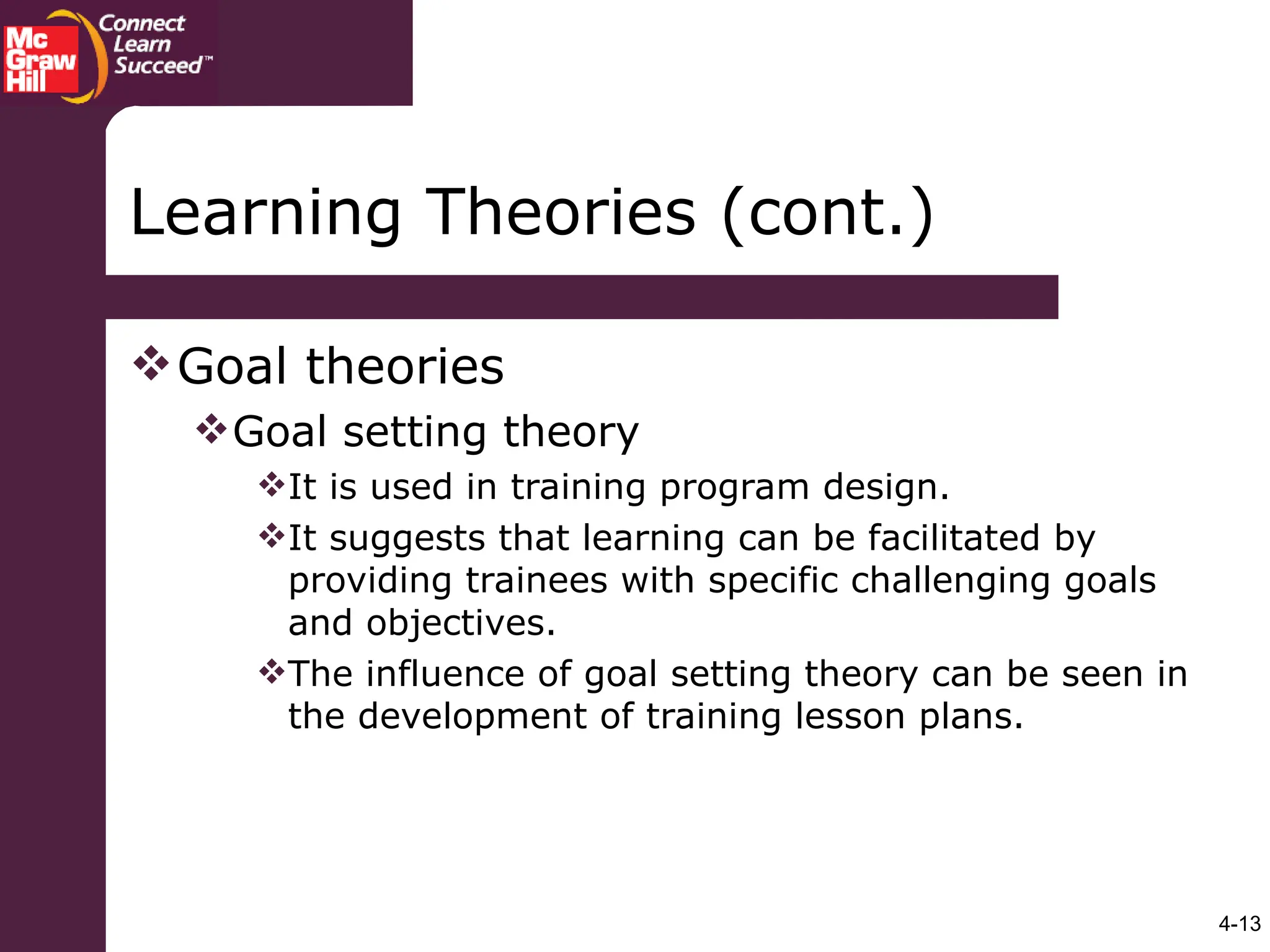
Goal setting theory
It is used in training program design.
It suggests that learning can be facilitated by
providing trainees with specific challenging goals
and objectives.
The influence of goal setting theory can be seen in
the development of training lesson plans.
Learning Theories (cont.)
4-14
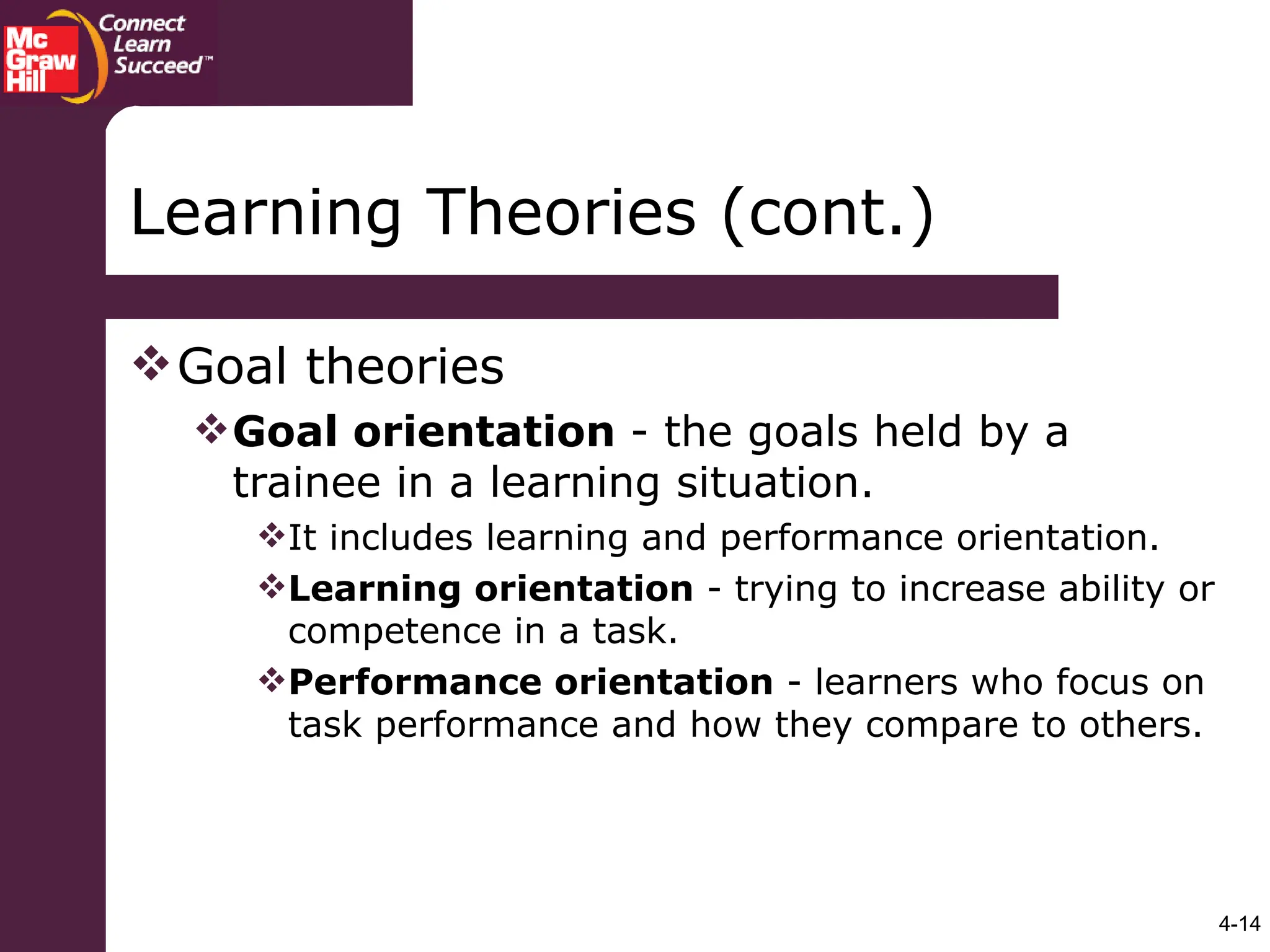
Goal theories
Goal orientation - the goals held by a
trainee in a learning situation.
It includes learning and performance orientation.
Learning orientation - trying to increase ability or
competence in a task.
Performance orientation - learners who focus on
task performance and how they compare to others.
Learning Theories (cont.)
4-15
Goal theories
Goal orientation
It affects the amount of effort a trainee will expend
in learning (motivation to learn).
Learners with a high learning orientation will direct
greater attention to the task and learn for the sake
of learning in comparison to learners with a
performance orientation.
Learners with a performance orientation will direct
more attention to performing well and less effort to
learning.
Learning Theories (cont.)
4-16
Learning Theories (cont.)
Need theories
Helps to explain the value that a person
places on certain outcomes.
Need - a deficiency that a person is
experiencing at any point in time.
Maslow’s and Alderfer’s need theories focused
on physiological needs, relatedness needs,
and growth needs.
4-17
Learning Theories (cont.)
Need theories
The major difference between Alderfer’s and
Maslow’s hierarchies of needs is that Alderfer
allows the possibility that if higher-level needs
are not satisfied, employees will refocus on
lower-level needs.
McClelland’s need theory focused primarily on
needs for achievement, affiliation, and power.
4-18
Learning Theories (cont.)
Need theories
Suggest that to motivate learning, trainers
should identify trainees’ needs and
communicate how training program content
relates to fulfilling these needs.
If certain basic needs of trainees are not met, they
are unlikely to be motivated to learn.
4-19
Learning Theories (cont.)
Expectancy theory
It suggests that a person’s behavior is based
on three factors:
Expectancies - the link between trying to perform
a behavior and actually performing well.
Instrumentality - a belief that performing a given
behavior is associated with a particular outcome.
Valence - the value that a person places on an
outcome.
4-20
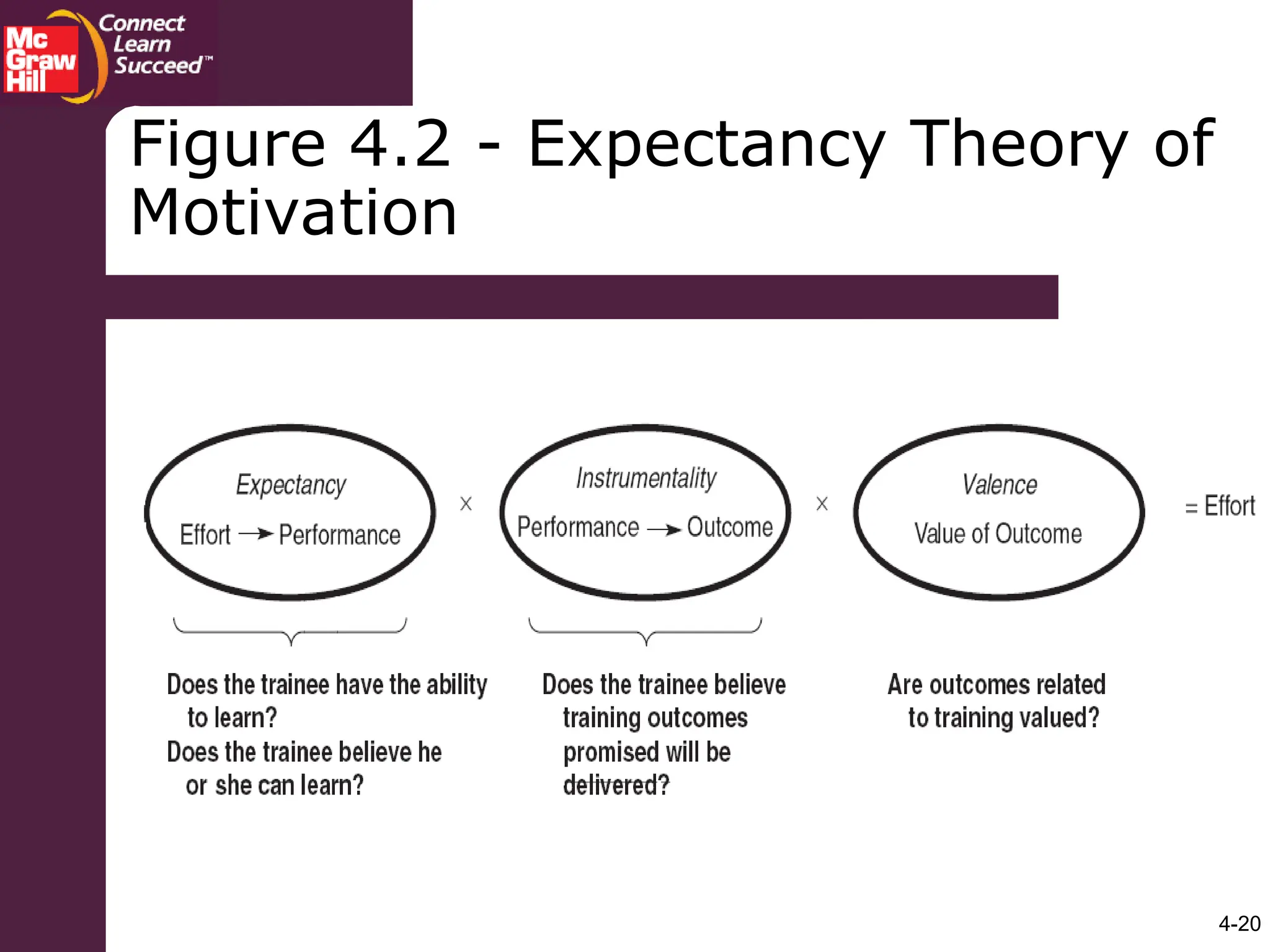
Figure 4.2 - Expectancy Theory of
Motivation
4-21
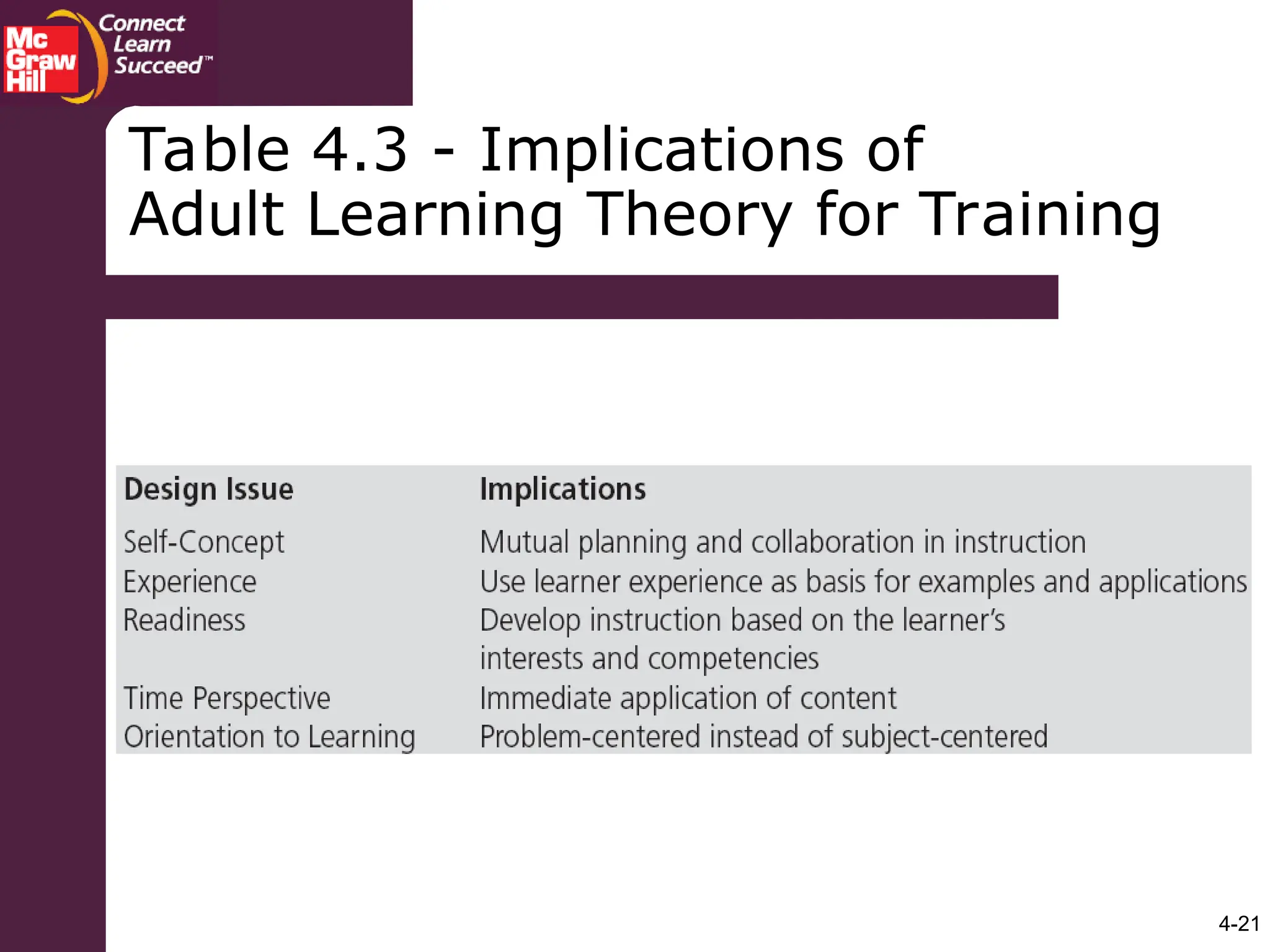
Table 4.3 - Implications of
Adult Learning Theory for Training
4-22
Learning Theories (cont.)
Information processing theory
It gives more emphasis to the internal
processes that occur when training content is
learned and retained.
It highlights how external events influence
learning, which include:
Changes in the intensity or frequency of the
stimulus that affect attention.
Informing the learner of the objectives to establish
an expectation.
Enhancing perceptual features of the material
(stimulus), drawing the attention of the learner to
certain features.
4-23
Learning Theories (cont.)
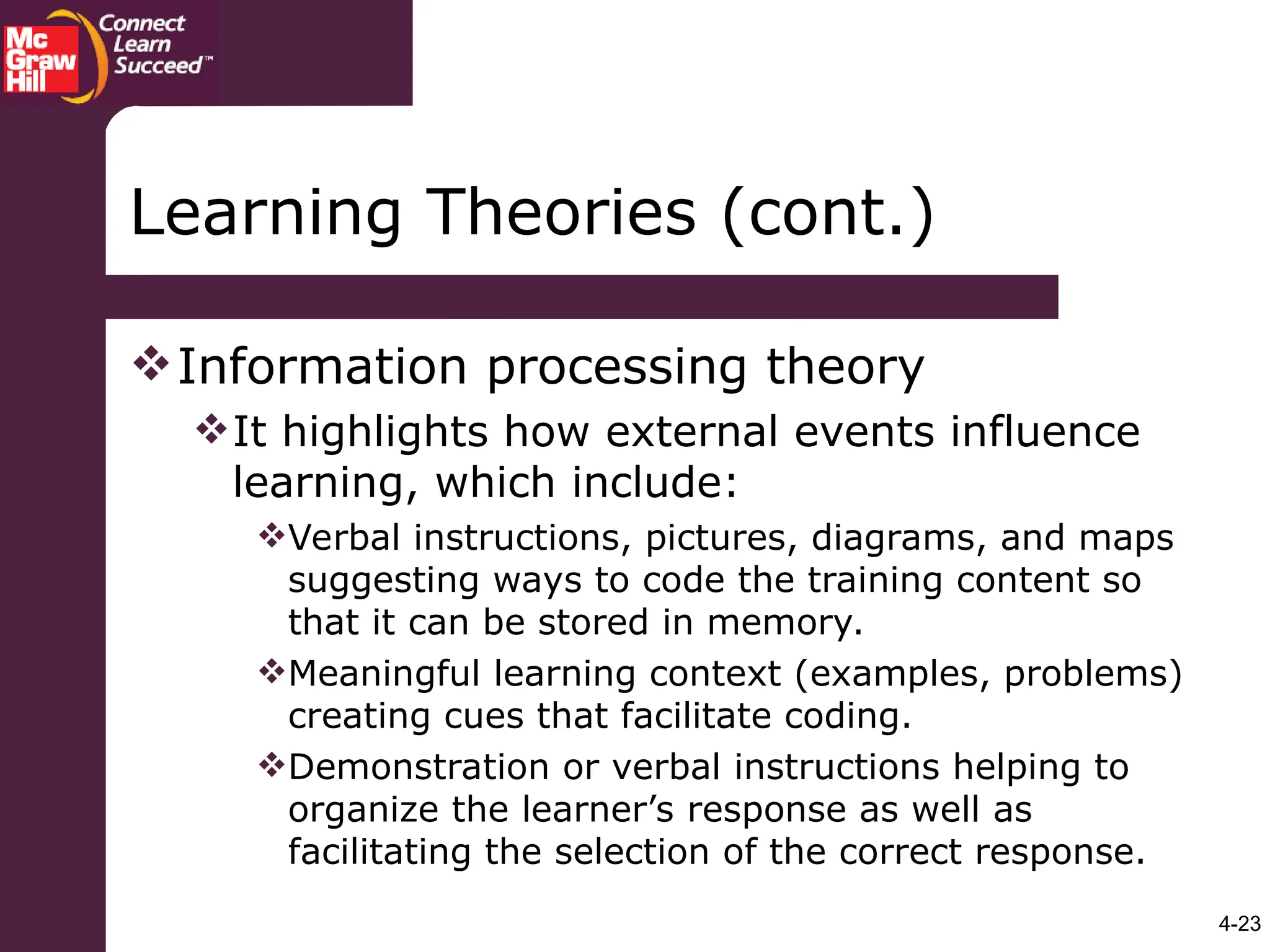
Information processing theory
It highlights how external events influence
learning, which include:
Verbal instructions, pictures, diagrams, and maps
suggesting ways to code the training content so
that it can be stored in memory.
Meaningful learning context (examples, problems)
creating cues that facilitate coding.
Demonstration or verbal instructions helping to
organize the learner’s response as well as
facilitating the selection of the correct response.
4-24
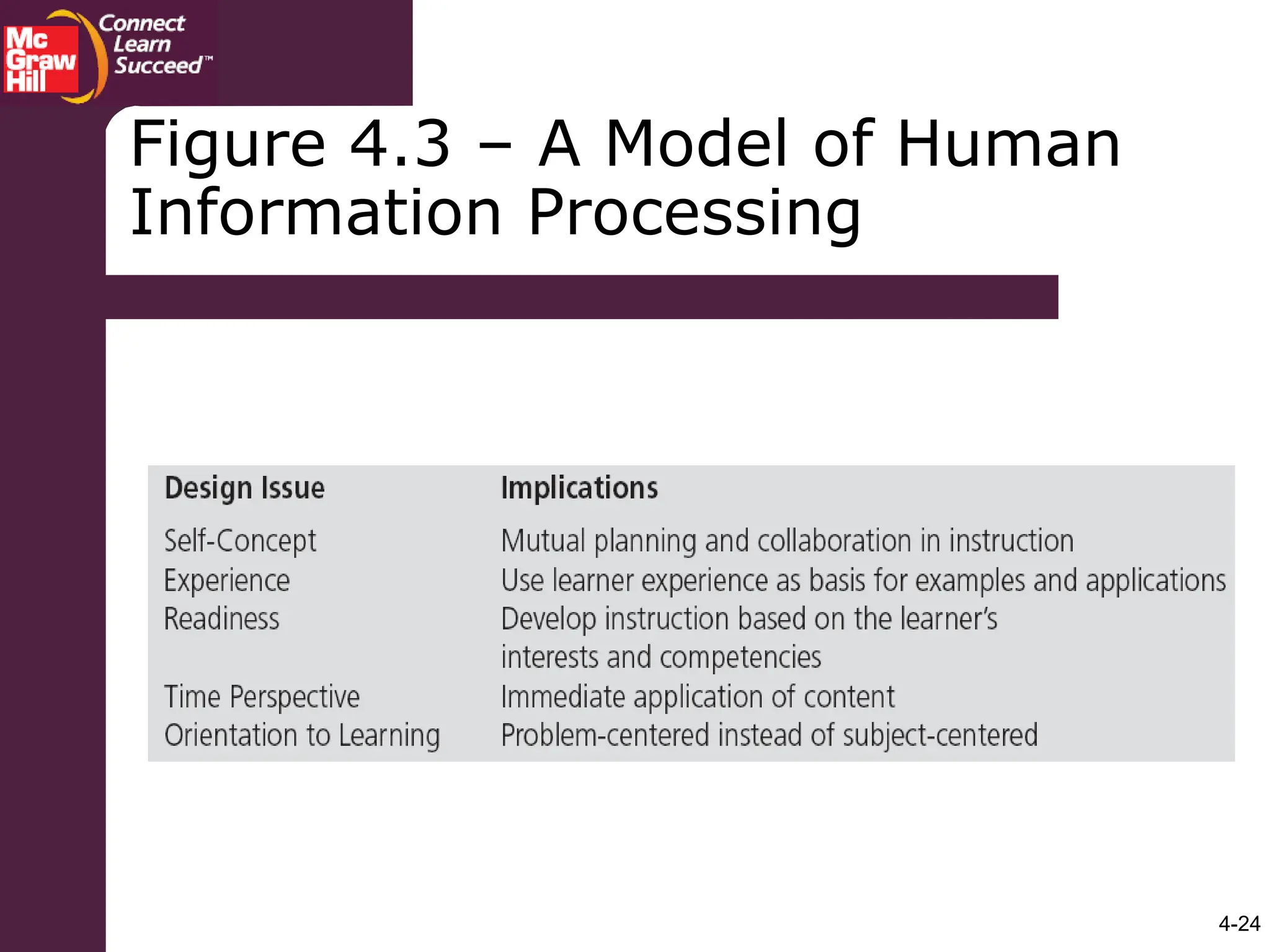
Figure 4.3 – A Model of Human
Information Processing
4-25
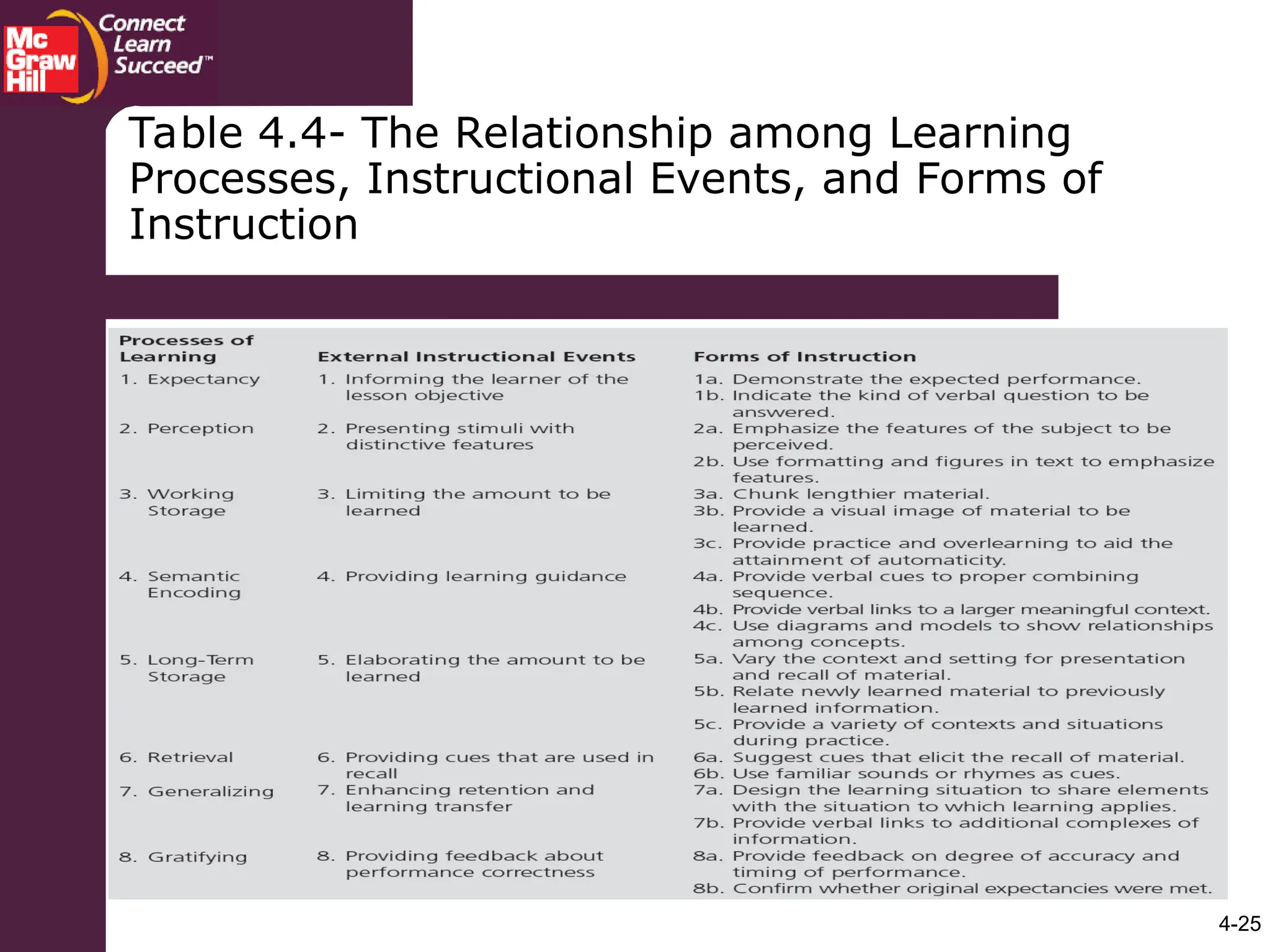
Table 4.4- The Relationship among Learning
Processes, Instructional Events, and Forms of
Instruction
4-26
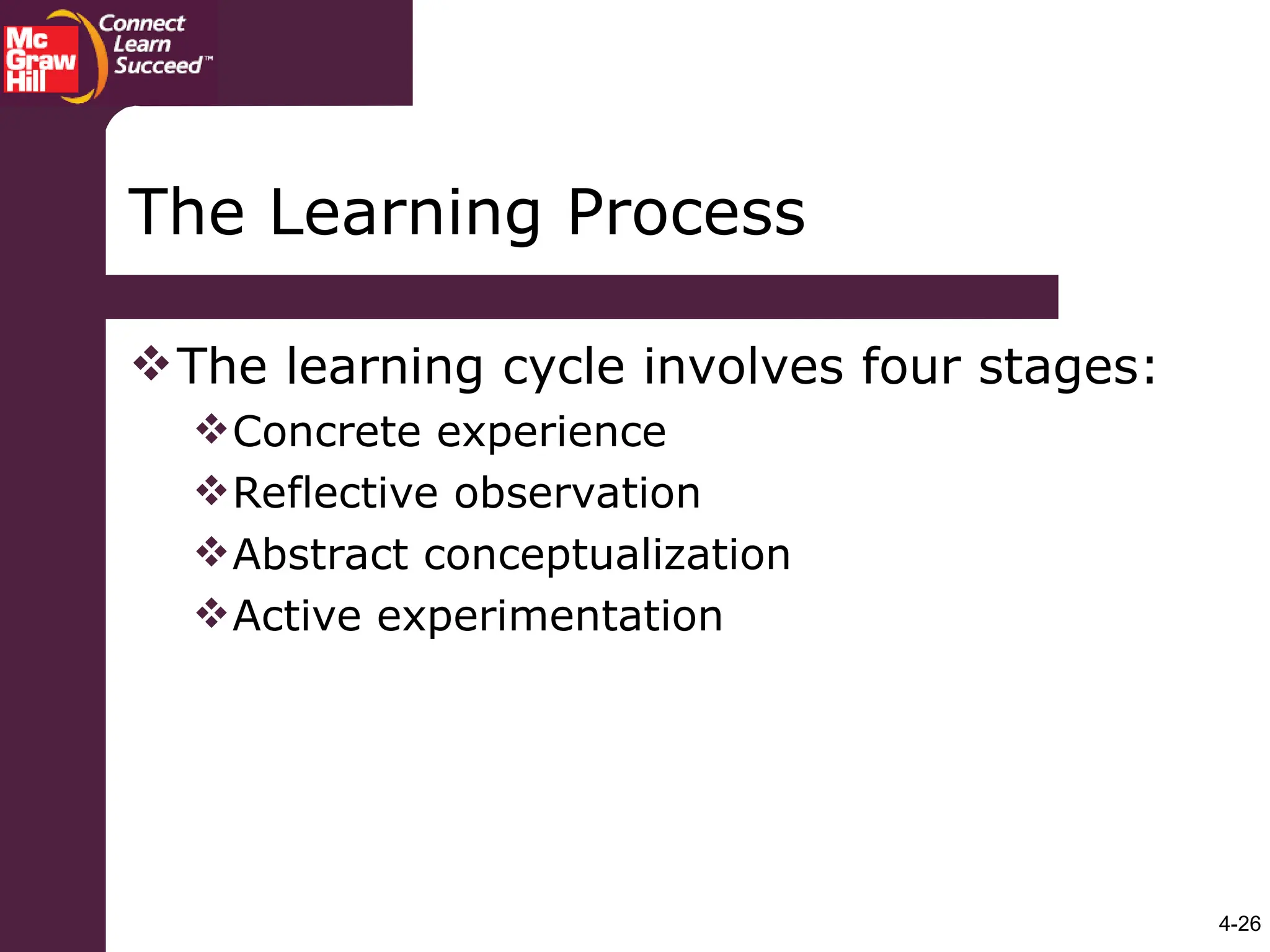
The Learning Process
The learning cycle involves four stages:
Concrete experience
Reflective observation
Abstract conceptualization
Active experimentation
4-27
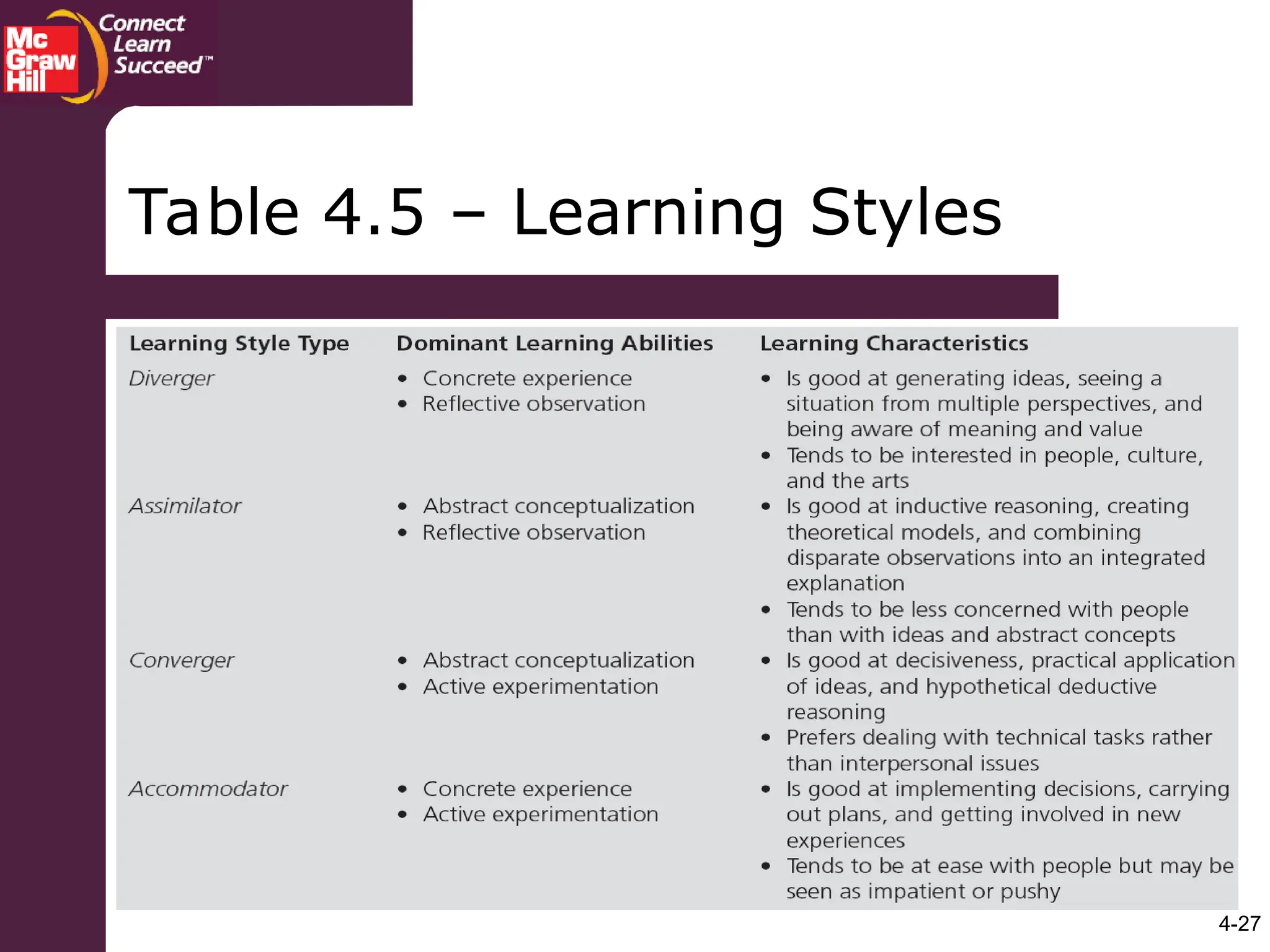
Table 4.5 – Learning Styles
4-28
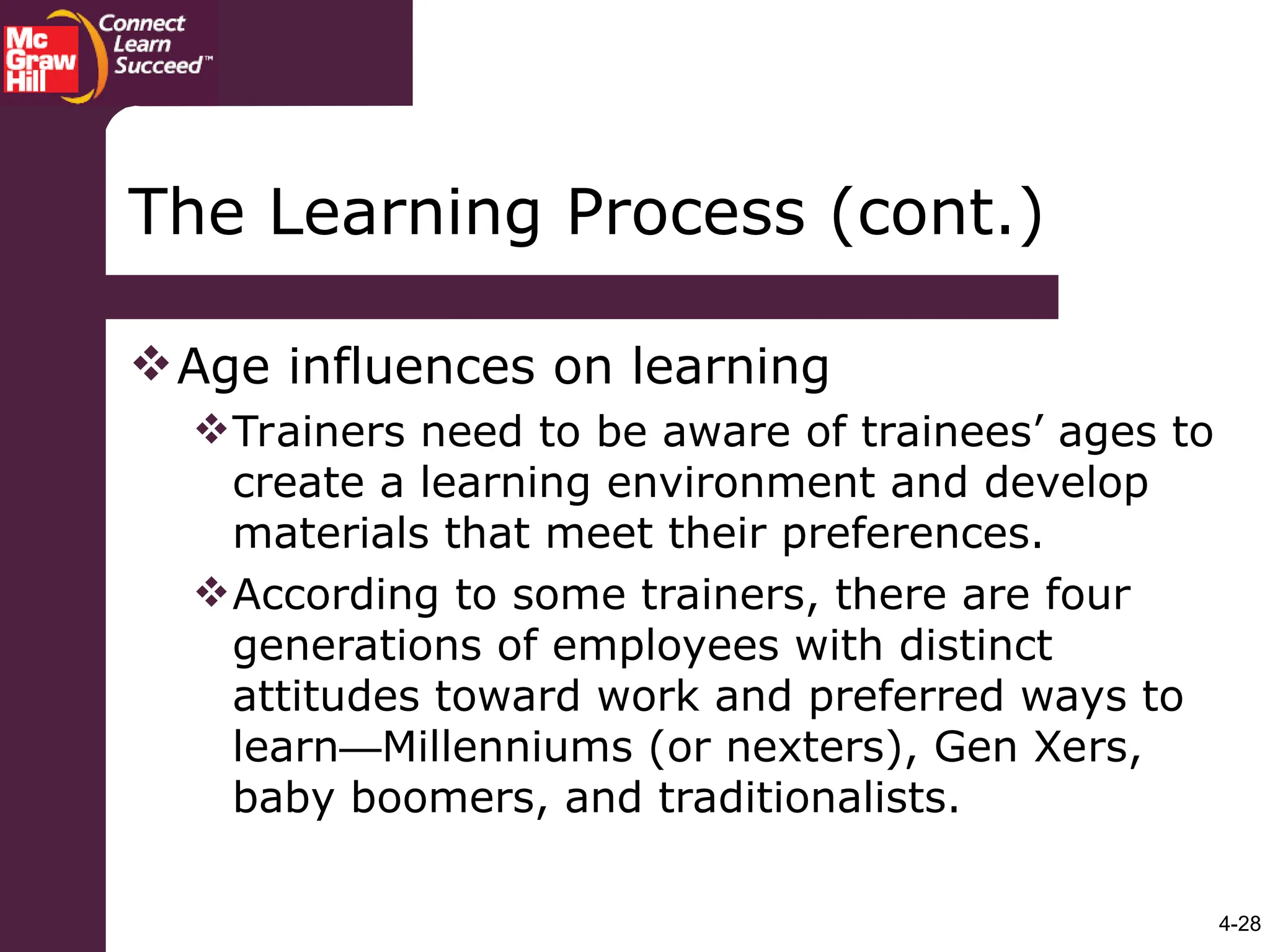
Age influences on learning
Trainers need to be aware of trainees’ ages to
create a learning environment and develop
materials that meet their preferences.
According to some trainers, there are four
generations of employees with distinct
attitudes toward work and preferred ways to
learn—Millenniums (or nexters), Gen Xers,
baby boomers, and traditionalists.
The Learning Process (cont.)
4-29
The Learning Process (cont.)
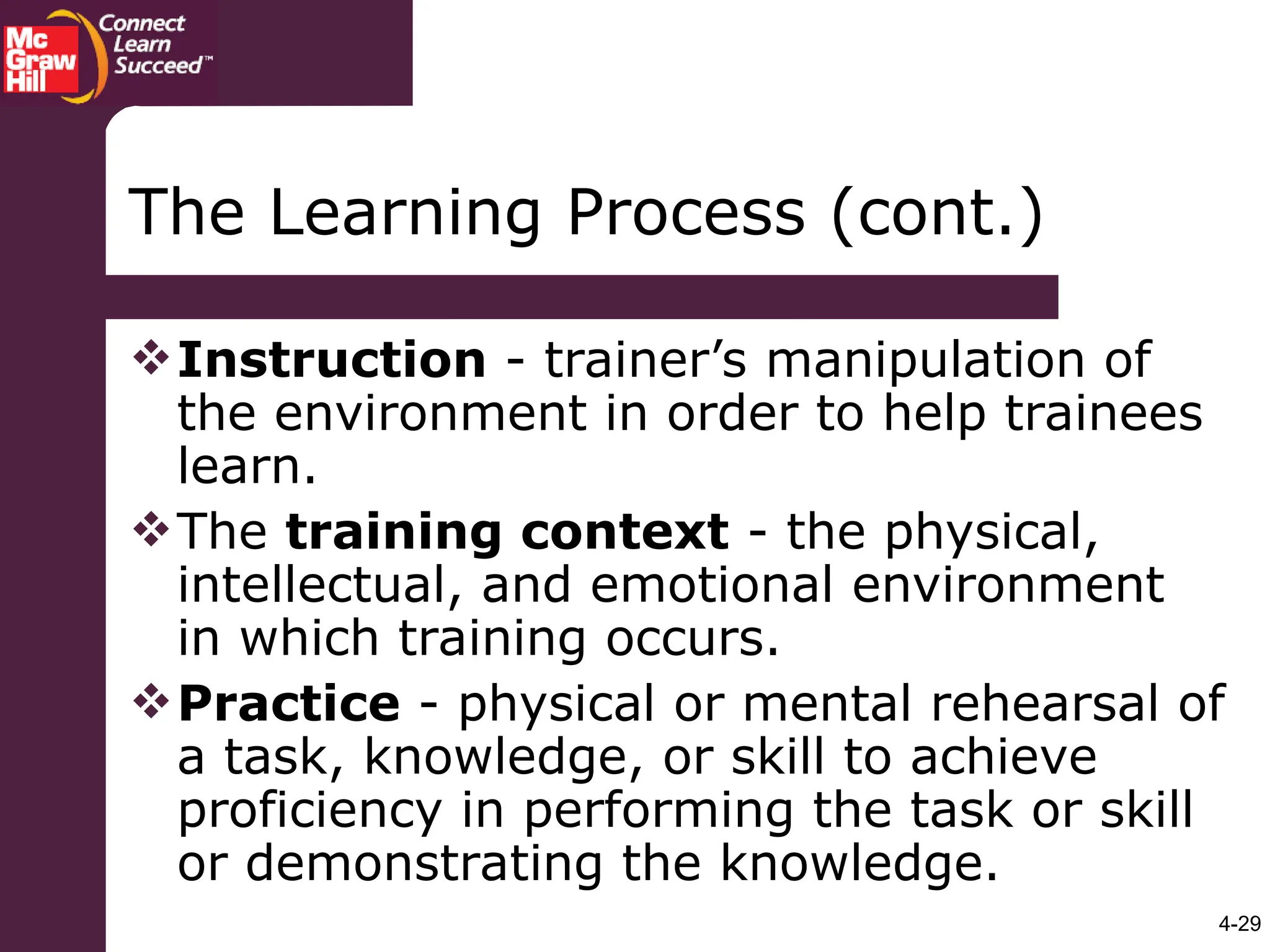
Instruction - trainer’s manipulation of
the environment in order to help trainees
learn.
The training context - the physical,
intellectual, and emotional environment
in which training occurs.
Practice - physical or mental rehearsal of
a task, knowledge, or skill to achieve
proficiency in performing the task or skill
or demonstrating the knowledge.
4-30
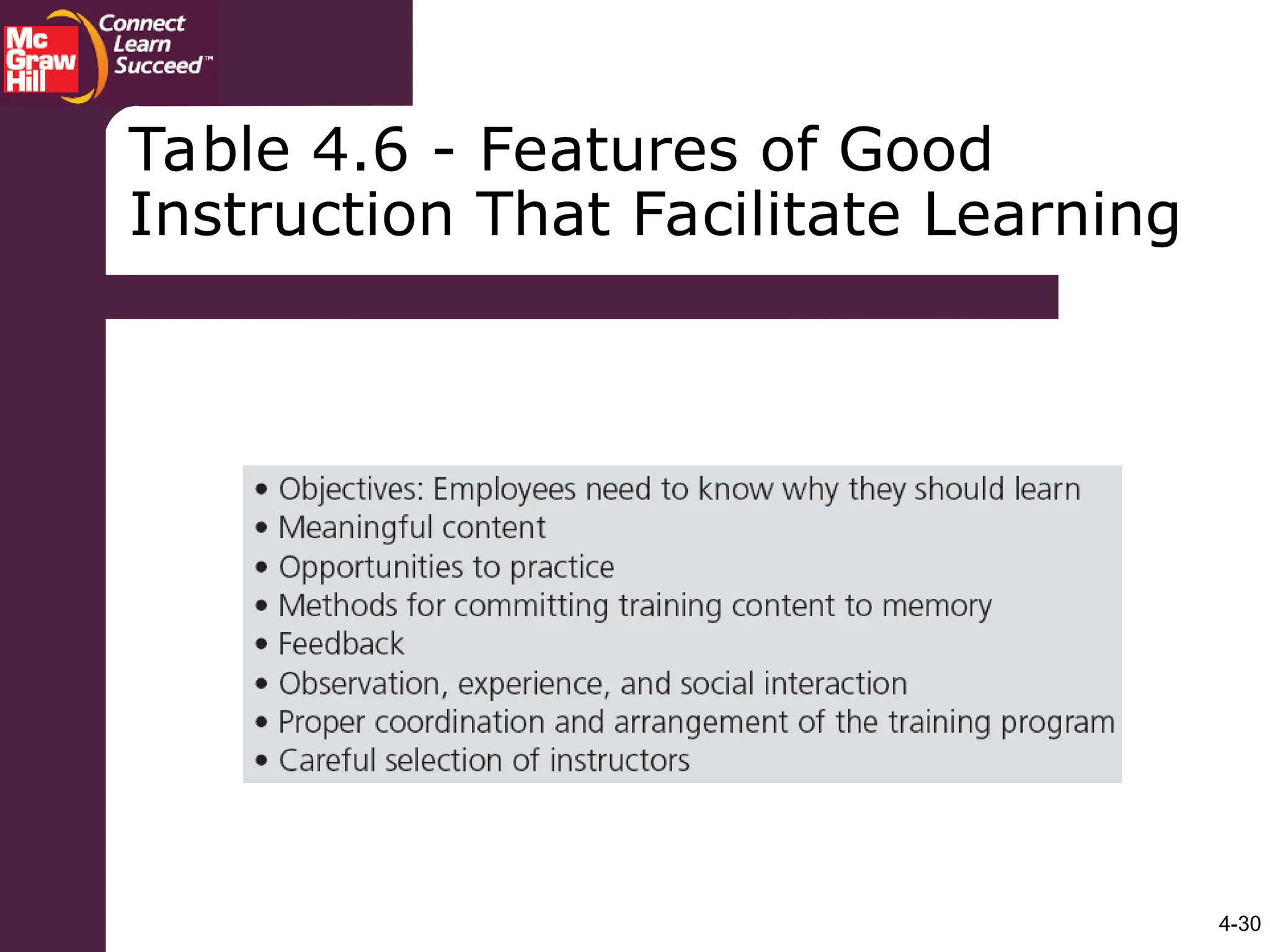
Table 4.6 - Features of Good
Instruction That Facilitate Learning
4-31
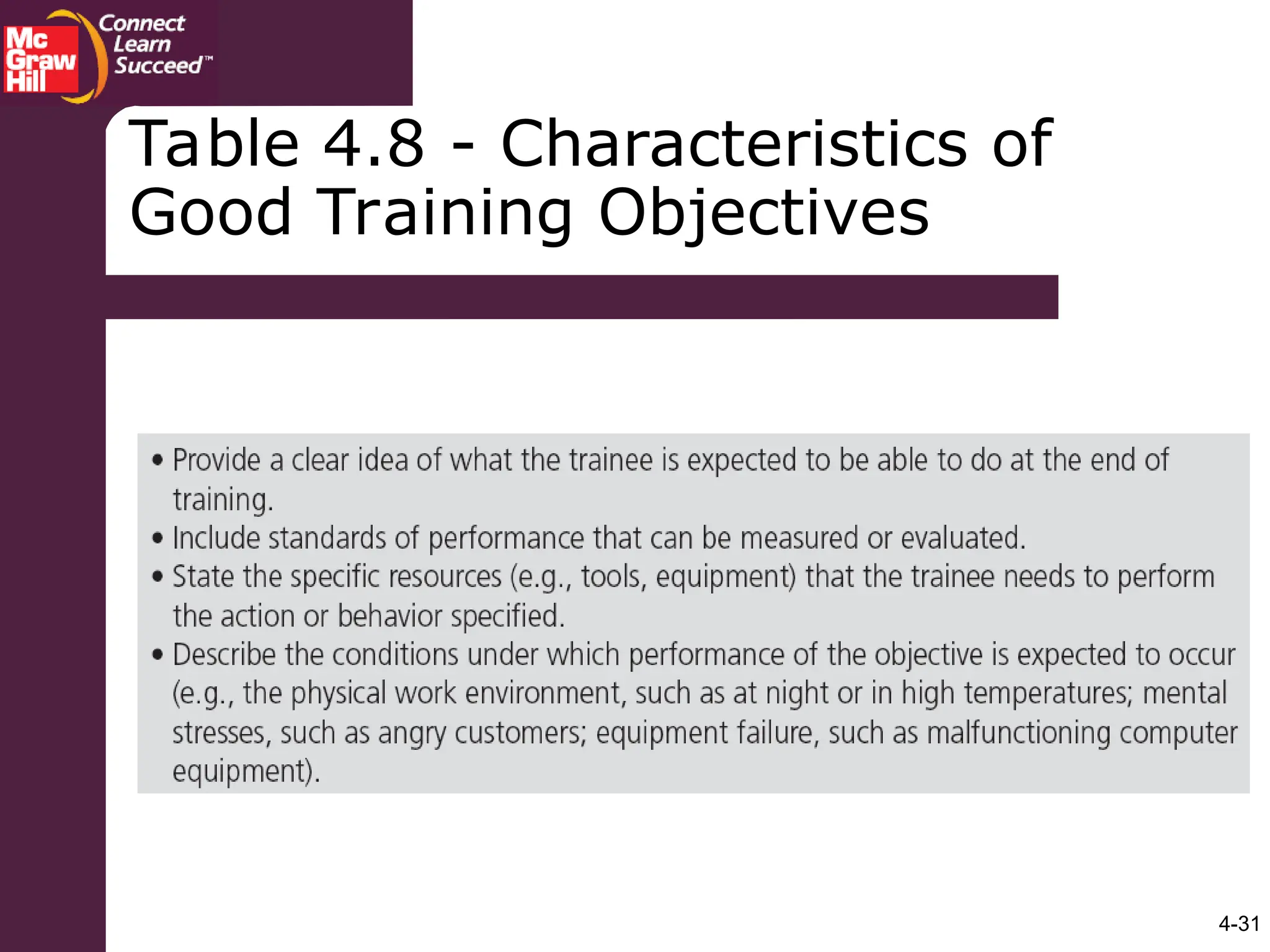
Table 4.8 - Characteristics of
Good Training Objectives
4-32
The Learning Process (cont.)
Metacognition - individual control over
one’s thinking.
Two ways that individuals engage in
metacognition are monitoring and control.
Advance organizers - outlines, texts,
diagrams, and graphs that help trainees
organize the information that will be
presented and practiced.
4-33
The Learning Process (cont.)
Overlearning - Continuing to practice
even after being able to perform the
objective several times.
Error management training - giving
trainees opportunities to make errors
during training; provides the opportunity
for trainees to engage in metacognition.
4-34
The Learning Process (cont.)
Practice can be massed, spaced, in whole,
or in part.
It must be related to the training
objectives.
Feedback is information about how well
people are meeting the training
objectives, and should be provided as
soon as possible after the trainees’
behavior.
4-35
The Learning Process (cont.)
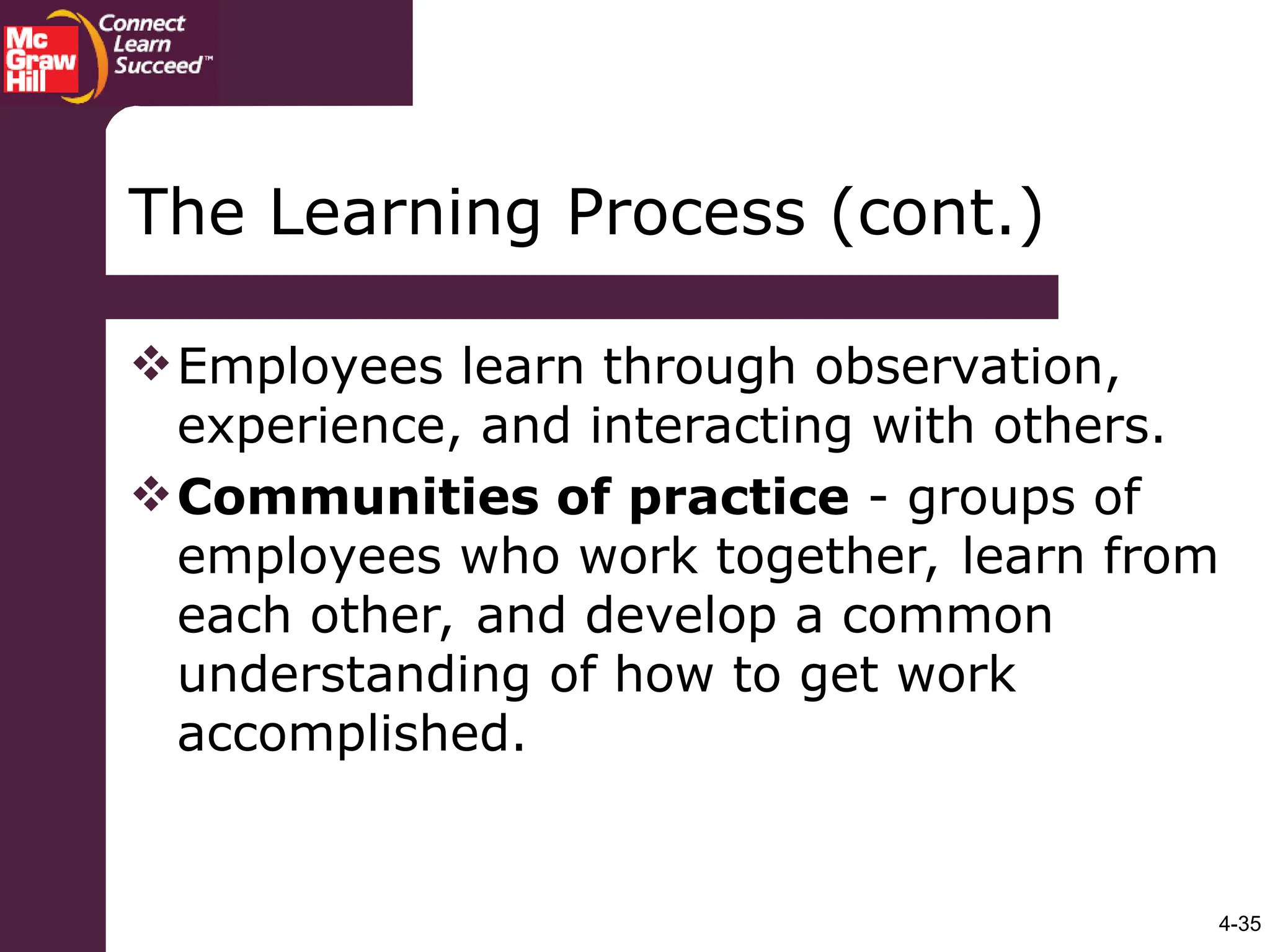
Employees learn through observation,
experience, and interacting with others.
Communities of practice - groups of
employees who work together, learn from
each other, and develop a common
understanding of how to get work
accomplished.
4-36
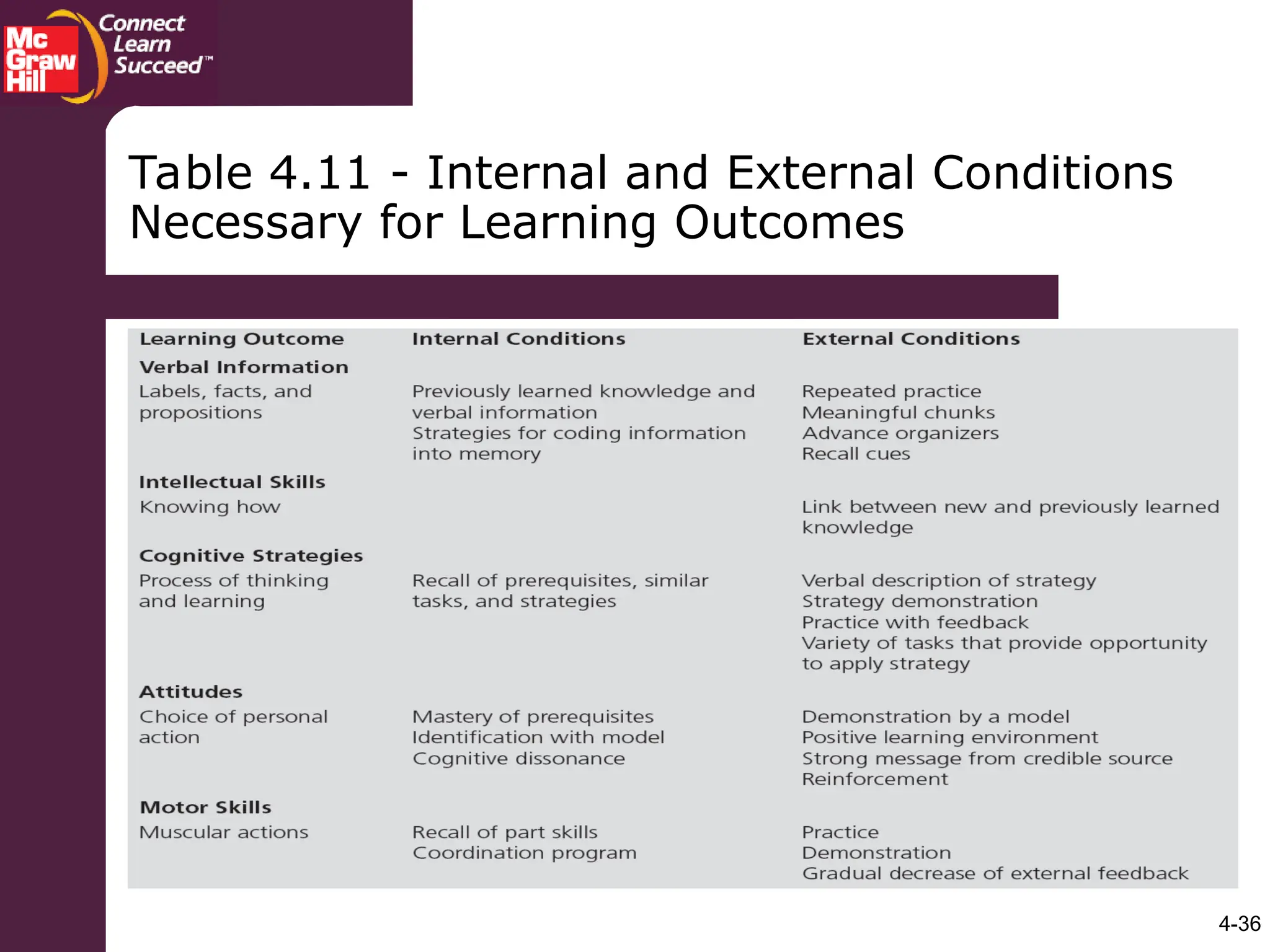
Table 4.11 - Internal and External Conditions
Necessary for Learning Outcomes
4-37
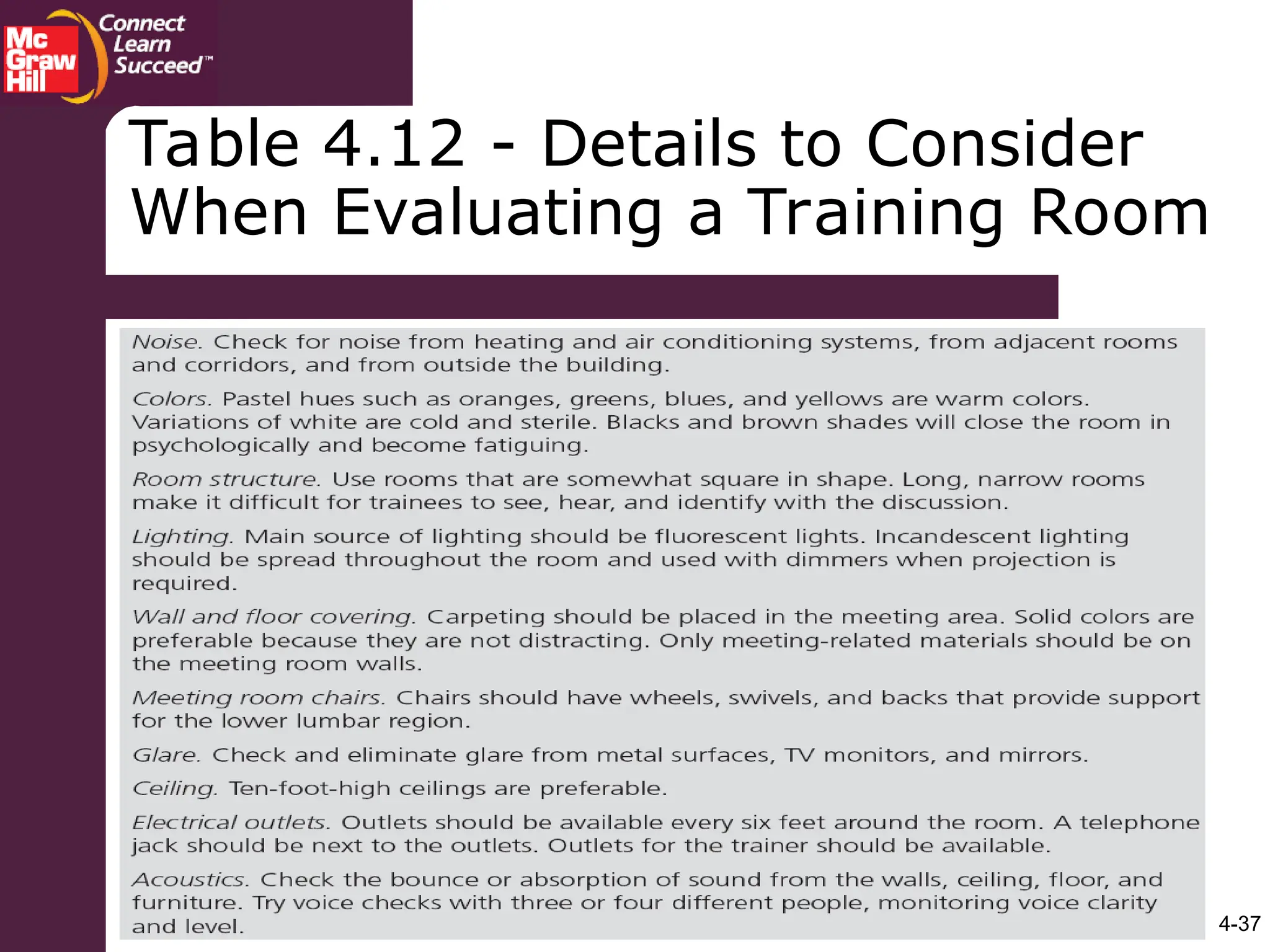
Table 4.12 - Details to Consider
When Evaluating a Training Room
4-38
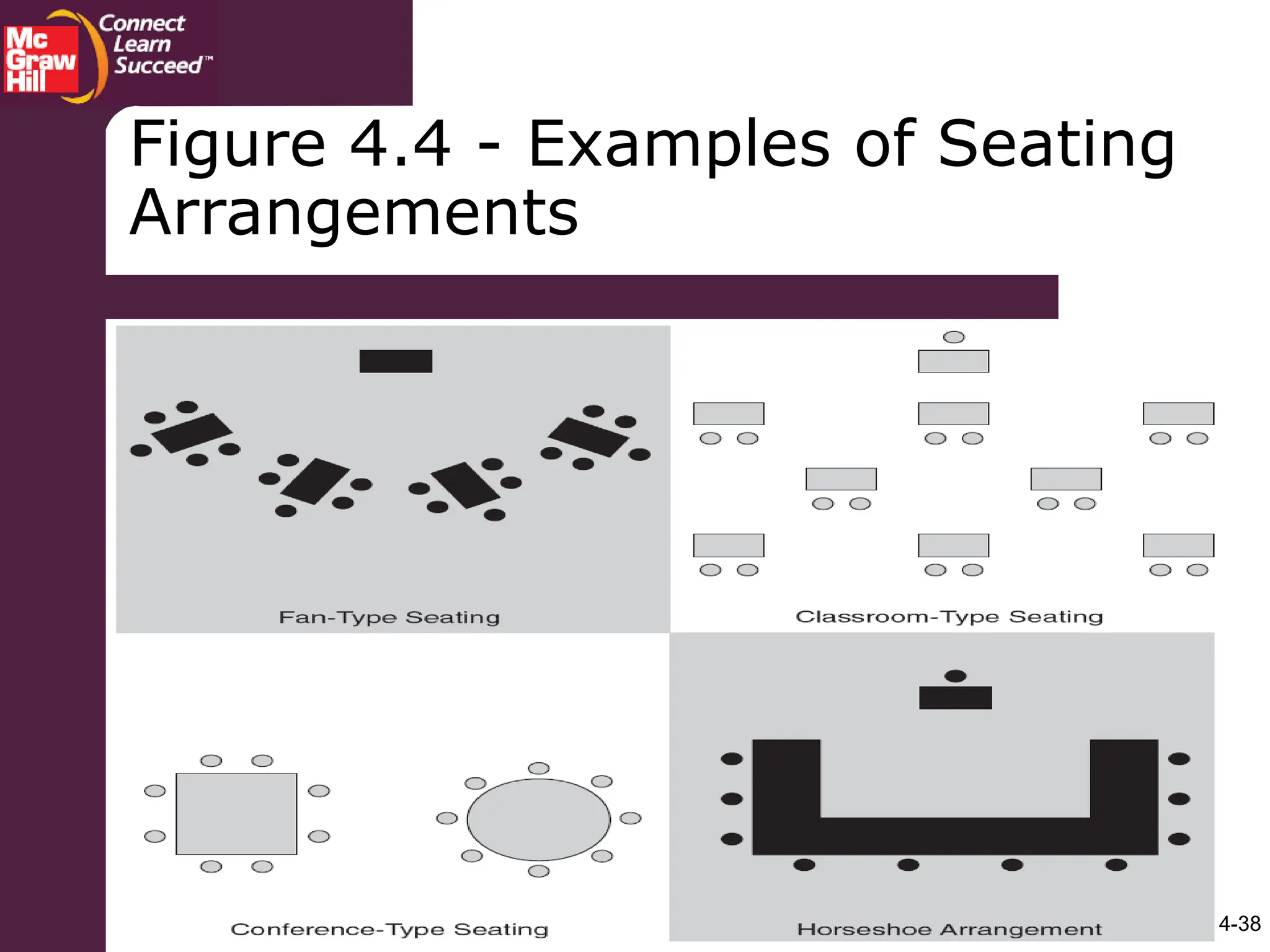
Figure 4.4 - Examples of Seating
Arrangements
4-39
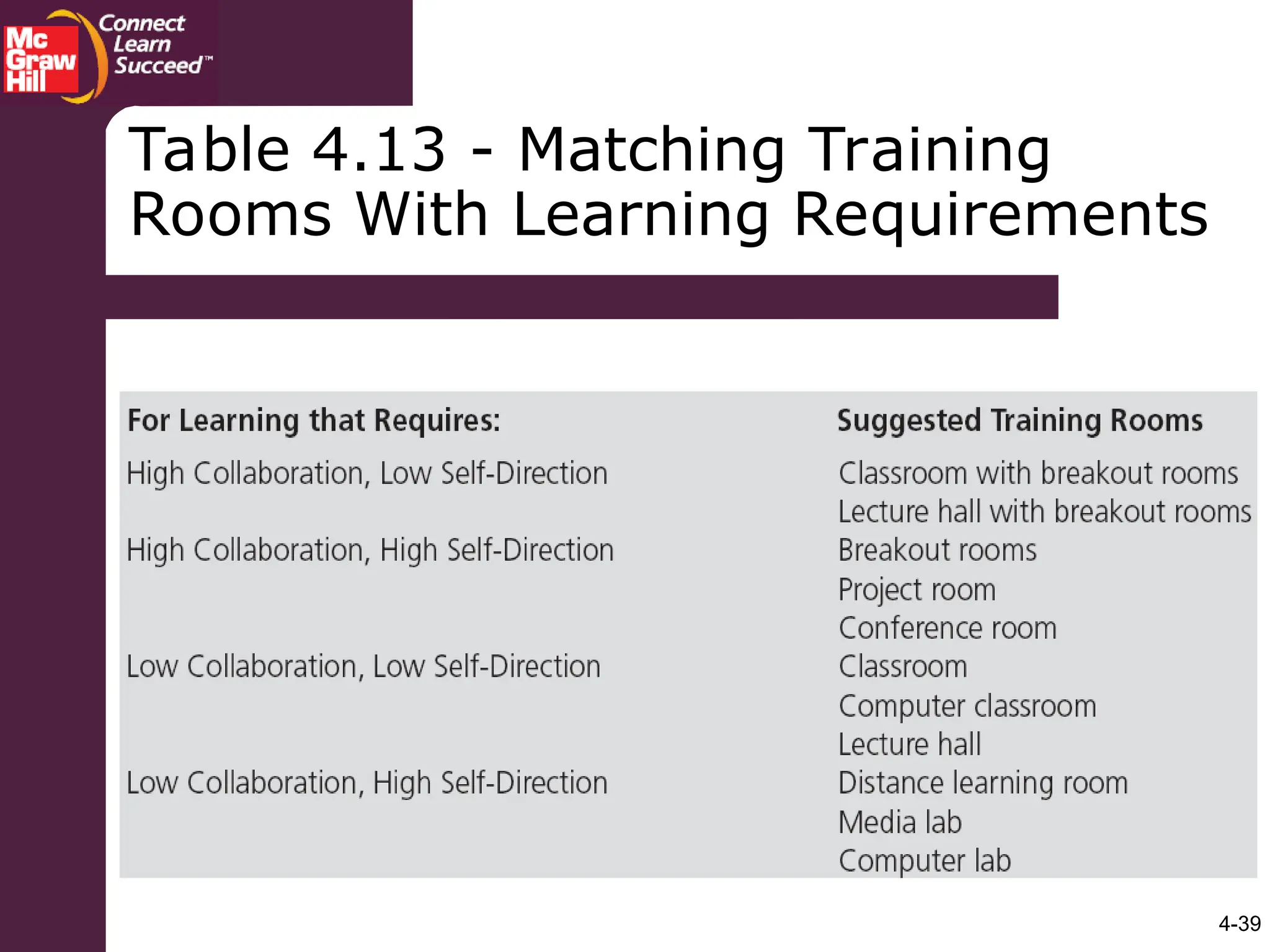
Table 4.13 - Matching Training
Rooms With Learning Requirements
4-40
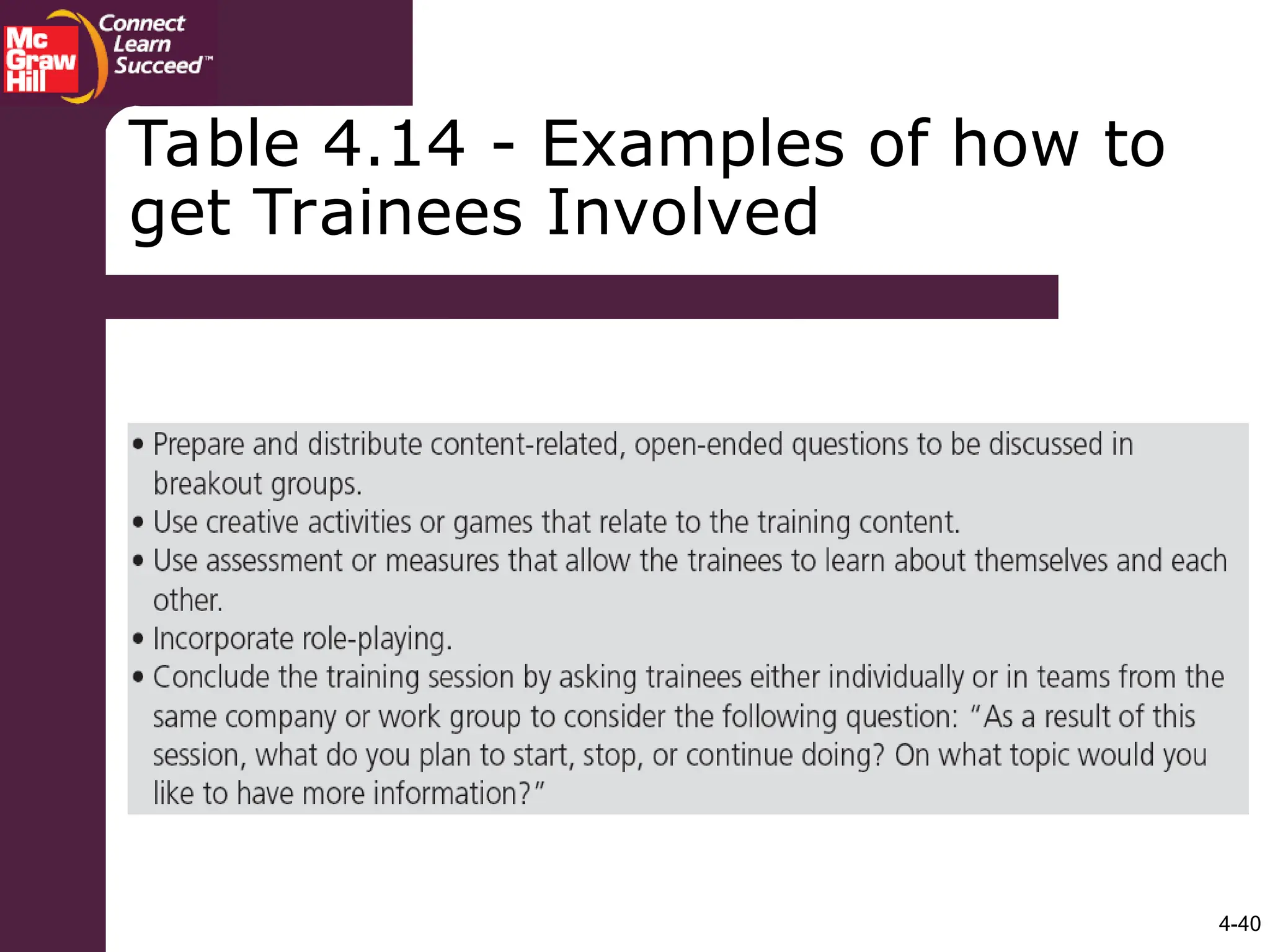
Table 4.14 - Examples of how to
get Trainees Involved
4-41
Table 4.15 - Design Document
Template
4-42
Table 4.17 - Sample of a Detailed
Lesson Plan
4-43
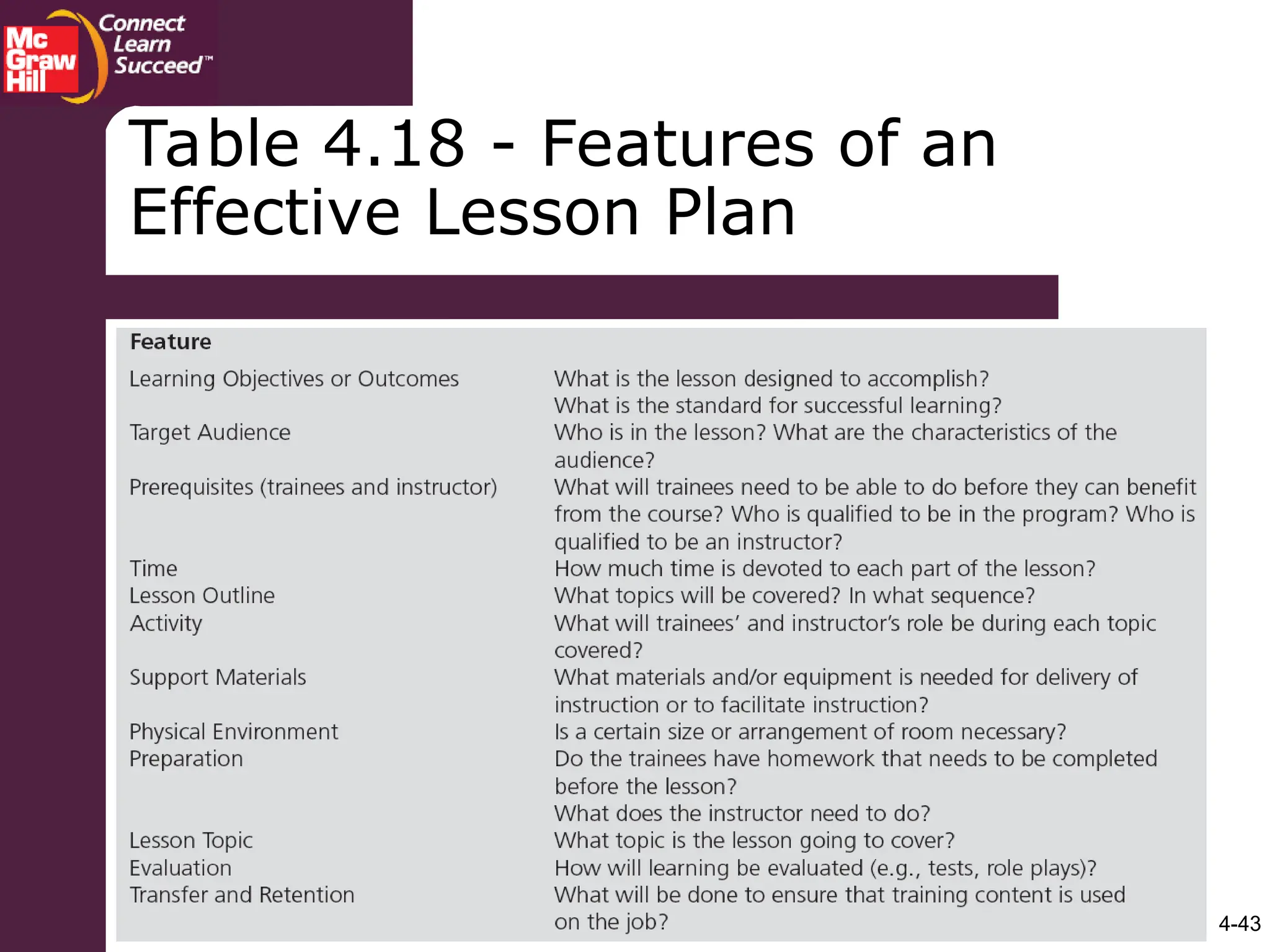
Table 4.18 - Features of an
Effective Lesson Plan
4-44
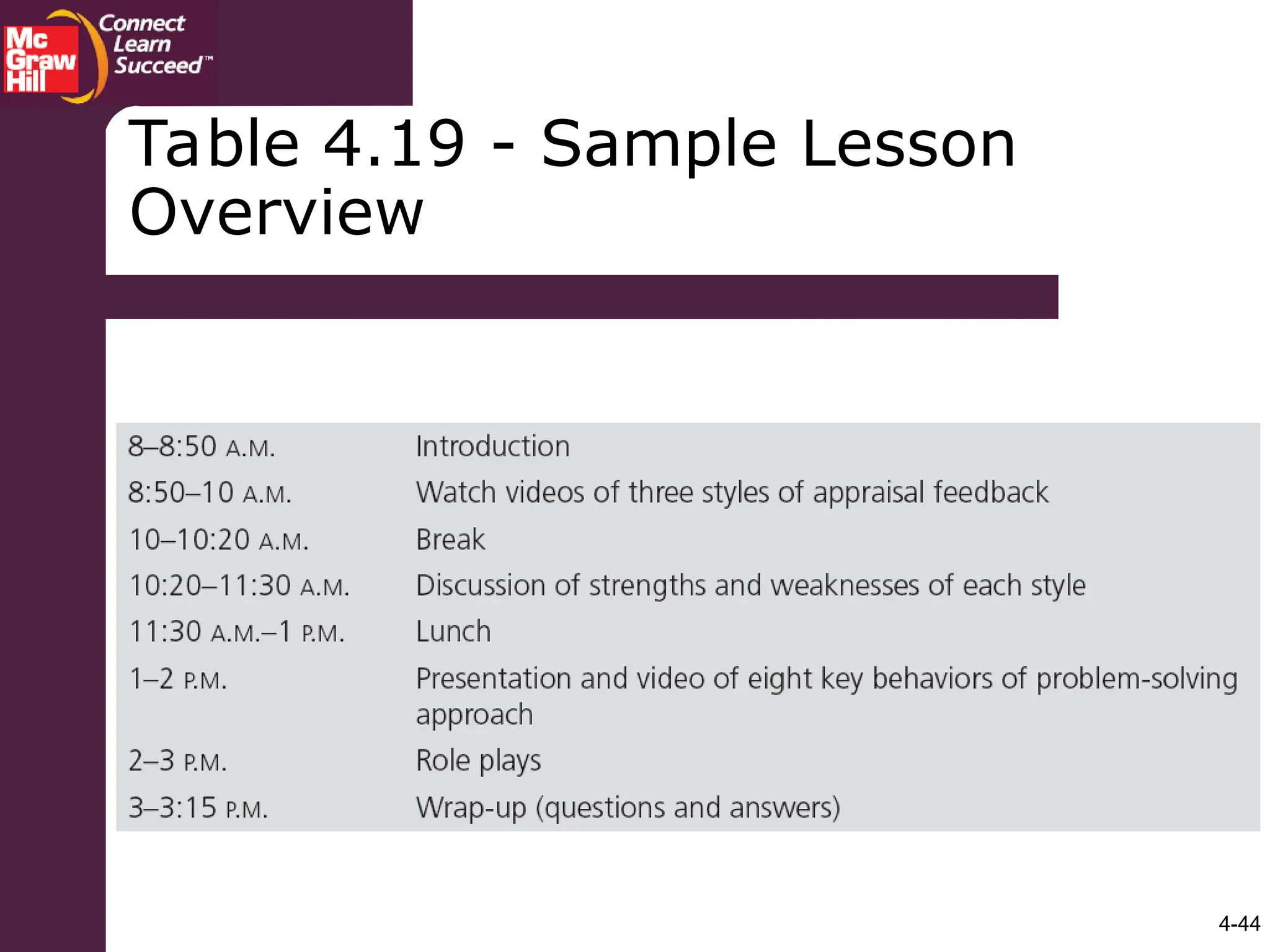
Table 4.19 - Sample Lesson
Overview

Traning&DevelopmentChapter004 leadership.ppt

  • 1.
    Chapter 4 Learning: Theoriesand Program Design Copyright © 2010 by the McGraw-Hill Companies, Inc. All rights reserved. McGraw-Hill/Irwin
  • 2.
    4-2 What is Learning?What is Learned? Learning Learning - - a relatively permanent change in human capabilities that is not a result of growth processes. These capabilities are related to specific learning outcomes.
  • 3.
    4-3 Table 4.1 –Learning Outcomes
  • 4.
    4-4 Reinforcement Theory SocialLearning Theory Goal Theories Need Theories Expectancy Theory Adult Learning Theory Information Processing Theory Learning Theories
  • 5.
    4-5 Reinforcement theory -emphasizes that people are motivated to perform or avoid certain behaviors because of past outcomes that have resulted from those behaviors. Several processes in reinforcement theory are positive reinforcement, negative reinforcement, extinction, and punishment. Learning Theories (cont.)
  • 6.
    4-6 Reinforcement theory The trainerneeds to identify what outcomes the learner finds most positive and negative. Trainers then need to link these outcomes to learners acquiring knowledge, skills, or changing behaviors. Trainers can withhold or provide job-related, personal, and career-related benefits to learners who master program content. Learning Theories (cont.)
  • 7.
    4-7 Table 4.2 -Schedules of Reinforcement
  • 8.
    4-8 Social learning theory- emphasizes that people learn by observing other persons (models) whom they believe are credible and knowledgeable. The theory recognizes that behavior that is reinforced or rewarded tends to be repeated. Learning Theories (cont.)
  • 9.
    4-9 Social learning theory Learningnew skills or behavior comes from: directly experiencing the consequences of using a behavior or skill, or the process of observing others and seeing the consequences of their behavior. Learning Theories (cont.)
  • 10.
    4-10 Social learning theory Learningis also influenced by a person’s self- efficacy, which is a person’s judgment about whether he or she can successfully learn knowledge and skills. A person’s self-efficacy can be increased using several methods: verbal persuasion, logical verification, observation of others (modeling), and past accomplishments. Learning Theories (cont.)
  • 11.
    4-11 Figure 4.1 -Processes of Social Learning Theory
  • 12.
    4-12 Goal theories Goal settingtheory - assumes that behavior results from a person’s conscious goals and intentions. Goals influence a person’s behavior by: directing energy and attention. sustaining effort over time. motivating the person to develop strategies for goal attainment. Learning Theories (cont.)
  • 13.
    4-13 Goal theories Goal settingtheory It is used in training program design. It suggests that learning can be facilitated by providing trainees with specific challenging goals and objectives. The influence of goal setting theory can be seen in the development of training lesson plans. Learning Theories (cont.)
  • 14.
    4-14 Goal theories Goal orientation- the goals held by a trainee in a learning situation. It includes learning and performance orientation. Learning orientation - trying to increase ability or competence in a task. Performance orientation - learners who focus on task performance and how they compare to others. Learning Theories (cont.)
  • 15.
    4-15 Goal theories Goal orientation Itaffects the amount of effort a trainee will expend in learning (motivation to learn). Learners with a high learning orientation will direct greater attention to the task and learn for the sake of learning in comparison to learners with a performance orientation. Learners with a performance orientation will direct more attention to performing well and less effort to learning. Learning Theories (cont.)
  • 16.
    4-16 Learning Theories (cont.) Needtheories Helps to explain the value that a person places on certain outcomes. Need - a deficiency that a person is experiencing at any point in time. Maslow’s and Alderfer’s need theories focused on physiological needs, relatedness needs, and growth needs.
  • 17.
    4-17 Learning Theories (cont.) Needtheories The major difference between Alderfer’s and Maslow’s hierarchies of needs is that Alderfer allows the possibility that if higher-level needs are not satisfied, employees will refocus on lower-level needs. McClelland’s need theory focused primarily on needs for achievement, affiliation, and power.
  • 18.
    4-18 Learning Theories (cont.) Needtheories Suggest that to motivate learning, trainers should identify trainees’ needs and communicate how training program content relates to fulfilling these needs. If certain basic needs of trainees are not met, they are unlikely to be motivated to learn.
  • 19.
    4-19 Learning Theories (cont.) Expectancytheory It suggests that a person’s behavior is based on three factors: Expectancies - the link between trying to perform a behavior and actually performing well. Instrumentality - a belief that performing a given behavior is associated with a particular outcome. Valence - the value that a person places on an outcome.
  • 20.
    4-20 Figure 4.2 -Expectancy Theory of Motivation
  • 21.
    4-21 Table 4.3 -Implications of Adult Learning Theory for Training
  • 22.
    4-22 Learning Theories (cont.) Informationprocessing theory It gives more emphasis to the internal processes that occur when training content is learned and retained. It highlights how external events influence learning, which include: Changes in the intensity or frequency of the stimulus that affect attention. Informing the learner of the objectives to establish an expectation. Enhancing perceptual features of the material (stimulus), drawing the attention of the learner to certain features.
  • 23.
    4-23 Learning Theories (cont.) Informationprocessing theory It highlights how external events influence learning, which include: Verbal instructions, pictures, diagrams, and maps suggesting ways to code the training content so that it can be stored in memory. Meaningful learning context (examples, problems) creating cues that facilitate coding. Demonstration or verbal instructions helping to organize the learner’s response as well as facilitating the selection of the correct response.
  • 24.
    4-24 Figure 4.3 –A Model of Human Information Processing
  • 25.
    4-25 Table 4.4- TheRelationship among Learning Processes, Instructional Events, and Forms of Instruction
  • 26.
    4-26 The Learning Process Thelearning cycle involves four stages: Concrete experience Reflective observation Abstract conceptualization Active experimentation
  • 27.
    4-27 Table 4.5 –Learning Styles
  • 28.
    4-28 Age influences onlearning Trainers need to be aware of trainees’ ages to create a learning environment and develop materials that meet their preferences. According to some trainers, there are four generations of employees with distinct attitudes toward work and preferred ways to learn—Millenniums (or nexters), Gen Xers, baby boomers, and traditionalists. The Learning Process (cont.)
  • 29.
    4-29 The Learning Process(cont.) Instruction - trainer’s manipulation of the environment in order to help trainees learn. The training context - the physical, intellectual, and emotional environment in which training occurs. Practice - physical or mental rehearsal of a task, knowledge, or skill to achieve proficiency in performing the task or skill or demonstrating the knowledge.
  • 30.
    4-30 Table 4.6 -Features of Good Instruction That Facilitate Learning
  • 31.
    4-31 Table 4.8 -Characteristics of Good Training Objectives
  • 32.
    4-32 The Learning Process(cont.) Metacognition - individual control over one’s thinking. Two ways that individuals engage in metacognition are monitoring and control. Advance organizers - outlines, texts, diagrams, and graphs that help trainees organize the information that will be presented and practiced.
  • 33.
    4-33 The Learning Process(cont.) Overlearning - Continuing to practice even after being able to perform the objective several times. Error management training - giving trainees opportunities to make errors during training; provides the opportunity for trainees to engage in metacognition.
  • 34.
    4-34 The Learning Process(cont.) Practice can be massed, spaced, in whole, or in part. It must be related to the training objectives. Feedback is information about how well people are meeting the training objectives, and should be provided as soon as possible after the trainees’ behavior.
  • 35.
    4-35 The Learning Process(cont.) Employees learn through observation, experience, and interacting with others. Communities of practice - groups of employees who work together, learn from each other, and develop a common understanding of how to get work accomplished.
  • 36.
    4-36 Table 4.11 -Internal and External Conditions Necessary for Learning Outcomes
  • 37.
    4-37 Table 4.12 -Details to Consider When Evaluating a Training Room
  • 38.
    4-38 Figure 4.4 -Examples of Seating Arrangements
  • 39.
    4-39 Table 4.13 -Matching Training Rooms With Learning Requirements
  • 40.
    4-40 Table 4.14 -Examples of how to get Trainees Involved
  • 41.
    4-41 Table 4.15 -Design Document Template
  • 42.
    4-42 Table 4.17 -Sample of a Detailed Lesson Plan
  • 43.
    4-43 Table 4.18 -Features of an Effective Lesson Plan
  • 44.
    4-44 Table 4.19 -Sample Lesson Overview