Traditional Training
Methods
Chapter 7
6th Edition
Raymond A. Noe
McGraw-Hill/Irwin

Copyright © 2013 by The McGraw-Hill Companies, Inc. All rights reserved.
Learning Objectives
• Discuss the strengths and weaknesses of

presentational, hands-on, and group building training
methods
• Provide recommendations for effective on-the-job
training (OJT)
• Develop a case study
• Develop a self-directed learning module

> E. Satriyo
7-2
Learning Objectives
 Discuss the key components of behavior modeling

training
 Explain the conditions necessary for adventure
learning to be effective
 Discuss what team training should focus on to
improve team performance

> E. Satriyo
7-3
Introduction
 Traditional training methods
 Require an instructor or facilitator

 Involve face-to-face interactions

> E. Satriyo
7-4
Presentation Methods
 Trainees are passive recipients of information, which

may include:
 Facts or information
 Processes
 Problem-solving methods

 Includes lectures and audio-visual techniques

> E. Satriyo
7-5
Presentation Methods
 Lecture
 Trainers communicate through spoken words

 Least expensive and least time-consuming ways to

present information
 Easily employed with large groups of trainees
 Supports behavior modeling and technology-based
techniques

> E. Satriyo
7-6
Presentation Method
 Disadvantages
 Lacks participant involvement, feedback, and meaningful
connection to work environment
 Appeals to few of the trainees’ senses
 Makes it difficult to judge learners’ level of understanding

> E. Satriyo
7-7
Table 7.1 - Variations of the Lecture
Method

> E. Satriyo
7-8
Presentation Methods
 Audiovisual instruction
 Used for improving communications, interviewing, and

customer-service skills
 Used for illustrating how procedures should be followed
 Disadvantages
 Too much content for the trainee to learn

 Poor dialogue between the actors hinders credibility or clarity of

the message
 Overuse of humor, music, or drama may make it difficult to
understand the important learning points

> E. Satriyo
7-9
Hands-on Methods
 Require trainee to be actively involved in learning
 On-the-job training (OJT)
 New or inexperienced employees learn work by:
 Observing peers or managers performing the job
 Trying to imitate their behavior
 Needs less investment in terms of time or money

> E. Satriyo
7-10
Hands-on Methods
Advantages
On-the-job
training (OJT)

• Customized to the
experiences and abilities of
trainees
• Training is immediately
applicable to the job
• Save costs
• Can be offered at any time,
and trainers will be
available because they are
peers

Disadvantages
•

•

•

Managers and peers may
not use the same process
to complete a task
Managers/Peers may
pass on bad habit as
useful skill
Unstructured OJT can
result in poorly trained
employees

> E. Satriyo
7-11
Table 7.2 - Principles of On-the-Job
Training (OJT)

> E. Satriyo
7-12
Hands-on Methods
 An effective OJT program should include:
 A policy statement that describes OJT purpose

 Clear specification of who is accountable for

conducting OJT
 Review of OJT practices in other companies
 Availability of lesson plans, checklists, manuals,
learning contracts, and progress reports
 Evaluation of employees’ levels of basic skills

> E. Satriyo
7-13
Hands-on Methods
Advantages

Self directed learning
Employees
• Take responsibility
for all aspects of
learning
• Determine when it
is conducted and
who will be
involved
Trainers serve as
facilitators

• Allows trainees to learn at
their own pace and receive
feedback about the learning
performance
• Requires fewer trainers,
reduces costs associated with
travel and meeting rooms,
and makes multiple-site
training more realistic
• Provides consistent training
content
• Makes it easier for shift
employees to gain access to
training materials

Disadvantages

• Trainees must be
motivated to learn on
their own
• Higher development
costs
• Development time is
longer

> E. Satriyo
7-14
Hands-on Methods
 Necessary steps to develop effective self-directed

learning:
 Conduct job analysis to identify the tasks that must be

covered
 Write trainee-centered learning objectives directly
related to the tasks
 Develop the content for the learning package
 Break the content into smaller pieces (“chunks”)
 Develop an evaluation package

> E. Satriyo
7-15
Hands-on Methods
Advantages
Apprenticeship
Work-study
training method
with both on-thejob and classroom
training

Disadvantages

• Learners can earn pay
• High development
while they learn
costs
• Involves effective learning • Increased time
about “why and how”
commitment required
of management and
• Results in full-time
journey workers
employment for trainees
• Limited access for
• Meets specific business
minorities and
training needs and help
women
attract talented employees
• No guarantee of fulltime employment
• Training results in
narrow focus
expertise

> E. Satriyo
7-16
Hands-on Methods
 Simulation
 Represents a real-life situation

 Trainees’ decisions and the resulting outcomes mirror

what would happen in real work situations
 Replicates the physical equipment that employees use
on the job
 Is used to teach production, process skills,
management, and interpersonal skills

> E. Satriyo
7-17
Hands-on Methods
 Case studies
 Description about how employees or an organization

dealt with a difficult situation
 Trainees are required to:
 Analyze and critique the actions taken
 Indicate the appropriate actions
 Suggest what might have been done differently

 Assumes that recall and use knowledge and skills is

better if:
 Learnt through the process of discovery

> E. Satriyo
7-18
Hands-on Methods
 Appropriate for developing higher order intellectual

skills
 Help trainees develop the willingness to take risks
 Case may not actually relate to the work situation or
problem that the trainee will encounter

> E. Satriyo
7-19
Table 7.5 - Process for Case
Development

> E. Satriyo
7-20
Hands-on Methods
 Business games
 Require trainees to gather information, analyze it, and

make decisions
 Primarily used for management skill development
 Mimic the competitive nature of business
 Designed to demonstrate understanding or application
of knowledge, skill, or behavior
 Provides several alternative courses of action
 Rules limit participant behavior

> E. Satriyo
7-21
Table 7.6- Questions to Use When
Debriefing A Game

> E. Satriyo
7-22
Hands-on Methods
 Role plays: Trainees act out characters assigned to

them
 Trainers need to engage in several activities before,

during, and after the role play
 Differ from simulations on the basis of:
 Response choices available to the trainees
 Level of detail of the situation given to trainees
 Outcomes of the trainees’ response

> E. Satriyo
7-23
Table 7.7 - Activities for Effective Role
Plays

> E. Satriyo
7-24
Hands-on Methods
 Behavior modeling
 Demonstrates key behaviors to replicate

 Provides trainees with the opportunity to practice the

key behaviors
 Based on the principles of social learning theory
 More appropriate for teaching skills and behaviors than
factual information

> E. Satriyo
7-25
Hands-on Methods
 Developing behavior modeling training programs

requires determining:
 The tasks that are not being adequately performed due to lack

of skill or behavior
 The key behaviors that are required to perform the task.

 Key behavior: Set of behaviors that are necessary to

complete a task
 Modeling display: Key behaviors that trainees will
practice to develop the same set of behaviors

> E. Satriyo
7-26
Table 7.8 - Activities in a Behavior
Modeling Training Program

> E. Satriyo
7-27
Hands-on Methods
 Modeling display
 Key behaviors that the trainees will practice to develop the
same set of behaviors
 Characteristics of effective modeling display
 Clearly presents key behaviors
 Is credible to trainees
 Overview of key behaviors is presented
 Key behavior is repeated
 Review of key behaviors is included
 Both positive and negative use of key behaviors is presented

> E. Satriyo
7-28
Hands-on Methods
 Application planning: Prepares trainees to use the

key behaviors on the job
 Involves identifying specific situations in which to use the key

behaviors

> E. Satriyo
7-29
Group Building Methods
 Designed to improve team or group effectiveness
 Team
 Two or more people with specific roles and shared
responsibilities working to achieve a common goal

 Experiential learning: Four stages are:
 Gaining conceptual knowledge and theory

 Taking part in a behavioral simulation
 Analyzing the activity
 Connecting the theory and activity to real-life situations

> E. Satriyo
7-30
Group Building Methods
 Adventure learning
 Focuses on the development of teamwork and

leadership skills through structured activities
 Includes wilderness training, outdoor training, drum
circles, and cooking classes
 Develops skills related to group effectiveness

> E. Satriyo
7-31
Group Building Methods
 To be successful:
 Exercises should be related to the types of skills participants are
expected to develop
 After the exercises, a skilled facilitator should lead a discussion
about:
 What happened in the exercise
 What was learned
 How events in the exercise relate to job situation
 How to apply what was learned on the job

> E. Satriyo
7-32
Group Building Methods
 Team training: Designed to improve team

effectiveness
 Effective team training helps
 Develop procedures to identify and resolve errors
 Coordinate information gathering

 Three components of team performance:
 Knowledge
 Attitudes
 Behavior

> E. Satriyo
7-33
Figure 7.4 - Main Elements of the
Structure of Team Training

> E. Satriyo
7-34
Group Building Methods
 Cross training: Team members understand and

practice each other’s skills
 Coordination training
 Sharing information and decision- making

responsibilities to maximize team performance
 Leader training: Training for team manager or

facilitator

> E. Satriyo
7-35
Group Building Methods
 Scenario-based training: Places team members in

a realistic context while learning
 Guided team self-correction: Emphasizes
continuous learning and knowledge sharing in teams

> E. Satriyo
7-36
Group Building Methods
 Action learning: Teams or work groups:
 Solve an actual problem

 Commit to an action plan
 Are accountable for carrying out the plan

 Addresses how to:
 Change the business

 Better utilize technology
 Remove barriers between the customer and company
 Develop global leaders

> E. Satriyo
7-37
Table 7.10 - Steps in Action Learning

> E. Satriyo
7-38
Group Building Methods
 Six sigma
 Quality standard with a goal of no more than 3.4

defects per million processes
 Training involves several levels
 On completion employees become certified as green
belts, champions, or black belts
 Kaizen
 Focuses on continuous improvement of business

processes

> E. Satriyo
7-39
Choosing a Training Method
 Identify the type of learning outcome
 Consider the extent to which the learning method

facilitates
 Learning
 Transfer of training

 Evaluate the related costs
 Consider the effectiveness of training method

> E. Satriyo
7-40
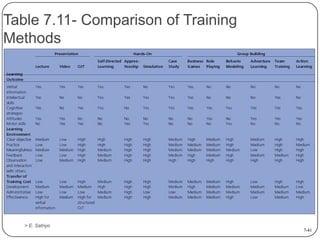
Table 7.11- Comparison of Training
Methods

> E. Satriyo
7-41

Employee Training & Development Ch 07

  • 1.
    Traditional Training Methods Chapter 7 6thEdition Raymond A. Noe McGraw-Hill/Irwin Copyright © 2013 by The McGraw-Hill Companies, Inc. All rights reserved.
  • 2.
    Learning Objectives • Discussthe strengths and weaknesses of presentational, hands-on, and group building training methods • Provide recommendations for effective on-the-job training (OJT) • Develop a case study • Develop a self-directed learning module > E. Satriyo 7-2
  • 3.
    Learning Objectives  Discussthe key components of behavior modeling training  Explain the conditions necessary for adventure learning to be effective  Discuss what team training should focus on to improve team performance > E. Satriyo 7-3
  • 4.
    Introduction  Traditional trainingmethods  Require an instructor or facilitator  Involve face-to-face interactions > E. Satriyo 7-4
  • 5.
    Presentation Methods  Traineesare passive recipients of information, which may include:  Facts or information  Processes  Problem-solving methods  Includes lectures and audio-visual techniques > E. Satriyo 7-5
  • 6.
    Presentation Methods  Lecture Trainers communicate through spoken words  Least expensive and least time-consuming ways to present information  Easily employed with large groups of trainees  Supports behavior modeling and technology-based techniques > E. Satriyo 7-6
  • 7.
    Presentation Method  Disadvantages Lacks participant involvement, feedback, and meaningful connection to work environment  Appeals to few of the trainees’ senses  Makes it difficult to judge learners’ level of understanding > E. Satriyo 7-7
  • 8.
    Table 7.1 -Variations of the Lecture Method > E. Satriyo 7-8
  • 9.
    Presentation Methods  Audiovisualinstruction  Used for improving communications, interviewing, and customer-service skills  Used for illustrating how procedures should be followed  Disadvantages  Too much content for the trainee to learn  Poor dialogue between the actors hinders credibility or clarity of the message  Overuse of humor, music, or drama may make it difficult to understand the important learning points > E. Satriyo 7-9
  • 10.
    Hands-on Methods  Requiretrainee to be actively involved in learning  On-the-job training (OJT)  New or inexperienced employees learn work by:  Observing peers or managers performing the job  Trying to imitate their behavior  Needs less investment in terms of time or money > E. Satriyo 7-10
  • 11.
    Hands-on Methods Advantages On-the-job training (OJT) •Customized to the experiences and abilities of trainees • Training is immediately applicable to the job • Save costs • Can be offered at any time, and trainers will be available because they are peers Disadvantages • • • Managers and peers may not use the same process to complete a task Managers/Peers may pass on bad habit as useful skill Unstructured OJT can result in poorly trained employees > E. Satriyo 7-11
  • 12.
    Table 7.2 -Principles of On-the-Job Training (OJT) > E. Satriyo 7-12
  • 13.
    Hands-on Methods  Aneffective OJT program should include:  A policy statement that describes OJT purpose  Clear specification of who is accountable for conducting OJT  Review of OJT practices in other companies  Availability of lesson plans, checklists, manuals, learning contracts, and progress reports  Evaluation of employees’ levels of basic skills > E. Satriyo 7-13
  • 14.
    Hands-on Methods Advantages Self directedlearning Employees • Take responsibility for all aspects of learning • Determine when it is conducted and who will be involved Trainers serve as facilitators • Allows trainees to learn at their own pace and receive feedback about the learning performance • Requires fewer trainers, reduces costs associated with travel and meeting rooms, and makes multiple-site training more realistic • Provides consistent training content • Makes it easier for shift employees to gain access to training materials Disadvantages • Trainees must be motivated to learn on their own • Higher development costs • Development time is longer > E. Satriyo 7-14
  • 15.
    Hands-on Methods  Necessarysteps to develop effective self-directed learning:  Conduct job analysis to identify the tasks that must be covered  Write trainee-centered learning objectives directly related to the tasks  Develop the content for the learning package  Break the content into smaller pieces (“chunks”)  Develop an evaluation package > E. Satriyo 7-15
  • 16.
    Hands-on Methods Advantages Apprenticeship Work-study training method withboth on-thejob and classroom training Disadvantages • Learners can earn pay • High development while they learn costs • Involves effective learning • Increased time about “why and how” commitment required of management and • Results in full-time journey workers employment for trainees • Limited access for • Meets specific business minorities and training needs and help women attract talented employees • No guarantee of fulltime employment • Training results in narrow focus expertise > E. Satriyo 7-16
  • 17.
    Hands-on Methods  Simulation Represents a real-life situation  Trainees’ decisions and the resulting outcomes mirror what would happen in real work situations  Replicates the physical equipment that employees use on the job  Is used to teach production, process skills, management, and interpersonal skills > E. Satriyo 7-17
  • 18.
    Hands-on Methods  Casestudies  Description about how employees or an organization dealt with a difficult situation  Trainees are required to:  Analyze and critique the actions taken  Indicate the appropriate actions  Suggest what might have been done differently  Assumes that recall and use knowledge and skills is better if:  Learnt through the process of discovery > E. Satriyo 7-18
  • 19.
    Hands-on Methods  Appropriatefor developing higher order intellectual skills  Help trainees develop the willingness to take risks  Case may not actually relate to the work situation or problem that the trainee will encounter > E. Satriyo 7-19
  • 20.
    Table 7.5 -Process for Case Development > E. Satriyo 7-20
  • 21.
    Hands-on Methods  Businessgames  Require trainees to gather information, analyze it, and make decisions  Primarily used for management skill development  Mimic the competitive nature of business  Designed to demonstrate understanding or application of knowledge, skill, or behavior  Provides several alternative courses of action  Rules limit participant behavior > E. Satriyo 7-21
  • 22.
    Table 7.6- Questionsto Use When Debriefing A Game > E. Satriyo 7-22
  • 23.
    Hands-on Methods  Roleplays: Trainees act out characters assigned to them  Trainers need to engage in several activities before, during, and after the role play  Differ from simulations on the basis of:  Response choices available to the trainees  Level of detail of the situation given to trainees  Outcomes of the trainees’ response > E. Satriyo 7-23
  • 24.
    Table 7.7 -Activities for Effective Role Plays > E. Satriyo 7-24
  • 25.
    Hands-on Methods  Behaviormodeling  Demonstrates key behaviors to replicate  Provides trainees with the opportunity to practice the key behaviors  Based on the principles of social learning theory  More appropriate for teaching skills and behaviors than factual information > E. Satriyo 7-25
  • 26.
    Hands-on Methods  Developingbehavior modeling training programs requires determining:  The tasks that are not being adequately performed due to lack of skill or behavior  The key behaviors that are required to perform the task.  Key behavior: Set of behaviors that are necessary to complete a task  Modeling display: Key behaviors that trainees will practice to develop the same set of behaviors > E. Satriyo 7-26
  • 27.
    Table 7.8 -Activities in a Behavior Modeling Training Program > E. Satriyo 7-27
  • 28.
    Hands-on Methods  Modelingdisplay  Key behaviors that the trainees will practice to develop the same set of behaviors  Characteristics of effective modeling display  Clearly presents key behaviors  Is credible to trainees  Overview of key behaviors is presented  Key behavior is repeated  Review of key behaviors is included  Both positive and negative use of key behaviors is presented > E. Satriyo 7-28
  • 29.
    Hands-on Methods  Applicationplanning: Prepares trainees to use the key behaviors on the job  Involves identifying specific situations in which to use the key behaviors > E. Satriyo 7-29
  • 30.
    Group Building Methods Designed to improve team or group effectiveness  Team  Two or more people with specific roles and shared responsibilities working to achieve a common goal  Experiential learning: Four stages are:  Gaining conceptual knowledge and theory  Taking part in a behavioral simulation  Analyzing the activity  Connecting the theory and activity to real-life situations > E. Satriyo 7-30
  • 31.
    Group Building Methods Adventure learning  Focuses on the development of teamwork and leadership skills through structured activities  Includes wilderness training, outdoor training, drum circles, and cooking classes  Develops skills related to group effectiveness > E. Satriyo 7-31
  • 32.
    Group Building Methods To be successful:  Exercises should be related to the types of skills participants are expected to develop  After the exercises, a skilled facilitator should lead a discussion about:  What happened in the exercise  What was learned  How events in the exercise relate to job situation  How to apply what was learned on the job > E. Satriyo 7-32
  • 33.
    Group Building Methods Team training: Designed to improve team effectiveness  Effective team training helps  Develop procedures to identify and resolve errors  Coordinate information gathering  Three components of team performance:  Knowledge  Attitudes  Behavior > E. Satriyo 7-33
  • 34.
    Figure 7.4 -Main Elements of the Structure of Team Training > E. Satriyo 7-34
  • 35.
    Group Building Methods Cross training: Team members understand and practice each other’s skills  Coordination training  Sharing information and decision- making responsibilities to maximize team performance  Leader training: Training for team manager or facilitator > E. Satriyo 7-35
  • 36.
    Group Building Methods Scenario-based training: Places team members in a realistic context while learning  Guided team self-correction: Emphasizes continuous learning and knowledge sharing in teams > E. Satriyo 7-36
  • 37.
    Group Building Methods Action learning: Teams or work groups:  Solve an actual problem  Commit to an action plan  Are accountable for carrying out the plan  Addresses how to:  Change the business  Better utilize technology  Remove barriers between the customer and company  Develop global leaders > E. Satriyo 7-37
  • 38.
    Table 7.10 -Steps in Action Learning > E. Satriyo 7-38
  • 39.
    Group Building Methods Six sigma  Quality standard with a goal of no more than 3.4 defects per million processes  Training involves several levels  On completion employees become certified as green belts, champions, or black belts  Kaizen  Focuses on continuous improvement of business processes > E. Satriyo 7-39
  • 40.
    Choosing a TrainingMethod  Identify the type of learning outcome  Consider the extent to which the learning method facilitates  Learning  Transfer of training  Evaluate the related costs  Consider the effectiveness of training method > E. Satriyo 7-40
  • 41.
    Table 7.11- Comparisonof Training Methods > E. Satriyo 7-41