1
THEORY OF METAL CUTTING
Manoj Yadav
Mechanical Engg. Dept.
Inderprastha Engg. College
Ghaziabad.
 Cutting Tool is a body which removes the
excess material through a direct
mechanical contact.
 Machine Tool is machine which provides
the necessary relative motion between the
work and the tool.
2
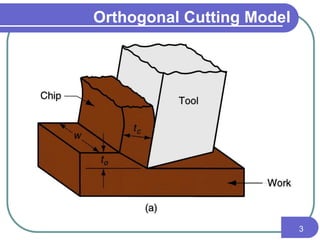
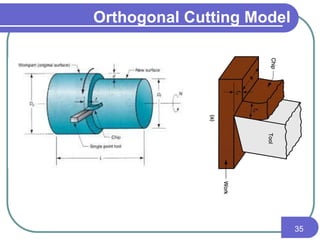
Orthogonal Cutting Model
3
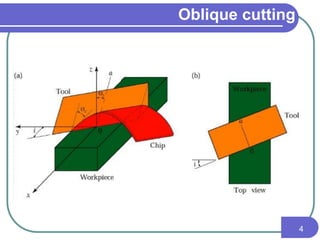
Oblique cutting
4
Chip Formation: Introduction
 For all types of machining, including grinding,
honing, lapping, planing, turning, or milling, the
phenomenon of chip formation is similar at the
point where the tool meets the work.
5
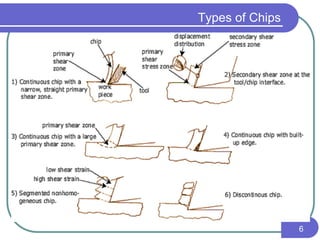
Types of Chips
6
Types of Chips
7
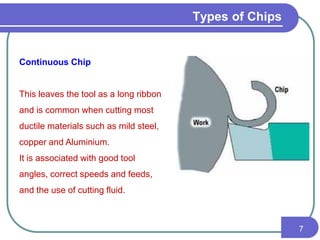
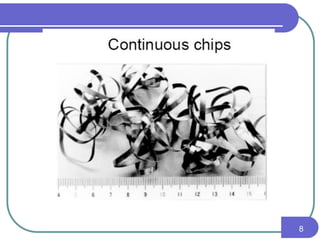
Continuous Chip
This leaves the tool as a long ribbon
and is common when cutting most
ductile materials such as mild steel,
copper and Aluminium.
It is associated with good tool
angles, correct speeds and feeds,
and the use of cutting fluid.
8
9
Types of Chips
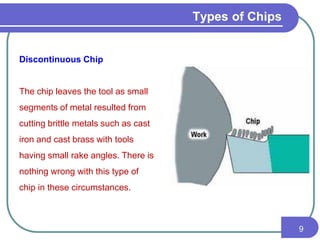
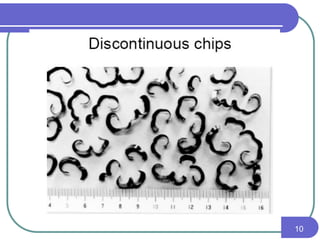
Discontinuous Chip
The chip leaves the tool as small
segments of metal resulted from
cutting brittle metals such as cast
iron and cast brass with tools
having small rake angles. There is
nothing wrong with this type of
chip in these circumstances.
10
11
Types of Chips
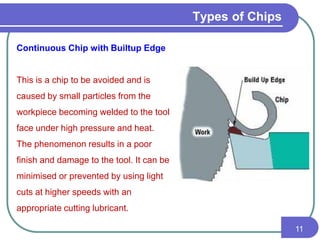
Continuous Chip with Builtup Edge
This is a chip to be avoided and is
caused by small particles from the
workpiece becoming welded to the tool
face under high pressure and heat.
The phenomenon results in a poor
finish and damage to the tool. It can be
minimised or prevented by using light
cuts at higher speeds with an
appropriate cutting lubricant.
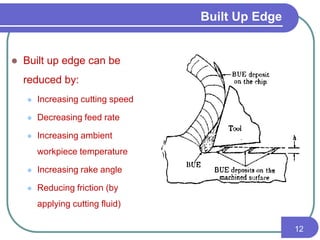
Built Up Edge
 Built up edge can be
reduced by:
 Increasing cutting speed
 Decreasing feed rate
 Increasing ambient
workpiece temperature
 Increasing rake angle
 Reducing friction (by
applying cutting fluid)
12
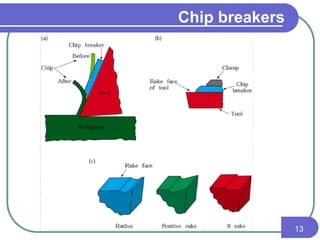
Chip breakers
13
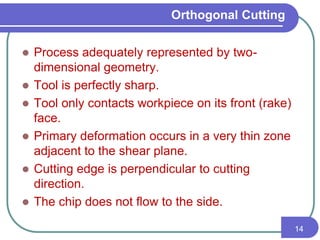
Orthogonal Cutting
 Process adequately represented by two-
dimensional geometry.
 Tool is perfectly sharp.
 Tool only contacts workpiece on its front (rake)
face.
 Primary deformation occurs in a very thin zone
adjacent to the shear plane.
 Cutting edge is perpendicular to cutting
direction.
 The chip does not flow to the side.
14
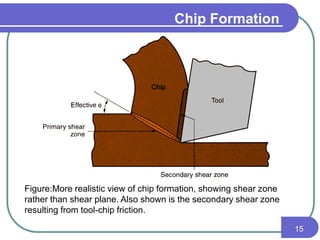
Figure:More realistic view of chip formation, showing shear zone
rather than shear plane. Also shown is the secondary shear zone
resulting from tool-chip friction.
Chip Formation
15
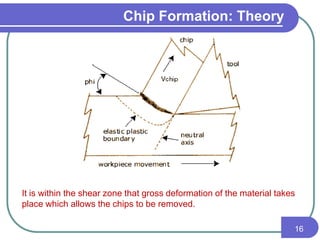
Chip Formation: Theory
16
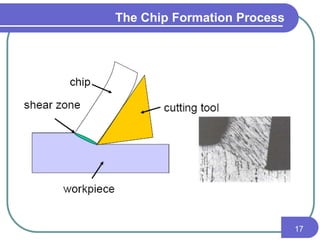
It is within the shear zone that gross deformation of the material takes
place which allows the chips to be removed.
The Chip Formation Process
17
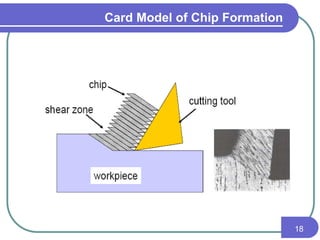
Card Model of Chip Formation
18
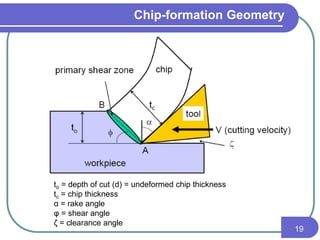
Chip-formation Geometry
19
to = depth of cut (d) = undeformed chip thickness
tc = chip thickness
α = rake angle
φ = shear angle
ζ = clearance angle
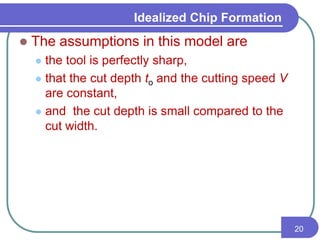
Idealized Chip Formation
 The assumptions in this model are
 the tool is perfectly sharp,
 that the cut depth to and the cutting speed V
are constant,
 and the cut depth is small compared to the
cut width.
20
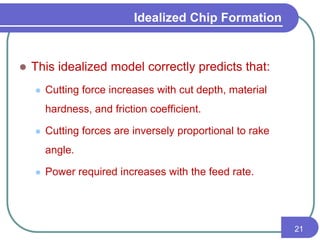
 This idealized model correctly predicts that:
 Cutting force increases with cut depth, material
hardness, and friction coefficient.
 Cutting forces are inversely proportional to rake
angle.
 Power required increases with the feed rate.
21
Idealized Chip Formation
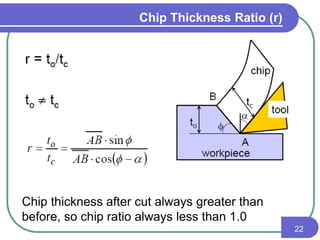
Chip Thickness Ratio (r)
22
Chip thickness after cut always greater than
before, so chip ratio always less than 1.0
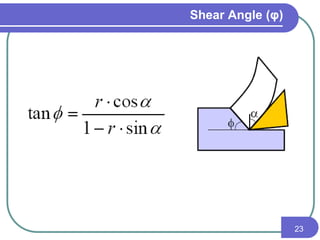
Shear Angle (φ)
23
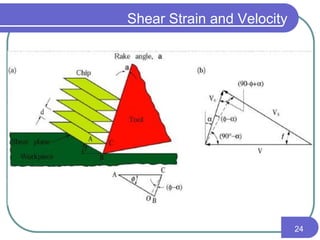
Shear Strain and Velocity
24
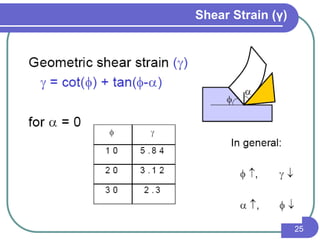
Shear Strain (γ)
25
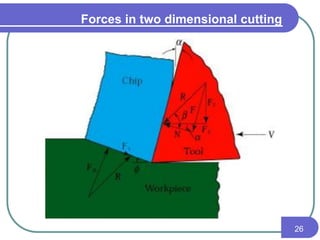
Forces in two dimensional cutting
26
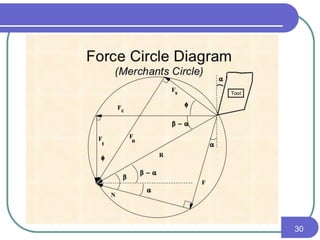
Resultant Forces
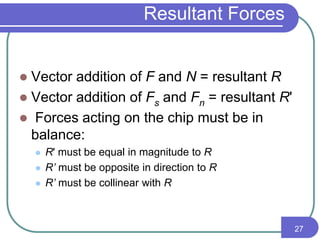
 Vector addition of F and N = resultant R
 Vector addition of Fs and Fn = resultant R'
 Forces acting on the chip must be in
balance:
 R' must be equal in magnitude to R
 R’ must be opposite in direction to R
 R’ must be collinear with R
27
Coefficient of Friction
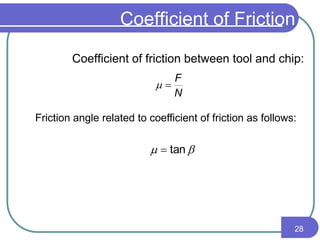
Coefficient of friction between tool and chip:
Friction angle related to coefficient of friction as follows:
N
F

 tan
28
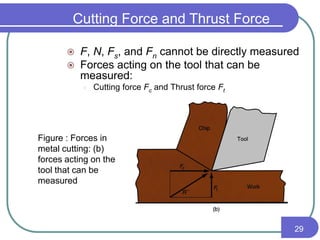
 F, N, Fs, and Fn cannot be directly measured
 Forces acting on the tool that can be
measured:
› Cutting force Fc and Thrust force Ft
Figure : Forces in
metal cutting: (b)
forces acting on the
tool that can be
measured
Cutting Force and Thrust Force
29
30
Forces in Metal Cutting
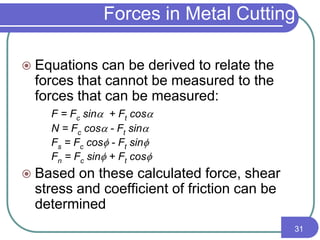
 Equations can be derived to relate the
forces that cannot be measured to the
forces that can be measured:
F = Fc sin + Ft cos
N = Fc cos - Ft sin
Fs = Fc cos - Ft sin
Fn = Fc sin + Ft cos
 Based on these calculated force, shear
stress and coefficient of friction can be
determined
31
Shear Stress
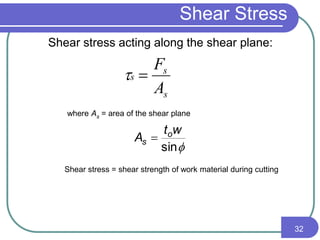
Shear stress acting along the shear plane:
sin
wt
A o
s 
where As = area of the shear plane
Shear stress = shear strength of work material during cutting
s
s
s
A
F

32
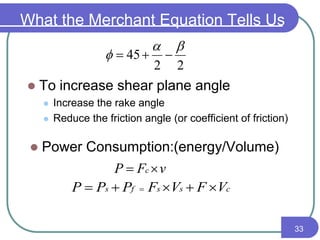
What the Merchant Equation Tells Us
 To increase shear plane angle
 Increase the rake angle
 Reduce the friction angle (or coefficient of friction)
22
45

 
33
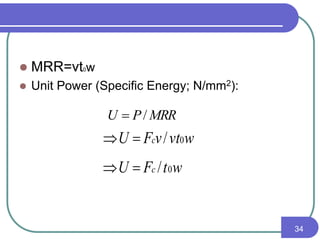
vFP c 
 Power Consumption:(energy/Volume)
cssfs VFVFPPP  
 MRR=vt0w
 Unit Power (Specific Energy; N/mm2):
34
MRRPU /
wvtvFU c 0/
wtFU c 0/
Orthogonal Cutting Model
35
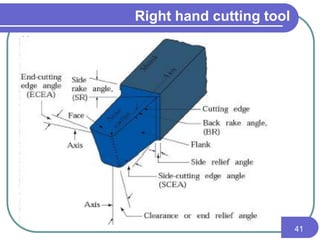
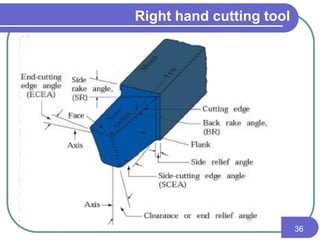
Right hand cutting tool
36
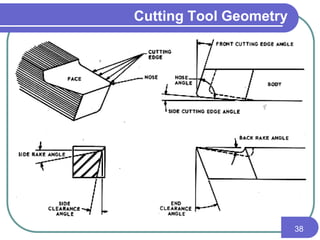
 Cutting Tool Signature
 Different angles
37
Cutting Tool Geometry
38
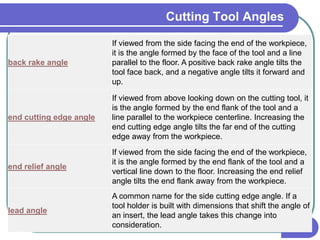
Cutting Tool Angles
39
back rake angle
If viewed from the side facing the end of the workpiece,
it is the angle formed by the face of the tool and a line
parallel to the floor. A positive back rake angle tilts the
tool face back, and a negative angle tilts it forward and
up.
end cutting edge angle
If viewed from above looking down on the cutting tool, it
is the angle formed by the end flank of the tool and a
line parallel to the workpiece centerline. Increasing the
end cutting edge angle tilts the far end of the cutting
edge away from the workpiece.
end relief angle
If viewed from the side facing the end of the workpiece,
it is the angle formed by the end flank of the tool and a
vertical line down to the floor. Increasing the end relief
angle tilts the end flank away from the workpiece.
lead angle
A common name for the side cutting edge angle. If a
tool holder is built with dimensions that shift the angle of
an insert, the lead angle takes this change into
consideration.
40
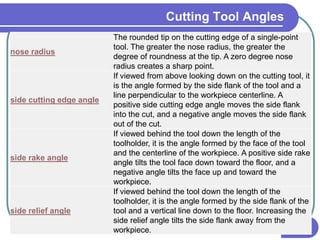
nose radius
The rounded tip on the cutting edge of a single-point
tool. The greater the nose radius, the greater the
degree of roundness at the tip. A zero degree nose
radius creates a sharp point.
side cutting edge angle
If viewed from above looking down on the cutting tool, it
is the angle formed by the side flank of the tool and a
line perpendicular to the workpiece centerline. A
positive side cutting edge angle moves the side flank
into the cut, and a negative angle moves the side flank
out of the cut.
side rake angle
If viewed behind the tool down the length of the
toolholder, it is the angle formed by the face of the tool
and the centerline of the workpiece. A positive side rake
angle tilts the tool face down toward the floor, and a
negative angle tilts the face up and toward the
workpiece.
side relief angle
If viewed behind the tool down the length of the
toolholder, it is the angle formed by the side flank of the
tool and a vertical line down to the floor. Increasing the
side relief angle tilts the side flank away from the
workpiece.
Cutting Tool Angles
Right hand cutting tool
41
Function of Tool Angles
 Side Rake Angle
This angle has a major effect on power efficiency and tool
life.
 Back Rake Angle
This angle controls the chip flow, and thrust force (into
spindle or away from) of the cut and the strength of the
cutting edges.
 Side Cutting Edge Angle
This angle reduces the thickness of the chip. Shock is
absorbed behind the cutting point, adding strength that
influences tool life.
42
 True Rake Angle
The combination of radial rake, axial rake, and corner angle
determines the chip formation shear angle, the power requirements,
tool force and temperature. True rake angle is the most significant
angle in the metal removal process. The higher the positive true rake
angle, the lower the force, the power requirements and the heat
generated. The cutting tool material, machine rigidity and other
variables determine the positive or negative values that can be used.
 Nose Radius
This strengthens the culting edge, improves finish and influences tool
life. Too large a radius increases radial forces and induces chatter.
Too small a nose radius may result in premature chipping or prevent
proper distribution of the heat and break down the properties of the
cutting tool material.
43
 Inclination Angle
This has a significant effect on the direction of the chip. Positive
inclination directs the chip outward and negative inclination directs
the chip toward the center of the cutter. The inclination angle is
perpendicular to the direction of tool travel. Any change in axial rake
angle, radial rake angle or chamfer angle can change the inclination
and therefore the direction of the chip flow:
 End Cutting Edge Angle
This provides clearance between the cutter and the finished surface
of the work which blends into the radius or chamfer of the tool. All
angle close to zero adds strength but causes rubbing and generates
heat. Too large an angle Weakens the tool. Flats parallel to the
finished surface are often ground on the end cutting edge or dish
angle to produce good surface finishes.
44
 Clearance Angles
 Primary clearance is directly below the cutting edge and is
selected for the material being machined. It prevents the cutter or
tool from rubbing on the workpiece. It also affects the strength of
the tool.
 The secondary clearance is on the tooth form of the cutter or the
shank of the single point tool. It must be large enough to clear the
workpiece and permit chips to escape but not so large that it
weakens the cutter or tool.
45
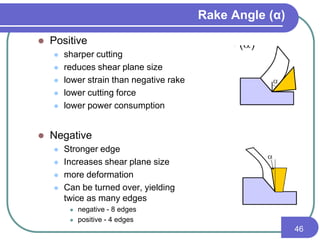
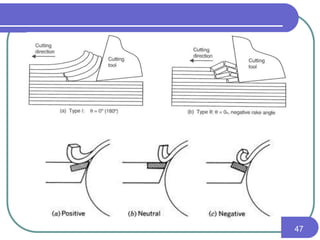
Rake Angle (α)
 Positive
 sharper cutting
 reduces shear plane size
 lower strain than negative rake
 lower cutting force
 lower power consumption
 Negative
 Stronger edge
 Increases shear plane size
 more deformation
 Can be turned over, yielding
twice as many edges
 negative - 8 edges
 positive - 4 edges
46
47
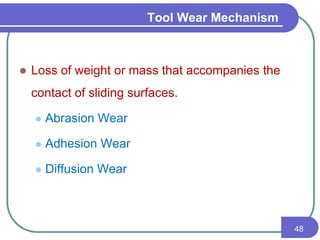
Tool Wear Mechanism
 Loss of weight or mass that accompanies the
contact of sliding surfaces.
 Abrasion Wear
 Adhesion Wear
 Diffusion Wear
48
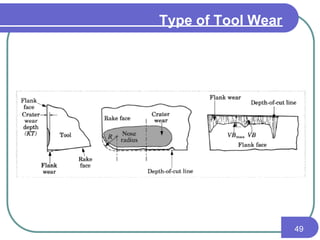
Type of Tool Wear
49
Tool Failure
 Tool failure implies that the tool has reached a
point beyond which it will not function
satisfactorily until it is reground.
 It Occurs due to
 Excessive Temperature
 Excessive Stress
 Flank Wear
 Crater Wear
50
Tool life
51
It could be defined from any of the
below mentioned criteria.
Volume of material removed
between two successive tool grind.
Number of work piece machined
between two successive tool grinds.
time of actual cutting between two
successive tool grinds.
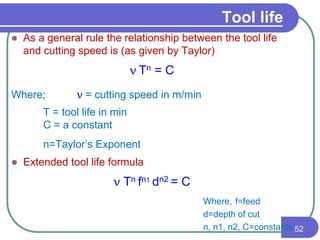
 As a general rule the relationship between the tool life
and cutting speed is (as given by Taylor)
vTn = C
Where; v = cutting speed in m/min
T = tool life in min
C = a constant
n=Taylor’s Exponent
 Extended tool life formula
v Tn fn1 dn2 = C
Where, f=feed
d=depth of cut
n, n1, n2, C=constants 52
Tool life
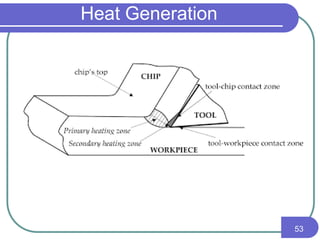
Heat Generation
53
Characteristics of Tool Material
54
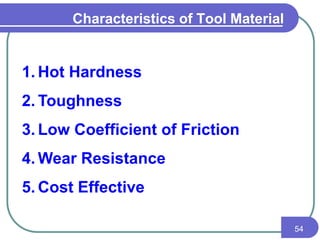
1. Hot Hardness
2. Toughness
3. Low Coefficient of Friction
4. Wear Resistance
5. Cost Effective
Types of Tool Materials
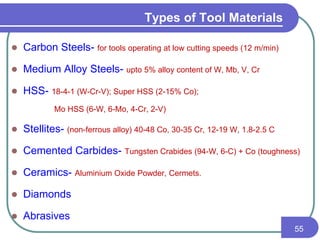
 Carbon Steels- for tools operating at low cutting speeds (12 m/min)
 Medium Alloy Steels- upto 5% alloy content of W, Mb, V, Cr
 HSS- 18-4-1 (W-Cr-V); Super HSS (2-15% Co);
Mo HSS (6-W, 6-Mo, 4-Cr, 2-V)
 Stellites- (non-ferrous alloy) 40-48 Co, 30-35 Cr, 12-19 W, 1.8-2.5 C
 Cemented Carbides- Tungsten Crabides (94-W, 6-C) + Co (toughness)
 Ceramics- Aluminium Oxide Powder, Cermets.
 Diamonds
 Abrasives
55
Tool Materials in Common Use
56
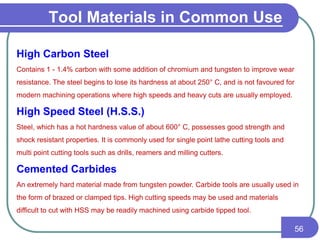
High Carbon Steel
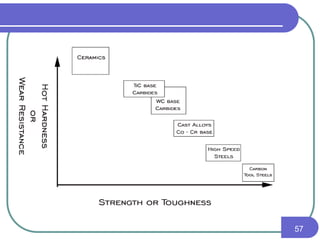
Contains 1 - 1.4% carbon with some addition of chromium and tungsten to improve wear
resistance. The steel begins to lose its hardness at about 250° C, and is not favoured for
modern machining operations where high speeds and heavy cuts are usually employed.
High Speed Steel (H.S.S.)
Steel, which has a hot hardness value of about 600° C, possesses good strength and
shock resistant properties. It is commonly used for single point lathe cutting tools and
multi point cutting tools such as drills, reamers and milling cutters.
Cemented Carbides
An extremely hard material made from tungsten powder. Carbide tools are usually used in
the form of brazed or clamped tips. High cutting speeds may be used and materials
difficult to cut with HSS may be readily machined using carbide tipped tool.
57
Cutting Fluids & Lubricants
 The aims in metal cutting are to retain accuracy, to get a good surface
finish on the workpiece and at the same time to have a longer tool life.
 However during the metal cutting process heat is generated due to:
 the deformation of the material ahead of the tool
 friction at the tool point
 Heat generated due to friction can readily be reduced by using a
lubricant.
 Heat caused by deformation cannot be reduced and yet it can be
carried away by a fluid.
 Thus the use of a cutting fluid will serve to reduce the tool wear, give
better surface finish and a tighter dimensional control.
58
 Cutting fluid is a substance (may be liquid, gas or solid) which is
applied to a tool during a cutting operation to facilitate removal of
chips.
 Functions of a cutting fluid:
 To cool the cutting tool –chip-w/p interface
 To lubricate the chip, tool and w/p
 To help carry away the chips
 To lubricate some of the moving parts of the m/c tool.
 To improve the surface finish and protecting finished surface
 To prevent the formation of BUE
 To Reduce thermal distortion
59
Cutting Fluids & Lubricants
It should have
 long life, free of excessive oxide formation that may clog circulation
system.
 suitable for a variety of cutting tools and materials and the cutting
operations.
 lubricating qualities,
 high thermal conductivity
 low viscosity to permit easy flow
 transparent where high dimensional accuracy and fine finish are
required.
 High Flash Point
60
Properties of Cutting Fluids & Lubricants
Cutting fluids in common use
 Water
 It has a high specific heat but is poor in lubrication and also encourages
rusting. It is used as a cooling agent during tool grinding.
 Water Soluble Oils
 Oil will not dissolve in water but can be made to form an intimate
mixture or emulsion by adding emulsifying agents.
 The oil is then suspended in the water in the form of tiny droplets.
 These fluids have average lubricating abilities and good cooling
properties.
 Soluble oils are suitable for light cutting operations on general purpose
machines where high rates of metal removal are often not of prime
importance.
61
 Mineral Oils
 These are straight oils derived from petroleum.
 They are used for heavier cutting operations because of their good
lubricating properties and are commonly found in production machines
where high rates of metal removal are employed.
 Mineral oils are very suitable for steels but should not be used on
copper or its alloys since it has a corrosive effect.
 Vegetable Oils
 They are good lubricants but are of little used since they are liable to
decompose and smell badly.
 Synthetic Oils
62
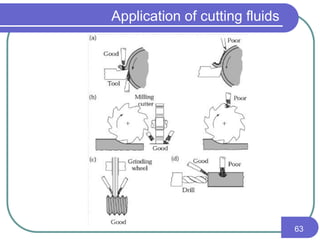
Cutting fluids in common use
Application of cutting fluids
63
Machinability
64
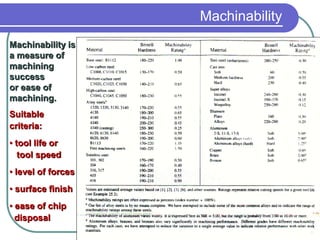
Machinability is
a measure of
machining
success
or ease of
machining.
Suitable
criteria:
• tool life or
tool speed
• level of forces
• surface finish
• ease of chip
disposal
65
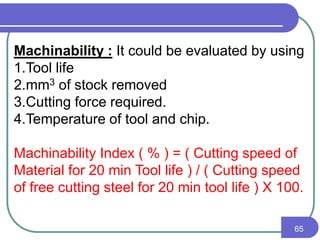
Machinability : It could be evaluated by using
1.Tool life
2.mm3 of stock removed
3.Cutting force required.
4.Temperature of tool and chip.
Machinability Index ( % ) = ( Cutting speed of
Material for 20 min Tool life ) / ( Cutting speed
of free cutting steel for 20 min tool life ) X 100.
IE3
16
Ma
nuf
act
uri
ng
En
gin
eer
ing
I -
Pr
oc
es
se
s
Optimizing Cutting Speed
 Have to select speed to achieve a
balance between high metal removal rate
and suitably long tool life
 Mathematical formulas are available to
determine optimal speed
 Two alternative objectives in these
formulas:
 Maximum production rate
 Minimum unit cost
IE3
16
Ma
nuf
act
uri
ng
En
gin
eer
ing
I -
Pr
oc
es
se
s
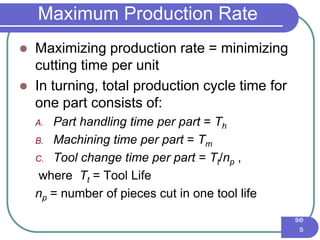
Maximum Production Rate
 Maximizing production rate = minimizing
cutting time per unit
 In turning, total production cycle time for
one part consists of:
A. Part handling time per part = Th
B. Machining time per part = Tm
C. Tool change time per part = Tt/np ,
where Tt = Tool Life
np = number of pieces cut in one tool life
IE3
16
Ma
nuf
act
uri
ng
En
gin
eer
ing
I -
Pr
oc
es
se
s
Maximum Production Rate
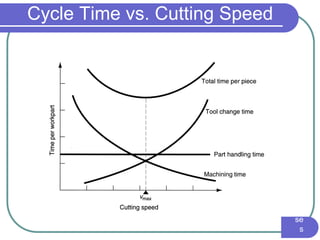
Total time per unit product for operation:
Tc =Production Cycle Time per Piece (min)
Now, Tool life for maximum production rate:
Tc = Th + Tm + Tt /np
Tmax = [(1-n)/n] Tt
IE3
16
Ma
nuf
act
uri
ng
En
gin
eer
ing
I -
Pr
oc
es
se
s
Cycle Time vs. Cutting Speed
IE3
16
Ma
nuf
act
uri
ng
En
gin
eer
ing
I -
Pr
oc
es
se
s
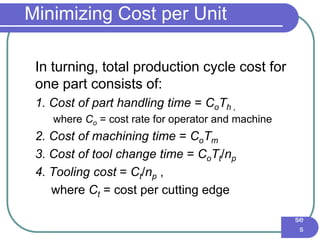
Minimizing Cost per Unit
In turning, total production cycle cost for
one part consists of:
1. Cost of part handling time = CoTh ,
where Co = cost rate for operator and machine
2. Cost of machining time = CoTm
3. Cost of tool change time = CoTt/np
4. Tooling cost = Ct/np ,
where Ct = cost per cutting edge
IE3
16
Ma
nuf
act
uri
ng
En
gin
eer
ing
I -
Pr
oc
es
se
s
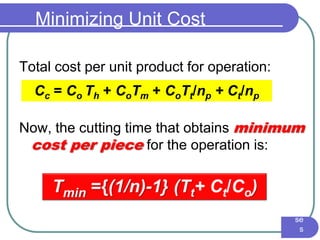
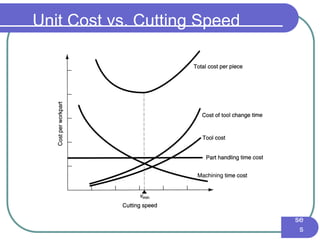
Minimizing Unit Cost
Total cost per unit product for operation:
Now, the cutting time that obtains minimum
cost per piece for the operation is:
Cc = Co Th + CoTm + CoTt/np + Ct/np
Tmin ={(1/n)-1} (Tt+ Ct/Co)
IE3
16
Ma
nuf
act
uri
ng
En
gin
eer
ing
I -
Pr
oc
es
se
s
Unit Cost vs. Cutting Speed
IE3
16
Ma
nuf
act
uri
ng
En
gin
eer
ing
I -
Pr
oc
es
se
s
Comments on Machining Economics
 As tool change time Tt and/or tooling cost
Ct increase, cutting speed should be
reduced
 Tools should not be changed too often if
either tool cost or tool change time is high
 Disposable inserts have an advantage over
regrindable tools because tool change time is
lower
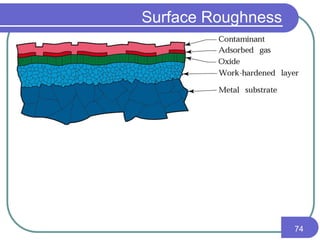
Surface Roughness
74
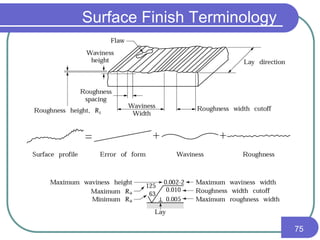
Surface Finish Terminology
75
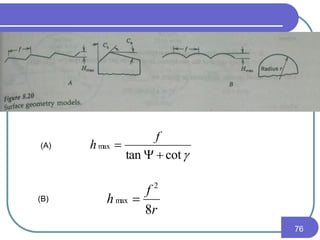
76
cottan
max


f
h
r
f
h
8
2
max (B)
(A)
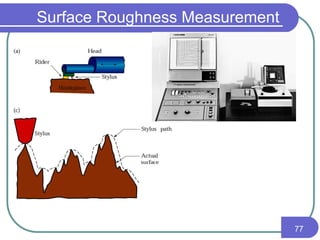
Surface Roughness Measurement
77

Ipecmanuscunit1 150825052256-lva1-app6891

  • 1.
    1 THEORY OF METALCUTTING Manoj Yadav Mechanical Engg. Dept. Inderprastha Engg. College Ghaziabad.
  • 2.
     Cutting Toolis a body which removes the excess material through a direct mechanical contact.  Machine Tool is machine which provides the necessary relative motion between the work and the tool. 2
  • 3.
  • 4.
  • 5.
    Chip Formation: Introduction For all types of machining, including grinding, honing, lapping, planing, turning, or milling, the phenomenon of chip formation is similar at the point where the tool meets the work. 5
  • 6.
  • 7.
    Types of Chips 7 ContinuousChip This leaves the tool as a long ribbon and is common when cutting most ductile materials such as mild steel, copper and Aluminium. It is associated with good tool angles, correct speeds and feeds, and the use of cutting fluid.
  • 8.
  • 9.
    9 Types of Chips DiscontinuousChip The chip leaves the tool as small segments of metal resulted from cutting brittle metals such as cast iron and cast brass with tools having small rake angles. There is nothing wrong with this type of chip in these circumstances.
  • 10.
  • 11.
    11 Types of Chips ContinuousChip with Builtup Edge This is a chip to be avoided and is caused by small particles from the workpiece becoming welded to the tool face under high pressure and heat. The phenomenon results in a poor finish and damage to the tool. It can be minimised or prevented by using light cuts at higher speeds with an appropriate cutting lubricant.
  • 12.
    Built Up Edge Built up edge can be reduced by:  Increasing cutting speed  Decreasing feed rate  Increasing ambient workpiece temperature  Increasing rake angle  Reducing friction (by applying cutting fluid) 12
  • 13.
  • 14.
    Orthogonal Cutting  Processadequately represented by two- dimensional geometry.  Tool is perfectly sharp.  Tool only contacts workpiece on its front (rake) face.  Primary deformation occurs in a very thin zone adjacent to the shear plane.  Cutting edge is perpendicular to cutting direction.  The chip does not flow to the side. 14
  • 15.
    Figure:More realistic viewof chip formation, showing shear zone rather than shear plane. Also shown is the secondary shear zone resulting from tool-chip friction. Chip Formation 15
  • 16.
    Chip Formation: Theory 16 Itis within the shear zone that gross deformation of the material takes place which allows the chips to be removed.
  • 17.
  • 18.
    Card Model ofChip Formation 18
  • 19.
    Chip-formation Geometry 19 to =depth of cut (d) = undeformed chip thickness tc = chip thickness α = rake angle φ = shear angle ζ = clearance angle
  • 20.
    Idealized Chip Formation The assumptions in this model are  the tool is perfectly sharp,  that the cut depth to and the cutting speed V are constant,  and the cut depth is small compared to the cut width. 20
  • 21.
     This idealizedmodel correctly predicts that:  Cutting force increases with cut depth, material hardness, and friction coefficient.  Cutting forces are inversely proportional to rake angle.  Power required increases with the feed rate. 21 Idealized Chip Formation
  • 22.
    Chip Thickness Ratio(r) 22 Chip thickness after cut always greater than before, so chip ratio always less than 1.0
  • 23.
  • 24.
    Shear Strain andVelocity 24
  • 25.
  • 26.
    Forces in twodimensional cutting 26
  • 27.
    Resultant Forces  Vectoraddition of F and N = resultant R  Vector addition of Fs and Fn = resultant R'  Forces acting on the chip must be in balance:  R' must be equal in magnitude to R  R’ must be opposite in direction to R  R’ must be collinear with R 27
  • 28.
    Coefficient of Friction Coefficientof friction between tool and chip: Friction angle related to coefficient of friction as follows: N F   tan 28
  • 29.
     F, N,Fs, and Fn cannot be directly measured  Forces acting on the tool that can be measured: › Cutting force Fc and Thrust force Ft Figure : Forces in metal cutting: (b) forces acting on the tool that can be measured Cutting Force and Thrust Force 29
  • 30.
  • 31.
    Forces in MetalCutting  Equations can be derived to relate the forces that cannot be measured to the forces that can be measured: F = Fc sin + Ft cos N = Fc cos - Ft sin Fs = Fc cos - Ft sin Fn = Fc sin + Ft cos  Based on these calculated force, shear stress and coefficient of friction can be determined 31
  • 32.
    Shear Stress Shear stressacting along the shear plane: sin wt A o s  where As = area of the shear plane Shear stress = shear strength of work material during cutting s s s A F  32
  • 33.
    What the MerchantEquation Tells Us  To increase shear plane angle  Increase the rake angle  Reduce the friction angle (or coefficient of friction) 22 45    33 vFP c   Power Consumption:(energy/Volume) cssfs VFVFPPP  
  • 34.
     MRR=vt0w  UnitPower (Specific Energy; N/mm2): 34 MRRPU / wvtvFU c 0/ wtFU c 0/
  • 35.
  • 36.
  • 37.
     Cutting ToolSignature  Different angles 37
  • 38.
  • 39.
    Cutting Tool Angles 39 backrake angle If viewed from the side facing the end of the workpiece, it is the angle formed by the face of the tool and a line parallel to the floor. A positive back rake angle tilts the tool face back, and a negative angle tilts it forward and up. end cutting edge angle If viewed from above looking down on the cutting tool, it is the angle formed by the end flank of the tool and a line parallel to the workpiece centerline. Increasing the end cutting edge angle tilts the far end of the cutting edge away from the workpiece. end relief angle If viewed from the side facing the end of the workpiece, it is the angle formed by the end flank of the tool and a vertical line down to the floor. Increasing the end relief angle tilts the end flank away from the workpiece. lead angle A common name for the side cutting edge angle. If a tool holder is built with dimensions that shift the angle of an insert, the lead angle takes this change into consideration.
  • 40.
    40 nose radius The roundedtip on the cutting edge of a single-point tool. The greater the nose radius, the greater the degree of roundness at the tip. A zero degree nose radius creates a sharp point. side cutting edge angle If viewed from above looking down on the cutting tool, it is the angle formed by the side flank of the tool and a line perpendicular to the workpiece centerline. A positive side cutting edge angle moves the side flank into the cut, and a negative angle moves the side flank out of the cut. side rake angle If viewed behind the tool down the length of the toolholder, it is the angle formed by the face of the tool and the centerline of the workpiece. A positive side rake angle tilts the tool face down toward the floor, and a negative angle tilts the face up and toward the workpiece. side relief angle If viewed behind the tool down the length of the toolholder, it is the angle formed by the side flank of the tool and a vertical line down to the floor. Increasing the side relief angle tilts the side flank away from the workpiece. Cutting Tool Angles
  • 41.
  • 42.
    Function of ToolAngles  Side Rake Angle This angle has a major effect on power efficiency and tool life.  Back Rake Angle This angle controls the chip flow, and thrust force (into spindle or away from) of the cut and the strength of the cutting edges.  Side Cutting Edge Angle This angle reduces the thickness of the chip. Shock is absorbed behind the cutting point, adding strength that influences tool life. 42
  • 43.
     True RakeAngle The combination of radial rake, axial rake, and corner angle determines the chip formation shear angle, the power requirements, tool force and temperature. True rake angle is the most significant angle in the metal removal process. The higher the positive true rake angle, the lower the force, the power requirements and the heat generated. The cutting tool material, machine rigidity and other variables determine the positive or negative values that can be used.  Nose Radius This strengthens the culting edge, improves finish and influences tool life. Too large a radius increases radial forces and induces chatter. Too small a nose radius may result in premature chipping or prevent proper distribution of the heat and break down the properties of the cutting tool material. 43
  • 44.
     Inclination Angle Thishas a significant effect on the direction of the chip. Positive inclination directs the chip outward and negative inclination directs the chip toward the center of the cutter. The inclination angle is perpendicular to the direction of tool travel. Any change in axial rake angle, radial rake angle or chamfer angle can change the inclination and therefore the direction of the chip flow:  End Cutting Edge Angle This provides clearance between the cutter and the finished surface of the work which blends into the radius or chamfer of the tool. All angle close to zero adds strength but causes rubbing and generates heat. Too large an angle Weakens the tool. Flats parallel to the finished surface are often ground on the end cutting edge or dish angle to produce good surface finishes. 44
  • 45.
     Clearance Angles Primary clearance is directly below the cutting edge and is selected for the material being machined. It prevents the cutter or tool from rubbing on the workpiece. It also affects the strength of the tool.  The secondary clearance is on the tooth form of the cutter or the shank of the single point tool. It must be large enough to clear the workpiece and permit chips to escape but not so large that it weakens the cutter or tool. 45
  • 46.
    Rake Angle (α) Positive  sharper cutting  reduces shear plane size  lower strain than negative rake  lower cutting force  lower power consumption  Negative  Stronger edge  Increases shear plane size  more deformation  Can be turned over, yielding twice as many edges  negative - 8 edges  positive - 4 edges 46
  • 47.
  • 48.
    Tool Wear Mechanism Loss of weight or mass that accompanies the contact of sliding surfaces.  Abrasion Wear  Adhesion Wear  Diffusion Wear 48
  • 49.
    Type of ToolWear 49
  • 50.
    Tool Failure  Toolfailure implies that the tool has reached a point beyond which it will not function satisfactorily until it is reground.  It Occurs due to  Excessive Temperature  Excessive Stress  Flank Wear  Crater Wear 50
  • 51.
    Tool life 51 It couldbe defined from any of the below mentioned criteria. Volume of material removed between two successive tool grind. Number of work piece machined between two successive tool grinds. time of actual cutting between two successive tool grinds.
  • 52.
     As ageneral rule the relationship between the tool life and cutting speed is (as given by Taylor) vTn = C Where; v = cutting speed in m/min T = tool life in min C = a constant n=Taylor’s Exponent  Extended tool life formula v Tn fn1 dn2 = C Where, f=feed d=depth of cut n, n1, n2, C=constants 52 Tool life
  • 53.
  • 54.
    Characteristics of ToolMaterial 54 1. Hot Hardness 2. Toughness 3. Low Coefficient of Friction 4. Wear Resistance 5. Cost Effective
  • 55.
    Types of ToolMaterials  Carbon Steels- for tools operating at low cutting speeds (12 m/min)  Medium Alloy Steels- upto 5% alloy content of W, Mb, V, Cr  HSS- 18-4-1 (W-Cr-V); Super HSS (2-15% Co); Mo HSS (6-W, 6-Mo, 4-Cr, 2-V)  Stellites- (non-ferrous alloy) 40-48 Co, 30-35 Cr, 12-19 W, 1.8-2.5 C  Cemented Carbides- Tungsten Crabides (94-W, 6-C) + Co (toughness)  Ceramics- Aluminium Oxide Powder, Cermets.  Diamonds  Abrasives 55
  • 56.
    Tool Materials inCommon Use 56 High Carbon Steel Contains 1 - 1.4% carbon with some addition of chromium and tungsten to improve wear resistance. The steel begins to lose its hardness at about 250° C, and is not favoured for modern machining operations where high speeds and heavy cuts are usually employed. High Speed Steel (H.S.S.) Steel, which has a hot hardness value of about 600° C, possesses good strength and shock resistant properties. It is commonly used for single point lathe cutting tools and multi point cutting tools such as drills, reamers and milling cutters. Cemented Carbides An extremely hard material made from tungsten powder. Carbide tools are usually used in the form of brazed or clamped tips. High cutting speeds may be used and materials difficult to cut with HSS may be readily machined using carbide tipped tool.
  • 57.
  • 58.
    Cutting Fluids &Lubricants  The aims in metal cutting are to retain accuracy, to get a good surface finish on the workpiece and at the same time to have a longer tool life.  However during the metal cutting process heat is generated due to:  the deformation of the material ahead of the tool  friction at the tool point  Heat generated due to friction can readily be reduced by using a lubricant.  Heat caused by deformation cannot be reduced and yet it can be carried away by a fluid.  Thus the use of a cutting fluid will serve to reduce the tool wear, give better surface finish and a tighter dimensional control. 58
  • 59.
     Cutting fluidis a substance (may be liquid, gas or solid) which is applied to a tool during a cutting operation to facilitate removal of chips.  Functions of a cutting fluid:  To cool the cutting tool –chip-w/p interface  To lubricate the chip, tool and w/p  To help carry away the chips  To lubricate some of the moving parts of the m/c tool.  To improve the surface finish and protecting finished surface  To prevent the formation of BUE  To Reduce thermal distortion 59 Cutting Fluids & Lubricants
  • 60.
    It should have long life, free of excessive oxide formation that may clog circulation system.  suitable for a variety of cutting tools and materials and the cutting operations.  lubricating qualities,  high thermal conductivity  low viscosity to permit easy flow  transparent where high dimensional accuracy and fine finish are required.  High Flash Point 60 Properties of Cutting Fluids & Lubricants
  • 61.
    Cutting fluids incommon use  Water  It has a high specific heat but is poor in lubrication and also encourages rusting. It is used as a cooling agent during tool grinding.  Water Soluble Oils  Oil will not dissolve in water but can be made to form an intimate mixture or emulsion by adding emulsifying agents.  The oil is then suspended in the water in the form of tiny droplets.  These fluids have average lubricating abilities and good cooling properties.  Soluble oils are suitable for light cutting operations on general purpose machines where high rates of metal removal are often not of prime importance. 61
  • 62.
     Mineral Oils These are straight oils derived from petroleum.  They are used for heavier cutting operations because of their good lubricating properties and are commonly found in production machines where high rates of metal removal are employed.  Mineral oils are very suitable for steels but should not be used on copper or its alloys since it has a corrosive effect.  Vegetable Oils  They are good lubricants but are of little used since they are liable to decompose and smell badly.  Synthetic Oils 62 Cutting fluids in common use
  • 63.
  • 64.
    Machinability 64 Machinability is a measureof machining success or ease of machining. Suitable criteria: • tool life or tool speed • level of forces • surface finish • ease of chip disposal
  • 65.
    65 Machinability : Itcould be evaluated by using 1.Tool life 2.mm3 of stock removed 3.Cutting force required. 4.Temperature of tool and chip. Machinability Index ( % ) = ( Cutting speed of Material for 20 min Tool life ) / ( Cutting speed of free cutting steel for 20 min tool life ) X 100.
  • 66.
    IE3 16 Ma nuf act uri ng En gin eer ing I - Pr oc es se s Optimizing CuttingSpeed  Have to select speed to achieve a balance between high metal removal rate and suitably long tool life  Mathematical formulas are available to determine optimal speed  Two alternative objectives in these formulas:  Maximum production rate  Minimum unit cost
  • 67.
    IE3 16 Ma nuf act uri ng En gin eer ing I - Pr oc es se s Maximum ProductionRate  Maximizing production rate = minimizing cutting time per unit  In turning, total production cycle time for one part consists of: A. Part handling time per part = Th B. Machining time per part = Tm C. Tool change time per part = Tt/np , where Tt = Tool Life np = number of pieces cut in one tool life
  • 68.
    IE3 16 Ma nuf act uri ng En gin eer ing I - Pr oc es se s Maximum ProductionRate Total time per unit product for operation: Tc =Production Cycle Time per Piece (min) Now, Tool life for maximum production rate: Tc = Th + Tm + Tt /np Tmax = [(1-n)/n] Tt
  • 69.
  • 70.
    IE3 16 Ma nuf act uri ng En gin eer ing I - Pr oc es se s Minimizing Costper Unit In turning, total production cycle cost for one part consists of: 1. Cost of part handling time = CoTh , where Co = cost rate for operator and machine 2. Cost of machining time = CoTm 3. Cost of tool change time = CoTt/np 4. Tooling cost = Ct/np , where Ct = cost per cutting edge
  • 71.
    IE3 16 Ma nuf act uri ng En gin eer ing I - Pr oc es se s Minimizing UnitCost Total cost per unit product for operation: Now, the cutting time that obtains minimum cost per piece for the operation is: Cc = Co Th + CoTm + CoTt/np + Ct/np Tmin ={(1/n)-1} (Tt+ Ct/Co)
  • 72.
  • 73.
    IE3 16 Ma nuf act uri ng En gin eer ing I - Pr oc es se s Comments onMachining Economics  As tool change time Tt and/or tooling cost Ct increase, cutting speed should be reduced  Tools should not be changed too often if either tool cost or tool change time is high  Disposable inserts have an advantage over regrindable tools because tool change time is lower
  • 74.
  • 75.
  • 76.
  • 77.