1. Overview of Machining Technology
2. Theory of Chip Formation in Metal
Machining
3. Force Relationships and the Merchant
Equation
4. Power and Energy Relationships in
Machining
5. Cutting Temperature
A family of shaping operations, the common feature
of which is removal of material from a starting
workpart so the remaining part has the desired
geometry
 Machining – material removal by a sharp cutting
tool, e.g., turning, milling, drilling
 Abrasive processes – material removal by
hard, abrasive particles, e.g., grinding
 Nontraditional processes - various energy
forms other than sharp cutting tool to remove
material
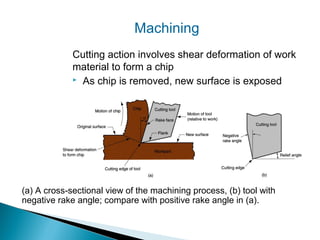
Cutting action involves shear deformation of work
material to form a chip
 As chip is removed, new surface is exposed
(a) A cross sectional view of the machining process, (b) tool with‑
negative rake angle; compare with positive rake angle in (a).
Machining
 Variety of work materials can be machined
◦ Most frequently used to cut metals
 Variety of part shapes and special geometric
features possible, such as:
◦ Screw threads
◦ Accurate round holes
◦ Very straight edges and surfaces
 Good dimensional accuracy and surface finish
 Wasteful of material
◦ Chips generated in machining are wasted material, at
least in the unit operation
 Time consuming
◦ A machining operation generally takes more time to
shape a given part than alternative shaping processes,
such as casting, powder metallurgy, or forming
 Generally performed after other manufacturing
processes, such as casting, forging, and bar
drawing
◦ Other processes create the general shape of the
starting workpart
◦ Machining provides the final shape, dimensions, finish,
and special geometric details that other processes
cannot create
 Speed is the relative movement between tool and
w/p, which produces a cut
 Feed is the relative movement between tool and
w/p, which spreads the cut
 Most Important Machining Operations:
◦ Turning
◦ Drilling
◦ Milling
 Other Machining Operations:
◦ Shaping and Planing
◦ Broaching
◦ Sawing
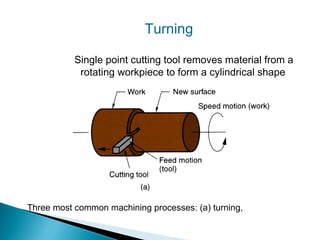
Single point cutting tool removes material from a
rotating workpiece to form a cylindrical shape
Three most common machining processes: (a) turning,
Turning
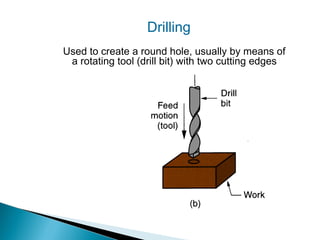
Used to create a round hole, usually by means of
a rotating tool (drill bit) with two cutting edges
Drilling
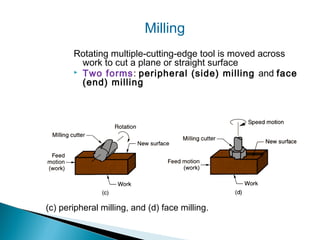
Rotating multiple-cutting-edge tool is moved across
work to cut a plane or straight surface
 Two forms: peripheral (side) milling and face
(end) milling
(c) peripheral milling, and (d) face milling.
Milling
1. Single-Point Tools
◦ One dominant cutting edge
◦ Point is usually rounded to form a nose radius
◦ Turning uses single point tools
2. Multiple Cutting Edge Tools
◦ More than one cutting edge
◦ Motion relative to work achieved by rotating
◦ Drilling and milling use rotating multiple cutting edge
tools
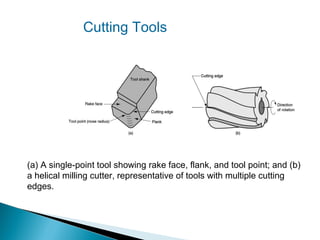
(a) A single point tool showing rake face, flank, and tool point; and (b)‑
a helical milling cutter, representative of tools with multiple cutting
edges.
Cutting Tools
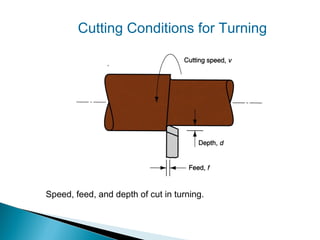
 Three dimensions of a machining
process:
◦ Cutting speed v – primary motion
◦ Feed f – secondary motion
◦ Depth of cut d – penetration of tool below
original work surface
 For certain operations, material
removal rate can be computed as
RMR = v f d
where v = cutting speed; f = feed; d =
depth of cut
Cutting Conditions for Turning
Speed, feed, and depth of cut in turning.
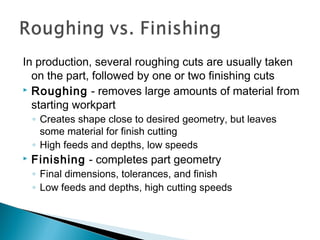
In production, several roughing cuts are usually taken
on the part, followed by one or two finishing cuts
 Roughing - removes large amounts of material from
starting workpart
◦ Creates shape close to desired geometry, but leaves
some material for finish cutting
◦ High feeds and depths, low speeds
 Finishing - completes part geometry
◦ Final dimensions, tolerances, and finish
◦ Low feeds and depths, high cutting speeds
A power‑driven machine that performs a machining
operation, including grinding
 Functions in machining:
◦ Holds workpart
◦ Positions tool relative to work
◦ Provides power at speed, feed, and depth that have
been set
 The term is also applied to machines that perform
metal forming operations
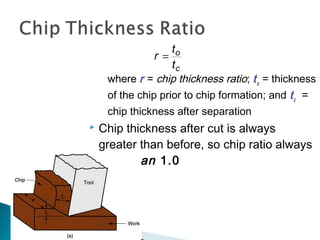
where r = chip thickness ratio; to
= thickness
of the chip prior to chip formation; and tc
=
chip thickness after separation
 Chip thickness after cut is always
greater than before, so chip ratio always
less than 1.0
c
o
t
t
r =
to
tc
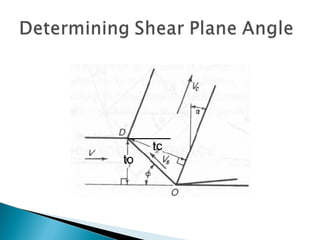
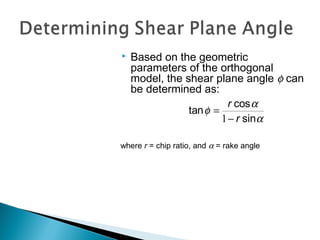
 Based on the geometric
parameters of the orthogonal
model, the shear plane angle φ can
be determined as:
where r = chip ratio, and α = rake angle
α
α
φ
sin
cos
tan
r
r
−
=
1
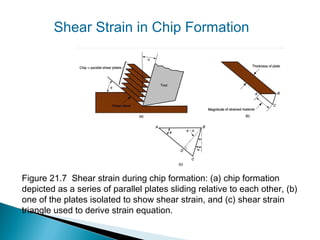
Figure 21.7 Shear strain during chip formation: (a) chip formation
depicted as a series of parallel plates sliding relative to each other, (b)
one of the plates isolated to show shear strain, and (c) shear strain
triangle used to derive strain equation.
Shear Strain in Chip Formation
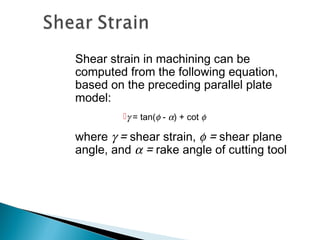
Shear strain in machining can be
computed from the following equation,
based on the preceding parallel plate
model:
γ = tan(φ - α) + cot φ
where γ = shear strain, φ = shear plane
angle, and α = rake angle of cutting tool
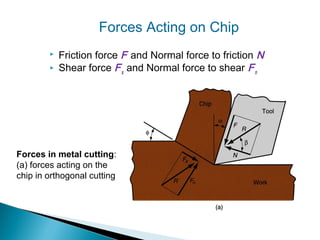
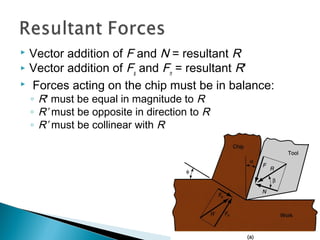
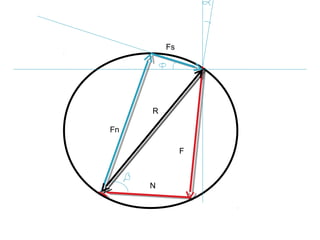
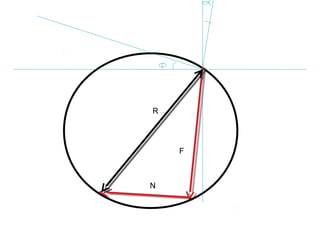
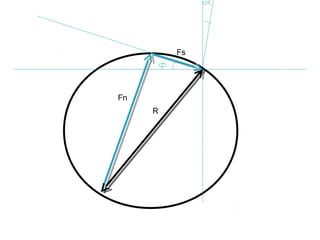
 Friction force F and Normal force to friction N
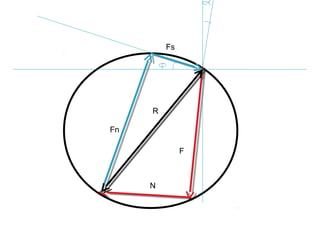
 Shear force Fs
and Normal force to shear Fn
Forces in metal cutting:
(a) forces acting on the
chip in orthogonal cutting
Forces Acting on Chip
 Vector addition of F and N = resultant R
 Vector addition of Fs
and Fn
= resultant R'
 Forces acting on the chip must be in balance:
◦ R' must be equal in magnitude to R
◦ R’ must be opposite in direction to R
◦ R’ must be collinear with R
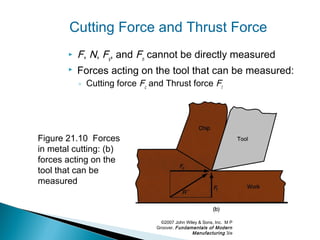
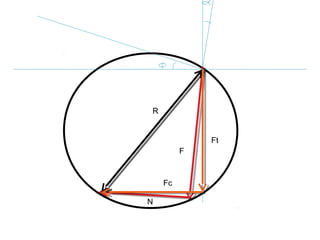
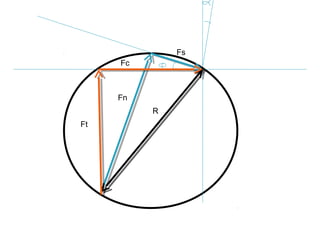
 F, N, Fs
, and Fn
cannot be directly measured
 Forces acting on the tool that can be measured:
◦ Cutting force Fc
and Thrust force Ft
©2007 John Wiley & Sons, Inc. M P
Groover, Fundamentals of Modern
Manufacturing 3/e
Figure 21.10 Forces
in metal cutting: (b)
forces acting on the
tool that can be
measured
Cutting Force and Thrust Force
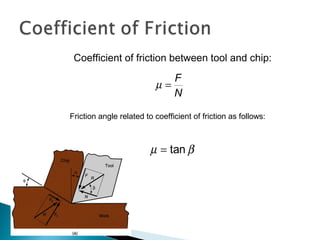
Coefficient of friction between tool and chip:
Friction angle related to coefficient of friction as follows:
N
F
=µ
βµ tan=
F
F
N
Fn
Fs
R
F
F
N
R
F
F
N
R
Ft
Fc
F
F
N
R
Ft
Fc
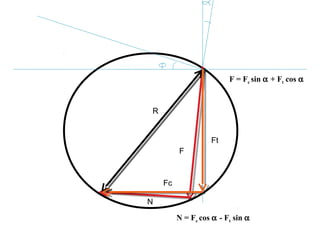
F = Fc sin α + Ft cos α
N = Fc cos α - Ft sin α
F
F
N
Fn
Fs
R
F
Fn
Fs
R
F
Fn
Fs
R
Fc
Ft
F
Fn
Fs
R
Fc
Ft
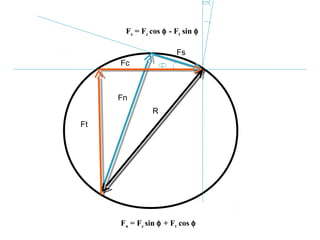
Fs = Fc cos φ - Ft sin φ
Fn = Fc sin φ + Ft cos φ
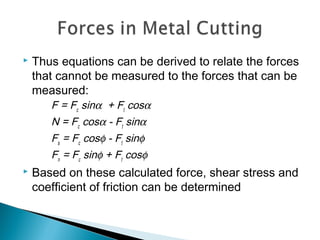
 Thus equations can be derived to relate the forces
that cannot be measured to the forces that can be
measured:
F = Fc
sinα + Ft
cosα
N = Fc
cosα ‑ Ft
sinα
Fs
= Fc
cosφ ‑ Ft
sinφ
Fn
= Fc
sinφ + Ft
cosφ
 Based on these calculated force, shear stress and
coefficient of friction can be determined
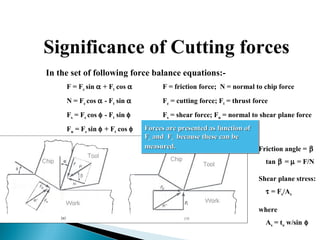
Significance of Cutting forces
In the set of following force balance equations:-
F = Fc sin α + Ft cos α F = friction force; N = normal to chip force
N = Fc cos α - Ft sin α Fc = cutting force; Ft = thrust force
Fs = Fc cos φ - Ft sin φ Fs = shear force; Fn = normal to shear plane force
Fn = Fc sin φ + Ft cos φ
Friction angle = β
tan β = µ = F/N
Shear plane stress:
τ = Fs/As
where
As = to w/sin φ
Forces are presented as function ofForces are presented as function of
FFcc and Fand Ftt because these can bebecause these can be
measured.measured.
Forces are presented as function ofForces are presented as function of
FFcc and Fand Ftt because these can bebecause these can be
measured.measured.
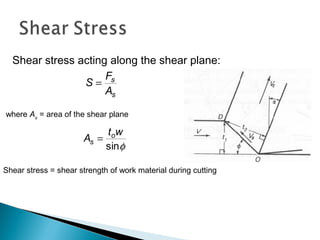
Shear stress acting along the shear plane:
φsin
wt
A o
s =
where As
= area of the shear plane
Shear stress = shear strength of work material during cutting
s
s
A
F
S =
Cutting forces given shear strength
Letting S = shear strength, we can derive the following
equations for the cutting and thrust forces*:
Fs = S As
Fc = Fs cos ( β − α)/[cos ( φ + β − α)]
Ft = Fs sin ( β − α)/[cos ( φ + β − α)]
* The other forces can be determined from the equations on the previous
slide.
Machining example
In orthogonal machining the tool has rake angle 10°, chip thickness before
cut is to = 0.02 in, and chip thickness after cut is tc = 0.045 in. The cutting
and thrust forces are measured at Fc = 350 lb and Ft = 285 lb while at a
cutting speed of 200 ft/min. Determine the machining shear strain, shear
stress, and cutting horsepower.
Solution (shear strain):
Determine r = 0.02/0.045 = 0.444
Determine shear plane angle from tan φ = r cos α /[1 – r sin α]
tan φ = 0.444 cos 10 /[1 – 0.444 sin 10] => φ = 25.4°
Now calculate shear strain from γ = tan(φ - α) + cot φ
γ = tan(25.4 - 10) + cot 25.4 = 2.386 in/in answer!
Machining example (cont.)
In orthogonal machining the tool has rake angle 10°, chip thickness before
cut is to = 0.02 in, and chip thickness after cut is tc = 0.045 in. The cutting
and thrust forces are measured at Fc = 350 lb and Ft = 285 lb while at a
cutting speed of 200 ft/min. Determine the machining shear strain, shear
stress, and cutting horsepower.
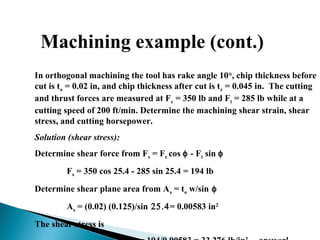
Solution (shear stress):
Determine shear force from Fs = Fc cos φ - Ft sin φ
Fs = 350 cos 25.4 - 285 sin 25.4 = 194 lb
Determine shear plane area from As = to w/sin φ
As = (0.02) (0.125)/sin 25.4= 0.00583 in2
The shear stress is
Machining example (cont.)
In orthogonal machining the tool has rake angle 10°, chip thickness before
cut is to = 0.02 in, and chip thickness after cut is tc = 0.045 in. The cutting
and thrust forces are measured at Fc = 350 lb and Ft = 285 lb while at a
cutting speed of 200 ft/min. Determine the machining shear strain, shear
stress, and cutting horsepower.
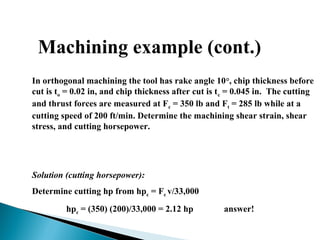
Solution (cutting horsepower):
Determine cutting hp from hpc = Fc v/33,000
hpc = (350) (200)/33,000 = 2.12 hp answer!
 Shear Plane Angle Ф = tan-1
[(r cos α )/(1 – r sin α)]
 Shear Strain γ = tan(φ - α) + cot φ
 Forces in Cutting:
F = Fc sinα + Ft cosα
N = Fc cosα ‑ Ft sinα
Fs = Fc cosφ ‑ Ft sinφ
Fn = Fc sinφ + Ft cosφ
 Forces Fc and Ft in terms of Fs:
Fc = Fs cos ( β − α)/[cos ( φ + β − α)]
Ft = Fssin ( β − α)/[cos ( φ + β − α)]
 Merchant Relation:
φ = 45 + α/2−β/2
 Shear Stress:
τ = Fs/As
where As = to w/sin φ
 Cutting Power:
P = V Fc / 33,000 hp (V in ft /s and Fc in lb)
P = V Fc / 1000 kW (V in m /s and Fc in N)
PG = Pc / E

1theoryofmetalcutting 130917122754-phpapp02

  • 2.
    1. Overview ofMachining Technology 2. Theory of Chip Formation in Metal Machining 3. Force Relationships and the Merchant Equation 4. Power and Energy Relationships in Machining 5. Cutting Temperature
  • 3.
    A family ofshaping operations, the common feature of which is removal of material from a starting workpart so the remaining part has the desired geometry  Machining – material removal by a sharp cutting tool, e.g., turning, milling, drilling  Abrasive processes – material removal by hard, abrasive particles, e.g., grinding  Nontraditional processes - various energy forms other than sharp cutting tool to remove material
  • 4.
    Cutting action involvesshear deformation of work material to form a chip  As chip is removed, new surface is exposed (a) A cross sectional view of the machining process, (b) tool with‑ negative rake angle; compare with positive rake angle in (a). Machining
  • 5.
     Variety ofwork materials can be machined ◦ Most frequently used to cut metals  Variety of part shapes and special geometric features possible, such as: ◦ Screw threads ◦ Accurate round holes ◦ Very straight edges and surfaces  Good dimensional accuracy and surface finish
  • 6.
     Wasteful ofmaterial ◦ Chips generated in machining are wasted material, at least in the unit operation  Time consuming ◦ A machining operation generally takes more time to shape a given part than alternative shaping processes, such as casting, powder metallurgy, or forming
  • 7.
     Generally performedafter other manufacturing processes, such as casting, forging, and bar drawing ◦ Other processes create the general shape of the starting workpart ◦ Machining provides the final shape, dimensions, finish, and special geometric details that other processes cannot create
  • 8.
     Speed isthe relative movement between tool and w/p, which produces a cut  Feed is the relative movement between tool and w/p, which spreads the cut
  • 9.
     Most ImportantMachining Operations: ◦ Turning ◦ Drilling ◦ Milling  Other Machining Operations: ◦ Shaping and Planing ◦ Broaching ◦ Sawing
  • 10.
    Single point cuttingtool removes material from a rotating workpiece to form a cylindrical shape Three most common machining processes: (a) turning, Turning
  • 11.
    Used to createa round hole, usually by means of a rotating tool (drill bit) with two cutting edges Drilling
  • 12.
    Rotating multiple-cutting-edge toolis moved across work to cut a plane or straight surface  Two forms: peripheral (side) milling and face (end) milling (c) peripheral milling, and (d) face milling. Milling
  • 13.
    1. Single-Point Tools ◦One dominant cutting edge ◦ Point is usually rounded to form a nose radius ◦ Turning uses single point tools 2. Multiple Cutting Edge Tools ◦ More than one cutting edge ◦ Motion relative to work achieved by rotating ◦ Drilling and milling use rotating multiple cutting edge tools
  • 14.
    (a) A singlepoint tool showing rake face, flank, and tool point; and (b)‑ a helical milling cutter, representative of tools with multiple cutting edges. Cutting Tools
  • 15.
     Three dimensionsof a machining process: ◦ Cutting speed v – primary motion ◦ Feed f – secondary motion ◦ Depth of cut d – penetration of tool below original work surface  For certain operations, material removal rate can be computed as RMR = v f d where v = cutting speed; f = feed; d = depth of cut
  • 16.
    Cutting Conditions forTurning Speed, feed, and depth of cut in turning.
  • 17.
    In production, severalroughing cuts are usually taken on the part, followed by one or two finishing cuts  Roughing - removes large amounts of material from starting workpart ◦ Creates shape close to desired geometry, but leaves some material for finish cutting ◦ High feeds and depths, low speeds  Finishing - completes part geometry ◦ Final dimensions, tolerances, and finish ◦ Low feeds and depths, high cutting speeds
  • 18.
    A power‑driven machinethat performs a machining operation, including grinding  Functions in machining: ◦ Holds workpart ◦ Positions tool relative to work ◦ Provides power at speed, feed, and depth that have been set  The term is also applied to machines that perform metal forming operations
  • 19.
    where r =chip thickness ratio; to = thickness of the chip prior to chip formation; and tc = chip thickness after separation  Chip thickness after cut is always greater than before, so chip ratio always less than 1.0 c o t t r =
  • 20.
  • 21.
     Based onthe geometric parameters of the orthogonal model, the shear plane angle φ can be determined as: where r = chip ratio, and α = rake angle α α φ sin cos tan r r − = 1
  • 22.
    Figure 21.7 Shearstrain during chip formation: (a) chip formation depicted as a series of parallel plates sliding relative to each other, (b) one of the plates isolated to show shear strain, and (c) shear strain triangle used to derive strain equation. Shear Strain in Chip Formation
  • 23.
    Shear strain inmachining can be computed from the following equation, based on the preceding parallel plate model: γ = tan(φ - α) + cot φ where γ = shear strain, φ = shear plane angle, and α = rake angle of cutting tool
  • 24.
     Friction forceF and Normal force to friction N  Shear force Fs and Normal force to shear Fn Forces in metal cutting: (a) forces acting on the chip in orthogonal cutting Forces Acting on Chip
  • 25.
     Vector additionof F and N = resultant R  Vector addition of Fs and Fn = resultant R'  Forces acting on the chip must be in balance: ◦ R' must be equal in magnitude to R ◦ R’ must be opposite in direction to R ◦ R’ must be collinear with R
  • 26.
     F, N,Fs , and Fn cannot be directly measured  Forces acting on the tool that can be measured: ◦ Cutting force Fc and Thrust force Ft ©2007 John Wiley & Sons, Inc. M P Groover, Fundamentals of Modern Manufacturing 3/e Figure 21.10 Forces in metal cutting: (b) forces acting on the tool that can be measured Cutting Force and Thrust Force
  • 27.
    Coefficient of frictionbetween tool and chip: Friction angle related to coefficient of friction as follows: N F =µ βµ tan=
  • 28.
  • 29.
  • 30.
  • 31.
    F F N R Ft Fc F = Fcsin α + Ft cos α N = Fc cos α - Ft sin α
  • 32.
  • 33.
  • 34.
  • 35.
    F Fn Fs R Fc Ft Fs = Fccos φ - Ft sin φ Fn = Fc sin φ + Ft cos φ
  • 36.
     Thus equationscan be derived to relate the forces that cannot be measured to the forces that can be measured: F = Fc sinα + Ft cosα N = Fc cosα ‑ Ft sinα Fs = Fc cosφ ‑ Ft sinφ Fn = Fc sinφ + Ft cosφ  Based on these calculated force, shear stress and coefficient of friction can be determined
  • 37.
    Significance of Cuttingforces In the set of following force balance equations:- F = Fc sin α + Ft cos α F = friction force; N = normal to chip force N = Fc cos α - Ft sin α Fc = cutting force; Ft = thrust force Fs = Fc cos φ - Ft sin φ Fs = shear force; Fn = normal to shear plane force Fn = Fc sin φ + Ft cos φ Friction angle = β tan β = µ = F/N Shear plane stress: τ = Fs/As where As = to w/sin φ Forces are presented as function ofForces are presented as function of FFcc and Fand Ftt because these can bebecause these can be measured.measured. Forces are presented as function ofForces are presented as function of FFcc and Fand Ftt because these can bebecause these can be measured.measured.
  • 38.
    Shear stress actingalong the shear plane: φsin wt A o s = where As = area of the shear plane Shear stress = shear strength of work material during cutting s s A F S =
  • 39.
    Cutting forces givenshear strength Letting S = shear strength, we can derive the following equations for the cutting and thrust forces*: Fs = S As Fc = Fs cos ( β − α)/[cos ( φ + β − α)] Ft = Fs sin ( β − α)/[cos ( φ + β − α)] * The other forces can be determined from the equations on the previous slide.
  • 40.
    Machining example In orthogonalmachining the tool has rake angle 10°, chip thickness before cut is to = 0.02 in, and chip thickness after cut is tc = 0.045 in. The cutting and thrust forces are measured at Fc = 350 lb and Ft = 285 lb while at a cutting speed of 200 ft/min. Determine the machining shear strain, shear stress, and cutting horsepower. Solution (shear strain): Determine r = 0.02/0.045 = 0.444 Determine shear plane angle from tan φ = r cos α /[1 – r sin α] tan φ = 0.444 cos 10 /[1 – 0.444 sin 10] => φ = 25.4° Now calculate shear strain from γ = tan(φ - α) + cot φ γ = tan(25.4 - 10) + cot 25.4 = 2.386 in/in answer!
  • 41.
    Machining example (cont.) Inorthogonal machining the tool has rake angle 10°, chip thickness before cut is to = 0.02 in, and chip thickness after cut is tc = 0.045 in. The cutting and thrust forces are measured at Fc = 350 lb and Ft = 285 lb while at a cutting speed of 200 ft/min. Determine the machining shear strain, shear stress, and cutting horsepower. Solution (shear stress): Determine shear force from Fs = Fc cos φ - Ft sin φ Fs = 350 cos 25.4 - 285 sin 25.4 = 194 lb Determine shear plane area from As = to w/sin φ As = (0.02) (0.125)/sin 25.4= 0.00583 in2 The shear stress is
  • 42.
    Machining example (cont.) Inorthogonal machining the tool has rake angle 10°, chip thickness before cut is to = 0.02 in, and chip thickness after cut is tc = 0.045 in. The cutting and thrust forces are measured at Fc = 350 lb and Ft = 285 lb while at a cutting speed of 200 ft/min. Determine the machining shear strain, shear stress, and cutting horsepower. Solution (cutting horsepower): Determine cutting hp from hpc = Fc v/33,000 hpc = (350) (200)/33,000 = 2.12 hp answer!
  • 43.
     Shear PlaneAngle Ф = tan-1 [(r cos α )/(1 – r sin α)]  Shear Strain γ = tan(φ - α) + cot φ  Forces in Cutting: F = Fc sinα + Ft cosα N = Fc cosα ‑ Ft sinα Fs = Fc cosφ ‑ Ft sinφ Fn = Fc sinφ + Ft cosφ  Forces Fc and Ft in terms of Fs: Fc = Fs cos ( β − α)/[cos ( φ + β − α)] Ft = Fssin ( β − α)/[cos ( φ + β − α)]  Merchant Relation: φ = 45 + α/2−β/2  Shear Stress: τ = Fs/As where As = to w/sin φ  Cutting Power: P = V Fc / 33,000 hp (V in ft /s and Fc in lb) P = V Fc / 1000 kW (V in m /s and Fc in N) PG = Pc / E

Editor's Notes