PRODUCTION TECHNOLOGY
Metal Cutting
Prepared by
Asst. Prof. Jihan Patel
Ahmedabad Institute of technology
INTRODUCTION
• Machining is an essential process of finishing by
which jobs of desired dimensions and surface
finish are produced by gradually removing the
excess material from the preformed blank in the
form of chips, with the help of cutting tools
moved past the work surface.
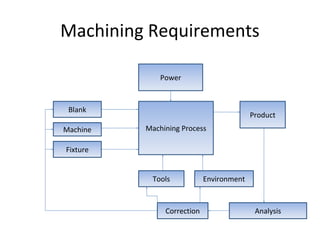
Machining Requirements
Power
Correction
EnvironmentTools
Analysis
Product
Machining Process
Fixture
Machine
Blank
Machining – Purpose, Principle and Definition
Purpose of Machining Most of the engineering components such as gears,
bearings, clutches, tools, screws and nuts etc. need dimensional and form accuracy
and good surface finish for serving their purposes. Performing like casting, forging
etc. generally cannot provide the desired accuracy and finish. For that such
preformed parts, called blanks, need semi-finishing and finishing and it is done by
machining and grinding. Grinding is also basically a machining process. Machining
to high accuracy and finish essentially enables a product
• fulfill its functional requirements
• improve its performance
• prolong its service
Principle of
Machining
Principle of Machining
A metal rod of irregular shape, size and surface is
converted into a finished rod of desired
dimension and surface by machining by proper
relative motions of the tool-work pair.
Definition of
Machining:
Definition of Machining:
Machining is an essential process of finishing by
which jobs are produced to the desired
dimensions and surface finish by gradually
removing the excess material from the
preformed blank in
Machine Tool • A machine tool is a non portable power operated
and reasonably valued device or system of devices in
which energy is expended to produce jobs of desired
size, shape and surface finish. By removing excess
material is just like machining from the preformed
blanks in the form of chips with the help of cutting
tools moved past the work.
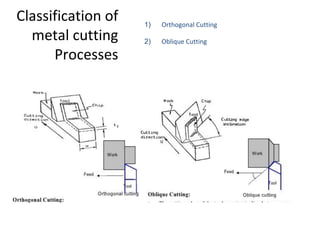
Classification of
metal cutting
Processes
1) Orthogonal Cutting
2) Oblique Cutting
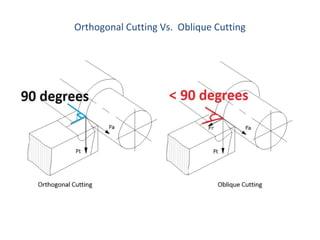
Orthogonal Cutting Vs. Oblique Cutting
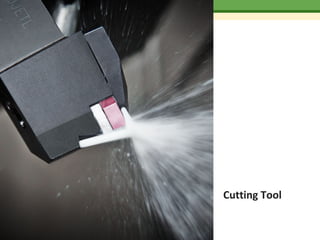
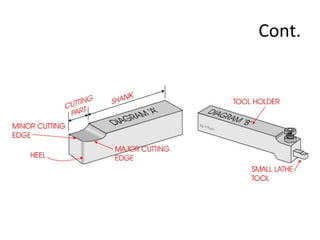
Cutting Tool
Cont.
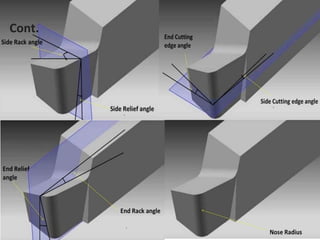
Cont.
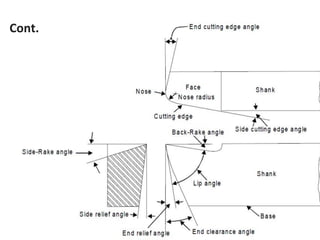
Cont.
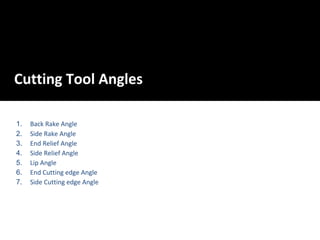
Cutting Tool Angles
1. Back Rake Angle
2. Side Rake Angle
3. End Relief Angle
4. Side Relief Angle
5. Lip Angle
6. End Cutting edge Angle
7. Side Cutting edge Angle
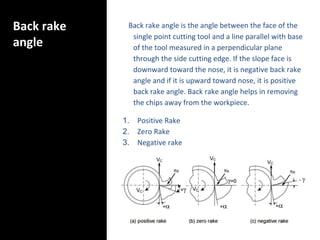
Back rake
angle
Back rake angle is the angle between the face of the
single point cutting tool and a line parallel with base
of the tool measured in a perpendicular plane
through the side cutting edge. If the slope face is
downward toward the nose, it is negative back rake
angle and if it is upward toward nose, it is positive
back rake angle. Back rake angle helps in removing
the chips away from the workpiece.
1. Positive Rake
2. Zero Rake
3. Negative rake
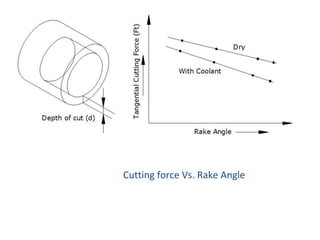
Cutting force Vs. Rake Angle
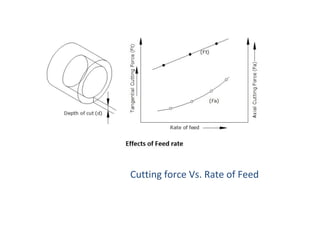
Cutting force Vs. Rate of Feed
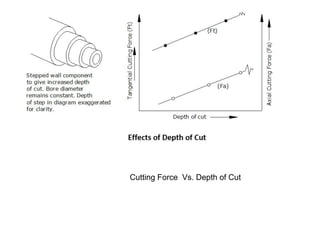
Cutting Force Vs. Depth of Cut
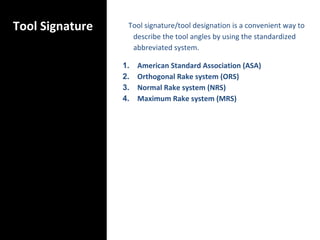
Tool Signature Tool signature/tool designation is a convenient way to
describe the tool angles by using the standardized
abbreviated system.
1. American Standard Association (ASA)
2. Orthogonal Rake system (ORS)
3. Normal Rake system (NRS)
4. Maximum Rake system (MRS)
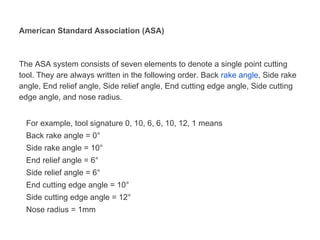
American Standard Association (ASA)
The ASA system consists of seven elements to denote a single point cutting
tool. They are always written in the following order. Back rake angle, Side rake
angle, End relief angle, Side relief angle, End cutting edge angle, Side cutting
edge angle, and nose radius.
For example, tool signature 0, 10, 6, 6, 10, 12, 1 means
Back rake angle = 0°
Side rake angle = 10°
End relief angle = 6°
Side relief angle = 6°
End cutting edge angle = 10°
Side cutting edge angle = 12°
Nose radius = 1mm
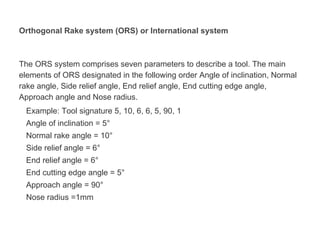
Orthogonal Rake system (ORS) or International system
The ORS system comprises seven parameters to describe a tool. The main
elements of ORS designated in the following order Angle of inclination, Normal
rake angle, Side relief angle, End relief angle, End cutting edge angle,
Approach angle and Nose radius.
Example: Tool signature 5, 10, 6, 6, 5, 90, 1
Angle of inclination = 5°
Normal rake angle = 10°
Side relief angle = 6°
End relief angle = 6°
End cutting edge angle = 5°
Approach angle = 90°
Nose radius =1mm
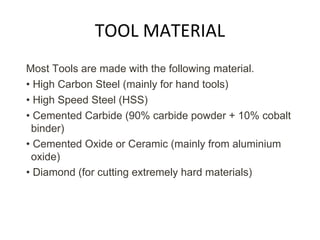
TOOL MATERIAL
Most Tools are made with the following material.
• High Carbon Steel (mainly for hand tools)
• High Speed Steel (HSS)
• Cemented Carbide (90% carbide powder + 10% cobalt
binder)
• Cemented Oxide or Ceramic (mainly from aluminium
oxide)
• Diamond (for cutting extremely hard materials)
Characteristics of
cutting tool
materials.
• Ability to retain hardness at elevated
temperature.
• Ability to resist shock, i.e. toughness.
• Good resistance to wear – low coefficient of
friction.
• Reasonably cheap and easy to be fabricated
or shaped.
• Acceptable mechanical properties such as
tensile strength, thermal conductivity,
coefficient of thermal expansion, module of
elasticity, etc.
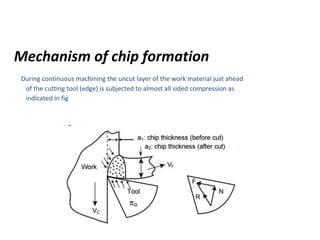
Mechanism of chip formation
During continuous machining the uncut layer of the work material just ahead
of the cutting tool (edge) is subjected to almost all sided compression as
indicated in fig
cont.
The force exerted by the tool on the chip arises out of the normal force, N and
frictional force, F as indicated in Fig
Due to such compression, shear stress develops, within that compressed region, in
different magnitude, in different directions and rapidly increases in magnitude.
Whenever and wherever the value of the shear stress reaches or exceeds the shear
strength of that work material in the deformation region, yielding or slip takes
place resulting shear deformation in that region and the plane of maximum shear
stress.
cont.
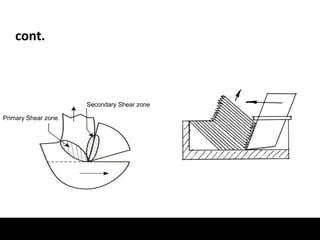
Primary Shear zone
Secondary Shear zone
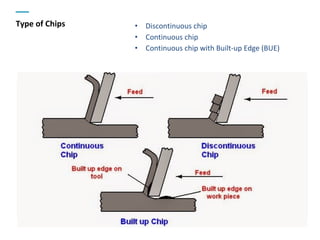
Type of Chips • Discontinuous chip
• Continuous chip
• Continuous chip with Built-up Edge (BUE)
Continuous chip
Continuous chips are normally produced when machining steel or ductile materials
at high cutting speeds. The continuous chip which is like a ribbon flows along the
rake face.
Reasons
• Ductile work materials
• High cutting speeds
• Small feeds and depths
• Sharp cutting edge
• Low tool-chip friction
Discontinuous chip
When brittle materials like cast iron are cut, the deformed material gets fractured
very easily and thus the Chip produced is in the form of discontinuous segments
Reasons
• Brittle work materials
• Low cutting speeds
• Large feed and depth of cut
• High tool-chip friction
Continuous chip with Built-up Edge (BUE)
When the friction between tool and chip is high while machining ductile materials,
some particles of chip adhere to the tool rake face near the tool tip. When such
sizeable material piles upon the rake face, it acts as a cutting edge in place of the
actual cutting edge is termed as built up edge (BUE). By virtue of work hardening,
BUE is harder than the parent work material
Reasons
• Ductile materials
• Low-to-medium cutting speeds
• Tool-chip friction causes portions of chip to adhere to rake face
• BUE forms, then breaks off, cyclically
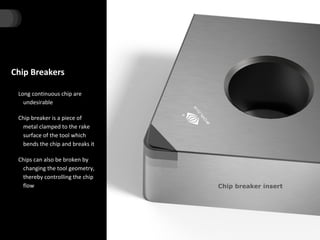
Chip Breakers
Long continuous chip are
undesirable
Chip breaker is a piece of
metal clamped to the rake
surface of the tool which
bends the chip and breaks it
Chips can also be broken by
changing the tool geometry,
thereby controlling the chip
flow Chip breaker insert
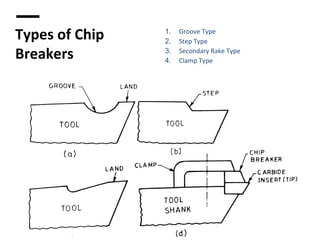
Types of Chip
Breakers
1. Groove Type
2. Step Type
3. Secondary Rake Type
4. Clamp Type
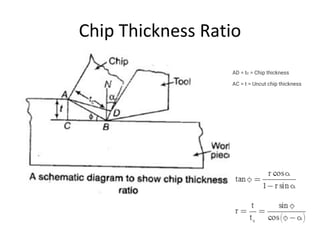
Chip Thickness Ratio
AD = tc = Chip thickness
AC = t = Uncut chip thickness
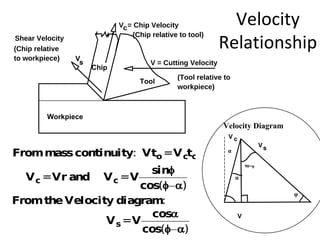
Velocity
Relationship
Velocity Diagram
(Chip relative
to workpiece)
V = Chip Velocity
(Chip relative to tool)
Tool
Workpiece
Chip
V
s V = Cutting Velocity
(Tool relative to
workpiece)
Shear Velocity
c
α
90−φ
φ
Vs
V
α
V c
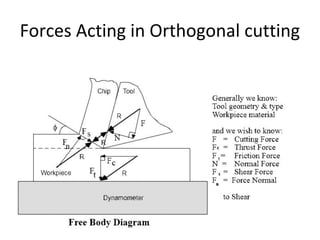
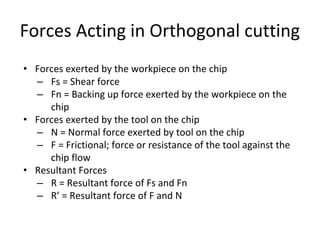
Forces Acting in Orthogonal cutting
• Forces exerted by the workpiece on the chip
– Fs = Shear force
– Fn = Backing up force exerted by the workpiece on the
chip
• Forces exerted by the tool on the chip
– N = Normal force exerted by tool on the chip
– F = Frictional; force or resistance of the tool against the
chip flow
• Resultant Forces
– R = Resultant force of Fs and Fn
– R’ = Resultant force of F and N
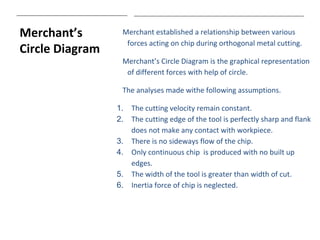
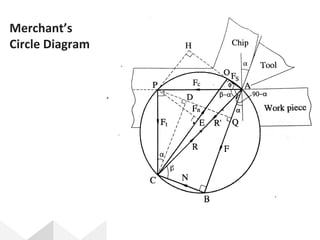
Merchant’s
Circle Diagram
Merchant established a relationship between various
forces acting on chip during orthogonal metal cutting.
Merchant’s Circle Diagram is the graphical representation
of different forces with help of circle.
The analyses made withe following assumptions.
1. The cutting velocity remain constant.
2. The cutting edge of the tool is perfectly sharp and flank
does not make any contact with workpiece.
3. There is no sideways flow of the chip.
4. Only continuous chip is produced with no built up
edges.
5. The width of the tool is greater than width of cut.
6. Inertia force of chip is neglected.
Merchant’s
Circle Diagram
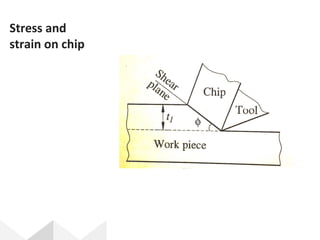
Stress and
strain on chip
Popular theories on mechanics of
metal cutting
1. Earnst-Morchant theory
2. Lee and Shaffer’s theory
Earnst-Morchant Theory
Based on the principal of minimum energy consumption and implies that the shear
angle should be such that
I. workdone in cutting is minimum
II. maximum shear occurs on the shear plane.
Assumptions
Behaviour of metal being machined is like that of on ideal plastic, maximum shear
stress plane and its does not depend on shear plane angle.
Lee and Shaffer’s theory
Assumption
1. material is rigid ideal plastic
2. deformation of the metal occurs on a single shear plane
3. there must be a stress field within the metal chip which transmits the cutting force
from shear plane to tool face.
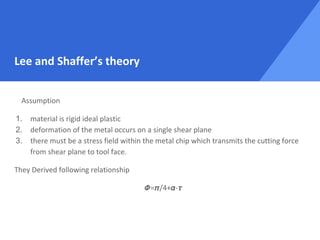
They Derived following relationship
= /4+ -
Example 1.
In Orthogonal turning of a 50 mm diameter Mild steel bar
on a lathe the following
data were obtained.
Rack angle = 15 degree ,, cutting speed=100m/min, Feed =
0.2
mm / rev., Cutting force = 180 Kg, Feed Force=60 Kg,
Calculate the shear plane
angle, Coefficient of friction , Cutting power, the chip
flow velocity and shear force,
if the chip thickness = 0.3 mm
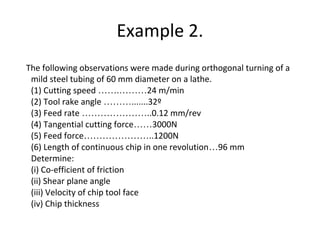
Example 2.
The following observations were made during orthogonal turning of a
mild steel tubing of 60 mm diameter on a lathe.
(1) Cutting speed …….………24 m/min
(2) Tool rake angle ……….......32º
(3) Feed rate …………………..0.12 mm/rev
(4) Tangential cutting force……3000N
(5) Feed force…………………..1200N
(6) Length of continuous chip in one revolution…96 mm
Determine:
(i) Co-efficient of friction
(ii) Shear plane angle
(iii) Velocity of chip tool face
(iv) Chip thickness
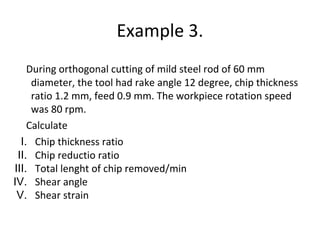
Example 3.
During orthogonal cutting of mild steel rod of 60 mm
diameter, the tool had rake angle 12 degree, chip thickness
ratio 1.2 mm, feed 0.9 mm. The workpiece rotation speed
was 80 rpm.
Calculate
I. Chip thickness ratio
II. Chip reductio ratio
III. Total lenght of chip removed/min
IV. Shear angle
V. Shear strain
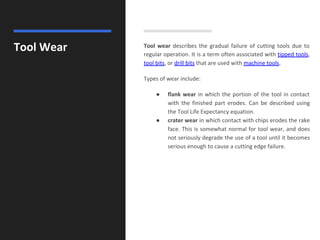
Tool Wear Tool wear describes the gradual failure of cutting tools due to
regular operation. It is a term often associated with tipped tools,
tool bits, or drill bits that are used with machine tools.
Types of wear include:
● flank wear in which the portion of the tool in contact
with the finished part erodes. Can be described using
the Tool Life Expectancy equation.
● crater wear in which contact with chips erodes the rake
face. This is somewhat normal for tool wear, and does
not seriously degrade the use of a tool until it becomes
serious enough to cause a cutting edge failure.
Factors Causing Wear
• Abrasion
• Adhesion
• Attrition
• Diffusion
• Fatigue
• Corrosion
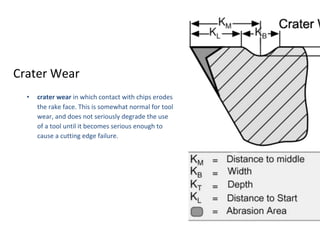
Crater Wear
• crater wear in which contact with chips erodes
the rake face. This is somewhat normal for tool
wear, and does not seriously degrade the use
of a tool until it becomes serious enough to
cause a cutting edge failure.
flank wear
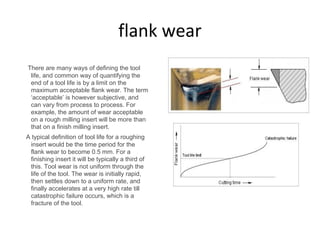
There are many ways of defining the tool
life, and common way of quantifying the
end of a tool life is by a limit on the
maximum acceptable flank wear. The term
‘acceptable’ is however subjective, and
can vary from process to process. For
example, the amount of wear acceptable
on a rough milling insert will be more than
that on a finish milling insert.
A typical definition of tool life for a roughing
insert would be the time period for the
flank wear to become 0.5 mm. For a
finishing insert it will be typically a third of
this. Tool wear is not uniform through the
life of the tool. The wear is initially rapid,
then settles down to a uniform rate, and
finally accelerates at a very high rate till
catastrophic failure occurs, which is a
fracture of the tool.
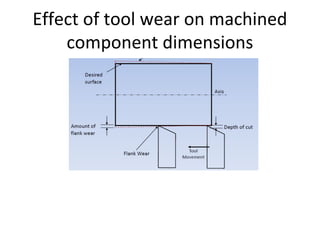
Effect of tool wear on machined
component dimensions
Tool Life
The tool life is the duration of actual cutting time after which the tool is no
longer usable.
Factors
Affecting
Tool Life
1. Cutting Speed
2. Feed and Depth of Cut
3. Tool Geometry
4. Tool Material
5. Work Material
6. Nature of Cutting
7. Rigidity of Machine Tool and Work
8. Cutting Fluid

Production technology Metal Cutting introduction

  • 1.
    PRODUCTION TECHNOLOGY Metal Cutting Preparedby Asst. Prof. Jihan Patel Ahmedabad Institute of technology
  • 2.
    INTRODUCTION • Machining isan essential process of finishing by which jobs of desired dimensions and surface finish are produced by gradually removing the excess material from the preformed blank in the form of chips, with the help of cutting tools moved past the work surface.
  • 3.
  • 4.
    Machining – Purpose,Principle and Definition Purpose of Machining Most of the engineering components such as gears, bearings, clutches, tools, screws and nuts etc. need dimensional and form accuracy and good surface finish for serving their purposes. Performing like casting, forging etc. generally cannot provide the desired accuracy and finish. For that such preformed parts, called blanks, need semi-finishing and finishing and it is done by machining and grinding. Grinding is also basically a machining process. Machining to high accuracy and finish essentially enables a product • fulfill its functional requirements • improve its performance • prolong its service
  • 5.
    Principle of Machining Principle ofMachining A metal rod of irregular shape, size and surface is converted into a finished rod of desired dimension and surface by machining by proper relative motions of the tool-work pair.
  • 6.
    Definition of Machining: Definition ofMachining: Machining is an essential process of finishing by which jobs are produced to the desired dimensions and surface finish by gradually removing the excess material from the preformed blank in
  • 7.
    Machine Tool •A machine tool is a non portable power operated and reasonably valued device or system of devices in which energy is expended to produce jobs of desired size, shape and surface finish. By removing excess material is just like machining from the preformed blanks in the form of chips with the help of cutting tools moved past the work.
  • 8.
    Classification of metal cutting Processes 1)Orthogonal Cutting 2) Oblique Cutting
  • 9.
    Orthogonal Cutting Vs.Oblique Cutting
  • 10.
  • 11.
  • 12.
  • 13.
  • 14.
    Cutting Tool Angles 1.Back Rake Angle 2. Side Rake Angle 3. End Relief Angle 4. Side Relief Angle 5. Lip Angle 6. End Cutting edge Angle 7. Side Cutting edge Angle
  • 15.
    Back rake angle Back rakeangle is the angle between the face of the single point cutting tool and a line parallel with base of the tool measured in a perpendicular plane through the side cutting edge. If the slope face is downward toward the nose, it is negative back rake angle and if it is upward toward nose, it is positive back rake angle. Back rake angle helps in removing the chips away from the workpiece. 1. Positive Rake 2. Zero Rake 3. Negative rake
  • 16.
  • 17.
    Cutting force Vs.Rate of Feed
  • 18.
    Cutting Force Vs.Depth of Cut
  • 19.
    Tool Signature Toolsignature/tool designation is a convenient way to describe the tool angles by using the standardized abbreviated system. 1. American Standard Association (ASA) 2. Orthogonal Rake system (ORS) 3. Normal Rake system (NRS) 4. Maximum Rake system (MRS)
  • 20.
    American Standard Association(ASA) The ASA system consists of seven elements to denote a single point cutting tool. They are always written in the following order. Back rake angle, Side rake angle, End relief angle, Side relief angle, End cutting edge angle, Side cutting edge angle, and nose radius. For example, tool signature 0, 10, 6, 6, 10, 12, 1 means Back rake angle = 0° Side rake angle = 10° End relief angle = 6° Side relief angle = 6° End cutting edge angle = 10° Side cutting edge angle = 12° Nose radius = 1mm
  • 21.
    Orthogonal Rake system(ORS) or International system The ORS system comprises seven parameters to describe a tool. The main elements of ORS designated in the following order Angle of inclination, Normal rake angle, Side relief angle, End relief angle, End cutting edge angle, Approach angle and Nose radius. Example: Tool signature 5, 10, 6, 6, 5, 90, 1 Angle of inclination = 5° Normal rake angle = 10° Side relief angle = 6° End relief angle = 6° End cutting edge angle = 5° Approach angle = 90° Nose radius =1mm
  • 22.
    TOOL MATERIAL Most Toolsare made with the following material. • High Carbon Steel (mainly for hand tools) • High Speed Steel (HSS) • Cemented Carbide (90% carbide powder + 10% cobalt binder) • Cemented Oxide or Ceramic (mainly from aluminium oxide) • Diamond (for cutting extremely hard materials)
  • 23.
    Characteristics of cutting tool materials. •Ability to retain hardness at elevated temperature. • Ability to resist shock, i.e. toughness. • Good resistance to wear – low coefficient of friction. • Reasonably cheap and easy to be fabricated or shaped. • Acceptable mechanical properties such as tensile strength, thermal conductivity, coefficient of thermal expansion, module of elasticity, etc.
  • 24.
    Mechanism of chipformation During continuous machining the uncut layer of the work material just ahead of the cutting tool (edge) is subjected to almost all sided compression as indicated in fig
  • 25.
    cont. The force exertedby the tool on the chip arises out of the normal force, N and frictional force, F as indicated in Fig Due to such compression, shear stress develops, within that compressed region, in different magnitude, in different directions and rapidly increases in magnitude. Whenever and wherever the value of the shear stress reaches or exceeds the shear strength of that work material in the deformation region, yielding or slip takes place resulting shear deformation in that region and the plane of maximum shear stress.
  • 26.
  • 27.
    Type of Chips• Discontinuous chip • Continuous chip • Continuous chip with Built-up Edge (BUE)
  • 28.
    Continuous chip Continuous chipsare normally produced when machining steel or ductile materials at high cutting speeds. The continuous chip which is like a ribbon flows along the rake face. Reasons • Ductile work materials • High cutting speeds • Small feeds and depths • Sharp cutting edge • Low tool-chip friction
  • 29.
    Discontinuous chip When brittlematerials like cast iron are cut, the deformed material gets fractured very easily and thus the Chip produced is in the form of discontinuous segments Reasons • Brittle work materials • Low cutting speeds • Large feed and depth of cut • High tool-chip friction
  • 30.
    Continuous chip withBuilt-up Edge (BUE) When the friction between tool and chip is high while machining ductile materials, some particles of chip adhere to the tool rake face near the tool tip. When such sizeable material piles upon the rake face, it acts as a cutting edge in place of the actual cutting edge is termed as built up edge (BUE). By virtue of work hardening, BUE is harder than the parent work material Reasons • Ductile materials • Low-to-medium cutting speeds • Tool-chip friction causes portions of chip to adhere to rake face • BUE forms, then breaks off, cyclically
  • 31.
    Chip Breakers Long continuouschip are undesirable Chip breaker is a piece of metal clamped to the rake surface of the tool which bends the chip and breaks it Chips can also be broken by changing the tool geometry, thereby controlling the chip flow Chip breaker insert
  • 32.
    Types of Chip Breakers 1.Groove Type 2. Step Type 3. Secondary Rake Type 4. Clamp Type
  • 33.
    Chip Thickness Ratio AD= tc = Chip thickness AC = t = Uncut chip thickness
  • 34.
    Velocity Relationship Velocity Diagram (Chip relative toworkpiece) V = Chip Velocity (Chip relative to tool) Tool Workpiece Chip V s V = Cutting Velocity (Tool relative to workpiece) Shear Velocity c α 90−φ φ Vs V α V c
  • 35.
    Forces Acting inOrthogonal cutting
  • 36.
    Forces Acting inOrthogonal cutting • Forces exerted by the workpiece on the chip – Fs = Shear force – Fn = Backing up force exerted by the workpiece on the chip • Forces exerted by the tool on the chip – N = Normal force exerted by tool on the chip – F = Frictional; force or resistance of the tool against the chip flow • Resultant Forces – R = Resultant force of Fs and Fn – R’ = Resultant force of F and N
  • 37.
    Merchant’s Circle Diagram Merchant establisheda relationship between various forces acting on chip during orthogonal metal cutting. Merchant’s Circle Diagram is the graphical representation of different forces with help of circle. The analyses made withe following assumptions. 1. The cutting velocity remain constant. 2. The cutting edge of the tool is perfectly sharp and flank does not make any contact with workpiece. 3. There is no sideways flow of the chip. 4. Only continuous chip is produced with no built up edges. 5. The width of the tool is greater than width of cut. 6. Inertia force of chip is neglected.
  • 38.
  • 39.
  • 40.
    Popular theories onmechanics of metal cutting 1. Earnst-Morchant theory 2. Lee and Shaffer’s theory
  • 41.
    Earnst-Morchant Theory Based onthe principal of minimum energy consumption and implies that the shear angle should be such that I. workdone in cutting is minimum II. maximum shear occurs on the shear plane. Assumptions Behaviour of metal being machined is like that of on ideal plastic, maximum shear stress plane and its does not depend on shear plane angle.
  • 42.
    Lee and Shaffer’stheory Assumption 1. material is rigid ideal plastic 2. deformation of the metal occurs on a single shear plane 3. there must be a stress field within the metal chip which transmits the cutting force from shear plane to tool face. They Derived following relationship = /4+ -
  • 43.
    Example 1. In Orthogonalturning of a 50 mm diameter Mild steel bar on a lathe the following data were obtained. Rack angle = 15 degree ,, cutting speed=100m/min, Feed = 0.2 mm / rev., Cutting force = 180 Kg, Feed Force=60 Kg, Calculate the shear plane angle, Coefficient of friction , Cutting power, the chip flow velocity and shear force, if the chip thickness = 0.3 mm
  • 44.
    Example 2. The followingobservations were made during orthogonal turning of a mild steel tubing of 60 mm diameter on a lathe. (1) Cutting speed …….………24 m/min (2) Tool rake angle ……….......32º (3) Feed rate …………………..0.12 mm/rev (4) Tangential cutting force……3000N (5) Feed force…………………..1200N (6) Length of continuous chip in one revolution…96 mm Determine: (i) Co-efficient of friction (ii) Shear plane angle (iii) Velocity of chip tool face (iv) Chip thickness
  • 45.
    Example 3. During orthogonalcutting of mild steel rod of 60 mm diameter, the tool had rake angle 12 degree, chip thickness ratio 1.2 mm, feed 0.9 mm. The workpiece rotation speed was 80 rpm. Calculate I. Chip thickness ratio II. Chip reductio ratio III. Total lenght of chip removed/min IV. Shear angle V. Shear strain
  • 46.
    Tool Wear Toolwear describes the gradual failure of cutting tools due to regular operation. It is a term often associated with tipped tools, tool bits, or drill bits that are used with machine tools. Types of wear include: ● flank wear in which the portion of the tool in contact with the finished part erodes. Can be described using the Tool Life Expectancy equation. ● crater wear in which contact with chips erodes the rake face. This is somewhat normal for tool wear, and does not seriously degrade the use of a tool until it becomes serious enough to cause a cutting edge failure.
  • 47.
    Factors Causing Wear •Abrasion • Adhesion • Attrition • Diffusion • Fatigue • Corrosion
  • 48.
    Crater Wear • craterwear in which contact with chips erodes the rake face. This is somewhat normal for tool wear, and does not seriously degrade the use of a tool until it becomes serious enough to cause a cutting edge failure.
  • 49.
    flank wear There aremany ways of defining the tool life, and common way of quantifying the end of a tool life is by a limit on the maximum acceptable flank wear. The term ‘acceptable’ is however subjective, and can vary from process to process. For example, the amount of wear acceptable on a rough milling insert will be more than that on a finish milling insert. A typical definition of tool life for a roughing insert would be the time period for the flank wear to become 0.5 mm. For a finishing insert it will be typically a third of this. Tool wear is not uniform through the life of the tool. The wear is initially rapid, then settles down to a uniform rate, and finally accelerates at a very high rate till catastrophic failure occurs, which is a fracture of the tool.
  • 50.
    Effect of toolwear on machined component dimensions
  • 51.
    Tool Life The toollife is the duration of actual cutting time after which the tool is no longer usable.
  • 52.
    Factors Affecting Tool Life 1. CuttingSpeed 2. Feed and Depth of Cut 3. Tool Geometry 4. Tool Material 5. Work Material 6. Nature of Cutting 7. Rigidity of Machine Tool and Work 8. Cutting Fluid