IP RAN Network
Design 2G & 3G
Muhamad Yopan
CCIE#38903
Ericsson Indonesia
CCIETalk session, May 12, 2013
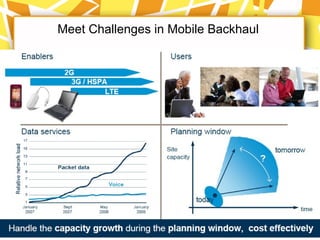
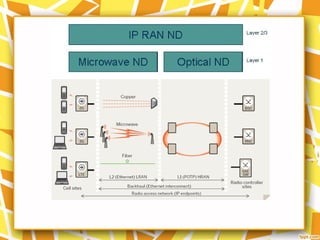
Meet Challenges in Mobile Backhaul
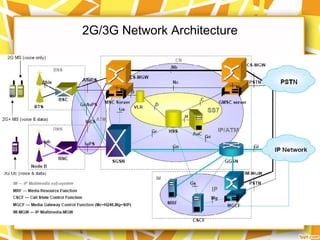
2G/3G Network Architecture
IP RAN Solution
What it means
• IP RAN is a full IP connectivity solution to enable smooth
and future-proof introduction and deployment of IP
transport in RAN.
• IP RAN covers IP feature in GSM and IP in WCDMA.
• IP RAN is a tested and verified solution and is aligned
with M-PBN.
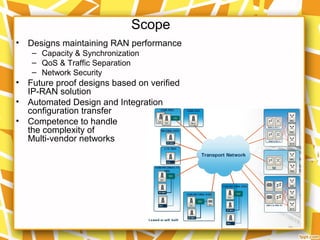
Scope
• Designs maintaining RAN performance
– Capacity & Synchronization
– QoS & Traffic Separation
– Network Security
• Future proof designs based on verified
IP-RAN solution
• Automated Design and Integration
configuration transfer
• Competence to handle
the complexity of
Multi-vendor networks
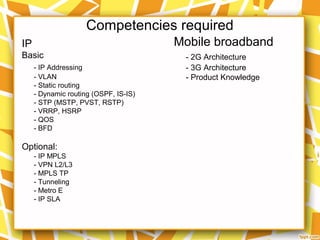
Competencies required
IP
Basic
- IP Addressing
- VLAN
- Static routing
- Dynamic routing (OSPF, IS-IS)
- STP (MSTP, PVST, RSTP)
- VRRP, HSRP
- QOS
- BFD
Optional:
- IP MPLS
- VPN L2/L3
- MPLS TP
- Tunneling
- Metro E
- IP SLA
Mobile broadband
- 2G Architecture
- 3G Architecture
- Product Knowledge
Functionality
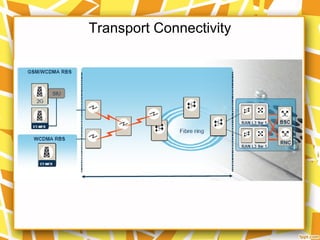
• Transport Connectivity
• Network Synchronization
• Quality of Service
• Security
Transport Connectivity
Synchronization in IP RAN
• In traditional GSM/WCDMA access networks, the distribution of a
reference clock signal to the RBS is supported by the SDH and PDH
technology
• In Packet Transport Network the
RBS cannot be synchronized by
traditional PDH/SDH layer 1
interface
Network Synchronization over IP
• Transport transparent and independent (L2, L3, access, backhaul)
• Client/Server solution, integrated in the certain boards
• Proven in real networks
• No need for GPS, ITU1588, Sync Over Ethernet solutions
• Use protocols available today (NTP/PTP)
QoS requirements on IP RAN
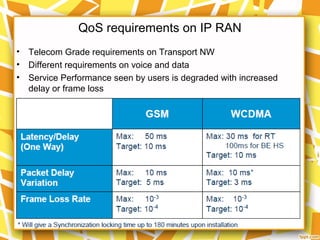
• Telecom Grade requirements on Transport NW
• Different requirements on voice and data
• Service Performance seen by users is degraded with increased
delay or frame loss
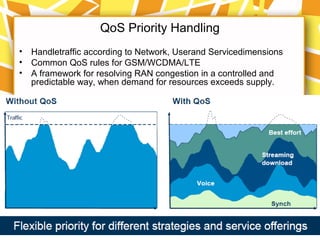
QoS Priority Handling
• Handletraffic according to Network, Userand Servicedimensions
• Common QoS rules for GSM/WCDMA/LTE
• A framework for resolving RAN congestion in a controlled and
predictable way, when demand for resources exceeds supply.
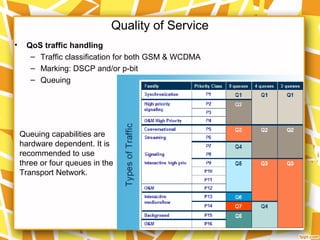
Quality of Service
• QoS traffic handling
– Traffic classification for both GSM & WCDMA
– Marking: DSCP and/or p-bit
– Queuing
Queuing capabilities are
hardware dependent. It is
recommended to use
three or four queues in the
Transport Network.
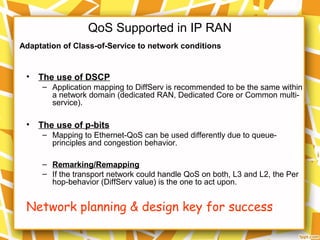
QoS Supported in IP RAN
• The use of DSCP
– Application mapping to DiffServ is recommended to be the same within
a network domain (dedicated RAN, Dedicated Core or Common multi-
service).
• The use of p-bits
– Mapping to Ethernet-QoS can be used differently due to queue-
principles and congestion behavior.
– Remarking/Remapping
– If the transport network could handle QoS on both, L3 and L2, the Per
hop-behavior (DiffServ value) is the one to act upon.
Network planning & design key for success
Adaptation of Class-of-Service to network conditions
Security
• RAN Security:
– Iub user plane frames are encrypted (3GPP standard) from RNC
to UE
– Abis user plane is not encrypted from BSC to RBS
– Control plane is sent open for bothGSM & WCDMA
– O&M traffic is protected on application level for both GSM &
WCDMA
– Highest priority is to protect BSC/RNC and OSS from external
intrusion.
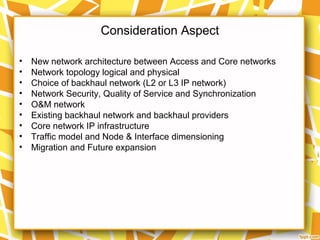
Consideration Aspect
• New network architecture between Access and Core networks
• Network topology logical and physical
• Choice of backhaul network (L2 or L3 IP network)
• Network Security, Quality of Service and Synchronization
• O&M network
• Existing backhaul network and backhaul providers
• Core network IP infrastructure
• Traffic model and Node & Interface dimensioning
• Migration and Future expansion
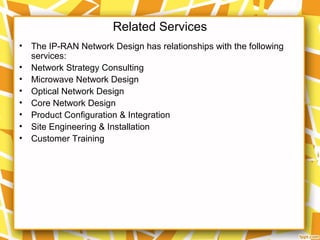
Related Services
• The IP-RAN Network Design has relationships with the following
services:
• Network Strategy Consulting
• Microwave Network Design
• Optical Network Design
• Core Network Design
• Product Configuration & Integration
• Site Engineering & Installation
• Customer Training
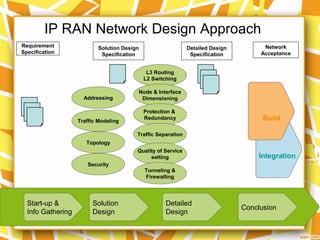
IP RAN Network Design Approach
Build
Requirement
Specification
Detailed Design
Specification
Network
Acceptance
Addressing
Traffic Modeling
Topology
Security
L3 Routing
L2 Switching
Node & Interface
Dimensioning
Protection &
Redundancy
Traffic Separation
Quality of Service
setting
Solution Design
Specification
Tunneling &
Firewalling
Start-up &
Info Gathering
Solution
Design
Detailed
Design
Conclusion
Integration
Build
Cases
2G Physical Topology
2G Logical Topology (Southbound)
2G Logical Topology (Northbound)
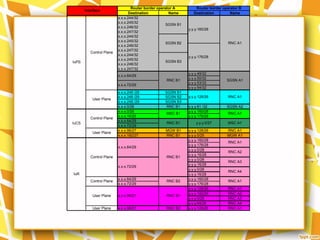
Destination Name Destination Name
x.x.x.244/32
x.x.x.245/32
x.x.x.246/32
x.x.x.247/32
x.x.x.244/32
x.x.x.245/32
x.x.x.246/32
x.x.x.247/32
x.x.x.244/32
x.x.x.245/32
x.x.x.246/32
x.x.x.247/32
y.y.y.49/32
y.y.y.50/32
y.y.y.53/32
y.y.y.54/32
x.x.x.248 /29 SGSN B1
x.x.x.248 /29 SGSN B2
x.x.x.248 /29 SGSN B3
x.x.x.0/26 RNC B1 y.y.y.81 /32 SGSN A2
x.x.x.0/28 y.y.y.160/28
x.x.x.16/28 y.y.y.176/28
x.x.x.64/29
x.x.x.72/29
x.x.x.96/27 MGW B1 y.y.y.128/26 RNC A1
x.x.x.192/27 RNC B1 y.y.y.0/25 MGW A1
y.y.y.160/28
y.y.y.176/28
y.y.y.0/28
y.y.y.16/28
y.y.y.0/28
y.y.y.16/28
y.y.y.0/28
y.y.y.16/28
x.x.x.64/29 y.y.y.160/28
x.x.x.72/29 y.y.y.176/28
y.y.y.128/26 RNC A1
y.y.y.192/26 RNC A2
y.y.y.0/26 RNC A3
y.y.y.64/26 RNC A4
User Plane x.x.x.96/27 RNC B2 y.y.y.128/26 RNC A1
Interface
Router border operator A Router border operator B
IuPS
Control Plane
SGSN B1
y.y.y.160/28
RNC A1SGSN B2
y.y.y.176/28
SGSN B3
x.x.x.64/29
RNC B1 SGSN A1
x.x.x.72/29
User Plane
y.y.y.128/26 RNC A1
IuCS
Control Plane
MSC B1 RNC A1
RNC B1 y.y.y.0/27 MSC A1
User Plane
IuR
Control Plane
x.x.x.64/29
Control Plane
RNC B1
RNC A1
RNC A2
x.x.x.72/29
RNC A3
RNC A4
RNC B2 RNC A1
User Plane x.x.x.96/27 RNC B1

Ip ran v1.1

  • 1.
    IP RAN Network Design2G & 3G Muhamad Yopan CCIE#38903 Ericsson Indonesia CCIETalk session, May 12, 2013
  • 2.
    Meet Challenges inMobile Backhaul
  • 3.
  • 4.
    IP RAN Solution Whatit means • IP RAN is a full IP connectivity solution to enable smooth and future-proof introduction and deployment of IP transport in RAN. • IP RAN covers IP feature in GSM and IP in WCDMA. • IP RAN is a tested and verified solution and is aligned with M-PBN.
  • 5.
    Scope • Designs maintainingRAN performance – Capacity & Synchronization – QoS & Traffic Separation – Network Security • Future proof designs based on verified IP-RAN solution • Automated Design and Integration configuration transfer • Competence to handle the complexity of Multi-vendor networks
  • 6.
    Competencies required IP Basic - IPAddressing - VLAN - Static routing - Dynamic routing (OSPF, IS-IS) - STP (MSTP, PVST, RSTP) - VRRP, HSRP - QOS - BFD Optional: - IP MPLS - VPN L2/L3 - MPLS TP - Tunneling - Metro E - IP SLA Mobile broadband - 2G Architecture - 3G Architecture - Product Knowledge
  • 7.
    Functionality • Transport Connectivity •Network Synchronization • Quality of Service • Security
  • 8.
  • 9.
    Synchronization in IPRAN • In traditional GSM/WCDMA access networks, the distribution of a reference clock signal to the RBS is supported by the SDH and PDH technology • In Packet Transport Network the RBS cannot be synchronized by traditional PDH/SDH layer 1 interface
  • 10.
    Network Synchronization overIP • Transport transparent and independent (L2, L3, access, backhaul) • Client/Server solution, integrated in the certain boards • Proven in real networks • No need for GPS, ITU1588, Sync Over Ethernet solutions • Use protocols available today (NTP/PTP)
  • 11.
    QoS requirements onIP RAN • Telecom Grade requirements on Transport NW • Different requirements on voice and data • Service Performance seen by users is degraded with increased delay or frame loss
  • 12.
    QoS Priority Handling •Handletraffic according to Network, Userand Servicedimensions • Common QoS rules for GSM/WCDMA/LTE • A framework for resolving RAN congestion in a controlled and predictable way, when demand for resources exceeds supply.
  • 13.
    Quality of Service •QoS traffic handling – Traffic classification for both GSM & WCDMA – Marking: DSCP and/or p-bit – Queuing Queuing capabilities are hardware dependent. It is recommended to use three or four queues in the Transport Network.
  • 14.
    QoS Supported inIP RAN • The use of DSCP – Application mapping to DiffServ is recommended to be the same within a network domain (dedicated RAN, Dedicated Core or Common multi- service). • The use of p-bits – Mapping to Ethernet-QoS can be used differently due to queue- principles and congestion behavior. – Remarking/Remapping – If the transport network could handle QoS on both, L3 and L2, the Per hop-behavior (DiffServ value) is the one to act upon. Network planning & design key for success Adaptation of Class-of-Service to network conditions
  • 15.
    Security • RAN Security: –Iub user plane frames are encrypted (3GPP standard) from RNC to UE – Abis user plane is not encrypted from BSC to RBS – Control plane is sent open for bothGSM & WCDMA – O&M traffic is protected on application level for both GSM & WCDMA – Highest priority is to protect BSC/RNC and OSS from external intrusion.
  • 17.
    Consideration Aspect • Newnetwork architecture between Access and Core networks • Network topology logical and physical • Choice of backhaul network (L2 or L3 IP network) • Network Security, Quality of Service and Synchronization • O&M network • Existing backhaul network and backhaul providers • Core network IP infrastructure • Traffic model and Node & Interface dimensioning • Migration and Future expansion
  • 18.
    Related Services • TheIP-RAN Network Design has relationships with the following services: • Network Strategy Consulting • Microwave Network Design • Optical Network Design • Core Network Design • Product Configuration & Integration • Site Engineering & Installation • Customer Training
  • 19.
    IP RAN NetworkDesign Approach Build Requirement Specification Detailed Design Specification Network Acceptance Addressing Traffic Modeling Topology Security L3 Routing L2 Switching Node & Interface Dimensioning Protection & Redundancy Traffic Separation Quality of Service setting Solution Design Specification Tunneling & Firewalling Start-up & Info Gathering Solution Design Detailed Design Conclusion Integration Build
  • 20.
  • 21.
  • 22.
    2G Logical Topology(Southbound)
  • 23.
    2G Logical Topology(Northbound)
  • 25.
    Destination Name DestinationName x.x.x.244/32 x.x.x.245/32 x.x.x.246/32 x.x.x.247/32 x.x.x.244/32 x.x.x.245/32 x.x.x.246/32 x.x.x.247/32 x.x.x.244/32 x.x.x.245/32 x.x.x.246/32 x.x.x.247/32 y.y.y.49/32 y.y.y.50/32 y.y.y.53/32 y.y.y.54/32 x.x.x.248 /29 SGSN B1 x.x.x.248 /29 SGSN B2 x.x.x.248 /29 SGSN B3 x.x.x.0/26 RNC B1 y.y.y.81 /32 SGSN A2 x.x.x.0/28 y.y.y.160/28 x.x.x.16/28 y.y.y.176/28 x.x.x.64/29 x.x.x.72/29 x.x.x.96/27 MGW B1 y.y.y.128/26 RNC A1 x.x.x.192/27 RNC B1 y.y.y.0/25 MGW A1 y.y.y.160/28 y.y.y.176/28 y.y.y.0/28 y.y.y.16/28 y.y.y.0/28 y.y.y.16/28 y.y.y.0/28 y.y.y.16/28 x.x.x.64/29 y.y.y.160/28 x.x.x.72/29 y.y.y.176/28 y.y.y.128/26 RNC A1 y.y.y.192/26 RNC A2 y.y.y.0/26 RNC A3 y.y.y.64/26 RNC A4 User Plane x.x.x.96/27 RNC B2 y.y.y.128/26 RNC A1 Interface Router border operator A Router border operator B IuPS Control Plane SGSN B1 y.y.y.160/28 RNC A1SGSN B2 y.y.y.176/28 SGSN B3 x.x.x.64/29 RNC B1 SGSN A1 x.x.x.72/29 User Plane y.y.y.128/26 RNC A1 IuCS Control Plane MSC B1 RNC A1 RNC B1 y.y.y.0/27 MSC A1 User Plane IuR Control Plane x.x.x.64/29 Control Plane RNC B1 RNC A1 RNC A2 x.x.x.72/29 RNC A3 RNC A4 RNC B2 RNC A1 User Plane x.x.x.96/27 RNC B1

Editor's Notes

  • #20 The service is divided in three major phases; • Information Gathering collects the operator’s requirements and system requirements for the IP RAN Network Design and translates them into a project specification and a requirement specification. • Solution Design creates a network solution, where the requirements are translated into plans that consider network architecture, capacity, security, Service Level Agreements, etc. Detailed Design builds on the solution design and produces all necessary material for a successful integration and implementation of the IP RAN solution. -------------------- Information Gathering The main activity of this sub-process is to collect requirements and assumptions regarding how to introduce the LTE/WCDMA/GSM IP RAN solution. This sub-process involves the following activities: • Creating a Responsibility Matrix, reflecting customer and Ericsson responsibilities during the design project. This may be defined by the Ericsson project manager for the overall IP RAN deployment project. • Gathering customer requirements, assumptions, agreements, and guidelines from various other sources into a specification that will be the basis for the design. Some examples of customer requirements: • Selection of nodes and site infrastructure for IP RAN deployment and details of site survey • Survey of northbound, to Core Network, IP site Infrastructure • Survey of the operator’s access transport network (ATN), in case of selfbuilt IP-ATN for IP RAN • Number of subscribers and distribution of subscribers, actual and forecasted IP RAN Network Design for GSM, WCDMA and LTE 18/22103-FGC1010109 Rev H 2012-11-16  Ericsson AB 2009 - 2012 open 13 (16) Ericsson Internal • Traffic model, actual and forecasted • Network related requirements, e.g. SLAs, security policies, IP addressing and network expansion plans The focus of the Information Gathering phase is the interaction between the customer and Ericsson, in order to ensure a mutual understanding of the requirements and assumptions to be used in the Solution Design and Detailed Design. Solution Design The main goals of the Solution Design phase are to translate technical requirements into an IP RAN Network Design, to identify the network elements to be included in the IP introduction in RAN, and to describe the impact on the existing network infrastructure. During Solution Design, the following activities are covered: • Define the IP RAN network aspects suitable for the operator’s network • Develop and apply network scenarios, traffic models, and subscriber profiles, etc. • Dimension the network with respect to the traffic model, QoS requirements, security policies, geographical needs, topology, bandwidth, and redundancy • Perform node dimensioning and link dimensioning, based on customer requirements and other inputs • Define security activities (traffic separation, VLAN, authentication, encryption) • Manage the following based on Service Level Agreements; - Delay and variation - Synchronization - Packet drop probability - Availability - Prioritization • Define type nodes in terms of HW and SW, based on product packages • Perform high-level logical network design. The result will be a network drawing showing physical and logical network topology. Detailed Design In the Detailed Design sub-process, the implementation and integration details are completed, starting from the high-level solution made in the Solution Design. Many of the activities will be the same as for the Solution Design subprocess, but on a more detailed level. During Detailed Design, the following activities are covered: • Perform the complete logical network design, which enhances the highlevel design with descriptions of all logical connections between the involved nodes. Complete address plans and routing plans are included, among others • Perform physical network design, based on the logical network design. This results in descriptions that show all physical interfaces and the connections between them • Present detailed node HW dimensioning and link dimensioning based on detailed traffic model information provided either by the customer or a network audit service • Create node configuration, which specifies configuration information for implementation of each node and interface (such as addresses, routing, protocols, security, and more) • Create the documentation needed for presentation and understanding of the Detailed Design. The result includes detailed drawings for the logical and physical views Acceptance and conclusion The outputs of the Detailed Design sub-process are handed over to the implementation and integration phase of IP RAN deployment project. Acceptance of IP RAN Network Design for LTE/WCDMA/GSM is concluded by the successful integration and implementation of Detailed Design.