Small Cell Interoperability in the RAN Impossible Physics, Hard Design, or just Red-Tape? 
V2.4, 1st October 2014 
CTO 
N.D. Johnson
(C) 2014 ip.access Ltd All rights reserved 
Small Cell Interoperability 
Why do we care? 
• 
Some anecdotes from history 
• 
Abis, Iu-b, Iu-r 
Beyond standards 
• 
NGMN, SCF and other interoperability initiatives 
Buridan Telecom 
• 
In the end, you have to choose 
The schizophrenic vendor 
• 
Can you be the incumbent and the upstart at the same time? 
Interoperability and cloud-RAN 
• 
Don’t be beguiled into another layer of private interfaces 
A message of hope 
• 
It might just work!
(C) 2014 ip.access Ltd All rights reserved 
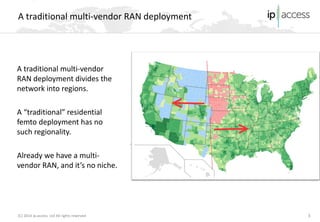
A traditional multi-vendor RAN deployment 3 
A traditional multi-vendor RAN deployment divides the network into regions. 
A “traditional” residential femto deployment has no such regionality. 
Already we have a multi- vendor RAN, and it’s no niche.
(C) 2014 ip.access Ltd All rights reserved 
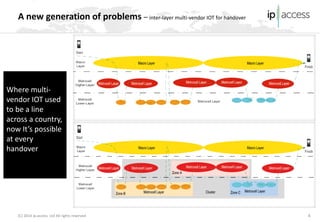
A new generation of problems – inter-layer multi-vendor IOT for handover 4 
Where multi- vendor IOT used to be a line across a country, now It’s possible at every handover
(C) 2014 ip.access Ltd All rights reserved 
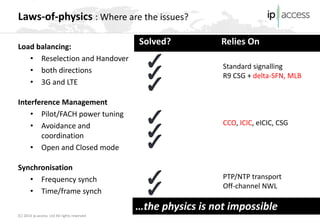
Laws-of-physics : Where are the issues? 
Load balancing: 
• 
Reselection and Handover 
• 
both directions 
• 
3G and LTE 
Interference Management 
• 
Pilot/FACH power tuning 
• 
Avoidance and coordination 
•Open and Closed mode 
Synchronisation 
•Frequency synch 
•Time/frame synch 
Solved? 
Relies On 
Standard signalling 
R9 CSG + delta-SFN, MLB 
CCO, ICIC, eICIC, CSG 
PTP/NTP transport 
Off-channel NWL 
…the physics is not impossible
(C) 2014 ip.access Ltd All rights reserved 
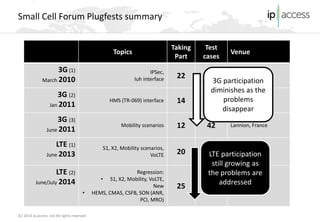
Small Cell Forum Plugfests summary 
Topics 
Taking Part 
Test 
cases 
Venue 
3G (1) 
March 2010 
IPSec, 
Iuh interface 
22 
26 
Sophia Antipolis, 
France 
3G (2) 
Jan 2011 
HMS (TR-069) interface 
14 
35 
Sophia Antipolis, 
France 
3G (3) 
June 2011 
Mobility scenarios 
12 
42 
Lannion, France 
LTE (1) 
June 2013 
S1, X2, Mobility scenarios, 
VoLTE 
20 
28 
Kranj, Slovenia 
LTE (2) 
June/July 2014 
Regression: 
• 
S1, X2, Mobility, VoLTE, 
New 
• 
HEMS, CMAS, CSFB, SON (ANR, PCI, MRO) 
25 
94 
Paris, France 
3G participation diminishes as the problems disappear 
LTE participation still growing as the problems are addressed
(C) 2014 ip.access Ltd All rights reserved 
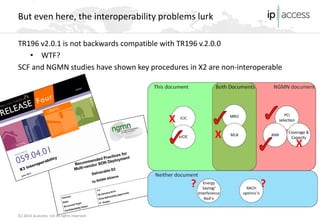
But even here, the interoperability problems lurk 
TR196 v2.0.1 is not backwards compatible with TR196 v.2.0.0 
• 
WTF? 
SCF and NGMN studies have shown key procedures in X2 are non-interoperable 
X 
X 
? 
? 
X
(C) 2014 ip.access Ltd All rights reserved 
How has it come to be like this? 
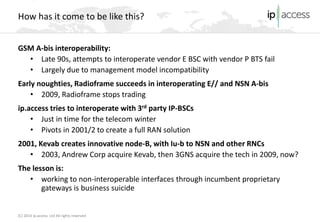
GSM A-bis interoperability: 
• 
Late 90s, attempts to interoperate vendor E BSC with vendor P BTS fail 
• 
Largely due to management model incompatibility 
Early noughties, Radioframe succeeds in interoperating E// and NSN A-bis 
• 
2009, Radioframe stops trading 
ip.access tries to interoperate with 3rd party IP-BSCs 
• 
Just in time for the telecom winter 
• 
Pivots in 2001/2 to create a full RAN solution 
2001, Kevab creates innovative node-B, with Iu-b to NSN and other RNCs 
• 
2003, Andrew Corp acquire Kevab, then 3GNS acquire the tech in 2009, now? 
The lesson is: 
• 
working to non-interoperable interfaces through incumbent proprietary gateways is business suicide
(C) 2014 ip.access Ltd All rights reserved 
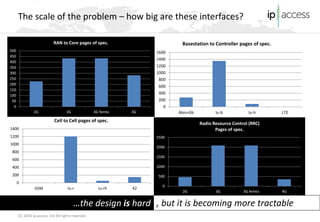
The scale of the problem – how big are these interfaces? 
0 
200 
400 
600 
800 
1000 
1200 
1400 
1600 
Abis+Gb 
Iu-b 
Iu-h 
LTE 
Basestation to Controller pages of spec. 
0 
200 
400 
600 
800 
1000 
1200 
1400 
GSM 
Iu-r 
Iu-rh 
X2 
Cell to Cell pages of spec. 
0 
500 
1000 
1500 
2000 
2500 
2G 
3G 
3G femto 
4G 
Radio Resource Control (RRC) 
Pages of spec. 
0 
50 
100 
150 
200 
250 
300 
350 
400 
450 
500 
2G 
3G 
3G femto 
4G 
RAN to Core pages of spec. 
…the design is hard 
, but it is becoming more tractable
(C) 2014 ip.access Ltd All rights reserved 
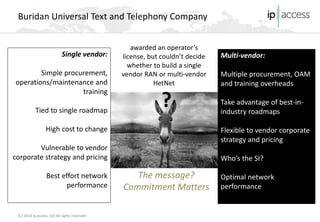
Buridan Universal Text and Telephony Company 
awarded an operator’s license, but couldn’t decide whether to build a single vendor RAN or multi-vendor HetNet 
? 
The message? 
Commitment Matters 
Multi-vendor: 
Multiple procurement, OAM and training overheads 
Take advantage of best-in- industry roadmaps 
Flexible to vendor corporate strategy and pricing 
Who’s the SI? 
Optimal network performance 
Single vendor: 
Simple procurement, operations/maintenance and training 
Tied to single roadmap 
High cost to change 
Vulnerable to vendor corporate strategy and pricing 
Best effort network performance
(C) 2014 ip.access Ltd All rights reserved 
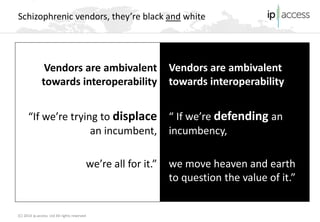
Schizophrenic vendors, they’re black and white 
Vendors are ambivalent towards interoperability 
“If we’re trying to displace an incumbent, 
we’re all for it.” 
Vendors are ambivalent towards interoperability 
“ If we’re defending an incumbency, 
we move heaven and earth to question the value of it.”
(C) 2014 ip.access Ltd All rights reserved 
Operator Process, and who’s the SI? 
Operator processes are still largely tuned to macro deployment: 
• 
Operator A: “it takes us six weeks to deploy a cell” 
• 
Operator B: “each cell we deploy touches 17 departments in my organisation” 
• 
AT&T (SCA 2013): “we can’t order equipment to be installed at a location that doesn’t have a street address – our tools won’t let us.” 
Who fixes it when it’s broken 
If it takes time to fix, then the customer will 
lose patience and revert to the 
tried-and-tested 
?
(C) 2014 ip.access Ltd All rights reserved 
A message of hope… 
Operator processes are still largely tuned to macro deployment, but are moving: 
•Operator A: “it used to take us six weeks to deploy a cell. Now it takes us two hours” 
•Operator B: “each cell we deploy used to touch 17 departments in my organisation. Now it’s two.” 
•AT&T (SCA 2013): “we couldn’t order equipment to be installed at a location that doesn’t have a street address – our tools wouldn’t let us. But now we can.” 
…the red tape was there, but with the right commitment, it’s now being cut
(C) 2014 ip.access Ltd All rights reserved 
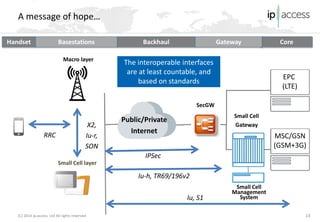
A message of hope… 14 
Small Cell Management System 
Small Cell 
Gateway 
Public/Private Internet 
EPC 
(LTE) 
Backhaul 
Basestations 
Core 
Gateway 
Small Cell layer 
MSC/GSN 
(GSM+3G) 
SecGW 
Macro layer 
Handset 
RRC 
X2, 
Iu-r, 
SON 
IPSec 
Iu-h, TR69/196v2 
Iu, S1 
The interoperable interfaces are at least countable, and based on standards
(C) 2014 ip.access Ltd All rights reserved 
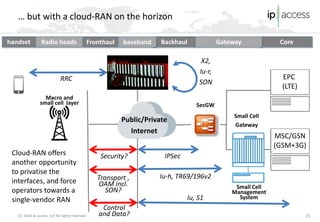
… but with a cloud-RAN on the horizon 15 
Small Cell Management System 
Small Cell 
Gateway 
Public/Private 
Internet 
EPC 
(LTE) 
Backhaul 
Radio heads 
Core 
Gateway 
MSC/GSN 
(GSM+3G) 
SecGW 
Macro and small cell layer 
handset 
RRC 
X2, 
Iu-r, 
SON 
IPSec 
Iu-h, TR69/196v2 
Iu, S1 
Fronthaul 
baseband 
Security? 
Transport , OAM incl. SON? 
Control and Data? 
Cloud-RAN offers another opportunity to privatise the interfaces, and force operators towards a single-vendor RAN
(C) 2014 ip.access Ltd All rights reserved 
A message of hope… 
•Operators are vocally insistent on multi-vendor interoperability on key interfaces 
•Incumbents will reluctantly agree to integrate in a multi-vendor context 
•The “who’s the SI?” question remains an issue 
•the answer is rarely “the incumbent”, though it’s expensive for the incomer 
•Initiatives such as the SCF Interoperability Plugfests are removing the sting and the risk from multi-vendor integration 
•Technology such as Self-Organisation (centralised, distributed and hybrid) with standardised interfaces and procedures will also reduce the SI burden. 
•With these issues in place… 
•Properly interoperable interfaces 
•Technology to reduce the SI burden 
•Exhaustive cross-industry laboratory pre-test 
•Operator commitment, with business processes to match 
…we can do it! 
It can be done..
(C) 2014 ip.access Ltd All rights reserved 
Nick Johnson 
CTO, ip.access 
Thanks for your attention… 
ndj@ipaccess.com

Small Cell Interoperability in the RAN

  • 1.
    Small Cell Interoperabilityin the RAN Impossible Physics, Hard Design, or just Red-Tape? V2.4, 1st October 2014 CTO N.D. Johnson
  • 2.
    (C) 2014 ip.accessLtd All rights reserved Small Cell Interoperability Why do we care? • Some anecdotes from history • Abis, Iu-b, Iu-r Beyond standards • NGMN, SCF and other interoperability initiatives Buridan Telecom • In the end, you have to choose The schizophrenic vendor • Can you be the incumbent and the upstart at the same time? Interoperability and cloud-RAN • Don’t be beguiled into another layer of private interfaces A message of hope • It might just work!
  • 3.
    (C) 2014 ip.accessLtd All rights reserved A traditional multi-vendor RAN deployment 3 A traditional multi-vendor RAN deployment divides the network into regions. A “traditional” residential femto deployment has no such regionality. Already we have a multi- vendor RAN, and it’s no niche.
  • 4.
    (C) 2014 ip.accessLtd All rights reserved A new generation of problems – inter-layer multi-vendor IOT for handover 4 Where multi- vendor IOT used to be a line across a country, now It’s possible at every handover
  • 5.
    (C) 2014 ip.accessLtd All rights reserved Laws-of-physics : Where are the issues? Load balancing: • Reselection and Handover • both directions • 3G and LTE Interference Management • Pilot/FACH power tuning • Avoidance and coordination •Open and Closed mode Synchronisation •Frequency synch •Time/frame synch Solved? Relies On Standard signalling R9 CSG + delta-SFN, MLB CCO, ICIC, eICIC, CSG PTP/NTP transport Off-channel NWL …the physics is not impossible
  • 6.
    (C) 2014 ip.accessLtd All rights reserved Small Cell Forum Plugfests summary Topics Taking Part Test cases Venue 3G (1) March 2010 IPSec, Iuh interface 22 26 Sophia Antipolis, France 3G (2) Jan 2011 HMS (TR-069) interface 14 35 Sophia Antipolis, France 3G (3) June 2011 Mobility scenarios 12 42 Lannion, France LTE (1) June 2013 S1, X2, Mobility scenarios, VoLTE 20 28 Kranj, Slovenia LTE (2) June/July 2014 Regression: • S1, X2, Mobility, VoLTE, New • HEMS, CMAS, CSFB, SON (ANR, PCI, MRO) 25 94 Paris, France 3G participation diminishes as the problems disappear LTE participation still growing as the problems are addressed
  • 7.
    (C) 2014 ip.accessLtd All rights reserved But even here, the interoperability problems lurk TR196 v2.0.1 is not backwards compatible with TR196 v.2.0.0 • WTF? SCF and NGMN studies have shown key procedures in X2 are non-interoperable X X ? ? X
  • 8.
    (C) 2014 ip.accessLtd All rights reserved How has it come to be like this? GSM A-bis interoperability: • Late 90s, attempts to interoperate vendor E BSC with vendor P BTS fail • Largely due to management model incompatibility Early noughties, Radioframe succeeds in interoperating E// and NSN A-bis • 2009, Radioframe stops trading ip.access tries to interoperate with 3rd party IP-BSCs • Just in time for the telecom winter • Pivots in 2001/2 to create a full RAN solution 2001, Kevab creates innovative node-B, with Iu-b to NSN and other RNCs • 2003, Andrew Corp acquire Kevab, then 3GNS acquire the tech in 2009, now? The lesson is: • working to non-interoperable interfaces through incumbent proprietary gateways is business suicide
  • 9.
    (C) 2014 ip.accessLtd All rights reserved The scale of the problem – how big are these interfaces? 0 200 400 600 800 1000 1200 1400 1600 Abis+Gb Iu-b Iu-h LTE Basestation to Controller pages of spec. 0 200 400 600 800 1000 1200 1400 GSM Iu-r Iu-rh X2 Cell to Cell pages of spec. 0 500 1000 1500 2000 2500 2G 3G 3G femto 4G Radio Resource Control (RRC) Pages of spec. 0 50 100 150 200 250 300 350 400 450 500 2G 3G 3G femto 4G RAN to Core pages of spec. …the design is hard , but it is becoming more tractable
  • 10.
    (C) 2014 ip.accessLtd All rights reserved Buridan Universal Text and Telephony Company awarded an operator’s license, but couldn’t decide whether to build a single vendor RAN or multi-vendor HetNet ? The message? Commitment Matters Multi-vendor: Multiple procurement, OAM and training overheads Take advantage of best-in- industry roadmaps Flexible to vendor corporate strategy and pricing Who’s the SI? Optimal network performance Single vendor: Simple procurement, operations/maintenance and training Tied to single roadmap High cost to change Vulnerable to vendor corporate strategy and pricing Best effort network performance
  • 11.
    (C) 2014 ip.accessLtd All rights reserved Schizophrenic vendors, they’re black and white Vendors are ambivalent towards interoperability “If we’re trying to displace an incumbent, we’re all for it.” Vendors are ambivalent towards interoperability “ If we’re defending an incumbency, we move heaven and earth to question the value of it.”
  • 12.
    (C) 2014 ip.accessLtd All rights reserved Operator Process, and who’s the SI? Operator processes are still largely tuned to macro deployment: • Operator A: “it takes us six weeks to deploy a cell” • Operator B: “each cell we deploy touches 17 departments in my organisation” • AT&T (SCA 2013): “we can’t order equipment to be installed at a location that doesn’t have a street address – our tools won’t let us.” Who fixes it when it’s broken If it takes time to fix, then the customer will lose patience and revert to the tried-and-tested ?
  • 13.
    (C) 2014 ip.accessLtd All rights reserved A message of hope… Operator processes are still largely tuned to macro deployment, but are moving: •Operator A: “it used to take us six weeks to deploy a cell. Now it takes us two hours” •Operator B: “each cell we deploy used to touch 17 departments in my organisation. Now it’s two.” •AT&T (SCA 2013): “we couldn’t order equipment to be installed at a location that doesn’t have a street address – our tools wouldn’t let us. But now we can.” …the red tape was there, but with the right commitment, it’s now being cut
  • 14.
    (C) 2014 ip.accessLtd All rights reserved A message of hope… 14 Small Cell Management System Small Cell Gateway Public/Private Internet EPC (LTE) Backhaul Basestations Core Gateway Small Cell layer MSC/GSN (GSM+3G) SecGW Macro layer Handset RRC X2, Iu-r, SON IPSec Iu-h, TR69/196v2 Iu, S1 The interoperable interfaces are at least countable, and based on standards
  • 15.
    (C) 2014 ip.accessLtd All rights reserved … but with a cloud-RAN on the horizon 15 Small Cell Management System Small Cell Gateway Public/Private Internet EPC (LTE) Backhaul Radio heads Core Gateway MSC/GSN (GSM+3G) SecGW Macro and small cell layer handset RRC X2, Iu-r, SON IPSec Iu-h, TR69/196v2 Iu, S1 Fronthaul baseband Security? Transport , OAM incl. SON? Control and Data? Cloud-RAN offers another opportunity to privatise the interfaces, and force operators towards a single-vendor RAN
  • 16.
    (C) 2014 ip.accessLtd All rights reserved A message of hope… •Operators are vocally insistent on multi-vendor interoperability on key interfaces •Incumbents will reluctantly agree to integrate in a multi-vendor context •The “who’s the SI?” question remains an issue •the answer is rarely “the incumbent”, though it’s expensive for the incomer •Initiatives such as the SCF Interoperability Plugfests are removing the sting and the risk from multi-vendor integration •Technology such as Self-Organisation (centralised, distributed and hybrid) with standardised interfaces and procedures will also reduce the SI burden. •With these issues in place… •Properly interoperable interfaces •Technology to reduce the SI burden •Exhaustive cross-industry laboratory pre-test •Operator commitment, with business processes to match …we can do it! It can be done..
  • 17.
    (C) 2014 ip.accessLtd All rights reserved Nick Johnson CTO, ip.access Thanks for your attention… ndj@ipaccess.com