British Telecommunications plc 2018
5G Radio Access Network Architecture Evolution
Professor Andy Sutton CEng FIET
Principal Network Architect
Architecture & Strategy
BT Technology
30th January 2019
British Telecommunications plc 2018
Contents
• Lessons from the past - GSM, UMTS and LTE
• 5G RAN architecture evolution
• RAN functional decomposition
• Access network connectivity
• 5G network deployment
• 5G demo update
• Summary
2
British Telecommunications plc 2018
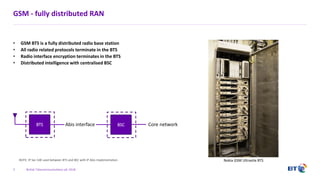
GSM - fully distributed RAN
• GSM BTS is a fully distributed radio base station
• All radio related protocols terminate in the BTS
• Radio interface encryption terminates in the BTS
• Distributed intelligence with centralised BSC
3
BTS Abis interface BSC
Nokia GSM Ultrasite BTS
Core network
NOTE: IP Sec GW used between BTS and BSC with IP Abis implementation
British Telecommunications plc 2018
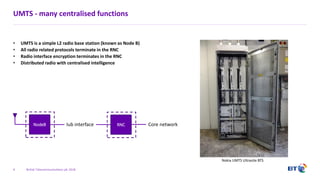
UMTS - many centralised functions
• UMTS is a simple L2 radio base station (known as Node B)
• All radio related protocols terminate in the RNC
• Radio interface encryption terminates in the RNC
• Distributed radio with centralised intelligence
4
NodeB Iub interface RNC
Nokia UMTS Ultrasite BTS
Core network
British Telecommunications plc 2018
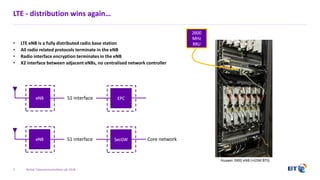
LTE - distribution wins again…
• LTE eNB is a fully distributed radio base station
• All radio related protocols terminate in the eNB
• Radio interface encryption terminates in the eNB
• X2 interface between adjacent eNBs, no centralised network controller
5
eNB S1 interface EPC
Huawei 3900 eNB (+GSM BTS)
eNB S1 interface SecGW Core network
2600
MHz
RRU
British Telecommunications plc 2018
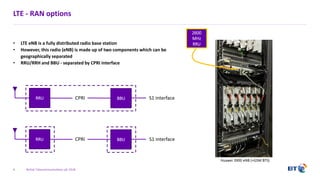
LTE - RAN options
• LTE eNB is a fully distributed radio base station
• However, this radio (eNB) is made up of two components which can be
geographically separated
• RRU/RRH and BBU - separated by CPRI interface
6
RRU CPRI BBU
Huawei 3900 eNB (+GSM BTS)
RRU CPRI BBU S1 interface
2600
MHz
RRU
S1 interface
British Telecommunications plc 2018
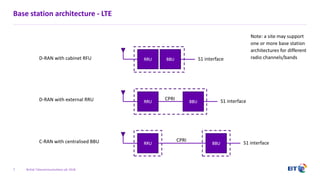
Base station architecture - LTE
7
RRU BBU
RRU
S1 interface
BBU S1 interface
RRU BBU S1 interface
CPRI
CPRI
D-RAN with cabinet RFU
D-RAN with external RRU
C-RAN with centralised BBU
Note: a site may support
one or more base station
architectures for different
radio channels/bands
British Telecommunications plc 2018
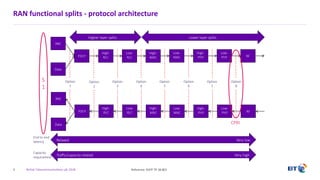
RAN functional splits - protocol architecture
8
RRC
PDCP
Data
Low-
RLC
High-
MAC
High-
PHY
Low-
MAC
Low-
PHY RF
High-
RLC
RRC
PDCP
Data
Low-
RLC
High-
MAC
High-
PHY
Low-
MAC
Low-
PHY RF
High-
RLC
Option
1
Option
2
Option
3
Option
4
Option
5
Option
6
Option
7
Option
8
Relaxed Very low
End to end
latency
Traffic/capacity related Very high
Capacity
requirement
Higher layer splits Lower layer splits
S
1
CPRI
Reference 3GPP TR 38.801
British Telecommunications plc 2018
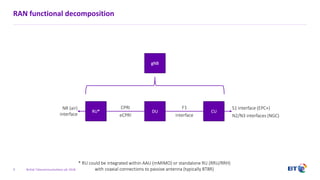
RAN functional decomposition
9
gNB
RU* DU CU
* RU could be integrated within AAU (mMIMO) or standalone RU (RRU/RRH)
with coaxial connections to passive antenna (typically 8T8R)
CPRI
eCPRI
F1
interface
S1 interface (EPC+)
N2/N3 interfaces (NGC)
NR (air)
interface
British Telecommunications plc 2018
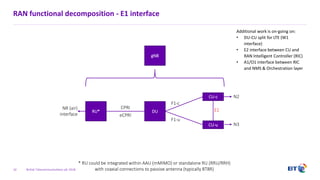
RAN functional decomposition - E1 interface
10
gNB
RU* DU
CU-c
* RU could be integrated within AAU (mMIMO) or standalone RU (RRU/RRH)
with coaxial connections to passive antenna (typically 8T8R)
CPRI
eCPRI
F1-c
NR (air)
interface
CU-u
F1-u
N2
N3
E1
Additional work is on-going on:
• DU-CU split for LTE (W1
interface)
• E2 interface between CU and
RAN Intelligent Controller (RIC)
• A1/O1 interface between RIC
and NMS & Orchestration layer
British Telecommunications plc 2018
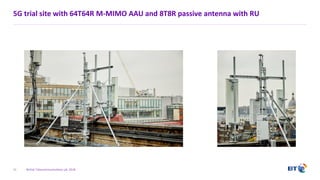
5G trial site with 64T64R M-MIMO AAU and 8T8R passive antenna with RU
11
British Telecommunications plc 2018
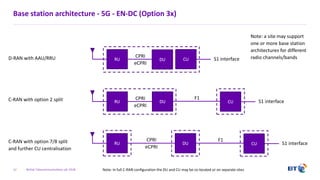
Base station architecture - 5G - EN-DC (Option 3x)
12
RU CU
RU
S1 interface
DU
RU DU
D-RAN with AAU/RRU
C-RAN with option 2 split
C-RAN with option 7/8 split
and further CU centralisation
DU
CPRI
eCPRI
CU S1 interface
F1CPRI
eCPRI
CU S1 interface
F1CPRI
eCPRI
Note: a site may support
one or more base station
architectures for different
radio channels/bands
Note: In full C-RAN configuration the DU and CU may be co-located or on separate sites
British Telecommunications plc 2018
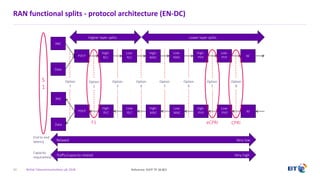
RAN functional splits - protocol architecture (EN-DC)
13
RRC
PDCP
Data
Low-
RLC
High-
MAC
High-
PHY
Low-
MAC
Low-
PHY RF
High-
RLC
RRC
PDCP
Data
Low-
RLC
High-
MAC
High-
PHY
Low-
MAC
Low-
PHY RF
High-
RLC
Option
1
Option
2
Option
3
Option
4
Option
5
Option
6
Option
7
Option
8
Relaxed Very low
End to end
latency
Traffic/capacity related Very high
Capacity
requirement
Higher layer splits Lower layer splits
S
1
CPRIeCPRIF1
Reference 3GPP TR 38.801
British Telecommunications plc 2018
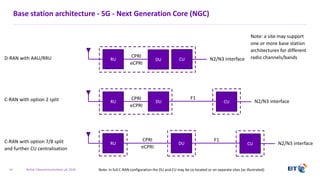
Base station architecture - 5G - Next Generation Core (NGC)
14
RU CU
RU
N2/N3 interface
DU
RU DU
D-RAN with AAU/RRU
C-RAN with option 2 split
C-RAN with option 7/8 split
and further CU centralisation
DU
CPRI
eCPRI
CU N2/N3 interface
F1CPRI
eCPRI
CU N2/N3 interface
F1CPRI
eCPRI
Note: a site may support
one or more base station
architectures for different
radio channels/bands
Note: In full C-RAN configuration the DU and CU may be co-located or on separate sites (as illustrated)
British Telecommunications plc 2018
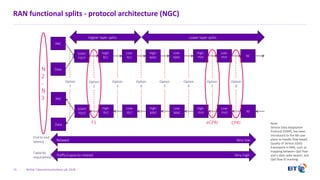
RAN functional splits - protocol architecture (NGC)
15
RRC
SDAP/
PDCP
Data
Low-
RLC
High-
MAC
High-
PHY
Low-
MAC
Low-
PHY RF
High-
RLC
RRC
SDAP/
PDCP
Data
Low-
RLC
High-
MAC
High-
PHY
Low-
MAC
Low-
PHY RF
High-
RLC
Option
1
Option
2
Option
3
Option
4
Option
5
Option
6
Option
7
Option
8
Relaxed Very low
End to end
latency
Traffic/capacity related Very high
Capacity
requirement
Higher layer splits Lower layer splits
N
2
-
N
3
CPRIeCPRIF1 Note:
Service Data Adaptation
Protocol (SDAP), has been
introduced to the NR user
plane to handle flow-based
Quality of Service (QoS)
framework in RAN, such as
mapping between QoS flow
and a data radio bearer, and
QoS flow ID marking.
British Telecommunications plc 2018
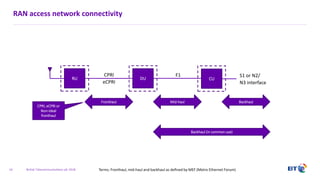
RAN access network connectivity
16
RU DU CU
S1 or N2/
N3 interface
F1CPRI
eCPRI
Terms; Fronthaul, mid-haul and backhaul as defined by MEF (Metro Ethernet Forum)
Fronthaul Mid-haul Backhaul
Backhaul (in common use)
CPRI, eCPRI or
Non-ideal
fronthaul
British Telecommunications plc 2018
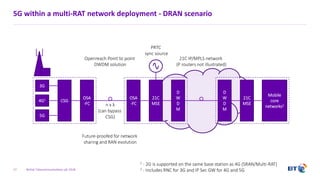
5G within a multi-RAT network deployment - DRAN scenario
17
3G
4G1
5G
CSG
OSA
-FC
OSA
-FC
21C
MSE
D
W
D
M
D
W
D
M
21C
MSE
Mobile
core
networks2
21C IP/MPLS network
(P routers not illustrated)
Openreach Point to point
DWDM solution
Future-proofed for network
sharing and RAN evolution
n x λ
(can bypass
CSG)
1 - 2G is supported on the same base station as 4G (SRAN/Multi-RAT)
2 - Includes RNC for 3G and IP Sec GW for 4G and 5G
PRTC
sync source
British Telecommunications plc 2018
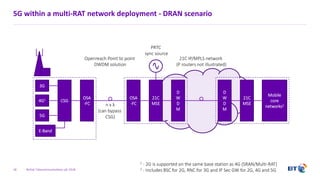
5G within a multi-RAT network deployment - DRAN scenario
18
3G
4G1
5G
CSG
OSA
-FC
OSA
-FC
21C
MSE
D
W
D
M
D
W
D
M
21C
MSE
Mobile
core
networks2
21C IP/MPLS network
(P routers not illustrated)
Openreach Point to point
DWDM solution
n x λ
(can bypass
CSG)
1 - 2G is supported on the same base station as 4G (SRAN/Multi-RAT)
2 - Includes BSC for 2G, RNC for 3G and IP Sec GW for 2G, 4G and 5G
PRTC
sync source
E-Band
British Telecommunications plc 2018
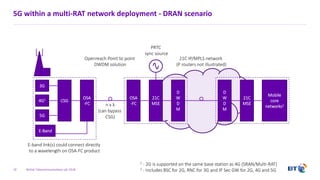
5G within a multi-RAT network deployment - DRAN scenario
19
3G
4G1
5G
CSG
OSA
-FC
OSA
-FC
21C
MSE
D
W
D
M
D
W
D
M
21C
MSE
Mobile
core
networks2
21C IP/MPLS network
(P routers not illustrated)
Openreach Point to point
DWDM solution
n x λ
(can bypass
CSG)
1 - 2G is supported on the same base station as 4G (SRAN/Multi-RAT)
2 - Includes BSC for 2G, RNC for 3G and IP Sec GW for 2G, 4G and 5G
PRTC
sync source
E-Band
E-band link(s) could connect directly
to a wavelength on OSA-FC product
British Telecommunications plc 2018
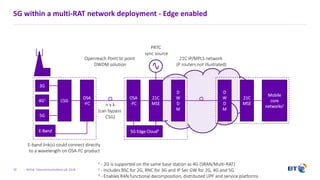
5G within a multi-RAT network deployment - Edge enabled
20
3G
4G1
5G
CSG
OSA
-FC
OSA
-FC
21C
MSE
D
W
D
M
D
W
D
M
21C
MSE
Mobile
core
networks2
21C IP/MPLS network
(P routers not illustrated)
Openreach Point to point
DWDM solution
n x λ
(can bypass
CSG)
1 - 2G is supported on the same base station as 4G (SRAN/Multi-RAT)
2 - Includes BSC for 2G, RNC for 3G and IP Sec GW for 2G, 4G and 5G
3 - Enables RAN functional decomposition, distributed UPF and service platforms
PRTC
sync source
E-Band
E-band link(s) could connect directly
to a wavelength on OSA-FC product
5G Edge Cloud3
British Telecommunications plc 2018
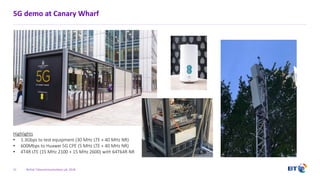
5G demo at Canary Wharf
21
Highlights
• 1.3Gbps to test equipment (30 MHz LTE + 40 MHz NR)
• 600Mbps to Huawei 5G CPE (5 MHz LTE + 40 MHz NR)
• 4T4R LTE (15 MHz 2100 + 15 MHz 2600) with 64T64R NR
British Telecommunications plc 2018
Summary
• The functional decomposition of the RAN is at an advanced stage in standards,
industry fora and implementation (XRAN/ORAN, 3GPP, ONAP)
• Traditional 4G centric CRAN (CPRI based) is popular in Asia due to availability of dark
fibre, this brings radio optimisation benefits through centralised scheduling etc.
• CPRI doesn’t scale for 5G due to amount of spectrum and antennas therefore eCPRI
was developed by the same industry partners who developed CPRI
• Several industry groups are working towards a virtualised RAN to disaggregate the
hardware from software for many functions, also enables innovative new entrants to
market
• Major RAN vendors offer a range of different RAN architectures to meet various
deployment scenarios
• BT is currently rolling out the radio, backhaul and core network infrastructure
necessary to be a leader in 5G and converged networks
22
https://www.ngmn.org/fileadmin/ngmn/content/downloads/Technical/2018/180226_NGMN_RANFSX_D1_V20_Final.pdf
British Telecommunications plc 2018
Thank You
Any questions?
23

Prof. Andy Sutton: 5G RAN Architecture Evolution - Jan 2019

  • 1.
    British Telecommunications plc2018 5G Radio Access Network Architecture Evolution Professor Andy Sutton CEng FIET Principal Network Architect Architecture & Strategy BT Technology 30th January 2019
  • 2.
    British Telecommunications plc2018 Contents • Lessons from the past - GSM, UMTS and LTE • 5G RAN architecture evolution • RAN functional decomposition • Access network connectivity • 5G network deployment • 5G demo update • Summary 2
  • 3.
    British Telecommunications plc2018 GSM - fully distributed RAN • GSM BTS is a fully distributed radio base station • All radio related protocols terminate in the BTS • Radio interface encryption terminates in the BTS • Distributed intelligence with centralised BSC 3 BTS Abis interface BSC Nokia GSM Ultrasite BTS Core network NOTE: IP Sec GW used between BTS and BSC with IP Abis implementation
  • 4.
    British Telecommunications plc2018 UMTS - many centralised functions • UMTS is a simple L2 radio base station (known as Node B) • All radio related protocols terminate in the RNC • Radio interface encryption terminates in the RNC • Distributed radio with centralised intelligence 4 NodeB Iub interface RNC Nokia UMTS Ultrasite BTS Core network
  • 5.
    British Telecommunications plc2018 LTE - distribution wins again… • LTE eNB is a fully distributed radio base station • All radio related protocols terminate in the eNB • Radio interface encryption terminates in the eNB • X2 interface between adjacent eNBs, no centralised network controller 5 eNB S1 interface EPC Huawei 3900 eNB (+GSM BTS) eNB S1 interface SecGW Core network 2600 MHz RRU
  • 6.
    British Telecommunications plc2018 LTE - RAN options • LTE eNB is a fully distributed radio base station • However, this radio (eNB) is made up of two components which can be geographically separated • RRU/RRH and BBU - separated by CPRI interface 6 RRU CPRI BBU Huawei 3900 eNB (+GSM BTS) RRU CPRI BBU S1 interface 2600 MHz RRU S1 interface
  • 7.
    British Telecommunications plc2018 Base station architecture - LTE 7 RRU BBU RRU S1 interface BBU S1 interface RRU BBU S1 interface CPRI CPRI D-RAN with cabinet RFU D-RAN with external RRU C-RAN with centralised BBU Note: a site may support one or more base station architectures for different radio channels/bands
  • 8.
    British Telecommunications plc2018 RAN functional splits - protocol architecture 8 RRC PDCP Data Low- RLC High- MAC High- PHY Low- MAC Low- PHY RF High- RLC RRC PDCP Data Low- RLC High- MAC High- PHY Low- MAC Low- PHY RF High- RLC Option 1 Option 2 Option 3 Option 4 Option 5 Option 6 Option 7 Option 8 Relaxed Very low End to end latency Traffic/capacity related Very high Capacity requirement Higher layer splits Lower layer splits S 1 CPRI Reference 3GPP TR 38.801
  • 9.
    British Telecommunications plc2018 RAN functional decomposition 9 gNB RU* DU CU * RU could be integrated within AAU (mMIMO) or standalone RU (RRU/RRH) with coaxial connections to passive antenna (typically 8T8R) CPRI eCPRI F1 interface S1 interface (EPC+) N2/N3 interfaces (NGC) NR (air) interface
  • 10.
    British Telecommunications plc2018 RAN functional decomposition - E1 interface 10 gNB RU* DU CU-c * RU could be integrated within AAU (mMIMO) or standalone RU (RRU/RRH) with coaxial connections to passive antenna (typically 8T8R) CPRI eCPRI F1-c NR (air) interface CU-u F1-u N2 N3 E1 Additional work is on-going on: • DU-CU split for LTE (W1 interface) • E2 interface between CU and RAN Intelligent Controller (RIC) • A1/O1 interface between RIC and NMS & Orchestration layer
  • 11.
    British Telecommunications plc2018 5G trial site with 64T64R M-MIMO AAU and 8T8R passive antenna with RU 11
  • 12.
    British Telecommunications plc2018 Base station architecture - 5G - EN-DC (Option 3x) 12 RU CU RU S1 interface DU RU DU D-RAN with AAU/RRU C-RAN with option 2 split C-RAN with option 7/8 split and further CU centralisation DU CPRI eCPRI CU S1 interface F1CPRI eCPRI CU S1 interface F1CPRI eCPRI Note: a site may support one or more base station architectures for different radio channels/bands Note: In full C-RAN configuration the DU and CU may be co-located or on separate sites
  • 13.
    British Telecommunications plc2018 RAN functional splits - protocol architecture (EN-DC) 13 RRC PDCP Data Low- RLC High- MAC High- PHY Low- MAC Low- PHY RF High- RLC RRC PDCP Data Low- RLC High- MAC High- PHY Low- MAC Low- PHY RF High- RLC Option 1 Option 2 Option 3 Option 4 Option 5 Option 6 Option 7 Option 8 Relaxed Very low End to end latency Traffic/capacity related Very high Capacity requirement Higher layer splits Lower layer splits S 1 CPRIeCPRIF1 Reference 3GPP TR 38.801
  • 14.
    British Telecommunications plc2018 Base station architecture - 5G - Next Generation Core (NGC) 14 RU CU RU N2/N3 interface DU RU DU D-RAN with AAU/RRU C-RAN with option 2 split C-RAN with option 7/8 split and further CU centralisation DU CPRI eCPRI CU N2/N3 interface F1CPRI eCPRI CU N2/N3 interface F1CPRI eCPRI Note: a site may support one or more base station architectures for different radio channels/bands Note: In full C-RAN configuration the DU and CU may be co-located or on separate sites (as illustrated)
  • 15.
    British Telecommunications plc2018 RAN functional splits - protocol architecture (NGC) 15 RRC SDAP/ PDCP Data Low- RLC High- MAC High- PHY Low- MAC Low- PHY RF High- RLC RRC SDAP/ PDCP Data Low- RLC High- MAC High- PHY Low- MAC Low- PHY RF High- RLC Option 1 Option 2 Option 3 Option 4 Option 5 Option 6 Option 7 Option 8 Relaxed Very low End to end latency Traffic/capacity related Very high Capacity requirement Higher layer splits Lower layer splits N 2 - N 3 CPRIeCPRIF1 Note: Service Data Adaptation Protocol (SDAP), has been introduced to the NR user plane to handle flow-based Quality of Service (QoS) framework in RAN, such as mapping between QoS flow and a data radio bearer, and QoS flow ID marking.
  • 16.
    British Telecommunications plc2018 RAN access network connectivity 16 RU DU CU S1 or N2/ N3 interface F1CPRI eCPRI Terms; Fronthaul, mid-haul and backhaul as defined by MEF (Metro Ethernet Forum) Fronthaul Mid-haul Backhaul Backhaul (in common use) CPRI, eCPRI or Non-ideal fronthaul
  • 17.
    British Telecommunications plc2018 5G within a multi-RAT network deployment - DRAN scenario 17 3G 4G1 5G CSG OSA -FC OSA -FC 21C MSE D W D M D W D M 21C MSE Mobile core networks2 21C IP/MPLS network (P routers not illustrated) Openreach Point to point DWDM solution Future-proofed for network sharing and RAN evolution n x λ (can bypass CSG) 1 - 2G is supported on the same base station as 4G (SRAN/Multi-RAT) 2 - Includes RNC for 3G and IP Sec GW for 4G and 5G PRTC sync source
  • 18.
    British Telecommunications plc2018 5G within a multi-RAT network deployment - DRAN scenario 18 3G 4G1 5G CSG OSA -FC OSA -FC 21C MSE D W D M D W D M 21C MSE Mobile core networks2 21C IP/MPLS network (P routers not illustrated) Openreach Point to point DWDM solution n x λ (can bypass CSG) 1 - 2G is supported on the same base station as 4G (SRAN/Multi-RAT) 2 - Includes BSC for 2G, RNC for 3G and IP Sec GW for 2G, 4G and 5G PRTC sync source E-Band
  • 19.
    British Telecommunications plc2018 5G within a multi-RAT network deployment - DRAN scenario 19 3G 4G1 5G CSG OSA -FC OSA -FC 21C MSE D W D M D W D M 21C MSE Mobile core networks2 21C IP/MPLS network (P routers not illustrated) Openreach Point to point DWDM solution n x λ (can bypass CSG) 1 - 2G is supported on the same base station as 4G (SRAN/Multi-RAT) 2 - Includes BSC for 2G, RNC for 3G and IP Sec GW for 2G, 4G and 5G PRTC sync source E-Band E-band link(s) could connect directly to a wavelength on OSA-FC product
  • 20.
    British Telecommunications plc2018 5G within a multi-RAT network deployment - Edge enabled 20 3G 4G1 5G CSG OSA -FC OSA -FC 21C MSE D W D M D W D M 21C MSE Mobile core networks2 21C IP/MPLS network (P routers not illustrated) Openreach Point to point DWDM solution n x λ (can bypass CSG) 1 - 2G is supported on the same base station as 4G (SRAN/Multi-RAT) 2 - Includes BSC for 2G, RNC for 3G and IP Sec GW for 2G, 4G and 5G 3 - Enables RAN functional decomposition, distributed UPF and service platforms PRTC sync source E-Band E-band link(s) could connect directly to a wavelength on OSA-FC product 5G Edge Cloud3
  • 21.
    British Telecommunications plc2018 5G demo at Canary Wharf 21 Highlights • 1.3Gbps to test equipment (30 MHz LTE + 40 MHz NR) • 600Mbps to Huawei 5G CPE (5 MHz LTE + 40 MHz NR) • 4T4R LTE (15 MHz 2100 + 15 MHz 2600) with 64T64R NR
  • 22.
    British Telecommunications plc2018 Summary • The functional decomposition of the RAN is at an advanced stage in standards, industry fora and implementation (XRAN/ORAN, 3GPP, ONAP) • Traditional 4G centric CRAN (CPRI based) is popular in Asia due to availability of dark fibre, this brings radio optimisation benefits through centralised scheduling etc. • CPRI doesn’t scale for 5G due to amount of spectrum and antennas therefore eCPRI was developed by the same industry partners who developed CPRI • Several industry groups are working towards a virtualised RAN to disaggregate the hardware from software for many functions, also enables innovative new entrants to market • Major RAN vendors offer a range of different RAN architectures to meet various deployment scenarios • BT is currently rolling out the radio, backhaul and core network infrastructure necessary to be a leader in 5G and converged networks 22 https://www.ngmn.org/fileadmin/ngmn/content/downloads/Technical/2018/180226_NGMN_RANFSX_D1_V20_Final.pdf
  • 23.
    British Telecommunications plc2018 Thank You Any questions? 23