Core Network Evolution
Sarp Köksal
Outline
• Introduction
• 3G Core Network
• 4G Core Network
• 5G Core Network
• Conclusion
Introduction
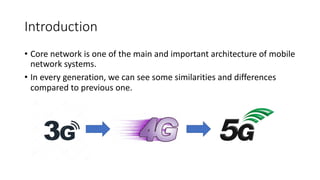
• Core network is one of the main and important architecture of mobile
network systems.
• In every generation, we can see some similarities and differences
compared to previous one.
3G Core Network
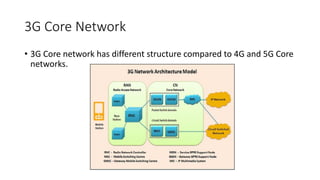
• 3G Core network has different structure compared to 4G and 5G Core
networks.
3G Core Network
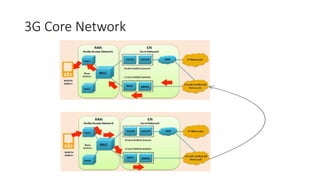
• Circuit Switching: It uses Circuit Switched Network in which dedicated link
or channel is provided for a particular time slot to set of users.
• MSC – Mobile Switching Centre manages circuit switched calls.
• GMSC – Gateway MSC acts as an intermediary between external and internal
networks.
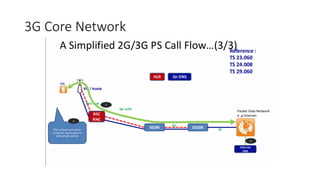
• Packet-switching: It uses IP Network where IP’s are responsible for
transmitting and receiving data among two or more devices.
• SGSN(Serving GPRS Support Node): The various functions provided by SGSN are
mobility management, session management, billing, communication with other
areas of the network.
• GGSN(Gateway GPRS Support Node): It can be considered as a very complex router
and handles the internal operations between the external packet switched networks
and UMTS packet switched network.
3G Core Network
3G Core Network
3G to 4G Core Network
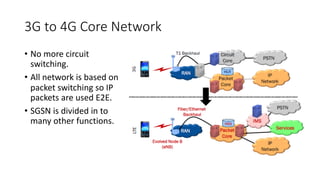
• No more circuit
switching.
• All network is based on
packet switching so IP
packets are used E2E.
• SGSN is divided in to
many other functions.
4G Core Network
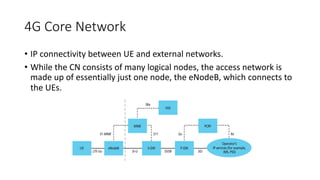
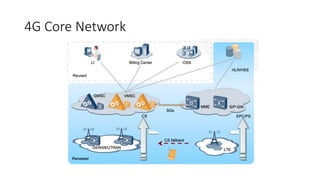
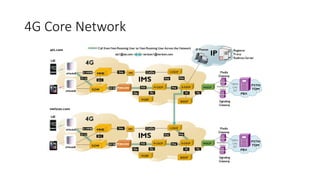
• IP connectivity between UE and external networks.
• While the CN consists of many logical nodes, the access network is
made up of essentially just one node, the eNodeB, which connects to
the UEs.
4G Core Network
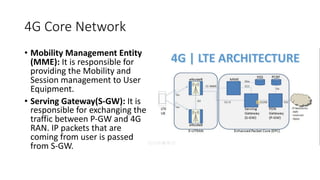
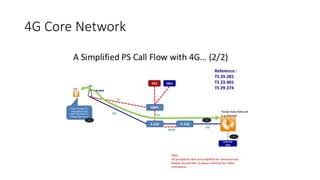
• Mobility Management Entity
(MME): It is responsible for
providing the Mobility and
Session management to User
Equipment.
• Serving Gateway(S-GW): It is
responsible for exchanging the
traffic between P-GW and 4G
RAN. IP packets that are
coming from user is passed
from S-GW.
4G Core Network
• PDN Gateway (P-GW): It is also responsible for data traffic between
S-GW and other networks like IMS or internet. One of main
responsibility of P-GW is to assigning the IP to UE.
• Home Subscriber Server (HSS): It is responsible for storing the data
for customer profile and it creates authentication vectors that are
sent to MME.
• Policy and Charging Rules Functions (PCRF): It is responsible for
providing the information of charging rules, flow control rules and
traffic priority.
4G Core Network
4G Core Network
4G Core Network
5G Core Network
• While 4G Core has evolved to 5G Core, it gained some new
capabilities and some functions are divided in to more functions but
general architecture is similar.
• Most significant difference is seperation of user and control planes.
• Core Network Functions are divided in to more other functions in
order to support micro service architecture.
5G Core Network
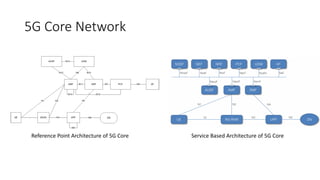
Reference Point Architecture of 5G Core Service Based Architecture of 5G Core
5G Core Network
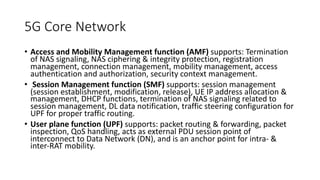
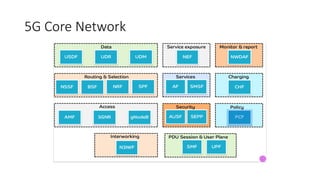
• Access and Mobility Management function (AMF) supports: Termination
of NAS signaling, NAS ciphering & integrity protection, registration
management, connection management, mobility management, access
authentication and authorization, security context management.
• Session Management function (SMF) supports: session management
(session establishment, modification, release), UE IP address allocation &
management, DHCP functions, termination of NAS signaling related to
session management, DL data notification, traffic steering configuration for
UPF for proper traffic routing.
• User plane function (UPF) supports: packet routing & forwarding, packet
inspection, QoS handling, acts as external PDU session point of
interconnect to Data Network (DN), and is an anchor point for intra- &
inter-RAT mobility.
5G Core Network
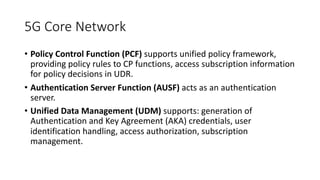
• Policy Control Function (PCF) supports unified policy framework,
providing policy rules to CP functions, access subscription information
for policy decisions in UDR.
• Authentication Server Function (AUSF) acts as an authentication
server.
• Unified Data Management (UDM) supports: generation of
Authentication and Key Agreement (AKA) credentials, user
identification handling, access authorization, subscription
management.
5G Core Network
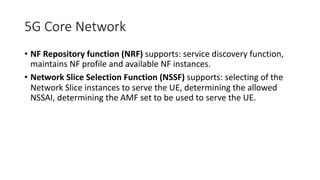
• NF Repository function (NRF) supports: service discovery function,
maintains NF profile and available NF instances.
• Network Slice Selection Function (NSSF) supports: selecting of the
Network Slice instances to serve the UE, determining the allowed
NSSAI, determining the AMF set to be used to serve the UE.
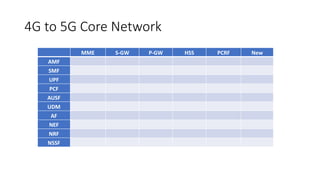
4G to 5G Core Network
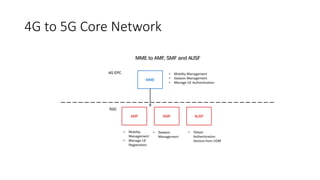
MME S-GW P-GW HSS PCRF New
AMF
SMF
UPF
PCF
AUSF
UDM
AF
NEF
NRF
NSSF
4G to 5G Core Network
• NSSF is new function which is not be found in 4G Core Network.
• In 5G, there will be specific network slices.
• NSSF will have the information about these different network slices
including their definitions, resources etc.
• UE will be able to ask for specific network slice and NSSF will give this
info.
• However, NSSF will just give information about slices, AMF will
authorize UE.
Network Slices
4G to 5G Core Network
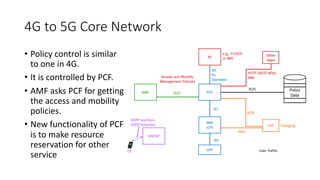
• Policy control is similar
to one in 4G.
• It is controlled by PCF.
• AMF asks PCF for getting
the access and mobility
policies.
• New functionality of PCF
is to make resource
reservation for other
service
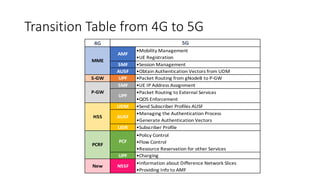
Transition Table from 4G to 5G
4G
AMF
•Mobility Management
•UE Registration
SMF •Session Management
AUSF •Obtain Authentication Vectors from UDM
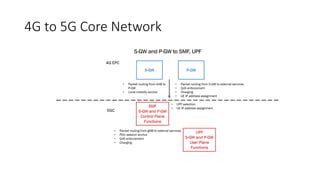
S-GW UPF •Packet Routing from gNodeB to P-GW
SMF •UE IP Address Assignment
UPF
•Packet Routing to External Services
•QOS Enforcement
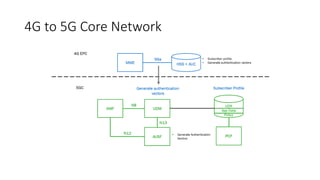
UDM •Send Subscriber Profiles AUSF
AUSF
•Managing the Authentication Process
•Generate Authentication Vectors
UDR •Subscriber Profile
PCF
•Policy Control
•Flow Control
•Resource Reservation for other Services
UPF •Charging
New NSSF
•Information about Difference Network Slices
•Providing Info to AMF
MME
5G
P-GW
HSS
PCRF
5G Core Network
5G Core Network
5G Core Network
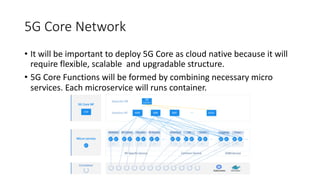
• It will be important to deploy 5G Core as cloud native because it will
require flexible, scalable and upgradable structure.
• 5G Core Functions will be formed by combining necessary micro
services. Each microservice will runs container.
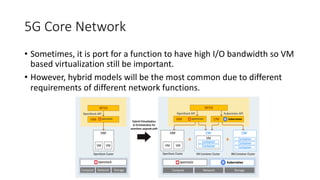
5G Core Network
• Sometimes, it is port for a function to have high I/O bandwidth so VM
based virtualization still be important.
• However, hybrid models will be the most common due to different
requirements of different network functions.
Conclusion
• As we move from 3rd generation of mobile network to 5th generation,
we can see many similarities in the core network sides.
• Circuit switching was ended after 3G Core.
• IP based packet switching is the only architecture both in 4G and 5G.
• Innovation between 4G and 5G is the infrastructure of core network.
• Core Functions will work as microservices.
References
• https://techdifferences.com/difference-between-3g-and-4g-technology.html
• https://www.linkedin.com/pulse/discover-5g-core-network-functions-compared-4g-lte-
paul-shepherd/
• Service-Oriented 5G Core Networks, Huawei, Gabriel Brown
• http://www.cse.unt.edu/~rdantu/FALL_2013_WIRELESS_NETWORKS/LTE_Alcatel_White
_Paper.pdf
• http://www.u5gig.ae/5G%20Core%20Network%20Evolution%20for%20NSA%20and%20S
A.pdf
• https://images.samsung.com/is/content/samsung/p5/global/business/networks/insights
/white-paper/5g-core-vision/5G_Core_Vision_Technical_Whitepaper.pdf
• https://www.academia.edu/14906762/Huawei-CS-Fallback-CSFB-Solution-vTraining-pdf
• https://www.slideshare.net/yusufd/introduction-to-mobile-core-network-17667704

Evolution of Core Networks

  • 1.
  • 2.
    Outline • Introduction • 3GCore Network • 4G Core Network • 5G Core Network • Conclusion
  • 3.
    Introduction • Core networkis one of the main and important architecture of mobile network systems. • In every generation, we can see some similarities and differences compared to previous one.
  • 4.
    3G Core Network •3G Core network has different structure compared to 4G and 5G Core networks.
  • 5.
    3G Core Network •Circuit Switching: It uses Circuit Switched Network in which dedicated link or channel is provided for a particular time slot to set of users. • MSC – Mobile Switching Centre manages circuit switched calls. • GMSC – Gateway MSC acts as an intermediary between external and internal networks. • Packet-switching: It uses IP Network where IP’s are responsible for transmitting and receiving data among two or more devices. • SGSN(Serving GPRS Support Node): The various functions provided by SGSN are mobility management, session management, billing, communication with other areas of the network. • GGSN(Gateway GPRS Support Node): It can be considered as a very complex router and handles the internal operations between the external packet switched networks and UMTS packet switched network.
  • 6.
  • 7.
  • 8.
    3G to 4GCore Network • No more circuit switching. • All network is based on packet switching so IP packets are used E2E. • SGSN is divided in to many other functions.
  • 9.
    4G Core Network •IP connectivity between UE and external networks. • While the CN consists of many logical nodes, the access network is made up of essentially just one node, the eNodeB, which connects to the UEs.
  • 10.
    4G Core Network •Mobility Management Entity (MME): It is responsible for providing the Mobility and Session management to User Equipment. • Serving Gateway(S-GW): It is responsible for exchanging the traffic between P-GW and 4G RAN. IP packets that are coming from user is passed from S-GW.
  • 11.
    4G Core Network •PDN Gateway (P-GW): It is also responsible for data traffic between S-GW and other networks like IMS or internet. One of main responsibility of P-GW is to assigning the IP to UE. • Home Subscriber Server (HSS): It is responsible for storing the data for customer profile and it creates authentication vectors that are sent to MME. • Policy and Charging Rules Functions (PCRF): It is responsible for providing the information of charging rules, flow control rules and traffic priority.
  • 12.
  • 13.
  • 14.
  • 15.
    5G Core Network •While 4G Core has evolved to 5G Core, it gained some new capabilities and some functions are divided in to more functions but general architecture is similar. • Most significant difference is seperation of user and control planes. • Core Network Functions are divided in to more other functions in order to support micro service architecture.
  • 16.
    5G Core Network ReferencePoint Architecture of 5G Core Service Based Architecture of 5G Core
  • 17.
    5G Core Network •Access and Mobility Management function (AMF) supports: Termination of NAS signaling, NAS ciphering & integrity protection, registration management, connection management, mobility management, access authentication and authorization, security context management. • Session Management function (SMF) supports: session management (session establishment, modification, release), UE IP address allocation & management, DHCP functions, termination of NAS signaling related to session management, DL data notification, traffic steering configuration for UPF for proper traffic routing. • User plane function (UPF) supports: packet routing & forwarding, packet inspection, QoS handling, acts as external PDU session point of interconnect to Data Network (DN), and is an anchor point for intra- & inter-RAT mobility.
  • 18.
    5G Core Network •Policy Control Function (PCF) supports unified policy framework, providing policy rules to CP functions, access subscription information for policy decisions in UDR. • Authentication Server Function (AUSF) acts as an authentication server. • Unified Data Management (UDM) supports: generation of Authentication and Key Agreement (AKA) credentials, user identification handling, access authorization, subscription management.
  • 19.
    5G Core Network •NF Repository function (NRF) supports: service discovery function, maintains NF profile and available NF instances. • Network Slice Selection Function (NSSF) supports: selecting of the Network Slice instances to serve the UE, determining the allowed NSSAI, determining the AMF set to be used to serve the UE.
  • 20.
    4G to 5GCore Network MME S-GW P-GW HSS PCRF New AMF SMF UPF PCF AUSF UDM AF NEF NRF NSSF
  • 21.
    4G to 5GCore Network
  • 22.
    4G to 5GCore Network
  • 23.
    4G to 5GCore Network
  • 24.
    4G to 5GCore Network • NSSF is new function which is not be found in 4G Core Network. • In 5G, there will be specific network slices. • NSSF will have the information about these different network slices including their definitions, resources etc. • UE will be able to ask for specific network slice and NSSF will give this info. • However, NSSF will just give information about slices, AMF will authorize UE.
  • 25.
  • 26.
    4G to 5GCore Network • Policy control is similar to one in 4G. • It is controlled by PCF. • AMF asks PCF for getting the access and mobility policies. • New functionality of PCF is to make resource reservation for other service
  • 27.
    Transition Table from4G to 5G 4G AMF •Mobility Management •UE Registration SMF •Session Management AUSF •Obtain Authentication Vectors from UDM S-GW UPF •Packet Routing from gNodeB to P-GW SMF •UE IP Address Assignment UPF •Packet Routing to External Services •QOS Enforcement UDM •Send Subscriber Profiles AUSF AUSF •Managing the Authentication Process •Generate Authentication Vectors UDR •Subscriber Profile PCF •Policy Control •Flow Control •Resource Reservation for other Services UPF •Charging New NSSF •Information about Difference Network Slices •Providing Info to AMF MME 5G P-GW HSS PCRF
  • 28.
  • 29.
  • 30.
    5G Core Network •It will be important to deploy 5G Core as cloud native because it will require flexible, scalable and upgradable structure. • 5G Core Functions will be formed by combining necessary micro services. Each microservice will runs container.
  • 31.
    5G Core Network •Sometimes, it is port for a function to have high I/O bandwidth so VM based virtualization still be important. • However, hybrid models will be the most common due to different requirements of different network functions.
  • 32.
    Conclusion • As wemove from 3rd generation of mobile network to 5th generation, we can see many similarities in the core network sides. • Circuit switching was ended after 3G Core. • IP based packet switching is the only architecture both in 4G and 5G. • Innovation between 4G and 5G is the infrastructure of core network. • Core Functions will work as microservices.
  • 33.
    References • https://techdifferences.com/difference-between-3g-and-4g-technology.html • https://www.linkedin.com/pulse/discover-5g-core-network-functions-compared-4g-lte- paul-shepherd/ •Service-Oriented 5G Core Networks, Huawei, Gabriel Brown • http://www.cse.unt.edu/~rdantu/FALL_2013_WIRELESS_NETWORKS/LTE_Alcatel_White _Paper.pdf • http://www.u5gig.ae/5G%20Core%20Network%20Evolution%20for%20NSA%20and%20S A.pdf • https://images.samsung.com/is/content/samsung/p5/global/business/networks/insights /white-paper/5g-core-vision/5G_Core_Vision_Technical_Whitepaper.pdf • https://www.academia.edu/14906762/Huawei-CS-Fallback-CSFB-Solution-vTraining-pdf • https://www.slideshare.net/yusufd/introduction-to-mobile-core-network-17667704