IoT Security Patterns
Mark Benson, CTO
@markbenson
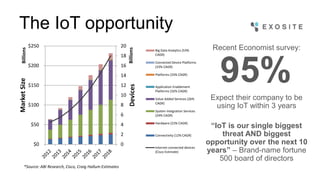
The IoT opportunity
Recent Economist survey:
Expect their company to be
using IoT within 3 years
“IoT is our single biggest
threat AND biggest
opportunity over the next 10
years” – Brand-name fortune
500 board of directors
*Source: ABI Research, Cisco, Craig Hallum Estimates
0
2
4
6
8
10
12
14
16
18
20
$0
$50
$100
$150
$200
$250
DevicesBillions
MarketSizeBillions
Big Data Analytics (53%
CAGR)
Connected Device Platforms
(33% CAGR)
Platforms (33% CAGR)
Application Enablement
Platforms (32% CAGR)
Value Added Services (26%
CAGR)
System Integration Services
(24% CAGR)
Hardware (23% CAGR)
Connectivity (12% CAGR)
Internet-connected devices
(Cisco Estimate)
95%
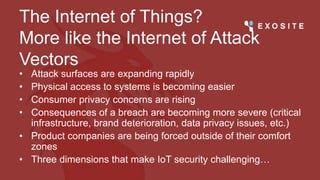
The Internet of Things?
More like the Internet of Attack
Vectors
• Attack surfaces are expanding rapidly
• Physical access to systems is becoming easier
• Consumer privacy concerns are rising
• Consequences of a breach are becoming more severe (critical
infrastructure, brand deterioration, data privacy issues, etc.)
• Product companies are being forced outside of their comfort
zones
• Three dimensions that make IoT security challenging…
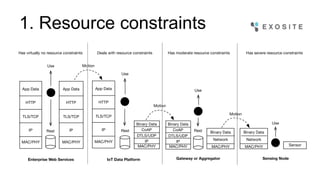
1. Resource constraints
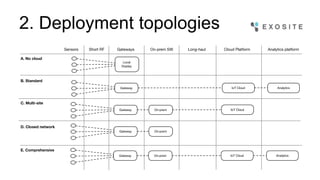
2. Deployment topologies
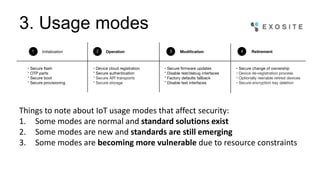
3. Usage modes
Things to note about IoT usage modes that affect security:
1. Some modes are normal and standard solutions exist
2. Some modes are new and standards are still emerging
3. Some modes are becoming more vulnerable due to resource constraints
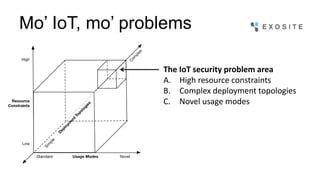
The IoT security problem area
A. High resource constraints
B. Complex deployment topologies
C. Novel usage modes
Mo’ IoT, mo’ problems
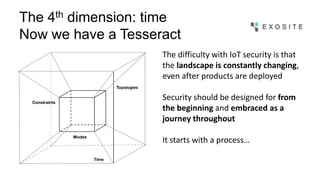
The 4th dimension: time
Now we have a Tesseract
The difficulty with IoT security is that
the landscape is constantly changing,
even after products are deployed
Security should be designed for from
the beginning and embraced as a
journey throughout
It starts with a process…
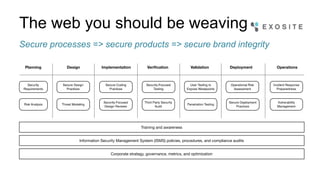
The web you should be weaving
Secure processes => secure products => secure brand integrity
Conclusion
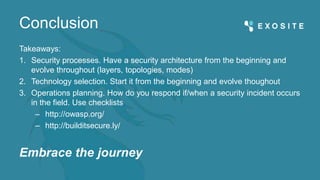
Takeaways:
1. Security processes. Have a security architecture from the beginning and
evolve throughout (layers, topologies, modes)
2. Technology selection. Start it from the beginning and evolve thoughout
3. Operations planning. How do you respond if/when a security incident occurs
in the field. Use checklists
– http://owasp.org/
– http://builditsecure.ly/
Embrace the journey
Thank you
Mark Benson
@markbenson

IoT security patterns

  • 1.
    IoT Security Patterns MarkBenson, CTO @markbenson
  • 2.
    The IoT opportunity RecentEconomist survey: Expect their company to be using IoT within 3 years “IoT is our single biggest threat AND biggest opportunity over the next 10 years” – Brand-name fortune 500 board of directors *Source: ABI Research, Cisco, Craig Hallum Estimates 0 2 4 6 8 10 12 14 16 18 20 $0 $50 $100 $150 $200 $250 DevicesBillions MarketSizeBillions Big Data Analytics (53% CAGR) Connected Device Platforms (33% CAGR) Platforms (33% CAGR) Application Enablement Platforms (32% CAGR) Value Added Services (26% CAGR) System Integration Services (24% CAGR) Hardware (23% CAGR) Connectivity (12% CAGR) Internet-connected devices (Cisco Estimate) 95%
  • 3.
    The Internet ofThings? More like the Internet of Attack Vectors • Attack surfaces are expanding rapidly • Physical access to systems is becoming easier • Consumer privacy concerns are rising • Consequences of a breach are becoming more severe (critical infrastructure, brand deterioration, data privacy issues, etc.) • Product companies are being forced outside of their comfort zones • Three dimensions that make IoT security challenging…
  • 4.
  • 5.
  • 6.
    3. Usage modes Thingsto note about IoT usage modes that affect security: 1. Some modes are normal and standard solutions exist 2. Some modes are new and standards are still emerging 3. Some modes are becoming more vulnerable due to resource constraints
  • 7.
    The IoT securityproblem area A. High resource constraints B. Complex deployment topologies C. Novel usage modes Mo’ IoT, mo’ problems
  • 8.
    The 4th dimension:time Now we have a Tesseract The difficulty with IoT security is that the landscape is constantly changing, even after products are deployed Security should be designed for from the beginning and embraced as a journey throughout It starts with a process…
  • 9.
    The web youshould be weaving Secure processes => secure products => secure brand integrity
  • 10.
    Conclusion Takeaways: 1. Security processes.Have a security architecture from the beginning and evolve throughout (layers, topologies, modes) 2. Technology selection. Start it from the beginning and evolve thoughout 3. Operations planning. How do you respond if/when a security incident occurs in the field. Use checklists – http://owasp.org/ – http://builditsecure.ly/ Embrace the journey
  • 11.