CHEMICAL BONDS
Hydrogen bond, dative bond and metallic bond
XYLENE AR
HYDROGEN BOND
• Hydrogen bonding is the interaction between hydrogen atoms with atoms that
have high electronegativity such as nitrogen, oxygen and fluorine.
 Hydrogen bonds are also inter-molecular attractions that affect the physical
properties of materials namely 1) melting point & boiling point, 2) solubility
in water, 3) solubility in organic solvents and 4) electrical conductivity.
1) Melting point and boiling point
- depending on the strength of the attraction between the molecules.
- the presence of hydrogen bonds increases the melting point and boiling point.
- larger molecules have a higher Van der Waals attraction, therefore higher heat energy
is required to break the bond. This makes the melting point and boiling point high
 Molecular materials or covalent compounds have different types of
intermolecular attraction namely hydrogen bonds and Van der Waals forces.
H-O-H
HYDROGEN BOND
 An essential requirement for the formation of hydrogen bonds :
1) A hydrogen atom fused with an atom has high electronegativity properties.
2) Pair/s of lone electrons on the electronegative atom
Ammonia liquid
Hydrogen bond
Hydrogen fluoride
Lone pair of electrons
 For example :
H
H-N-H
Lone pair of electrons
Water molecule
H F Lone pair of electrons
HYDROGEN BOND
 2) Solubility in water
- the molecular substances must have the ability to form hydrogen bonds
- therefore, the molecular material is insoluble in water/ only slightly soluble
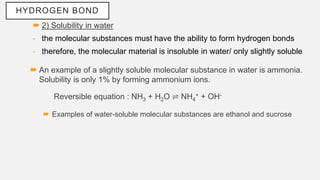
 An example of a slightly soluble molecular substance in water is ammonia.
Solubility is only 1% by forming ammonium ions.
Reversible equation : NH3 + H2O ⇌ NH4
+ + OH-
 Examples of water-soluble molecular substances are ethanol and sucrose
HYDROGEN BOND
 3) Solubility in organic solvents
- Solvents and solutes have a Van der Waals attraction between the molecules.
- It makes the molecular material soluble in organic solvents
 4) Electrical conductivity
- Electrical conduction occurs as a result of the movement of electrons in a
molecule, however, electrons cannot move properly because there is not
enough space between molecules in a solid or liquid.
- It makes the molecular material unable to conduct electricity.
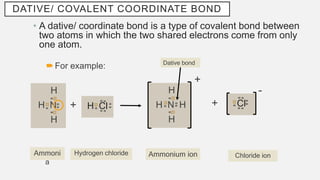
DATIVE/ COVALENT COORDINATE BOND
• A dative/ coordinate bond is a type of covalent bond between
two atoms in which the two shared electrons come from only
one atom.
For example:
H
H N
H
Dative bond
H Cl
+
H
H N H
H
Cl
+
+
-
Ammonium ion
Ammoni
a
Hydrogen chloride Chloride ion
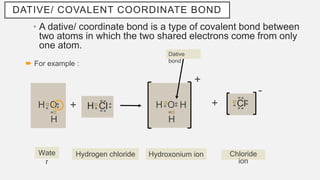
DATIVE/ COVALENT COORDINATE BOND
• A dative/ coordinate bond is a type of covalent bond between
two atoms in which the two shared electrons come from only
one atom.
 For example :
H O
H
Dative
bond
H Cl
+ H O H
H
Cl
+
+
-
Hydroxonium ion
Wate
r
Hydrogen chloride Chloride
ion
METALLIC BONDING
• Bonds formed between metal atoms
• The valence electrons of metal atoms are depleted to form an ocean of
electrons
• The electrostatic force between the ocean of electrons and positively
charged metal ions forms a metal bond
• Metals can conduct electricity because electrons in an ocean of
electrons can move freely and carry a charge.
+
+ + +
+
+
+ + +
+ + +
e-
e-
e-
e-
e-
e-
e-
e-
e-

Hydrogen dative bonds

  • 1.
    CHEMICAL BONDS Hydrogen bond,dative bond and metallic bond XYLENE AR
  • 2.
    HYDROGEN BOND • Hydrogenbonding is the interaction between hydrogen atoms with atoms that have high electronegativity such as nitrogen, oxygen and fluorine.  Hydrogen bonds are also inter-molecular attractions that affect the physical properties of materials namely 1) melting point & boiling point, 2) solubility in water, 3) solubility in organic solvents and 4) electrical conductivity. 1) Melting point and boiling point - depending on the strength of the attraction between the molecules. - the presence of hydrogen bonds increases the melting point and boiling point. - larger molecules have a higher Van der Waals attraction, therefore higher heat energy is required to break the bond. This makes the melting point and boiling point high  Molecular materials or covalent compounds have different types of intermolecular attraction namely hydrogen bonds and Van der Waals forces.
  • 3.
    H-O-H HYDROGEN BOND  Anessential requirement for the formation of hydrogen bonds : 1) A hydrogen atom fused with an atom has high electronegativity properties. 2) Pair/s of lone electrons on the electronegative atom Ammonia liquid Hydrogen bond Hydrogen fluoride Lone pair of electrons  For example : H H-N-H Lone pair of electrons Water molecule H F Lone pair of electrons
  • 4.
    HYDROGEN BOND  2)Solubility in water - the molecular substances must have the ability to form hydrogen bonds - therefore, the molecular material is insoluble in water/ only slightly soluble  An example of a slightly soluble molecular substance in water is ammonia. Solubility is only 1% by forming ammonium ions. Reversible equation : NH3 + H2O ⇌ NH4 + + OH-  Examples of water-soluble molecular substances are ethanol and sucrose
  • 5.
    HYDROGEN BOND  3)Solubility in organic solvents - Solvents and solutes have a Van der Waals attraction between the molecules. - It makes the molecular material soluble in organic solvents  4) Electrical conductivity - Electrical conduction occurs as a result of the movement of electrons in a molecule, however, electrons cannot move properly because there is not enough space between molecules in a solid or liquid. - It makes the molecular material unable to conduct electricity.
  • 6.
    DATIVE/ COVALENT COORDINATEBOND • A dative/ coordinate bond is a type of covalent bond between two atoms in which the two shared electrons come from only one atom. For example: H H N H Dative bond H Cl + H H N H H Cl + + - Ammonium ion Ammoni a Hydrogen chloride Chloride ion
  • 7.
    DATIVE/ COVALENT COORDINATEBOND • A dative/ coordinate bond is a type of covalent bond between two atoms in which the two shared electrons come from only one atom.  For example : H O H Dative bond H Cl + H O H H Cl + + - Hydroxonium ion Wate r Hydrogen chloride Chloride ion
  • 8.
    METALLIC BONDING • Bondsformed between metal atoms • The valence electrons of metal atoms are depleted to form an ocean of electrons • The electrostatic force between the ocean of electrons and positively charged metal ions forms a metal bond • Metals can conduct electricity because electrons in an ocean of electrons can move freely and carry a charge. + + + + + + + + + + + + e- e- e- e- e- e- e- e- e-