SCIENCE VOCABULARY:
Identify the following sentences.
1. They are referred to as the outermost electrons.
2. It is the measure of tendency of an atom to attract
more electrons.
3. It is an energy needed by atoms to pull or remove
one or more electrons from neutral atom.
4. A dot diagram symbol written around the element
symbol.
5. The stability of an atom of having complete valence
electrons.
MELCS: Explain how ions are formed; (S9MT-IIe-f-16)
Enabling Objective
 Describe chemical bonding.
 Identify the types of chemical bonding.
Review:
Identify the following as ELEMENT or
COMPOUND.
1.Sodium Chloride
2.Potassium
3.Nitrogen
4.Carbon dioxide
5.Krypton
Review:
Identify the following elements, which is
METAL, NON-METAL and METALLOIDS.
1.Fe
2.Si
3.He
4.Mg
5.B
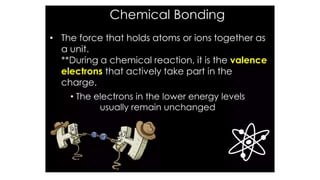
• A lasting attraction between atoms, ions or
molecules that enables the formation of
CHEMICAL COMPOUNDS
 Chemical bonding -the formation of a chemical bond between two or more atoms,
molecules, or ions to give rise to a chemical compound. These chemical bonds are what
keep the atoms together in the resulting compound.
 BOND = a force that holds groups of atoms together
 TO BOND = when two atoms become held together
 The bond may result from the electrostatic force of attraction between atoms with
opposite charges, or through the sharing of electrons as in the covalent bonds.
 There are three primary types of bonding: ionic, covalent, and metallic.
• also called “Molecular bond”
• a chemical bond that
IONIC BOND COVALENT BOND
Between a metal and
a non-metal
A transfer of electrons
Conducts electricity
when melted or
dissolved
Crystal solids
(made of ions)
• Between 2 non-metals
• A sharing of electrons
• Does not conduct
electricity
• Solid, liquid or gas
(made of molecules)
IONIC BOND
Compounds are
crystal lattices of
positive and
negative ions
Chemical formula is
the formula unit (the
formula that repeats)
COVALENT BOND
Compounds are
distinct and separate
units called
molecules.
Chemical formula can
be called a molecular
formula
IONIC BOND
Compounds are
crystal lattices of
positive and
negative ions
Chemical formula is
the formula unit (the
formula that repeats)
Inorganic
compounds are
often ionic.
COVALENT BOND
Compounds are
distinct and separate
units called
molecules.
Chemical formula can
be called a molecular
formula
Organic (biological)
molecules are covalent
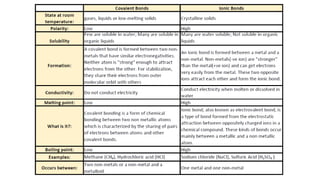
IONIC COMPOUNDS COVALENT COMPOUNDS
Non-metal + Metal Non-metal + Non-metal
Transfer electrons (metal to non-metal) Sharing of electrons
Positive and negative charges No charges
Solid at room temperature(25°C)
Soluble in water
Solid, Liquid , gas at room temperature
Insoluble in water
High melting and boiling points Low melting and boiling points
High attraction between particles
Good conductors of electricity
Weak attraction between molecules
Good insulators
Ionic and Covalent Bonding .pptx

Ionic and Covalent Bonding .pptx

  • 1.
    SCIENCE VOCABULARY: Identify thefollowing sentences. 1. They are referred to as the outermost electrons. 2. It is the measure of tendency of an atom to attract more electrons. 3. It is an energy needed by atoms to pull or remove one or more electrons from neutral atom. 4. A dot diagram symbol written around the element symbol. 5. The stability of an atom of having complete valence electrons.
  • 2.
    MELCS: Explain howions are formed; (S9MT-IIe-f-16) Enabling Objective  Describe chemical bonding.  Identify the types of chemical bonding.
  • 3.
    Review: Identify the followingas ELEMENT or COMPOUND. 1.Sodium Chloride 2.Potassium 3.Nitrogen 4.Carbon dioxide 5.Krypton
  • 4.
    Review: Identify the followingelements, which is METAL, NON-METAL and METALLOIDS. 1.Fe 2.Si 3.He 4.Mg 5.B
  • 11.
    • A lastingattraction between atoms, ions or molecules that enables the formation of CHEMICAL COMPOUNDS
  • 12.
     Chemical bonding-the formation of a chemical bond between two or more atoms, molecules, or ions to give rise to a chemical compound. These chemical bonds are what keep the atoms together in the resulting compound.  BOND = a force that holds groups of atoms together  TO BOND = when two atoms become held together  The bond may result from the electrostatic force of attraction between atoms with opposite charges, or through the sharing of electrons as in the covalent bonds.  There are three primary types of bonding: ionic, covalent, and metallic.
  • 21.
    • also called“Molecular bond” • a chemical bond that
  • 24.
    IONIC BOND COVALENTBOND Between a metal and a non-metal A transfer of electrons Conducts electricity when melted or dissolved Crystal solids (made of ions) • Between 2 non-metals • A sharing of electrons • Does not conduct electricity • Solid, liquid or gas (made of molecules)
  • 25.
    IONIC BOND Compounds are crystallattices of positive and negative ions Chemical formula is the formula unit (the formula that repeats) COVALENT BOND Compounds are distinct and separate units called molecules. Chemical formula can be called a molecular formula
  • 26.
    IONIC BOND Compounds are crystallattices of positive and negative ions Chemical formula is the formula unit (the formula that repeats) Inorganic compounds are often ionic. COVALENT BOND Compounds are distinct and separate units called molecules. Chemical formula can be called a molecular formula Organic (biological) molecules are covalent
  • 40.
    IONIC COMPOUNDS COVALENTCOMPOUNDS Non-metal + Metal Non-metal + Non-metal Transfer electrons (metal to non-metal) Sharing of electrons Positive and negative charges No charges Solid at room temperature(25°C) Soluble in water Solid, Liquid , gas at room temperature Insoluble in water High melting and boiling points Low melting and boiling points High attraction between particles Good conductors of electricity Weak attraction between molecules Good insulators