Periods: Energy Levels (n)
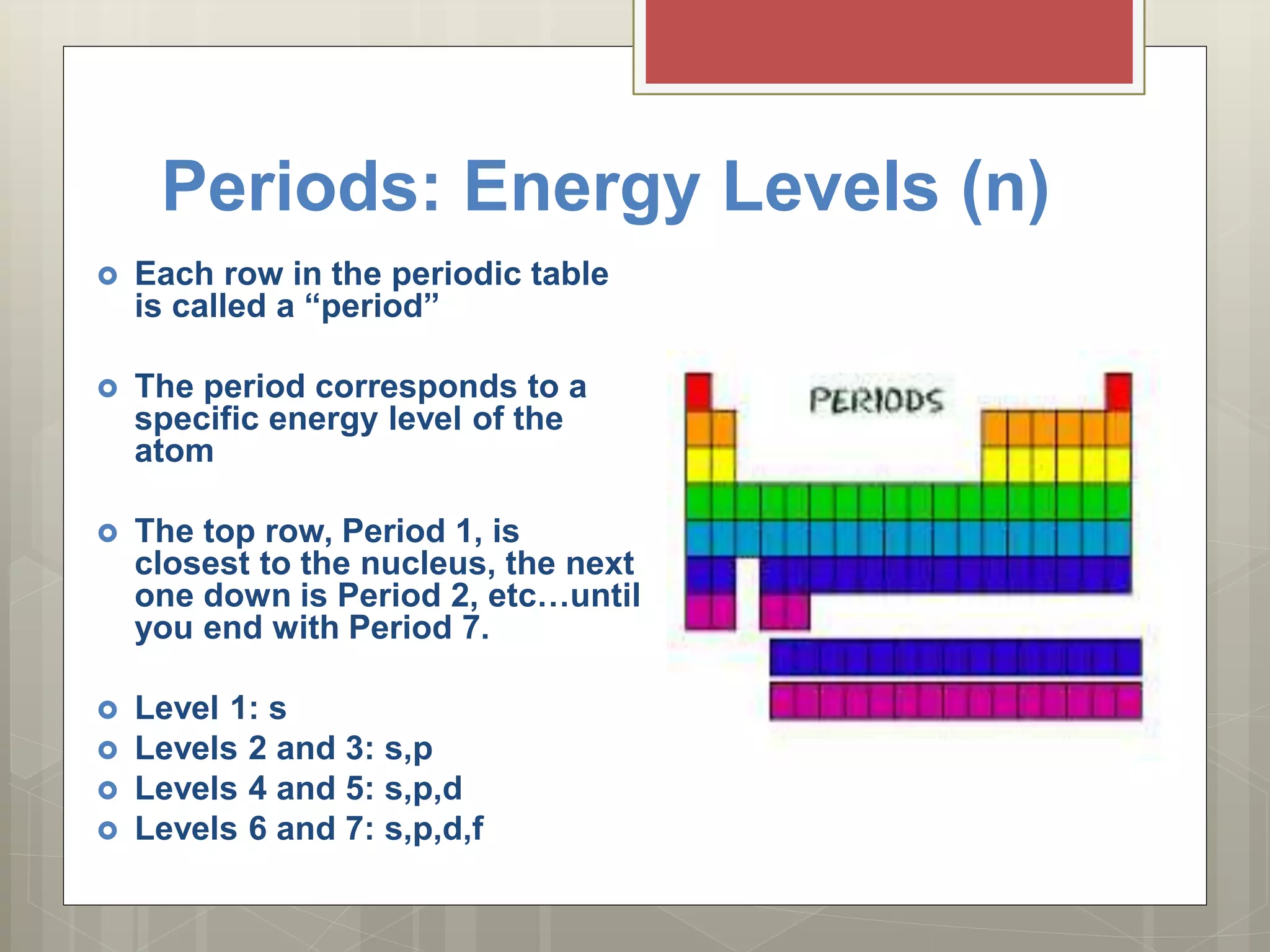
 Each row in the periodic table
is called a “period”
 The period corresponds to a
specific energy level of the
atom
 The top row, Period 1, is
closest to the nucleus, the next
one down is Period 2, etc…until
you end with Period 7.
 Level 1: s
 Levels 2 and 3: s,p
 Levels 4 and 5: s,p,d
 Levels 6 and 7: s,p,d,f
Groups: Valence Electrons
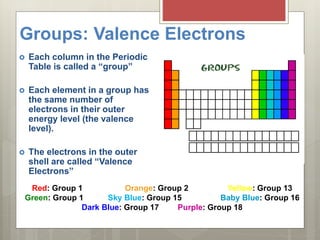
 Each column in the Periodic
Table is called a “group”
 Each element in a group has
the same number of
electrons in their outer
energy level (the valence
level).
 The electrons in the outer
shell are called “Valence
Electrons”
Red: Group 1 Orange: Group 2 Yellow: Group 13
Green: Group 1 Sky Blue: Group 15 Baby Blue: Group 16
Dark Blue: Group 17 Purple: Group 18
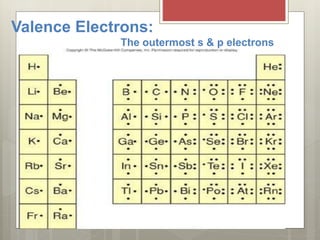
Valence Electrons
 Valence electrons are the electrons in the
highest occupied energy level of the atom.
 Valence electrons are the only electrons
generally involved in bond formation
(which we will talk about in the next unit!)
Bohr Atomic Structures
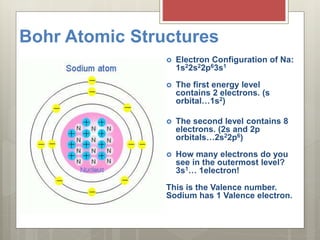
 Electron Configuration of Na:
1s22s22p63s1
 The first energy level
contains 2 electrons. (s
orbital…1s2)
 The second level contains 8
electrons. (2s and 2p
orbitals…2s22p6)
 How many electrons do you
see in the outermost level?
3s1… 1electron!
This is the Valence number.
Sodium has 1 Valence electron.
Pattern: Families
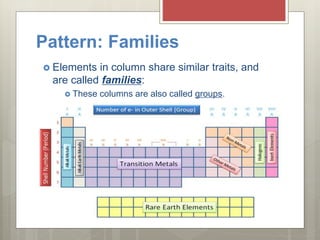
 Elements in column share similar traits, and
are called families:
 These columns are also called groups.
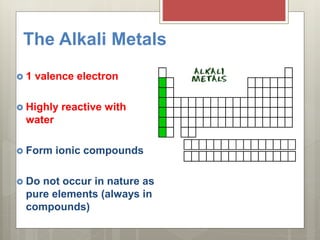
The Alkali Metals
 1 valence electron
 Highly reactive with
water
 Form ionic compounds
 Do not occur in nature as
pure elements (always in
compounds)
Alkaline-Earth
Metals
 Have 2 valence electrons
 Reactive, but less
reactive than alkali
metals
 Are ductile, malleable
and have a silvery luster
 Form alkaline (basic)
solutions) when put in
water
Transition metals…
and inner transition metals
 Are less reactive than
groups 1 and 2.
 Tend not to react in water.
 Are malleable and ductile,
but still harder than group 1
& 2.
 Tend to be solids at room
temperature.
 Are good conductors of
electricity and heat. **Inner transition metals
tend to be radioactive
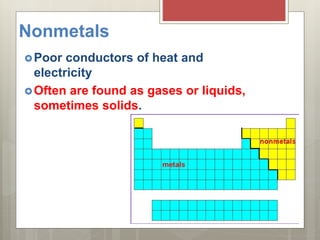
Nonmetals
Poor conductors of heat and
electricity
Often are found as gases or liquids,
sometimes solids.
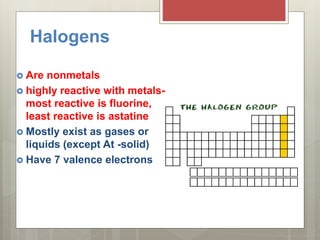
Halogens
 Are nonmetals
 highly reactive with metals-
most reactive is fluorine,
least reactive is astatine
 Mostly exist as gases or
liquids (except At -solid)
 Have 7 valence electrons
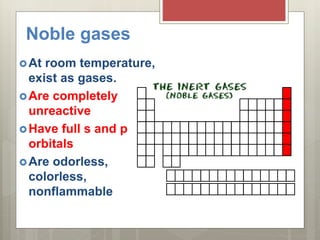
Noble gases
At room temperature,
exist as gases.
Are completely
unreactive
Have full s and p
orbitals
Are odorless,
colorless,
nonflammable
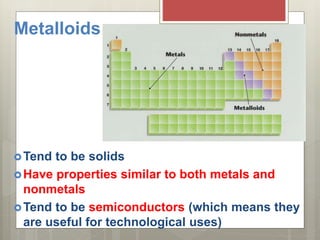
Metalloids
Tend to be solids
Have properties similar to both metals and
nonmetals
Tend to be semiconductors (which means they
are useful for technological uses)
Valence Electrons:
The outermost s & p electrons
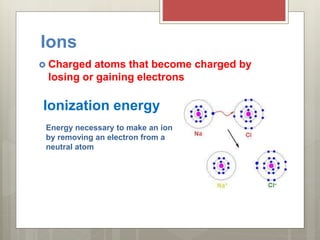
Ions
 Charged atoms that become charged by
losing or gaining electrons
Ionization energy
Energy necessary to make an ion
by removing an electron from a
neutral atom
Rule #1 to remember!
 When an element loses an electron, we
can think of it as being given away, which
is a good thing or POSITIVE thing to do.
Group 1 Elements
 H, Li, Na, K, Rb, Cs, Fr
 Achieve a stable octet (full outer shell) by
losing 1 electron, which forms a +1 ion
 H+ , Li+ , Na+ , etc…
Group 2 Elements
 Be, Mg, Ca, Sr, Ba, Ra
 Achieve a stable octet by losing 2
electrons, which forms a +2 ion
 Be2+, Mg2+, Ca2+, etc…
Rule #2 to remember!
 When an element gains an electron, we
can think of it as it is being stolen from
another ion, which is a bad or NEGATIVE
thing to do.
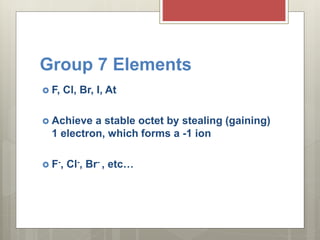
Group 7 Elements
 F, Cl, Br, I, At
 Achieve a stable octet by stealing (gaining)
1 electron, which forms a -1 ion
 F-, Cl-, Br- , etc…
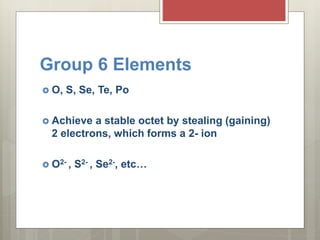
Group 6 Elements
 O, S, Se, Te, Po
 Achieve a stable octet by stealing (gaining)
2 electrons, which forms a 2- ion
 O2- , S2- , Se2-, etc…

Orbital Diagrams Valance Electrons Electron Dot Structures PPT.pptx

  • 1.
    Periods: Energy Levels(n)  Each row in the periodic table is called a “period”  The period corresponds to a specific energy level of the atom  The top row, Period 1, is closest to the nucleus, the next one down is Period 2, etc…until you end with Period 7.  Level 1: s  Levels 2 and 3: s,p  Levels 4 and 5: s,p,d  Levels 6 and 7: s,p,d,f
  • 2.
    Groups: Valence Electrons Each column in the Periodic Table is called a “group”  Each element in a group has the same number of electrons in their outer energy level (the valence level).  The electrons in the outer shell are called “Valence Electrons” Red: Group 1 Orange: Group 2 Yellow: Group 13 Green: Group 1 Sky Blue: Group 15 Baby Blue: Group 16 Dark Blue: Group 17 Purple: Group 18
  • 3.
    Valence Electrons  Valenceelectrons are the electrons in the highest occupied energy level of the atom.  Valence electrons are the only electrons generally involved in bond formation (which we will talk about in the next unit!)
  • 4.
    Bohr Atomic Structures Electron Configuration of Na: 1s22s22p63s1  The first energy level contains 2 electrons. (s orbital…1s2)  The second level contains 8 electrons. (2s and 2p orbitals…2s22p6)  How many electrons do you see in the outermost level? 3s1… 1electron! This is the Valence number. Sodium has 1 Valence electron.
  • 5.
    Pattern: Families  Elementsin column share similar traits, and are called families:  These columns are also called groups.
  • 6.
    The Alkali Metals 1 valence electron  Highly reactive with water  Form ionic compounds  Do not occur in nature as pure elements (always in compounds)
  • 7.
    Alkaline-Earth Metals  Have 2valence electrons  Reactive, but less reactive than alkali metals  Are ductile, malleable and have a silvery luster  Form alkaline (basic) solutions) when put in water
  • 8.
    Transition metals… and innertransition metals  Are less reactive than groups 1 and 2.  Tend not to react in water.  Are malleable and ductile, but still harder than group 1 & 2.  Tend to be solids at room temperature.  Are good conductors of electricity and heat. **Inner transition metals tend to be radioactive
  • 9.
    Nonmetals Poor conductors ofheat and electricity Often are found as gases or liquids, sometimes solids.
  • 10.
    Halogens  Are nonmetals highly reactive with metals- most reactive is fluorine, least reactive is astatine  Mostly exist as gases or liquids (except At -solid)  Have 7 valence electrons
  • 11.
    Noble gases At roomtemperature, exist as gases. Are completely unreactive Have full s and p orbitals Are odorless, colorless, nonflammable
  • 12.
    Metalloids Tend to besolids Have properties similar to both metals and nonmetals Tend to be semiconductors (which means they are useful for technological uses)
  • 13.
  • 14.
    Ions  Charged atomsthat become charged by losing or gaining electrons Ionization energy Energy necessary to make an ion by removing an electron from a neutral atom
  • 15.
    Rule #1 toremember!  When an element loses an electron, we can think of it as being given away, which is a good thing or POSITIVE thing to do.
  • 16.
    Group 1 Elements H, Li, Na, K, Rb, Cs, Fr  Achieve a stable octet (full outer shell) by losing 1 electron, which forms a +1 ion  H+ , Li+ , Na+ , etc…
  • 17.
    Group 2 Elements Be, Mg, Ca, Sr, Ba, Ra  Achieve a stable octet by losing 2 electrons, which forms a +2 ion  Be2+, Mg2+, Ca2+, etc…
  • 18.
    Rule #2 toremember!  When an element gains an electron, we can think of it as it is being stolen from another ion, which is a bad or NEGATIVE thing to do.
  • 19.
    Group 7 Elements F, Cl, Br, I, At  Achieve a stable octet by stealing (gaining) 1 electron, which forms a -1 ion  F-, Cl-, Br- , etc…
  • 20.
    Group 6 Elements O, S, Se, Te, Po  Achieve a stable octet by stealing (gaining) 2 electrons, which forms a 2- ion  O2- , S2- , Se2-, etc…