BANASTHALI VIDYAPITH
TOPIC : ION CHROMATOGRAPHY
ION EXCLUSION
CHROMATOGRAPHY
PRESENTED BY:
SWATI VERMA
M.PHARM
(PHARMACEUTICAL CHEMISTRY)
• Ion chromatography (or ion-exchange chromatography) is a chromatography
process that separates ions and polar molecules based on their affinity to the ion
exchanger. It works on almost any kind of charged molecule—including large
proteins, small nucleotides, and amino acids.
The two types of ion chromatography are :
anion-exchange
 cation-exchange
• It is often used in protein purification, water analysis, and quality control
• The water-soluble and charged molecules such as proteins, amino acids, and
peptides bind to moieties which are oppositely charged by forming ionic bonds
to the insoluble stationary phase.
• The equilibrated stationary phase consists of an ionizable functional group where
the targeted molecules of a mixture to be separated and quantified can bind while
passing through the column.
 If cationic species (type M+) are to be separated, a cationic column with a
stationary phase capable of exchanging cations will be employed. Such a
phase is constituted, for example, of a polymer containing sulfonate (−SO−3)
groups. Consequently the stationary phase is the equivalent of a polyanion.
Alternately, if anionic species (type A−) are to be separated, an anionic column
is selected capable of exchanging anions. This is achieved, for example, by
employing a polymer containing quaternary ammonium groups
• In anion exchangers, positively charged groups on the stationary phase attract
solute anions.
• Cation exchangers contain covalently bound, negatively charged sites that
attract solute cations.
• Mixture of similar charged ions separated by using ion exchange resin.
• Reversible exchange of similar charged ions.
• Cations and anions can be separated.
PRINCIPLE
 Reversible exchange of ions between ions present in the solution and ion exchange resin
 This chromatographic technique is concerned with the separation of ions and polar
compounds. Stationary phases contain ionic sites that create dipolar interactions with
the analytes present in the sample. If a compound has a high charge density, it will be
retained a longer time by the stationary phase.
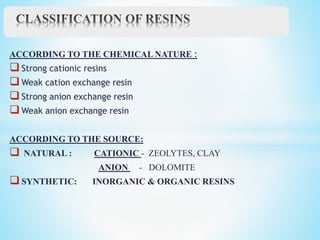
ACCORDING TO THE CHEMICAL NATURE :
Strong cationic resins
Weak cation exchange resin
Strong anion exchange resin
Weak anion exchange resin
ACCORDING TO THE SOURCE:
 NATURAL : CATIONIC - ZEOLYTES, CLAY
ANION - DOLOMITE
SYNTHETIC: INORGANIC & ORGANIC RESINS
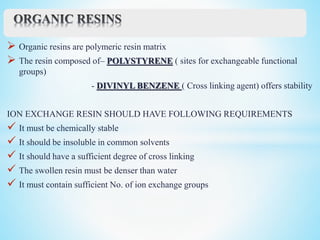
 Organic resins are polymeric resin matrix
 The resin composed of– POLYSTYRENE ( sites for exchangeable functional
groups)
- DIVINYL BENZENE ( Cross linking agent) offers stability
ION EXCHANGE RESIN SHOULD HAVE FOLLOWING REQUIREMENTS
 It must be chemically stable
 It should be insoluble in common solvents
 It should have a sufficient degree of cross linking
 The swollen resin must be denser than water
 It must contain sufficient No. of ion exchange groups
• Resins are amorphous ( non crystalline) particles of organic material.
• Polystyrene resins for ion exchange are made by copolymerization of styrene and
divinylbenzene whose content can vary from ( 1-16%) to increase the extent of
cross-linking of the insoluble hydrocarbon polymer.
• The benzene ring can be modified to produce a cation-exchange resin, containing
sulfonate groups ( -SO3
-), or an anion-exchange resin, containing ammonium
groups ( -NR3
+).
• The resin becomes more rigid and less porous as cross linking increases. Lightly
cross link resins permit rapid equilibration of solute between the inside and the
outside of the particle.
• Resins with little cross- linking swell in water. This hydration decreases both
density of ion-exchange sites and the selectivity of the resin for different ions.
• More heavily cross-linking resins exhibit less swelling and higher exchange
capacity and selectivity.
when an ion exchanger is placed in an electrolyte solution, the concentration of electrolyte is higher
outside the resin than inside it. The equilibrium between ions in solution and ions inside the resin is
called Donnan equilibrium.
Consider a quaternary ammonium anion-exchange resin ( R+) in its cl- form immersed in a solution of
KCL. Let the concentration of an ion inside the resin be [X]i and the concentration outside the resin is
[X]o. It can be shown from thermodynamics that the ion product inside the resin is approximately equal
to the product outside the resin:
[K+]i[Cl]i = [K+]o[Cl-]o (1)
From considerations of charge balance, we know that
[K+]o = [cl-]o (2)
Inside the resin, there are three charged species, and the charge balance is
[R+]i + [K+]i = [ Cl-]i (3)
Where [R+] is the concentration of quaternary ammonium ions attached to the resin.
Substituting equation (2) and (3) into equation (1) gives
[K+]i([K+]i + [R+]i) = [K+]o
2
Which says that [K+]o must be greater than [K+]i
Ions with the same charge as the resin are excluded. The counterion, Cl-, is not
excluded from the resin. There is no electrostatic barrier to penetration of an anion into
the resin. Anion exchange takes place freely in the quaternary ammonium resin even
though cations are repelled from the resin.
The Donnan equilibrium is the basis of ion-exclusion chromatography. Because dilute
electrolytes are excluded from the resin, they pass through a column faster than
nonelectrolytes, such as sugar, which freely penetrate the resin. When a solution of
NaCl and sugar is applied to an ion-exchange column, NaCl emerges from the column
before the sugar.
The high concentration of positive charges within the resin repels cation from the
resin.
Three classes
of ion
exchangers:
RESIN GELS
INORGANIC
EXCHANGERS
• Ion-exchange resins are used for applications involving small molecules (FM <
500), which can penetrate the small pores of the resin. A mesh-size of 100/200 is
suitable for most work. Higher mesh no. lead to finer separation but slower
column operation. For preparative separations, the sample may occupy 10-20% of
the column volume. Ion exchange gels are used for larger molecules, which cannot
penetrate the pores of resin. Separations involving harsh chemical conditions
(high temperature, high radiation levels, strongly basic solution, or powerful
oxidising agents) employ inorganic ion exchangers, such as hydrous oxides of Zr,
Ti &Sn
• Gradient elution with increasing ionic strength or changing pH is extremely
valuable in ion-exchange chromatography.
*
Mobile
phase
COLUMNPUMP
INJECTOR
WITH
LOOP
SUPPRESSOR
CONDUCTIVITY
DETECTOR
CHROMATOGRAM
IC
DIRECT
IC VIA
SUPPRESSOR
1. COLUMN
Glass, stainless steel or polymer
Length: Diameter ratio 20:100 to 100:1
2. PACKING THE COLUMN
Wet packing method
3. APPLICATION OF THE SAMPLE
After packing sample is added to the top of the column, use syringe or pipette
4. MOBILE PHASE
Acid, Alkali, Buffers
5. ELUTION
Components of mixture separated & move down the column at different rates depending
upon the affinity of the ion for ion exchanger.
6. ANALYSIS OF THE ELUATE
spectrophotometric., Flame photometry, Polarography, Conductometric
*
The column packing consist of a reactive layer bonded to inert polymeric particles.
Stationary phases must satisfy implicitly a number of requirements as narrow
granulometric distribution (mono-disperse), large specific surface area, mechanical
resistance, stability under acid and basic pH and rapid ion transfer.
 POLYMER BASED MATERIAL
The best known stationary phases are issued from copolymers of styrene and
divinylbenzene, in order to obtain packings hard enough to resist pressure in the
column. They are made of spherical particles with diameters of 5 to 15m that are
modified on the surface in order to introduce functional groups with acidic or
basic properties. For cation separation the cation-exchangers are usually a
sulfonic or carboxylic acid. Thus, concentrated sulphuric acid is used to attack
the accessible aromatic rings of the copolymer surface to link SO3H functional
groups.
A strongly acidic phase is obtained – for cation exchange – on which the anion is
fixed to the macromolecule while the cation can be reversibly exchanged with
other cationic species present in the mobile phase. These materials are stable over
a wide range of pHs and have an exchange capacity of a few mmol/g.
 Another approach for obtaining these stationary phases is based on
the copolymerization of a mixture of two acrylic monomers. One is
anionic (or cationic), according to the nature of the phase desired,
and the other is polyhydroxylated , in order to ensure the
hydrophilic character of the stationary phase.
 SILICA BASED MATERIAL
Porous silica particles can serve to support, through covalent bonding,
alkyl phenyl chains carrying sulfonated groups or quaternary
ammonium groups. This fixation step is similar to that used to obtain
bonded silica phases developed in HPLC.
 IC mobile phases are usually 100 % aqueous with organic or inorganic buffers
to control selectivity and when necessary a small content of methanol or
acetone used to dissolve certain samples having a low degree of ionization.
 Depending upon the type of stationary phase, the counter ions present in the
mobile phase derived from acids (perchloric, benzoic, phthalic, methane
sulfonic), or bases (the most popular for anion analyses are variants of sodium
hydroxide and sodium carbonate/bicarbonate).
 The pH is adjusted according to the separation to be achieved. The eluents can
be prepared in advance remembering that basic solutions have a tendency to
absorb atmospheric carbon dioxide, with for consequence a modification in the
retention times.
a. NATURE AND PROPERTIES OF ION EXCHANGE RESINS
Cross linking & swelling is important
If more cross- linking, they are more rigid, but swelling is less
swells less- separation of ions of different sizes is difficult
b. NATURE OF EXCHANGING IONS
1. valency of ions
2. Size of ions
3. Polarizability
4. Concentration of solution
5. Concentration & charge of ions
*
• The first peak in a chromatogram for anions results from the ionic strength of
the injected sample being different than that of the eluent.
• The anions in the sample displace the anions (e.g. carbonate/bicarbonate or
hydroxide) that are adsorbed onto the column packing. These displaced
anions move forwards with the mobile phase and when passed through the
detector appear as a positive peak .
• If a suppressor is installed at the column outlet and if carbonates make the
mobile phase, a negative peak, called the ‘water dip’ is often present. This
peak is the result of carbon dioxide which is formed in the suppressed mobile
phase (in the form of carbonic acid)
In order to calculate the mass concentration of a compound appearing as a peak on
a chromatogram, two basic conditions must be met-
First, an authentic sample of the compound to be measured should be available,
as a reference, to determine the detector sensitivity to this compound.
Second, a software giving the heights or areas of the different eluting peaks of
interest is also required.
All of the quantitative methods in chromatography rely on these two principles.
They are comparative but not absolute methods.
The signal recovered by the detector is sampled by the analogue–digital
converter (ADC) with a frequency of a few hundreds hertz in order to yield an
accurate reproduction of the narrowest peaks in chromatograms obtained from
GC with capillary columns. Each software package allows baseline correction,
treatment of negative signals and all incorporate different methods to calculate
peak areas
1. Ion exchange can be used to convert one salt to another
2. Softening of water
3. Ion exchange is used to purify water
4. Separation of inorganic ions
5. Separation of sugars, amino acids
6. Ion exchange column in HPLC
*
ION EXCLUSION
CHROMATOGRAPHY
• Ion exclusion chromatography (IEC) is a relatively old separation technique.
• IEC provides a useful technique for the separation of ionic from non ionic
compounds and to separate mixture of acids using an ion exchange stationary
phase in which ionic substances are rejected by the resin while non ionic or
partially ionized substances are retained and separated by partition between the
liquid inside the resin particles and the liquid outside the particles.
• The ionic substances therefore pass quickly through the column, but non ionic
(molecular) or partially ionized substances are held up and are eluted more
slowly.
• IEC is also referred to by several other names, including ion exclusion partition
chromatography, ion chromatography-exclusion mode, and Donnan
exclusion chromatography.
*
 The characteristic feature of ion exclusion chromatography is that the
sign of the electric charge of the dissociated functional groups on the ion
exchange resin is the same as that on the ionic compound analysed.
 It follows that negatively charged ions, e.g. dissociated acidic
compounds, are separated on cation-exchange resins with anionic (usually
sulphonic) functional groups.
 By analogy, positively charged species are separated on anion- exchange
resins containing cationic ( tetra alkyl ammonium functional groups)
• The same column can be used for both ion exchange chromatography and
ion exclusion chromatography
• The eluents used are usually water, water/ organic solvent mixtures,
dilute (high conductivity) aqueous solutions of a strong acid, or dilute
(low conductivity) aqueous solutions of a weak acid.
• A conductivity detector is commonly used to monitor the column effluent
and, when the eluent conductivity is extremely high, a suitable suppressor
system is generally used.
• Using IEC, it is possible to separate weakly ionized anions such as Sulfide,
phosphate, nitrite, aliphatic carboxylic acids, aromatic carboxylic acids,
bicarbonate, borate, aliphatic alcohols, sugars, amino acids, water, and
others, as well as ammonium, amines, and others, based on a
combination of the separation mechanisms of ion-exclusion, adsorption,
and/or size exclusion.
• For specific requirement of ion exclusion chromatography, large ion
exchange capacity is preferential.
• Columns capacity is increased by increasing its dimensions,
maximising the concentration of functional groups on the support,
and using a strong ion-exchanger.
• The usual supports are based on macro-porous copolymers of
styrene and divinylbenzene in which the degree of cross-linking is
characterized by the concentration of divinylbenzene in the reaction
mixture.
• In conventional IEC of ionic and non ionic substances, a
poly(styrene)divinylbenzene (PS-DVB) based strongly acidic cation
exchange resin in the hydrogen form is used exclusively as the
separation column. The resin bed can be considered to consist of three
distinct components:
1. a solid resin network with charged functional groups (the membrane);
2. occluded liquid with in the resin beads(the stationary phase); and
3. the mobile liquid between the resin beads (the mobile phase or
eluent).
• The ion exchange resin acts as a hypothetical semipermeable membrane
(a Donnan membrane) separating the two liquid phases .This membrane
is permeable only for non ionic substances.
*
• Ion exclusion chromatographic systems consist of the same
components as any high performance liquid chromatography
instrument.
• A UV detector is often used for the sensitive and selective detection
of UV absorbing substances such as aliphatic and aromatic carboxylic
acids.
• However, this detector is insensitive to some aliphatic carboxylic
acids, sugars and alcohols.
• Although a refractive index detector can be used as a bulk detector,
the detection response is not high and the detector is So
temperature sensitive.
*
• The most popular and universal detection method for IEC is conductivity.
• In order to decrease or suppress the eluent background conductivity, a
membrane suppressor system can be used (normally when the eluent is highly
conducting), or alternatively a weak acid eluent (aliphatic or aromatic
carboxylic acids)of low conductivity can be used.
• The most common resins used in ion exclusion chromatography are high
capacity PS-DVB-based strongly acidic cation exchange resins of 5 µ particle
size.
• Although the IEC separation of ionic and non ionic substances may be carried
out simply by using water as the eluent.
• dilute aqueous solutions of some mineral acids or weak carboxylic acids give
greatly improved peak shape and are therefore preferred for high resolution
separations.
• Decreasing the pH of the eluent increases the retention of weakly ionized
analytes such as carboxylic acids owing to a decrease in the fraction of the
ionized analytes present.
• Therefore, the eluent pH is a very important factor in regulating retention
volumes in IEC. Organic modifiers such as methanol and acetonitrile are often
used to reduce hydrophobic interactions of the analytes with the resin.
• When the column is filled with water, which is pumped
through as mobile phase, the water soluble molecules build
up hydration spheres around the dissociated functional
groups of the support.
• water contained in the pores of the support and in the
hydration spheres is immobilized thus forming the stationary
phase
• The basic mechanism is that the neutral and uncharged
molecules can penetrate the resin, whereas similarly
charged co-ions are repelled owing to the presence of
dissociated functional group immobilized in the stationary
phase.
*
• Because the concentration of the ions in the stationary phase exceeds that
in the mobile phase, osmotic forces tend to drive water into the resin
causing it to swell.
• This swelling is less for more highly cross-linked stationary phases and for
mobile phases containing high concentration of ions.
• The ratio of the concentration of ionized to neutral form of an analysed
compound is determined by its dissociation constant and is equivalent to
solute effective charge.
• Solute retention therefore depends on this constant.
• Strong acids that are completely dissociated are electronically repulsed .
As a consequence they are eluted un separated in the column dead volume
( VM) , which corresponds to the volume of the mobile phase in the
column.
• On the other hand un dissociated molecules are able to enter the resin
network.
• They are eluted together with a retention volume equal to the sum of
the inner and dead column volumes.
• The inner column volume means just the column of the volume of
stationary phase.
• Only electrolytes of the intermediate strength can be separated by this
method.
• For these electrolytes higher retention volumes are expected for
species with higher pka value
To optimize an IEC separation, careful selection of the following experimental
parameters must
be made:
1. The type of matrix used as the stationary phase (PS-DVB, polymethacrylate
or silica);
2. The nature of the functional group (e.g. strong or weak acid);
3. The ion exchange capacity (low or high);
4. The nature of the eluent (e.g. strong or weak acids);
5. The pH of the eluent
6. The amount of organic modifier present in the eluent; and
7. The type of detector used (universal or selective).
1. Carboxylic acids
Separation of carboxylic acids is probably the most common use of IEC. Carboxylic
acids such as formic, acetic, propionic, butyric, valeric, citric, tartaric, oxalic,
malonic, benzoic, salicylic, and others have been determined using UV and
conductivity detection
2. Weak Inorganic Acids and Bases
IEC has found increasing use for the determination of weakly ionized inorganic
anions such as Sulfide, nitrite, phosphate, sulfate, Arsenite, arsenate, bicarbonate,
borate and cyanide
.
 Neutral compounds such as sugars and alcohols can be separated by IEC, One
of the more significant applications of IEC is its use for the determination of
water. Using a short column packed with PS-DVB based cation exchangers in
the hydrogen form and eluting with methanol containing a small amount of
strong acid, a peak for water can be obtained with a spectrophotometric detector
at 310nm. This method is applicable to the determination of water in some
organic solvents.
3. Strong Inorganic Acids
a simple and highly sensitive method involving simultaneous ion exclusion/cation
exchange chromatography with conductimetric detection on a polymethacrylate-based
weakly acidic cation exchange resin in the hydrogen form has been developed for the
determination of inorganic strong acid anions such as sulfate, nitrate and chloride ions,
and strong base cations such as sodium, ammonium potassium, magnesium and calcium
ions commonly found in acid rainwater
Ion exchange

Ion exchange

  • 1.
    BANASTHALI VIDYAPITH TOPIC :ION CHROMATOGRAPHY ION EXCLUSION CHROMATOGRAPHY PRESENTED BY: SWATI VERMA M.PHARM (PHARMACEUTICAL CHEMISTRY)
  • 2.
    • Ion chromatography(or ion-exchange chromatography) is a chromatography process that separates ions and polar molecules based on their affinity to the ion exchanger. It works on almost any kind of charged molecule—including large proteins, small nucleotides, and amino acids. The two types of ion chromatography are : anion-exchange  cation-exchange • It is often used in protein purification, water analysis, and quality control • The water-soluble and charged molecules such as proteins, amino acids, and peptides bind to moieties which are oppositely charged by forming ionic bonds to the insoluble stationary phase. • The equilibrated stationary phase consists of an ionizable functional group where the targeted molecules of a mixture to be separated and quantified can bind while passing through the column.
  • 3.
     If cationicspecies (type M+) are to be separated, a cationic column with a stationary phase capable of exchanging cations will be employed. Such a phase is constituted, for example, of a polymer containing sulfonate (−SO−3) groups. Consequently the stationary phase is the equivalent of a polyanion. Alternately, if anionic species (type A−) are to be separated, an anionic column is selected capable of exchanging anions. This is achieved, for example, by employing a polymer containing quaternary ammonium groups • In anion exchangers, positively charged groups on the stationary phase attract solute anions. • Cation exchangers contain covalently bound, negatively charged sites that attract solute cations.
  • 5.
    • Mixture ofsimilar charged ions separated by using ion exchange resin. • Reversible exchange of similar charged ions. • Cations and anions can be separated. PRINCIPLE  Reversible exchange of ions between ions present in the solution and ion exchange resin  This chromatographic technique is concerned with the separation of ions and polar compounds. Stationary phases contain ionic sites that create dipolar interactions with the analytes present in the sample. If a compound has a high charge density, it will be retained a longer time by the stationary phase.
  • 7.
    ACCORDING TO THECHEMICAL NATURE : Strong cationic resins Weak cation exchange resin Strong anion exchange resin Weak anion exchange resin ACCORDING TO THE SOURCE:  NATURAL : CATIONIC - ZEOLYTES, CLAY ANION - DOLOMITE SYNTHETIC: INORGANIC & ORGANIC RESINS
  • 10.
     Organic resinsare polymeric resin matrix  The resin composed of– POLYSTYRENE ( sites for exchangeable functional groups) - DIVINYL BENZENE ( Cross linking agent) offers stability ION EXCHANGE RESIN SHOULD HAVE FOLLOWING REQUIREMENTS  It must be chemically stable  It should be insoluble in common solvents  It should have a sufficient degree of cross linking  The swollen resin must be denser than water  It must contain sufficient No. of ion exchange groups
  • 11.
    • Resins areamorphous ( non crystalline) particles of organic material. • Polystyrene resins for ion exchange are made by copolymerization of styrene and divinylbenzene whose content can vary from ( 1-16%) to increase the extent of cross-linking of the insoluble hydrocarbon polymer. • The benzene ring can be modified to produce a cation-exchange resin, containing sulfonate groups ( -SO3 -), or an anion-exchange resin, containing ammonium groups ( -NR3 +). • The resin becomes more rigid and less porous as cross linking increases. Lightly cross link resins permit rapid equilibration of solute between the inside and the outside of the particle. • Resins with little cross- linking swell in water. This hydration decreases both density of ion-exchange sites and the selectivity of the resin for different ions. • More heavily cross-linking resins exhibit less swelling and higher exchange capacity and selectivity.
  • 14.
    when an ionexchanger is placed in an electrolyte solution, the concentration of electrolyte is higher outside the resin than inside it. The equilibrium between ions in solution and ions inside the resin is called Donnan equilibrium. Consider a quaternary ammonium anion-exchange resin ( R+) in its cl- form immersed in a solution of KCL. Let the concentration of an ion inside the resin be [X]i and the concentration outside the resin is [X]o. It can be shown from thermodynamics that the ion product inside the resin is approximately equal to the product outside the resin: [K+]i[Cl]i = [K+]o[Cl-]o (1) From considerations of charge balance, we know that [K+]o = [cl-]o (2) Inside the resin, there are three charged species, and the charge balance is [R+]i + [K+]i = [ Cl-]i (3) Where [R+] is the concentration of quaternary ammonium ions attached to the resin. Substituting equation (2) and (3) into equation (1) gives [K+]i([K+]i + [R+]i) = [K+]o 2 Which says that [K+]o must be greater than [K+]i
  • 15.
    Ions with thesame charge as the resin are excluded. The counterion, Cl-, is not excluded from the resin. There is no electrostatic barrier to penetration of an anion into the resin. Anion exchange takes place freely in the quaternary ammonium resin even though cations are repelled from the resin. The Donnan equilibrium is the basis of ion-exclusion chromatography. Because dilute electrolytes are excluded from the resin, they pass through a column faster than nonelectrolytes, such as sugar, which freely penetrate the resin. When a solution of NaCl and sugar is applied to an ion-exchange column, NaCl emerges from the column before the sugar. The high concentration of positive charges within the resin repels cation from the resin. Three classes of ion exchangers: RESIN GELS INORGANIC EXCHANGERS
  • 16.
    • Ion-exchange resinsare used for applications involving small molecules (FM < 500), which can penetrate the small pores of the resin. A mesh-size of 100/200 is suitable for most work. Higher mesh no. lead to finer separation but slower column operation. For preparative separations, the sample may occupy 10-20% of the column volume. Ion exchange gels are used for larger molecules, which cannot penetrate the pores of resin. Separations involving harsh chemical conditions (high temperature, high radiation levels, strongly basic solution, or powerful oxidising agents) employ inorganic ion exchangers, such as hydrous oxides of Zr, Ti &Sn • Gradient elution with increasing ionic strength or changing pH is extremely valuable in ion-exchange chromatography. *
  • 17.
  • 19.
    1. COLUMN Glass, stainlesssteel or polymer Length: Diameter ratio 20:100 to 100:1 2. PACKING THE COLUMN Wet packing method 3. APPLICATION OF THE SAMPLE After packing sample is added to the top of the column, use syringe or pipette 4. MOBILE PHASE Acid, Alkali, Buffers 5. ELUTION Components of mixture separated & move down the column at different rates depending upon the affinity of the ion for ion exchanger. 6. ANALYSIS OF THE ELUATE spectrophotometric., Flame photometry, Polarography, Conductometric *
  • 20.
    The column packingconsist of a reactive layer bonded to inert polymeric particles. Stationary phases must satisfy implicitly a number of requirements as narrow granulometric distribution (mono-disperse), large specific surface area, mechanical resistance, stability under acid and basic pH and rapid ion transfer.  POLYMER BASED MATERIAL The best known stationary phases are issued from copolymers of styrene and divinylbenzene, in order to obtain packings hard enough to resist pressure in the column. They are made of spherical particles with diameters of 5 to 15m that are modified on the surface in order to introduce functional groups with acidic or basic properties. For cation separation the cation-exchangers are usually a sulfonic or carboxylic acid. Thus, concentrated sulphuric acid is used to attack the accessible aromatic rings of the copolymer surface to link SO3H functional groups. A strongly acidic phase is obtained – for cation exchange – on which the anion is fixed to the macromolecule while the cation can be reversibly exchanged with other cationic species present in the mobile phase. These materials are stable over a wide range of pHs and have an exchange capacity of a few mmol/g.
  • 21.
     Another approachfor obtaining these stationary phases is based on the copolymerization of a mixture of two acrylic monomers. One is anionic (or cationic), according to the nature of the phase desired, and the other is polyhydroxylated , in order to ensure the hydrophilic character of the stationary phase.  SILICA BASED MATERIAL Porous silica particles can serve to support, through covalent bonding, alkyl phenyl chains carrying sulfonated groups or quaternary ammonium groups. This fixation step is similar to that used to obtain bonded silica phases developed in HPLC.
  • 22.
     IC mobilephases are usually 100 % aqueous with organic or inorganic buffers to control selectivity and when necessary a small content of methanol or acetone used to dissolve certain samples having a low degree of ionization.  Depending upon the type of stationary phase, the counter ions present in the mobile phase derived from acids (perchloric, benzoic, phthalic, methane sulfonic), or bases (the most popular for anion analyses are variants of sodium hydroxide and sodium carbonate/bicarbonate).  The pH is adjusted according to the separation to be achieved. The eluents can be prepared in advance remembering that basic solutions have a tendency to absorb atmospheric carbon dioxide, with for consequence a modification in the retention times.
  • 23.
    a. NATURE ANDPROPERTIES OF ION EXCHANGE RESINS Cross linking & swelling is important If more cross- linking, they are more rigid, but swelling is less swells less- separation of ions of different sizes is difficult b. NATURE OF EXCHANGING IONS 1. valency of ions 2. Size of ions 3. Polarizability 4. Concentration of solution 5. Concentration & charge of ions *
  • 24.
    • The firstpeak in a chromatogram for anions results from the ionic strength of the injected sample being different than that of the eluent. • The anions in the sample displace the anions (e.g. carbonate/bicarbonate or hydroxide) that are adsorbed onto the column packing. These displaced anions move forwards with the mobile phase and when passed through the detector appear as a positive peak . • If a suppressor is installed at the column outlet and if carbonates make the mobile phase, a negative peak, called the ‘water dip’ is often present. This peak is the result of carbon dioxide which is formed in the suppressed mobile phase (in the form of carbonic acid)
  • 26.
    In order tocalculate the mass concentration of a compound appearing as a peak on a chromatogram, two basic conditions must be met- First, an authentic sample of the compound to be measured should be available, as a reference, to determine the detector sensitivity to this compound. Second, a software giving the heights or areas of the different eluting peaks of interest is also required. All of the quantitative methods in chromatography rely on these two principles. They are comparative but not absolute methods. The signal recovered by the detector is sampled by the analogue–digital converter (ADC) with a frequency of a few hundreds hertz in order to yield an accurate reproduction of the narrowest peaks in chromatograms obtained from GC with capillary columns. Each software package allows baseline correction, treatment of negative signals and all incorporate different methods to calculate peak areas
  • 28.
    1. Ion exchangecan be used to convert one salt to another 2. Softening of water 3. Ion exchange is used to purify water 4. Separation of inorganic ions 5. Separation of sugars, amino acids 6. Ion exchange column in HPLC *
  • 29.
  • 30.
    • Ion exclusionchromatography (IEC) is a relatively old separation technique. • IEC provides a useful technique for the separation of ionic from non ionic compounds and to separate mixture of acids using an ion exchange stationary phase in which ionic substances are rejected by the resin while non ionic or partially ionized substances are retained and separated by partition between the liquid inside the resin particles and the liquid outside the particles. • The ionic substances therefore pass quickly through the column, but non ionic (molecular) or partially ionized substances are held up and are eluted more slowly. • IEC is also referred to by several other names, including ion exclusion partition chromatography, ion chromatography-exclusion mode, and Donnan exclusion chromatography. *
  • 31.
     The characteristicfeature of ion exclusion chromatography is that the sign of the electric charge of the dissociated functional groups on the ion exchange resin is the same as that on the ionic compound analysed.  It follows that negatively charged ions, e.g. dissociated acidic compounds, are separated on cation-exchange resins with anionic (usually sulphonic) functional groups.  By analogy, positively charged species are separated on anion- exchange resins containing cationic ( tetra alkyl ammonium functional groups)
  • 32.
    • The samecolumn can be used for both ion exchange chromatography and ion exclusion chromatography • The eluents used are usually water, water/ organic solvent mixtures, dilute (high conductivity) aqueous solutions of a strong acid, or dilute (low conductivity) aqueous solutions of a weak acid. • A conductivity detector is commonly used to monitor the column effluent and, when the eluent conductivity is extremely high, a suitable suppressor system is generally used. • Using IEC, it is possible to separate weakly ionized anions such as Sulfide, phosphate, nitrite, aliphatic carboxylic acids, aromatic carboxylic acids, bicarbonate, borate, aliphatic alcohols, sugars, amino acids, water, and others, as well as ammonium, amines, and others, based on a combination of the separation mechanisms of ion-exclusion, adsorption, and/or size exclusion.
  • 33.
    • For specificrequirement of ion exclusion chromatography, large ion exchange capacity is preferential. • Columns capacity is increased by increasing its dimensions, maximising the concentration of functional groups on the support, and using a strong ion-exchanger. • The usual supports are based on macro-porous copolymers of styrene and divinylbenzene in which the degree of cross-linking is characterized by the concentration of divinylbenzene in the reaction mixture.
  • 34.
    • In conventionalIEC of ionic and non ionic substances, a poly(styrene)divinylbenzene (PS-DVB) based strongly acidic cation exchange resin in the hydrogen form is used exclusively as the separation column. The resin bed can be considered to consist of three distinct components: 1. a solid resin network with charged functional groups (the membrane); 2. occluded liquid with in the resin beads(the stationary phase); and 3. the mobile liquid between the resin beads (the mobile phase or eluent). • The ion exchange resin acts as a hypothetical semipermeable membrane (a Donnan membrane) separating the two liquid phases .This membrane is permeable only for non ionic substances. *
  • 35.
    • Ion exclusionchromatographic systems consist of the same components as any high performance liquid chromatography instrument. • A UV detector is often used for the sensitive and selective detection of UV absorbing substances such as aliphatic and aromatic carboxylic acids. • However, this detector is insensitive to some aliphatic carboxylic acids, sugars and alcohols. • Although a refractive index detector can be used as a bulk detector, the detection response is not high and the detector is So temperature sensitive. *
  • 36.
    • The mostpopular and universal detection method for IEC is conductivity. • In order to decrease or suppress the eluent background conductivity, a membrane suppressor system can be used (normally when the eluent is highly conducting), or alternatively a weak acid eluent (aliphatic or aromatic carboxylic acids)of low conductivity can be used. • The most common resins used in ion exclusion chromatography are high capacity PS-DVB-based strongly acidic cation exchange resins of 5 µ particle size. • Although the IEC separation of ionic and non ionic substances may be carried out simply by using water as the eluent.
  • 37.
    • dilute aqueoussolutions of some mineral acids or weak carboxylic acids give greatly improved peak shape and are therefore preferred for high resolution separations. • Decreasing the pH of the eluent increases the retention of weakly ionized analytes such as carboxylic acids owing to a decrease in the fraction of the ionized analytes present. • Therefore, the eluent pH is a very important factor in regulating retention volumes in IEC. Organic modifiers such as methanol and acetonitrile are often used to reduce hydrophobic interactions of the analytes with the resin.
  • 38.
    • When thecolumn is filled with water, which is pumped through as mobile phase, the water soluble molecules build up hydration spheres around the dissociated functional groups of the support. • water contained in the pores of the support and in the hydration spheres is immobilized thus forming the stationary phase • The basic mechanism is that the neutral and uncharged molecules can penetrate the resin, whereas similarly charged co-ions are repelled owing to the presence of dissociated functional group immobilized in the stationary phase. *
  • 39.
    • Because theconcentration of the ions in the stationary phase exceeds that in the mobile phase, osmotic forces tend to drive water into the resin causing it to swell. • This swelling is less for more highly cross-linked stationary phases and for mobile phases containing high concentration of ions. • The ratio of the concentration of ionized to neutral form of an analysed compound is determined by its dissociation constant and is equivalent to solute effective charge. • Solute retention therefore depends on this constant. • Strong acids that are completely dissociated are electronically repulsed . As a consequence they are eluted un separated in the column dead volume ( VM) , which corresponds to the volume of the mobile phase in the column.
  • 40.
    • On theother hand un dissociated molecules are able to enter the resin network. • They are eluted together with a retention volume equal to the sum of the inner and dead column volumes. • The inner column volume means just the column of the volume of stationary phase. • Only electrolytes of the intermediate strength can be separated by this method. • For these electrolytes higher retention volumes are expected for species with higher pka value
  • 42.
    To optimize anIEC separation, careful selection of the following experimental parameters must be made: 1. The type of matrix used as the stationary phase (PS-DVB, polymethacrylate or silica); 2. The nature of the functional group (e.g. strong or weak acid); 3. The ion exchange capacity (low or high); 4. The nature of the eluent (e.g. strong or weak acids); 5. The pH of the eluent 6. The amount of organic modifier present in the eluent; and 7. The type of detector used (universal or selective).
  • 43.
    1. Carboxylic acids Separationof carboxylic acids is probably the most common use of IEC. Carboxylic acids such as formic, acetic, propionic, butyric, valeric, citric, tartaric, oxalic, malonic, benzoic, salicylic, and others have been determined using UV and conductivity detection 2. Weak Inorganic Acids and Bases IEC has found increasing use for the determination of weakly ionized inorganic anions such as Sulfide, nitrite, phosphate, sulfate, Arsenite, arsenate, bicarbonate, borate and cyanide .
  • 44.
     Neutral compoundssuch as sugars and alcohols can be separated by IEC, One of the more significant applications of IEC is its use for the determination of water. Using a short column packed with PS-DVB based cation exchangers in the hydrogen form and eluting with methanol containing a small amount of strong acid, a peak for water can be obtained with a spectrophotometric detector at 310nm. This method is applicable to the determination of water in some organic solvents. 3. Strong Inorganic Acids a simple and highly sensitive method involving simultaneous ion exclusion/cation exchange chromatography with conductimetric detection on a polymethacrylate-based weakly acidic cation exchange resin in the hydrogen form has been developed for the determination of inorganic strong acid anions such as sulfate, nitrate and chloride ions, and strong base cations such as sodium, ammonium potassium, magnesium and calcium ions commonly found in acid rainwater