PREPARED BY
ANUSREE V
SECOND SEMESTER M.PHARM
PHARMACEUTICAL CHEMISTRY
AL SHIFA COLLEGE OF PHARMACY
ION EXCLUSION
CHROMATOGRAPHY
OTHER NAMES
 Ion exclusion partition chromatography
 Ion chromatography – Exclusion mode
 Donnan exclusion chromatography
2
INTRODUCTION
 First introduced by Wheaton and Bauman in 1953.
 IEC is a technique used to separate ionic compounds
from non-ionic compounds and to separate mixtures
of acids.
3
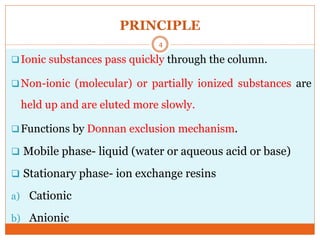
PRINCIPLE
Ionic substances pass quickly through the column.
Non-ionic (molecular) or partially ionized substances are
held up and are eluted more slowly.
Functions by Donnan exclusion mechanism.
 Mobile phase- liquid (water or aqueous acid or base)
 Stationary phase- ion exchange resins
a) Cationic
b) Anionic
4
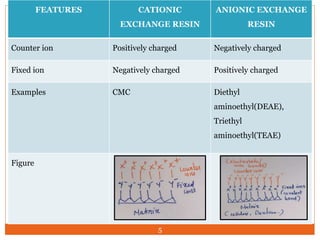
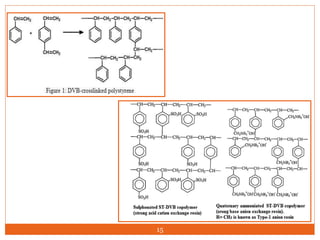
FEATURES CATIONIC
EXCHANGE RESIN
ANIONIC EXCHANGE
RESIN
Counter ion Positively charged Negatively charged
Fixed ion Negatively charged Positively charged
Examples CMC Diethyl
aminoethyl(DEAE),
Triethyl
aminoethyl(TEAE)
Figure
5
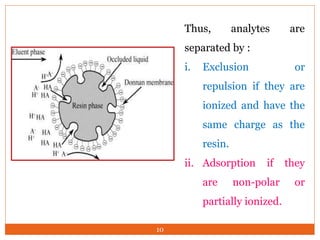
Chromatographic system consists of 3 phases.
1. Mobile phase
2. Resin phase
3. Occluded liquid phase
 The mobile phase passes through the interstitial volume
existing between the beads of the ion-exchange resin.
 The resin phase is the solid resin network and functionalized
groups, which can be considered to be a semipermeable ion-
exchange membrane separating the flowing mobile phase
from the stationary occluded liquid inside the resin.
6
 An occluded liquid phase is formed by mobile phase that
becomes trapped within the pores of the resin phase.
 This trapped liquid acts as the stationary phase of the
system.
 When the column is filled with water, pumped through as a
mobile phase, the water molecules accumulate as
hydration spheres around the dissociated functional groups
of the support.
 Water contained in the pores of the support and in the
hydration spheres is immobilized, thus forming the
stationary phase.
7
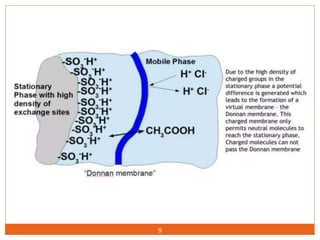
 The commonly accepted retention mechanism of IEC
involves the formation of a pseudo semi-permeable
membrane around the resin stationary phase.
 The ion exclusion process relies on the establishment of an
electrical potential between a dil. MP and a stationary phase
of high ion exchange site concentration.
Ionic solutes of similar charge to the stationary phase
(generally sulfonated cation exchangers are used for weak
acid analytes), experience repulsion from the resin surface,
where as neutral species can penetrate the resins pores and
stationary occluded phase, thus experiencing retention.
8
9
Thus, analytes are
separated by :
i. Exclusion or
repulsion if they are
ionized and have the
same charge as the
resin.
ii. Adsorption if they
are non-polar or
partially ionized.
10
ADVANTAGES
 The eluent is water or aqueous acid or base with little or no
organic modifier, which offers environmental and economic
benefits in addition to compatibility with aqueous sample
matrices.
 Difficult separations such as simple aliphatic carboxylic
acids (e.g., formate, acetate, propionate and butyrate) are
possible.
11
 It is compatible with a wide range of detection methods.
 The columns can be ion exchange columns, reversed-phase
or normal-phase columns, or dynamically modified reversed-
phase with an ion pairing agent.
 It is stable for long-term analysis of complex samples such as
wine or mustard.
12
INSTRUMENTATION
13
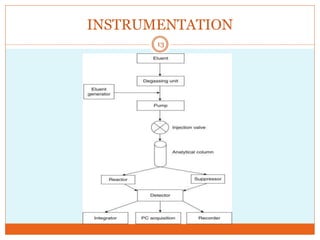
The typical ion chromatograph consists of an eluent generator
or an eluent reservoir with degassing facilities.
 An eluent delivery system including an isocratic or a gradient
high-pressure pump, sample pretreatment and injection
system, which is either a manual valve or an autosampler.
 A separation column.
Column packed with stationary phase material.
14
15
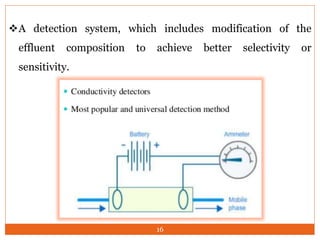
A detection system, which includes modification of the
effluent composition to achieve better selectivity or
sensitivity.
16
17
18
19
A data acquisition system, which is mainly based on personal
computers.
The main feature of typical IC instrumentation is the
suppression system allowing the decrease of background
conductivity of the effluent and providing better sensitivity
for conductimetric detection.
APPLICATIONS
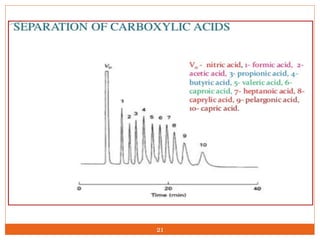
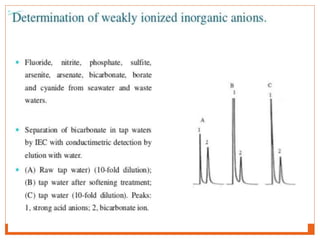
 Technique is mainly used for the separation of weak
acids, particularly carboxylic acids, but has also been
applied to the separation of carbohydrates, phenols
and amino acids and can also be used for the
separation of weak bases.
20
21
22
23
24
25
26
REFERENCE
Skoog, Holler, Crouch; Instrumental Analysis.
Bronislaw Krzysztof Glod, Principles and appications
of ion exclusion chromatography, Acta
chromatographica, January 1997.
K.L. Ng, P.R. Haddad; ACIDS/Liquid
chromatography; Encyclopedia Separation
Science,2000.
27
Yal Yashin and A Ya Yashin, HF Walton; Ion exchange/Ion
chromatography instrumentation.
Bronislaw Krzysztof Glod, Marc Baumann; A theoretical
explanation for the retention mechanism of ion exclusion
chromatography; 12 May 2003.
Fotouh R. Mansour Christine L. Kirkpatrick Neil D.
Danielson; Ion Exclusion Chromatography of Aromatic Acids;
Journal of Chromatographic Science, Volume 51, Issue 7,
August 2013, Pages 655–665.
www.chrom-china.com
quimica.udea.edu.co
28
29
www.semanticscholar.org
 K. Tanaka, P.R. Haddad, Ion exlcusion chromatography:
liquid chromatography;Encyclopedia of Separation Science,
2000.
 B. Paull, P.N. Nesterenko, in Liquid Chromatography:
Fundamentals and Instrumentation, 2013
30

Ion exclusion chromatography

  • 1.
    PREPARED BY ANUSREE V SECONDSEMESTER M.PHARM PHARMACEUTICAL CHEMISTRY AL SHIFA COLLEGE OF PHARMACY ION EXCLUSION CHROMATOGRAPHY
  • 2.
    OTHER NAMES  Ionexclusion partition chromatography  Ion chromatography – Exclusion mode  Donnan exclusion chromatography 2
  • 3.
    INTRODUCTION  First introducedby Wheaton and Bauman in 1953.  IEC is a technique used to separate ionic compounds from non-ionic compounds and to separate mixtures of acids. 3
  • 4.
    PRINCIPLE Ionic substances passquickly through the column. Non-ionic (molecular) or partially ionized substances are held up and are eluted more slowly. Functions by Donnan exclusion mechanism.  Mobile phase- liquid (water or aqueous acid or base)  Stationary phase- ion exchange resins a) Cationic b) Anionic 4
  • 5.
    FEATURES CATIONIC EXCHANGE RESIN ANIONICEXCHANGE RESIN Counter ion Positively charged Negatively charged Fixed ion Negatively charged Positively charged Examples CMC Diethyl aminoethyl(DEAE), Triethyl aminoethyl(TEAE) Figure 5
  • 6.
    Chromatographic system consistsof 3 phases. 1. Mobile phase 2. Resin phase 3. Occluded liquid phase  The mobile phase passes through the interstitial volume existing between the beads of the ion-exchange resin.  The resin phase is the solid resin network and functionalized groups, which can be considered to be a semipermeable ion- exchange membrane separating the flowing mobile phase from the stationary occluded liquid inside the resin. 6
  • 7.
     An occludedliquid phase is formed by mobile phase that becomes trapped within the pores of the resin phase.  This trapped liquid acts as the stationary phase of the system.  When the column is filled with water, pumped through as a mobile phase, the water molecules accumulate as hydration spheres around the dissociated functional groups of the support.  Water contained in the pores of the support and in the hydration spheres is immobilized, thus forming the stationary phase. 7
  • 8.
     The commonlyaccepted retention mechanism of IEC involves the formation of a pseudo semi-permeable membrane around the resin stationary phase.  The ion exclusion process relies on the establishment of an electrical potential between a dil. MP and a stationary phase of high ion exchange site concentration. Ionic solutes of similar charge to the stationary phase (generally sulfonated cation exchangers are used for weak acid analytes), experience repulsion from the resin surface, where as neutral species can penetrate the resins pores and stationary occluded phase, thus experiencing retention. 8
  • 9.
  • 10.
    Thus, analytes are separatedby : i. Exclusion or repulsion if they are ionized and have the same charge as the resin. ii. Adsorption if they are non-polar or partially ionized. 10
  • 11.
    ADVANTAGES  The eluentis water or aqueous acid or base with little or no organic modifier, which offers environmental and economic benefits in addition to compatibility with aqueous sample matrices.  Difficult separations such as simple aliphatic carboxylic acids (e.g., formate, acetate, propionate and butyrate) are possible. 11
  • 12.
     It iscompatible with a wide range of detection methods.  The columns can be ion exchange columns, reversed-phase or normal-phase columns, or dynamically modified reversed- phase with an ion pairing agent.  It is stable for long-term analysis of complex samples such as wine or mustard. 12
  • 13.
  • 14.
    The typical ionchromatograph consists of an eluent generator or an eluent reservoir with degassing facilities.  An eluent delivery system including an isocratic or a gradient high-pressure pump, sample pretreatment and injection system, which is either a manual valve or an autosampler.  A separation column. Column packed with stationary phase material. 14
  • 15.
  • 16.
    A detection system,which includes modification of the effluent composition to achieve better selectivity or sensitivity. 16
  • 17.
  • 18.
  • 19.
    19 A data acquisitionsystem, which is mainly based on personal computers. The main feature of typical IC instrumentation is the suppression system allowing the decrease of background conductivity of the effluent and providing better sensitivity for conductimetric detection.
  • 20.
    APPLICATIONS  Technique ismainly used for the separation of weak acids, particularly carboxylic acids, but has also been applied to the separation of carbohydrates, phenols and amino acids and can also be used for the separation of weak bases. 20
  • 21.
  • 22.
  • 23.
  • 24.
  • 25.
  • 26.
  • 27.
    REFERENCE Skoog, Holler, Crouch;Instrumental Analysis. Bronislaw Krzysztof Glod, Principles and appications of ion exclusion chromatography, Acta chromatographica, January 1997. K.L. Ng, P.R. Haddad; ACIDS/Liquid chromatography; Encyclopedia Separation Science,2000. 27
  • 28.
    Yal Yashin andA Ya Yashin, HF Walton; Ion exchange/Ion chromatography instrumentation. Bronislaw Krzysztof Glod, Marc Baumann; A theoretical explanation for the retention mechanism of ion exclusion chromatography; 12 May 2003. Fotouh R. Mansour Christine L. Kirkpatrick Neil D. Danielson; Ion Exclusion Chromatography of Aromatic Acids; Journal of Chromatographic Science, Volume 51, Issue 7, August 2013, Pages 655–665. www.chrom-china.com quimica.udea.edu.co 28
  • 29.
    29 www.semanticscholar.org  K. Tanaka,P.R. Haddad, Ion exlcusion chromatography: liquid chromatography;Encyclopedia of Separation Science, 2000.  B. Paull, P.N. Nesterenko, in Liquid Chromatography: Fundamentals and Instrumentation, 2013
  • 30.