Module 5
Ion Implantation
Ion Implantation - Introduction
● The biggest limitation of thermal diffusion is that the
process is isotropic i.e. lateral diffusion cannot be
avoided, though diffusion coefficients in different
crystallographic directions might be different.
● Thus, an oxide window that serves as a mask to protect
certain regions of the wafers, can be ineffective due to
lateral diffusion
● This is especially important for doping small regions (due
to device miniaturization).
● Doping control is also difficult to achieve due to presence
of concentration gradients.
● These gradients will change in subsequent annealing steps.
Thus, there is a thermal budget associated with doping
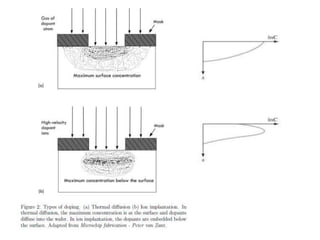
● Ion implantation is a relatively newer doping technique that
operates close to room temperature
● It is a physical process of doping, not based on a chemical
reaction
● Since ion implantation takes place close to room temperature,
it is compatible with conventional lithographic processes, so
small regions can be doped
● Also, since temperature is low, lateral diffusion is negligible
● Ion implantation is used mostly for doping of silicon in VLSI
processing.
● Ion implantation provides a technique by which the dose of
implanted dopants can be precisely controlled.
● In ion implantation, dopant atoms are ionized, isolated,
accelerated and made to impinge on the wafer surface
● These atoms penetrate greater depth into the material and
get embedded into the wafer.
● In ion implantation, an ion beam is accelerated towards the
target with an energy typically greater than 50 eV.
● The ion beam can be focused and can also be tilted with
reference to the wafer surface.
● Ion implantation can be selectively applied over regions on the
wafer by using an appropriate masking material.
● In a diffusion process the mask has to withstand high
temperatures. However in an ion implantation process the
wafer is not intentionally heated.
● For moderate doses, the temperature of the wafer would not
increase substantially above room temperature. So it is
possible to use photo resist to mask ion implantation.
● The ion energies can be in the range of a few 100s of eV
to MeV.
● In a crystalline silicon lattice, the energy required to
dislodge atoms from their lattice sites and create a stable
vacancy – interstitial pair is 15 eV.
● This means that each implanted ion would cause damage to
the crystalline structure. Hence the silicon as implanted
would not be very useful.
● Typically the damage has to be annealed out and the
implanted dopants activated by high temperature thermal
processing subsequent to implantation.
● Each ion entering the target material would go through a
series of events which would result in loss of ion energy
and the ion would eventually come to rest. These events
are random in nature.
Ion implantation Process
□ Ionised impurity atoms accelerated through
an electrostatic field strike the surface of
the wafer
□ Dose controlled by measuring the ion
current
□ Penetration depth of impurity ion controlled
by controlling electric field
Ion implantation equipment typically consists of :
• an Ionization chamber, where ions of the desired
element are produced,
• an accelerator, where the ions are electrostatically
accelerated to a high energy, and
• a target chamber, where the ions impinge on a target,
which is the material to be implanted.
• Each ion is typically a single atom, and the actual amount of
material implanted in the target is the integral over time of
the ion current. This amount is called the dose.
• The currents supplied by implanters are typically small
(microamperes) and thus the dose which can be implanted in a
reasonable amount of time is small.
• Thus, ion implantation finds application in cases where the
amount of chemical change required is small.
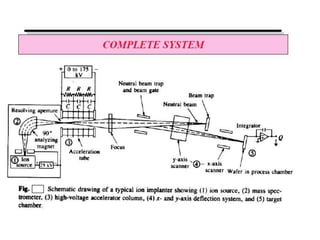
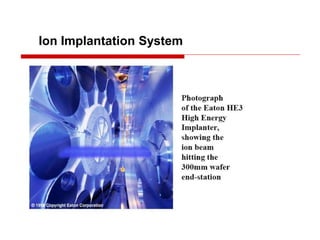
Ion Implantation System
An ion implanter is a high voltage particle
accelerator producing a high velocity beam
of ions which can penetrate the surface of
silicon target wafers
Components:
□ Ion Source
□ Mass analyser
□ High voltage accelerator
□ Scanning system
□ Target chamber
1. Ion Source
● Dopant ions such as boron, phosphorus or arsenic are created from a
gas source, so that the purity of the source can be very high but are
highly toxic
● Ion source starts with a feed gas that contains the desired implant
species. Common feed gases used in silicon technologies are BF3 ,AsH3
and PH3
● If the desired implant species is not available in the gaseous form, a
solid charge can be heated and the resultant vapor used as the
source.
● Then the feed gas is passed in a region of very low pressure that is
maintained between a heated filament and a metal plate
● The filament is maintained at a large negative potential w.r.t. plate.
● Electrons boil off the filament and are accelerated towards the
plate.
● As they do so, they collide with the gas feed molecules, transferring
some of their energy to BF3 , for example, breaks up into B++, B+ ,
BF+ , BF2 + , F+ and a variety of other species in varying quantities
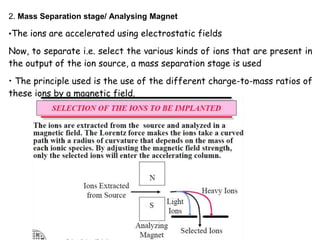
2. Mass Separation stage/ Analysing Magnet
•The ions are accelerated using electrostatic fields
Now, to separate i.e. select the various kinds of ions that are present in
the output of the ion source, a mass separation stage is used
• The principle used is the use of the different charge-to-mass ratios of
these ions by a magnetic field.
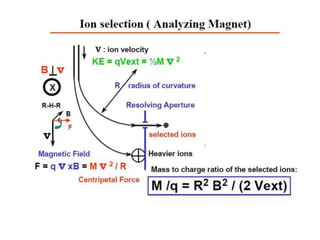
● The magnetic field of the analyzer is chosen such that only ions
with the desired charge to mass ratio can travel through
without being blocked by the analyzer walls.
● A magnetic field B is applied normal to the path of ions with
charge q and velocity v
● The force on the ions is given by F=qvB and the ions move in a
circular path of radius r and there is a centripetal force
F=M v2/R
● Therefore, qvB= M v2/R [velocity v is unchanged]
And R = Mv/qB ------------------------------------(1)
● Now for an ion accelerated through a potential Vext the velocity
is given by:
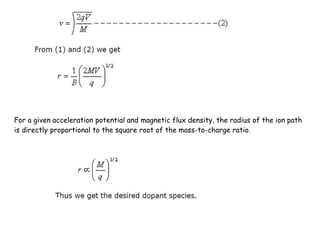
M v2 /2 = qVex , from where we get v as:
For a given acceleration potential and magnetic flux density, the radius of the ion path
is directly proportional to the square root of the mass-to-charge ratio.
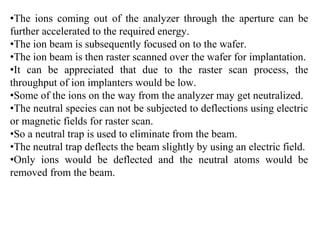
•The ions coming out of the analyzer through the aperture can be
further accelerated to the required energy.
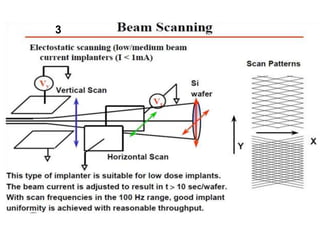
•The ion beam is subsequently focused on to the wafer.
•The ion beam is then raster scanned over the wafer for implantation.
•It can be appreciated that due to the raster scan process, the
throughput of ion implanters would be low.
•Some of the ions on the way from the analyzer may get neutralized.
•The neutral species can not be subjected to deflections using electric
or magnetic fields for raster scan.
•So a neutral trap is used to eliminate from the beam.
•The neutral trap deflects the beam slightly by using an electric field.
•Only ions would be deflected and the neutral atoms would be
removed from the beam.
3
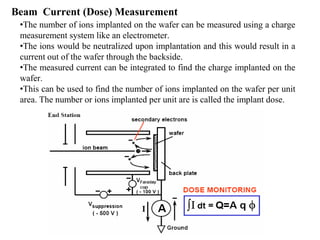
•The number of ions implanted on the wafer can be measured using a charge
measurement system like an electrometer.
•The ions would be neutralized upon implantation and this would result in a
current out of the wafer through the backside.
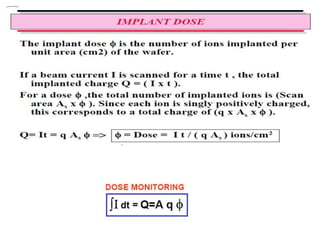
•The measured current can be integrated to find the charge implanted on the
wafer.
•This can be used to find the number of ions implanted on the wafer per unit
area. The number or ions implanted per unit are is called the implant dose.
Beam Current (Dose) Measurement
Most semiconductors are crystalline and have highly anisotropic properties. Because of the
ordered arrangement of lattice atoms, ions can penetrate more deeply into the crystal along
major axis and planes. This phenomenon is called channeling effect. To avoid channeling,
ion implantation is often carried out with an ion beam misoriented from the major axis by an
angle of at least 7 to 10 . Both Si and GaAs behave nearly as an amorphous solid when a
misoriented beam is used.
Channeling Effect
Fig. channeling effect
Ref-IcengB1
Ref pdf : implant-2[1]
Not isotropic.
= Having propertiesthat differ according to the direction of
measurement.
amorphous solid=A noncrystalline solid with nowell-defined
ordered structure.
Ion Stopping
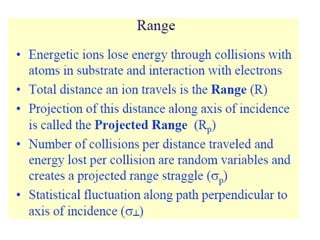
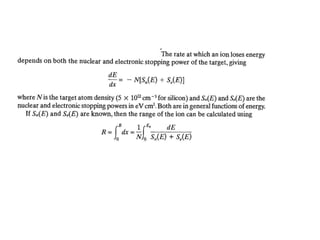
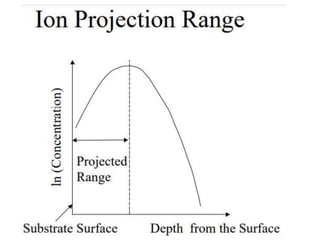
● The maximum concentration is at a
certain depth below the surface,
called range
● In thermal diffusion, the maximum
concentration is at the surface and
the concentration decreases with
depth
● The range depends on the ion type
and the energy, as shown in figure 19
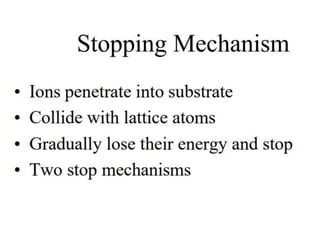
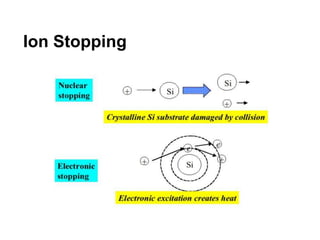
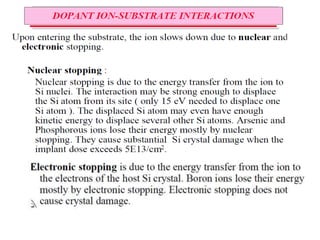
● There are two stopping mechanisms -
the nucleus of the wafer atoms and
the interaction of the positive ions
with the electrons
● In ion implantation, the beam density
(# ions/cm2), ion energy, and
orientation of the wafer matter
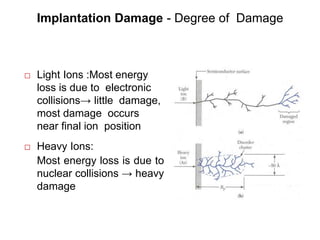
Implantation Damage - Degree of Damage
□ Light Ions :Most energy
loss is due to electronic
collisions→ little damage,
most damage occurs
near final ion position
□ Heavy Ions:
Most energy loss is due to
nuclear collisions → heavy
damage
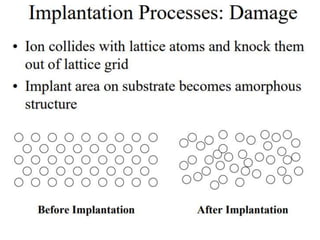
● In ion implantation, since the wafer surface is impacted by high
energy ions, it can cause damage by knocking Si atoms from their
position, causing local structural damage.
● This needs a post thermal annealing treatment to repair the
damage.
● There are two ways of doing this.
1. Tube furnace - low temperature annealing (600-1000 C). To
minimize lateral diffusion.
2. Rapid thermal annealing - higher temperatures are possible but for
shorter times.
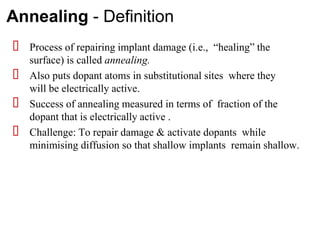
Annealing - Definition
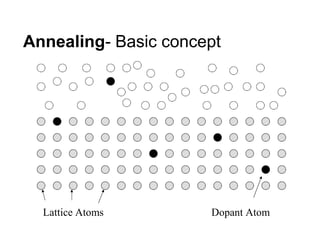
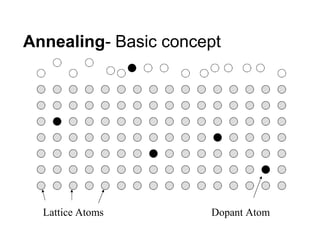
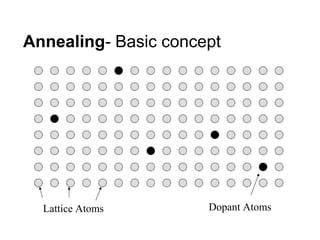
⮚ Process of repairing implant damage (i.e., “healing” the
surface) is called annealing.
⮚ Also puts dopant atoms in substitutional sites where they
will be electrically active.
⮚ Success of annealing measured in terms of fraction of the
dopant that is electrically active .
⮚ Challenge: To repair damage & activate dopants while
minimising diffusion so that shallow implants remain shallow.
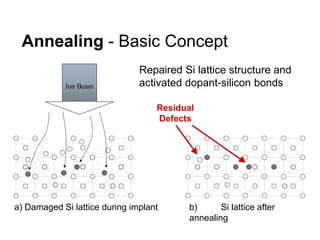
Ion Beam
Repaired Si lattice structure and
activated dopant-silicon bonds
Annealing - Basic Concept
b) Si lattice after
annealing
a) Damaged Si lattice during implant
Residual
Defects
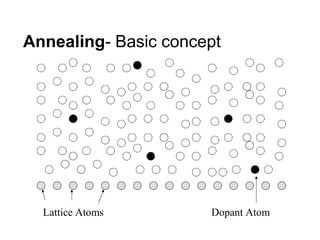
Annealing- Basic concept
Lattice Atoms Dopant Atom
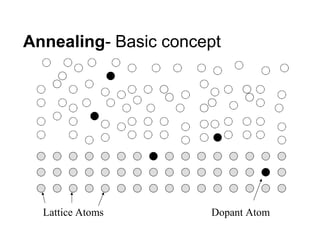
Annealing- Basic concept
Lattice Atoms Dopant Atom
Annealing- Basic concept
Lattice Atoms Dopant Atom
Annealing- Basic concept
Lattice Atoms Dopant Atom
Annealing- Basic concept
Lattice Atoms Dopant Atoms
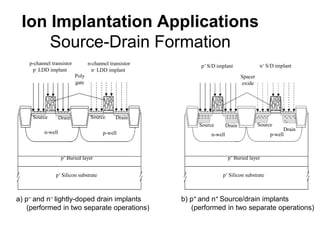
Ion Implantation Applications
Source-Drain Formation
+ + + + + + + +
+ + + + + + + +
- - - - -
--------
n-well p-well
p+ Buried layer
p+ Silicon substrate
p+ S/D implant n+ S/D implant
Spacer
oxide
+ + + +
Drain
+ + + +
Source
- - - - -
-- -- --
--
Drain
Source
b) p+ and n+ Source/drain implants
(performed in two separate operations)
+ + + + + + + + - - - - - - - - - -
n-well p-well
p+ Buried layer
p+ Silicon substrate
p-channel transistor
p– LDD implant
n-channel transistor
n– LDD implant
Drain
Source Drain
Source
Poly
gate
a) p– and n– lightly-doped drain implants
(performed in two separate operations)
Ion Implantation - Advantages
1. Good control of dopant concentration
2. Excellent dopant uniformity
3. Precise control of dopant depth
4. High purity of dopants
5. Low temperature processing
6. Can implant dopants through films
7. Highly abrupt junctions can be made
8. Complex doping profiles can be made using multiple
energy implants
Drawbacks of Ion Implantation
⮚ Incident ions damage semiconductor lattice.
⮚ Complete repair may not be possible.
⮚ Very shallow/deep profiles difficult/impossible (implant
depth limited to 1 micron).
⮚ Low throughput (involves single wafer processing).
⮚ Equipment very complex, expensive and high
maintenance cost.
⮚ Often uses extremely toxic gases such as Arsine and
Phosphine.
Ion Implantation System

IONIMPLANTATION (1).pptx

  • 1.
  • 3.
    Ion Implantation -Introduction ● The biggest limitation of thermal diffusion is that the process is isotropic i.e. lateral diffusion cannot be avoided, though diffusion coefficients in different crystallographic directions might be different. ● Thus, an oxide window that serves as a mask to protect certain regions of the wafers, can be ineffective due to lateral diffusion ● This is especially important for doping small regions (due to device miniaturization). ● Doping control is also difficult to achieve due to presence of concentration gradients. ● These gradients will change in subsequent annealing steps. Thus, there is a thermal budget associated with doping
  • 4.
    ● Ion implantationis a relatively newer doping technique that operates close to room temperature ● It is a physical process of doping, not based on a chemical reaction ● Since ion implantation takes place close to room temperature, it is compatible with conventional lithographic processes, so small regions can be doped ● Also, since temperature is low, lateral diffusion is negligible ● Ion implantation is used mostly for doping of silicon in VLSI processing. ● Ion implantation provides a technique by which the dose of implanted dopants can be precisely controlled. ● In ion implantation, dopant atoms are ionized, isolated, accelerated and made to impinge on the wafer surface ● These atoms penetrate greater depth into the material and get embedded into the wafer.
  • 5.
    ● In ionimplantation, an ion beam is accelerated towards the target with an energy typically greater than 50 eV. ● The ion beam can be focused and can also be tilted with reference to the wafer surface. ● Ion implantation can be selectively applied over regions on the wafer by using an appropriate masking material. ● In a diffusion process the mask has to withstand high temperatures. However in an ion implantation process the wafer is not intentionally heated. ● For moderate doses, the temperature of the wafer would not increase substantially above room temperature. So it is possible to use photo resist to mask ion implantation.
  • 6.
    ● The ionenergies can be in the range of a few 100s of eV to MeV. ● In a crystalline silicon lattice, the energy required to dislodge atoms from their lattice sites and create a stable vacancy – interstitial pair is 15 eV. ● This means that each implanted ion would cause damage to the crystalline structure. Hence the silicon as implanted would not be very useful. ● Typically the damage has to be annealed out and the implanted dopants activated by high temperature thermal processing subsequent to implantation. ● Each ion entering the target material would go through a series of events which would result in loss of ion energy and the ion would eventually come to rest. These events are random in nature.
  • 7.
    Ion implantation Process □Ionised impurity atoms accelerated through an electrostatic field strike the surface of the wafer □ Dose controlled by measuring the ion current □ Penetration depth of impurity ion controlled by controlling electric field
  • 8.
    Ion implantation equipmenttypically consists of : • an Ionization chamber, where ions of the desired element are produced, • an accelerator, where the ions are electrostatically accelerated to a high energy, and • a target chamber, where the ions impinge on a target, which is the material to be implanted. • Each ion is typically a single atom, and the actual amount of material implanted in the target is the integral over time of the ion current. This amount is called the dose. • The currents supplied by implanters are typically small (microamperes) and thus the dose which can be implanted in a reasonable amount of time is small. • Thus, ion implantation finds application in cases where the amount of chemical change required is small.
  • 9.
    Ion Implantation System Anion implanter is a high voltage particle accelerator producing a high velocity beam of ions which can penetrate the surface of silicon target wafers Components: □ Ion Source □ Mass analyser □ High voltage accelerator □ Scanning system □ Target chamber
  • 11.
    1. Ion Source ●Dopant ions such as boron, phosphorus or arsenic are created from a gas source, so that the purity of the source can be very high but are highly toxic ● Ion source starts with a feed gas that contains the desired implant species. Common feed gases used in silicon technologies are BF3 ,AsH3 and PH3 ● If the desired implant species is not available in the gaseous form, a solid charge can be heated and the resultant vapor used as the source. ● Then the feed gas is passed in a region of very low pressure that is maintained between a heated filament and a metal plate ● The filament is maintained at a large negative potential w.r.t. plate. ● Electrons boil off the filament and are accelerated towards the plate. ● As they do so, they collide with the gas feed molecules, transferring some of their energy to BF3 , for example, breaks up into B++, B+ , BF+ , BF2 + , F+ and a variety of other species in varying quantities
  • 12.
    2. Mass Separationstage/ Analysing Magnet •The ions are accelerated using electrostatic fields Now, to separate i.e. select the various kinds of ions that are present in the output of the ion source, a mass separation stage is used • The principle used is the use of the different charge-to-mass ratios of these ions by a magnetic field.
  • 13.
    ● The magneticfield of the analyzer is chosen such that only ions with the desired charge to mass ratio can travel through without being blocked by the analyzer walls. ● A magnetic field B is applied normal to the path of ions with charge q and velocity v ● The force on the ions is given by F=qvB and the ions move in a circular path of radius r and there is a centripetal force F=M v2/R ● Therefore, qvB= M v2/R [velocity v is unchanged] And R = Mv/qB ------------------------------------(1) ● Now for an ion accelerated through a potential Vext the velocity is given by: M v2 /2 = qVex , from where we get v as:
  • 14.
    For a givenacceleration potential and magnetic flux density, the radius of the ion path is directly proportional to the square root of the mass-to-charge ratio.
  • 16.
    •The ions comingout of the analyzer through the aperture can be further accelerated to the required energy. •The ion beam is subsequently focused on to the wafer. •The ion beam is then raster scanned over the wafer for implantation. •It can be appreciated that due to the raster scan process, the throughput of ion implanters would be low. •Some of the ions on the way from the analyzer may get neutralized. •The neutral species can not be subjected to deflections using electric or magnetic fields for raster scan. •So a neutral trap is used to eliminate from the beam. •The neutral trap deflects the beam slightly by using an electric field. •Only ions would be deflected and the neutral atoms would be removed from the beam.
  • 17.
  • 18.
    •The number ofions implanted on the wafer can be measured using a charge measurement system like an electrometer. •The ions would be neutralized upon implantation and this would result in a current out of the wafer through the backside. •The measured current can be integrated to find the charge implanted on the wafer. •This can be used to find the number of ions implanted on the wafer per unit area. The number or ions implanted per unit are is called the implant dose. Beam Current (Dose) Measurement
  • 20.
    Most semiconductors arecrystalline and have highly anisotropic properties. Because of the ordered arrangement of lattice atoms, ions can penetrate more deeply into the crystal along major axis and planes. This phenomenon is called channeling effect. To avoid channeling, ion implantation is often carried out with an ion beam misoriented from the major axis by an angle of at least 7 to 10 . Both Si and GaAs behave nearly as an amorphous solid when a misoriented beam is used. Channeling Effect Fig. channeling effect Ref-IcengB1 Ref pdf : implant-2[1] Not isotropic. = Having propertiesthat differ according to the direction of measurement. amorphous solid=A noncrystalline solid with nowell-defined ordered structure.
  • 23.
  • 28.
    ● The maximumconcentration is at a certain depth below the surface, called range ● In thermal diffusion, the maximum concentration is at the surface and the concentration decreases with depth ● The range depends on the ion type and the energy, as shown in figure 19 ● There are two stopping mechanisms - the nucleus of the wafer atoms and the interaction of the positive ions with the electrons ● In ion implantation, the beam density (# ions/cm2), ion energy, and orientation of the wafer matter
  • 31.
    Implantation Damage -Degree of Damage □ Light Ions :Most energy loss is due to electronic collisions→ little damage, most damage occurs near final ion position □ Heavy Ions: Most energy loss is due to nuclear collisions → heavy damage
  • 32.
    ● In ionimplantation, since the wafer surface is impacted by high energy ions, it can cause damage by knocking Si atoms from their position, causing local structural damage. ● This needs a post thermal annealing treatment to repair the damage. ● There are two ways of doing this. 1. Tube furnace - low temperature annealing (600-1000 C). To minimize lateral diffusion. 2. Rapid thermal annealing - higher temperatures are possible but for shorter times.
  • 33.
    Annealing - Definition ⮚Process of repairing implant damage (i.e., “healing” the surface) is called annealing. ⮚ Also puts dopant atoms in substitutional sites where they will be electrically active. ⮚ Success of annealing measured in terms of fraction of the dopant that is electrically active . ⮚ Challenge: To repair damage & activate dopants while minimising diffusion so that shallow implants remain shallow.
  • 34.
    Ion Beam Repaired Silattice structure and activated dopant-silicon bonds Annealing - Basic Concept b) Si lattice after annealing a) Damaged Si lattice during implant Residual Defects
  • 35.
  • 36.
  • 37.
  • 38.
  • 39.
  • 40.
    Ion Implantation Applications Source-DrainFormation + + + + + + + + + + + + + + + + - - - - - -------- n-well p-well p+ Buried layer p+ Silicon substrate p+ S/D implant n+ S/D implant Spacer oxide + + + + Drain + + + + Source - - - - - -- -- -- -- Drain Source b) p+ and n+ Source/drain implants (performed in two separate operations) + + + + + + + + - - - - - - - - - - n-well p-well p+ Buried layer p+ Silicon substrate p-channel transistor p– LDD implant n-channel transistor n– LDD implant Drain Source Drain Source Poly gate a) p– and n– lightly-doped drain implants (performed in two separate operations)
  • 41.
    Ion Implantation -Advantages 1. Good control of dopant concentration 2. Excellent dopant uniformity 3. Precise control of dopant depth 4. High purity of dopants 5. Low temperature processing 6. Can implant dopants through films 7. Highly abrupt junctions can be made 8. Complex doping profiles can be made using multiple energy implants
  • 42.
    Drawbacks of IonImplantation ⮚ Incident ions damage semiconductor lattice. ⮚ Complete repair may not be possible. ⮚ Very shallow/deep profiles difficult/impossible (implant depth limited to 1 micron). ⮚ Low throughput (involves single wafer processing). ⮚ Equipment very complex, expensive and high maintenance cost. ⮚ Often uses extremely toxic gases such as Arsine and Phosphine.
  • 43.