Iodine - essential trace element.
In the body - minute amount (normally
20-30 mg) .
80% (15 milligrams in adult) of the iodine
-in the thyroid gland for the synthesis of
several thyroid hormones.
The remainder - distributed throughout
other tissues, like mammary, salivary,
gastric glands and in the kidneys.
Within the circulation iodine occurs as free
iodine ion or as protein-bound iodine.
Excretion - in urine and small amount in
feces.
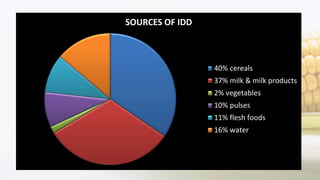
SOURCES OF IDD
40% cereals
37% milk & milk products
2% vegetables
10% pulses
11% flesh foods
16% water
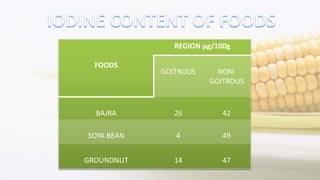
FOODS
REGION µg/100g
GOITROUS NON-
GOITROUS
BAJRA 26 42
SOYA BEAN 4 49
GROUNDNUT 14 47
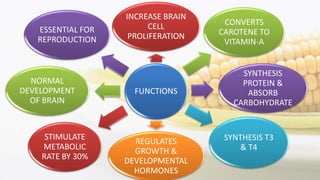
FUNCTIONS
INCREASE BRAIN
CELL
PROLIFERATION
CONVERTS
CAROTENE TO
VITAMIN-A
SYNTHESIS
PROTEIN &
ABSORB
CARBOHYDRATE
SYNTHESIS T3
& T4
REGULATES
GROWTH &
DEVELOPMENTAL
HORMONES
STIMULATE
METABOLIC
RATE BY 30%
NORMAL
DEVELOPMENT
OF BRAIN
ESSENTIAL FOR
REPRODUCTION
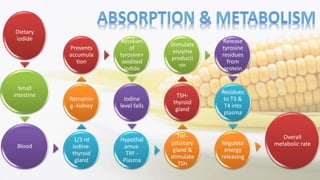
Dietary
iodide
Small
intestine
Blood
1/3 rd
iodine-
thyroid
gland
Remainin
g- kidney
Prevents
accumula
tion
Residues
of
tyrosine+
oxidized
iodide
Iodine
level falls
Hypothal
amus-
TRF -
Plasma
TRF-
pituitary
gland &
stimulate
TSH
TSH-
thyroid
gland
Stimulate
enzyme
producti
on
Release
tyrosine
residues
from
protein
Residues
to T3 &
T4 into
plasma
Regulate
energy
releasing
Overall
metabolic rate
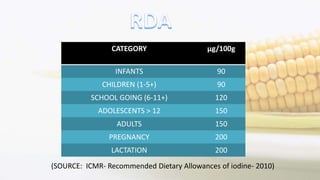
CATEGORY µg/100g
INFANTS 90
CHILDREN (1-5+) 90
SCHOOL GOING (6-11+) 120
ADOLESCENTS > 12 150
ADULTS 150
PREGNANCY 200
LACTATION 200
(SOURCE: ICMR- Recommended Dietary Allowances of iodine- 2010)
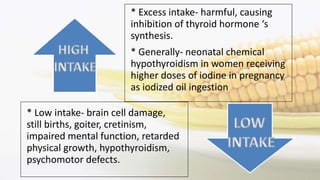
* Excess intake- harmful, causing
inhibition of thyroid hormone ‘s
synthesis.
* Generally- neonatal chemical
hypothyroidism in women receiving
higher doses of iodine in pregnancy
as iodized oil ingestion
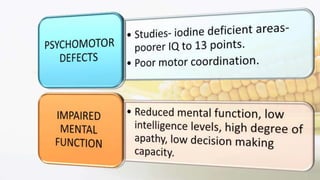
* Low intake- brain cell damage,
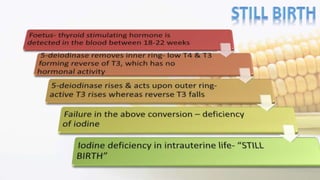
still births, goiter, cretinism,
impaired mental function, retarded
physical growth, hypothyroidism,
psychomotor defects.
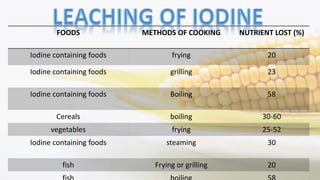
FOODS METHODS OF COOKING NUTRIENT LOST (%)
Iodine containing foods frying 20
Iodine containing foods grilling 23
Iodine containing foods Boiling 58
Cereals boiling 30-60
vegetables frying 25-52
Iodine containing foods steaming 30
fish Frying or grilling 20
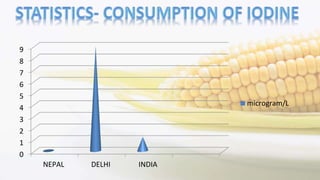
0
1
2
3
4
5
6
7
8
9
NEPAL DELHI INDIA
microgram/L
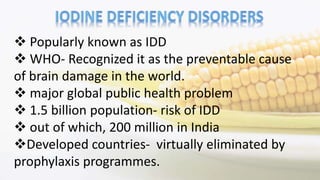
 Popularly known as IDD
 WHO- Recognized it as the preventable cause
of brain damage in the world.
 major global public health problem
 1.5 billion population- risk of IDD
 out of which, 200 million in India
Developed countries- virtually eliminated by
prophylaxis programmes.
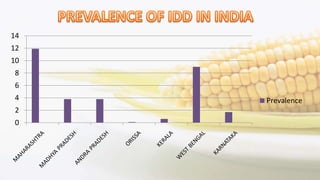
0
2
4
6
8
10
12
14
Prevalence
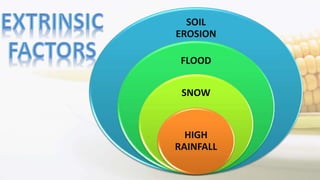
SOIL
EROSION
FLOOD
SNOW
HIGH
RAINFALL
Melting of Glaciers
Floods
Rainfall
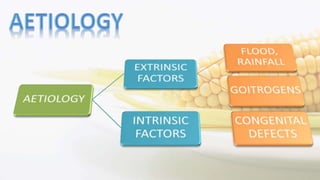
 Substances that interfere with iodine
metabolism at various stages of thyroid hormone
homeostasis.
 Inhibition of any of these hormones- disturbs
hormonal balance & leads to iodine deficiency.
 Depending on the level of interference, it is
categorized as follows:
 Rare congenital
defects- in hormone
synthesis & secretion &
peripheral resistance to
thyroid hormones & also
result in goiter
Goiter
Loss of 13 IQ points,
Leading Cause of Mental handicap
Cretinism
Spontaneous Abortions,
Stillbirths,
Birth Defects
Defects of Speech & Hearing,
Squint,
Psychomotor defects
IDD Problem Pyramid
1%-10%
5% -
30%
30% - 70%
Goitre &
Cretinism
Some brain
damage
Less active
population due to
decreased thyroid
function
(hypothyroidism)
• It's worldwide major
public health problem.
Globally 1.5 billion- risk
of Iodine deficiency
disorders.
• The pyramid shows the
visible effects of Iodine
Deficiency Disorders
(IDD) Goitre and
Cretinism account only
for 1--10% of these,
• Whereas 90% of the
effects remain hidden.
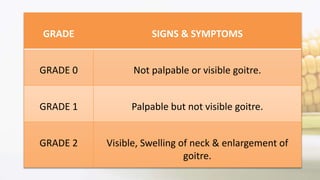
GRADE SIGNS & SYMPTOMS
GRADE 0 Not palpable or visible goitre.
GRADE 1 Palpable but not visible goitre.
GRADE 2 Visible, Swelling of neck & enlargement of
goitre.
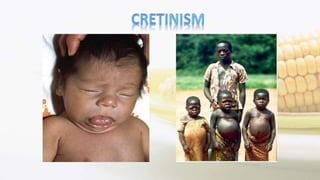
NEUROLOGICAL CRETINISM
• Mental retardation, deaf mutism, squint,
spastic displegia, spastic rigidity- forms
gait & brisk reflexes.
• Affects cochlea & brain development.
• Low iodine intake- pregnancy: physically
or mentally retarded children.
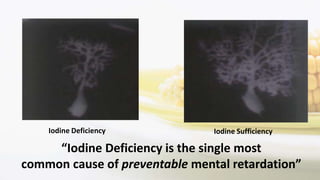
Iodine Deficiency Iodine Sufficiency
“Iodine Deficiency is the single most
common cause of preventable mental retardation”
MYXEDEMATOUS CRETINISM
•Coarse & dry skin, swollen tongue, deep
hoarse voice, apathy, skeletal growth
retardation, deaf- mutism .
• predominant- Goitrogens containing foods
like tapioca, sorghum, finger millets, sweet
potato, soya beans, almonds, groundnuts etc.,
are used in excess.
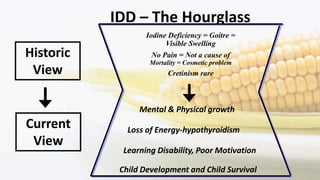
IDD – The Hourglass
Historic
View
Current
View
Iodine Deficiency = Goitre =
Visible Swelling
No Pain = Not a cause of
Mortality = Cosmetic problem
Cretinism rare
Mental & Physical growth
Loss of Energy-hypothyroidism
Learning Disability, Poor Motivation
Child Development and Child Survival
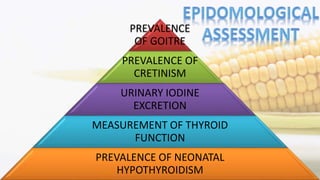
PREVALENCE
OF GOITRE
PREVALENCE OF
CRETINISM
URINARY IODINE
EXCRETION
MEASUREMENT OF THYROID
FUNCTION
PREVALENCE OF NEONATAL
HYPOTHYROIDISM
Iodine Deficiency Disorder

Iodine Deficiency Disorder

  • 2.
    Iodine - essentialtrace element. In the body - minute amount (normally 20-30 mg) . 80% (15 milligrams in adult) of the iodine -in the thyroid gland for the synthesis of several thyroid hormones.
  • 3.
    The remainder -distributed throughout other tissues, like mammary, salivary, gastric glands and in the kidneys. Within the circulation iodine occurs as free iodine ion or as protein-bound iodine. Excretion - in urine and small amount in feces.
  • 4.
    SOURCES OF IDD 40%cereals 37% milk & milk products 2% vegetables 10% pulses 11% flesh foods 16% water
  • 5.
    FOODS REGION µg/100g GOITROUS NON- GOITROUS BAJRA26 42 SOYA BEAN 4 49 GROUNDNUT 14 47
  • 6.
    FUNCTIONS INCREASE BRAIN CELL PROLIFERATION CONVERTS CAROTENE TO VITAMIN-A SYNTHESIS PROTEIN& ABSORB CARBOHYDRATE SYNTHESIS T3 & T4 REGULATES GROWTH & DEVELOPMENTAL HORMONES STIMULATE METABOLIC RATE BY 30% NORMAL DEVELOPMENT OF BRAIN ESSENTIAL FOR REPRODUCTION
  • 7.
    Dietary iodide Small intestine Blood 1/3 rd iodine- thyroid gland Remainin g- kidney Prevents accumula tion Residues of tyrosine+ oxidized iodide Iodine levelfalls Hypothal amus- TRF - Plasma TRF- pituitary gland & stimulate TSH TSH- thyroid gland Stimulate enzyme producti on Release tyrosine residues from protein Residues to T3 & T4 into plasma Regulate energy releasing Overall metabolic rate
  • 8.
    CATEGORY µg/100g INFANTS 90 CHILDREN(1-5+) 90 SCHOOL GOING (6-11+) 120 ADOLESCENTS > 12 150 ADULTS 150 PREGNANCY 200 LACTATION 200 (SOURCE: ICMR- Recommended Dietary Allowances of iodine- 2010)
  • 9.
    * Excess intake-harmful, causing inhibition of thyroid hormone ‘s synthesis. * Generally- neonatal chemical hypothyroidism in women receiving higher doses of iodine in pregnancy as iodized oil ingestion * Low intake- brain cell damage, still births, goiter, cretinism, impaired mental function, retarded physical growth, hypothyroidism, psychomotor defects.
  • 10.
    FOODS METHODS OFCOOKING NUTRIENT LOST (%) Iodine containing foods frying 20 Iodine containing foods grilling 23 Iodine containing foods Boiling 58 Cereals boiling 30-60 vegetables frying 25-52 Iodine containing foods steaming 30 fish Frying or grilling 20
  • 11.
  • 12.
     Popularly knownas IDD  WHO- Recognized it as the preventable cause of brain damage in the world.  major global public health problem  1.5 billion population- risk of IDD  out of which, 200 million in India Developed countries- virtually eliminated by prophylaxis programmes.
  • 14.
  • 16.
  • 17.
  • 18.
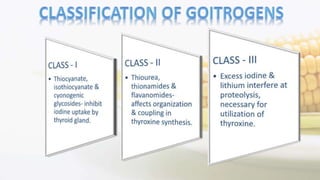
     Substances thatinterfere with iodine metabolism at various stages of thyroid hormone homeostasis.  Inhibition of any of these hormones- disturbs hormonal balance & leads to iodine deficiency.  Depending on the level of interference, it is categorized as follows:
  • 20.
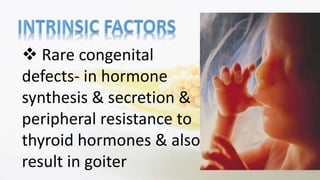
     Rare congenital defects-in hormone synthesis & secretion & peripheral resistance to thyroid hormones & also result in goiter
  • 21.
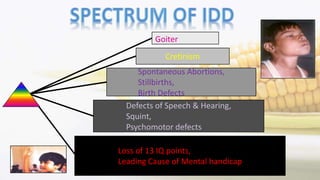
    Goiter Loss of 13IQ points, Leading Cause of Mental handicap Cretinism Spontaneous Abortions, Stillbirths, Birth Defects Defects of Speech & Hearing, Squint, Psychomotor defects
  • 22.
    IDD Problem Pyramid 1%-10% 5%- 30% 30% - 70% Goitre & Cretinism Some brain damage Less active population due to decreased thyroid function (hypothyroidism) • It's worldwide major public health problem. Globally 1.5 billion- risk of Iodine deficiency disorders. • The pyramid shows the visible effects of Iodine Deficiency Disorders (IDD) Goitre and Cretinism account only for 1--10% of these, • Whereas 90% of the effects remain hidden.
  • 26.
    GRADE SIGNS &SYMPTOMS GRADE 0 Not palpable or visible goitre. GRADE 1 Palpable but not visible goitre. GRADE 2 Visible, Swelling of neck & enlargement of goitre.
  • 29.
    NEUROLOGICAL CRETINISM • Mentalretardation, deaf mutism, squint, spastic displegia, spastic rigidity- forms gait & brisk reflexes. • Affects cochlea & brain development. • Low iodine intake- pregnancy: physically or mentally retarded children.
  • 30.
    Iodine Deficiency IodineSufficiency “Iodine Deficiency is the single most common cause of preventable mental retardation”
  • 31.
    MYXEDEMATOUS CRETINISM •Coarse &dry skin, swollen tongue, deep hoarse voice, apathy, skeletal growth retardation, deaf- mutism . • predominant- Goitrogens containing foods like tapioca, sorghum, finger millets, sweet potato, soya beans, almonds, groundnuts etc., are used in excess.
  • 32.
    IDD – TheHourglass Historic View Current View Iodine Deficiency = Goitre = Visible Swelling No Pain = Not a cause of Mortality = Cosmetic problem Cretinism rare Mental & Physical growth Loss of Energy-hypothyroidism Learning Disability, Poor Motivation Child Development and Child Survival
  • 33.
    PREVALENCE OF GOITRE PREVALENCE OF CRETINISM URINARYIODINE EXCRETION MEASUREMENT OF THYROID FUNCTION PREVALENCE OF NEONATAL HYPOTHYROIDISM