Iodine Deficiency Disorder(IDD)
Dr. Moumita Pal
MBBS,DPH, MD
Dept. of Community Medicine
College of Medicine and Sagore Dutta Hospital
Iodine
• Essential micro-nutrient
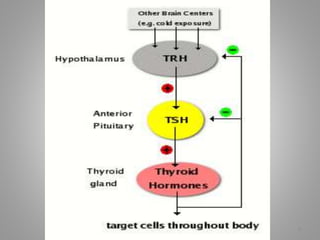
• Required for synthesis of thyroid hormons-T3(
triiodothyronin) and T4 (thyroxine)
• Fetus and neonates- protein metabolism in brain
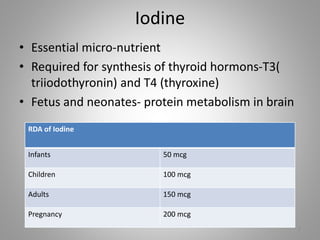
RDA of Iodine
Infants 50 mcg
Children 100 mcg
Adults 150 mcg
Pregnancy 200 mcg
2
Sources
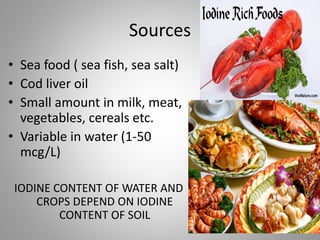
• Sea food ( sea fish, sea salt)
• Cod liver oil
• Small amount in milk, meat,
vegetables, cereals etc.
• Variable in water (1-50
mcg/L)
IODINE CONTENT OF WATER AND
CROPS DEPEND ON IODINE
CONTENT OF SOIL
3
Goitrogens
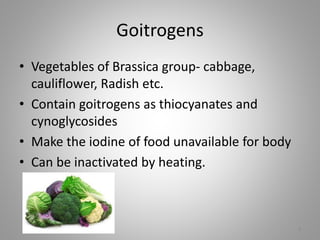
• Vegetables of Brassica group- cabbage,
cauliflower, Radish etc.
• Contain goitrogens as thiocyanates and
cynoglycosides
• Make the iodine of food unavailable for body
• Can be inactivated by heating.
4
Absorption
• Small intestine
• 30% utilized by thyroid gland for synthesis of
hormone
• Remainder excreted in urine
5
6
• Iodine Deficiency Disorders refer to a
spectrum of health consequences resulting
from inadequate intake of iodine.
• Major nutritional problem
• Spectrum of diseases (from intrauterine to
childhood and adulthood)
7
Problem burden
• >7 % of World population suffers from iodine
deficiency.
• Serious problem of third world countries like
India, Bangladesh, Bhutan, Myanmar,
Indonesia, Nepal, Sri Lanka and Thailand.
• Severity higher in South-East Asia in World
8
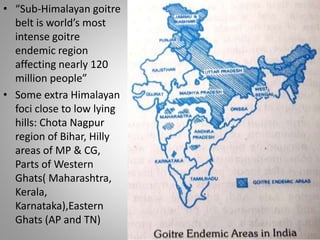
• “Sub-Himalayan goitre
belt is world’s most
intense goitre
endemic region
affecting nearly 120
million people”
• Some extra Himalayan
foci close to low lying
hills: Chota Nagpur
region of Bihar, Hilly
areas of MP & CG,
Parts of Western
Ghats( Maharashtra,
Kerala,
Karnataka),Eastern
Ghats (AP and TN)
9
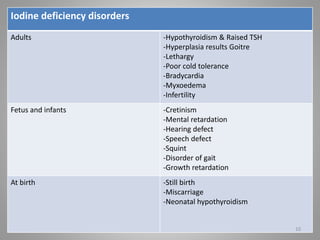
Iodine deficiency disorders
Adults -Hypothyroidism & Raised TSH
-Hyperplasia results Goitre
-Lethargy
-Poor cold tolerance
-Bradycardia
-Myxoedema
-Infertility
Fetus and infants -Cretinism
-Mental retardation
-Hearing defect
-Speech defect
-Squint
-Disorder of gait
-Growth retardation
At birth -Still birth
-Miscarriage
-Neonatal hypothyroidism
10
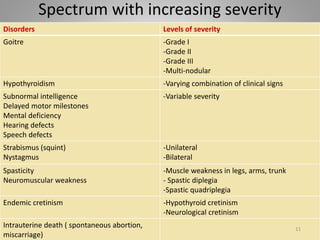
Spectrum with increasing severity
Disorders Levels of severity
Goitre -Grade I
-Grade II
-Grade III
-Multi-nodular
Hypothyroidism -Varying combination of clinical signs
Subnormal intelligence
Delayed motor milestones
Mental deficiency
Hearing defects
Speech defects
-Variable severity
Strabismus (squint)
Nystagmus
-Unilateral
-Bilateral
Spasticity
Neuromuscular weakness
-Muscle weakness in legs, arms, trunk
- Spastic diplegia
-Spastic quadriplegia
Endemic cretinism -Hypothyroid cretinism
-Neurological cretinism
Intrauterine death ( spontaneous abortion,
miscarriage)
11
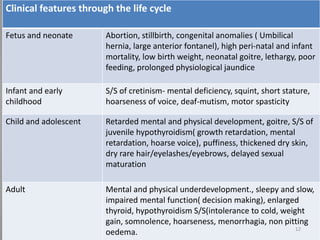
Clinical features through the life cycle
Fetus and neonate Abortion, stillbirth, congenital anomalies ( Umbilical
hernia, large anterior fontanel), high peri-natal and infant
mortality, low birth weight, neonatal goitre, lethargy, poor
feeding, prolonged physiological jaundice
Infant and early
childhood
S/S of cretinism- mental deficiency, squint, short stature,
hoarseness of voice, deaf-mutism, motor spasticity
Child and adolescent Retarded mental and physical development, goitre, S/S of
juvenile hypothyroidism( growth retardation, mental
retardation, hoarse voice), puffiness, thickened dry skin,
dry rare hair/eyelashes/eyebrows, delayed sexual
maturation
Adult Mental and physical underdevelopment., sleepy and slow,
impaired mental function( decision making), enlarged
thyroid, hypothyroidism S/S(intolerance to cold, weight
gain, somnolence, hoarseness, menorrhagia, non pitting
oedema. 12
Epidemiological assessment of Iodine
deficiency
• For surveillance of goitre control program.
• Indicators are- prevalence of goitre
-prevalence of cretinism
-urinary iodine excretion
-thyroid function test
-prevalence of neonatal hypothyroidism
13
Iodine check up
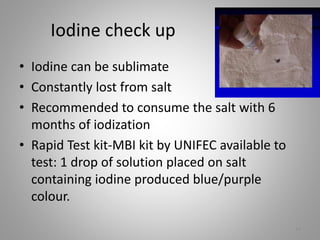
• Iodine can be sublimate
• Constantly lost from salt
• Recommended to consume the salt with 6
months of iodization
• Rapid Test kit-MBI kit by UNIFEC available to
test: 1 drop of solution placed on salt
containing iodine produced blue/purple
colour.
14
Prevention and control
Under National IDD control program 4 main
components are:
1. Use of iodized salt or oil
2. Iodine monitoring
3. Manpower training
4. Mass communication
15
1.Using Iodized salt/oil:
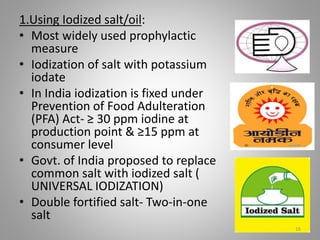
• Most widely used prophylactic
measure
• Iodization of salt with potassium
iodate
• In India iodization is fixed under
Prevention of Food Adulteration
(PFA) Act- ≥ 30 ppm iodine at
production point & ≥15 ppm at
consumer level
• Govt. of India proposed to replace
common salt with iodized salt (
UNIVERSAL IODIZATION)
• Double fortified salt- Two-in-one
salt
16
Iodized oil:
Intramuscular- injection (mostly poppy seed oil)
• NIN Hyderabad developed iodized oil in safflower
or safola oil
• Dose-1ml: provide protection for 4 years
• Expensive
• Reaching every victim is difficult
• Recommended for severely endemic population
where quick response is needed
17
• Iodized oil oral:
• Technically simple
• Oral oil or sodium iodate tablets
• Limited research available
• Costlier than IM oil
18
2. Iodine monitoring:
• Network of laboratories for-
1.iodine excretion detection
2.Detection of iodine in water soil and food
3.Detection of iodine in salt for quality control
• Neonatal hypothyroidism : sensitive pointer of
environmental iodine deficiency & indicator
for monitoring impact of program
19
Cont…
3.Manpower training:
• to all related to program
• Training in all aspect of goitre control including legal
enforcement and public education, goitre survey
methodology, lab techniques
4.Mass communication: (IEC activities)
• Tool for nutritional education.
• Creation of public awareness through lectures, road
shows, audio-visual aids, school and women groups etc.
• IEC campaign to increase awareness on consumption of
Iodized salt
• Global IDD day-21st Oct.
20
21

Iodine deficiency disorder(idd)

  • 1.
    Iodine Deficiency Disorder(IDD) Dr.Moumita Pal MBBS,DPH, MD Dept. of Community Medicine College of Medicine and Sagore Dutta Hospital
  • 2.
    Iodine • Essential micro-nutrient •Required for synthesis of thyroid hormons-T3( triiodothyronin) and T4 (thyroxine) • Fetus and neonates- protein metabolism in brain RDA of Iodine Infants 50 mcg Children 100 mcg Adults 150 mcg Pregnancy 200 mcg 2
  • 3.
    Sources • Sea food( sea fish, sea salt) • Cod liver oil • Small amount in milk, meat, vegetables, cereals etc. • Variable in water (1-50 mcg/L) IODINE CONTENT OF WATER AND CROPS DEPEND ON IODINE CONTENT OF SOIL 3
  • 4.
    Goitrogens • Vegetables ofBrassica group- cabbage, cauliflower, Radish etc. • Contain goitrogens as thiocyanates and cynoglycosides • Make the iodine of food unavailable for body • Can be inactivated by heating. 4
  • 5.
    Absorption • Small intestine •30% utilized by thyroid gland for synthesis of hormone • Remainder excreted in urine 5
  • 6.
  • 7.
    • Iodine DeficiencyDisorders refer to a spectrum of health consequences resulting from inadequate intake of iodine. • Major nutritional problem • Spectrum of diseases (from intrauterine to childhood and adulthood) 7
  • 8.
    Problem burden • >7% of World population suffers from iodine deficiency. • Serious problem of third world countries like India, Bangladesh, Bhutan, Myanmar, Indonesia, Nepal, Sri Lanka and Thailand. • Severity higher in South-East Asia in World 8
  • 9.
    • “Sub-Himalayan goitre beltis world’s most intense goitre endemic region affecting nearly 120 million people” • Some extra Himalayan foci close to low lying hills: Chota Nagpur region of Bihar, Hilly areas of MP & CG, Parts of Western Ghats( Maharashtra, Kerala, Karnataka),Eastern Ghats (AP and TN) 9
  • 10.
    Iodine deficiency disorders Adults-Hypothyroidism & Raised TSH -Hyperplasia results Goitre -Lethargy -Poor cold tolerance -Bradycardia -Myxoedema -Infertility Fetus and infants -Cretinism -Mental retardation -Hearing defect -Speech defect -Squint -Disorder of gait -Growth retardation At birth -Still birth -Miscarriage -Neonatal hypothyroidism 10
  • 11.
    Spectrum with increasingseverity Disorders Levels of severity Goitre -Grade I -Grade II -Grade III -Multi-nodular Hypothyroidism -Varying combination of clinical signs Subnormal intelligence Delayed motor milestones Mental deficiency Hearing defects Speech defects -Variable severity Strabismus (squint) Nystagmus -Unilateral -Bilateral Spasticity Neuromuscular weakness -Muscle weakness in legs, arms, trunk - Spastic diplegia -Spastic quadriplegia Endemic cretinism -Hypothyroid cretinism -Neurological cretinism Intrauterine death ( spontaneous abortion, miscarriage) 11
  • 12.
    Clinical features throughthe life cycle Fetus and neonate Abortion, stillbirth, congenital anomalies ( Umbilical hernia, large anterior fontanel), high peri-natal and infant mortality, low birth weight, neonatal goitre, lethargy, poor feeding, prolonged physiological jaundice Infant and early childhood S/S of cretinism- mental deficiency, squint, short stature, hoarseness of voice, deaf-mutism, motor spasticity Child and adolescent Retarded mental and physical development, goitre, S/S of juvenile hypothyroidism( growth retardation, mental retardation, hoarse voice), puffiness, thickened dry skin, dry rare hair/eyelashes/eyebrows, delayed sexual maturation Adult Mental and physical underdevelopment., sleepy and slow, impaired mental function( decision making), enlarged thyroid, hypothyroidism S/S(intolerance to cold, weight gain, somnolence, hoarseness, menorrhagia, non pitting oedema. 12
  • 13.
    Epidemiological assessment ofIodine deficiency • For surveillance of goitre control program. • Indicators are- prevalence of goitre -prevalence of cretinism -urinary iodine excretion -thyroid function test -prevalence of neonatal hypothyroidism 13
  • 14.
    Iodine check up •Iodine can be sublimate • Constantly lost from salt • Recommended to consume the salt with 6 months of iodization • Rapid Test kit-MBI kit by UNIFEC available to test: 1 drop of solution placed on salt containing iodine produced blue/purple colour. 14
  • 15.
    Prevention and control UnderNational IDD control program 4 main components are: 1. Use of iodized salt or oil 2. Iodine monitoring 3. Manpower training 4. Mass communication 15
  • 16.
    1.Using Iodized salt/oil: •Most widely used prophylactic measure • Iodization of salt with potassium iodate • In India iodization is fixed under Prevention of Food Adulteration (PFA) Act- ≥ 30 ppm iodine at production point & ≥15 ppm at consumer level • Govt. of India proposed to replace common salt with iodized salt ( UNIVERSAL IODIZATION) • Double fortified salt- Two-in-one salt 16
  • 17.
    Iodized oil: Intramuscular- injection(mostly poppy seed oil) • NIN Hyderabad developed iodized oil in safflower or safola oil • Dose-1ml: provide protection for 4 years • Expensive • Reaching every victim is difficult • Recommended for severely endemic population where quick response is needed 17
  • 18.
    • Iodized oiloral: • Technically simple • Oral oil or sodium iodate tablets • Limited research available • Costlier than IM oil 18
  • 19.
    2. Iodine monitoring: •Network of laboratories for- 1.iodine excretion detection 2.Detection of iodine in water soil and food 3.Detection of iodine in salt for quality control • Neonatal hypothyroidism : sensitive pointer of environmental iodine deficiency & indicator for monitoring impact of program 19
  • 20.
    Cont… 3.Manpower training: • toall related to program • Training in all aspect of goitre control including legal enforcement and public education, goitre survey methodology, lab techniques 4.Mass communication: (IEC activities) • Tool for nutritional education. • Creation of public awareness through lectures, road shows, audio-visual aids, school and women groups etc. • IEC campaign to increase awareness on consumption of Iodized salt • Global IDD day-21st Oct. 20
  • 21.