Mostaque Ahmed
PGT
Department of Community Medicine
Gauhati Medical College & Hospital,
Guwahati, Assam
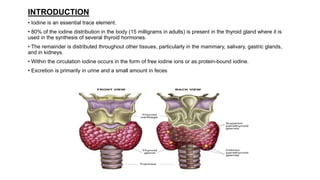
INTRODUCTION
• Iodine is an essential trace element.
• 80% of the iodine distribution in the body (15 milligrams in adults) is present in the thyroid gland where it is
used in the synthesis of several thyroid hormones.
• The remainder is distributed throughout other tissues, particularly in the mammary, salivary, gastric glands,
and in kidneys.
• Within the circulation iodine occurs in the form of free iodine ions or as protein-bound iodine.
• Excretion is primarily in urine and a small amount in feces
Absorption and Metabolism
• Bioavailability of iodine is greater than 90%. Most iodine that is ingested is reduced to
iodide and is absorbed almost completely, primarily in the small intestine.
• Some iodine-containing compounds (thyroid hormones) are absorbed intact. Once in
circulation, iodide is principally removed by the thyroid gland and kidneys.
Transport
• The protein responsible for iodide transport is the sodium/iodide symporter
• The sodium/iodide symporter in the thyroid basal membrane transfers iodide from the
circulation into the thyroid gland at a concentration gradient of about 20-50 times the rate
of plasma.
• This ensures that the thyroid gland obtains adequate amounts of iodide for hormone
synthesis.
Storage and Excretion
• The thyroid selectively concentrates iodide in amounts required for
adequate thyroid hormone synthesis.
• Several other tissues can also concentrate iodine, Including salivary
glands, gastric mucosa, breast, and Choroid plexus.
• Most excretion of iodine occurs through the urine with the remainder
excreted in the feces.
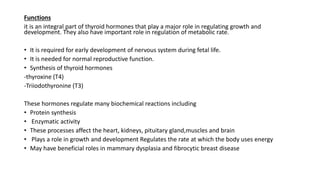
Functions
it is an integral part of thyroid hormones that play a major role in regulating growth and
development. They also have important role in regulation of metabolic rate.
• It is required for early development of nervous system during fetal life.
• It is needed for normal reproductive function.
• Synthesis of thyroid hormones
-thyroxine (T4)
-Triiodothyronine (T3)
These hormones regulate many biochemical reactions including
• Protein synthesis
• Enzymatic activity
• These processes affect the heart, kidneys, pituitary gland,muscles and brain
• Plays a role in growth and development Regulates the rate at which the body uses energy
• May have beneficial roles in mammary dysplasia and fibrocytic breast disease
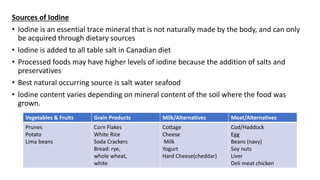
Sources of Iodine
• Iodine is an essential trace mineral that is not naturally made by the body, and can only
be acquired through dietary sources
• lodine is added to all table salt in Canadian diet
• Processed foods may have higher levels of iodine because the addition of salts and
preservatives
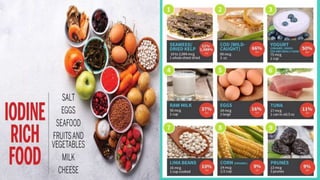
• Best natural occurring source is salt water seafood
• lodine content varies depending on mineral content of the soil where the food was
grown.
Vegetables & Fruits Grain Products Milk/Alternatives Meat/Alternatives
Prunes
Potato
Lima beans
Corn Flakes
White Rice
Soda Crackers
Bread: rye,
whole wheat,
white
Cottage
Cheese
Milk
Yogurt
Hard Cheese(cheddar)
Cod/Haddock
Egg
Beans (navy)
Soy nuts
Liver
Deli meat chicken
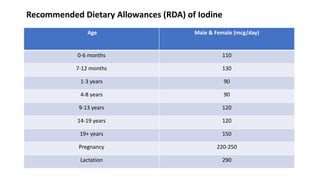
Age Male & Female (mcg/day)
0-6 months 110
7-12 months 130
1-3 years 90
4-8 years 90
9-13 years 120
14-19 years 120
19+ years 150
Pregnancy 220-250
Lactation 290
Recommended Dietary Allowances (RDA) of Iodine
Iodine deficiency
It occurs when the soil is poor in iodine, causing a low concentration in food
products and insufficient iodine intake (amount <50 mcg/day) in the population.
When iodine requirements are not met, the thyroid may no longer be able to
synthesize sufficient amounts of thyroid hormone.
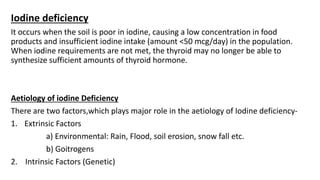
Aetiology of iodine Deficiency
There are two factors,which plays major role in the aetiology of Iodine deficiency-
1. Extrinsic Factors
a) Environmental: Rain, Flood, soil erosion, snow fall etc.
b) Goitrogens
2. Intrinsic Factors (Genetic)
Snow fall Heavy Rain Fall
Flood Soil Erosion
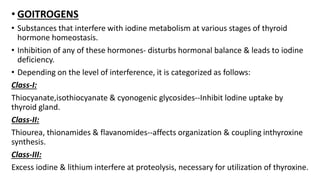
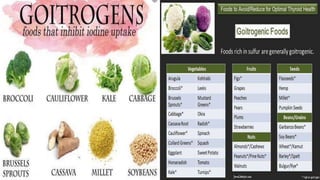
• GOITROGENS
• Substances that interfere with iodine metabolism at various stages of thyroid
hormone homeostasis.
• Inhibition of any of these hormones- disturbs hormonal balance & leads to iodine
deficiency.
• Depending on the level of interference, it is categorized as follows:
Class-I:
Thiocyanate,isothiocyanate & cyonogenic glycosides--Inhibit lodine uptake by
thyroid gland.
Class-II:
Thiourea, thionamides & flavanomides--affects organization & coupling inthyroxine
synthesis.
Class-III:
Excess iodine & lithium interfere at proteolysis, necessary for utilization of thyroxine.
Intrinsic Factors includes genetic disorders that causes mal-absorption as well
as defective Iodine metabolism & Transportation.
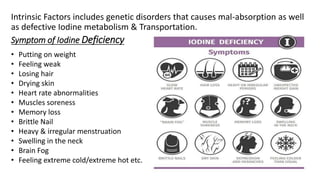
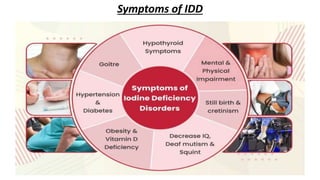
Symptom of Iodine Deficiency
• Putting on weight
• Feeling weak
• Losing hair
• Drying skin
• Heart rate abnormalities
• Muscles soreness
• Memory loss
• Brittle Nail
• Heavy & irregular menstruation
• Swelling in the neck
• Brain Fog
• Feeling extreme cold/extreme hot etc.
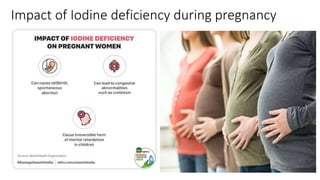
Impact of Iodine deficiency during pregnancy
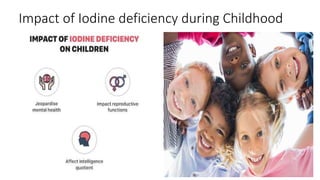
Impact of Iodine deficiency during Childhood
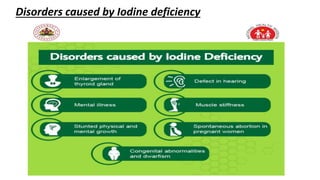
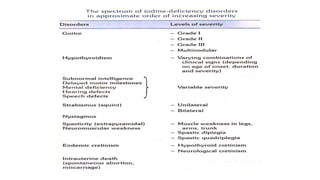
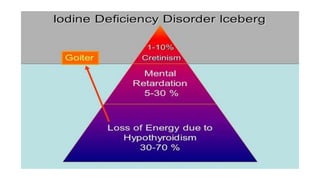
Disorders caused by Iodine deficiency
Spectrum of Iodine Deficiency Disorders (IDD):
Iodine deficiency is the lack of the trace element iodine, an essential
nutrient in the diet, which leads to several health manifestation all
together comes under a single umbrella known as “Spectrum of
Iodine deficiency disorders”
Iodine-deficiency disorders, which can start before birth, jeopardize
children’s mental health and very their survival. During the neonatal
period,childhood and adolescence, iodine-deficiency disorders can
lead to hypothyroidism and hyperthyroidism. Serious iodine
deficiency during pregnancy can result in stillbirth, spontaneous
abortion and congenital abnormalities such as cretinism (irreversible
form of mental retardation) mental impairment that reduces
intellectual capacity at home, in school and at work.
Symptoms of IDD
Global Scenario of IDD
IDDs are a major challenge to the health of populations the world over
particularly among preschool children and pregnant women in low-
income countries.
Globally two billion people are at risk of iodine deficiency disorders due
to insufficient iodine intake. Nearly 266 million school-aged children
worldwide have insufficient iodine intake.
Of the 130 countries which reported data for IDD (comprising 91.1% of
the total global population), it was found that IDD was one of the major
public health problem in 47 countries.
Indian scenario:
IDD was first documented in India in Himalayan region in the year 1908.
In India, the entire population is prone to IDD due to deficiency of
iodine in the soil of the subcontinent and consequently the food
derived from it.
In a surveys conducted by the Central and State Health Directorates,
Indian Council of Medical Research (ICMR) and medical institutes since
have clearly demonstrated that IDD is a public health problem in all
States and union territories in India.
Of 325 districts that were surveyed across the India, 263 districts were
found to be IDD endemic (i.e. the prevalence of IDD is above 10
percent in the population)
Past surveys have shown that there is no state in India which is free
from iodine deficiency disorder (IDD).
According to NFHS-5 data, Almost 167 million people are at risk of IDD
across the India (mainly sub Himalayan regions), out of the 167 million
people, 54 million suffer from goiter and two million from cretinism.
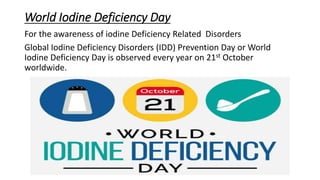
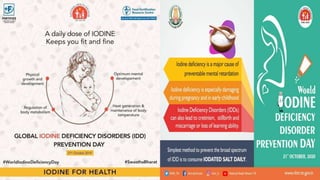
World Iodine Deficiency Day
For the awareness of iodine Deficiency Related Disorders
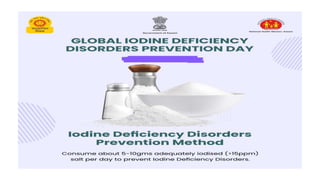
Global Iodine Deficiency Disorders (IDD) Prevention Day or World
Iodine Deficiency Day is observed every year on 21st October
worldwide.
National Iodine Deficiency Disorders Control
Programme (NIDDCP)
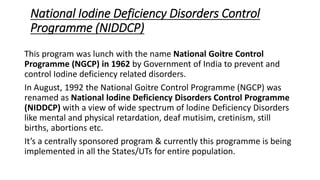
This program was lunch with the name National Goitre Control
Programme (NGCP) in 1962 by Government of India to prevent and
control Iodine deficiency related disorders.
In August, 1992 the National Goitre Control Programme (NGCP) was
renamed as National lodine Deficiency Disorders Control Programme
(NIDDCP) with a view of wide spectrum of lodine Deficiency Disorders
like mental and physical retardation, deaf mutisim, cretinism, still
births, abortions etc.
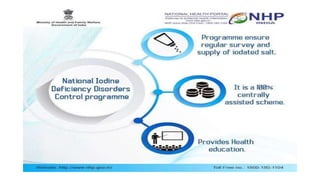
It’s a centrally sponsored program & currently this programme is being
implemented in all the States/UTs for entire population.
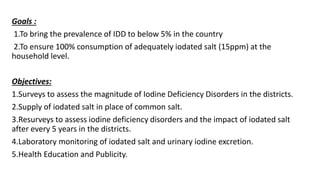
Goals :
1.To bring the prevalence of IDD to below 5% in the country
2.To ensure 100% consumption of adequately iodated salt (15ppm) at the
household level.
Objectives:
1.Surveys to assess the magnitude of Iodine Deficiency Disorders in the districts.
2.Supply of iodated salt in place of common salt.
3.Resurveys to assess iodine deficiency disorders and the impact of iodated salt
after every 5 years in the districts.
4.Laboratory monitoring of iodated salt and urinary iodine excretion.

5.Health Education and Publicity.
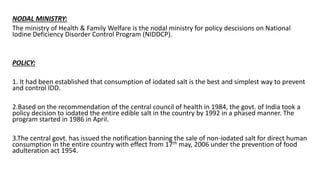
NODAL MINISTRY:
The ministry of Health & Family Welfare is the nodal ministry for policy descisions on National
Iodine Deficiency Disorder Control Program (NIDDCP).
POLICY:
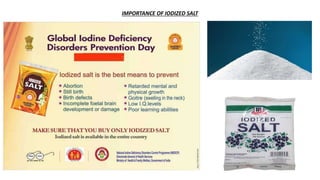
1. It had been established that consumption of iodated salt is the best and simplest way to prevent
and control IDD.
2.Based on the recommendation of the central council of health in 1984, the govt. of India took a
policy decision to iodated the entire edible salt in the country by 1992 in a phased manner. The
program started in 1986 in April.
3.The central govt. has issued the notification banning the sale of non-iodated salt for direct human
consumption in the entire country with effect from 17th may, 2006 under the prevention of food
adulteration act 1954.
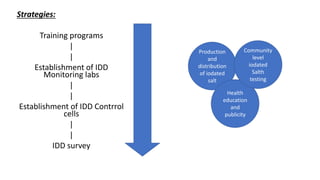
Strategies:
Training programs
|
|
Establishment of IDD
Monitoring labs
|
|
Establishment of IDD Contrrol
cells
|
|
IDD survey
Production
and
distribution
of iodated
salt
Health
education
and
publicity
Community
level
iodated
Salth
testing
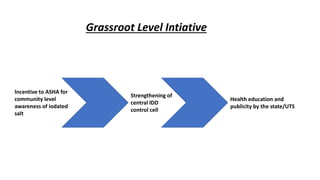
Incentive to ASHA for
community level
awareness of iodated
salt
Strengthening of
central IDD
control cell
Health education and
publicity by the state/UTS
Grassroot Level Intiative
IMPORTANCE OF IODIZED SALT
Take Home Messages
1.Optimal maternal lodine nutrition essential for physical and brain development of foetus and
new born.
2.Maternal iodine requirements higher during pregnancy and lactation
3.NIDDCP- a public health success story however with unfinished agenda
• Last mile unreached
• Sub-national inequities- rural-urban, zonal and socio-economic
• Focus on maternal lodine nutrition
4. Need for Sustainable Elimination of IDD
• Periodic and regular national and state level surveys
• Food fortification – Universal Salt iodization at National, State and District level
• Iodine supplementation including Multiple Micronutrient Supplementation (MMS)
• Inclusion of iodine fortified salt in Public Distribution System (PDS), special feeding
programs reaching pregnant women and lactating women
Iodine & Health.pptx

Iodine & Health.pptx

  • 1.
    Mostaque Ahmed PGT Department ofCommunity Medicine Gauhati Medical College & Hospital, Guwahati, Assam
  • 2.
    INTRODUCTION • Iodine isan essential trace element. • 80% of the iodine distribution in the body (15 milligrams in adults) is present in the thyroid gland where it is used in the synthesis of several thyroid hormones. • The remainder is distributed throughout other tissues, particularly in the mammary, salivary, gastric glands, and in kidneys. • Within the circulation iodine occurs in the form of free iodine ions or as protein-bound iodine. • Excretion is primarily in urine and a small amount in feces
  • 3.
    Absorption and Metabolism •Bioavailability of iodine is greater than 90%. Most iodine that is ingested is reduced to iodide and is absorbed almost completely, primarily in the small intestine. • Some iodine-containing compounds (thyroid hormones) are absorbed intact. Once in circulation, iodide is principally removed by the thyroid gland and kidneys. Transport • The protein responsible for iodide transport is the sodium/iodide symporter • The sodium/iodide symporter in the thyroid basal membrane transfers iodide from the circulation into the thyroid gland at a concentration gradient of about 20-50 times the rate of plasma. • This ensures that the thyroid gland obtains adequate amounts of iodide for hormone synthesis.
  • 4.
    Storage and Excretion •The thyroid selectively concentrates iodide in amounts required for adequate thyroid hormone synthesis. • Several other tissues can also concentrate iodine, Including salivary glands, gastric mucosa, breast, and Choroid plexus. • Most excretion of iodine occurs through the urine with the remainder excreted in the feces.
  • 5.
    Functions it is anintegral part of thyroid hormones that play a major role in regulating growth and development. They also have important role in regulation of metabolic rate. • It is required for early development of nervous system during fetal life. • It is needed for normal reproductive function. • Synthesis of thyroid hormones -thyroxine (T4) -Triiodothyronine (T3) These hormones regulate many biochemical reactions including • Protein synthesis • Enzymatic activity • These processes affect the heart, kidneys, pituitary gland,muscles and brain • Plays a role in growth and development Regulates the rate at which the body uses energy • May have beneficial roles in mammary dysplasia and fibrocytic breast disease
  • 6.
    Sources of Iodine •Iodine is an essential trace mineral that is not naturally made by the body, and can only be acquired through dietary sources • lodine is added to all table salt in Canadian diet • Processed foods may have higher levels of iodine because the addition of salts and preservatives • Best natural occurring source is salt water seafood • lodine content varies depending on mineral content of the soil where the food was grown. Vegetables & Fruits Grain Products Milk/Alternatives Meat/Alternatives Prunes Potato Lima beans Corn Flakes White Rice Soda Crackers Bread: rye, whole wheat, white Cottage Cheese Milk Yogurt Hard Cheese(cheddar) Cod/Haddock Egg Beans (navy) Soy nuts Liver Deli meat chicken
  • 8.
    Age Male &Female (mcg/day) 0-6 months 110 7-12 months 130 1-3 years 90 4-8 years 90 9-13 years 120 14-19 years 120 19+ years 150 Pregnancy 220-250 Lactation 290 Recommended Dietary Allowances (RDA) of Iodine
  • 9.
    Iodine deficiency It occurswhen the soil is poor in iodine, causing a low concentration in food products and insufficient iodine intake (amount <50 mcg/day) in the population. When iodine requirements are not met, the thyroid may no longer be able to synthesize sufficient amounts of thyroid hormone. Aetiology of iodine Deficiency There are two factors,which plays major role in the aetiology of Iodine deficiency- 1. Extrinsic Factors a) Environmental: Rain, Flood, soil erosion, snow fall etc. b) Goitrogens 2. Intrinsic Factors (Genetic)
  • 10.
    Snow fall HeavyRain Fall Flood Soil Erosion
  • 11.
    • GOITROGENS • Substancesthat interfere with iodine metabolism at various stages of thyroid hormone homeostasis. • Inhibition of any of these hormones- disturbs hormonal balance & leads to iodine deficiency. • Depending on the level of interference, it is categorized as follows: Class-I: Thiocyanate,isothiocyanate & cyonogenic glycosides--Inhibit lodine uptake by thyroid gland. Class-II: Thiourea, thionamides & flavanomides--affects organization & coupling inthyroxine synthesis. Class-III: Excess iodine & lithium interfere at proteolysis, necessary for utilization of thyroxine.
  • 13.
    Intrinsic Factors includesgenetic disorders that causes mal-absorption as well as defective Iodine metabolism & Transportation. Symptom of Iodine Deficiency • Putting on weight • Feeling weak • Losing hair • Drying skin • Heart rate abnormalities • Muscles soreness • Memory loss • Brittle Nail • Heavy & irregular menstruation • Swelling in the neck • Brain Fog • Feeling extreme cold/extreme hot etc.
  • 14.
    Impact of Iodinedeficiency during pregnancy
  • 15.
    Impact of Iodinedeficiency during Childhood
  • 16.
    Disorders caused byIodine deficiency
  • 17.
    Spectrum of IodineDeficiency Disorders (IDD): Iodine deficiency is the lack of the trace element iodine, an essential nutrient in the diet, which leads to several health manifestation all together comes under a single umbrella known as “Spectrum of Iodine deficiency disorders” Iodine-deficiency disorders, which can start before birth, jeopardize children’s mental health and very their survival. During the neonatal period,childhood and adolescence, iodine-deficiency disorders can lead to hypothyroidism and hyperthyroidism. Serious iodine deficiency during pregnancy can result in stillbirth, spontaneous abortion and congenital abnormalities such as cretinism (irreversible form of mental retardation) mental impairment that reduces intellectual capacity at home, in school and at work.
  • 19.
  • 20.
    Global Scenario ofIDD IDDs are a major challenge to the health of populations the world over particularly among preschool children and pregnant women in low- income countries. Globally two billion people are at risk of iodine deficiency disorders due to insufficient iodine intake. Nearly 266 million school-aged children worldwide have insufficient iodine intake. Of the 130 countries which reported data for IDD (comprising 91.1% of the total global population), it was found that IDD was one of the major public health problem in 47 countries.
  • 21.
    Indian scenario: IDD wasfirst documented in India in Himalayan region in the year 1908. In India, the entire population is prone to IDD due to deficiency of iodine in the soil of the subcontinent and consequently the food derived from it. In a surveys conducted by the Central and State Health Directorates, Indian Council of Medical Research (ICMR) and medical institutes since have clearly demonstrated that IDD is a public health problem in all States and union territories in India.
  • 22.
    Of 325 districtsthat were surveyed across the India, 263 districts were found to be IDD endemic (i.e. the prevalence of IDD is above 10 percent in the population) Past surveys have shown that there is no state in India which is free from iodine deficiency disorder (IDD). According to NFHS-5 data, Almost 167 million people are at risk of IDD across the India (mainly sub Himalayan regions), out of the 167 million people, 54 million suffer from goiter and two million from cretinism.
  • 24.
    World Iodine DeficiencyDay For the awareness of iodine Deficiency Related Disorders Global Iodine Deficiency Disorders (IDD) Prevention Day or World Iodine Deficiency Day is observed every year on 21st October worldwide.
  • 28.
    National Iodine DeficiencyDisorders Control Programme (NIDDCP) This program was lunch with the name National Goitre Control Programme (NGCP) in 1962 by Government of India to prevent and control Iodine deficiency related disorders. In August, 1992 the National Goitre Control Programme (NGCP) was renamed as National lodine Deficiency Disorders Control Programme (NIDDCP) with a view of wide spectrum of lodine Deficiency Disorders like mental and physical retardation, deaf mutisim, cretinism, still births, abortions etc. It’s a centrally sponsored program & currently this programme is being implemented in all the States/UTs for entire population.
  • 29.
    Goals : 1.To bringthe prevalence of IDD to below 5% in the country 2.To ensure 100% consumption of adequately iodated salt (15ppm) at the household level. Objectives: 1.Surveys to assess the magnitude of Iodine Deficiency Disorders in the districts. 2.Supply of iodated salt in place of common salt. 3.Resurveys to assess iodine deficiency disorders and the impact of iodated salt after every 5 years in the districts. 4.Laboratory monitoring of iodated salt and urinary iodine excretion. 5.Health Education and Publicity.
  • 30.
    NODAL MINISTRY: The ministryof Health & Family Welfare is the nodal ministry for policy descisions on National Iodine Deficiency Disorder Control Program (NIDDCP). POLICY: 1. It had been established that consumption of iodated salt is the best and simplest way to prevent and control IDD. 2.Based on the recommendation of the central council of health in 1984, the govt. of India took a policy decision to iodated the entire edible salt in the country by 1992 in a phased manner. The program started in 1986 in April. 3.The central govt. has issued the notification banning the sale of non-iodated salt for direct human consumption in the entire country with effect from 17th may, 2006 under the prevention of food adulteration act 1954.
  • 31.
    Strategies: Training programs | | Establishment ofIDD Monitoring labs | | Establishment of IDD Contrrol cells | | IDD survey Production and distribution of iodated salt Health education and publicity Community level iodated Salth testing
  • 32.
    Incentive to ASHAfor community level awareness of iodated salt Strengthening of central IDD control cell Health education and publicity by the state/UTS Grassroot Level Intiative
  • 34.
  • 35.
    Take Home Messages 1.Optimalmaternal lodine nutrition essential for physical and brain development of foetus and new born. 2.Maternal iodine requirements higher during pregnancy and lactation 3.NIDDCP- a public health success story however with unfinished agenda • Last mile unreached • Sub-national inequities- rural-urban, zonal and socio-economic • Focus on maternal lodine nutrition 4. Need for Sustainable Elimination of IDD • Periodic and regular national and state level surveys • Food fortification – Universal Salt iodization at National, State and District level • Iodine supplementation including Multiple Micronutrient Supplementation (MMS) • Inclusion of iodine fortified salt in Public Distribution System (PDS), special feeding programs reaching pregnant women and lactating women