MINERALS
S.PREETHI
ASSISTANT PROFESSOR
PG DEPT. OF FOOD AND NUTRITION
BISHOP HEBER COLLEGE
Introduction
2
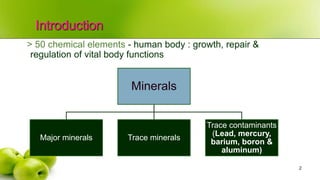
> 50 chemical elements - human body : growth, repair &
regulation of vital body functions
Minerals
Major minerals Trace minerals
Trace contaminants
(Lead, mercury,
barium, boron &
aluminum)
Introduction
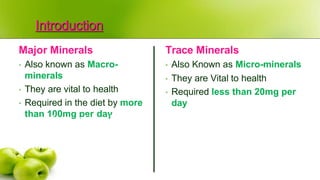
Major Minerals
• Also known as Macro-
minerals
• They are vital to health
• Required in the diet by more
than 100mg per day
Trace Minerals
• Also Known as Micro-minerals
• They are Vital to health
• Required less than 20mg per
day
calcium, phosphorus,
sodium, potassium,
magnesium
Iron, Iodine, Fluorine,
Zinc, Copper Cobalt,
Chromium, Manganese,
Molybdenum, Selenium,
Nickel, Tin, Silicon &
Function of Minerals
As Constituents of bones and teeth: Ca, P, Mg
As Constituents of soft tissues (liver): P
As soluble salts that give to body fluid & cell content, their
composition & Stability that are essential for life– Na, K, Cl, P
Specific functions:
Formation of Haemoglobin - Fe
Formation of thyroxine - Iodine
Constitution of enzymes and hormones: Zn in Carbonic Anhydrase &
Insulin
Cobalt– constituent of Vit-B12
Major Minerals
Calcium
• Macro-mineral
• Constitutes 1.5-2% of the body weight of an adult human
• An average adult body contains about 1200 gm - >98%
present in bones
• Calcium in blood: 10 mg/dl (60%-ionized, 40%-protein
bound)
• The developing fetus requires about 30 g of calcium
• Severe Sweating– loss of 42-121mg/day
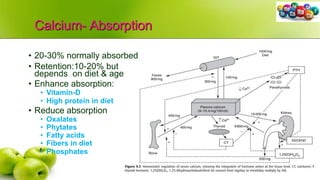
Calcium- Absorption
• 20-30% normally absorbed
• Retention:10-20% but
depends on diet & age
• Enhance absorption:
• Vitamin-D
• High protein in diet
• Reduce absorption
• Oxalates
• Phytates
• Fatty acids
• Fibers in diet
• Phosphates
Calcium-Sources
• Milk and milk Products
• Cow milk- 1200mg
• Human Milk- 300mg
• Egg and Fish
• Cheapest dietary sources:
• Green leafy vegetables (presence of
oxalates)
• Millets
• Cereals (bioavailability reduces by
Phytate)
• Water- 200mg/day
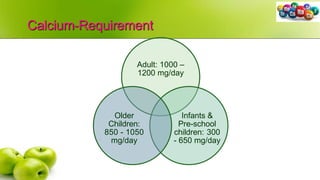
Calcium-Requirement
Adult: 1000 –
1200 mg/day
Infants &
Pre-school
children: 300
- 650 mg/day
Older
Children:
850 - 1050
mg/day
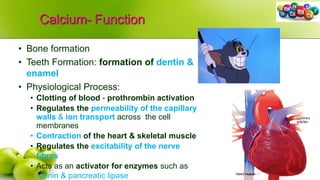
Calcium- Function
• Bone formation
• Teeth Formation: formation of dentin &
enamel
• Physiological Process:
• Clotting of blood - prothrombin activation
• Regulates the permeability of the capillary
walls & ion transport across the cell
membranes
• Contraction of the heart & skeletal muscle
• Regulates the excitability of the nerve
fibres
• Acts as an activator for enzymes such as
rennin & pancreatic lipase
Calcium- Disorder
• Calcium Deficiency
• Effects in Adults:
• Osteoporosis
• Fractures of brittle bone by miner accidents
• Effects in Children:
• Decreased rate of growth
• Loss of Calcium from Bone leading to development of Osteoporosis
• Hyperplasia of parathyroid gland
• Hyper-irritability and tetany leading to death
HypoCalcemia-
• Motor nerves become over
susceptible to stimuli
HyperCalcemia-
• Common in 5-8 months children
• May occur because of excess
Vit-D
• Symptoms: loss of appetite,
Vomiting and wasting
• Treated by diet with low Calcium
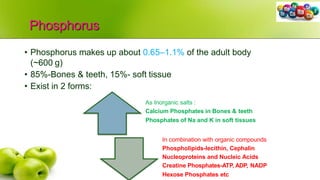
Phosphorus
• Phosphorus makes up about 0.65–1.1% of the adult body
(~600 g)
• 85%-Bones & teeth, 15%- soft tissue
• Exist in 2 forms:
As Inorganic salts :
Calcium Phosphates in Bones & teeth
Phosphates of Na and K in soft tissues
In combination with organic compounds
Phospholipids-lecithin, Cephalin
Nucleoproteins and Nucleic Acids
Creatine Phosphates-ATP, ADP, NADP
Hexose Phosphates etc
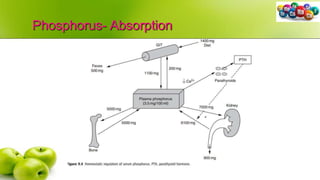
Phosphorus- Absorption
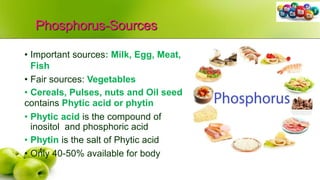
Phosphorus-Sources
• Important sources: Milk, Egg, Meat,
Fish
• Fair sources: Vegetables
• Cereals, Pulses, nuts and Oil seed
contains Phytic acid or phytin
• Phytic acid is the compound of
inositol and phosphoric acid
• Phytin is the salt of Phytic acid
• Only 40-50% available for body
Phosphorus-Requirement
•Phosphorus requirements have not been
specifically considered by FAO/WHO
Committees,
But
•Other groups of experts have suggested that
phosphorus intake should be at least equal to
calcium intakes in most age groups, except in
infancy where the ratio suggested is
1:1.5 (P:Ca)
Phosphorus- Function
• Bone and Teeth Formation: formation of dentin and
enamel
• Required for formation of Phospholipids—integral
part of cell structure, act as intermediate in fat
transport and metabolism
• Required for carbohydrate metabolism– Glycogen
phosphorylation by inorganic phosphorus
• Required for formation of nucleic acid and
nucleoprotein– Integral part of DNA
Magnesium
•Adult human body contains 25gm of
Mg
•50% present in bones in
combination with Phosphorus and
carbonate
•1/5th of Mg is present in soft tissue
Magnesium- Absorption
• Average diet contains 300-400mg of
magnesium
• 40-50% not absorbed
• 1/5th of Magnesium is excreted in urine
• Urine level: 2-3mg/100ml
• Blood: 1.6mg/100ml
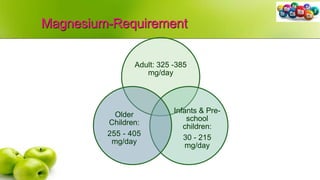
Magnesium-Requirement
Adult: 325 -385
mg/day
Infants & Pre-
school
children:
30 - 215
mg/day
Older
Children:
255 - 405
mg/day
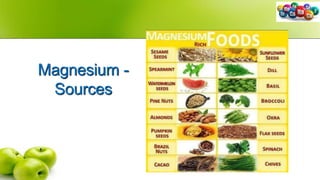
Magnesium -
Sources
Magnesium- Disorder
• It is characterized by Depression, Muscular weakness,
vertigo and liability to convulsion, irritability, tetany,
hyper-reflexia and occasionally hypo-reflexia
• It is seen in Chronic alcoholics, liver cirrhosis, PEM, mal-
absorption syndrome & toxemias of Pregnancy
Treatment:
• Administration of Magnesium salts (100mg MgCl) within 4
hours
Sodium Chloride
• The adult - 100 g of sodium ion
• Sodium is lost - urine & sweat that passed out in urine is regulated
by the kidney but that lost by sweating is not controlled
• Depletion of NaCl causes muscular cramps.
• The requirement of sodium chloride depends upon climate,
occupation & physical activity
• Adult requirement is about 5 gm per day
• A strong relationship between hypertension & dietary salt intake has
been observed & intake of more than 10 gm of salt per day is
considered to have definitive tendency to raise blood pressure
Potassium
• The adult human body contains about 250 g of potassium
• Potassium is vaso active, increases blood flow and sustains
metabolic needs of the tissue
• Potassium supplements lower blood pressure, although the
response is slow.
• High dietary sodium, low dietary potassium have been implicated
in the aetiology of hypertension as evidenced by epidemiological
clinical studies
• The ideal desirable sodium : potassium ratio in the diet is 1:1 (in
mmol)
Trace Minerals
Iron
•The adult human body contains
between 3-4 g of iron, of which
about 60-70 per cent is
present in the blood (Hb iron)
as circulating iron, and the rest
(1 to 1.5 g) as storage iron
•Each gram of hemoglobin
contains about 3.34 mg of iron
Iron- Absorption
• Iron ingested is converted to Ferrous (absorbable) form by the
help of reducing substances
• Absorption takes place from Duodenum and upper jejunum
Absorption affected by:
• Whether it is Haeme Fe or Non haem
• Presence of Vit-C– Increases Fe absorption
• Phytate, Oxalates– reduces Fe absorption
Iron-Requirement
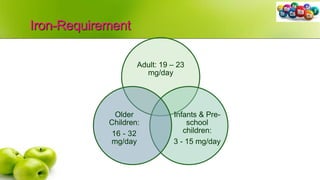
Adult: 19 – 23
mg/day
Infants & Pre-
school
children:
3 - 15 mg/day
Older
Children:
16 - 32
mg/day
Iron-Function
Biological importance:
• Iron porphyrin (heme) compounds – Haemoglobin,
Myoglobin
• Heme enzymes– Mitochondrial cytochromes,
Microsomal cytochrome, catalase, peroxidase
• Flavin-enzymes– Succinic dehydrogenase, xanthine
oxidase
• Transport and storage form- Transferrin , Ferritin,
Hemosiderin
Iron-Sources
4/26/2019 29
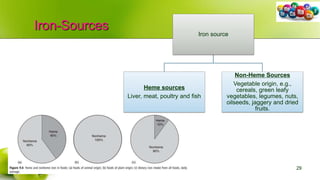
Iron source
Heme sources
Liver, meat, poultry and fish
Non-Heme Sources
Vegetable origin, e.g.,
cereals, green leafy
vegetables, legumes, nuts,
oilseeds, jaggery and dried
fruits.
Iron-Disorder
Excess Iron
• Siderosis – Iron is stored in the hemosiderin – not
available form
• Haemochromatosis – Excess iron is absorbed from
intestine and deposited in liver, spleen, pancreas,
skin– leading to diabetes, liver cirrhosis, skin
discoloration
Iron-Disorder
Iron deficiency Anemia
• Characterized by low oxygen carrying power and low Hb content in
blood (5- 9gm/100ml blood)
• Women of Child bearing age – CLINICAL FEATURE - Fatigue,
lassitude, pallor skin, giddiness
• Weaned infant and young children– there is tendency of children below
3 to eat mud
Treatment
• Anemic women: Ferrous tablet 0.2g x3 times a day
• Children below 12 months: 0.2g ferrous ammonium citrate + glycerin x
3times
• 1-5 yr children: 0.4-0.9g ferrous ammonium citrate x 3times
Iodine
• Essential trace element
• The adult human body contains about 50 mg of iodine,
and the blood level is about 8-12mg/dl
Iodine- Absorption
• Takes place in intestine
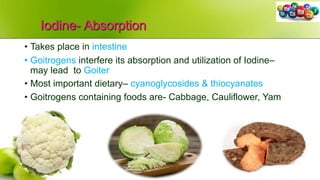
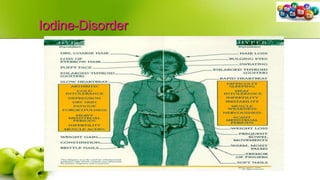
• Goitrogens interfere its absorption and utilization of Iodine–
may lead to Goiter
• Most important dietary– cyanoglycosides & thiocyanates
• Goitrogens containing foods are- Cabbage, Cauliflower, Yam
Iodine-Function
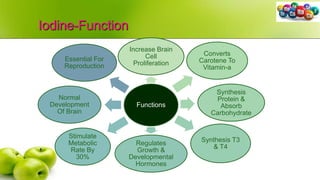
Functions
Increase Brain
Cell
Proliferation
Converts
Carotene To
Vitamin-a
Synthesis
Protein &
Absorb
Carbohydrate
Synthesis T3
& T4
Regulates
Growth &
Developmental
Hormones
Stimulate
Metabolic
Rate By
30%
Normal
Development
Of Brain
Essential For
Reproduction
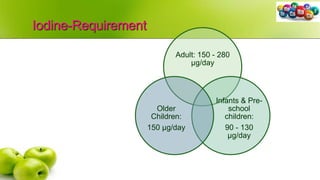
Iodine-Requirement
Adult: 150 - 280
µg/day
Infants & Pre-
school
children:
90 - 130
µg/day
Older
Children:
150 µg/day
Iodine-Sources
• The best sources of iodine are sea foods (e.g., sea fish, sea salt)
and cod liver oil
• Smaller amounts occur in other foods, e.g., milk, meat, vegetables,
cereals, etc.
• The iodine content of fresh water is small & very variable, about 1-
50 micrograms/L
• About 90 per cent of iodine comes from foods eaten; the remainder
from drinking water.
• Fortified Salts— Iodized salts (prophylactic) [iodized bread, iodized
oil]
• 50 ppm at production level
• 30 ppm in retailer level
• 15 ppm at consumer level
Iodine-Disorder
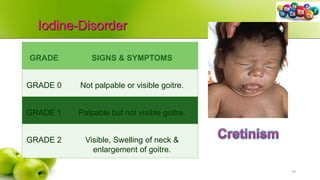
Iodine-Disorder
39
GRADE SIGNS & SYMPTOMS
GRADE 0 Not palpable or visible goitre.
GRADE 1 Palpable but not visible goitre.
GRADE 2 Visible, Swelling of neck &
enlargement of goitre.
Flourine
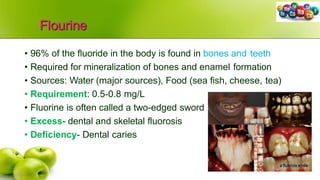
• 96% of the fluoride in the body is found in bones and teeth
• Required for mineralization of bones and enamel formation
• Sources: Water (major sources), Food (sea fish, cheese, tea)
• Requirement: 0.5-0.8 mg/L
• Fluorine is often called a two-edged sword
• Excess- dental and skeletal fluorosis
• Deficiency- Dental caries
Copper
• Adult body is contains about 100-150 mg Cu
• Blood Contains: 0.11gmg/100ml
• Required for bone development, Elastin formation,
cytochrome oxidase function, Iron absorption, tyrosinase
(melanin formation)
• Deficiency-Cardiac Hypertrophy, Aortic Aneurysm, Cerebral
Demyelination, Ataxia, impaired bone formation
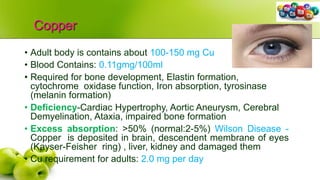
• Excess absorption: >50% (normal:2-5%) Wilson Disease -
Copper is deposited in brain, descendent membrane of eyes
(Kayser-Feisher ring) , liver, kidney and damaged them
• Cu requirement for adults: 2.0 mg per day
Zinc
• Component of >300 enzymes
• It is active in the metabolism of glucides and proteins
• Required for the synthesis of insulin by the pancreas and for the immunity
function.
• Zinc is present in small amounts in all tissues. Zinc-plasma level is about
96µg per 100 ml for healthy adults, and 89 µg per 100 ml for healthy
children.
• The average adult body contains 1.4 to 2.3 g of zinc
• Zinc deficiency has been reported to result in growth failure and sexual
infantilism in adolescents, and in loss of taste and delayed wound healing
• There are also reports of low circulating zinc levels in clinical disorders
such as liver disease, pernicious anaemia, thalassaemia and
myocardial infarction
Zinc
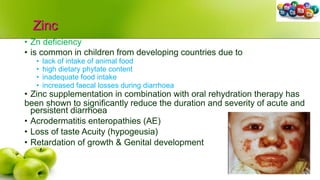
• Zn deficiency
• is common in children from developing countries due to
• lack of intake of animal food
• high dietary phytate content
• inadequate food intake
• increased faecal losses during diarrhoea
• Zinc supplementation in combination with oral rehydration therapy has
been shown to significantly reduce the duration and severity of acute and
persistent diarrhoea
• Acrodermatitis enteropathies (AE)
• Loss of taste Acuity (hypogeusia)
• Retardation of growth & Genital development
Zinc
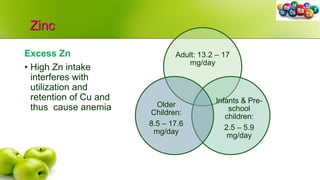
Excess Zn
• High Zn intake
interferes with
utilization and
retention of Cu and
thus cause anemia
Adult: 13.2 – 17
mg/day
Infants & Pre-
school
children:
2.5 – 5.9
mg/day
Older
Children:
8.5 – 17.6
mg/day
Minerals in Food

Minerals in Food

  • 1.
    MINERALS S.PREETHI ASSISTANT PROFESSOR PG DEPT.OF FOOD AND NUTRITION BISHOP HEBER COLLEGE
  • 2.
    Introduction 2 > 50 chemicalelements - human body : growth, repair & regulation of vital body functions Minerals Major minerals Trace minerals Trace contaminants (Lead, mercury, barium, boron & aluminum)
  • 3.
    Introduction Major Minerals • Alsoknown as Macro- minerals • They are vital to health • Required in the diet by more than 100mg per day Trace Minerals • Also Known as Micro-minerals • They are Vital to health • Required less than 20mg per day calcium, phosphorus, sodium, potassium, magnesium Iron, Iodine, Fluorine, Zinc, Copper Cobalt, Chromium, Manganese, Molybdenum, Selenium, Nickel, Tin, Silicon &
  • 4.
    Function of Minerals AsConstituents of bones and teeth: Ca, P, Mg As Constituents of soft tissues (liver): P As soluble salts that give to body fluid & cell content, their composition & Stability that are essential for life– Na, K, Cl, P Specific functions: Formation of Haemoglobin - Fe Formation of thyroxine - Iodine Constitution of enzymes and hormones: Zn in Carbonic Anhydrase & Insulin Cobalt– constituent of Vit-B12
  • 5.
  • 6.
    Calcium • Macro-mineral • Constitutes1.5-2% of the body weight of an adult human • An average adult body contains about 1200 gm - >98% present in bones • Calcium in blood: 10 mg/dl (60%-ionized, 40%-protein bound) • The developing fetus requires about 30 g of calcium • Severe Sweating– loss of 42-121mg/day
  • 7.
    Calcium- Absorption • 20-30%normally absorbed • Retention:10-20% but depends on diet & age • Enhance absorption: • Vitamin-D • High protein in diet • Reduce absorption • Oxalates • Phytates • Fatty acids • Fibers in diet • Phosphates
  • 8.
    Calcium-Sources • Milk andmilk Products • Cow milk- 1200mg • Human Milk- 300mg • Egg and Fish • Cheapest dietary sources: • Green leafy vegetables (presence of oxalates) • Millets • Cereals (bioavailability reduces by Phytate) • Water- 200mg/day
  • 9.
    Calcium-Requirement Adult: 1000 – 1200mg/day Infants & Pre-school children: 300 - 650 mg/day Older Children: 850 - 1050 mg/day
  • 10.
    Calcium- Function • Boneformation • Teeth Formation: formation of dentin & enamel • Physiological Process: • Clotting of blood - prothrombin activation • Regulates the permeability of the capillary walls & ion transport across the cell membranes • Contraction of the heart & skeletal muscle • Regulates the excitability of the nerve fibres • Acts as an activator for enzymes such as rennin & pancreatic lipase
  • 11.
    Calcium- Disorder • CalciumDeficiency • Effects in Adults: • Osteoporosis • Fractures of brittle bone by miner accidents • Effects in Children: • Decreased rate of growth • Loss of Calcium from Bone leading to development of Osteoporosis • Hyperplasia of parathyroid gland • Hyper-irritability and tetany leading to death HypoCalcemia- • Motor nerves become over susceptible to stimuli HyperCalcemia- • Common in 5-8 months children • May occur because of excess Vit-D • Symptoms: loss of appetite, Vomiting and wasting • Treated by diet with low Calcium
  • 12.
    Phosphorus • Phosphorus makesup about 0.65–1.1% of the adult body (~600 g) • 85%-Bones & teeth, 15%- soft tissue • Exist in 2 forms: As Inorganic salts : Calcium Phosphates in Bones & teeth Phosphates of Na and K in soft tissues In combination with organic compounds Phospholipids-lecithin, Cephalin Nucleoproteins and Nucleic Acids Creatine Phosphates-ATP, ADP, NADP Hexose Phosphates etc
  • 13.
  • 14.
    Phosphorus-Sources • Important sources:Milk, Egg, Meat, Fish • Fair sources: Vegetables • Cereals, Pulses, nuts and Oil seed contains Phytic acid or phytin • Phytic acid is the compound of inositol and phosphoric acid • Phytin is the salt of Phytic acid • Only 40-50% available for body
  • 15.
    Phosphorus-Requirement •Phosphorus requirements havenot been specifically considered by FAO/WHO Committees, But •Other groups of experts have suggested that phosphorus intake should be at least equal to calcium intakes in most age groups, except in infancy where the ratio suggested is 1:1.5 (P:Ca)
  • 16.
    Phosphorus- Function • Boneand Teeth Formation: formation of dentin and enamel • Required for formation of Phospholipids—integral part of cell structure, act as intermediate in fat transport and metabolism • Required for carbohydrate metabolism– Glycogen phosphorylation by inorganic phosphorus • Required for formation of nucleic acid and nucleoprotein– Integral part of DNA
  • 17.
    Magnesium •Adult human bodycontains 25gm of Mg •50% present in bones in combination with Phosphorus and carbonate •1/5th of Mg is present in soft tissue
  • 18.
    Magnesium- Absorption • Averagediet contains 300-400mg of magnesium • 40-50% not absorbed • 1/5th of Magnesium is excreted in urine • Urine level: 2-3mg/100ml • Blood: 1.6mg/100ml
  • 19.
    Magnesium-Requirement Adult: 325 -385 mg/day Infants& Pre- school children: 30 - 215 mg/day Older Children: 255 - 405 mg/day
  • 20.
  • 21.
    Magnesium- Disorder • Itis characterized by Depression, Muscular weakness, vertigo and liability to convulsion, irritability, tetany, hyper-reflexia and occasionally hypo-reflexia • It is seen in Chronic alcoholics, liver cirrhosis, PEM, mal- absorption syndrome & toxemias of Pregnancy Treatment: • Administration of Magnesium salts (100mg MgCl) within 4 hours
  • 22.
    Sodium Chloride • Theadult - 100 g of sodium ion • Sodium is lost - urine & sweat that passed out in urine is regulated by the kidney but that lost by sweating is not controlled • Depletion of NaCl causes muscular cramps. • The requirement of sodium chloride depends upon climate, occupation & physical activity • Adult requirement is about 5 gm per day • A strong relationship between hypertension & dietary salt intake has been observed & intake of more than 10 gm of salt per day is considered to have definitive tendency to raise blood pressure
  • 23.
    Potassium • The adulthuman body contains about 250 g of potassium • Potassium is vaso active, increases blood flow and sustains metabolic needs of the tissue • Potassium supplements lower blood pressure, although the response is slow. • High dietary sodium, low dietary potassium have been implicated in the aetiology of hypertension as evidenced by epidemiological clinical studies • The ideal desirable sodium : potassium ratio in the diet is 1:1 (in mmol)
  • 24.
  • 25.
    Iron •The adult humanbody contains between 3-4 g of iron, of which about 60-70 per cent is present in the blood (Hb iron) as circulating iron, and the rest (1 to 1.5 g) as storage iron •Each gram of hemoglobin contains about 3.34 mg of iron
  • 26.
    Iron- Absorption • Ironingested is converted to Ferrous (absorbable) form by the help of reducing substances • Absorption takes place from Duodenum and upper jejunum Absorption affected by: • Whether it is Haeme Fe or Non haem • Presence of Vit-C– Increases Fe absorption • Phytate, Oxalates– reduces Fe absorption
  • 27.
    Iron-Requirement Adult: 19 –23 mg/day Infants & Pre- school children: 3 - 15 mg/day Older Children: 16 - 32 mg/day
  • 28.
    Iron-Function Biological importance: • Ironporphyrin (heme) compounds – Haemoglobin, Myoglobin • Heme enzymes– Mitochondrial cytochromes, Microsomal cytochrome, catalase, peroxidase • Flavin-enzymes– Succinic dehydrogenase, xanthine oxidase • Transport and storage form- Transferrin , Ferritin, Hemosiderin
  • 29.
    Iron-Sources 4/26/2019 29 Iron source Hemesources Liver, meat, poultry and fish Non-Heme Sources Vegetable origin, e.g., cereals, green leafy vegetables, legumes, nuts, oilseeds, jaggery and dried fruits.
  • 30.
    Iron-Disorder Excess Iron • Siderosis– Iron is stored in the hemosiderin – not available form • Haemochromatosis – Excess iron is absorbed from intestine and deposited in liver, spleen, pancreas, skin– leading to diabetes, liver cirrhosis, skin discoloration
  • 31.
    Iron-Disorder Iron deficiency Anemia •Characterized by low oxygen carrying power and low Hb content in blood (5- 9gm/100ml blood) • Women of Child bearing age – CLINICAL FEATURE - Fatigue, lassitude, pallor skin, giddiness • Weaned infant and young children– there is tendency of children below 3 to eat mud Treatment • Anemic women: Ferrous tablet 0.2g x3 times a day • Children below 12 months: 0.2g ferrous ammonium citrate + glycerin x 3times • 1-5 yr children: 0.4-0.9g ferrous ammonium citrate x 3times
  • 32.
    Iodine • Essential traceelement • The adult human body contains about 50 mg of iodine, and the blood level is about 8-12mg/dl
  • 33.
    Iodine- Absorption • Takesplace in intestine • Goitrogens interfere its absorption and utilization of Iodine– may lead to Goiter • Most important dietary– cyanoglycosides & thiocyanates • Goitrogens containing foods are- Cabbage, Cauliflower, Yam
  • 34.
    Iodine-Function Functions Increase Brain Cell Proliferation Converts Carotene To Vitamin-a Synthesis Protein& Absorb Carbohydrate Synthesis T3 & T4 Regulates Growth & Developmental Hormones Stimulate Metabolic Rate By 30% Normal Development Of Brain Essential For Reproduction
  • 35.
    Iodine-Requirement Adult: 150 -280 µg/day Infants & Pre- school children: 90 - 130 µg/day Older Children: 150 µg/day
  • 36.
    Iodine-Sources • The bestsources of iodine are sea foods (e.g., sea fish, sea salt) and cod liver oil • Smaller amounts occur in other foods, e.g., milk, meat, vegetables, cereals, etc. • The iodine content of fresh water is small & very variable, about 1- 50 micrograms/L • About 90 per cent of iodine comes from foods eaten; the remainder from drinking water. • Fortified Salts— Iodized salts (prophylactic) [iodized bread, iodized oil] • 50 ppm at production level • 30 ppm in retailer level • 15 ppm at consumer level
  • 37.
  • 38.
    Iodine-Disorder 39 GRADE SIGNS &SYMPTOMS GRADE 0 Not palpable or visible goitre. GRADE 1 Palpable but not visible goitre. GRADE 2 Visible, Swelling of neck & enlargement of goitre.
  • 39.
    Flourine • 96% ofthe fluoride in the body is found in bones and teeth • Required for mineralization of bones and enamel formation • Sources: Water (major sources), Food (sea fish, cheese, tea) • Requirement: 0.5-0.8 mg/L • Fluorine is often called a two-edged sword • Excess- dental and skeletal fluorosis • Deficiency- Dental caries
  • 40.
    Copper • Adult bodyis contains about 100-150 mg Cu • Blood Contains: 0.11gmg/100ml • Required for bone development, Elastin formation, cytochrome oxidase function, Iron absorption, tyrosinase (melanin formation) • Deficiency-Cardiac Hypertrophy, Aortic Aneurysm, Cerebral Demyelination, Ataxia, impaired bone formation • Excess absorption: >50% (normal:2-5%) Wilson Disease - Copper is deposited in brain, descendent membrane of eyes (Kayser-Feisher ring) , liver, kidney and damaged them • Cu requirement for adults: 2.0 mg per day
  • 41.
    Zinc • Component of>300 enzymes • It is active in the metabolism of glucides and proteins • Required for the synthesis of insulin by the pancreas and for the immunity function. • Zinc is present in small amounts in all tissues. Zinc-plasma level is about 96µg per 100 ml for healthy adults, and 89 µg per 100 ml for healthy children. • The average adult body contains 1.4 to 2.3 g of zinc • Zinc deficiency has been reported to result in growth failure and sexual infantilism in adolescents, and in loss of taste and delayed wound healing • There are also reports of low circulating zinc levels in clinical disorders such as liver disease, pernicious anaemia, thalassaemia and myocardial infarction
  • 42.
    Zinc • Zn deficiency •is common in children from developing countries due to • lack of intake of animal food • high dietary phytate content • inadequate food intake • increased faecal losses during diarrhoea • Zinc supplementation in combination with oral rehydration therapy has been shown to significantly reduce the duration and severity of acute and persistent diarrhoea • Acrodermatitis enteropathies (AE) • Loss of taste Acuity (hypogeusia) • Retardation of growth & Genital development
  • 43.
    Zinc Excess Zn • HighZn intake interferes with utilization and retention of Cu and thus cause anemia Adult: 13.2 – 17 mg/day Infants & Pre- school children: 2.5 – 5.9 mg/day Older Children: 8.5 – 17.6 mg/day