NUTRITIONAL ANEMIA
Dr. Moumita Pal
MBBS, DPH, MD
Dept. of Community
Medicine
College of Medicine and
Sagar Dutta Hospital
1
Iron
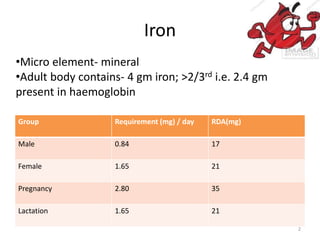
Group Requirement (mg) / day RDA(mg)
Male 0.84 17
Female 1.65 21
Pregnancy 2.80 35
Lactation 1.65 21
•Micro element- mineral
•Adult body contains- 4 gm iron; >2/3rd i.e. 2.4 gm
present in haemoglobin
2
Iron- sources
• Haem-iron: Non vegetarian sources- meat,
fish, poultry, liver. Help in absorption of
Non haem iron. Milk is poor source but iron
in breast milk is well utilized.
• Non haem iron: vegetarian sources like
cereals, green leafy vegetables, pulses,
nuts, dry fruits, jaggery. Bioavailability is
poor.
• Decrease absorption- Phytic acid( cereals,
fibre), polyphenols( in plants), tannins
( tea), phosphates ( milk, eggs), calcium
• Enhance non haem iron absorption- haem
iron, ascorbic acid, low pH ( vit C ).
3
Absorption and Loss
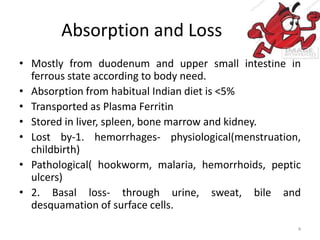
• Mostly from duodenum and upper small intestine in
ferrous state according to body need.
• Absorption from habitual Indian diet is <5%
• Transported as Plasma Ferritin
• Stored in liver, spleen, bone marrow and kidney.
• Lost by-1. hemorrhages- physiological(menstruation,
childbirth)
• Pathological( hookworm, malaria, hemorrhoids, peptic
ulcers)
• 2. Basal loss- through urine, sweat, bile and
desquamation of surface cells.
4
Functions
• Formation of haemoglobin and Myoglobin.
• Constituents of enzymes like cytochromes,
catalase, peroxidase,
• Oxygen transport and cellular respiration.
• Cellular immune response and functioning of
phagocytes.
• Brain development and function
• Regulation of body temperature and muscle
activity.
5
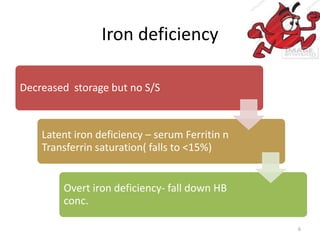
Iron deficiency
Decreased storage but no S/S
Latent iron deficiency – serum Ferritin n
Transferrin saturation( falls to <15%)
Overt iron deficiency- fall down HB
conc.
6
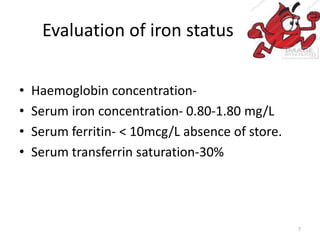
Evaluation of iron status
• Haemoglobin concentration-
• Serum iron concentration- 0.80-1.80 mg/L
• Serum ferritin- < 10mcg/L absence of store.
• Serum transferrin saturation-30%
7
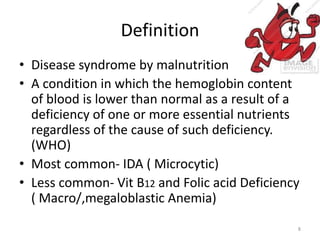
Definition
• Disease syndrome by malnutrition
• A condition in which the hemoglobin content
of blood is lower than normal as a result of a
deficiency of one or more essential nutrients
regardless of the cause of such deficiency.
(WHO)
• Most common- IDA ( Microcytic)
• Less common- Vit B12 and Folic acid Deficiency
( Macro/,megaloblastic Anemia)
8
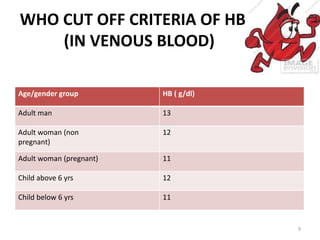
WHO CUT OFF CRITERIA OF HB%
(IN VENOUS BLOOD)
Age/gender group HB ( g/dl)
Adult man 13
Adult woman (non
pregnant)
12
Adult woman (pregnant) 11
Child above 6 yrs 12
Child below 6 yrs 11
9
The problem Statement
• World wide problem specially for developing
countries.
• More prevalent in women of child baring age,
young children, pregnancy, lactation.
• In India >50% of women, 70% of children are
anemic.
• Adolescent girls- 72.6% anemic ( DLHS)
• Megaloblastic anemia masked by IDA. 30% in
pregnant women
10
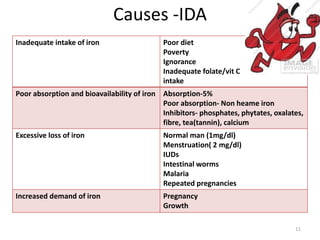
Causes -IDA
Inadequate intake of iron Poor diet
Poverty
Ignorance
Inadequate folate/vit C
intake
Poor absorption and bioavailability of iron Absorption-5%
Poor absorption- Non heame iron
Inhibitors- phosphates, phytates, oxalates,
fibre, tea(tannin), calcium
Excessive loss of iron Normal man (1mg/dl)
Menstruation( 2 mg/dl)
IUDs
Intestinal worms
Malaria
Repeated pregnancies
Increased demand of iron Pregnancy
Growth
11
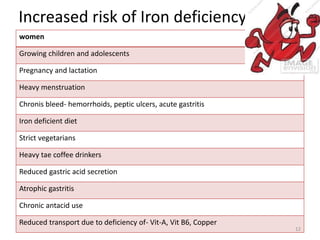
Increased risk of Iron deficiency
women
Growing children and adolescents
Pregnancy and lactation
Heavy menstruation
Chronis bleed- hemorrhoids, peptic ulcers, acute gastritis
Iron deficient diet
Strict vegetarians
Heavy tae coffee drinkers
Reduced gastric acid secretion
Atrophic gastritis
Chronic antacid use
Reduced transport due to deficiency of- Vit-A, Vit B6, Copper
12
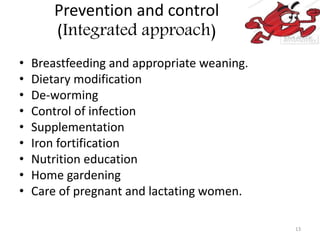
Prevention and control
(Integrated approach)
• Breastfeeding and appropriate weaning.
• Dietary modification
• De-worming
• Control of infection
• Supplementation
• Iron fortification
• Nutrition education
• Home gardening
• Care of pregnant and lactating women.
13
Iron fortification
• By National Institute of Nutrition, Hyderabad
• Addition of ferric ortho-phosphate or ferrous
sulphate with sodium bisulphate to fortify
common salt
• Consumed over 12-18 months-reduced
prevalence
• Advantages- universally consumed by all
sections, no special delivery system needed.
14
National nutritional anemia
prophylaxis program
• Launched in 1972
• Beneficiaries : pregnant and lactating women,
children 1-5 years and women acceptors of
family planning.
• Currently operating as a part of RMNCH+A.
• Target group includes infants(6-12 months),
School children 5-10 years and adolescents
10-19 years.
15
1
16
17
New strategies under
RMNCH+A
18
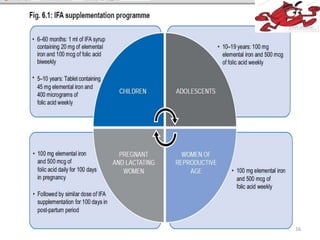
NATIONAL IRON + INITIATIVE
• Continuum of care- management of anemia across all life
stages.
• Use of folic acid in planned pregnancies-3 months before
and 3 months after conception to prevent Neural tube
defect.
• For 6-60months- ASHA are key person to visit home to
provide 1 dose under direct observation and educate
mother about importance of IFA.
• IFA tablets for adolescent is colored blue- IRON KI NILI GOLI
to distinguish it from red IFA for pregnant and lactating
women.
19
The weekly Iron and Folic Acid
supplementation (WIFS)
• Community based intervention
• address IDA amongst adolescents( boys and
girls) for both Urban and Rural areas.
• Covers adolescent enrolled in class VI-XII of
Govt., Govt. aided and Municipal schools.
• Includes out of school girls too through
anganwadis.
20
Cont. Key features of WIFS
• Supervised administration of weekly IFA
• Screening of target groups for mod and severe
anemia and referral to appropriate facility
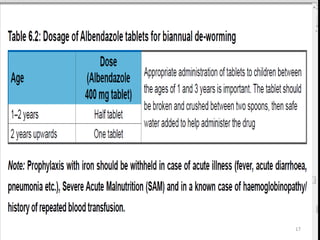
• Bi annual de worming
• IEC for improve diet and prevention of worm
infestation.
21
Causes of poor out come of the
program
• Poor perception of the problem by population
• Poor compliance
• Medicine supply and stock inadequate and
poor quality
• Knowledge of functionaries and beneficiaries
poor
• Evaluation system not implimented
22
23

Nutritional anemia

  • 1.
    NUTRITIONAL ANEMIA Dr. MoumitaPal MBBS, DPH, MD Dept. of Community Medicine College of Medicine and Sagar Dutta Hospital 1
  • 2.
    Iron Group Requirement (mg)/ day RDA(mg) Male 0.84 17 Female 1.65 21 Pregnancy 2.80 35 Lactation 1.65 21 •Micro element- mineral •Adult body contains- 4 gm iron; >2/3rd i.e. 2.4 gm present in haemoglobin 2
  • 3.
    Iron- sources • Haem-iron:Non vegetarian sources- meat, fish, poultry, liver. Help in absorption of Non haem iron. Milk is poor source but iron in breast milk is well utilized. • Non haem iron: vegetarian sources like cereals, green leafy vegetables, pulses, nuts, dry fruits, jaggery. Bioavailability is poor. • Decrease absorption- Phytic acid( cereals, fibre), polyphenols( in plants), tannins ( tea), phosphates ( milk, eggs), calcium • Enhance non haem iron absorption- haem iron, ascorbic acid, low pH ( vit C ). 3
  • 4.
    Absorption and Loss •Mostly from duodenum and upper small intestine in ferrous state according to body need. • Absorption from habitual Indian diet is <5% • Transported as Plasma Ferritin • Stored in liver, spleen, bone marrow and kidney. • Lost by-1. hemorrhages- physiological(menstruation, childbirth) • Pathological( hookworm, malaria, hemorrhoids, peptic ulcers) • 2. Basal loss- through urine, sweat, bile and desquamation of surface cells. 4
  • 5.
    Functions • Formation ofhaemoglobin and Myoglobin. • Constituents of enzymes like cytochromes, catalase, peroxidase, • Oxygen transport and cellular respiration. • Cellular immune response and functioning of phagocytes. • Brain development and function • Regulation of body temperature and muscle activity. 5
  • 6.
    Iron deficiency Decreased storagebut no S/S Latent iron deficiency – serum Ferritin n Transferrin saturation( falls to <15%) Overt iron deficiency- fall down HB conc. 6
  • 7.
    Evaluation of ironstatus • Haemoglobin concentration- • Serum iron concentration- 0.80-1.80 mg/L • Serum ferritin- < 10mcg/L absence of store. • Serum transferrin saturation-30% 7
  • 8.
    Definition • Disease syndromeby malnutrition • A condition in which the hemoglobin content of blood is lower than normal as a result of a deficiency of one or more essential nutrients regardless of the cause of such deficiency. (WHO) • Most common- IDA ( Microcytic) • Less common- Vit B12 and Folic acid Deficiency ( Macro/,megaloblastic Anemia) 8
  • 9.
    WHO CUT OFFCRITERIA OF HB% (IN VENOUS BLOOD) Age/gender group HB ( g/dl) Adult man 13 Adult woman (non pregnant) 12 Adult woman (pregnant) 11 Child above 6 yrs 12 Child below 6 yrs 11 9
  • 10.
    The problem Statement •World wide problem specially for developing countries. • More prevalent in women of child baring age, young children, pregnancy, lactation. • In India >50% of women, 70% of children are anemic. • Adolescent girls- 72.6% anemic ( DLHS) • Megaloblastic anemia masked by IDA. 30% in pregnant women 10
  • 11.
    Causes -IDA Inadequate intakeof iron Poor diet Poverty Ignorance Inadequate folate/vit C intake Poor absorption and bioavailability of iron Absorption-5% Poor absorption- Non heame iron Inhibitors- phosphates, phytates, oxalates, fibre, tea(tannin), calcium Excessive loss of iron Normal man (1mg/dl) Menstruation( 2 mg/dl) IUDs Intestinal worms Malaria Repeated pregnancies Increased demand of iron Pregnancy Growth 11
  • 12.
    Increased risk ofIron deficiency women Growing children and adolescents Pregnancy and lactation Heavy menstruation Chronis bleed- hemorrhoids, peptic ulcers, acute gastritis Iron deficient diet Strict vegetarians Heavy tae coffee drinkers Reduced gastric acid secretion Atrophic gastritis Chronic antacid use Reduced transport due to deficiency of- Vit-A, Vit B6, Copper 12
  • 13.
    Prevention and control (Integratedapproach) • Breastfeeding and appropriate weaning. • Dietary modification • De-worming • Control of infection • Supplementation • Iron fortification • Nutrition education • Home gardening • Care of pregnant and lactating women. 13
  • 14.
    Iron fortification • ByNational Institute of Nutrition, Hyderabad • Addition of ferric ortho-phosphate or ferrous sulphate with sodium bisulphate to fortify common salt • Consumed over 12-18 months-reduced prevalence • Advantages- universally consumed by all sections, no special delivery system needed. 14
  • 15.
    National nutritional anemia prophylaxisprogram • Launched in 1972 • Beneficiaries : pregnant and lactating women, children 1-5 years and women acceptors of family planning. • Currently operating as a part of RMNCH+A. • Target group includes infants(6-12 months), School children 5-10 years and adolescents 10-19 years. 15
  • 16.
  • 17.
  • 18.
  • 19.
    NATIONAL IRON +INITIATIVE • Continuum of care- management of anemia across all life stages. • Use of folic acid in planned pregnancies-3 months before and 3 months after conception to prevent Neural tube defect. • For 6-60months- ASHA are key person to visit home to provide 1 dose under direct observation and educate mother about importance of IFA. • IFA tablets for adolescent is colored blue- IRON KI NILI GOLI to distinguish it from red IFA for pregnant and lactating women. 19
  • 20.
    The weekly Ironand Folic Acid supplementation (WIFS) • Community based intervention • address IDA amongst adolescents( boys and girls) for both Urban and Rural areas. • Covers adolescent enrolled in class VI-XII of Govt., Govt. aided and Municipal schools. • Includes out of school girls too through anganwadis. 20
  • 21.
    Cont. Key featuresof WIFS • Supervised administration of weekly IFA • Screening of target groups for mod and severe anemia and referral to appropriate facility • Bi annual de worming • IEC for improve diet and prevention of worm infestation. 21
  • 22.
    Causes of poorout come of the program • Poor perception of the problem by population • Poor compliance • Medicine supply and stock inadequate and poor quality • Knowledge of functionaries and beneficiaries poor • Evaluation system not implimented 22
  • 23.