CASTING
Dr. Affan Ahmad
Incharge
Department of Science of Dental Materials
KMDC
CASTING PROCEDURE
 The casting procedure consists of:
1. Forming a wax pattern
2. Surrounding it with investment material
3. Heating the investment mould to remove the wax
4. Introduction of molten metal into the mould
 The purpose of dental casting is to provide a metallic
replacement for missing tooth structure
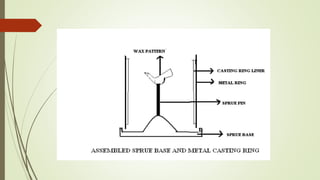
COMPONENTS OF INVESTMENT MOULD
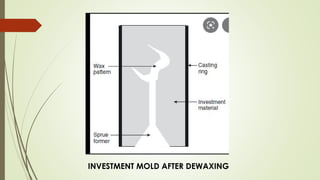
MOULD CAVITY: Produced by setting of the investment
material around the wax pattern, sprue former and
sprue base, after which the sprue former and base are
removed and wax or resin pattern is eliminated by a
burnout process
 SPRUE: It is a channel embedded in an investment
mould through which molten metal flows
 CASTING RING LINERS
INVESTMENT MOLD AFTER DEWAXING
CASTING PROCEDURE
 The casting procedure involves the following steps:
1. Formation of wax pattern
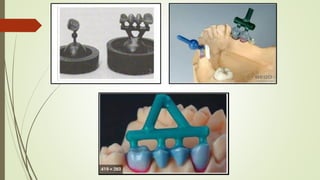
2. Spruing of wax pattern
3. Investing of wax pattern
4. Elimination of wax pattern
5. Casting the molten alloy in the mould cavity
6. Removal of the casting and its cleaning
FORMATION OF WAX PATTERN
1. DIRECT WAX PATTERN If the wax pattern is prepared
inside the mouth of the patient
2. INDIRECT WAX PATTERN When impression of the cavity
preparation or the prepared tooth is taken and a die is
formed on which the wax pattern is formed
SPRUING OF THE WAX PATTERN
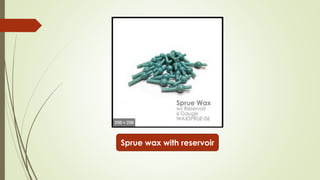
Sprue wax with reservoir
• The factors which influence the quality of the
casting are:
1. Size of the sprue
2. Diameter of the sprue
3. Location of the sprue
4. Length of the sprue
5. Direction of the sprue
• SPRUE DIAMETER:
The diameter of the sprue controls the rate of flow of the
molten metal into the mould cavity. It should be larger or
same as the thickest part of the wax pattern.
◦ Large diameter sprue improves the flow of molten metal
into the mould
◦ Less diameter of sprue causes localized shrinkage porosity
• POSITION OF SPRUE:
The position of the sprue should be at the bulkiest portion of
the wax pattern
• ATTACHMENT OF SPRUE:
The sprue former should be attached to the portion of the pattern with
the largest cross sectional area so that the molten metal flows from
the thick sections to thin sections minimizing the risk of turbulence
◦ High turbulence causes porosity .
• LENGTH OF SPRUE:
The length of the sprue former should be long enough so that the wax
pattern can be positioned approximately 6mm from the end of
casting ring and should be short enough so that the molten alloy does
not solidify before it fills the mould
◦ Short sprue causes porosity in casting at the junction of sprue and
wax pattern
◦ Long sprue causes solidification of metal in the sprue first leading to
casting shrinkage and incomplete casting
• DIRECTION OF SPRUE: The sprue former should be directed
away from any thin or delicate parts of the pattern. To
obtain a satisfactory casting, the sprue former should be at
45° angle to the proximal area
INVESTING PROCEDURE FOR WAX PATTERN
• There are two methods of investing wax pattern:
1. Hand-Investing Procedure
2. Vacuum-Investing Procedure
HAND INVESTING PROCEDURE
 The powder and liquid components of investment material are
mixed properly.
 After being spatulated, the investment is placed on a vibrator to
remove air bubbles.
 The investment is then painted on the wax pattern while holding
the sprue base.
 Then the casting ring is placed over the sprue base and filled with
investment material.
 Left for 45-60 min to allow the investment to set.
VACCUM INVESTING PROCEDURE
 The powder and liquid are mixed under vacuum.
 The mixed investment is allowed to flow into the ring
and around the wax pattern in the presence of
vacuum.
 This technique reduces the amount of porosity in the
investment which results in smoother cast surface with
better detail production.
After the casting ring is completely filled with the investment
material either by hand or vacuum investing procedure:
• The investment is allowed to harden in air if thermal
expansion technique is used
• If hygroscopic expansion technique is used, the casting
ring should be placed immediately in water bath at 37°C
and allowed to harden under water
WAX ELIMINATION
• Once the investment material has set, the casting ring is
transferred to the furnace for burnout process.
• Proper and careful heating of the investment material
is necessary because:
1. Complete elimination of wax
2. Correct thermal expansion
3. Prevent overheating of calcium sulfate hemihydrate
• For Gypsum-Bonded investment the temperature of the
furnace should be either 500°C for hygroscopic technique
and 700°C for thermal expansion technique
• The range of temperature for phosphate-bonded
investment is 700-1030°C
• Heating of the investment mould should be carried out at a
rate which allows the steam and other gases to be
liberated
• The temperature of the investment should not fall
significantly before casting
• The mould temperature should be high enough to facilitate
the thermal expansion and to prevent premature
crystallization of the molten alloy
CASTING MACHINES
• When the wax pattern is completely eliminated and the
mould has reached the casting temperature the alloy is
melted by an appropriate method and cast into the
mould cavity.
• There are various types of machines that can be used to
melt the alloy, which have the following three variables:
1. The alloy is melted in the mold sprue base or in a separate
crucible located in the casting machine
2. The alloy is melted by either gas-torch. Oxyacetylene
torch, electrical induction heating or electrical resistance
melting
3. The molten alloy is driven into the mould by gravity, air
pressure, steam pressure or by centrifugal force
CASTING RING LINER
• Solid casting rings do not permit the investment to
expand laterally, therefore to overcome this lateral
restriction the walls of the casting ring are lined with a
ring liner.
• Ring liner:
1. Allows the setting expansion in the investment by
forming a pliable lining inside the casting ring.
2. Prevents rapid cooling and contraction of the mould
after the burnout process as it has a thermal
insulating property.
3. Causes semi-hygroscopic expansion.
CLEANING OF THE CASTING
• When the hot molten metal enters the mould cavity, certain
alloys especially gold is contaminated on the surface and the
surface of the casting appears dark with oxides and tarnish.
• PICKLING is a process by which such surface films can be
removed.
• Pickling consists of heating the discolored casting in an acid.
Available pickling solutions are 50% hydrochloric acid solution
or solution of sulfuric acid.
• The casting to be cleaned is placed in a container to which
the pickling solution is added. It is then warmed gently until
surface becomes bright and the casting is then rinsed
thoroughly with water
DEFECTS IN CASTING
• Defects in casting can be listed under four headings:
1. Finning and bubbling
2. Porosity
3. Incomplete casting
4. Oversized or undersized casting
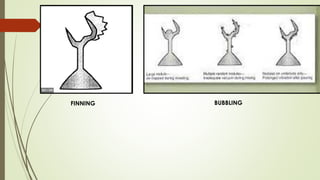
FINNING AND BUBBLING
 FINS are produced due to the flow of molten metal into
the cracks present in the investment due to rapid
heating of the investment in the furnace.
 Bubbling effect of the casting surface is due to the
porosities in the investment caused by entrapment of air
bubbles during mixing.
FINNING BUBBLING
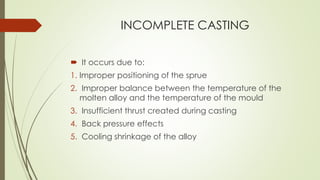
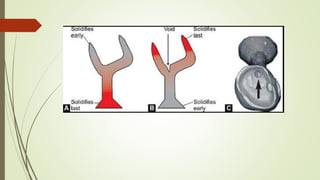
INCOMPLETE CASTING
 It occurs due to:
1. Improper positioning of the sprue
2. Improper balance between the temperature of the
molten alloy and the temperature of the mould
3. Insufficient thrust created during casting
4. Back pressure effects
5. Cooling shrinkage of the alloy
POROSITY
 Porosity may be seen as surface pitting on the casting or
revealed within the cast metal on finishing and polishing.
 Pitting of the surface is due to embedment of broken
pieces of investment or other particles fallen from the
sprue.
 Gaseous porosities are produced due to entrapment of
gases when the alloy become rigid
UNDERSIZED OR OVERSIZED CASTINGS
 The casting becomes under or over sized if there in
improper balance between the contractions and
expansions occurring during casting
References
• Applied Dental Materials by John. F. McCabe
THANK YOU

CASTING (Presentation by Dr. Affan, KMDC)

  • 1.
    CASTING Dr. Affan Ahmad Incharge Departmentof Science of Dental Materials KMDC
  • 2.
    CASTING PROCEDURE  Thecasting procedure consists of: 1. Forming a wax pattern 2. Surrounding it with investment material 3. Heating the investment mould to remove the wax 4. Introduction of molten metal into the mould  The purpose of dental casting is to provide a metallic replacement for missing tooth structure
  • 3.
  • 4.
    MOULD CAVITY: Producedby setting of the investment material around the wax pattern, sprue former and sprue base, after which the sprue former and base are removed and wax or resin pattern is eliminated by a burnout process  SPRUE: It is a channel embedded in an investment mould through which molten metal flows  CASTING RING LINERS
  • 6.
  • 7.
    CASTING PROCEDURE  Thecasting procedure involves the following steps: 1. Formation of wax pattern 2. Spruing of wax pattern 3. Investing of wax pattern 4. Elimination of wax pattern 5. Casting the molten alloy in the mould cavity 6. Removal of the casting and its cleaning
  • 8.
  • 9.
    1. DIRECT WAXPATTERN If the wax pattern is prepared inside the mouth of the patient 2. INDIRECT WAX PATTERN When impression of the cavity preparation or the prepared tooth is taken and a die is formed on which the wax pattern is formed
  • 10.
    SPRUING OF THEWAX PATTERN
  • 11.
    Sprue wax withreservoir
  • 13.
    • The factorswhich influence the quality of the casting are: 1. Size of the sprue 2. Diameter of the sprue 3. Location of the sprue 4. Length of the sprue 5. Direction of the sprue
  • 14.
    • SPRUE DIAMETER: Thediameter of the sprue controls the rate of flow of the molten metal into the mould cavity. It should be larger or same as the thickest part of the wax pattern. ◦ Large diameter sprue improves the flow of molten metal into the mould ◦ Less diameter of sprue causes localized shrinkage porosity • POSITION OF SPRUE: The position of the sprue should be at the bulkiest portion of the wax pattern
  • 15.
    • ATTACHMENT OFSPRUE: The sprue former should be attached to the portion of the pattern with the largest cross sectional area so that the molten metal flows from the thick sections to thin sections minimizing the risk of turbulence ◦ High turbulence causes porosity . • LENGTH OF SPRUE: The length of the sprue former should be long enough so that the wax pattern can be positioned approximately 6mm from the end of casting ring and should be short enough so that the molten alloy does not solidify before it fills the mould ◦ Short sprue causes porosity in casting at the junction of sprue and wax pattern ◦ Long sprue causes solidification of metal in the sprue first leading to casting shrinkage and incomplete casting
  • 16.
    • DIRECTION OFSPRUE: The sprue former should be directed away from any thin or delicate parts of the pattern. To obtain a satisfactory casting, the sprue former should be at 45° angle to the proximal area
  • 17.
  • 18.
    • There aretwo methods of investing wax pattern: 1. Hand-Investing Procedure 2. Vacuum-Investing Procedure
  • 19.
    HAND INVESTING PROCEDURE The powder and liquid components of investment material are mixed properly.  After being spatulated, the investment is placed on a vibrator to remove air bubbles.  The investment is then painted on the wax pattern while holding the sprue base.  Then the casting ring is placed over the sprue base and filled with investment material.  Left for 45-60 min to allow the investment to set.
  • 20.
    VACCUM INVESTING PROCEDURE The powder and liquid are mixed under vacuum.  The mixed investment is allowed to flow into the ring and around the wax pattern in the presence of vacuum.  This technique reduces the amount of porosity in the investment which results in smoother cast surface with better detail production.
  • 21.
    After the castingring is completely filled with the investment material either by hand or vacuum investing procedure: • The investment is allowed to harden in air if thermal expansion technique is used • If hygroscopic expansion technique is used, the casting ring should be placed immediately in water bath at 37°C and allowed to harden under water
  • 22.
  • 23.
    • Once theinvestment material has set, the casting ring is transferred to the furnace for burnout process. • Proper and careful heating of the investment material is necessary because: 1. Complete elimination of wax 2. Correct thermal expansion 3. Prevent overheating of calcium sulfate hemihydrate
  • 24.
    • For Gypsum-Bondedinvestment the temperature of the furnace should be either 500°C for hygroscopic technique and 700°C for thermal expansion technique • The range of temperature for phosphate-bonded investment is 700-1030°C • Heating of the investment mould should be carried out at a rate which allows the steam and other gases to be liberated • The temperature of the investment should not fall significantly before casting • The mould temperature should be high enough to facilitate the thermal expansion and to prevent premature crystallization of the molten alloy
  • 25.
  • 26.
    • When thewax pattern is completely eliminated and the mould has reached the casting temperature the alloy is melted by an appropriate method and cast into the mould cavity. • There are various types of machines that can be used to melt the alloy, which have the following three variables: 1. The alloy is melted in the mold sprue base or in a separate crucible located in the casting machine 2. The alloy is melted by either gas-torch. Oxyacetylene torch, electrical induction heating or electrical resistance melting 3. The molten alloy is driven into the mould by gravity, air pressure, steam pressure or by centrifugal force
  • 27.
  • 28.
    • Solid castingrings do not permit the investment to expand laterally, therefore to overcome this lateral restriction the walls of the casting ring are lined with a ring liner. • Ring liner: 1. Allows the setting expansion in the investment by forming a pliable lining inside the casting ring. 2. Prevents rapid cooling and contraction of the mould after the burnout process as it has a thermal insulating property. 3. Causes semi-hygroscopic expansion.
  • 29.
  • 30.
    • When thehot molten metal enters the mould cavity, certain alloys especially gold is contaminated on the surface and the surface of the casting appears dark with oxides and tarnish. • PICKLING is a process by which such surface films can be removed. • Pickling consists of heating the discolored casting in an acid. Available pickling solutions are 50% hydrochloric acid solution or solution of sulfuric acid. • The casting to be cleaned is placed in a container to which the pickling solution is added. It is then warmed gently until surface becomes bright and the casting is then rinsed thoroughly with water
  • 31.
  • 32.
    • Defects incasting can be listed under four headings: 1. Finning and bubbling 2. Porosity 3. Incomplete casting 4. Oversized or undersized casting
  • 33.
    FINNING AND BUBBLING FINS are produced due to the flow of molten metal into the cracks present in the investment due to rapid heating of the investment in the furnace.  Bubbling effect of the casting surface is due to the porosities in the investment caused by entrapment of air bubbles during mixing.
  • 34.
  • 35.
    INCOMPLETE CASTING  Itoccurs due to: 1. Improper positioning of the sprue 2. Improper balance between the temperature of the molten alloy and the temperature of the mould 3. Insufficient thrust created during casting 4. Back pressure effects 5. Cooling shrinkage of the alloy
  • 37.
    POROSITY  Porosity maybe seen as surface pitting on the casting or revealed within the cast metal on finishing and polishing.  Pitting of the surface is due to embedment of broken pieces of investment or other particles fallen from the sprue.  Gaseous porosities are produced due to entrapment of gases when the alloy become rigid
  • 38.
    UNDERSIZED OR OVERSIZEDCASTINGS  The casting becomes under or over sized if there in improper balance between the contractions and expansions occurring during casting
  • 39.
    References • Applied DentalMaterials by John. F. McCabe THANK YOU