BASIC ALGEBRA
     Key Terms :
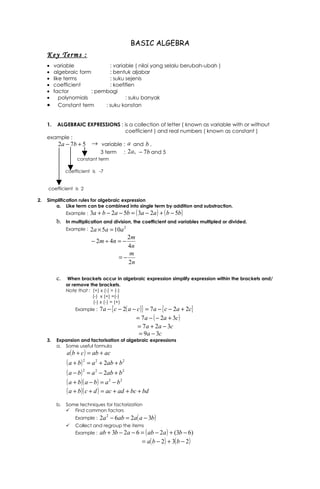
     •variable              : variable ( nilai yang selalu berubah-ubah )
     •algebraic form        : bentuk aljabar
     •like terms            : suku sejenis
     •coefficient           : koefifien
     •factor         : pembagi
     •   polynomials               : suku banyak
     • Constant term      : suku konstan


     1. ALGEBRAIC EXPRESSIONS : is a collection of letter ( known as variable with or without
                                coefficient ) and real numbers ( known as constant )
     example :
        2a − 7b + 5 → variable : a and b ,
                      3 term : 2a, − 7b and 5
                    constant term

               coefficient is -7


     coefficient is 2

2.   Simplification rules for algebraic expression
        a. Like term can be combined into single term by addition and substraction.
               Example :   3a + b − 2a − 5b = ( 3a − 2a ) + ( b − 5b )
          b.   In multiplication and division, the coefficient and variables multipled or divided.
               Example :   2a × 5a = 10a 2
                                           2m
                           − 2m ÷ 4n = −
                                           4n
                                            m
                                        =−
                                           2n

          c.   When brackets occur in algebraic expression simplify expression within the brackets and/
               or remove the brackets.
               Note that : (+) x (-) = (-)
                           (-) x (+) =(-)
                           (-) x (-) = (+)
                   Example :   7 a − { c − 2( a − c )} = 7a − { c − 2a + 2c}
                                                 = 7 a − ( − 2a + 3c )
                                                  = 7 a + 2a − 3c
                                                   = 9a − 3c
     3.   Expansion and factorisation of algebraic expressions
          a. Some useful formula
               a ( b + c ) = ab + ac
               ( a + b ) 2 = a 2 + 2ab + b 2
               ( a − b ) 2 = a 2 − 2ab + b 2
               ( a + b )( a − b ) = a 2 − b 2
               ( a + b )( c + d ) = ac + ad + bc + bd
          b.   Some techniques for factorization
                Find common factors
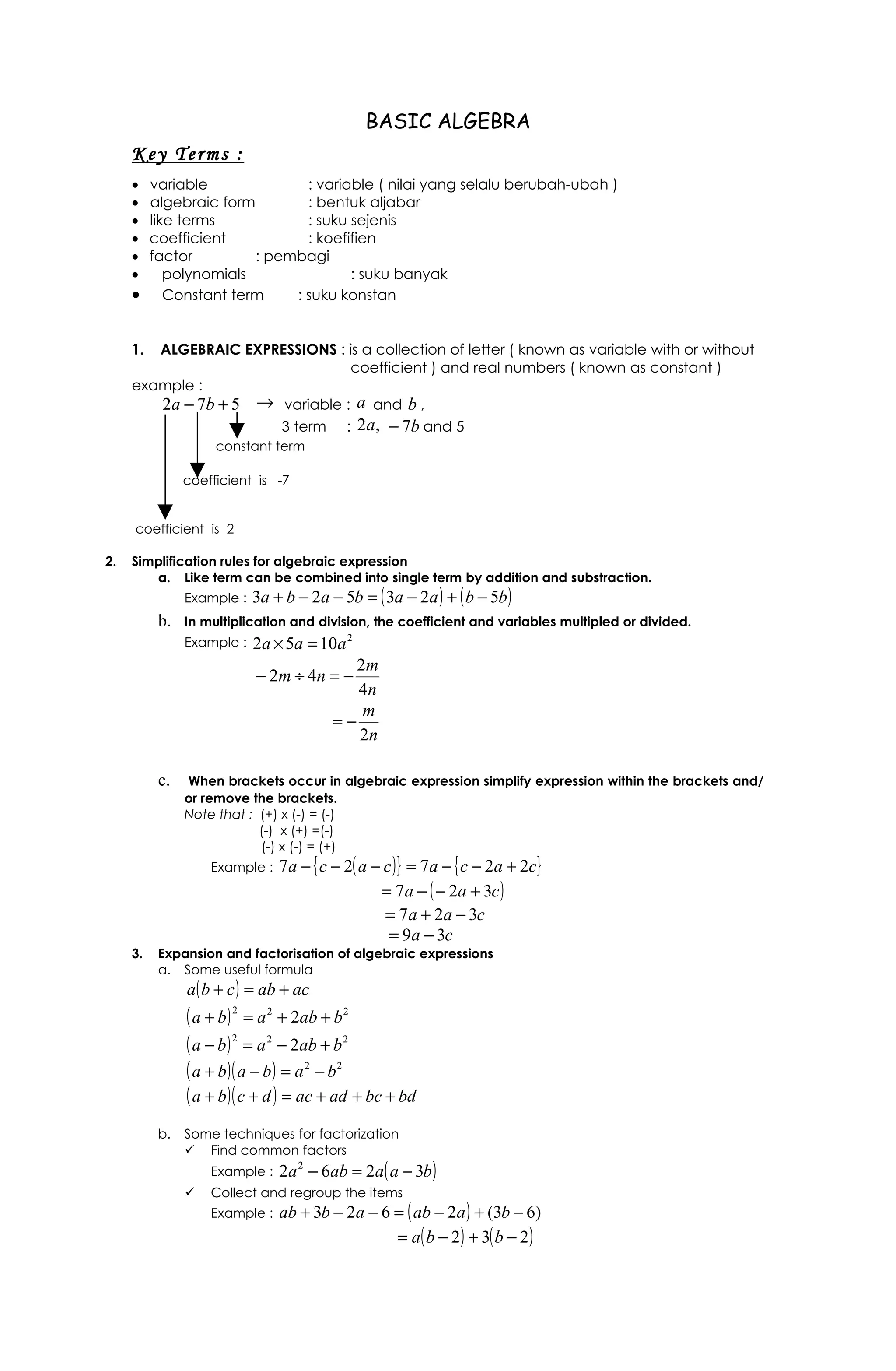
                   Example :   2a 2 − 6ab = 2a ( a − 3b )
                  Collect and regroup the items
                   Example :   ab + 3b − 2a − 6 = ( ab − 2a ) + (3b − 6)
                                                = a( b − 2 ) + 3( b − 2 )
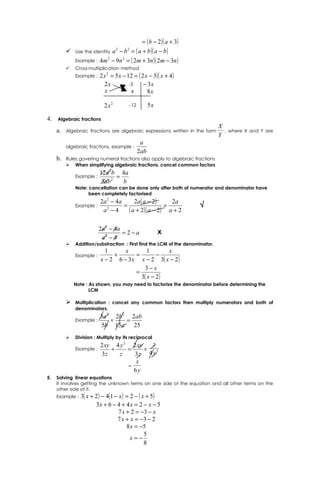
= ( b − 2 )( a + 3)
           Use the identity a 2 − b 2 = ( a + b )( a − b )
            Example : 4m − 9n = ( 2m + 3n )( 2m − 3n )
                           2      2

             Cross-multiplication method
              Example :   2 x 2 = 5 x − 12 = ( 2 x − 3)( x + 4 )
                            2x           -3     − 3x
                             x            4       8x

                            2x 2         -12         5x

4.   Algebraic fractions
                                                                               X
     a.   Algebraic fractions are algebraic expressions written in the form        , where X and Y are
                                                                               Y
                                                a
          algebraic fractions, example :
                                               2ab
     b.   Rules govering numeral fractions also apply to algebraic fractions
           When simplifying algebraic fractions, cancel common factors
                          12a 2b 4a
              Example :          =
                           3ab 2   b
              Note: cancellation can be done only after both of numerator and denominator have
                    been completely factorised
                          2a 2 − 4a      2a ( a − 2 )   2a
              Example :             =                 =              √
                           a −4
                             2
                                      ( a + 2)( a − 2) a + 2

                          2 a 2 − 4a
                                     =2−a                 x
                            a2 − 4
             Addition/substraction : First find the LCM of the denominator.
                            1      x        1       x
              Example :        +       =        −
                          x − 2 6 − 3 x x − 2 3( x − 2 )
                                          3− x
                                       =
                                         3( x − 2 )
              Note : As shown, you may need to factorise the denominator before determining the
                     LCM

             Multiplication : cancel any common factors then multiply numerators and both of
              denominators.
                          3a 2       2b 2 2ab
              Example :          x       =
                          5b         15a 25
             Division : Multiply by its reciprocal
                          2 xy 4 y 2 2 xy   z
              Example :       ÷     =     x   2
                          3z     z    3z 4 y
                                       x
                                    =
                                      6y
5.   Solving linear equations
     It involves getting the unknown terms on one side ot the equation and all other terms on the
     other side of it.
     Example :   3( x + 2 ) − 4(1 − x ) = 2 − ( x + 5)
                        3x + 6 − 4 + 4 x = 2 − x − 5
                                    7 x + 2 = −3 − x
                                   7 x + x = −3 − 2
                                        8 x = −5
                                                 5
                                          x=−
                                                 8
6.   Solving Fractional equations
     It involves rewriting the equation into one without fractions. One way is to multiply each term of
     the equation by the LCM of denominators.
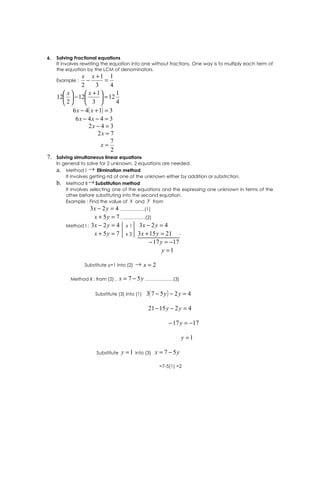
               x x +1 1
     Example :    −        =
               2      3       4
        x       x + 1       1
     12  − 12          = 12
       2        3           4
           6 x − 4( x + 1) = 3
            6x − 4x − 4 = 3
                   2x − 4 = 3
                       2x = 7
                              7
                         x=
                              2
7.   Solving simultaneous linear equations
     In general to solve for 2 unknown, 2 equations are needed.
     a. Method I → Elimination method
         It involves getting rid of one of the unknown either by addition or substrction.
     b. Method II → Substitution method
         It involves selecting one of the equations and the expressing one unknown in terms of the
         other before substituting into the second equation.
         Example : Find the value of x and y from
                    3 x − 2 y = 4 …………….(1)
                      x + 5 y = 7 …………….(2)
         Method I : 3 x − 2 y = 4 x 1 3x − 2 y = 4
                      x + 5 y = 7 x 3 3 x + 15 y = 21 -
                                           − 17 y = −17
                                                 y =1

                 Substitute y=1 into (2)   → x=2

           Method II : from (2) ,   x = 7 − 5 y ………………(3)

                      Substitute (3) into (1)   3( 7 − 5 y ) − 2 y = 4

                                                 21 − 15 y − 2 y = 4

                                                           − 17 y = −17

                                                                   y =1

                       Substitute   y =1   into (3)   x = 7 − 5y

                                                       =7-5(1) =2

Handout basic algebra

  • 1.
    BASIC ALGEBRA Key Terms : •variable : variable ( nilai yang selalu berubah-ubah ) •algebraic form : bentuk aljabar •like terms : suku sejenis •coefficient : koefifien •factor : pembagi • polynomials : suku banyak • Constant term : suku konstan 1. ALGEBRAIC EXPRESSIONS : is a collection of letter ( known as variable with or without coefficient ) and real numbers ( known as constant ) example : 2a − 7b + 5 → variable : a and b , 3 term : 2a, − 7b and 5 constant term coefficient is -7 coefficient is 2 2. Simplification rules for algebraic expression a. Like term can be combined into single term by addition and substraction. Example : 3a + b − 2a − 5b = ( 3a − 2a ) + ( b − 5b ) b. In multiplication and division, the coefficient and variables multipled or divided. Example : 2a × 5a = 10a 2 2m − 2m ÷ 4n = − 4n m =− 2n c. When brackets occur in algebraic expression simplify expression within the brackets and/ or remove the brackets. Note that : (+) x (-) = (-) (-) x (+) =(-) (-) x (-) = (+) Example : 7 a − { c − 2( a − c )} = 7a − { c − 2a + 2c} = 7 a − ( − 2a + 3c ) = 7 a + 2a − 3c = 9a − 3c 3. Expansion and factorisation of algebraic expressions a. Some useful formula a ( b + c ) = ab + ac ( a + b ) 2 = a 2 + 2ab + b 2 ( a − b ) 2 = a 2 − 2ab + b 2 ( a + b )( a − b ) = a 2 − b 2 ( a + b )( c + d ) = ac + ad + bc + bd b. Some techniques for factorization  Find common factors Example : 2a 2 − 6ab = 2a ( a − 3b )  Collect and regroup the items Example : ab + 3b − 2a − 6 = ( ab − 2a ) + (3b − 6) = a( b − 2 ) + 3( b − 2 )
  • 2.
    = ( b− 2 )( a + 3)  Use the identity a 2 − b 2 = ( a + b )( a − b ) Example : 4m − 9n = ( 2m + 3n )( 2m − 3n ) 2 2  Cross-multiplication method Example : 2 x 2 = 5 x − 12 = ( 2 x − 3)( x + 4 ) 2x -3 − 3x x 4 8x 2x 2 -12 5x 4. Algebraic fractions X a. Algebraic fractions are algebraic expressions written in the form , where X and Y are Y a algebraic fractions, example : 2ab b. Rules govering numeral fractions also apply to algebraic fractions  When simplifying algebraic fractions, cancel common factors 12a 2b 4a Example : = 3ab 2 b Note: cancellation can be done only after both of numerator and denominator have been completely factorised 2a 2 − 4a 2a ( a − 2 ) 2a Example : = = √ a −4 2 ( a + 2)( a − 2) a + 2 2 a 2 − 4a =2−a x a2 − 4  Addition/substraction : First find the LCM of the denominator. 1 x 1 x Example : + = − x − 2 6 − 3 x x − 2 3( x − 2 ) 3− x = 3( x − 2 ) Note : As shown, you may need to factorise the denominator before determining the LCM  Multiplication : cancel any common factors then multiply numerators and both of denominators. 3a 2 2b 2 2ab Example : x = 5b 15a 25  Division : Multiply by its reciprocal 2 xy 4 y 2 2 xy z Example : ÷ = x 2 3z z 3z 4 y x = 6y 5. Solving linear equations It involves getting the unknown terms on one side ot the equation and all other terms on the other side of it. Example : 3( x + 2 ) − 4(1 − x ) = 2 − ( x + 5) 3x + 6 − 4 + 4 x = 2 − x − 5 7 x + 2 = −3 − x 7 x + x = −3 − 2 8 x = −5 5 x=− 8
  • 3.
    6. Solving Fractional equations It involves rewriting the equation into one without fractions. One way is to multiply each term of the equation by the LCM of denominators. x x +1 1 Example : − = 2 3 4  x  x + 1 1 12  − 12  = 12 2  3  4 6 x − 4( x + 1) = 3 6x − 4x − 4 = 3 2x − 4 = 3 2x = 7 7 x= 2 7. Solving simultaneous linear equations In general to solve for 2 unknown, 2 equations are needed. a. Method I → Elimination method It involves getting rid of one of the unknown either by addition or substrction. b. Method II → Substitution method It involves selecting one of the equations and the expressing one unknown in terms of the other before substituting into the second equation. Example : Find the value of x and y from 3 x − 2 y = 4 …………….(1) x + 5 y = 7 …………….(2) Method I : 3 x − 2 y = 4 x 1 3x − 2 y = 4 x + 5 y = 7 x 3 3 x + 15 y = 21 - − 17 y = −17 y =1 Substitute y=1 into (2) → x=2 Method II : from (2) , x = 7 − 5 y ………………(3) Substitute (3) into (1) 3( 7 − 5 y ) − 2 y = 4 21 − 15 y − 2 y = 4 − 17 y = −17 y =1 Substitute y =1 into (3) x = 7 − 5y =7-5(1) =2