The Internet
      and
World Wide Web
Objectives
                                                   Describe the types of Web sites
   Discuss the history of the Internet

                                                      Recognize how Web pages
       Explain how to access and                   use graphics, animation, audio,
        connect to the Internet                   video, virtual reality, and plug-ins


                                           Identify the steps required for Web publishing
         Analyze an IP address


                                                  Describe the types of e-commerce
Identify the components of a Web address

                                                Explain how e-mail, FTP, newsgroups
 Explain the purpose of a Web browser       and message boards, mailing lists, chat rooms,
                                           Instant messaging, and Internet telephony work


   Search for information on the Web               Identify the rules of netiquette
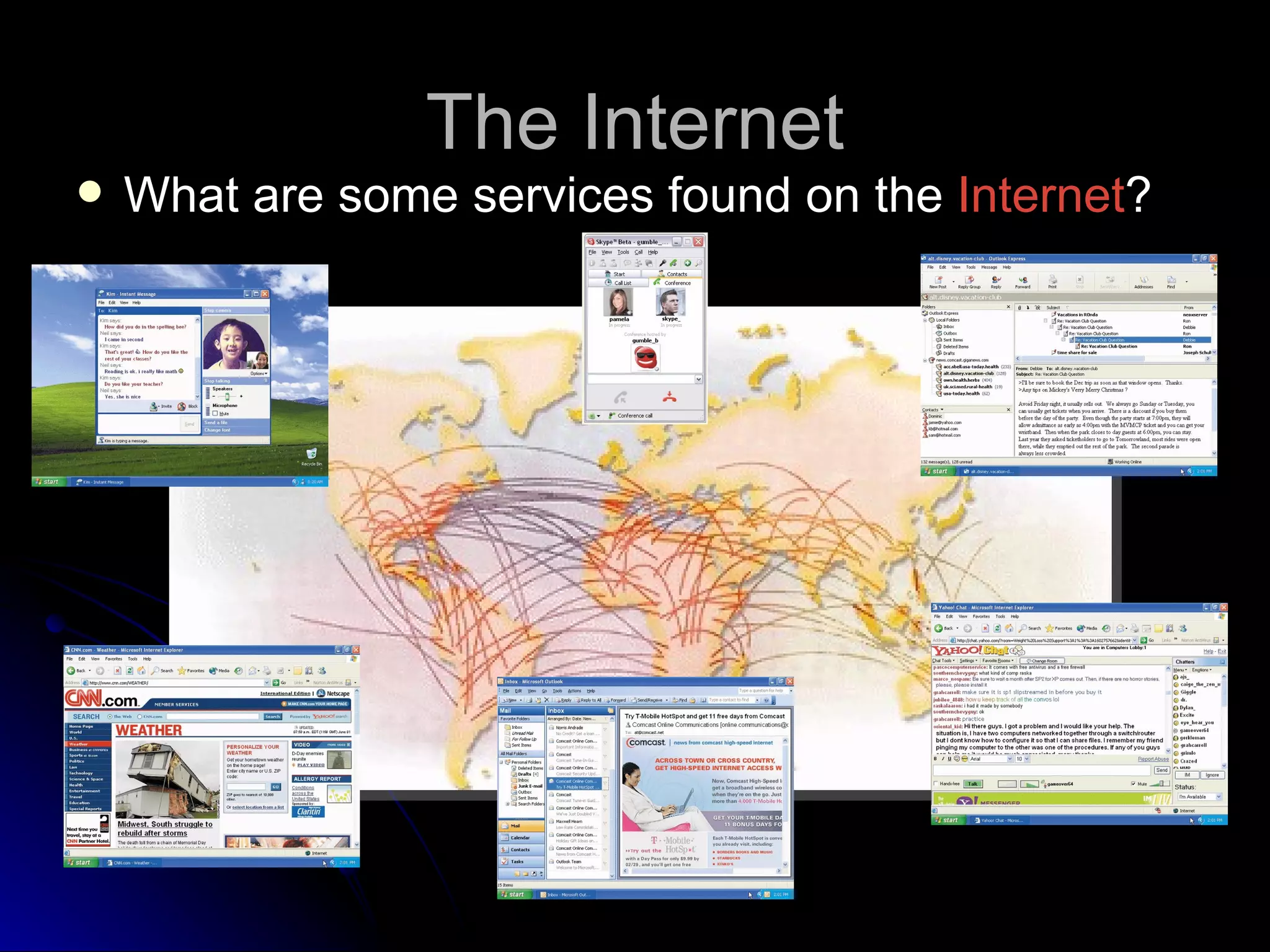
The Internet
   What are some services found on the Internet?
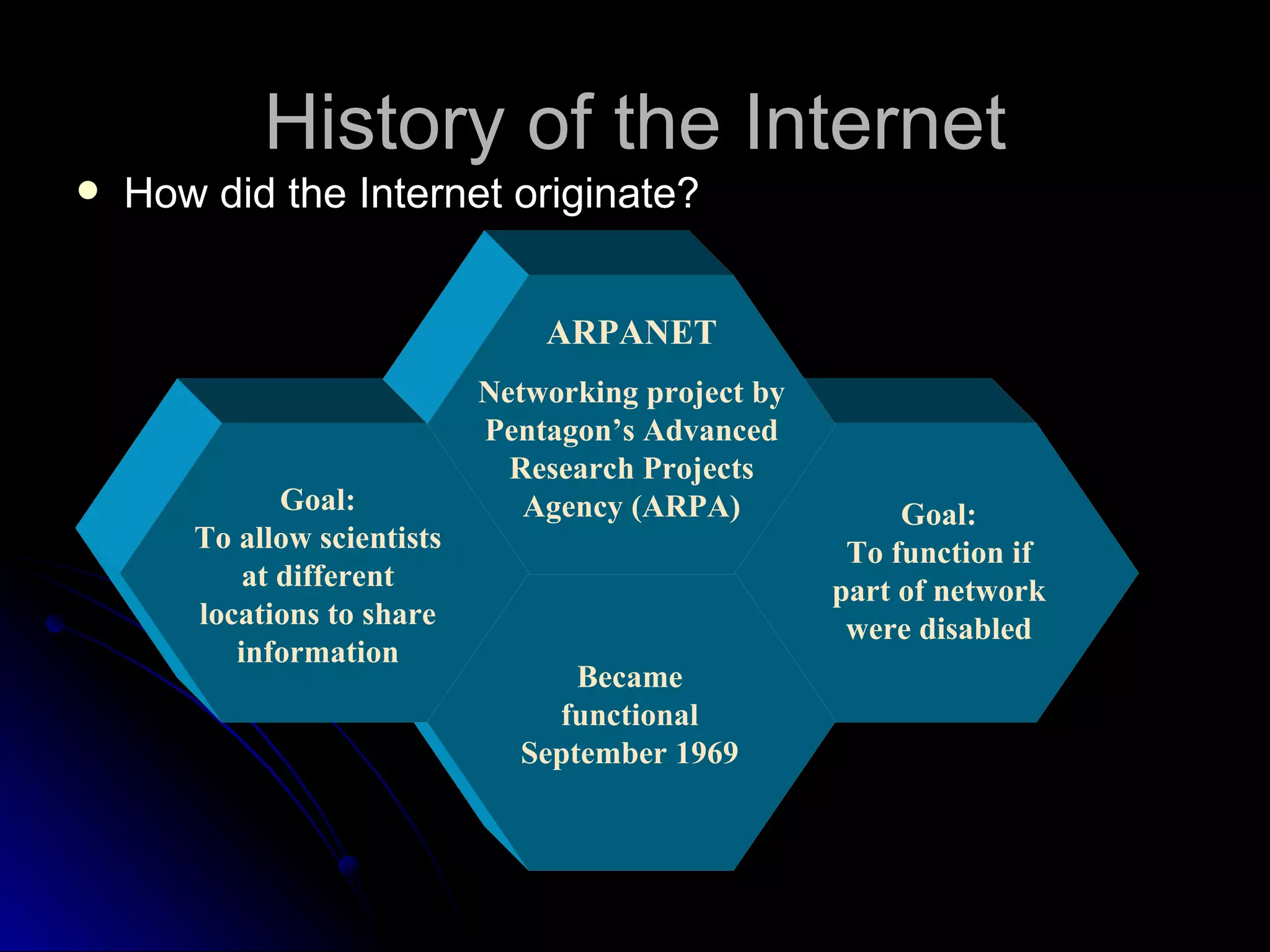
History of the Internet
   How did the Internet originate?


                                 ARPANET
                             Networking project by
                             Pentagon’s Advanced
                               Research Projects
              Goal:             Agency (ARPA)             Goal:
       To allow scientists                            To function if
           at different                              part of network
       locations to share                             were disabled
          information
                                   Became
                                 functional
                               September 1969
History of the Internet
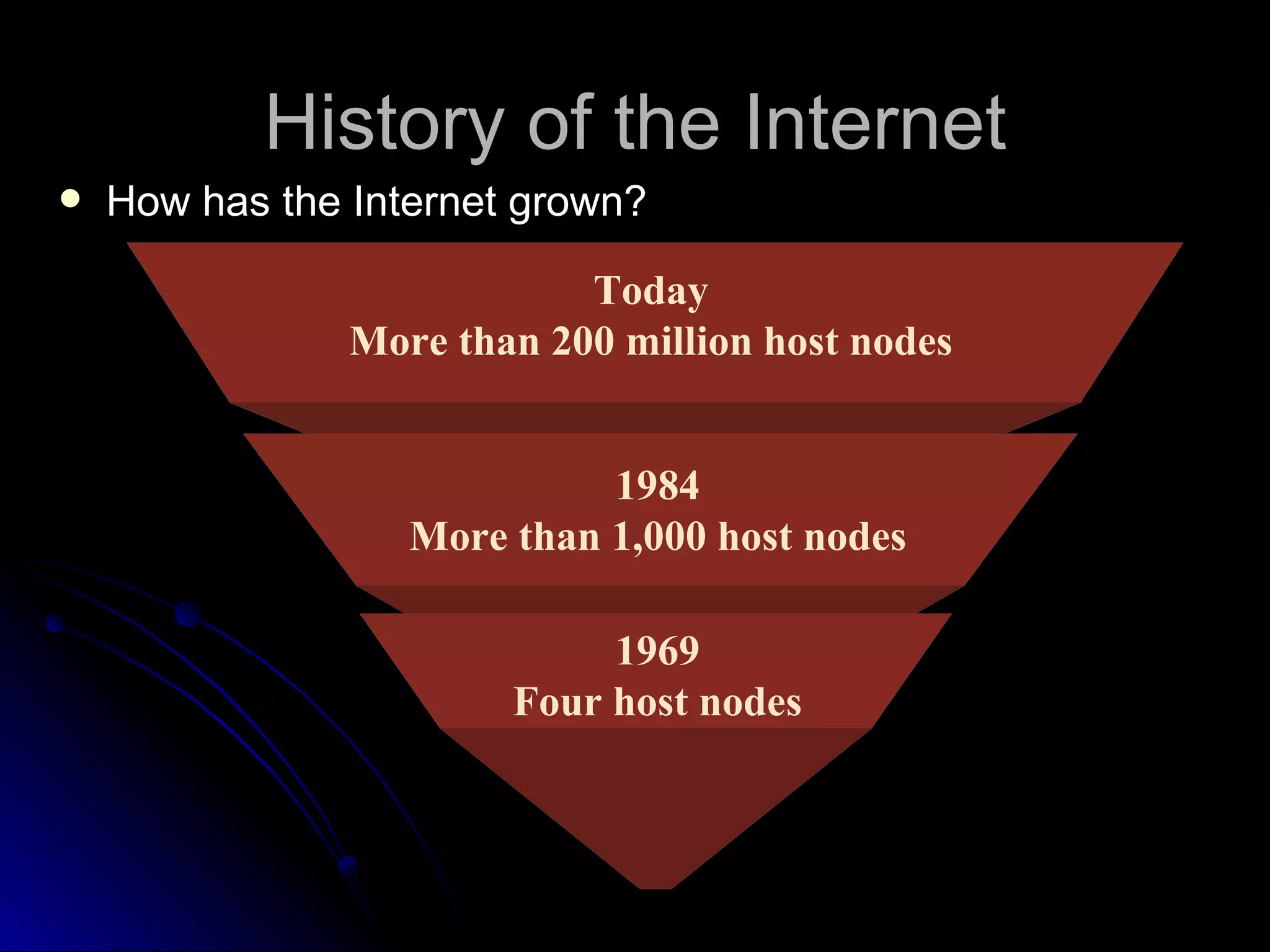
   How has the Internet grown?

                            Today
                More than 200 million host nodes


                             1984
                   More than 1,000 host nodes

                             1969
                        Four host nodes
History of the Internet
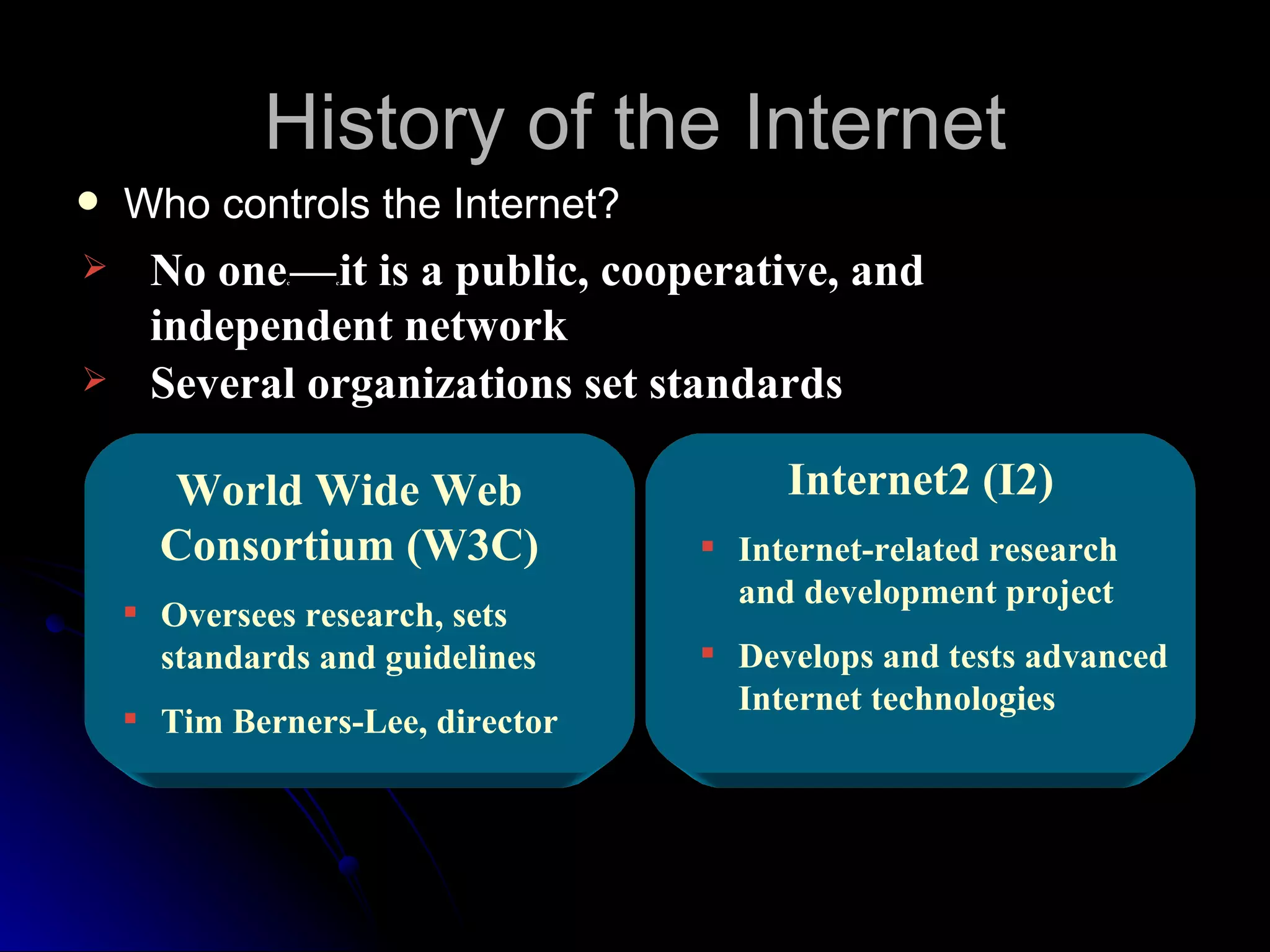
   Who controls the Internet?
    No one — it is a public, cooperative, and
              c   c


     independent network
    Several organizations set standards

      World Wide Web                   Internet2 (I2)
      Consortium (W3C)             Internet-related research
                                    and development project
     Oversees research, sets
      standards and guidelines     Develops and tests advanced
                                    Internet technologies
     Tim Berners-Lee, director
How the Internet Works
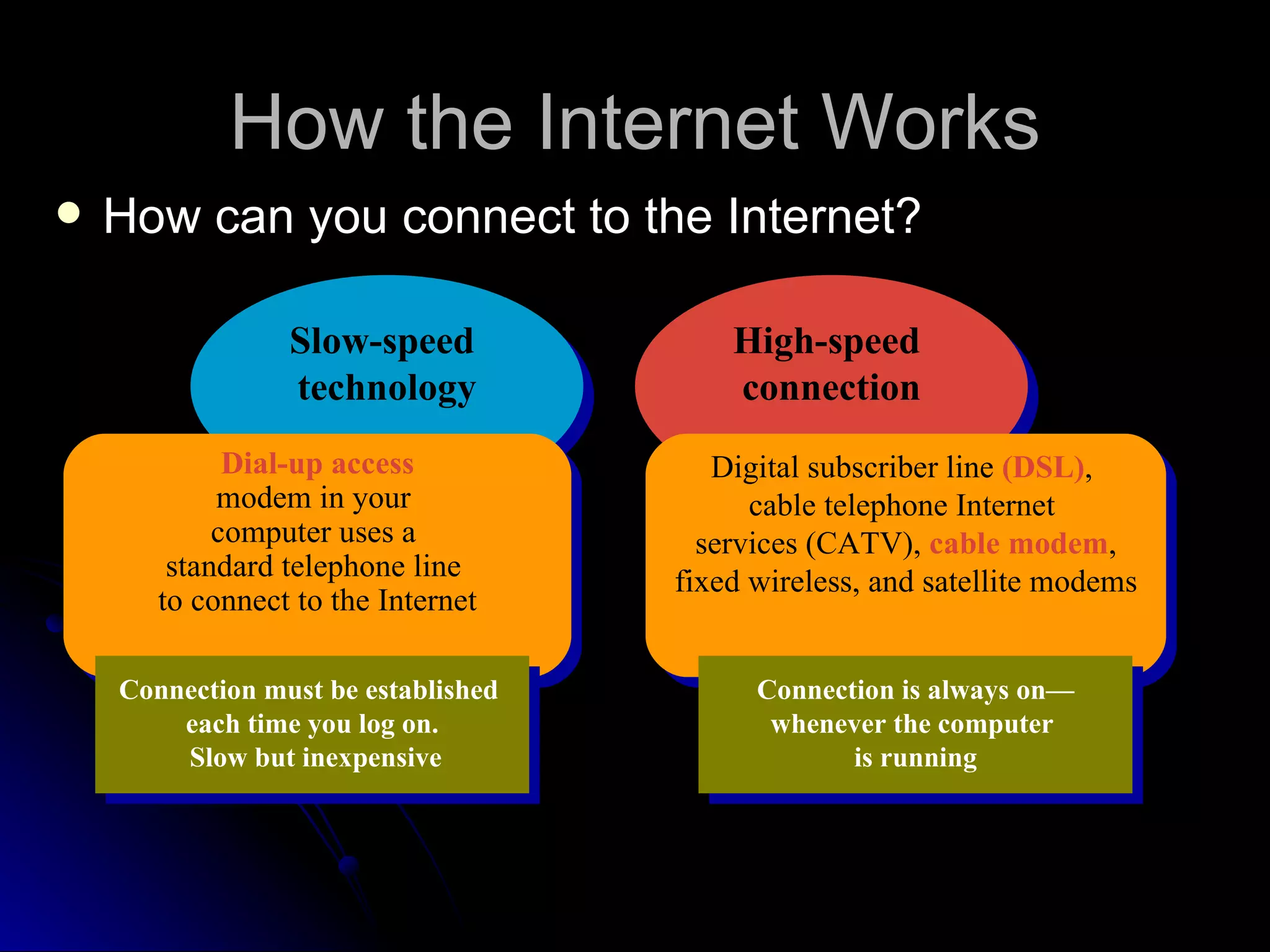
   How can you connect to the Internet?

                 Slow-speed              High-speed
                 technology              connection
             Dial-up access             Digital subscriber line (DSL),
            modem in your                  cable telephone Internet
            computer uses a            services (CATV), cable modem,
        standard telephone line      fixed wireless, and satellite modems
       to connect to the Internet

    Connection must be established         Connection is always on—
        each time you log on.               whenever the computer
        Slow but inexpensive                      is running
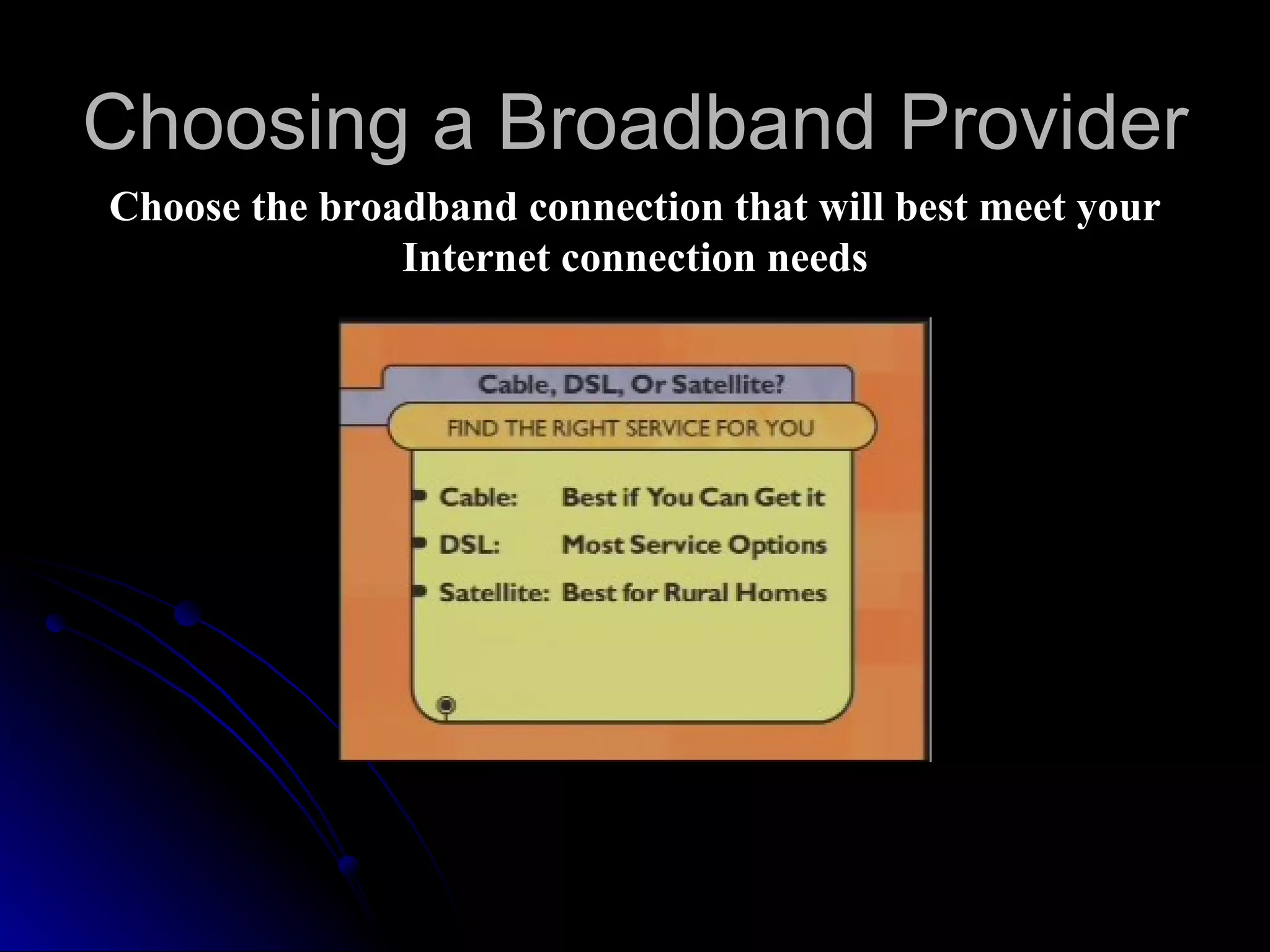
Choosing a Broadband Provider
Choose the broadband connection that will best meet your
               Internet connection needs
How the Internet Works
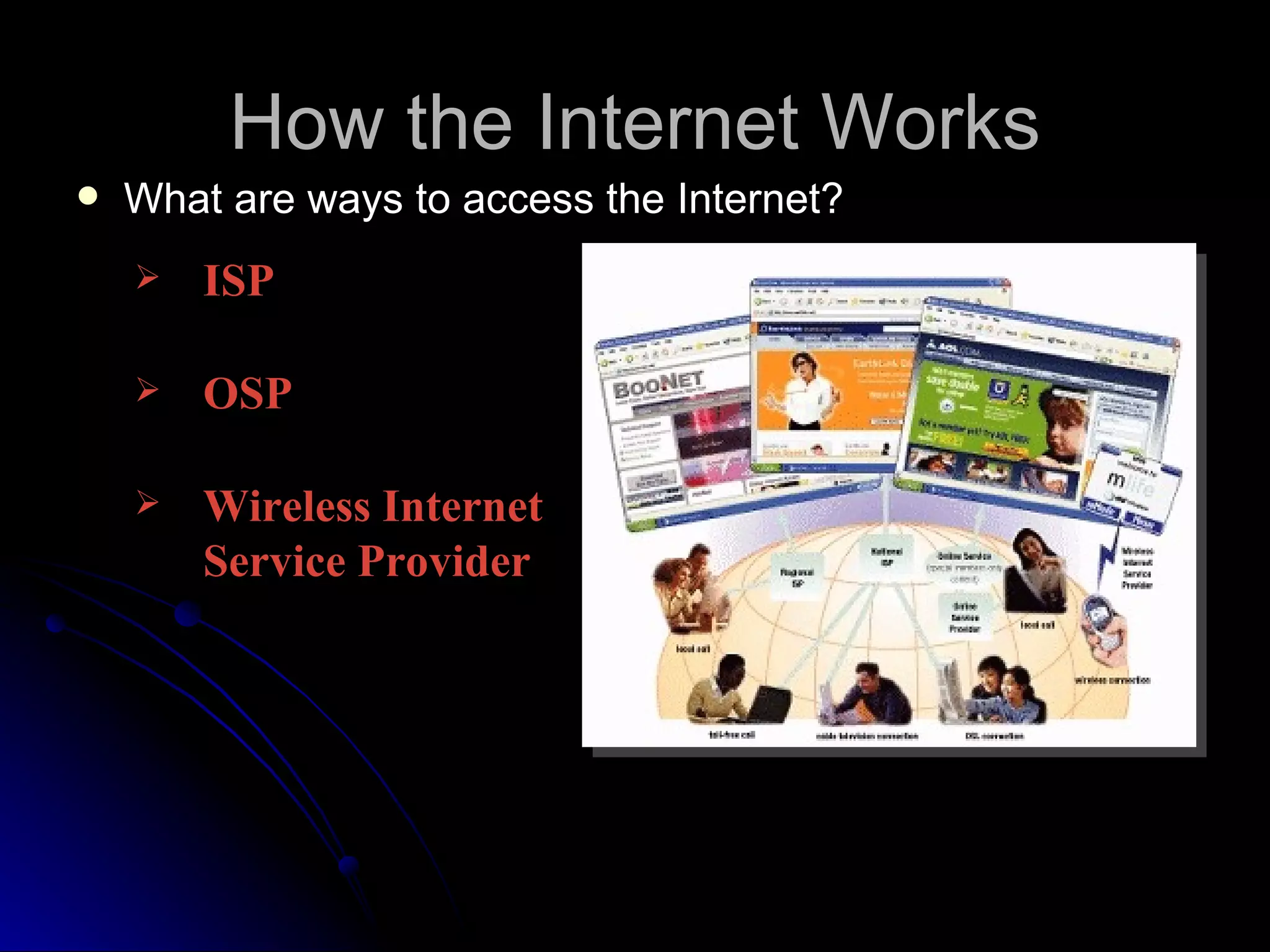
   What are ways to access the Internet?
       ISP, Regional
        or National
       OSP (AOL and
        MSN, for example)
       Wireless Internet
        Service Provider
How the Internet Works
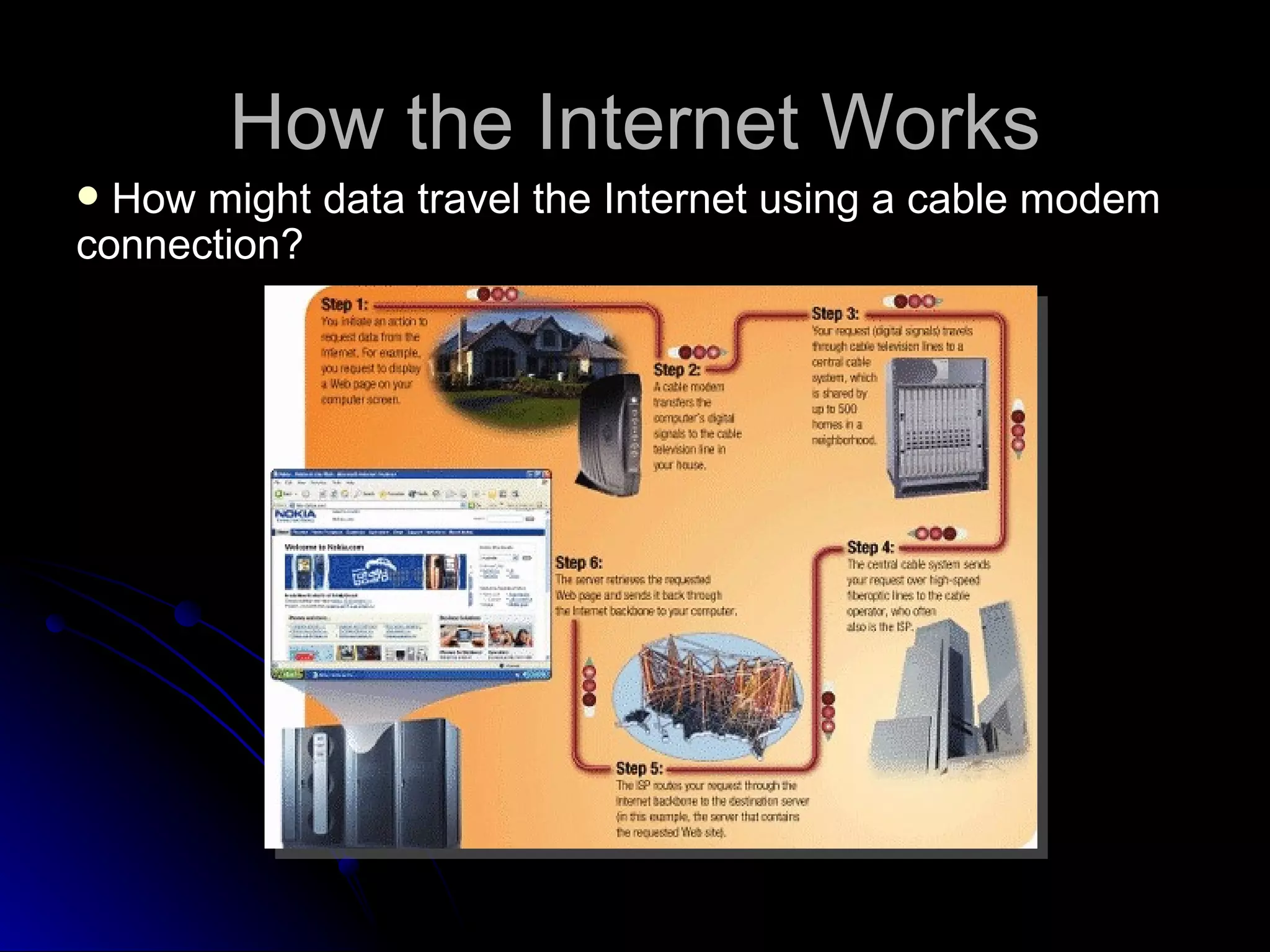
 How might data travel the Internet using a cable modem
connection?
How the Internet Works
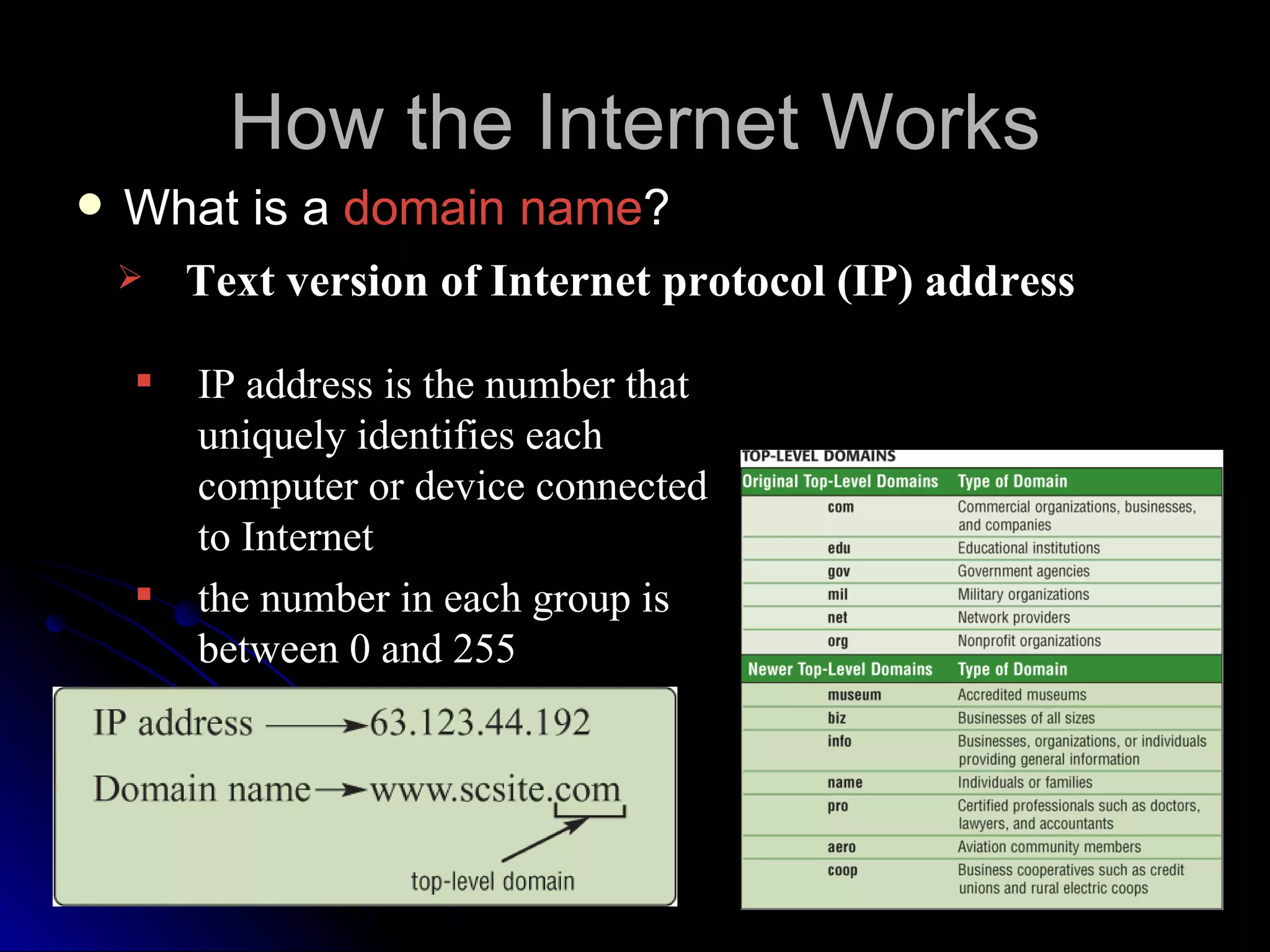
   What is a domain name?
       Text version of Internet protocol (IP) address

       IP address is the number that
        uniquely identifies each
        computer or device connected
        to Internet
       the number in each group is
        between 0 and 255
The World Wide Web
    What is the World Wide Web (WWW)?

            A worldwide collection of electronic documents

                                                         Also called the Web


             Each electronic document is called a Web page


    Can contain text, graphics, sound, video, and built-in connections


            A Web site is a collection of related Web pages
The World Wide Web
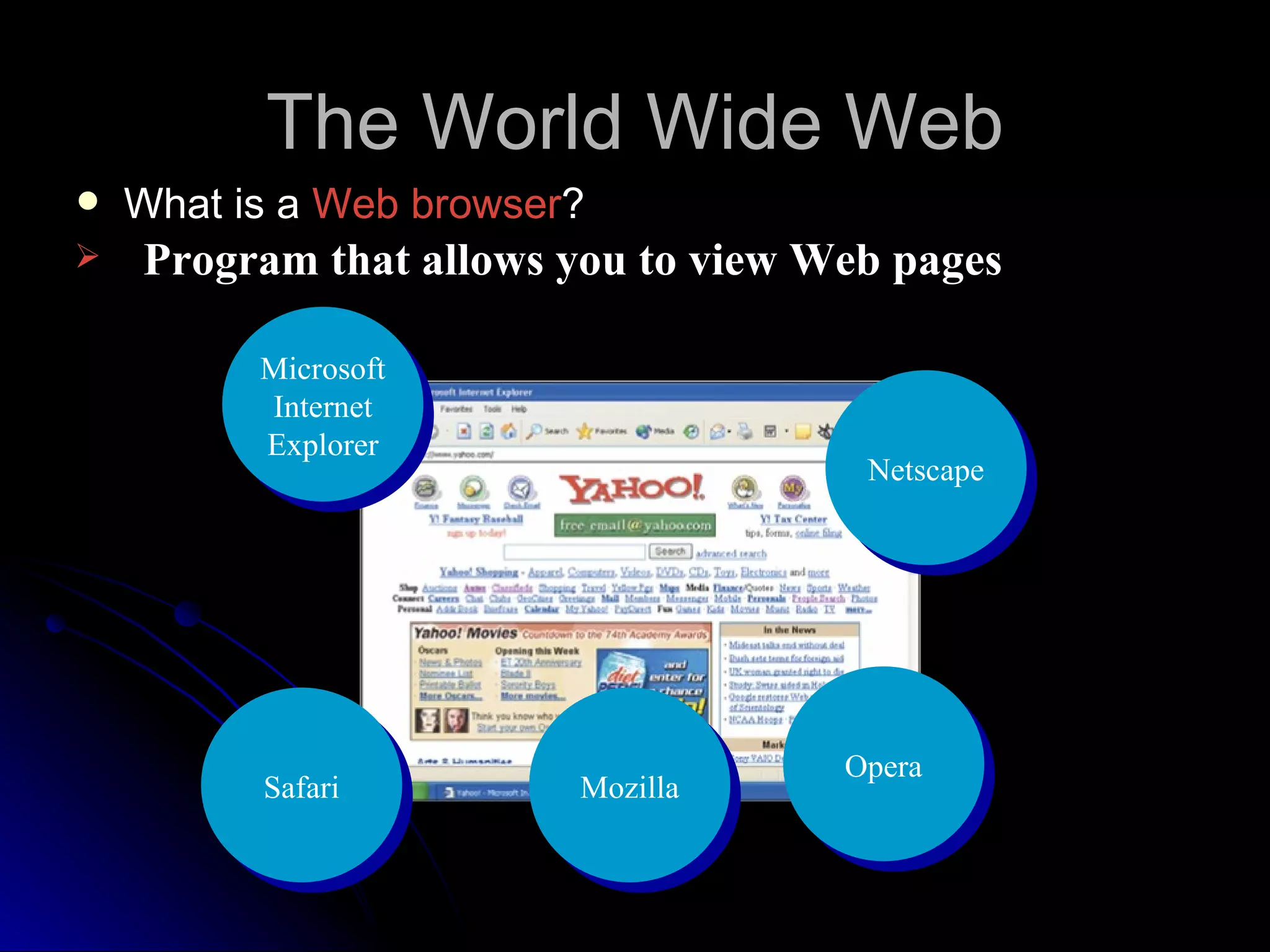
   What is a Web browser?
   Program that allows you to view Web pages

          Microsoft
          Internet
          Explorer
                                      Netscape


                                     Opera
          Safari         Mozilla
The World Wide Web
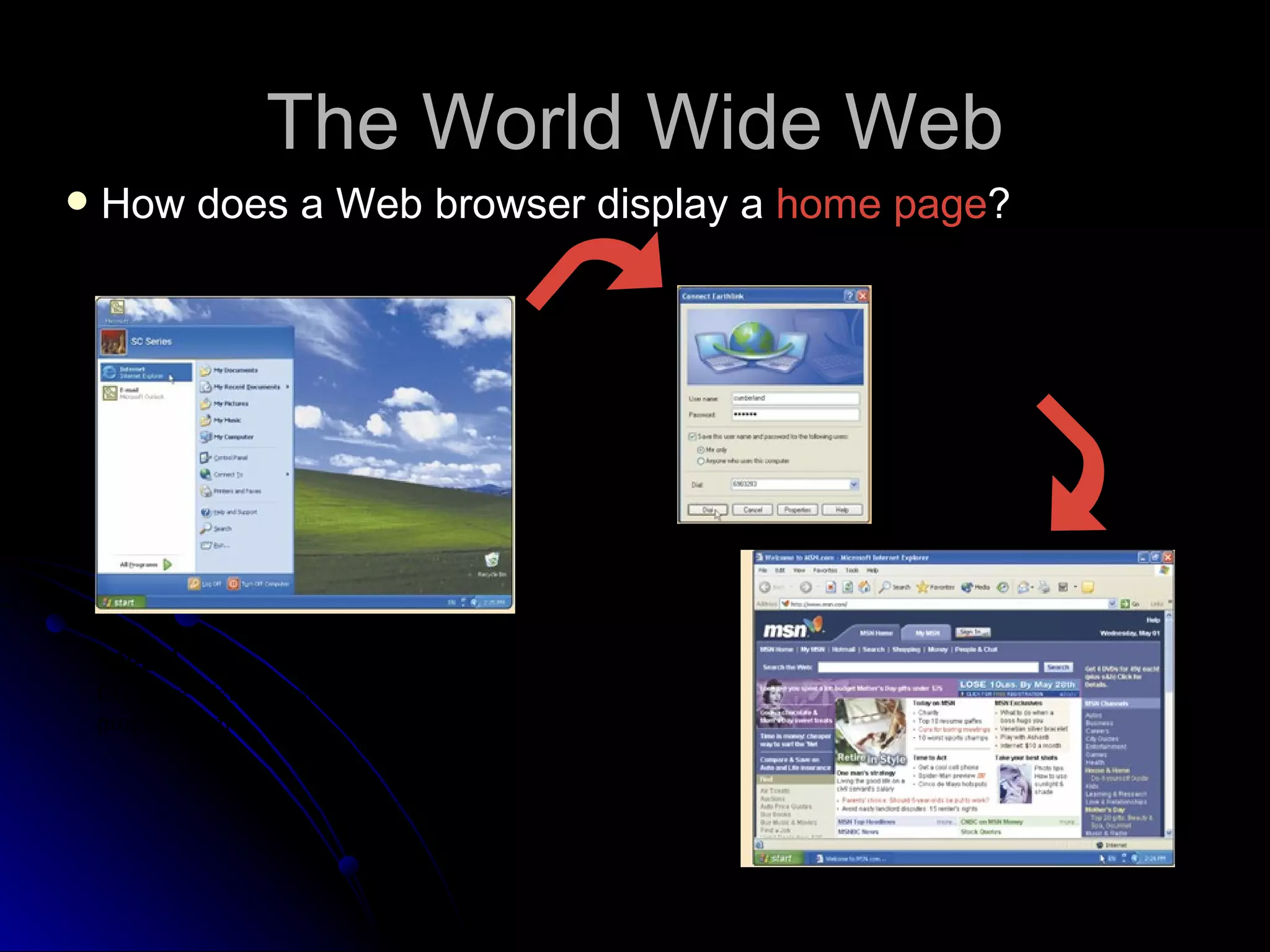
   How does a Web browser display a home page?

                                                     Step 2.
                                                     If necessary,
                                                     connect to the
                                                     Internet


    Step 1.
    Click the Web browser
    program name            Step 3.
                            Connection to the
                            Internet occurs, and a
                            home page displays
The World Wide Web
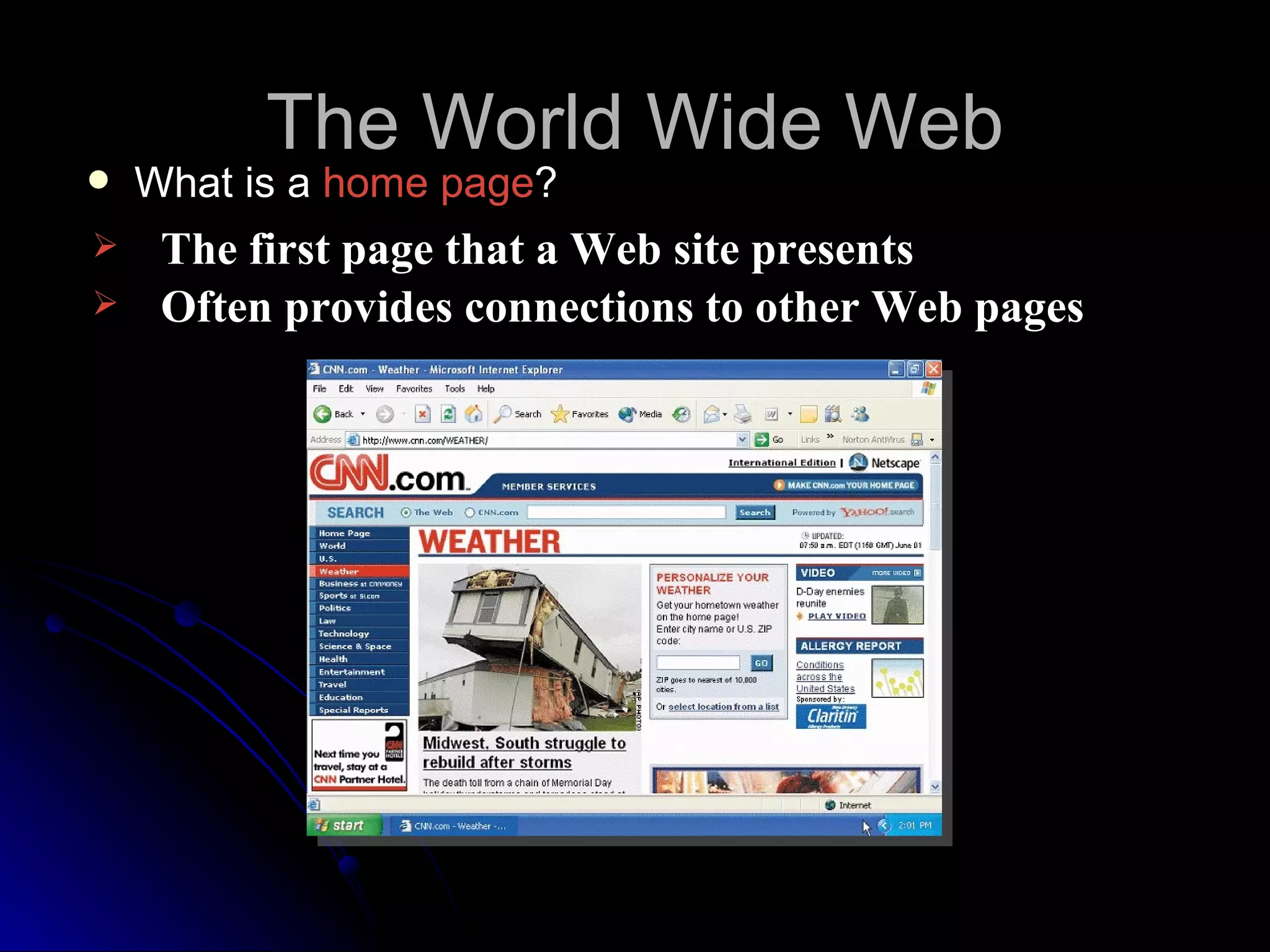
   What is a home page?
    The first page that a Web site presents
    Often provides connections to other Web pages
The World Wide Web
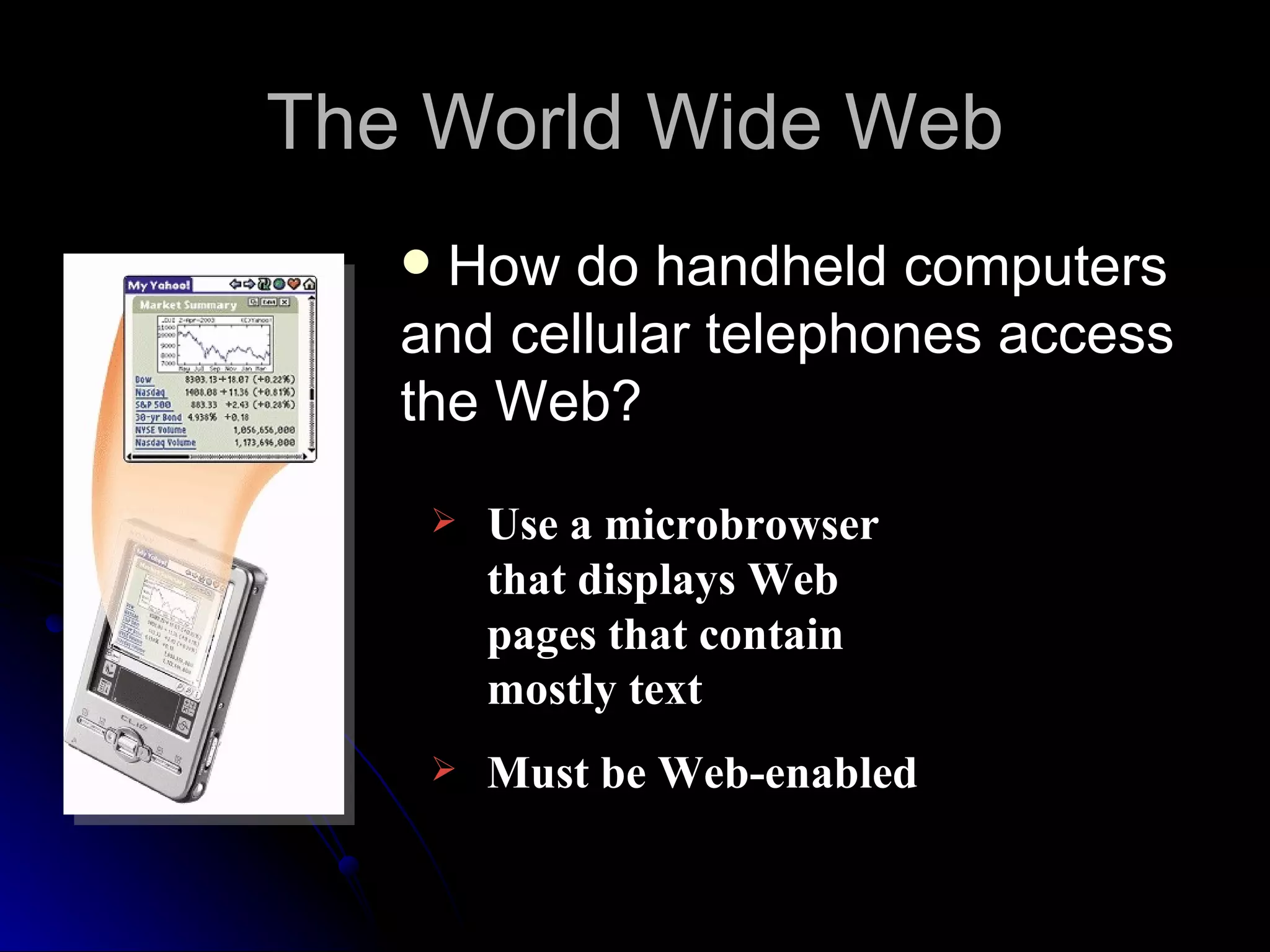
    How do handheld computers
   and cellular telephones access
   the Web?
       Use a microbrowser
        that displays Web
        pages that contain
        mostly text
       Must be Web-enabled
The World Wide Web
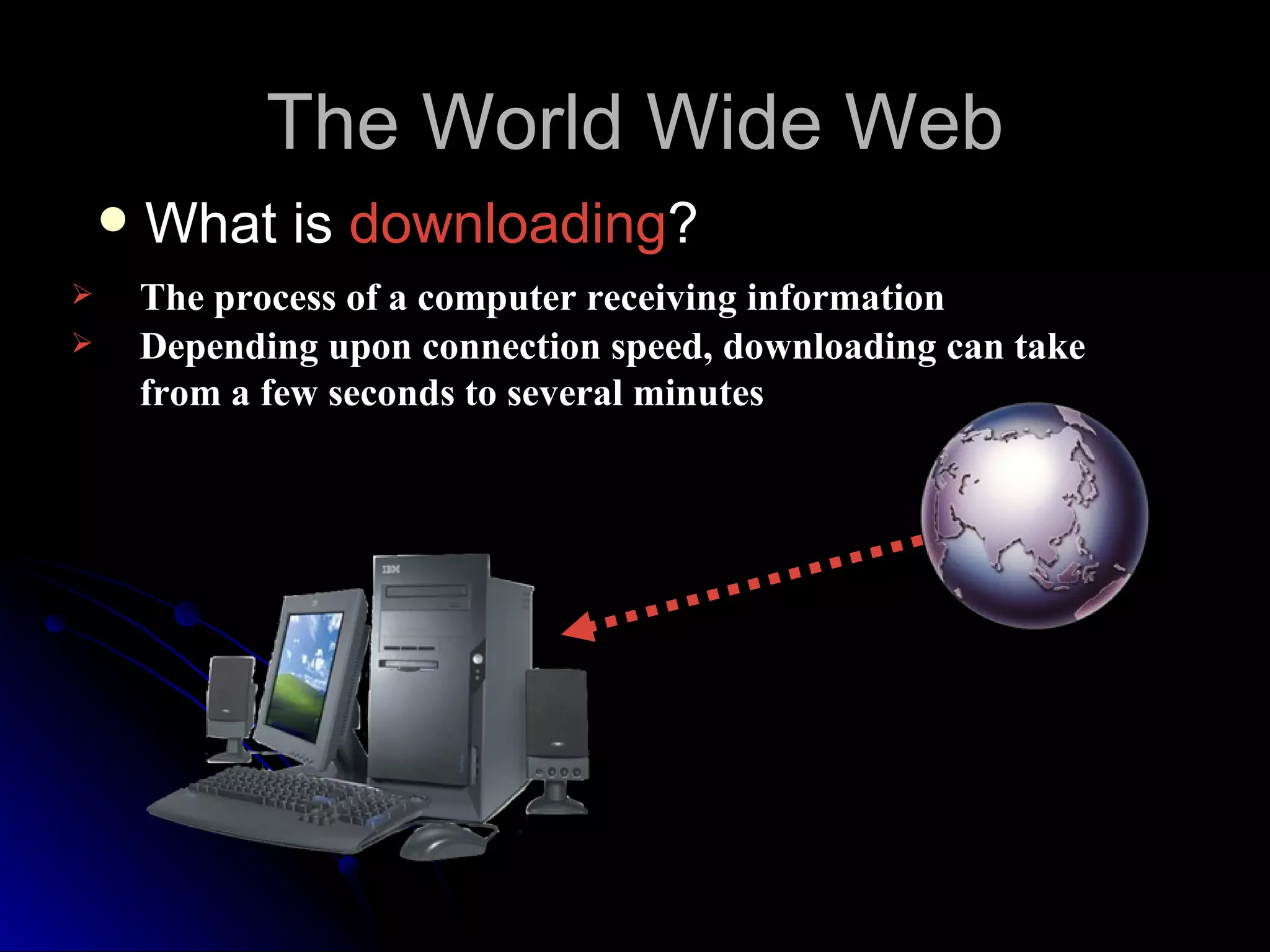
       What is downloading?
       The process of a computer receiving information
       Depending upon connection speed, downloading can take
        from a few seconds to several minutes
The World Wide Web
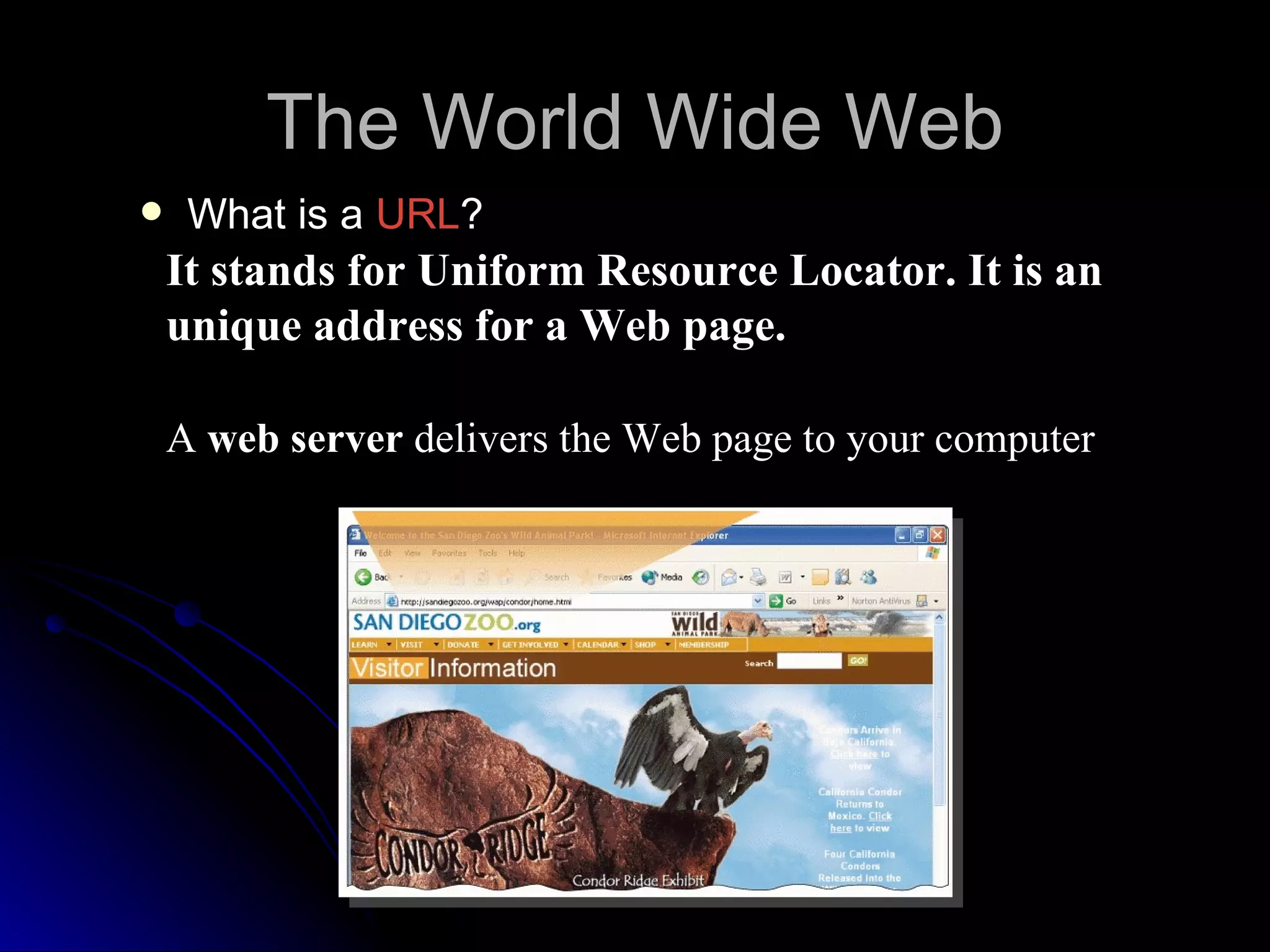
    What is a URL?
    It stands for Uniform Resource Locator. It is an
    unique address for a Web page.

    A web server delivers the Web page to your computer
The World Wide Web
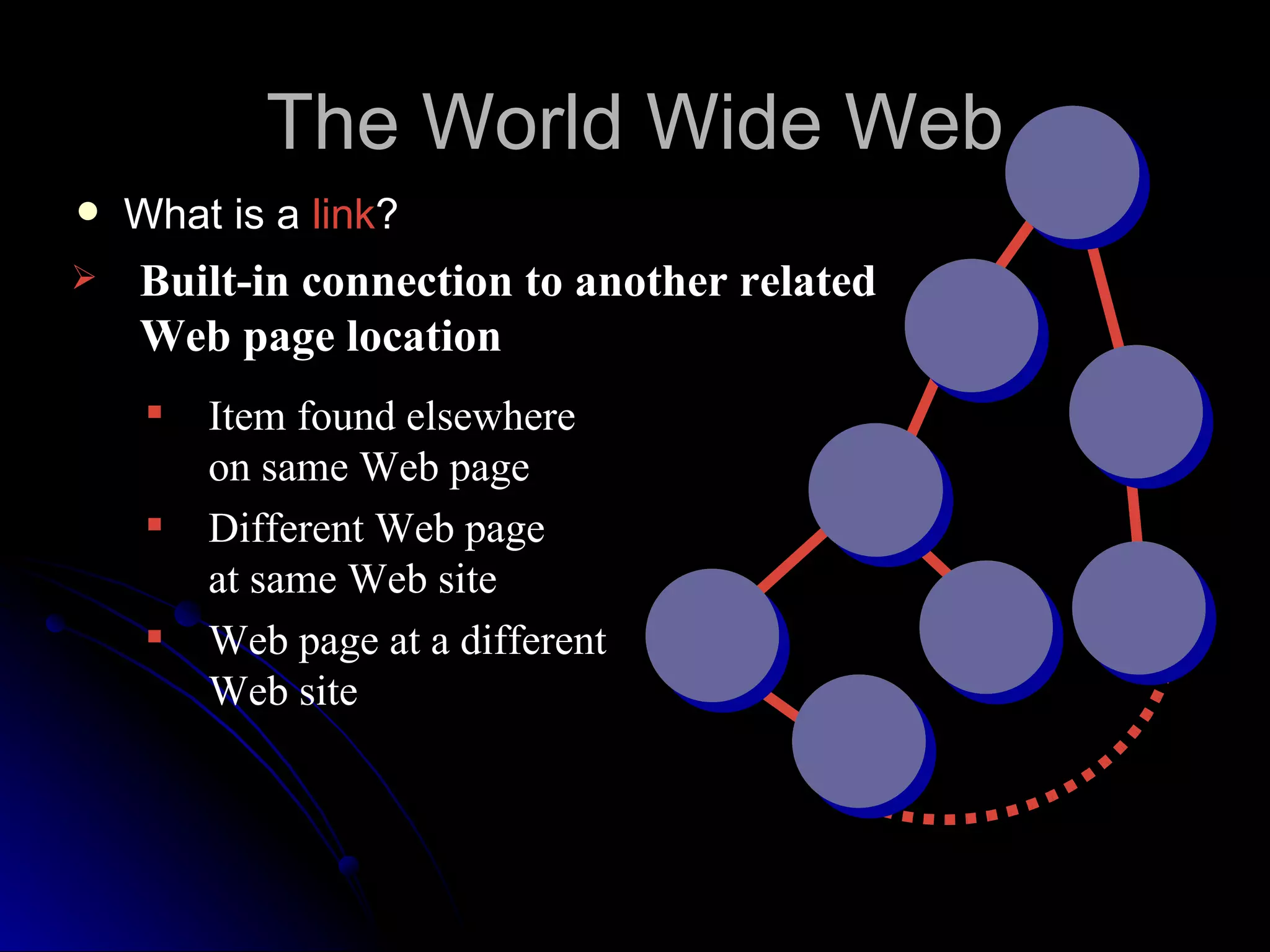
   What is a link?
   Built-in connection to another related
    Web page location
        Item found elsewhere
         on same Web page
        Different Web page
         at same Web site
        Web page at a different
         Web site
The World Wide Web
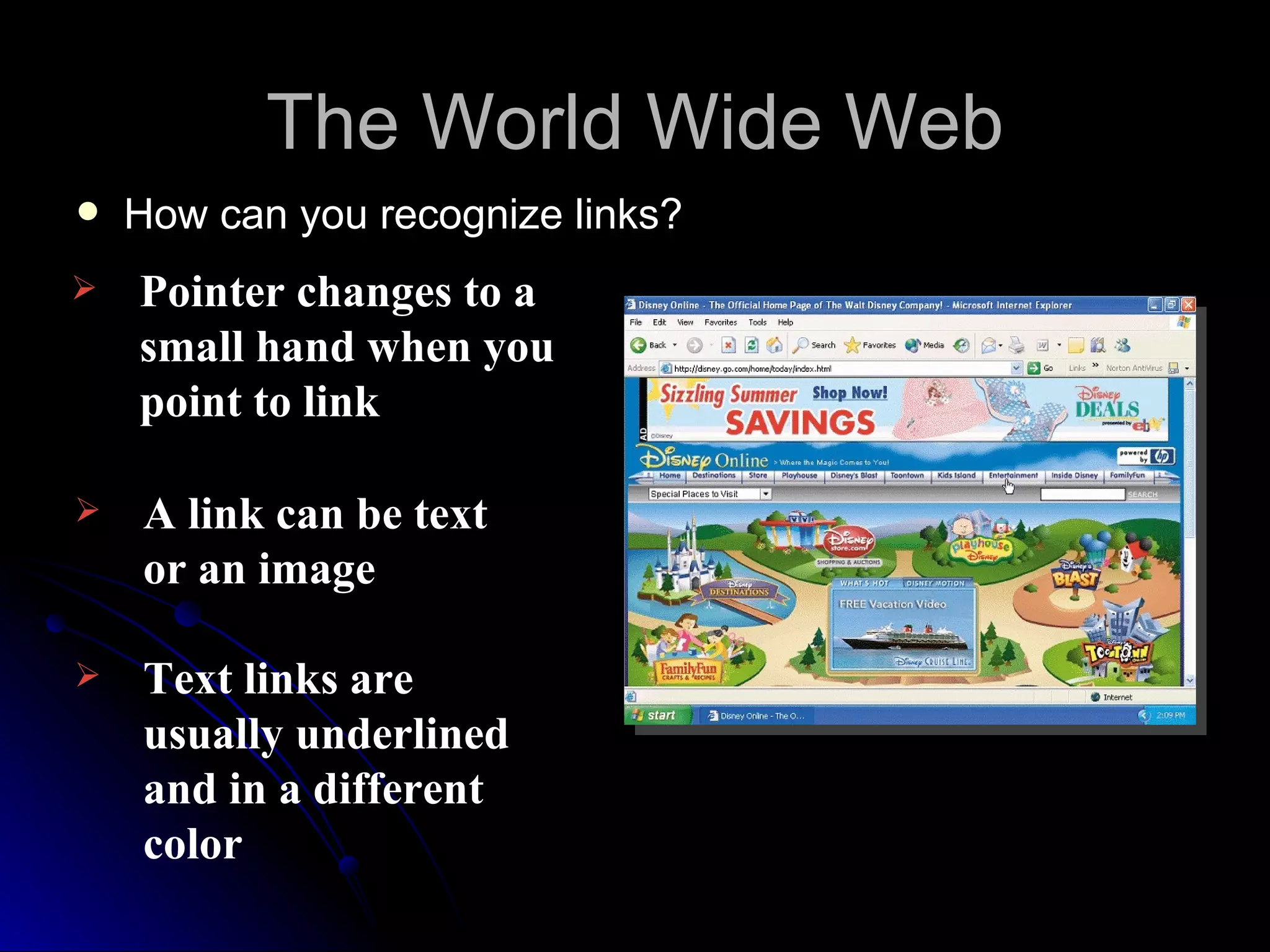
   How can you recognize links?
   Pointer changes to a
    small hand when you
    point to link

   A link can be text
    or an image

   Text links are
    usually underlined
    and in a different
    color
The World Wide Web
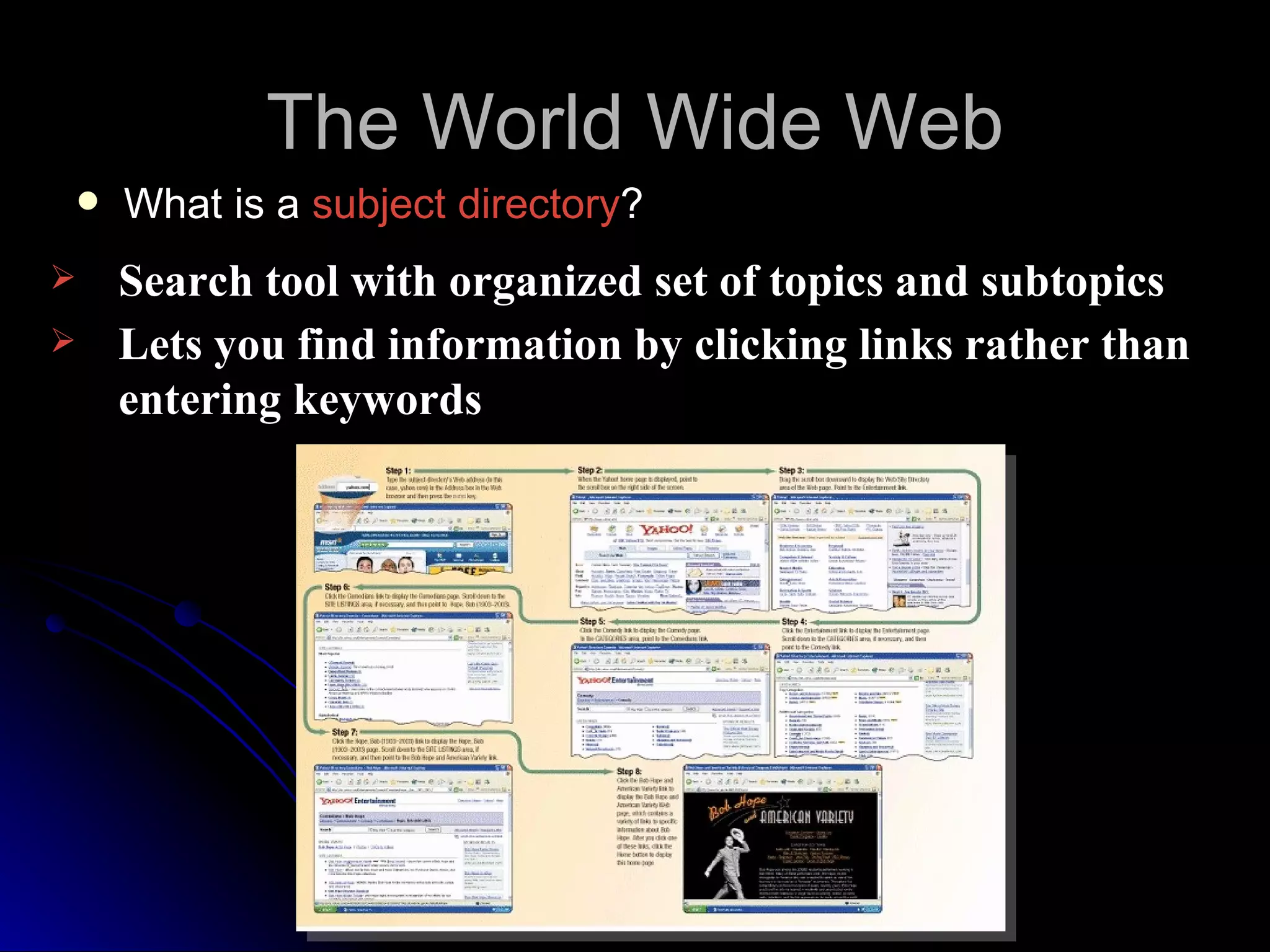
   What is a subject directory?
   Search tool with organized set of topics and subtopics
   Lets you find information by clicking links rather than
    entering keywords
The World Wide Web
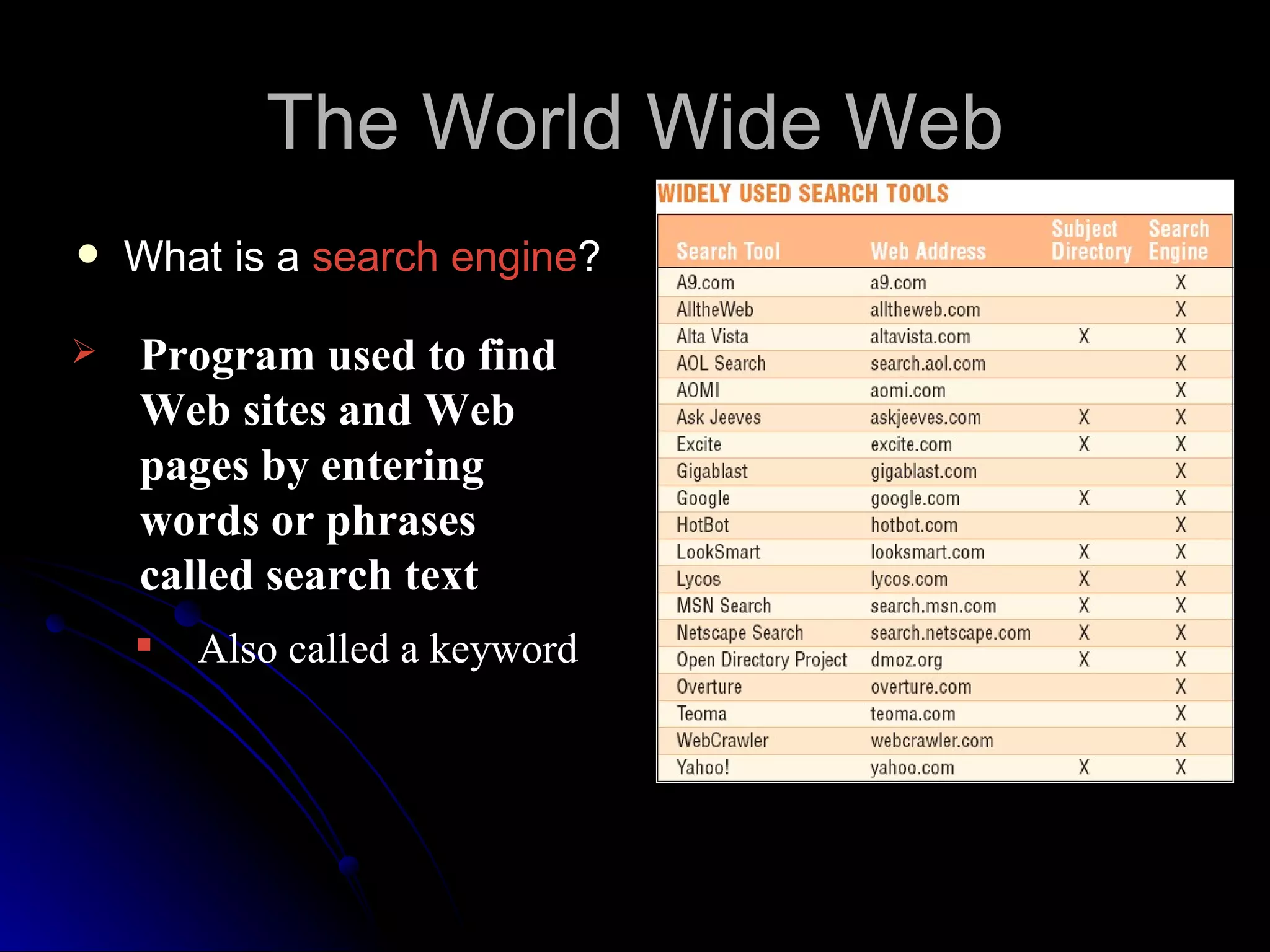
   What is a search engine?

   Program used to find
    Web sites and Web
    pages by entering
    words or phrases
    called search text
       Also called a keyword
The World Wide Web
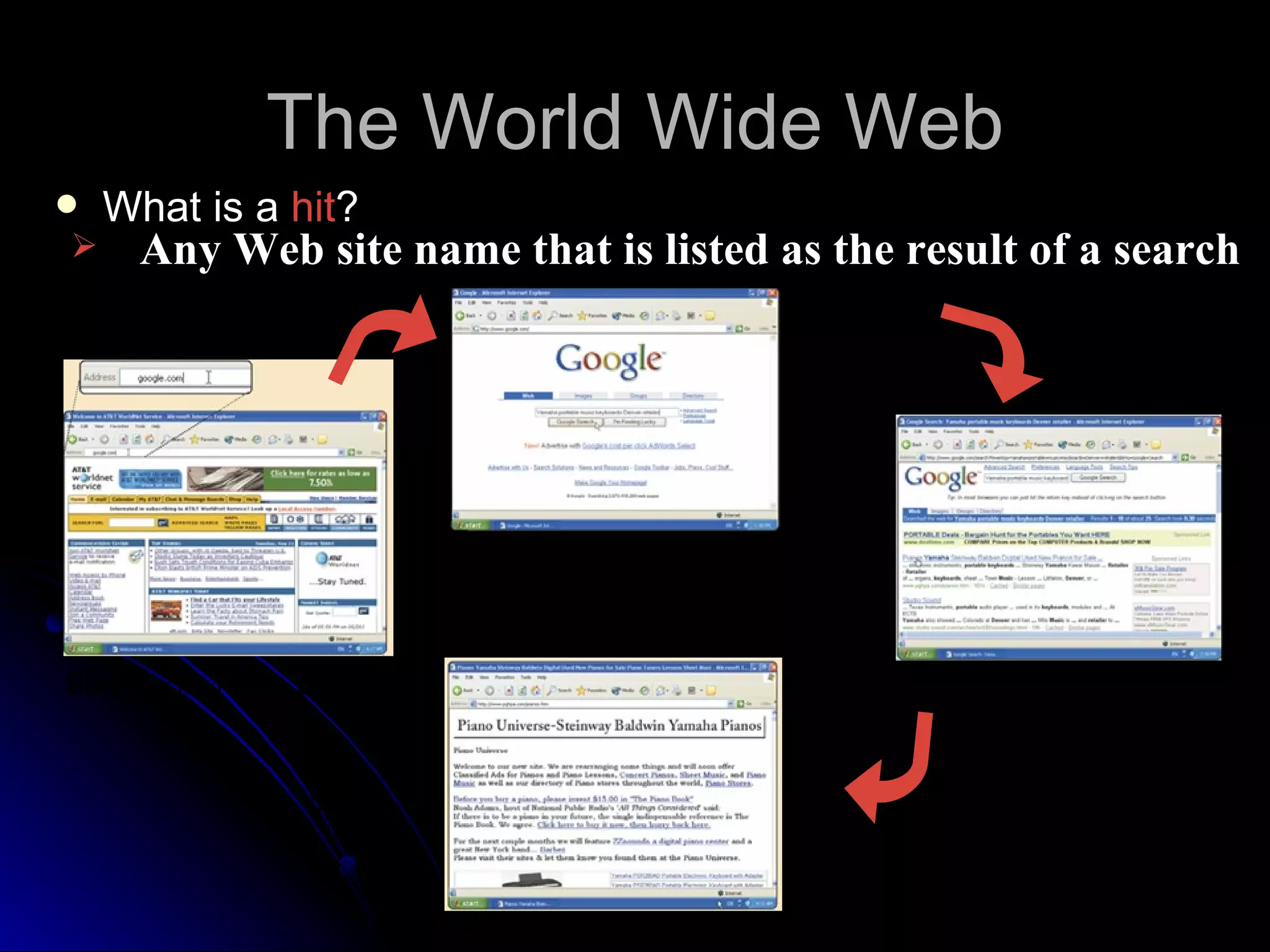
   What is a hit?
     Any Web site name that is listed as the result of a search
                                        Step 2.
                                        Select type of
                                        search you want
                                        to run


Step 1. Go to search engine                       Step 3. View hits


                      Step 4.
                      Click
                      link to view
                      Web site
The World Wide Web
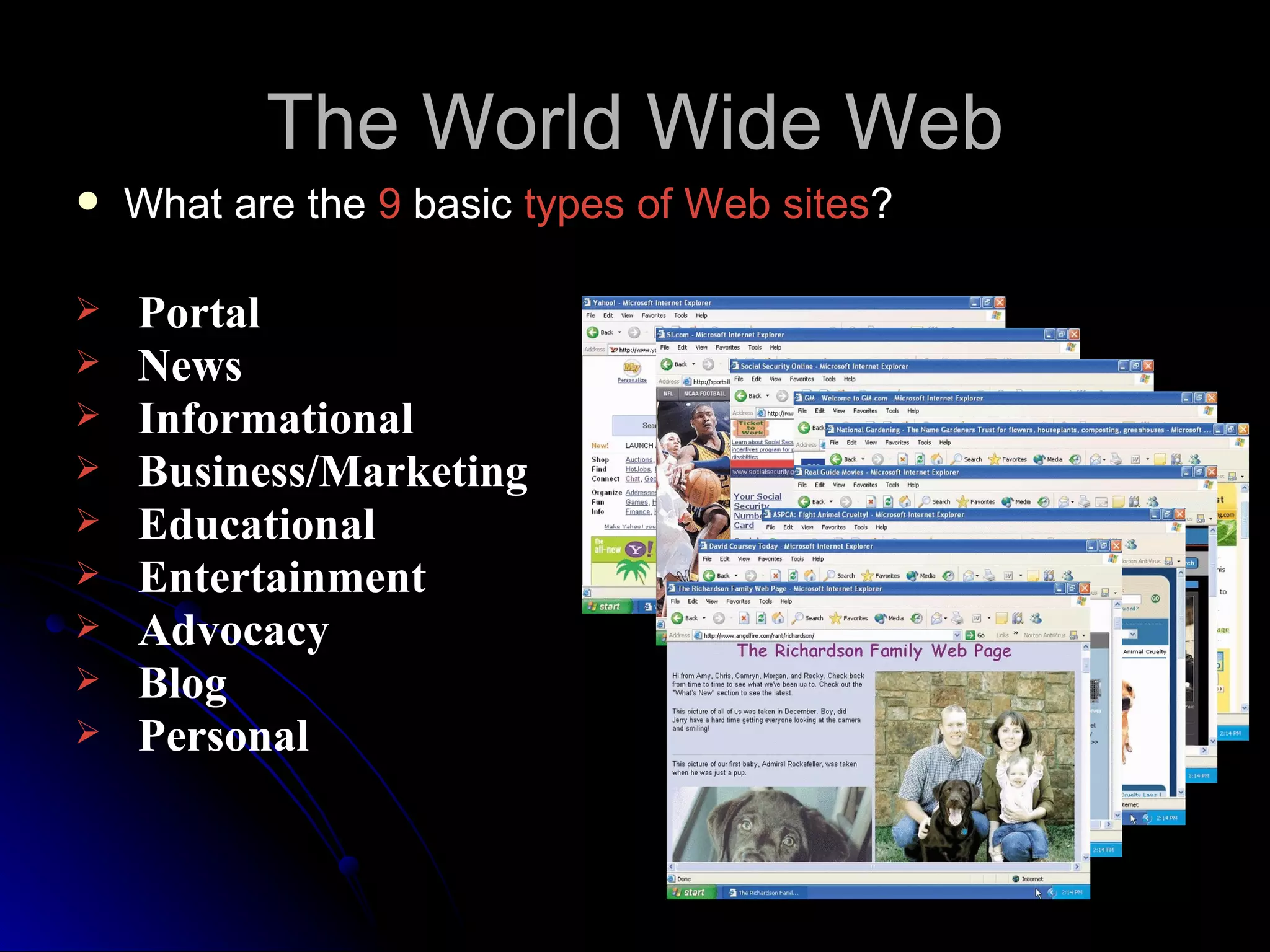
   What are the 9 basic types of Web sites?

   Portal
   News
   Informational
   Business/Marketing
   Educational
   Entertainment
   Advocacy
   Blog
   Personal
The World Wide Web
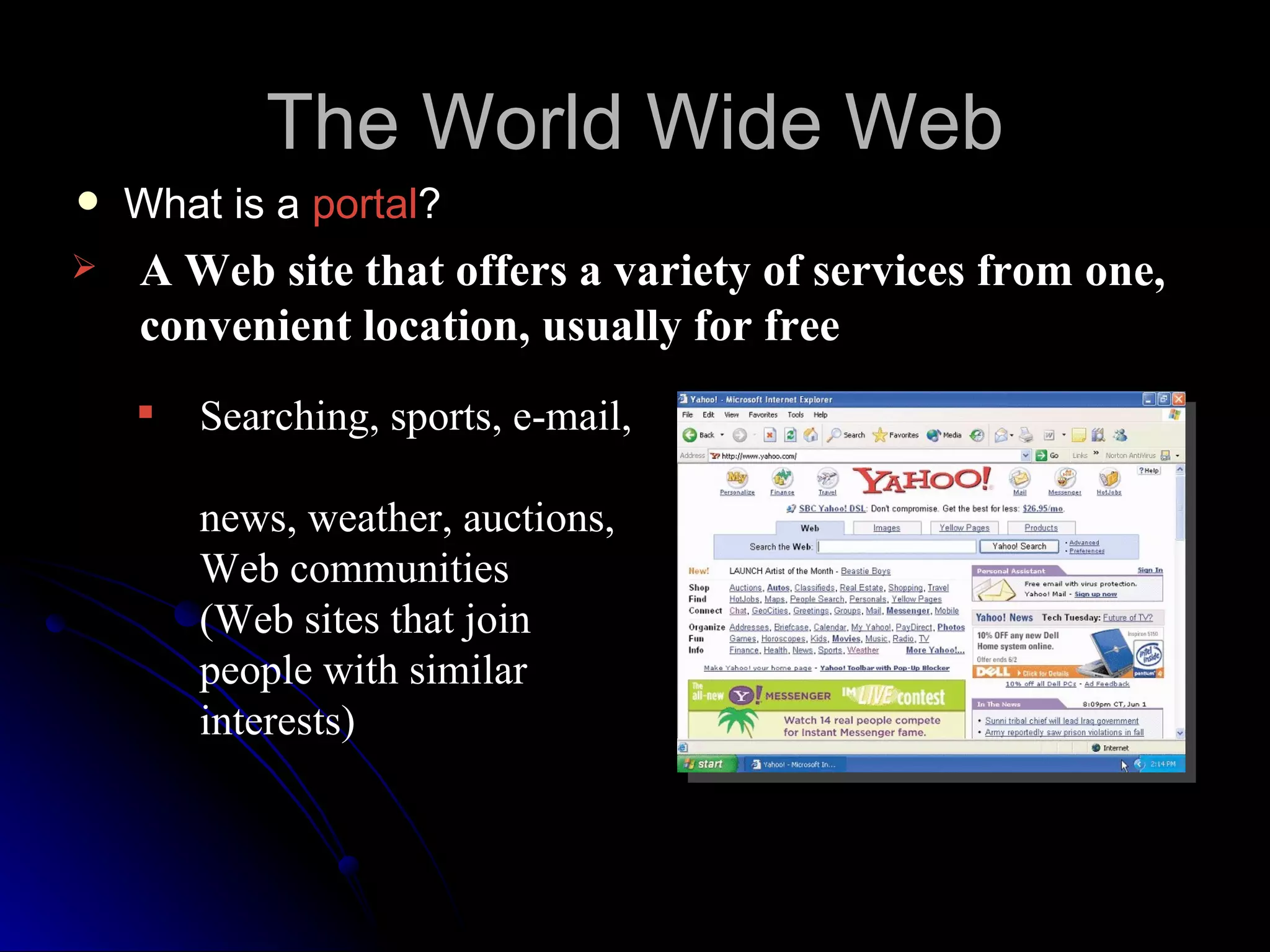
   What is a portal?
   A Web site that offers a variety of services from one,
    convenient location, usually for free
       Searching, sports, e-mail,

        news, weather, auctions,
        Web communities
        (Web sites that join
        people with similar
        interests)
The World Wide Web
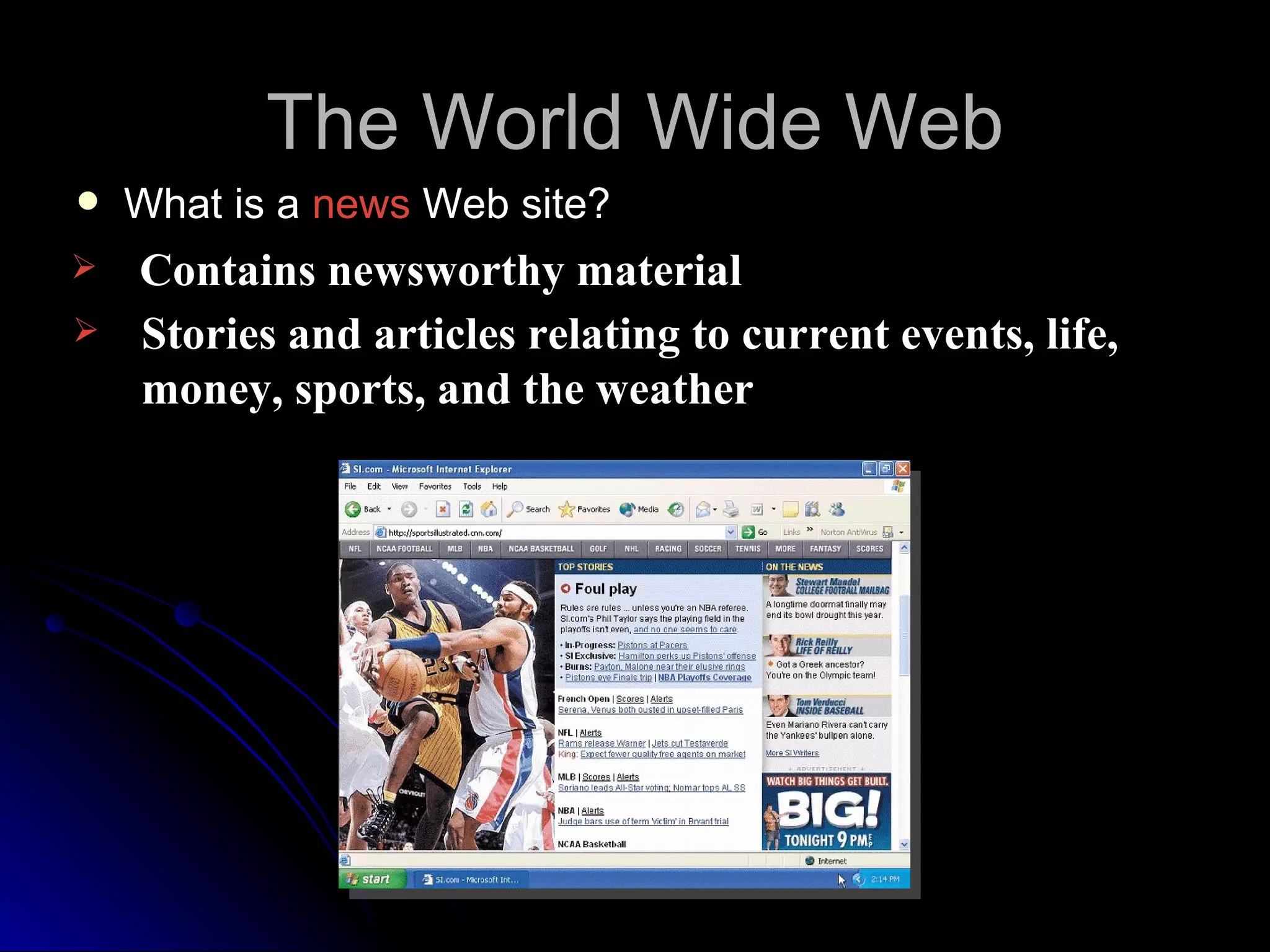
   What is a news Web site?
   Contains newsworthy material
   Stories and articles relating to current events, life,
    money, sports, and the weather
The World Wide Web
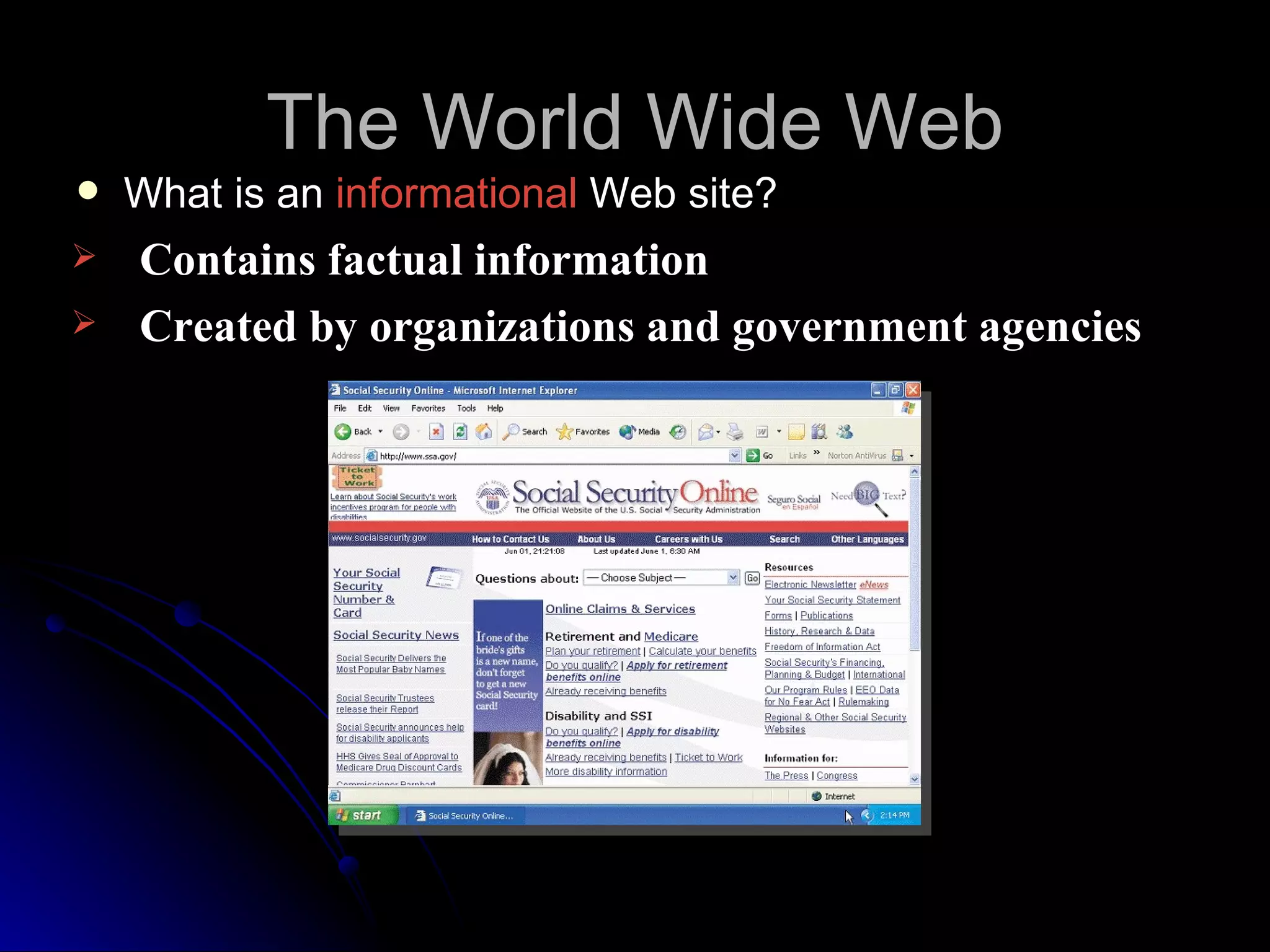
   What is an informational Web site?
   Contains factual information
   Created by organizations and government agencies
The World Wide Web
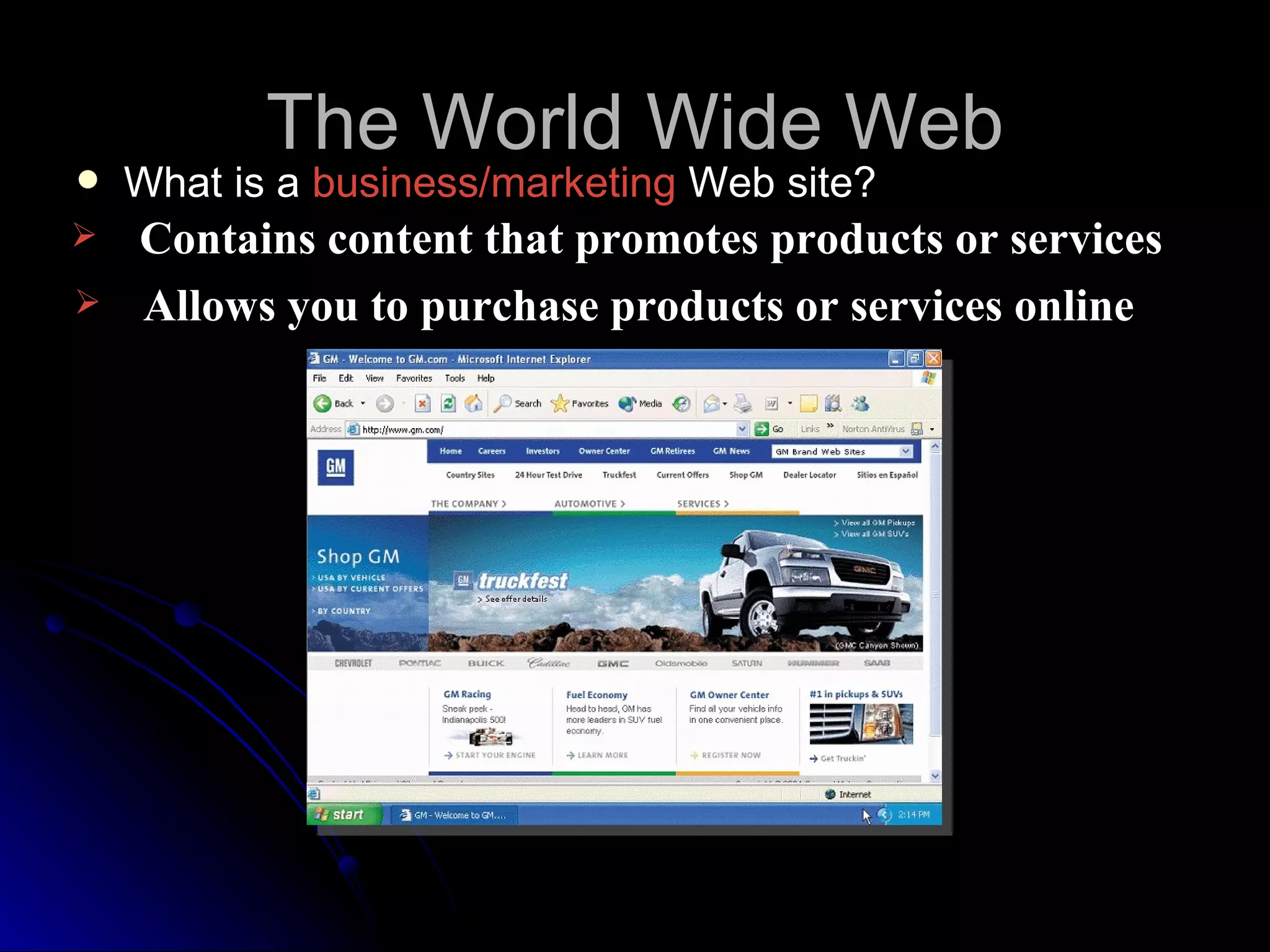
   What is a business/marketing Web site?
   Contains content that promotes products or services
   Allows you to purchase products or services online
The World Wide Web
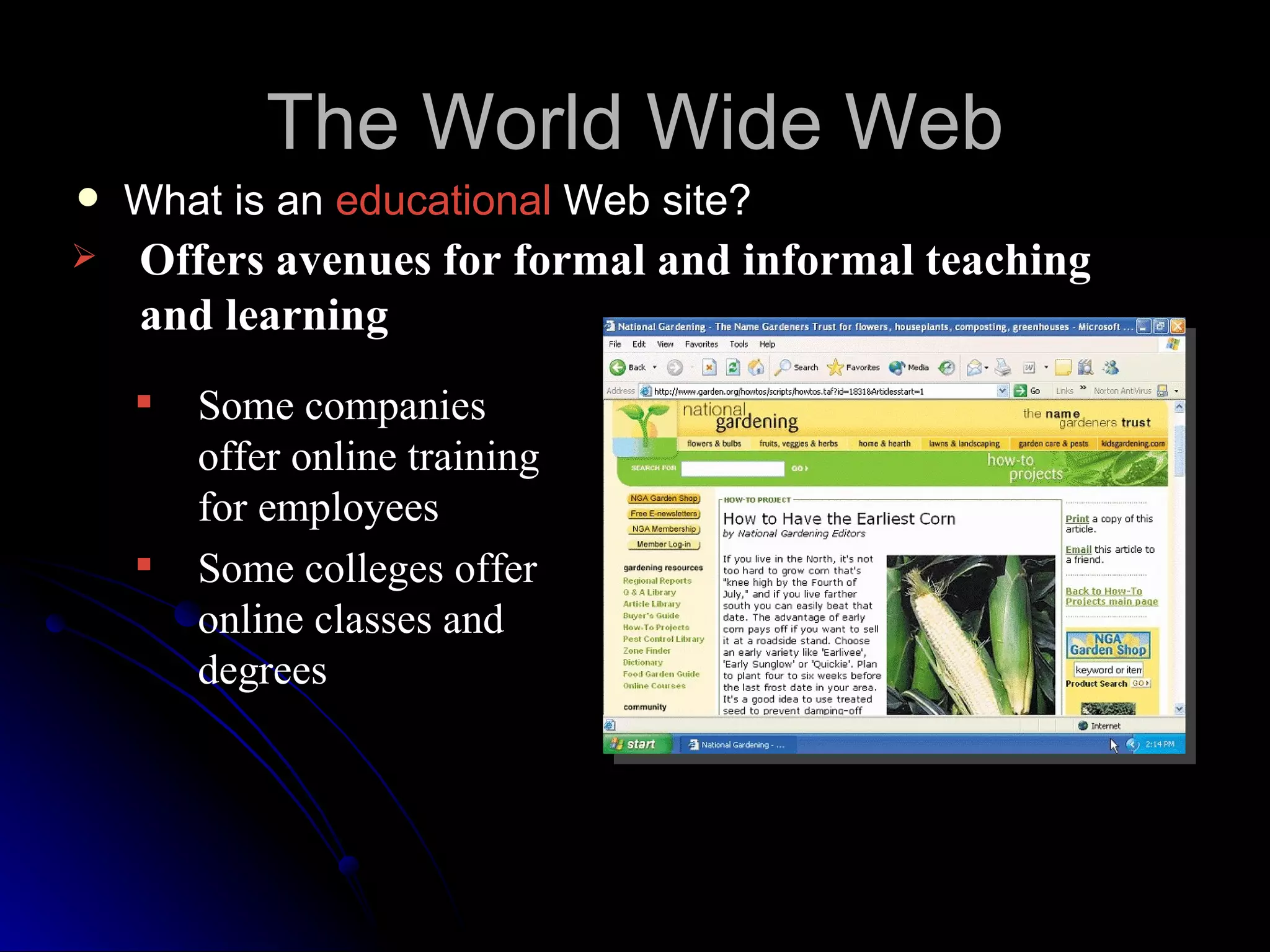
   What is an educational Web site?
   Offers avenues for formal and informal teaching
    and learning
       Some companies
        offer online training
        for employees
       Some colleges offer
        online classes and
        degrees
The World Wide Web
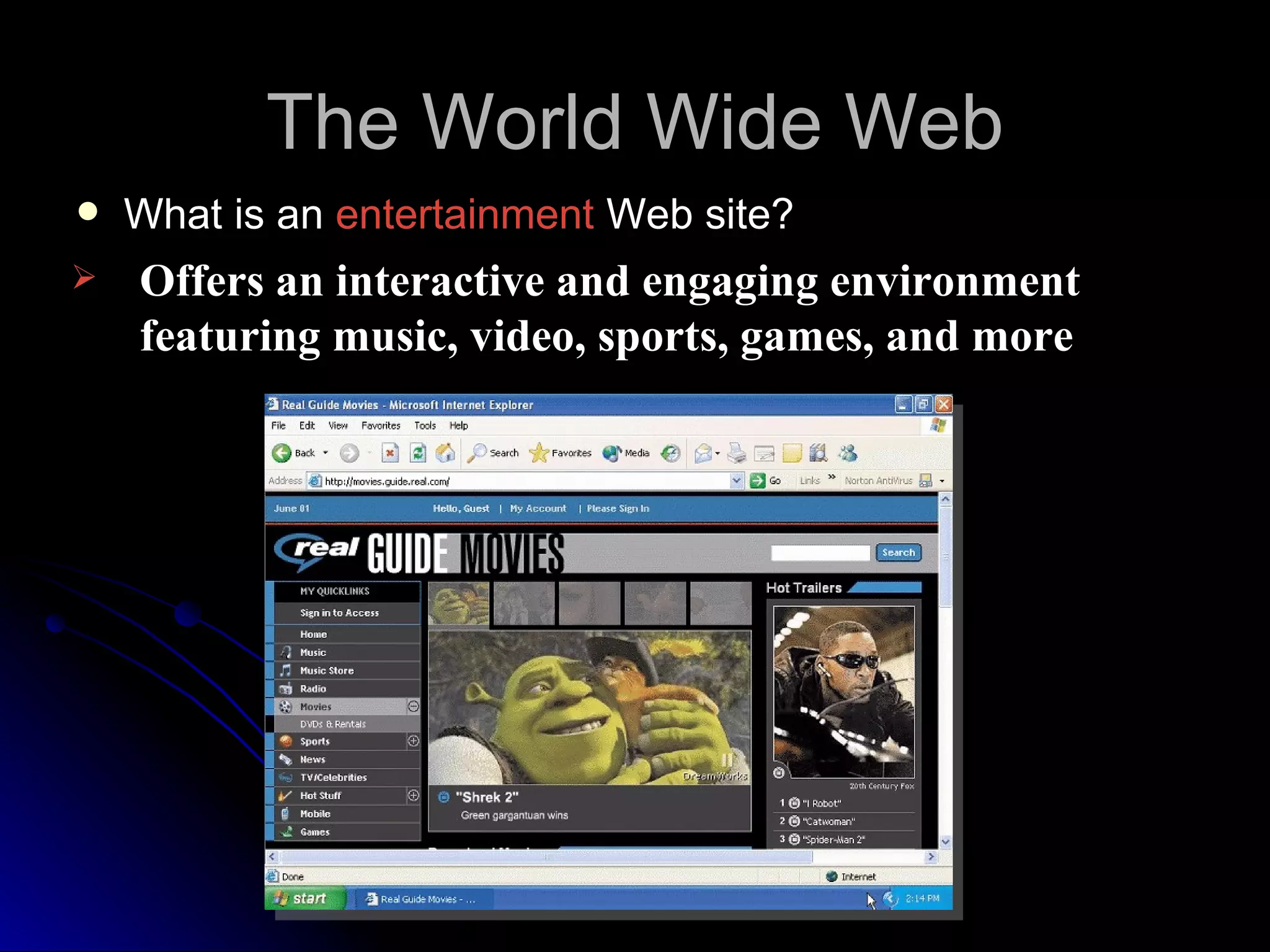
   What is an entertainment Web site?
   Offers an interactive and engaging environment
    featuring music, video, sports, games, and more
The World Wide Web
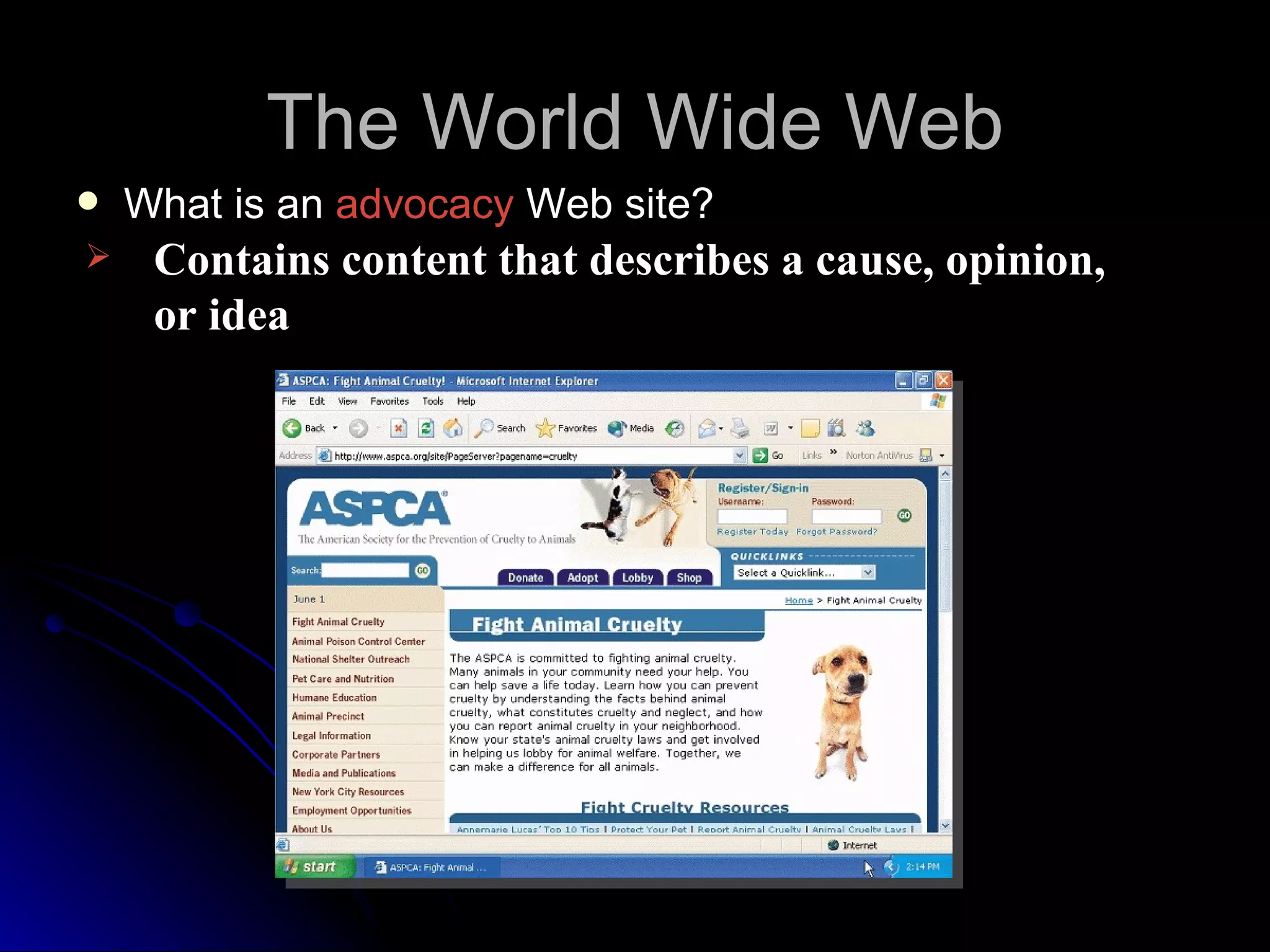
   What is an advocacy Web site?
    Contains content that describes a cause, opinion,
     or idea
The World Wide Web
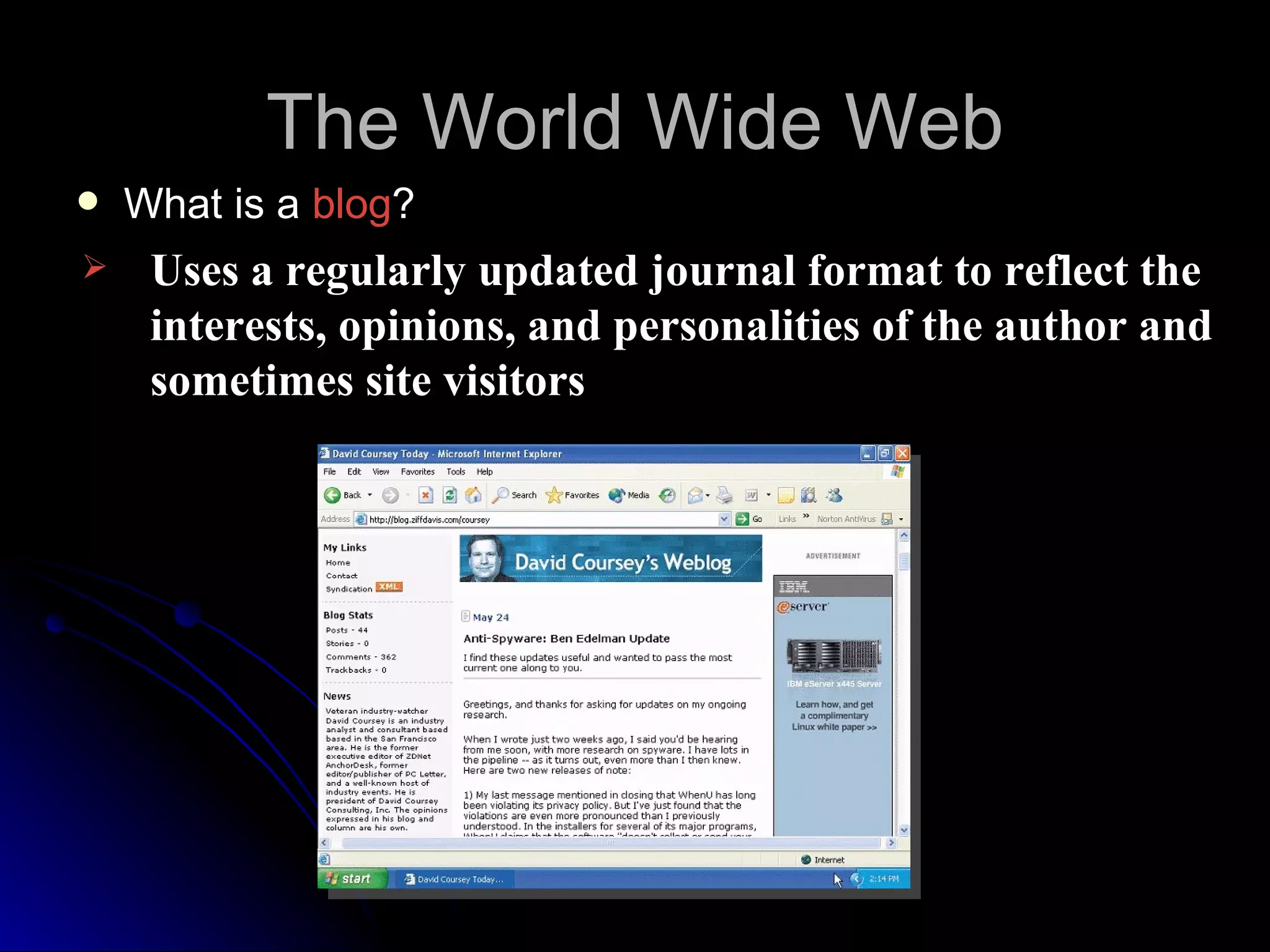
   What is a blog?
    Uses a regularly updated journal format to reflect the
     interests, opinions, and personalities of the author and
     sometimes site visitors
The World Wide Web
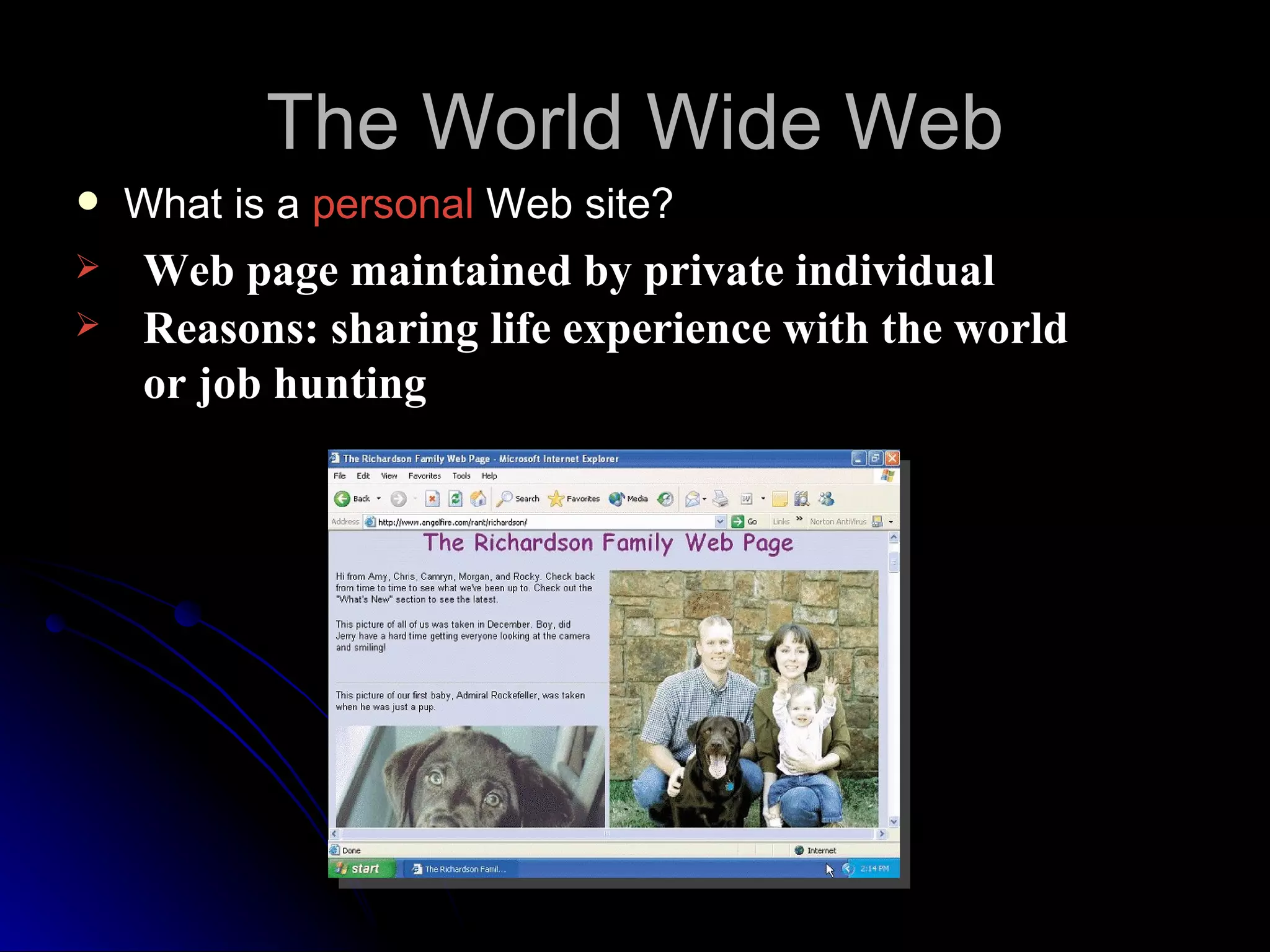
   What is a personal Web site?
   Web page maintained by private individual
   Reasons: sharing life experience with the world
    or job hunting
The World Wide Web
   What are the guidelines for evaluating the value of a
    Web site?


    Affiliation       Audience       Authority      Content


                  Currency       Design     Objectivity
The World Wide Web
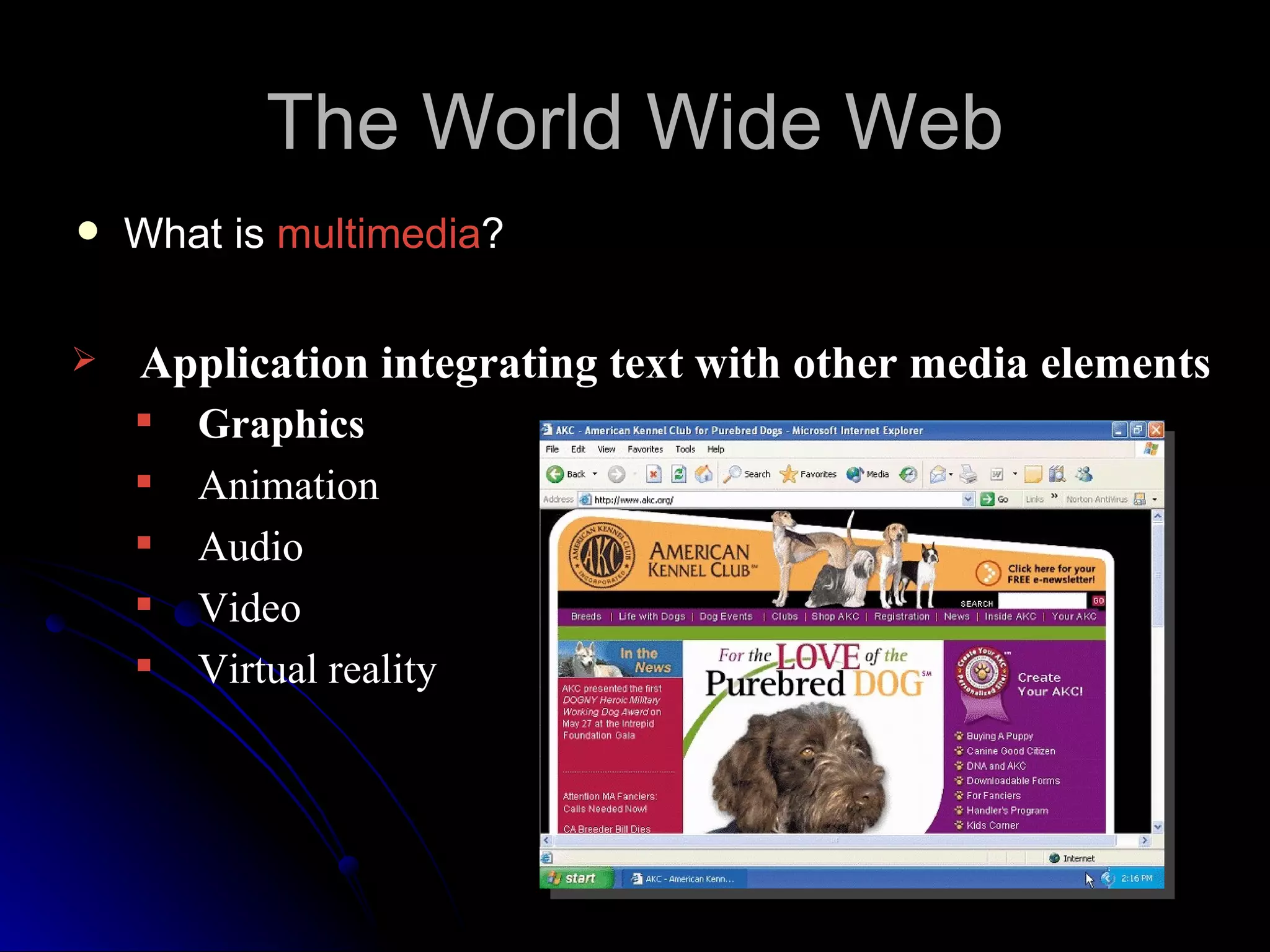
   What is multimedia?

   Application integrating text with other media elements
       Graphics
       Animation
       Audio
       Video
       Virtual reality
The World Wide Web
   What graphics formats are used on the Web?


        BMP                       JPEG                   PNG
                          (pronounced JAY-peg)      (pronounced ping)

                    GIF                      TIFF
              (pronounced JIFF)
The World Wide Web
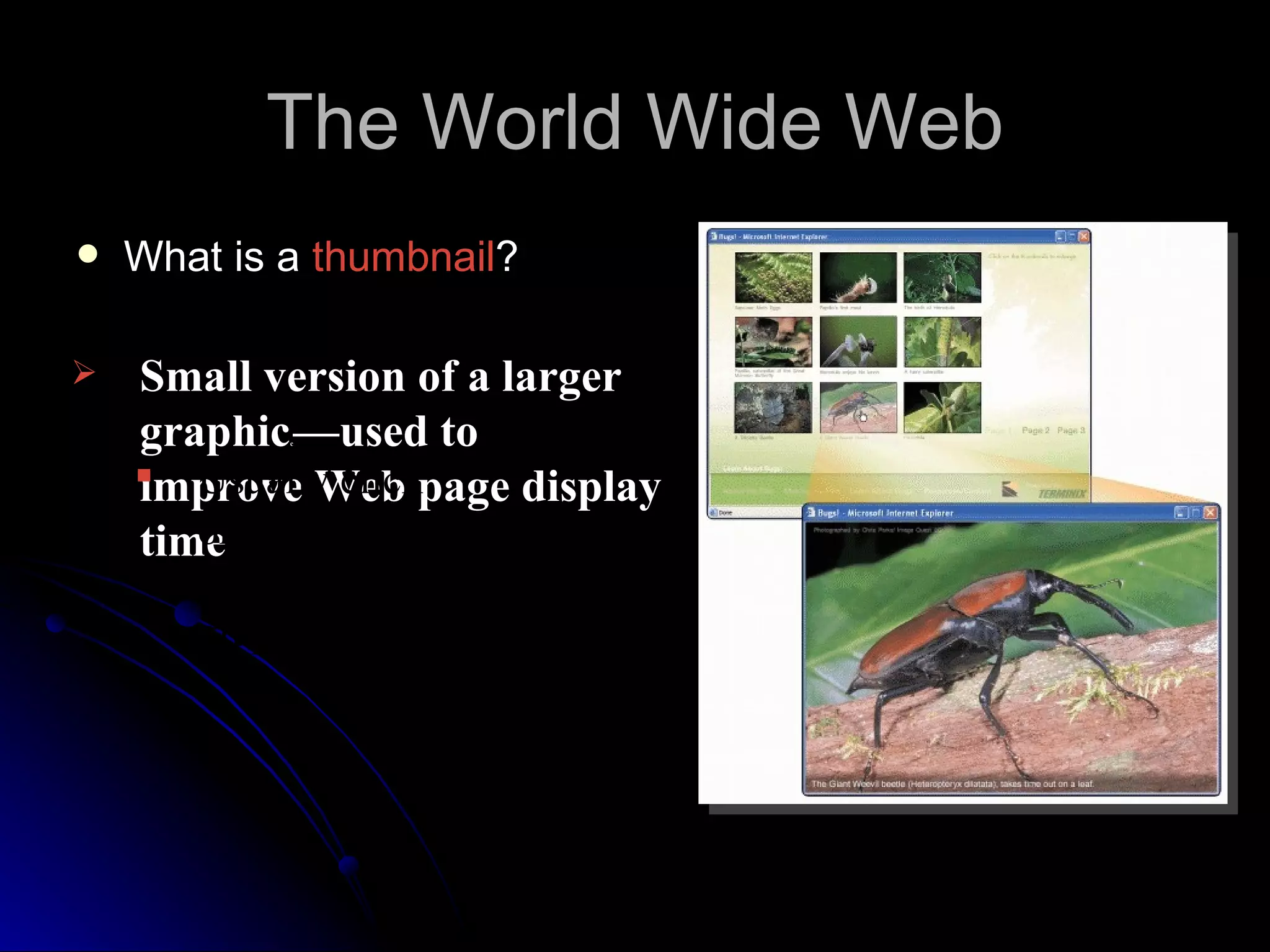
   What is a thumbnail?

   Small version of a larger
    graphic —used to
            c


     Usually clickpage display
    improve Web
    time thumbnail to
       on
       display larger
       graphic
The World Wide Web
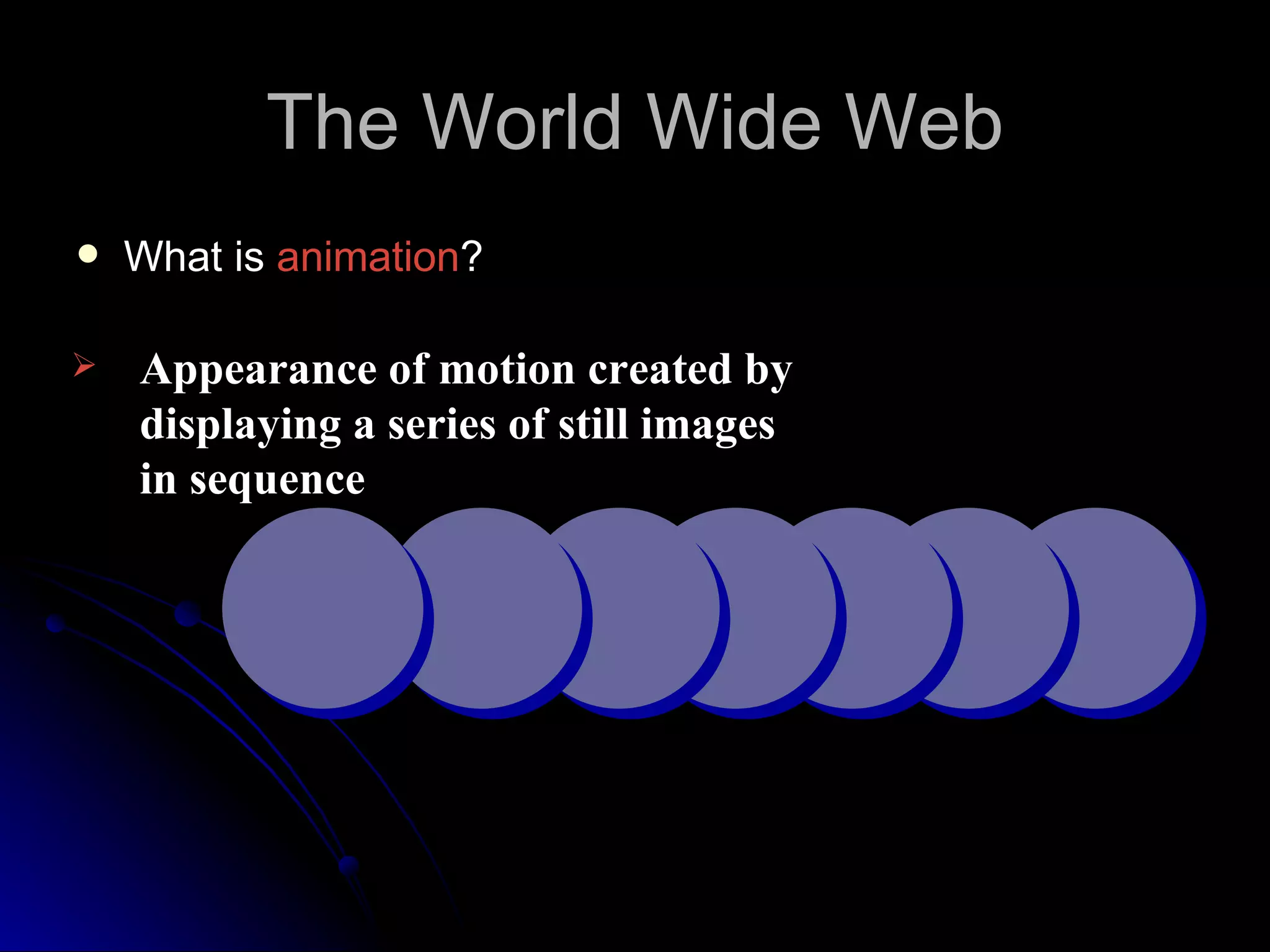
   What is animation?

   Appearance of motion created by
    displaying a series of still images
    in sequence
The World Wide Web
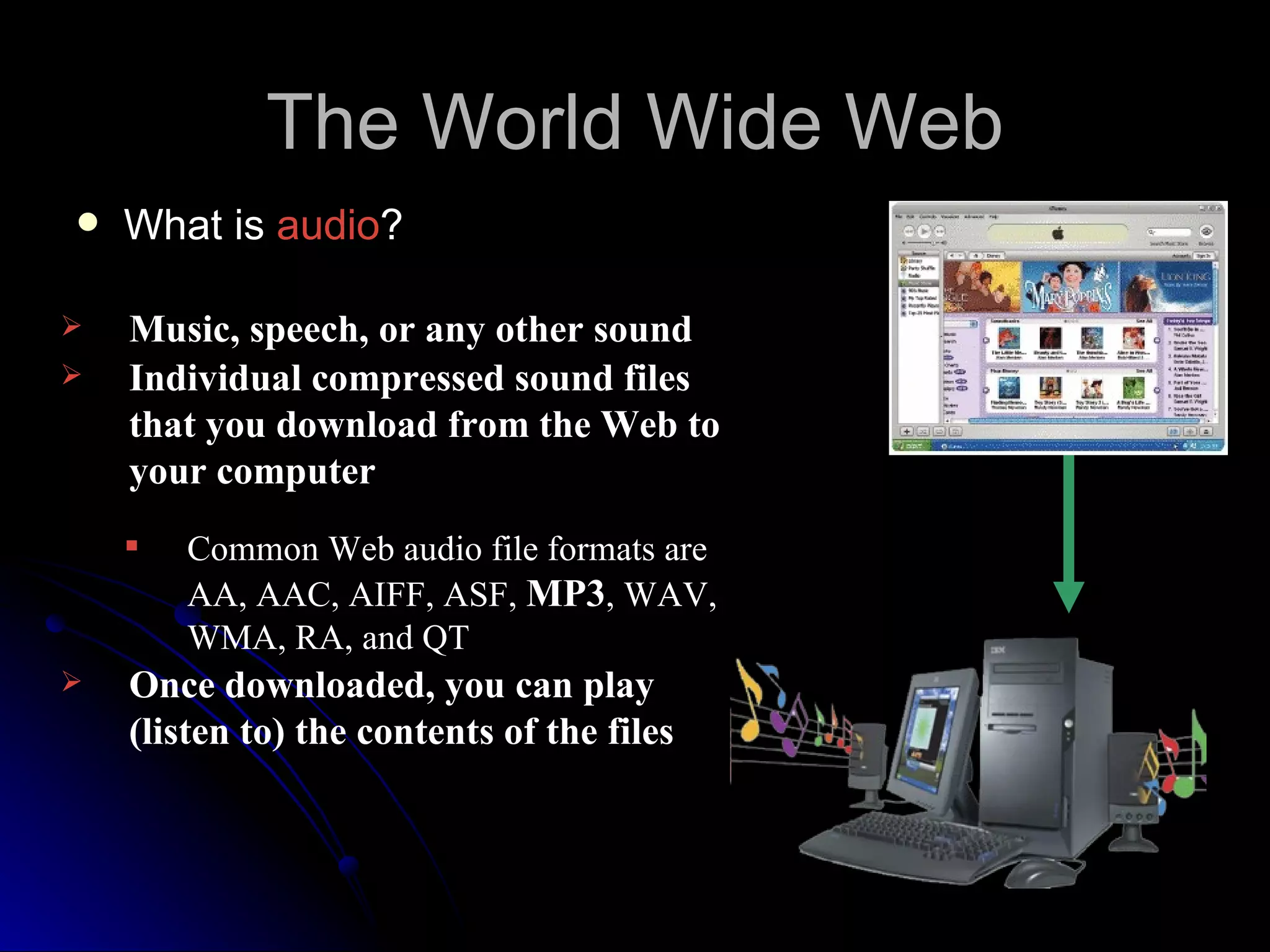
   What is audio?

   Music, speech, or any other sound
   Individual compressed sound files
    that you download from the Web to
    your computer
       Common Web audio file formats are
        AA, AAC, AIFF, ASF, MP3, WAV,
        WMA, RA, and QT
   Once downloaded, you can play
    (listen to) the contents of the files
The World Wide Web
   What is streaming audio?


            The process of      Enables you to
          transferring audio    listen to music
            in a continuous     as it downloads
             and even flow     to your computer
The World Wide Web
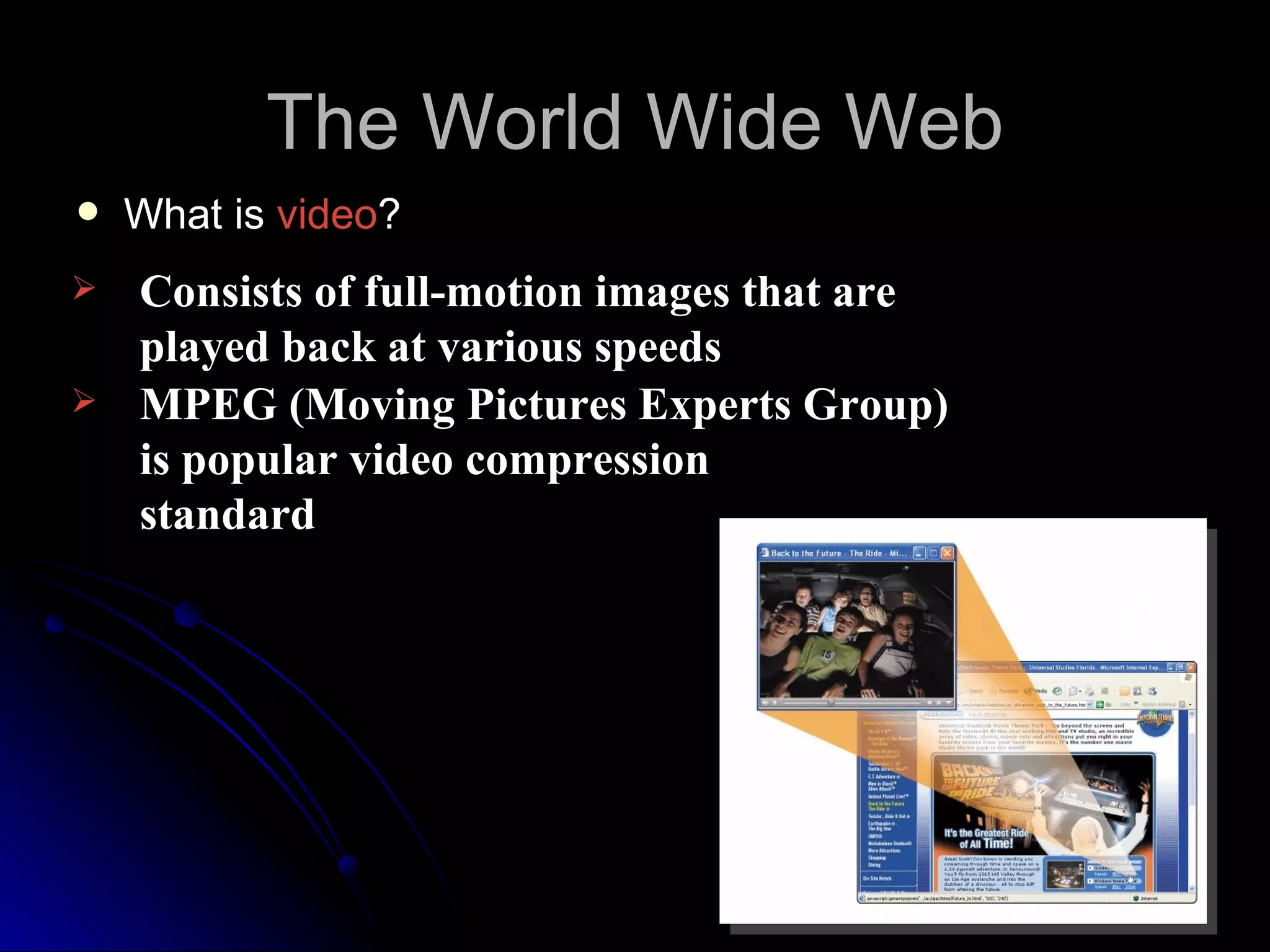
   What is video?
   Consists of full-motion images that are
    played back at various speeds
   MPEG (Moving Pictures Experts Group)
    is popular video compression
    standard
The World Wide Web
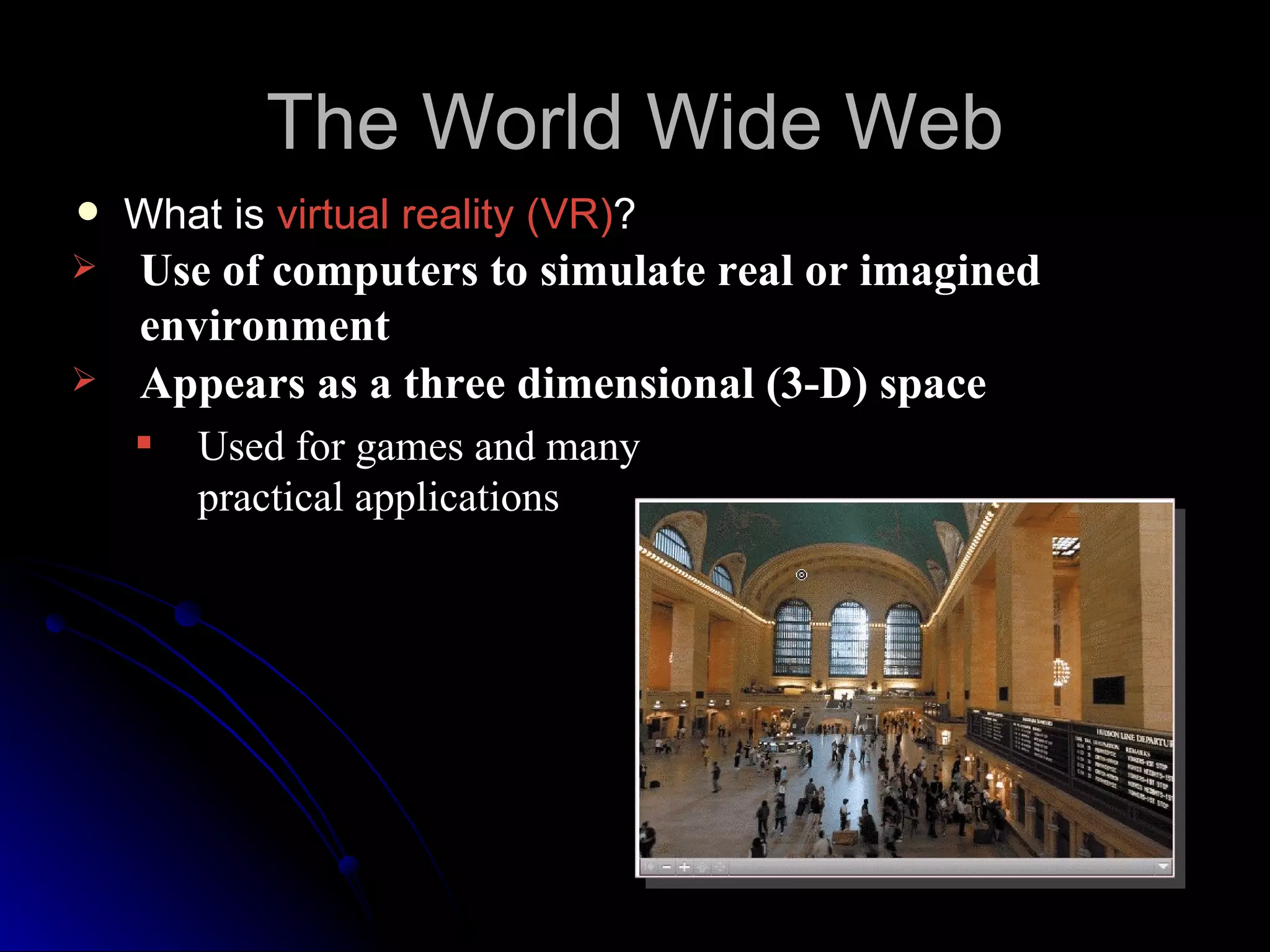
   What is virtual reality (VR)?
   Use of computers to simulate real or imagined
    environment
   Appears as a three dimensional (3-D) space
       Used for games and many
        practical applications
The World Wide Web
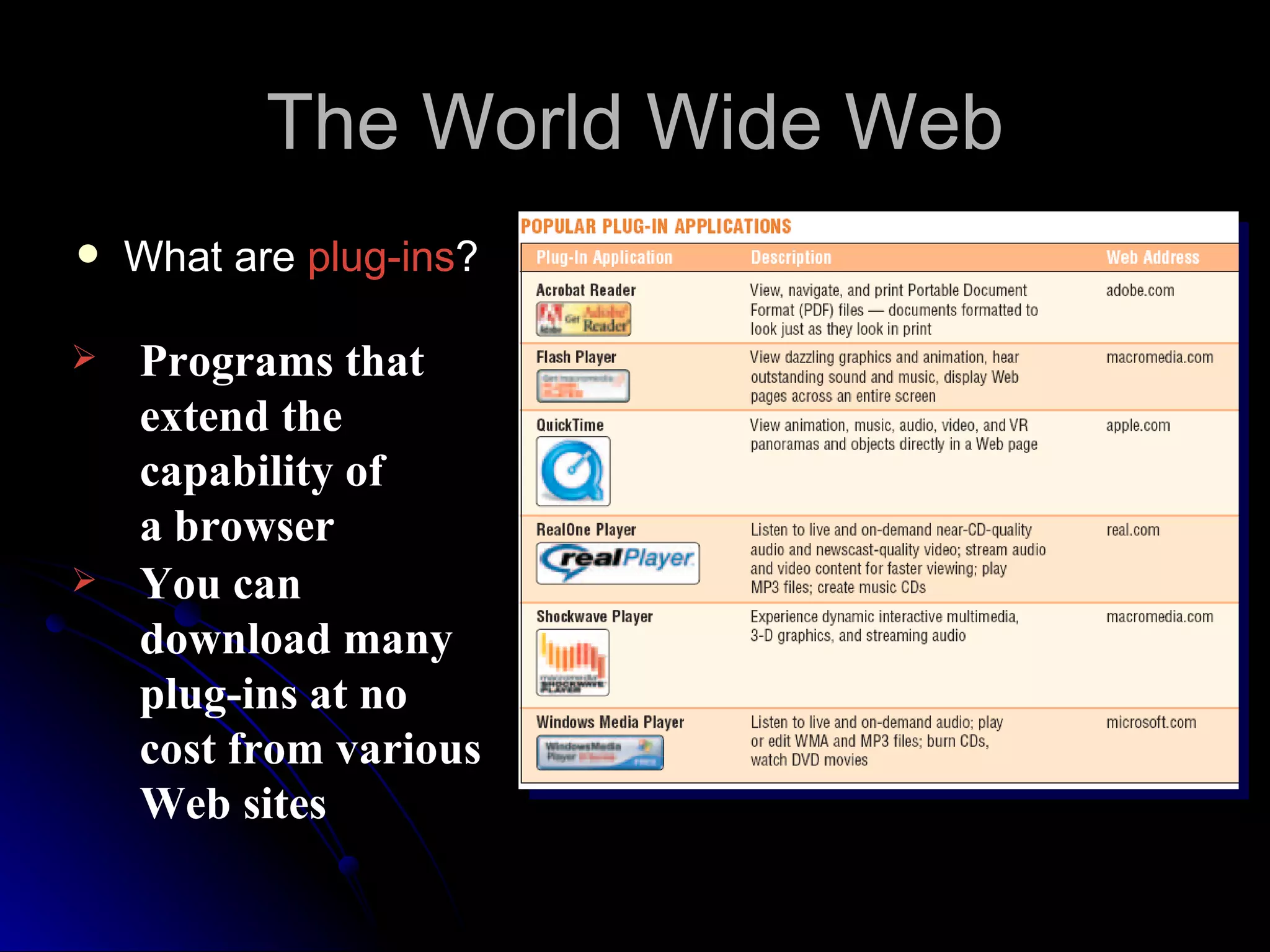
   What are plug-ins?

   Programs that
    extend the
    capability of
    a browser
   You can
    download many
    plug-ins at no
    cost from various
    Web sites
Web Publishing
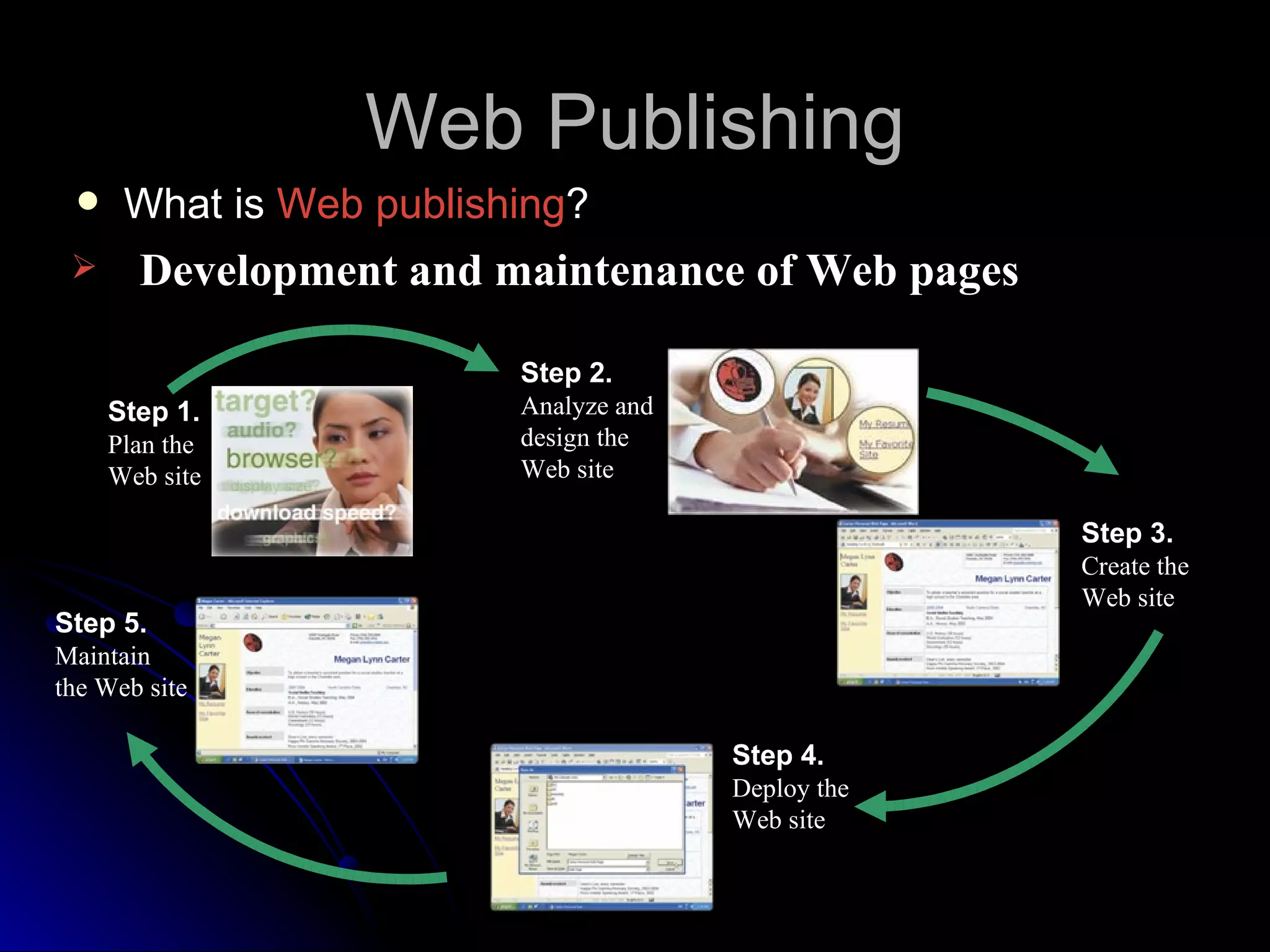
     What is Web publishing?
      Development and maintenance of Web pages

                         Step 2.
     Step 1.             Analyze and
     Plan the            design the
     Web site            Web site

                                                    Step 3.
                                                    Create the
                                                    Web site
Step 5.
Maintain
the Web site

                                       Step 4.
                                       Deploy the
                                       Web site
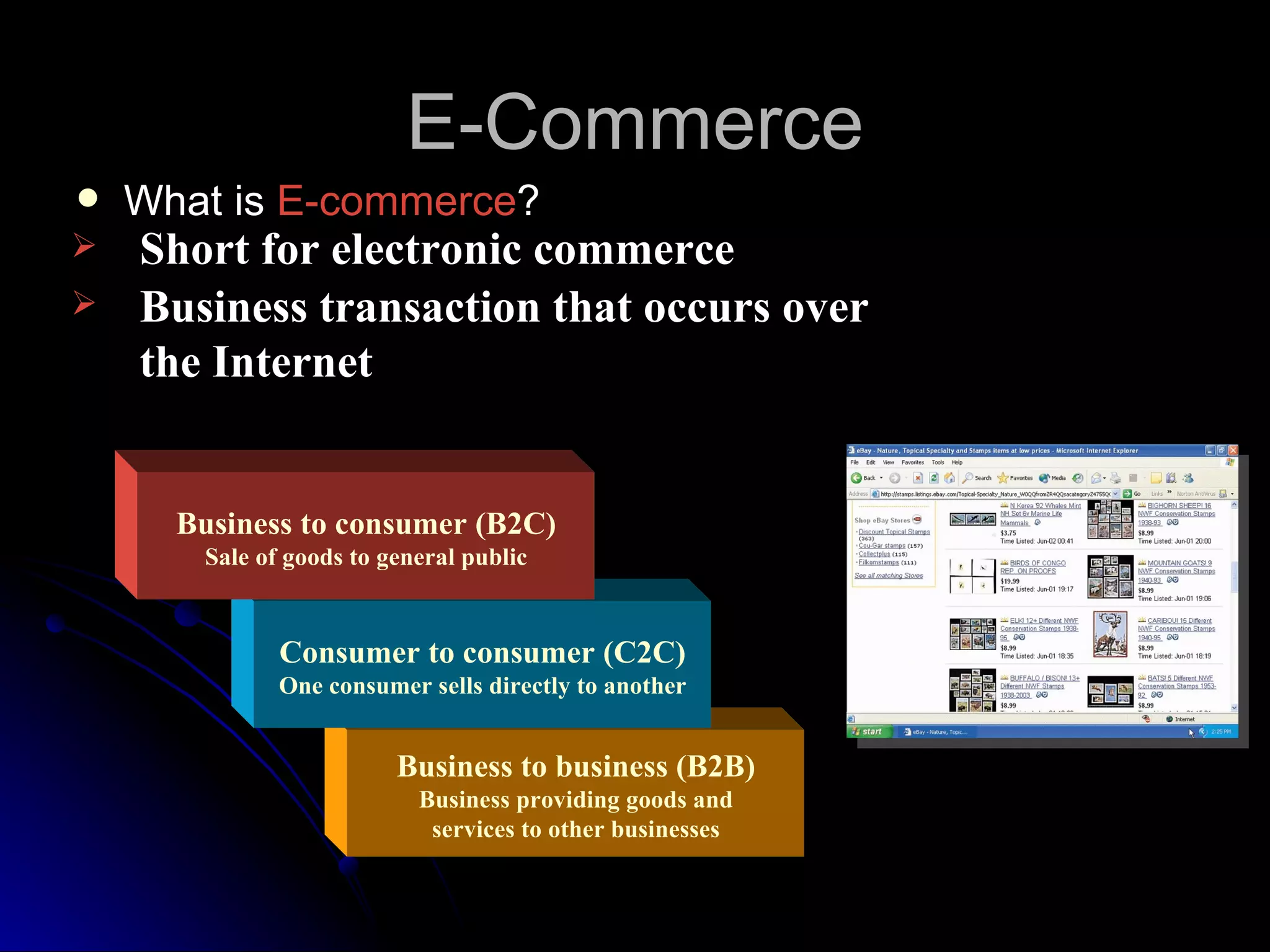
E-Commerce
   What is E-commerce?
   Short for electronic commerce
   Business transaction that occurs over
    the Internet


      Business to consumer (B2C)
       Sale of goods to general public


              Consumer to consumer (C2C)
              One consumer sells directly to another


                         Business to business (B2B)
                           Business providing goods and
                            services to other businesses
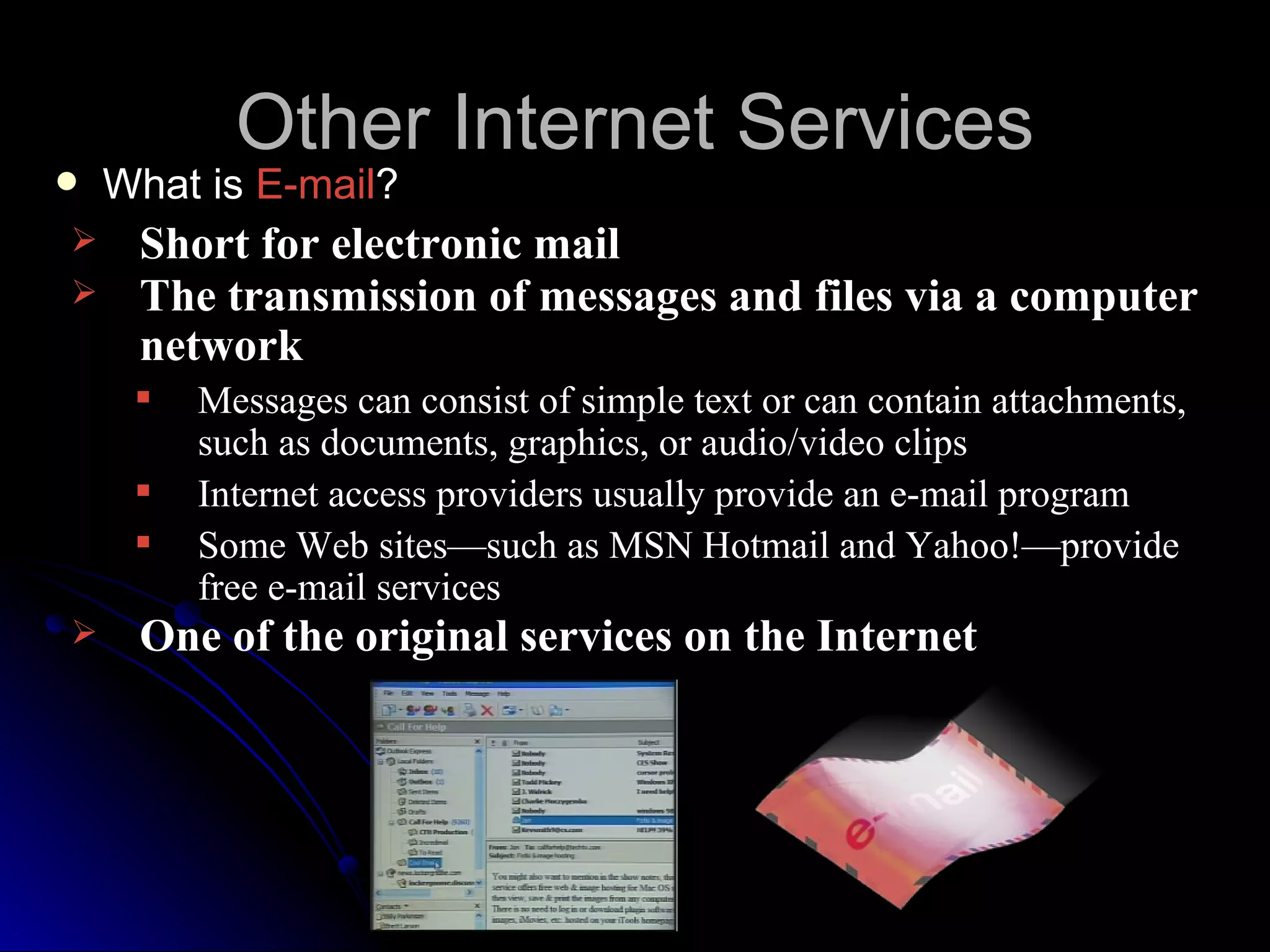
Other Internet Services
   What is E-mail?
    Short for electronic mail
    The transmission of messages and files via a computer
     network
        Messages can consist of simple text or can contain attachments,
         such as documents, graphics, or audio/video clips
        Internet access providers usually provide an e-mail program
        Some Web sites—such as MSN Hotmail and Yahoo!—provide
         free e-mail services
    One of the original services on the Internet
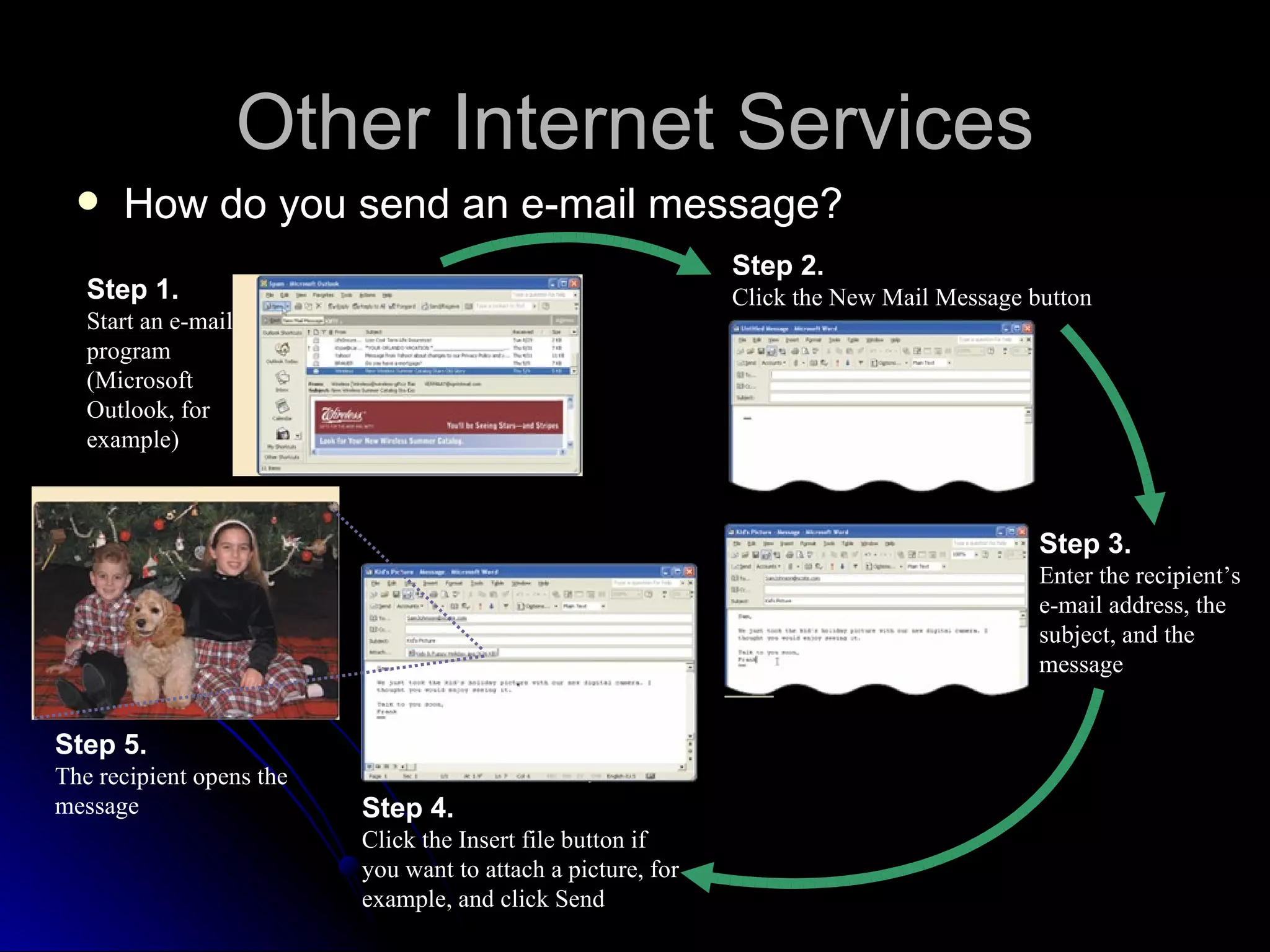
Other Internet Services
     How do you send an e-mail message?
                                                              Step 2.
   Step 1.                                                    Click the New Mail Message button
   Start an e-mail
   program
   (Microsoft
   Outlook, for
   example)


                                                                                          Step 3.
                                                                                          Enter the recipient’s
                                                                                          e-mail address, the
                                                                                          subject, and the
                                                                                          message


Step 5.
The recipient opens the
message                   Step 4.
                          Click the Insert file button if
                          you want to attach a picture, for
                          example, and click Send
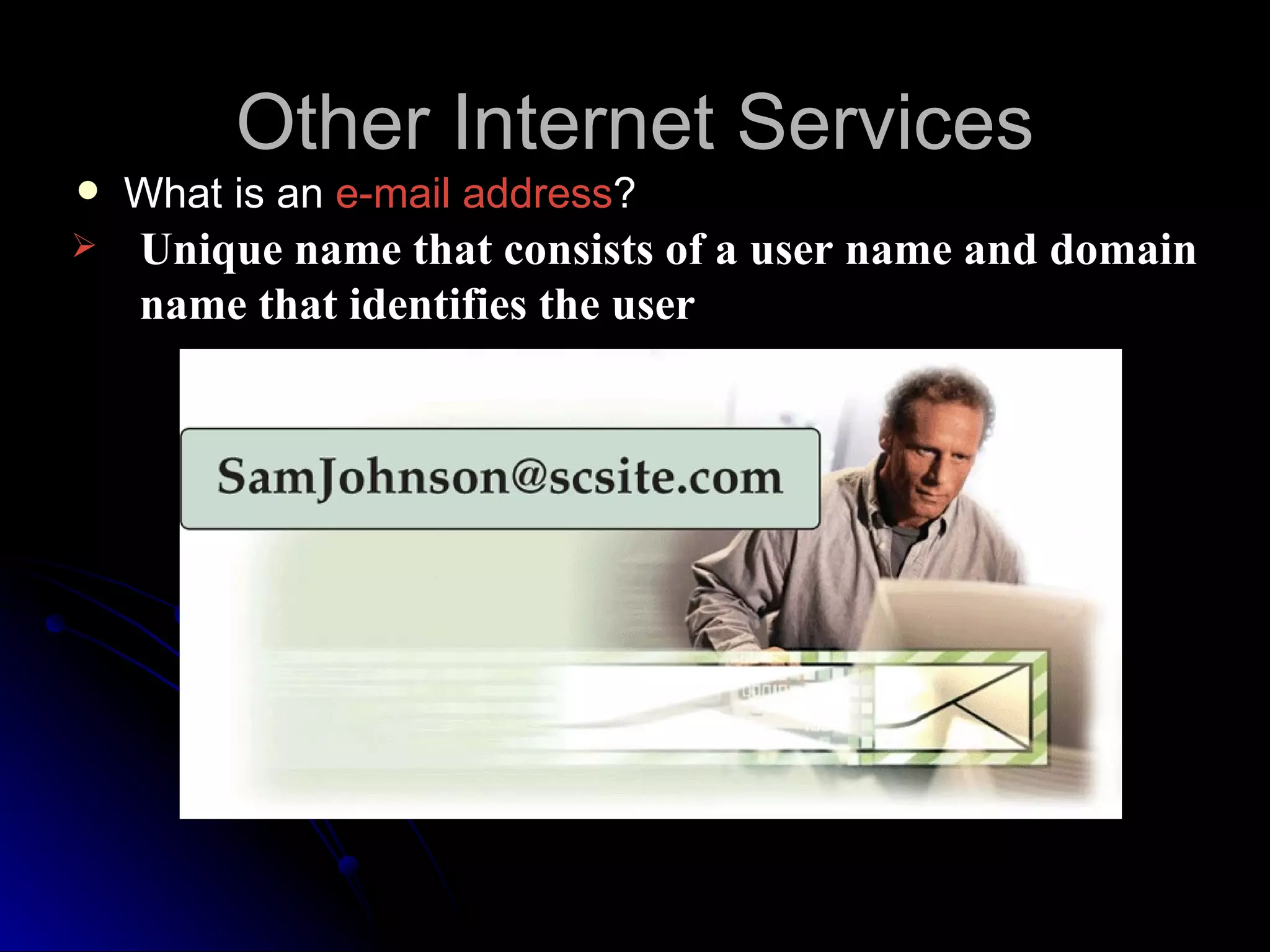
Other Internet Services
   What is an e-mail address?
   Unique name that consists of a user name and domain
    name that identifies the user
Other Internet Services
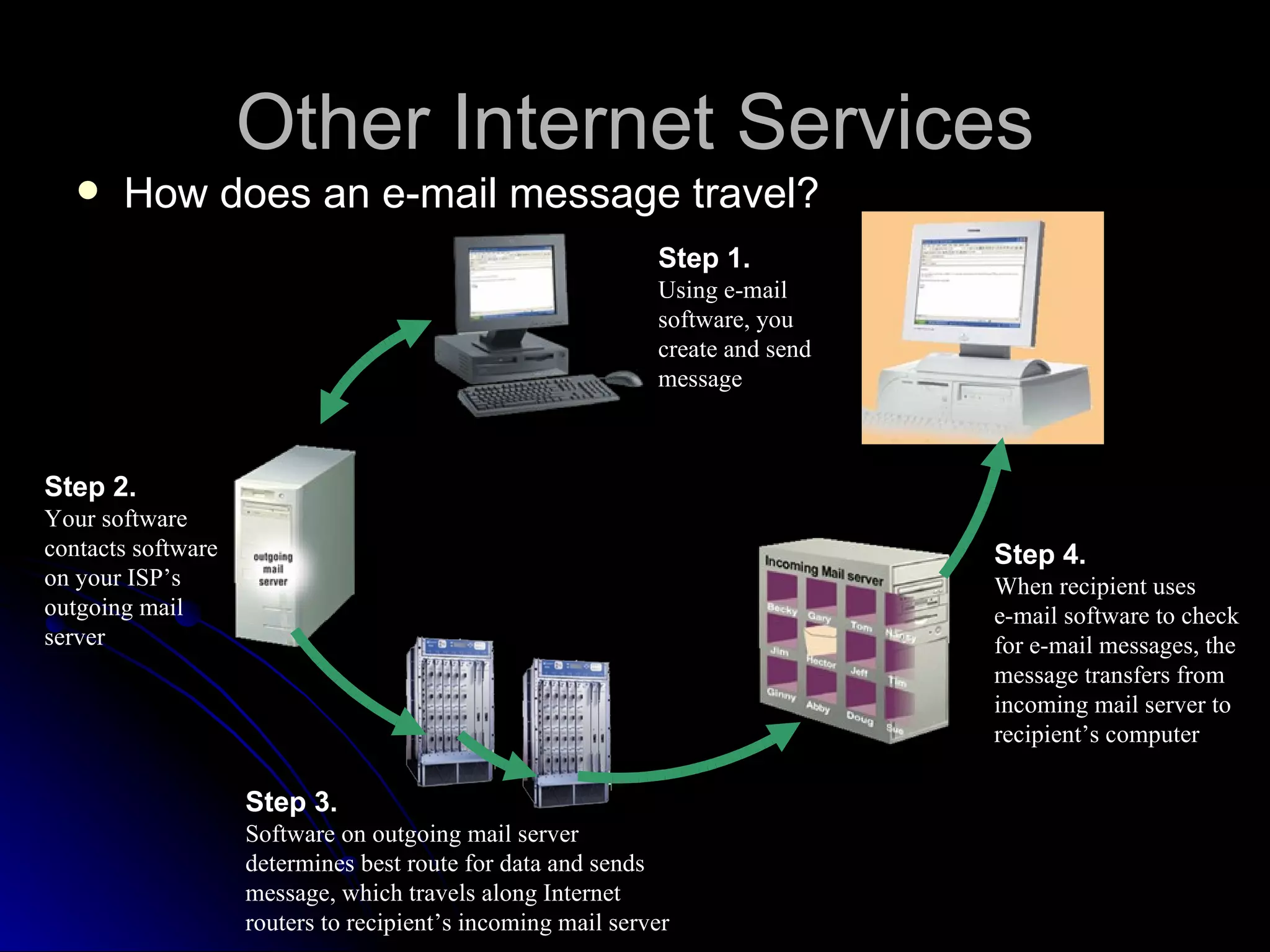
      How does an e-mail message travel?
                                                             Step 1.
                                                             Using e-mail
                                                             software, you
                                                             create and send
                                                             message


Step 2.
Your software
contacts software                                                              Step 4.
on your ISP’s                                                                  When recipient uses
outgoing mail                                                                  e-mail software to check
server                                                                         for e-mail messages, the
                                                                               message transfers from
                                                                               incoming mail server to
                                                                               recipient’s computer

                    Step 3.
                    Software on outgoing mail server
                    determines best route for data and sends
                    message, which travels along Internet
                    routers to recipient’s incoming mail server
Other Internet Services
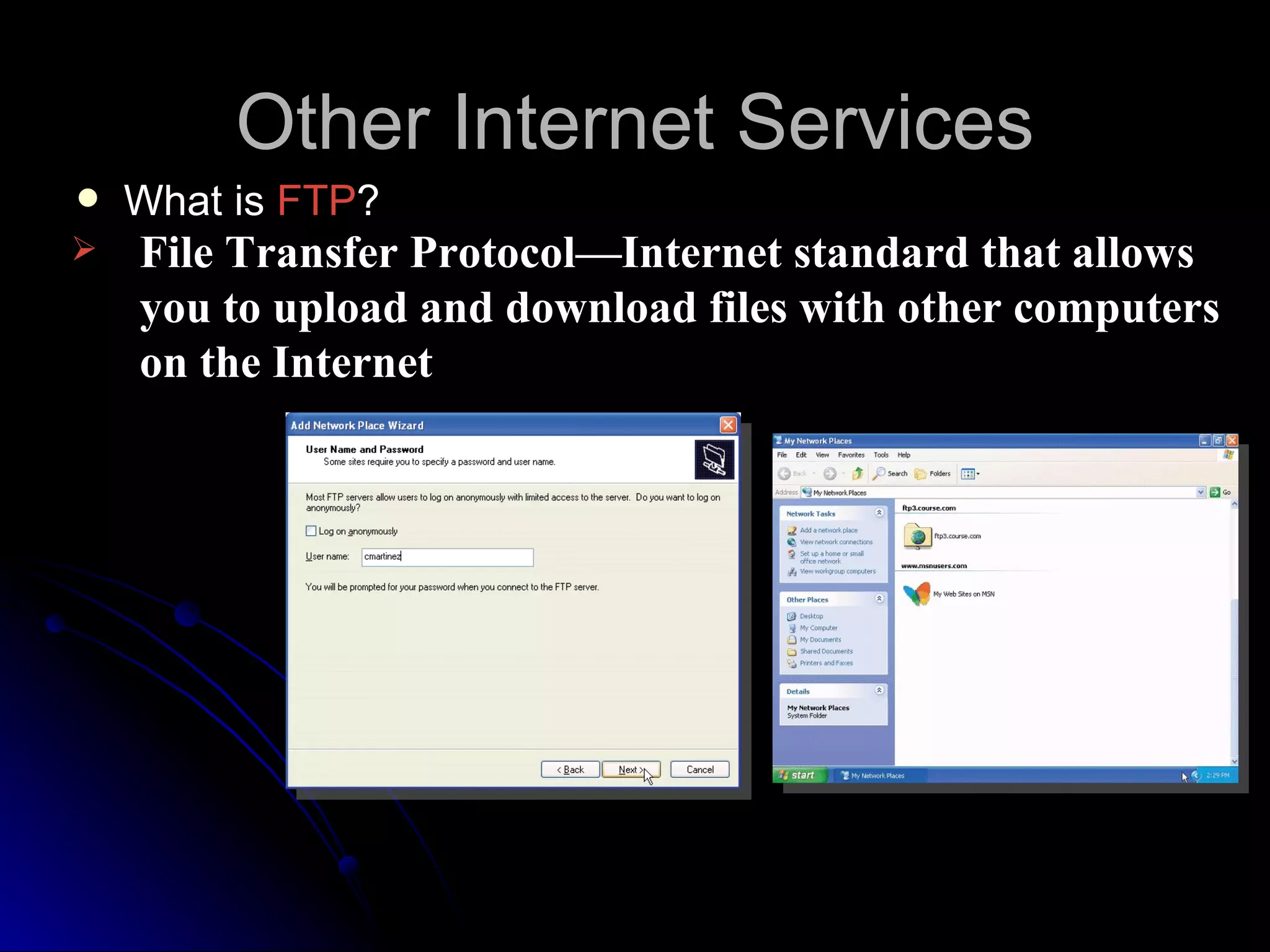
   What is FTP?
   File Transfer Protocol—Internet standard that allows
    you to upload and download files with other computers
    on the Internet
Other Internet Services
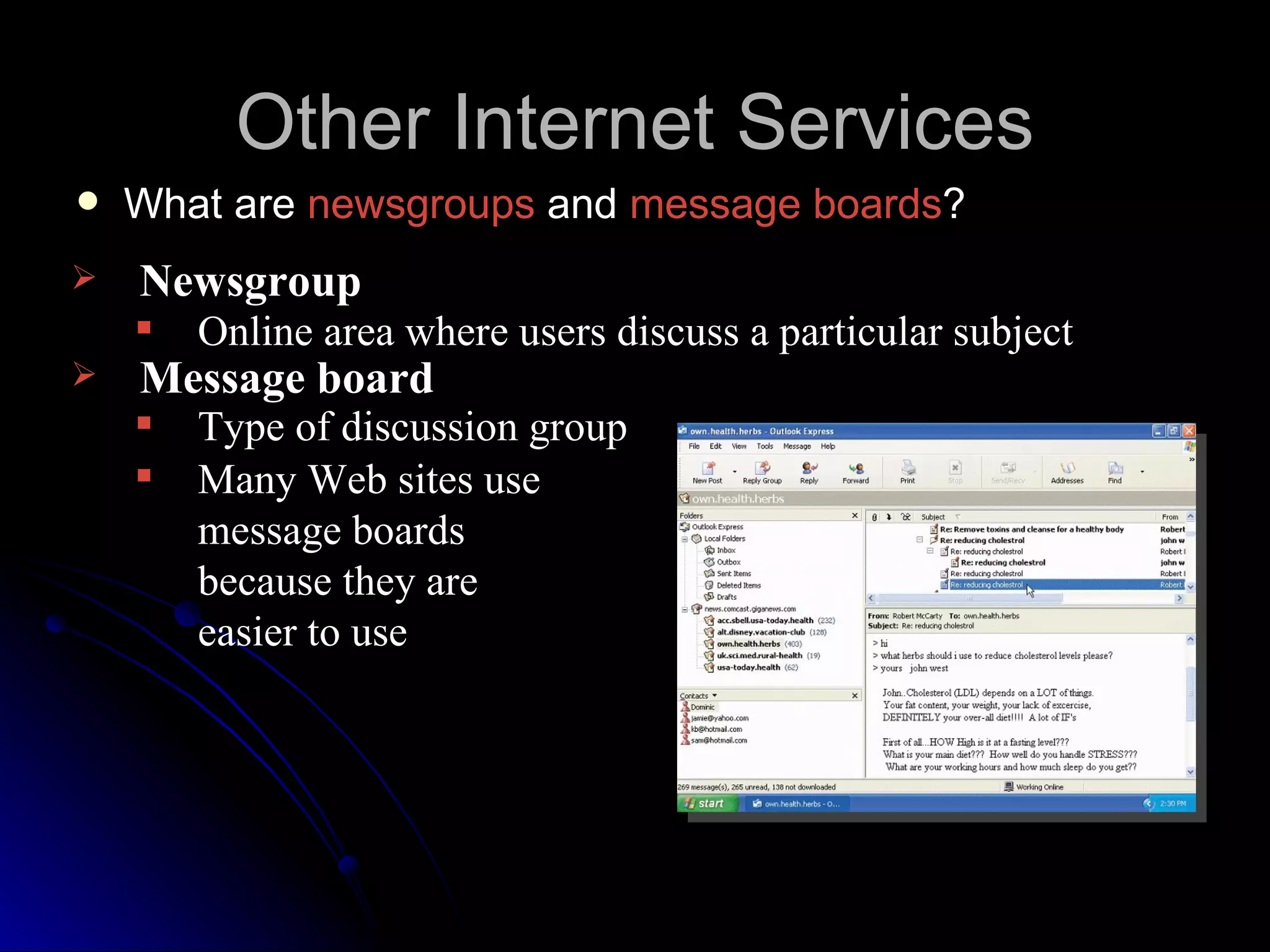
   What are newsgroups and message boards?
   Newsgroup
       Online area where users discuss a particular subject
   Message board
       Type of discussion group
       Many Web sites use
        message boards
        because they are
        easier to use
Other Internet Services
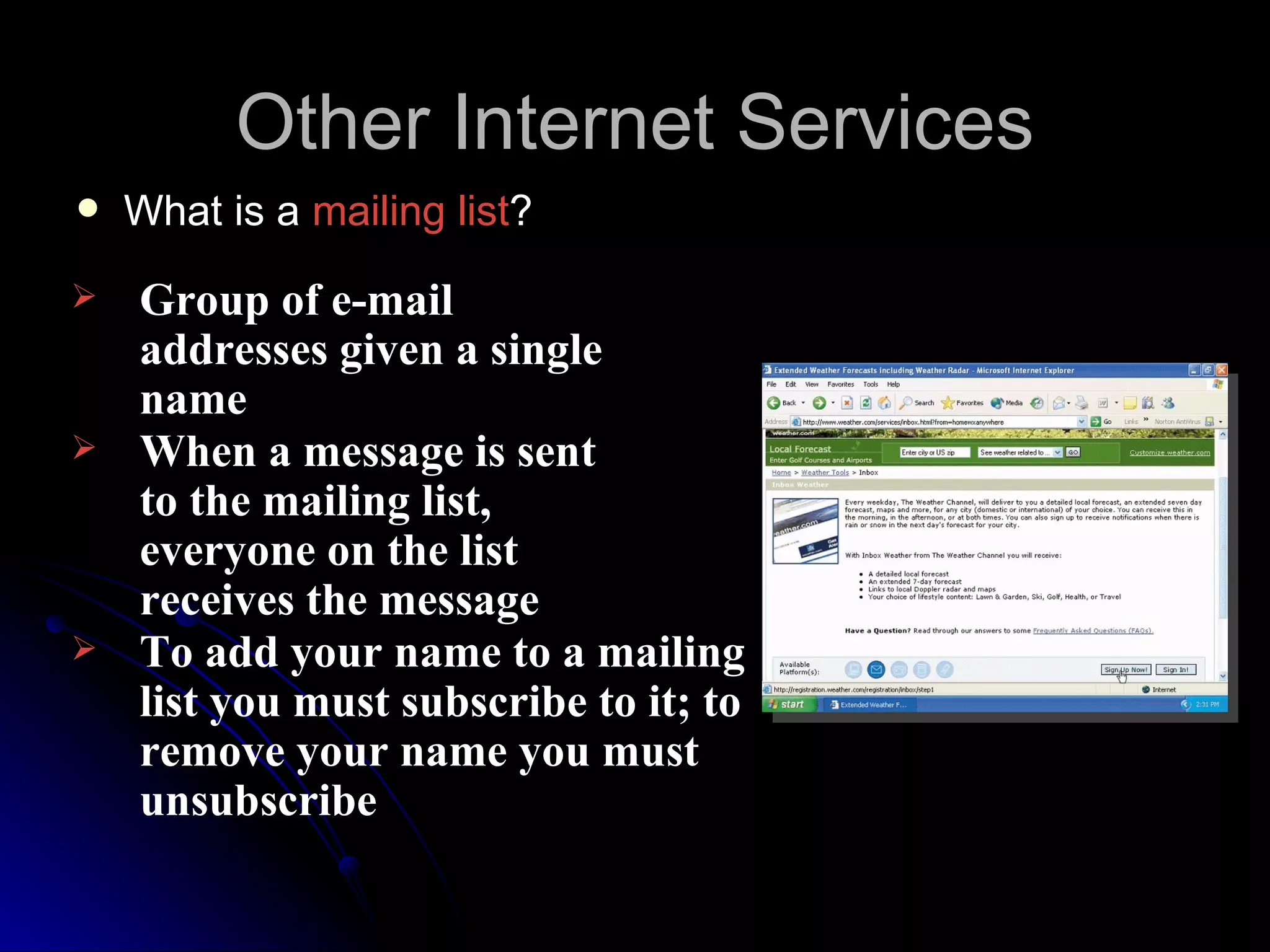
   What is a mailing list?
   Group of e-mail
    addresses given a single
    name
   When a message is sent
    to the mailing list,
    everyone on the list
    receives the message
   To add your name to a mailing
    list you must subscribe to it; to
    remove your name you must
    unsubscribe
Other Internet Services
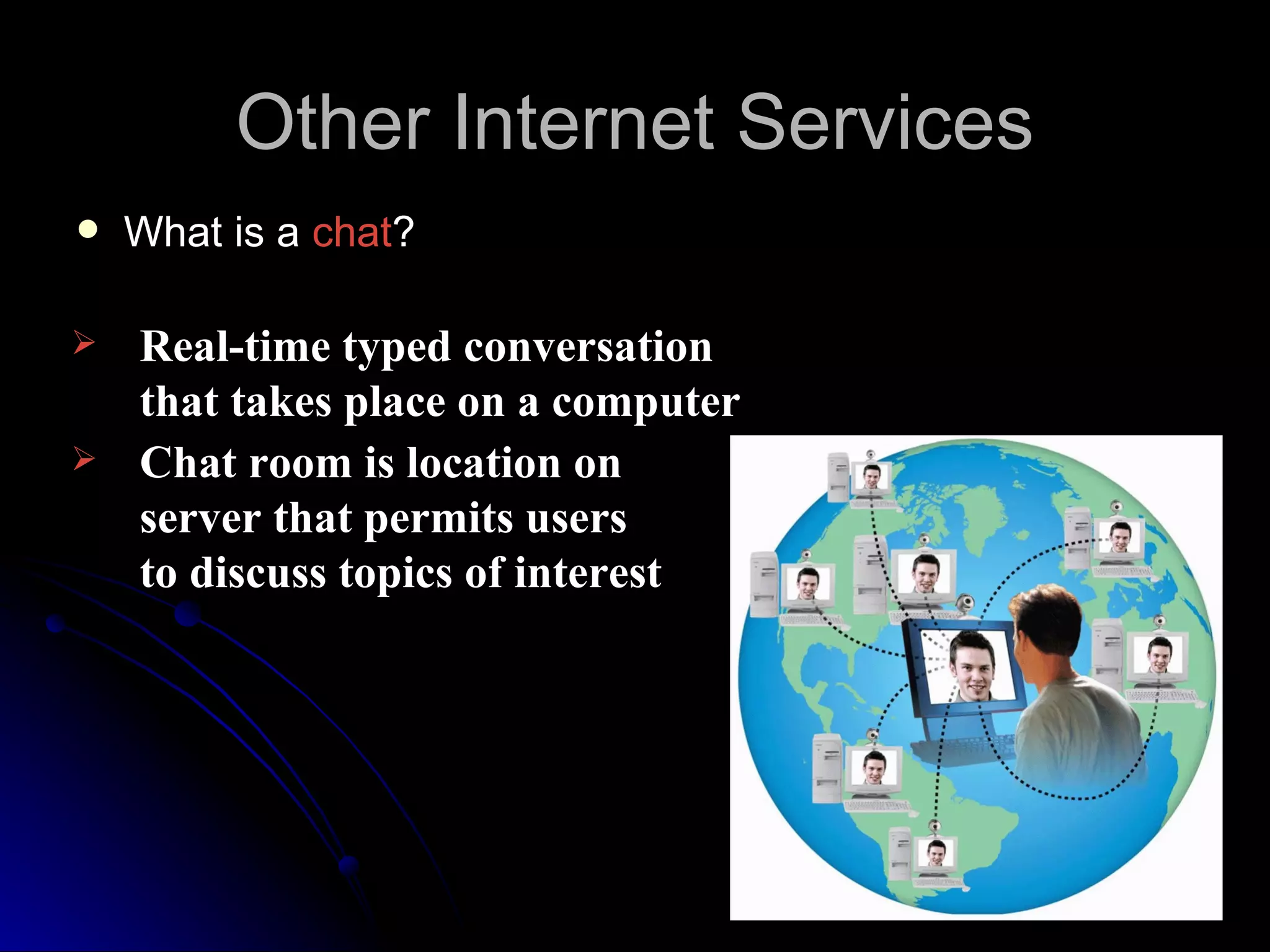
   What is a chat?

   Real-time typed conversation
    that takes place on a computer
   Chat room is location on
    server that permits users
    to discuss topics of interest
Other Internet Services
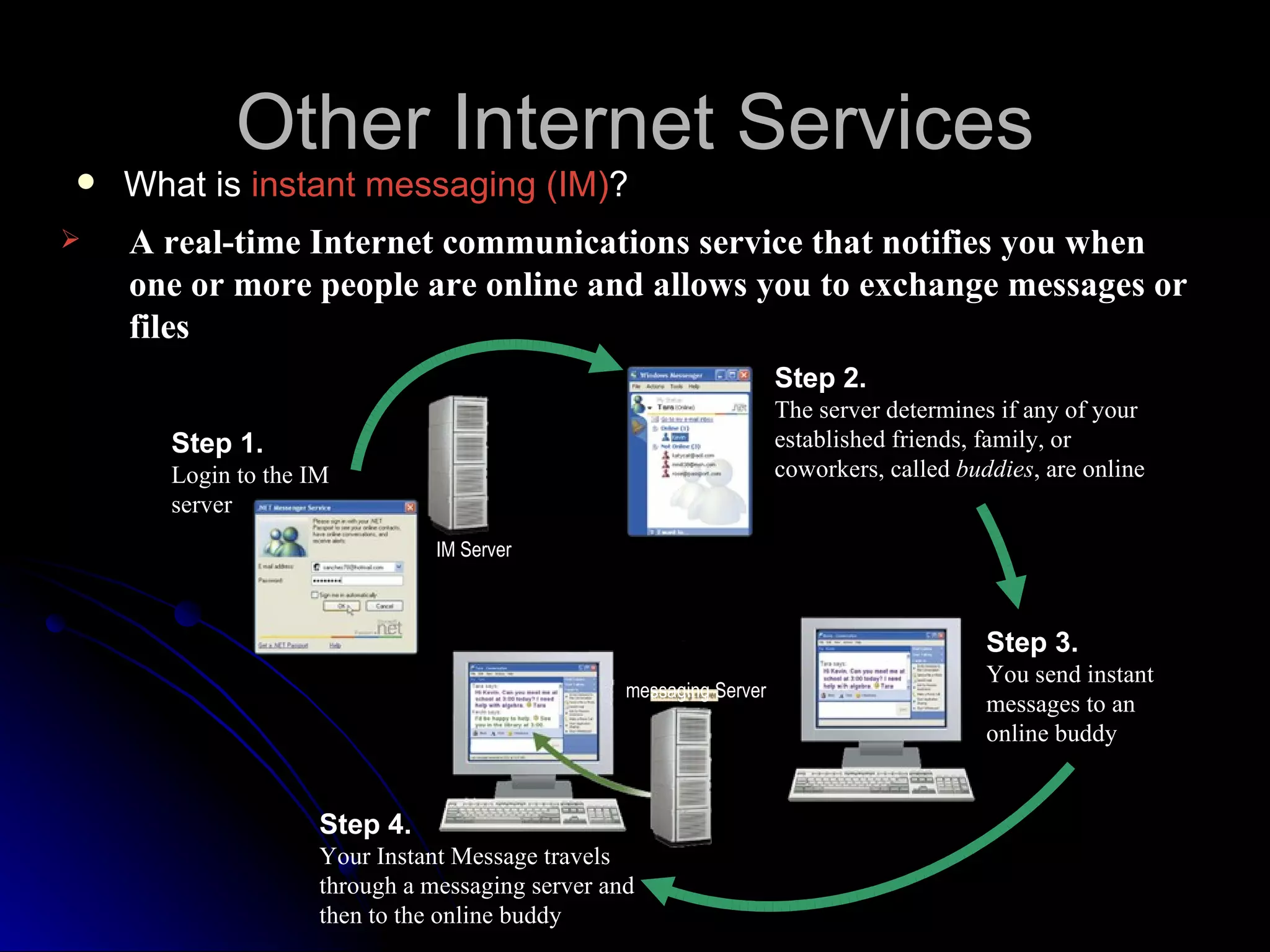
   What is instant messaging (IM)?
   A real-time Internet communications service that notifies you when
    one or more people are online and allows you to exchange messages or
    files
                                                                    Step 2.
                                                                    The server determines if any of your
      Step 1.                                                       established friends, family, or
      Login to the IM                                               coworkers, called buddies, are online
      server
                               IM Server


                                                                                         Step 3.
                                                                                         You send instant
                                                 messaging Server
                                                                                         messages to an
                                                                                         online buddy


                    Step 4.
                    Your Instant Message travels
                    through a messaging server and
                    then to the online buddy
Other Internet Services
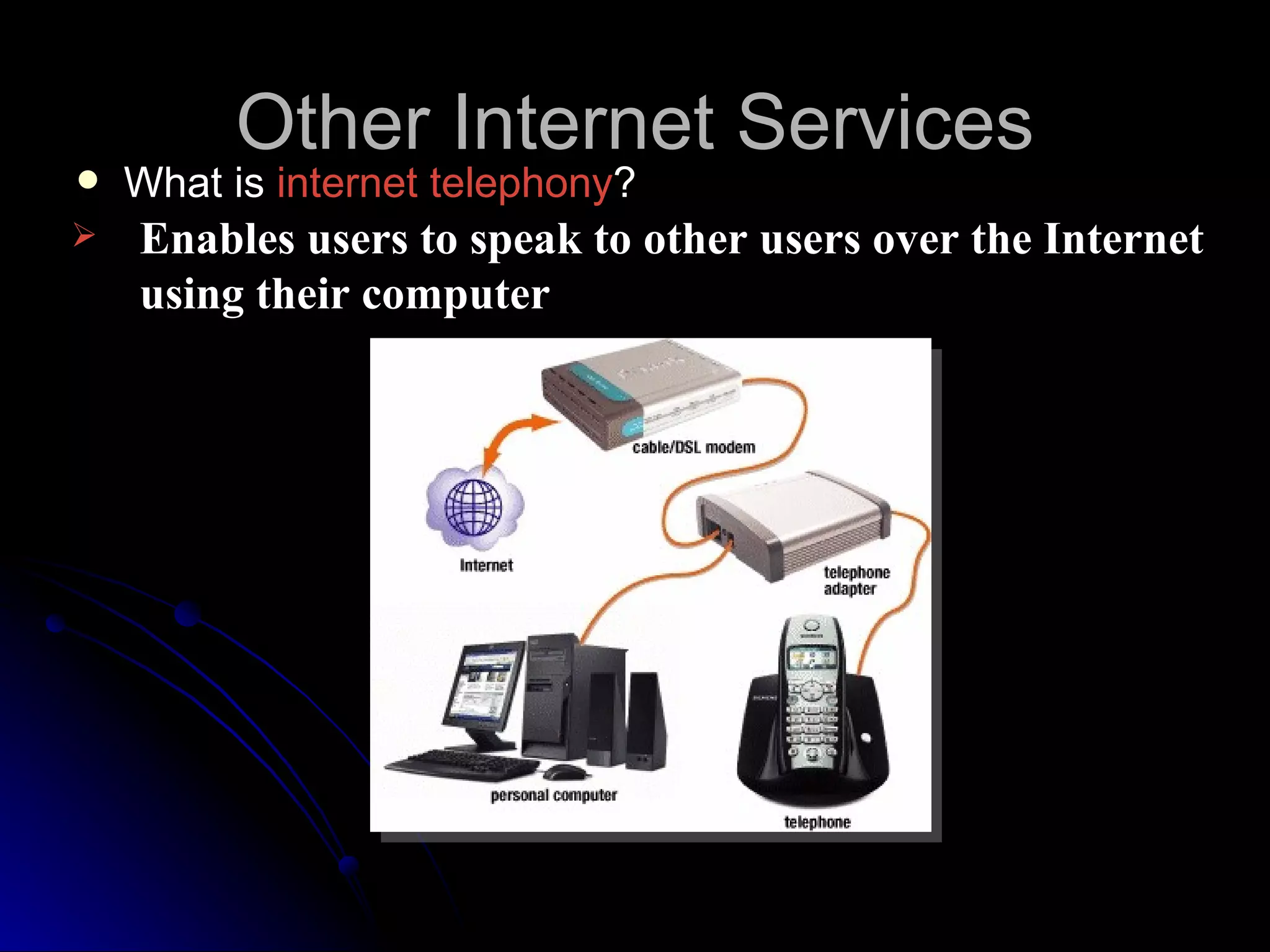
   What is internet telephony?
   Enables users to speak to other users over the Internet
    using their computer
Netiquette
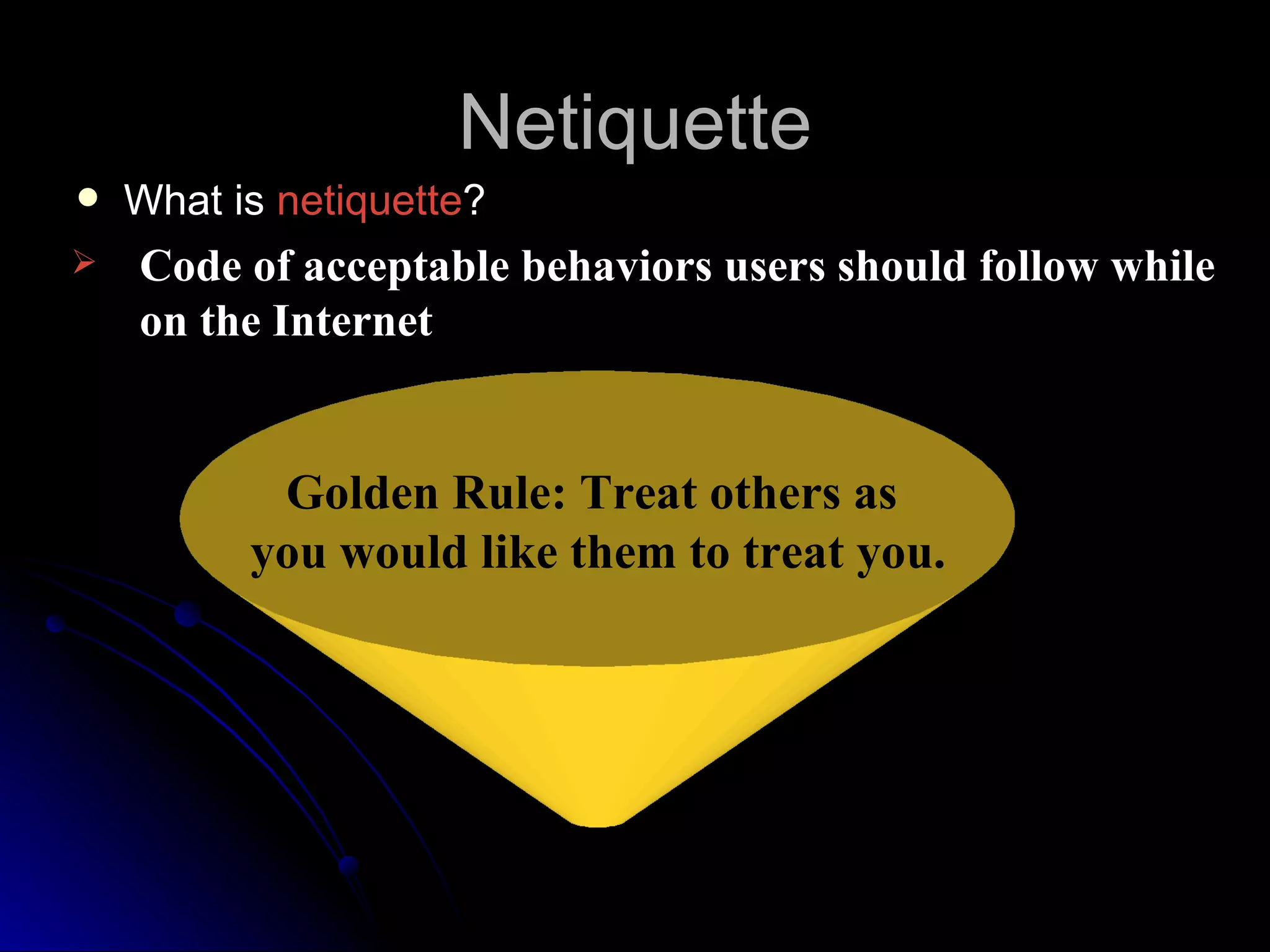
   What is netiquette?
   Code of acceptable behaviors users should follow while
    on the Internet


           Golden Rule: Treat others as
          you would like them to treat you.
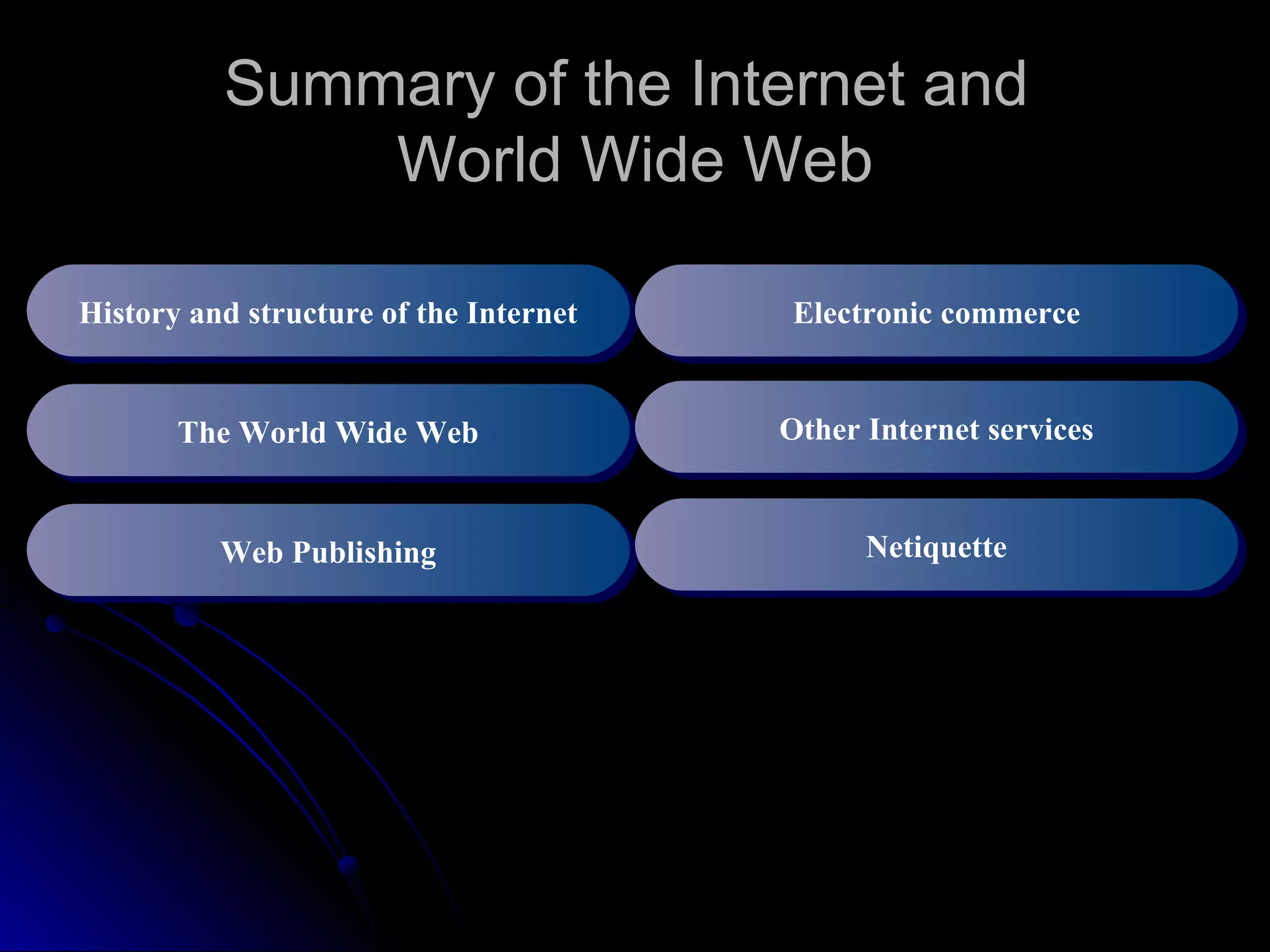
Summary of the Internet and
              World Wide Web

History and structure of the Internet   Electronic commerce


       The World Wide Web               Other Internet services


          Web Publishing                      Netiquette

The internet and WWW

  • 1.
    The Internet and World Wide Web
  • 2.
    Objectives Describe the types of Web sites Discuss the history of the Internet Recognize how Web pages Explain how to access and use graphics, animation, audio, connect to the Internet video, virtual reality, and plug-ins Identify the steps required for Web publishing Analyze an IP address Describe the types of e-commerce Identify the components of a Web address Explain how e-mail, FTP, newsgroups Explain the purpose of a Web browser and message boards, mailing lists, chat rooms, Instant messaging, and Internet telephony work Search for information on the Web Identify the rules of netiquette
  • 3.
    The Internet  What are some services found on the Internet?
  • 4.
    History of theInternet  How did the Internet originate? ARPANET Networking project by Pentagon’s Advanced Research Projects Goal: Agency (ARPA) Goal: To allow scientists To function if at different part of network locations to share were disabled information Became functional September 1969
  • 5.
    History of theInternet  How has the Internet grown? Today More than 200 million host nodes 1984 More than 1,000 host nodes 1969 Four host nodes
  • 6.
    History of theInternet  Who controls the Internet?  No one — it is a public, cooperative, and c c independent network  Several organizations set standards World Wide Web Internet2 (I2) Consortium (W3C)  Internet-related research and development project  Oversees research, sets standards and guidelines  Develops and tests advanced Internet technologies  Tim Berners-Lee, director
  • 7.
    How the InternetWorks  How can you connect to the Internet? Slow-speed High-speed technology connection Dial-up access Digital subscriber line (DSL), modem in your cable telephone Internet computer uses a services (CATV), cable modem, standard telephone line fixed wireless, and satellite modems to connect to the Internet Connection must be established Connection is always on— each time you log on. whenever the computer Slow but inexpensive is running
  • 8.
    Choosing a BroadbandProvider Choose the broadband connection that will best meet your Internet connection needs
  • 9.
    How the InternetWorks  What are ways to access the Internet?  ISP, Regional or National  OSP (AOL and MSN, for example)  Wireless Internet Service Provider
  • 10.
    How the InternetWorks  How might data travel the Internet using a cable modem connection?
  • 11.
    How the InternetWorks  What is a domain name?  Text version of Internet protocol (IP) address  IP address is the number that uniquely identifies each computer or device connected to Internet  the number in each group is between 0 and 255
  • 12.
    The World WideWeb  What is the World Wide Web (WWW)? A worldwide collection of electronic documents Also called the Web Each electronic document is called a Web page Can contain text, graphics, sound, video, and built-in connections A Web site is a collection of related Web pages
  • 13.
    The World WideWeb  What is a Web browser?  Program that allows you to view Web pages Microsoft Internet Explorer Netscape Opera Safari Mozilla
  • 14.
    The World WideWeb  How does a Web browser display a home page? Step 2. If necessary, connect to the Internet Step 1. Click the Web browser program name Step 3. Connection to the Internet occurs, and a home page displays
  • 15.
    The World WideWeb  What is a home page?  The first page that a Web site presents  Often provides connections to other Web pages
  • 16.
    The World WideWeb  How do handheld computers and cellular telephones access the Web?  Use a microbrowser that displays Web pages that contain mostly text  Must be Web-enabled
  • 17.
    The World WideWeb  What is downloading?  The process of a computer receiving information  Depending upon connection speed, downloading can take from a few seconds to several minutes
  • 18.
    The World WideWeb  What is a URL? It stands for Uniform Resource Locator. It is an unique address for a Web page. A web server delivers the Web page to your computer
  • 19.
    The World WideWeb  What is a link?  Built-in connection to another related Web page location  Item found elsewhere on same Web page  Different Web page at same Web site  Web page at a different Web site
  • 20.
    The World WideWeb  How can you recognize links?  Pointer changes to a small hand when you point to link  A link can be text or an image  Text links are usually underlined and in a different color
  • 21.
    The World WideWeb  What is a subject directory?  Search tool with organized set of topics and subtopics  Lets you find information by clicking links rather than entering keywords
  • 22.
    The World WideWeb  What is a search engine?  Program used to find Web sites and Web pages by entering words or phrases called search text  Also called a keyword
  • 23.
    The World WideWeb  What is a hit?  Any Web site name that is listed as the result of a search Step 2. Select type of search you want to run Step 1. Go to search engine Step 3. View hits Step 4. Click link to view Web site
  • 24.
    The World WideWeb  What are the 9 basic types of Web sites?  Portal  News  Informational  Business/Marketing  Educational  Entertainment  Advocacy  Blog  Personal
  • 25.
    The World WideWeb  What is a portal?  A Web site that offers a variety of services from one, convenient location, usually for free  Searching, sports, e-mail, news, weather, auctions, Web communities (Web sites that join people with similar interests)
  • 26.
    The World WideWeb  What is a news Web site?  Contains newsworthy material  Stories and articles relating to current events, life, money, sports, and the weather
  • 27.
    The World WideWeb  What is an informational Web site?  Contains factual information  Created by organizations and government agencies
  • 28.
    The World WideWeb  What is a business/marketing Web site?  Contains content that promotes products or services  Allows you to purchase products or services online
  • 29.
    The World WideWeb  What is an educational Web site?  Offers avenues for formal and informal teaching and learning  Some companies offer online training for employees  Some colleges offer online classes and degrees
  • 30.
    The World WideWeb  What is an entertainment Web site?  Offers an interactive and engaging environment featuring music, video, sports, games, and more
  • 31.
    The World WideWeb  What is an advocacy Web site?  Contains content that describes a cause, opinion, or idea
  • 32.
    The World WideWeb  What is a blog?  Uses a regularly updated journal format to reflect the interests, opinions, and personalities of the author and sometimes site visitors
  • 33.
    The World WideWeb  What is a personal Web site?  Web page maintained by private individual  Reasons: sharing life experience with the world or job hunting
  • 34.
    The World WideWeb  What are the guidelines for evaluating the value of a Web site? Affiliation Audience Authority Content Currency Design Objectivity
  • 35.
    The World WideWeb  What is multimedia?  Application integrating text with other media elements  Graphics  Animation  Audio  Video  Virtual reality
  • 36.
    The World WideWeb  What graphics formats are used on the Web? BMP JPEG PNG (pronounced JAY-peg) (pronounced ping) GIF TIFF (pronounced JIFF)
  • 37.
    The World WideWeb  What is a thumbnail?  Small version of a larger graphic —used to c  Usually clickpage display improve Web time thumbnail to on display larger graphic
  • 38.
    The World WideWeb  What is animation?  Appearance of motion created by displaying a series of still images in sequence
  • 39.
    The World WideWeb  What is audio?  Music, speech, or any other sound  Individual compressed sound files that you download from the Web to your computer  Common Web audio file formats are AA, AAC, AIFF, ASF, MP3, WAV, WMA, RA, and QT  Once downloaded, you can play (listen to) the contents of the files
  • 40.
    The World WideWeb  What is streaming audio? The process of Enables you to transferring audio listen to music in a continuous as it downloads and even flow to your computer
  • 41.
    The World WideWeb  What is video?  Consists of full-motion images that are played back at various speeds  MPEG (Moving Pictures Experts Group) is popular video compression standard
  • 42.
    The World WideWeb  What is virtual reality (VR)?  Use of computers to simulate real or imagined environment  Appears as a three dimensional (3-D) space  Used for games and many practical applications
  • 43.
    The World WideWeb  What are plug-ins?  Programs that extend the capability of a browser  You can download many plug-ins at no cost from various Web sites
  • 44.
    Web Publishing  What is Web publishing?  Development and maintenance of Web pages Step 2. Step 1. Analyze and Plan the design the Web site Web site Step 3. Create the Web site Step 5. Maintain the Web site Step 4. Deploy the Web site
  • 45.
    E-Commerce  What is E-commerce?  Short for electronic commerce  Business transaction that occurs over the Internet Business to consumer (B2C) Sale of goods to general public Consumer to consumer (C2C) One consumer sells directly to another Business to business (B2B) Business providing goods and services to other businesses
  • 46.
    Other Internet Services  What is E-mail?  Short for electronic mail  The transmission of messages and files via a computer network  Messages can consist of simple text or can contain attachments, such as documents, graphics, or audio/video clips  Internet access providers usually provide an e-mail program  Some Web sites—such as MSN Hotmail and Yahoo!—provide free e-mail services  One of the original services on the Internet
  • 47.
    Other Internet Services  How do you send an e-mail message? Step 2. Step 1. Click the New Mail Message button Start an e-mail program (Microsoft Outlook, for example) Step 3. Enter the recipient’s e-mail address, the subject, and the message Step 5. The recipient opens the message Step 4. Click the Insert file button if you want to attach a picture, for example, and click Send
  • 48.
    Other Internet Services  What is an e-mail address?  Unique name that consists of a user name and domain name that identifies the user
  • 49.
    Other Internet Services  How does an e-mail message travel? Step 1. Using e-mail software, you create and send message Step 2. Your software contacts software Step 4. on your ISP’s When recipient uses outgoing mail e-mail software to check server for e-mail messages, the message transfers from incoming mail server to recipient’s computer Step 3. Software on outgoing mail server determines best route for data and sends message, which travels along Internet routers to recipient’s incoming mail server
  • 50.
    Other Internet Services  What is FTP?  File Transfer Protocol—Internet standard that allows you to upload and download files with other computers on the Internet
  • 51.
    Other Internet Services  What are newsgroups and message boards?  Newsgroup  Online area where users discuss a particular subject  Message board  Type of discussion group  Many Web sites use message boards because they are easier to use
  • 52.
    Other Internet Services  What is a mailing list?  Group of e-mail addresses given a single name  When a message is sent to the mailing list, everyone on the list receives the message  To add your name to a mailing list you must subscribe to it; to remove your name you must unsubscribe
  • 53.
    Other Internet Services  What is a chat?  Real-time typed conversation that takes place on a computer  Chat room is location on server that permits users to discuss topics of interest
  • 54.
    Other Internet Services  What is instant messaging (IM)?  A real-time Internet communications service that notifies you when one or more people are online and allows you to exchange messages or files Step 2. The server determines if any of your Step 1. established friends, family, or Login to the IM coworkers, called buddies, are online server IM Server Step 3. You send instant messaging Server messages to an online buddy Step 4. Your Instant Message travels through a messaging server and then to the online buddy
  • 55.
    Other Internet Services  What is internet telephony?  Enables users to speak to other users over the Internet using their computer
  • 56.
    Netiquette  What is netiquette?  Code of acceptable behaviors users should follow while on the Internet Golden Rule: Treat others as you would like them to treat you.
  • 57.
    Summary of theInternet and World Wide Web History and structure of the Internet Electronic commerce The World Wide Web Other Internet services Web Publishing Netiquette