WEB SERVERS

By
- Kuldeep Kulkarni
WHAT ARE WEB SERVERS ?
The software (the computer application) that helps to
deliver content that can be accessed through the
Internet.
•

The most common use of web servers is to host
websites
•

There are other uses such as gaming, data storage or
running enterprise applications.
•

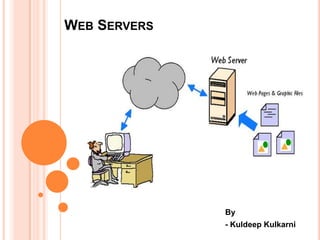
A web server serves web pages to clients across the
Internet or an Intranet. The web server hosts the pages,
scripts, programs, and multimedia files and serves them
using HTTP, a protocol designed to send files to web
browsers and other protocols.
•
EXAMPLE OF WEB SERVERS….
•

Apache HTTP Server

-Developed by Apache software foundation.
- Supports most of the OS like Unix, Linux, Novell
Netware, Windows, Mac OS X, Solaris, and FreeBSD.
•

Microsoft Internet Information Services (IIS)

- Supports only on Windows platform
•

Sun Java System Web Server

- Web Server is designed for medium to large business
applications. Sun Java System Web Server is available
for most operating systems.
HOW IT WORKS ….?
TOMCAT.
Tomcat is an open source web server and servlet
container developed by the Apache Software Foundation
(ASF).
•

•

What is servlet container?

- Servlet container (also known as a Web container) is the
component of a web server that interacts with the servlets.
A web container is responsible for managing the lifecycle
of servlets, mapping a URL to a particular servlet and
ensuring that the URL requester has the correct access
rights
Tomcat implements the Java Servlet and the JavaServer
Pages (JSP) specifications from Oracle Corporation, and
provides a "pure Java" HTTP web server environment for
Java code to run.
•
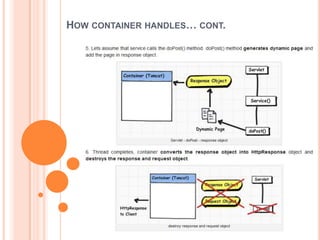
HOW CONTAINER HANDLES THE SERVLET REQ ?
HOW CONTAINER HANDLES… CONT.
COMPONENTS OF TOMCAT….
1.

Catalina

Catalina is Tomcat's servlet container. Catalina
implements Sun Microsystems' specifications for
servlet and JavaServer Pages (JSP). In Tomcat, a
Realm element represents a "database" of usernames,
passwords, and roles (similar to Unix groups)
assigned to those users. Different implementations of
Realm allow Catalina to be integrated into
environments where such authentication information
is already being created and maintained, and then use
that information to implement Container Managed
Security as described in the Servlet Specification. [2]
COMPONENTS CONT….

2. Coyote
Coyote is Tomcat's HTTP Connector component
that supports the HTTP 1.1 protocol for the web
server or application container. Coyote listens for
incoming connections on a specific TCP port on
the server and forwards the request to the Tomcat
Engine to process the request and send back a
response to the requesting client.
COMPONENTS CONT….

3. Jasper

Jasper is Tomcat's JSP Engine. Tomcat 5.x uses
Jasper 2, which is an implementation of the Sun
Microsystems's JavaServer Pages 2.0 specification.
Jasper parses JSP files to compile them into Java
code as servlets (that can be handled by Catalina). At
runtime, Jasper detects changes to JSP files and
recompiles them
TOMCAT VS. APACHE
•

The Apache Web server

-

Is faster than tomcat when it comes to static pages.

-

Is more configurable than tomcat

-

Is more robust than tomcat and

-

It supports CGI scripts, Server API modules, Perl,
PHP etc.

•

Hence for world’s web sites apache would generally
be a better choice than Tomcat, except that…

•

In itself, Apache doesn’t support Servlets or
JavaServer Pages !
TOMCAT VS. APACHE…CONT.
•The

solution of course is to allow the two
Webservers to work together.
•The

Apache server will be the principal server,
dealing with static documents
•Apache

will forward requests for Servlets or Javaserver pages to tomcat
HOW TO CONFIGURE TOMCAT ?

•LINUX

http://www.youtube.com/watch?v=jWDmG3JnNLE

•WINDOWS

http://www.youtube.com/watch?v=IX8xb-suzVg
THANK YOU !

•

I hope this was informative 

QUESTIONS …..?

Web servers

  • 1.
  • 2.
    WHAT ARE WEBSERVERS ? The software (the computer application) that helps to deliver content that can be accessed through the Internet. • The most common use of web servers is to host websites • There are other uses such as gaming, data storage or running enterprise applications. • A web server serves web pages to clients across the Internet or an Intranet. The web server hosts the pages, scripts, programs, and multimedia files and serves them using HTTP, a protocol designed to send files to web browsers and other protocols. •
  • 3.
    EXAMPLE OF WEBSERVERS…. • Apache HTTP Server -Developed by Apache software foundation. - Supports most of the OS like Unix, Linux, Novell Netware, Windows, Mac OS X, Solaris, and FreeBSD. • Microsoft Internet Information Services (IIS) - Supports only on Windows platform • Sun Java System Web Server - Web Server is designed for medium to large business applications. Sun Java System Web Server is available for most operating systems.
  • 4.
  • 5.
    TOMCAT. Tomcat is anopen source web server and servlet container developed by the Apache Software Foundation (ASF). • • What is servlet container? - Servlet container (also known as a Web container) is the component of a web server that interacts with the servlets. A web container is responsible for managing the lifecycle of servlets, mapping a URL to a particular servlet and ensuring that the URL requester has the correct access rights Tomcat implements the Java Servlet and the JavaServer Pages (JSP) specifications from Oracle Corporation, and provides a "pure Java" HTTP web server environment for Java code to run. •
  • 6.
    HOW CONTAINER HANDLESTHE SERVLET REQ ?
  • 7.
  • 8.
  • 9.
    COMPONENTS OF TOMCAT…. 1. Catalina Catalinais Tomcat's servlet container. Catalina implements Sun Microsystems' specifications for servlet and JavaServer Pages (JSP). In Tomcat, a Realm element represents a "database" of usernames, passwords, and roles (similar to Unix groups) assigned to those users. Different implementations of Realm allow Catalina to be integrated into environments where such authentication information is already being created and maintained, and then use that information to implement Container Managed Security as described in the Servlet Specification. [2]
  • 10.
    COMPONENTS CONT…. 2. Coyote Coyoteis Tomcat's HTTP Connector component that supports the HTTP 1.1 protocol for the web server or application container. Coyote listens for incoming connections on a specific TCP port on the server and forwards the request to the Tomcat Engine to process the request and send back a response to the requesting client.
  • 11.
    COMPONENTS CONT…. 3. Jasper Jasperis Tomcat's JSP Engine. Tomcat 5.x uses Jasper 2, which is an implementation of the Sun Microsystems's JavaServer Pages 2.0 specification. Jasper parses JSP files to compile them into Java code as servlets (that can be handled by Catalina). At runtime, Jasper detects changes to JSP files and recompiles them
  • 12.
    TOMCAT VS. APACHE • TheApache Web server - Is faster than tomcat when it comes to static pages. - Is more configurable than tomcat - Is more robust than tomcat and - It supports CGI scripts, Server API modules, Perl, PHP etc. • Hence for world’s web sites apache would generally be a better choice than Tomcat, except that… • In itself, Apache doesn’t support Servlets or JavaServer Pages !
  • 13.
    TOMCAT VS. APACHE…CONT. •The solutionof course is to allow the two Webservers to work together. •The Apache server will be the principal server, dealing with static documents •Apache will forward requests for Servlets or Javaserver pages to tomcat
  • 14.
    HOW TO CONFIGURETOMCAT ? •LINUX http://www.youtube.com/watch?v=jWDmG3JnNLE •WINDOWS http://www.youtube.com/watch?v=IX8xb-suzVg
  • 15.
    THANK YOU ! • Ihope this was informative  QUESTIONS …..?