-
- By Varsha Kumari
Assistant Professor
CEA Department, GLA University Mathura
Web technology
Markup and Scripting Languages
Course outlines
Web Technology is Set of technologies
used to create web application and
make the web pages interactive, and
more powerful.
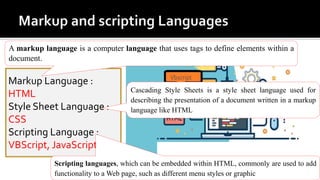
Markup Language :
HTML
Style Sheet Language :
CSS
Scripting Language :
VBScript, JavaScript
A markup language is a computer language that uses tags to define elements within a
document.
Scripting languages, which can be embedded within HTML, commonly are used to add
functionality to a Web page, such as different menu styles or graphic
Cascading Style Sheets is a style sheet language used for
describing the presentation of a document written in a markup
language like HTML
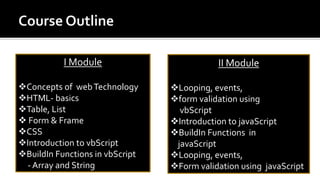
I Module
Concepts of webTechnology
HTML- basics
Table, List
 Form & Frame
CSS
Introduction to vbScript
BuildIn Functions in vbScript
- Array and String
II Module
Looping, events,
form validation using
vbScript
Introduction to javaScript
BuildIn Functions in
javaScript
Looping, events,
Form validation using javaScript
 Web history
 www
 internet, URL , HTTP
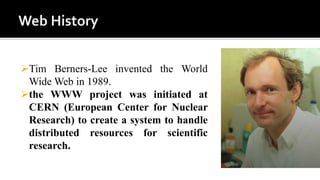
Tim Berners-Lee invented the World
Wide Web in 1989.
the WWW project was initiated at
CERN (European Center for Nuclear
Research) to create a system to handle
distributed resources for scientific
research.
WWW :World WideWeb or web
WWW is a framework for accessing linked
documents spread out over millions of machines
all over the Internet. The WWW has a unique
combination of flexibility, portability, and user-
friendly features.
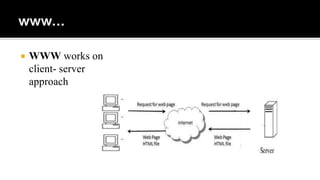
 WWW works on
client- server
approach
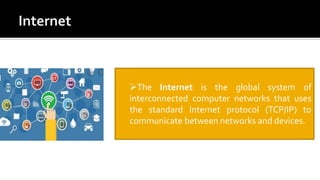
The Internet is the global system of
interconnected computer networks that uses
the standard Internet protocol (TCP/IP) to
communicate between networks and devices.
 Developed in 60s and 70s by US Department of Defense
 called ARPANET
 90s: network : known as Internet.
 Internet and Web is not the same thing: Web uses internet to
pass over the information.
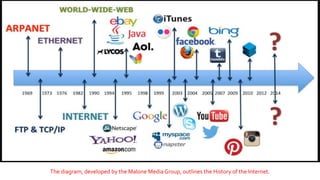
The diagram, developed by the Malone Media Group, outlines the History of the Internet.
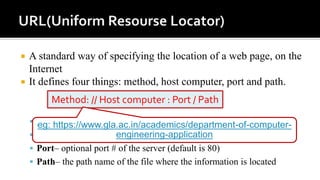
 A standard way of specifying the location of a web page, on the
Internet
 It defines four things: method, host computer, port and path.
 Method – protocol used to retrieve the document like HTTP.
 Host– a computer where the information is located.
 Port– optional port # of the server (default is 80)
 Path– the path name of the file where the information is located
Method: // Host computer : Port / Path
eg: https://www.gla.ac.in/academics/department-of-computer-
engineering-application
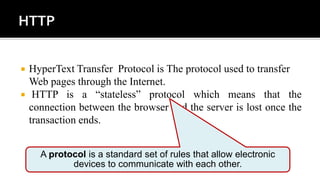
 HyperText Transfer Protocol is The protocol used to transfer
Web pages through the Internet.
 HTTP is a “stateless” protocol which means that the
connection between the browser and the server is lost once the
transaction ends.
A protocol is a standard set of rules that allow electronic
devices to communicate with each other.
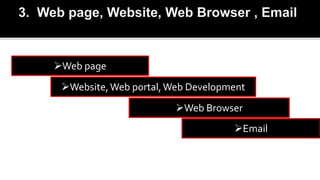
Web page
Website,Web portal,Web Development
Web Browser
Email
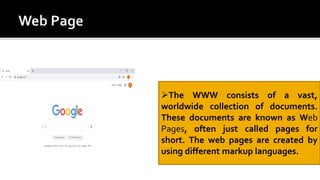
The WWW consists of a vast,
worldwide collection of documents.
These documents are known as Web
Pages, often just called pages for
short. The web pages are created by
using different markup languages.
 Static web page are fixed content documents that are created
and stored in a server. The contents in the server can be
changed, but the user cannot change it.
 Dynamic web page shows different information at different
point of time a fresh document is created for each request, the
contents of a dynamic document can vary from one request to
another.
 A website is a collection of web pages and related content that
is identified by a common domain name and published on at
least one web server. Notable examples are
 Example: gla.ac.in, wikipedia.org, google.com, and
amazon.com.
 a website is a location on the internet that is unique and which
is accessed via a web browser using a specific URL (web
address). Portals are also accessed via a web browser and
specific URL, but content is login protected and user-specific.
 Example:
 gla.ac.in is a website while
 glauniversity.in:8085 is web portal
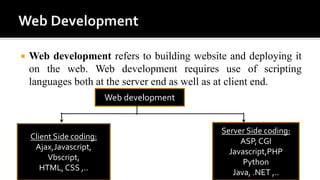
 Web development refers to building website and deploying it
on the web. Web development requires use of scripting
languages both at the server end as well as at client end.
Client Side coding:
Ajax,Javascript,
Vbscript,
HTML, CSS ,..
Server Side coding:
ASP, CGI
Javascript,PHP
Python
Java, .NET ,..
Web development
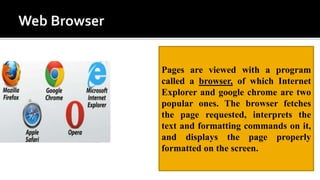
Pages are viewed with a program
called a browser, of which Internet
Explorer and google chrome are two
popular ones. The browser fetches
the page requested, interprets the
text and formatting commands on it,
and displays the page properly
formatted on the screen.
Electronic mail (email or e-mail) is a method
of exchanging messages ("mail") between people
using electronic devices
Each user of email is assigned a unique
name(E-mail address) for his email account.
Email message components:
E-mail Header: From, Date, To, Subject, CC, BCC
E-mail Body: Greeting , Text and Signature
Introduction to web technology

Introduction to web technology

  • 2.
    - - By VarshaKumari Assistant Professor CEA Department, GLA University Mathura
  • 3.
    Web technology Markup andScripting Languages Course outlines
  • 4.
    Web Technology isSet of technologies used to create web application and make the web pages interactive, and more powerful.
  • 5.
    Markup Language : HTML StyleSheet Language : CSS Scripting Language : VBScript, JavaScript A markup language is a computer language that uses tags to define elements within a document. Scripting languages, which can be embedded within HTML, commonly are used to add functionality to a Web page, such as different menu styles or graphic Cascading Style Sheets is a style sheet language used for describing the presentation of a document written in a markup language like HTML
  • 6.
    I Module Concepts ofwebTechnology HTML- basics Table, List  Form & Frame CSS Introduction to vbScript BuildIn Functions in vbScript - Array and String II Module Looping, events, form validation using vbScript Introduction to javaScript BuildIn Functions in javaScript Looping, events, Form validation using javaScript
  • 7.
     Web history www  internet, URL , HTTP
  • 8.
    Tim Berners-Lee inventedthe World Wide Web in 1989. the WWW project was initiated at CERN (European Center for Nuclear Research) to create a system to handle distributed resources for scientific research.
  • 9.
    WWW :World WideWebor web WWW is a framework for accessing linked documents spread out over millions of machines all over the Internet. The WWW has a unique combination of flexibility, portability, and user- friendly features.
  • 10.
     WWW workson client- server approach
  • 11.
    The Internet isthe global system of interconnected computer networks that uses the standard Internet protocol (TCP/IP) to communicate between networks and devices.
  • 12.
     Developed in60s and 70s by US Department of Defense  called ARPANET  90s: network : known as Internet.  Internet and Web is not the same thing: Web uses internet to pass over the information.
  • 13.
    The diagram, developedby the Malone Media Group, outlines the History of the Internet.
  • 14.
     A standardway of specifying the location of a web page, on the Internet  It defines four things: method, host computer, port and path.  Method – protocol used to retrieve the document like HTTP.  Host– a computer where the information is located.  Port– optional port # of the server (default is 80)  Path– the path name of the file where the information is located Method: // Host computer : Port / Path eg: https://www.gla.ac.in/academics/department-of-computer- engineering-application
  • 15.
     HyperText TransferProtocol is The protocol used to transfer Web pages through the Internet.  HTTP is a “stateless” protocol which means that the connection between the browser and the server is lost once the transaction ends. A protocol is a standard set of rules that allow electronic devices to communicate with each other.
  • 16.
    Web page Website,Web portal,WebDevelopment Web Browser Email
  • 17.
    The WWW consistsof a vast, worldwide collection of documents. These documents are known as Web Pages, often just called pages for short. The web pages are created by using different markup languages.
  • 18.
     Static webpage are fixed content documents that are created and stored in a server. The contents in the server can be changed, but the user cannot change it.  Dynamic web page shows different information at different point of time a fresh document is created for each request, the contents of a dynamic document can vary from one request to another.
  • 19.
     A websiteis a collection of web pages and related content that is identified by a common domain name and published on at least one web server. Notable examples are  Example: gla.ac.in, wikipedia.org, google.com, and amazon.com.
  • 20.
     a websiteis a location on the internet that is unique and which is accessed via a web browser using a specific URL (web address). Portals are also accessed via a web browser and specific URL, but content is login protected and user-specific.  Example:  gla.ac.in is a website while  glauniversity.in:8085 is web portal
  • 21.
     Web developmentrefers to building website and deploying it on the web. Web development requires use of scripting languages both at the server end as well as at client end. Client Side coding: Ajax,Javascript, Vbscript, HTML, CSS ,.. Server Side coding: ASP, CGI Javascript,PHP Python Java, .NET ,.. Web development
  • 22.
    Pages are viewedwith a program called a browser, of which Internet Explorer and google chrome are two popular ones. The browser fetches the page requested, interprets the text and formatting commands on it, and displays the page properly formatted on the screen.
  • 23.
    Electronic mail (emailor e-mail) is a method of exchanging messages ("mail") between people using electronic devices Each user of email is assigned a unique name(E-mail address) for his email account.
  • 24.
    Email message components: E-mailHeader: From, Date, To, Subject, CC, BCC E-mail Body: Greeting , Text and Signature