Client/Server ComputingClient/Server Computing
A simple definition
A simple definition of CS is
“ server software accepts requests for data
from client software and returns the
results to the client”
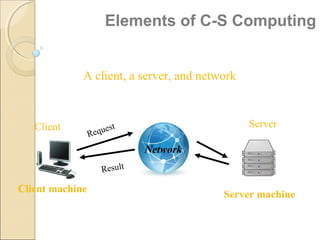
Network
Request
Result
Elements of C-S Computing
A client, a server, and network
Client Server
Client machine
Server machine
Where Operations are DoneWhere Operations are Done
In CS Relationship “most of the
application processing is done on a
computer (client side), which obtains
application services (such as
database services) from another
computer (server side) in a master
slave configuration
CS-Focus is on
In client-server computing major
focus is on SOFTWARE
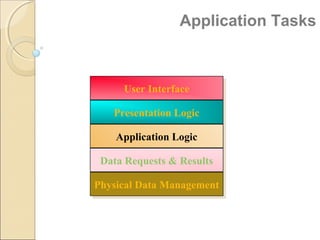
Application Tasks
User InterfaceUser Interface
Presentation LogicPresentation Logic
Application LogicApplication Logic
Data Requests & ResultsData Requests & Results
Physical Data ManagementPhysical Data Management
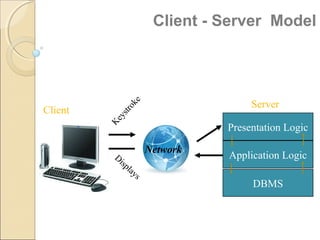
Presentation Logic
Application Logic
DBMS
Client
Server
Network
K
eystroke
Displays
Client - Server Model
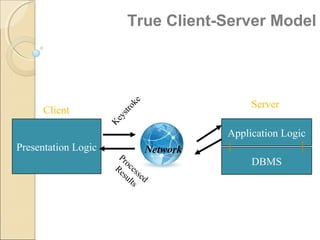
True Client-Server Model
Presentation Logic
Client
Server
Network
K
eystroke
Processed
Results
Application Logic
DBMS
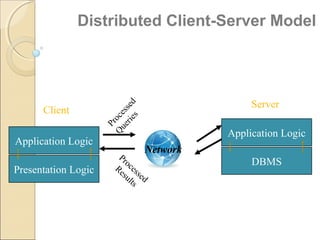
Distributed Client-Server Model
Client
Server
Network
Processed
Q
ueries
Processed
Results
Application Logic
DBMS
Application Logic
Presentation Logic
Client-server computing is distributed access,Client-server computing is distributed access,
not a distributed computing.not a distributed computing.
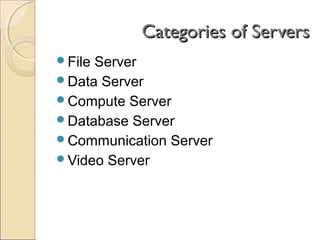
Categories of ServersCategories of Servers
File Server
Data Server
Compute Server
Database Server
Communication Server
Video Server
File ServerFile Server
File Servers manage a work group’s
application and data files, so that they may
be shared by the group.
Very I/O oriented
Pull large amount of data off the storage
subsystem and pass the data over the
network
Requires many slots for network
connections and a large-capacity, fast
hard disk subsystem.
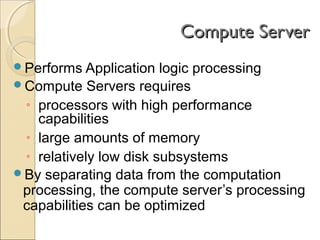
Compute ServerCompute Server
Performs Application logic processing
Compute Servers requires
◦ processors with high performance
capabilities
◦ large amounts of memory
◦ relatively low disk subsystems
By separating data from the computation
processing, the compute server’s processing
capabilities can be optimized
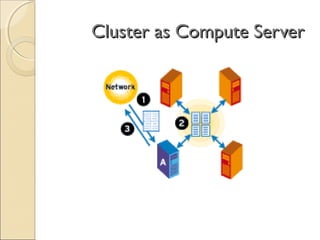
Cluster as Compute ServerCluster as Compute Server
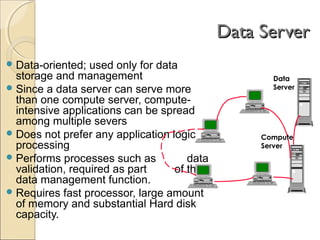
Data ServerData Server
Data-oriented; used only for data
storage and management
Since a data server can serve more
than one compute server, compute-
intensive applications can be spread
among multiple severs
Does not prefer any application logic
processing
Performs processes such as data
validation, required as part of the
data management function.
Requires fast processor, large amount
of memory and substantial Hard disk
capacity.
Data
Server
Compute
Server
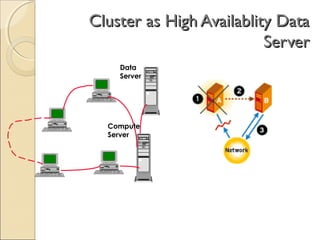
Cluster as High Availablity DataCluster as High Availablity Data
ServerServer
Data
Server
Compute
Server
Database ServerDatabase Server
Most typical use of technology in client-server
Accepts requests for data, retrieves the data from
its database(or requests data from another
node)and passes the results back.
Compute server with data server provides the
same functionality.
The server requirement depends on the size of
database, speed with which the database must be
updated, number of users and type of network
used.
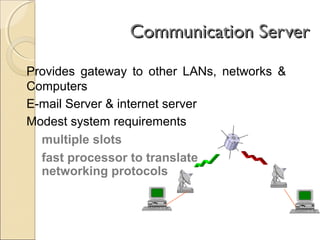
Communication ServerCommunication Server
Provides gateway to other LANs, networks &
Computers
E-mail Server & internet server
Modest system requirements
multiple slots
fast processor to translate
networking protocols
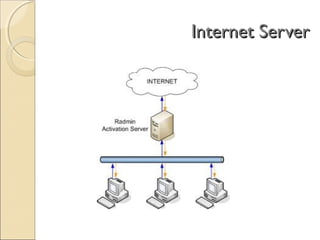
Internet ServerInternet Server
THANKYOUTHANKYOU

Client-Server Computing