The internet has been around for a while
but the World Wide Web (WWW) is
relatively new. It is based upon hypertext–
The concept of documents being linked to
one another in relevant places. The ideas
behind hypertext were around in the early
80s but began to form into reality in 1989.
At the time, Sir Timothy John Berners-Lee
from the European Laboratory for Particle
Physics wrote a paper titled “Information
Management: A Proposal”. In the following
years he began working on a hypertext
browser/editor.
 The World Wide Web (WWW)is a
 repository of information linked
 together from points all over the
 world. The WWW has a unique
 combination of flexibility, portability
 and user-friendly features that
 distinguish it from other services
 provided by the internet.
 The World Wide Web (WWW) is most
  often called Web.
 The Web is a network of computers all
  over the world.
 All the computers in the web can
  communicate with each other.
 All the computers use a communication
  standard called HTTP.
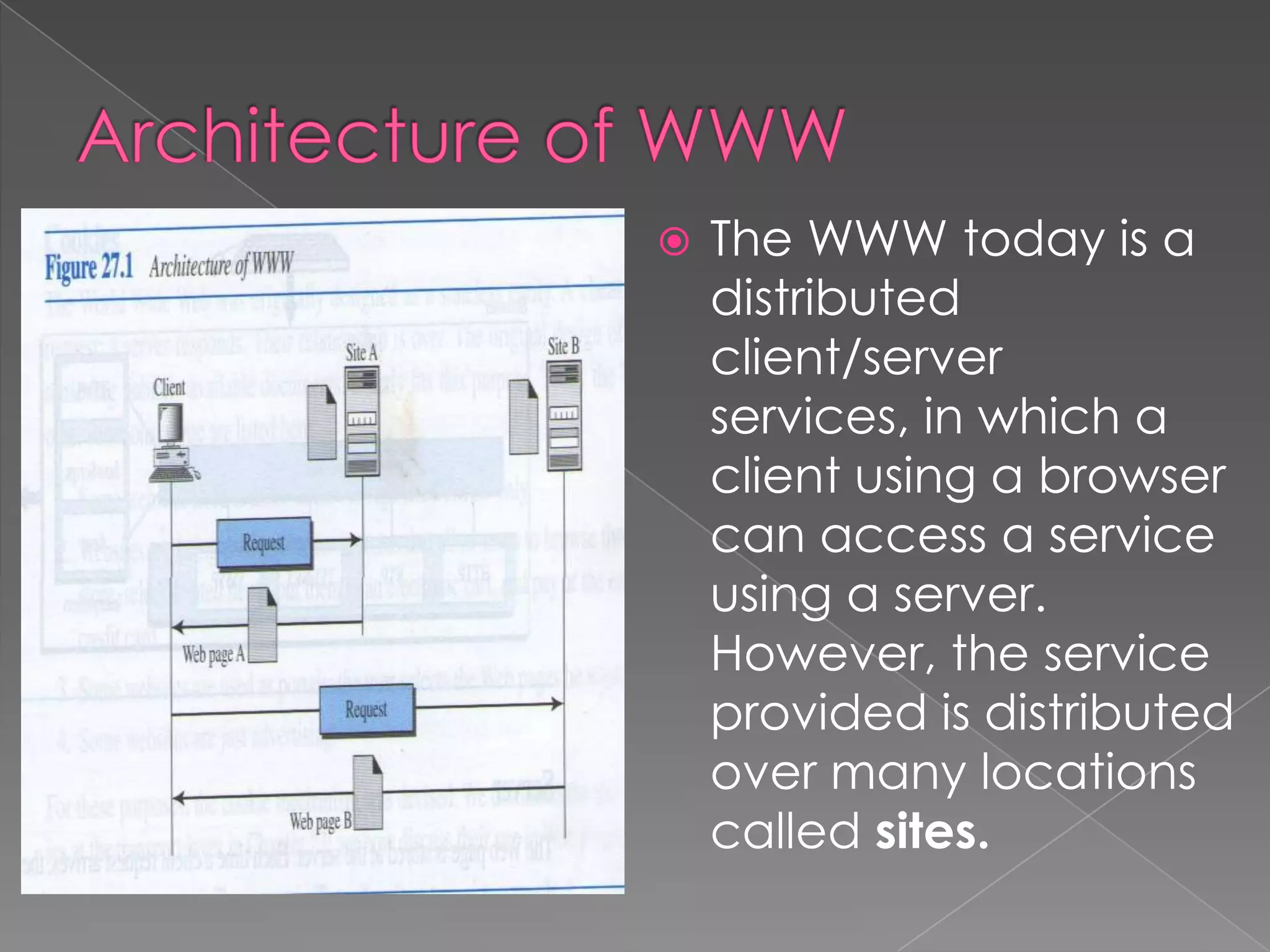
   The WWW today is a
    distributed
    client/server
    services, in which a
    client using a browser
    can access a service
    using a server.
    However, the service
    provided is distributed
    over many locations
    called sites.
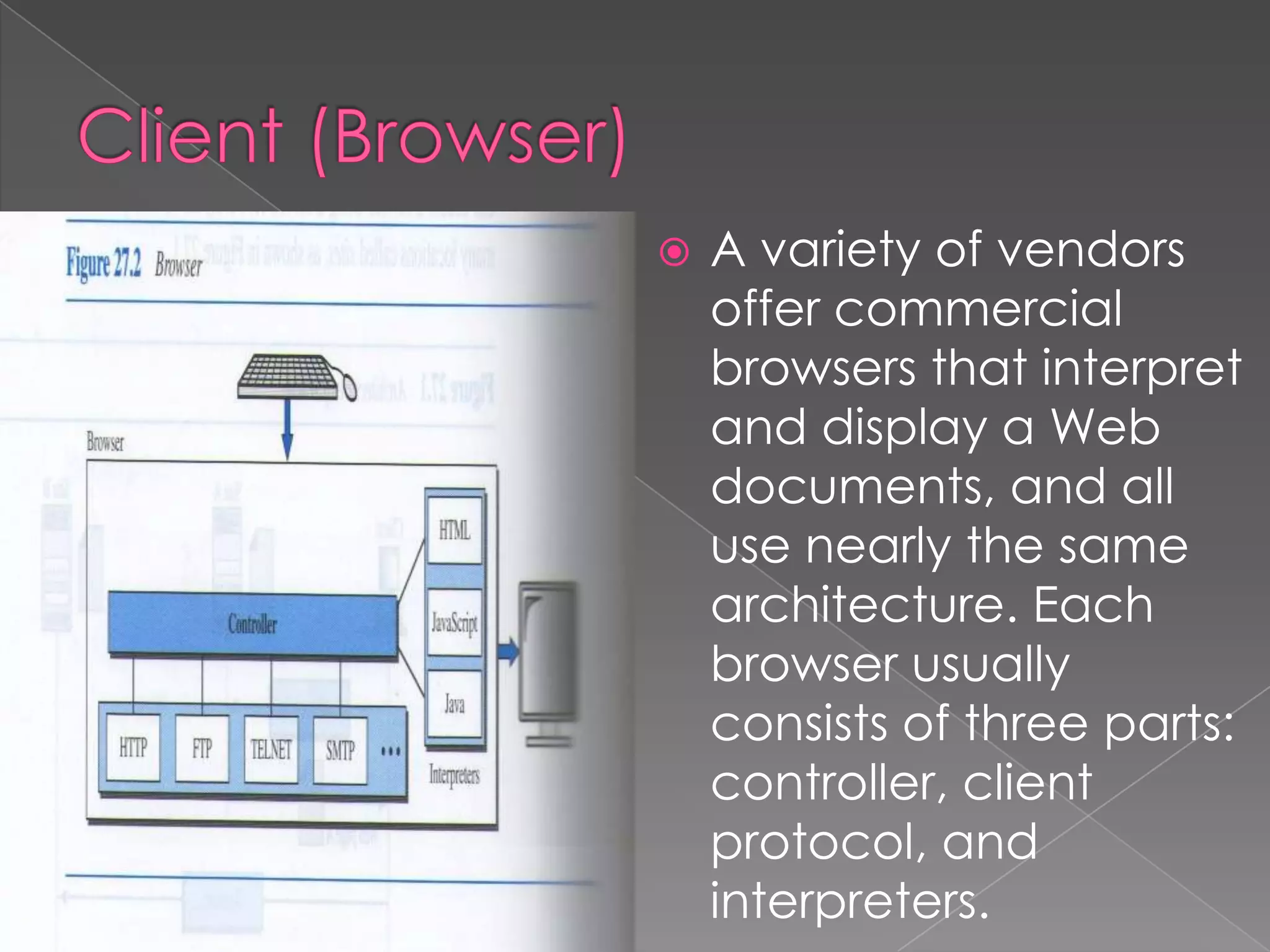
   A variety of vendors
    offer commercial
    browsers that interpret
    and display a Web
    documents, and all
    use nearly the same
    architecture. Each
    browser usually
    consists of three parts:
    controller, client
    protocol, and
    interpreters.
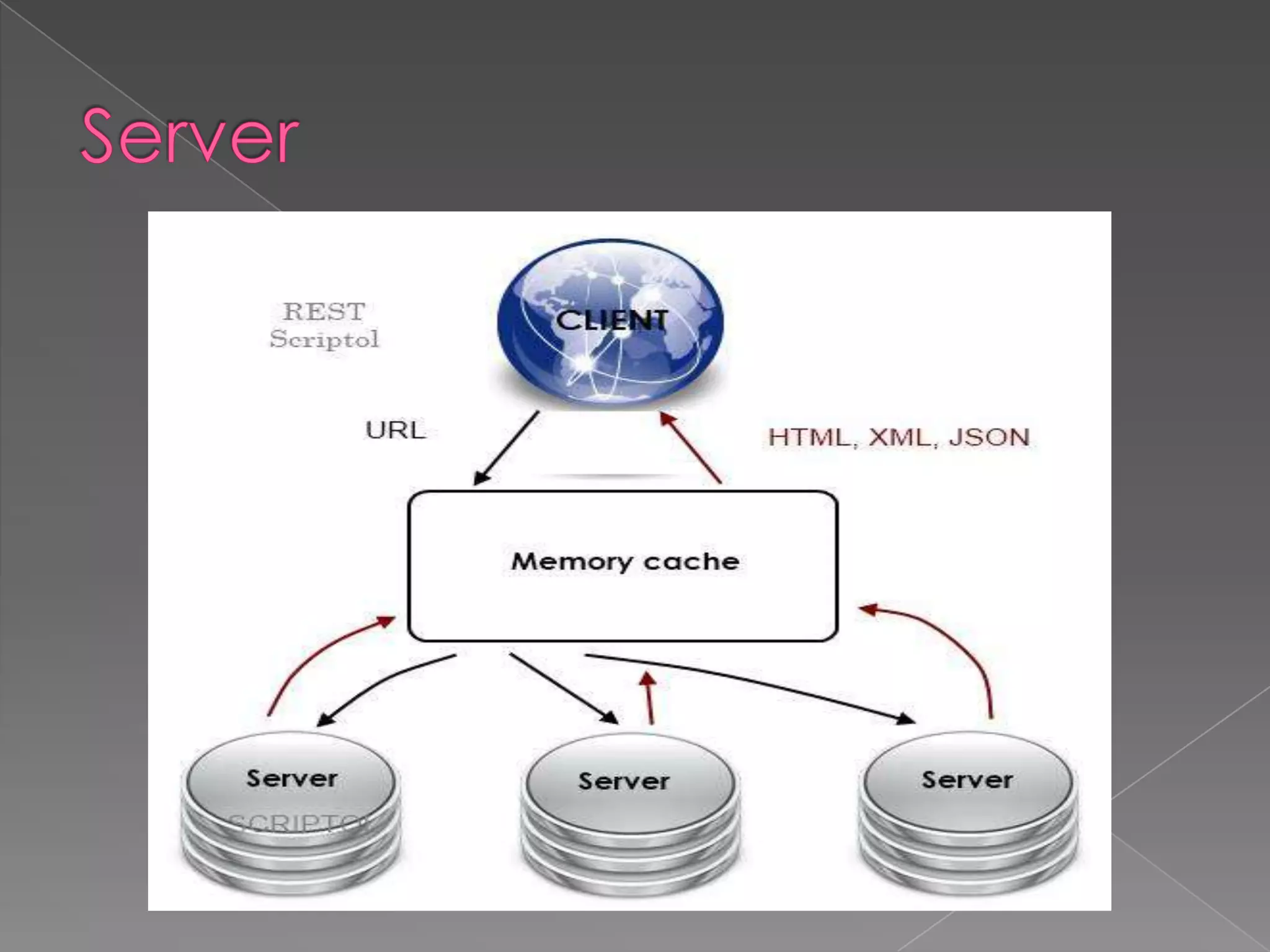
   The web page is stored at the server. Each
    time a client request arrives, the
    corresponding documents is sent to the
    client. To improve efficiency, servers
    normally store requested file in the cache in
    memory; memory is faster to access than
    disk. A server can also become more
    efficient through multithreading or
    multiprocessing. In this case, a server can
    answer more than one request at a time.
 The Uniform Resource Locator
 (URL) is a standard for specifying
 any kind of information on the
 internet. The URL defines four-
 things: protocol, host
 computer, port and path.
   The documents in the WWW can be
    grouped into three broad categories:
    Static, Dynamic and Active Documents.
    The category is based on the time at
    which the contents of the documents
    are determined.
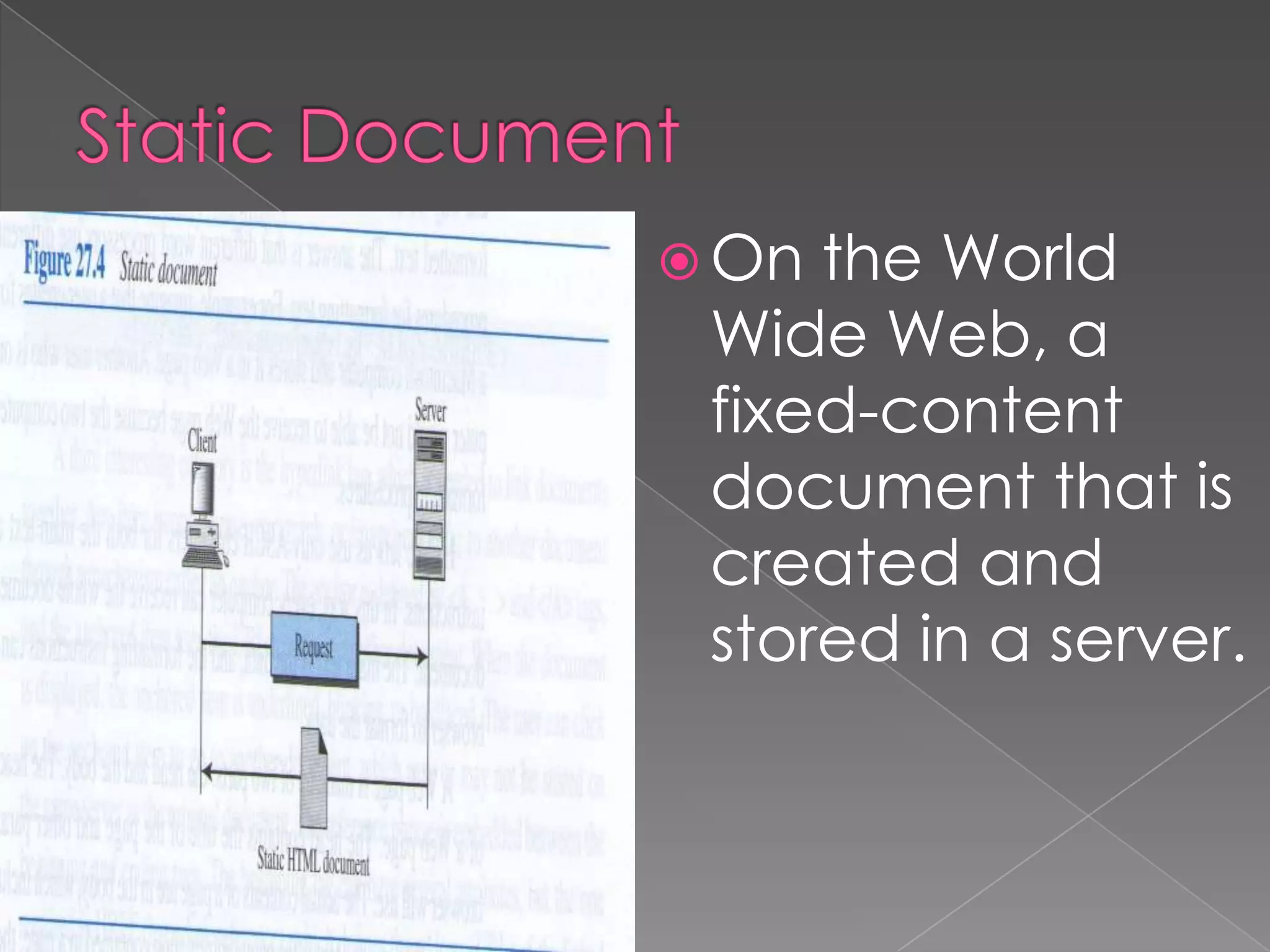
 On the World
 Wide Web, a
 fixed-content
 document that is
 created and
 stored in a server.
   HTML is a language for creating Web
    page. The term markup language
    comes from the books publishing
    industry. Before a book is type-set and
    printed, a copy editor reads the
    manuscript and puts mark on it. These
    marks tell the compositor how to format
    the text .
 HTML stands for Hyper Text Markup
  Language.
 HTML is not a programming language, it
  is a markup language.
 A markup language is a set of markup
  tags.
 HTML uses markup tags to describe web
  pages.
 HTML tags are keywords surrounded by
  angle brackets like <html>.
 HTML tags normally come in pairs like
  <b> and </b>.
 The first tag in a pair is the start tag, the
  second tag is the end tag.
 Start and end tags are also called
  opening tags and closing tags.
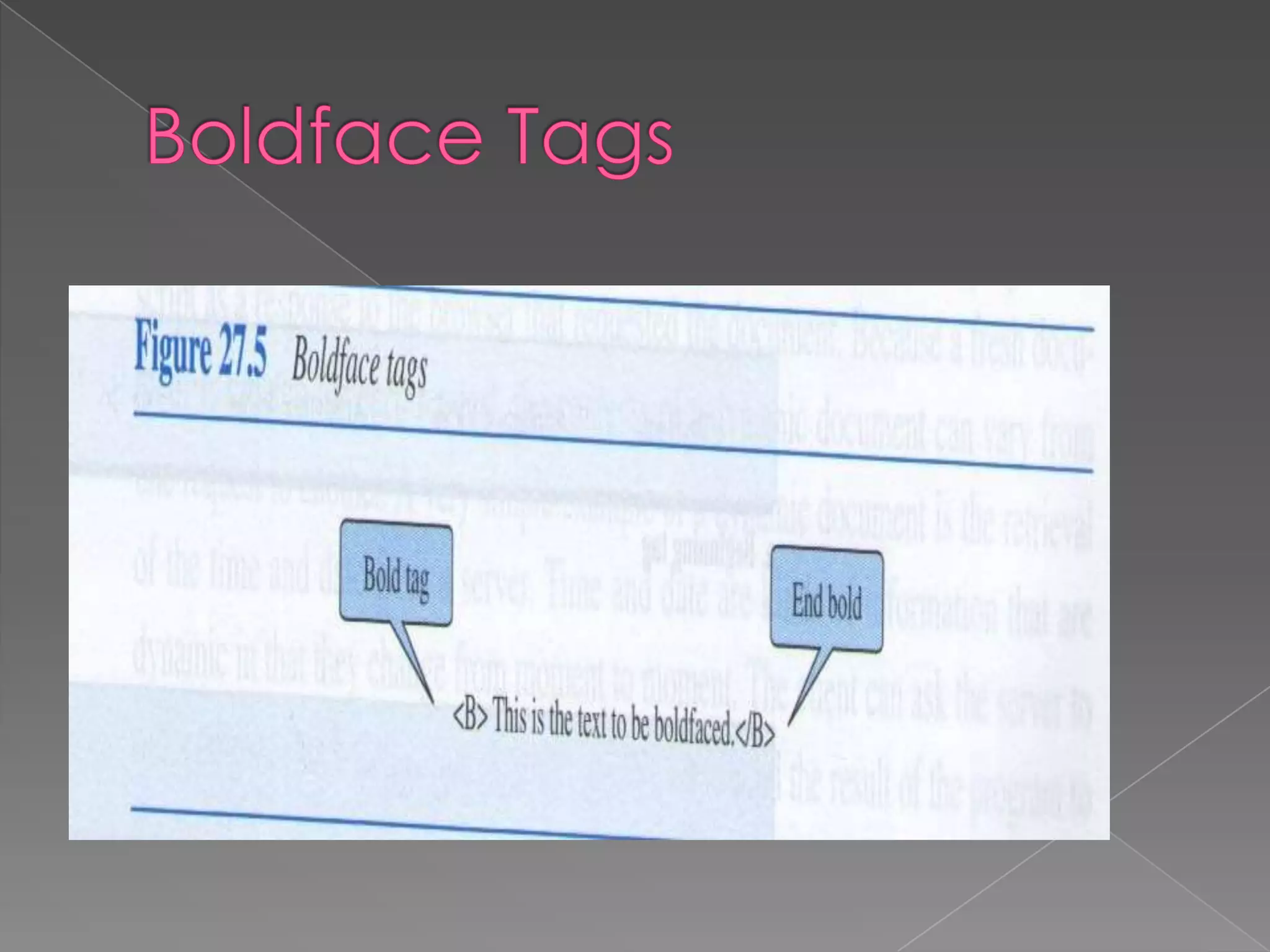
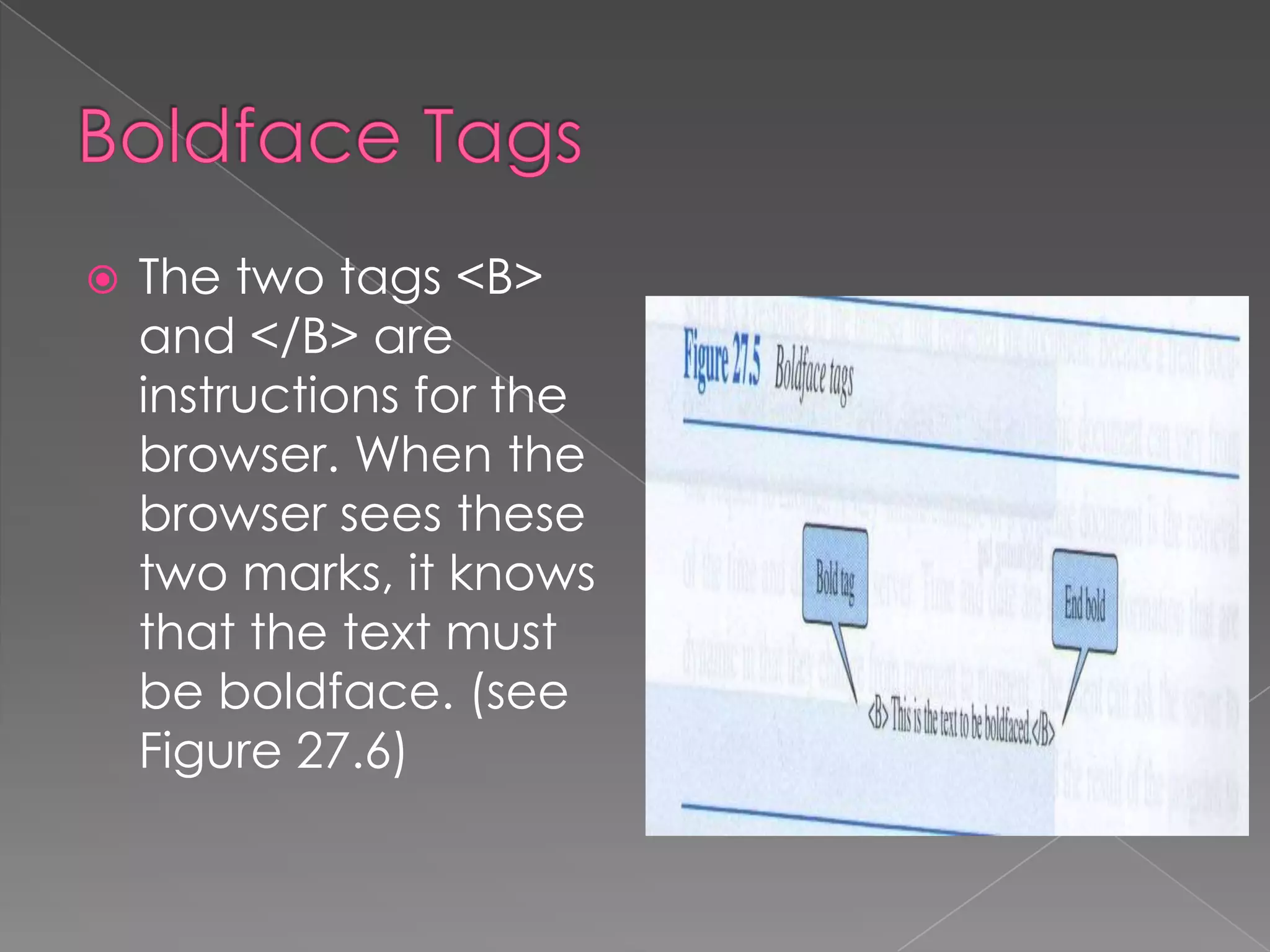
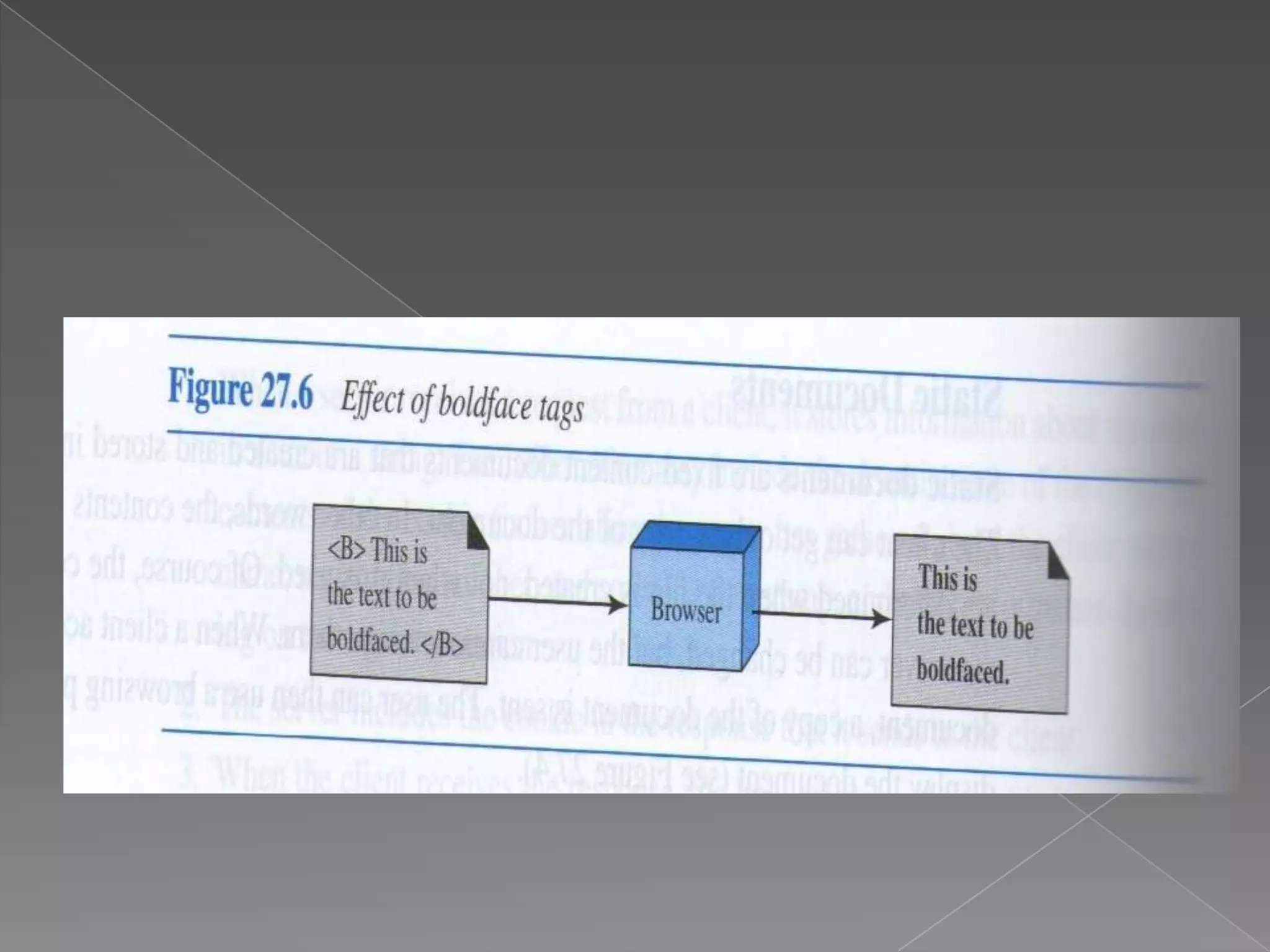
   The two tags <B>
    and </B> are
    instructions for the
    browser. When the
    browser sees these
    two marks, it knows
    that the text must
    be boldface. (see
    Figure 27.6)
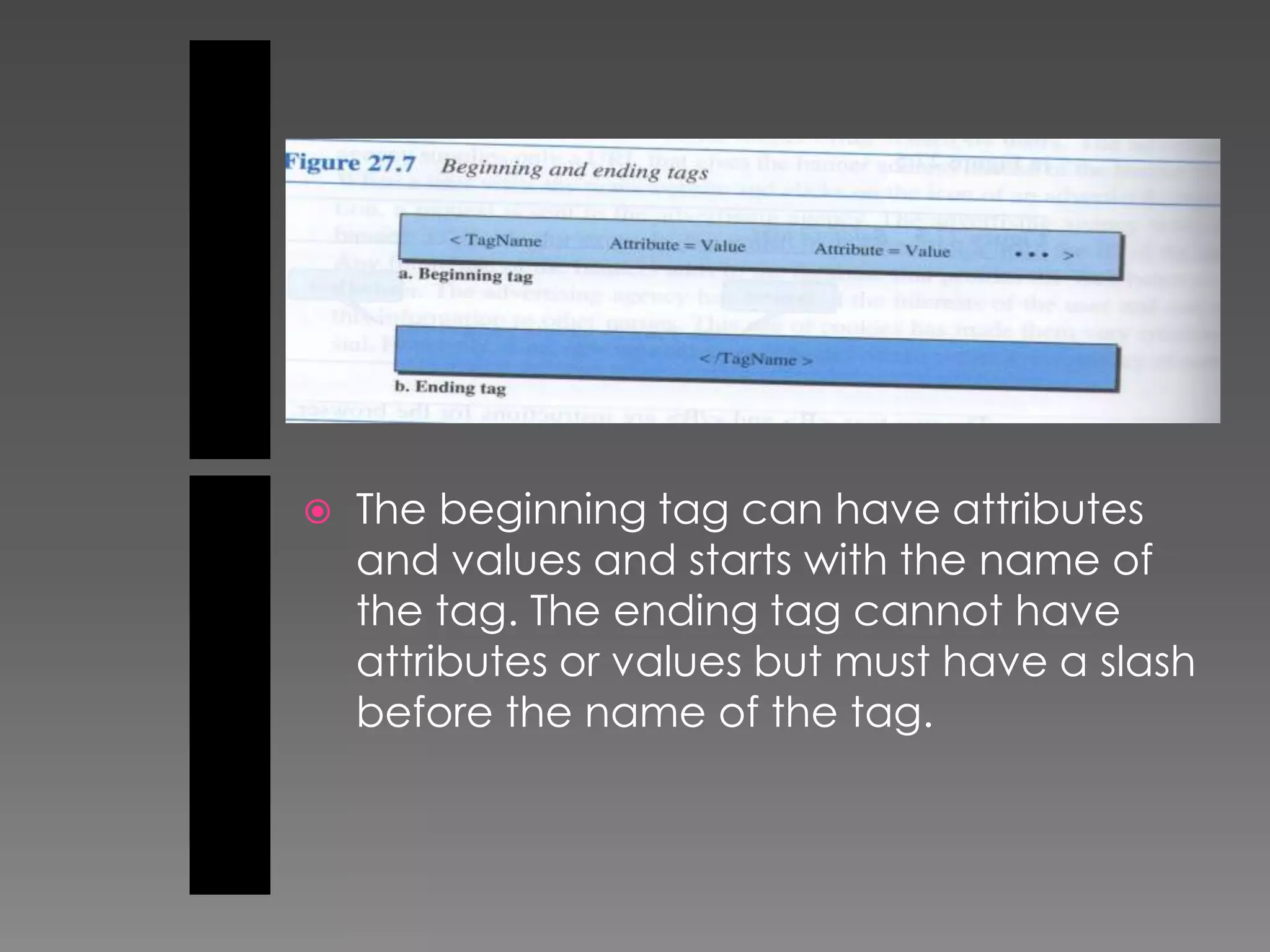
   The beginning tag can have attributes
    and values and starts with the name of
    the tag. The ending tag cannot have
    attributes or values but must have a slash
    before the name of the tag.
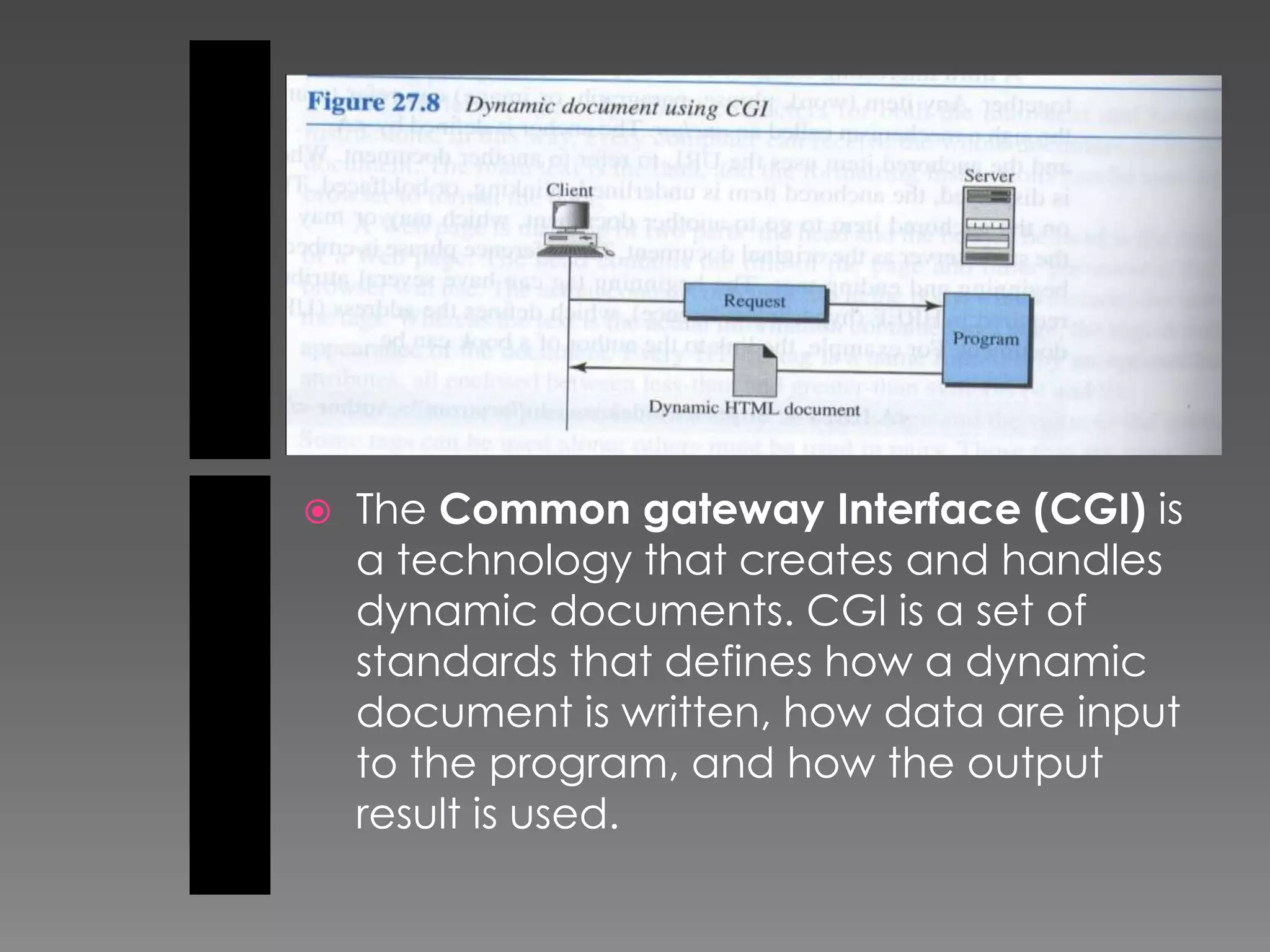
   A Web document created by running a
    CGI program at the server site.
   The Common gateway Interface (CGI) is
    a technology that creates and handles
    dynamic documents. CGI is a set of
    standards that defines how a dynamic
    document is written, how data are input
    to the program, and how the output
    result is used.
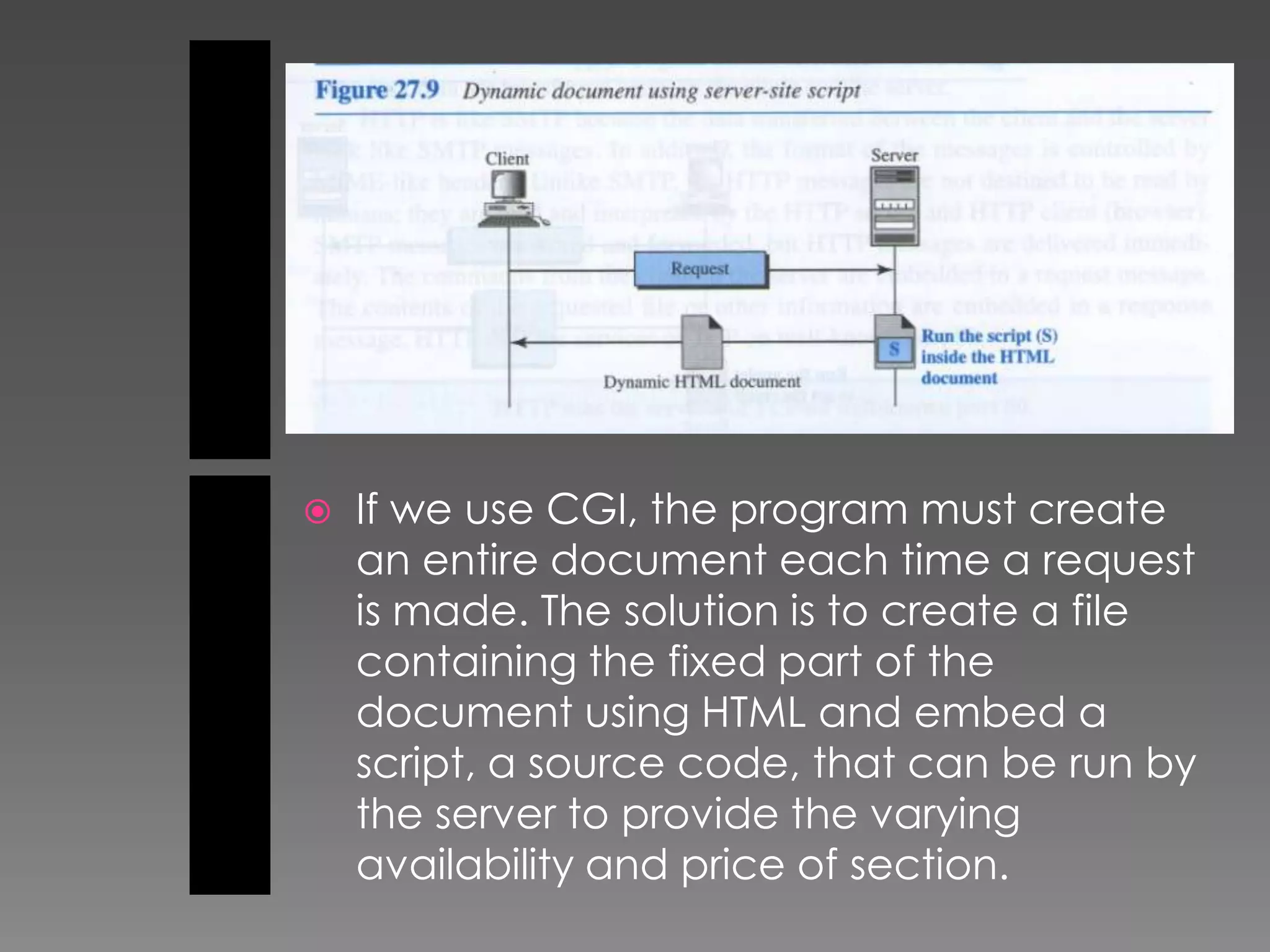
   If we use CGI, the program must create
    an entire document each time a request
    is made. The solution is to create a file
    containing the fixed part of the
    document using HTML and embed a
    script, a source code, that can be run by
    the server to provide the varying
    availability and price of section.
 For
    many applications, we need a
 program or a script to be run at
 the client site. These are called
 active documents.
   One way to create an active document
    is to use Java applets. Java is a
    combination of a high-level programming
    language, a run-time environment, and a
    class library that allows a programmer to
    write an active document (an applet)
    and a browser to run it.
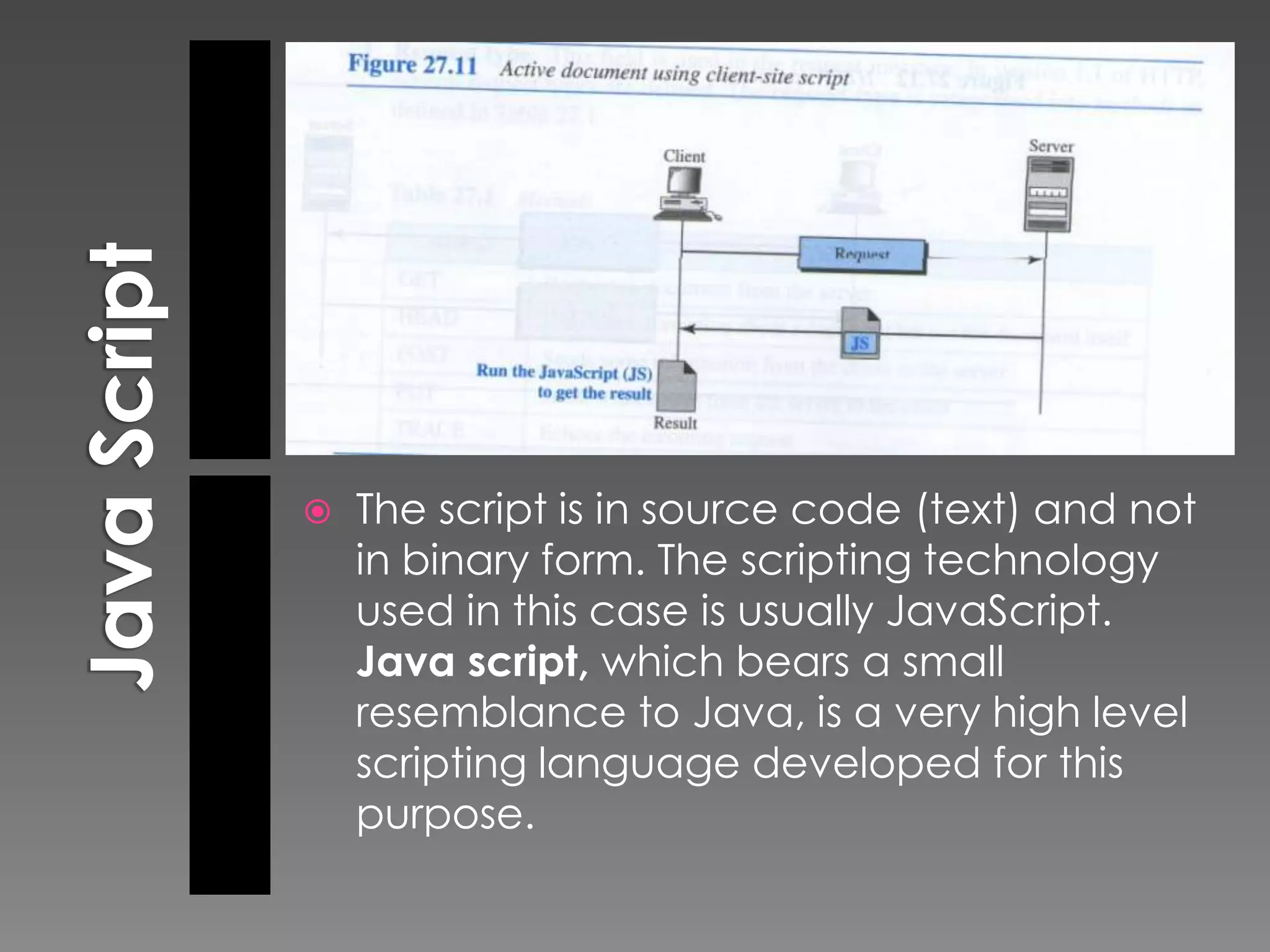
   The script is in source code (text) and not
    in binary form. The scripting technology
    used in this case is usually JavaScript.
    Java script, which bears a small
    resemblance to Java, is a very high level
    scripting language developed for this
    purpose.
   The Hypertext Transfer Protocol (HTTP) is a
    protocol used mainly to access data on
    World Wide Web. HTTP functions as a
    combination of FTP and SMTP. It is similar
    to FTP because it transfers files and uses
    the services of TCP.
   Although HTTP uses the services of
    TCP, HTTP itself is a stateless protocol. The
    client initializes the transaction by sending
    a request message. The server replies by
    sending a response.
Www(alyssa) (2)

Www(alyssa) (2)

  • 3.
    The internet hasbeen around for a while but the World Wide Web (WWW) is relatively new. It is based upon hypertext– The concept of documents being linked to one another in relevant places. The ideas behind hypertext were around in the early 80s but began to form into reality in 1989. At the time, Sir Timothy John Berners-Lee from the European Laboratory for Particle Physics wrote a paper titled “Information Management: A Proposal”. In the following years he began working on a hypertext browser/editor.
  • 4.
     The WorldWide Web (WWW)is a repository of information linked together from points all over the world. The WWW has a unique combination of flexibility, portability and user-friendly features that distinguish it from other services provided by the internet.
  • 5.
     The WorldWide Web (WWW) is most often called Web.  The Web is a network of computers all over the world.  All the computers in the web can communicate with each other.  All the computers use a communication standard called HTTP.
  • 6.
    The WWW today is a distributed client/server services, in which a client using a browser can access a service using a server. However, the service provided is distributed over many locations called sites.
  • 7.
    A variety of vendors offer commercial browsers that interpret and display a Web documents, and all use nearly the same architecture. Each browser usually consists of three parts: controller, client protocol, and interpreters.
  • 9.
    The web page is stored at the server. Each time a client request arrives, the corresponding documents is sent to the client. To improve efficiency, servers normally store requested file in the cache in memory; memory is faster to access than disk. A server can also become more efficient through multithreading or multiprocessing. In this case, a server can answer more than one request at a time.
  • 11.
     The UniformResource Locator (URL) is a standard for specifying any kind of information on the internet. The URL defines four- things: protocol, host computer, port and path.
  • 12.
    The documents in the WWW can be grouped into three broad categories: Static, Dynamic and Active Documents. The category is based on the time at which the contents of the documents are determined.
  • 13.
     On theWorld Wide Web, a fixed-content document that is created and stored in a server.
  • 14.
    HTML is a language for creating Web page. The term markup language comes from the books publishing industry. Before a book is type-set and printed, a copy editor reads the manuscript and puts mark on it. These marks tell the compositor how to format the text .
  • 15.
     HTML standsfor Hyper Text Markup Language.  HTML is not a programming language, it is a markup language.  A markup language is a set of markup tags.  HTML uses markup tags to describe web pages.
  • 16.
     HTML tagsare keywords surrounded by angle brackets like <html>.  HTML tags normally come in pairs like <b> and </b>.  The first tag in a pair is the start tag, the second tag is the end tag.  Start and end tags are also called opening tags and closing tags.
  • 18.
    The two tags <B> and </B> are instructions for the browser. When the browser sees these two marks, it knows that the text must be boldface. (see Figure 27.6)
  • 20.
    The beginning tag can have attributes and values and starts with the name of the tag. The ending tag cannot have attributes or values but must have a slash before the name of the tag.
  • 21.
    A Web document created by running a CGI program at the server site.
  • 22.
    The Common gateway Interface (CGI) is a technology that creates and handles dynamic documents. CGI is a set of standards that defines how a dynamic document is written, how data are input to the program, and how the output result is used.
  • 23.
    If we use CGI, the program must create an entire document each time a request is made. The solution is to create a file containing the fixed part of the document using HTML and embed a script, a source code, that can be run by the server to provide the varying availability and price of section.
  • 24.
     For many applications, we need a program or a script to be run at the client site. These are called active documents.
  • 25.
    One way to create an active document is to use Java applets. Java is a combination of a high-level programming language, a run-time environment, and a class library that allows a programmer to write an active document (an applet) and a browser to run it.
  • 26.
    The script is in source code (text) and not in binary form. The scripting technology used in this case is usually JavaScript. Java script, which bears a small resemblance to Java, is a very high level scripting language developed for this purpose.
  • 27.
    The Hypertext Transfer Protocol (HTTP) is a protocol used mainly to access data on World Wide Web. HTTP functions as a combination of FTP and SMTP. It is similar to FTP because it transfers files and uses the services of TCP.
  • 28.
    Although HTTP uses the services of TCP, HTTP itself is a stateless protocol. The client initializes the transaction by sending a request message. The server replies by sending a response.