Outlines
-Introduction
-Anatomy and physiology of:
 Cardiovascular system.
 Respiratory system.
 The skeletal system.
 The nervous system.
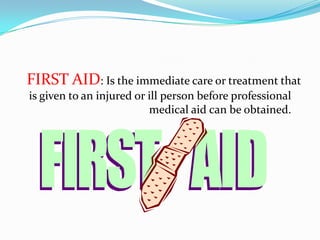
FIRST AID: Is the immediate care or treatment that
is given to an injured or ill person before professional
                          medical aid can be obtained.
Anatomy and physiology
Cardiovascular system
Anatomy: I - Heart:
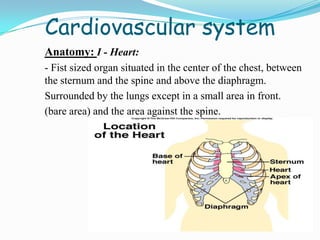
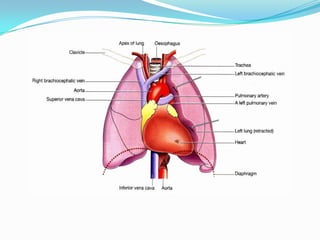
- Fist sized organ situated in the center of the chest, between
the sternum and the spine and above the diaphragm.
Surrounded by the lungs except in a small area in front.
(bare area) and the area against the spine.
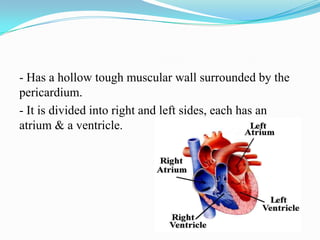
- Has a hollow tough muscular wall surrounded by the
pericardium.
- It is divided into right and left sides, each has an
atrium & a ventricle.
II - Vascular system
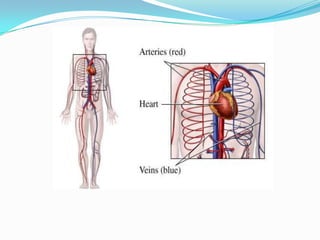
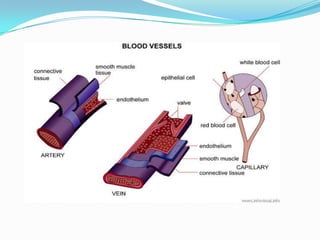
 Arteries:
 Thick walled, carrying blood from the heart under
 high pressure.
 Capillaries:
 Thin walled network of one cell layer.
 Veins:
 Thin walled vessels carrying blood under low
 pressure back to the heart.
  Two coronary arteries originate from the aorta
 encircling the heart to supply the myocardium.
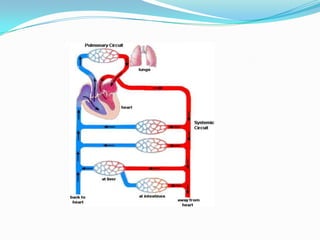
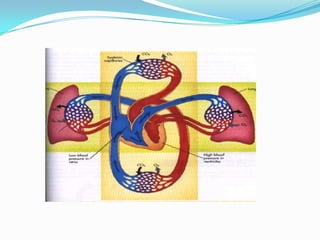
Physiology of the heart
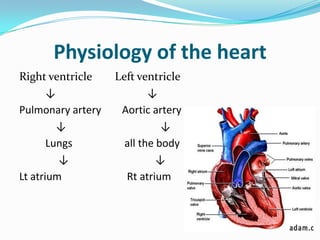
Right ventricle    Left ventricle
       ↓                   ↓
Pulmonary artery    Aortic artery
         ↓                    ↓
       Lungs         all the body
         ↓                   ↓
Lt atrium            Rt atrium
Functions of cardiovascular
            system
 1 – purify the blood through the pulmonary capillary
system.
2 – provide oxygenated blood to all tissues through the
systemic capillary system.

THE HEART beats 60-90 beats per minute during rest .
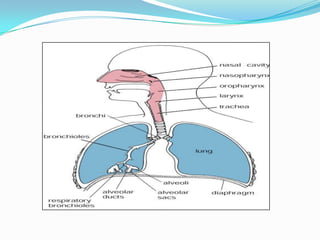
Respiratory system
4 components:
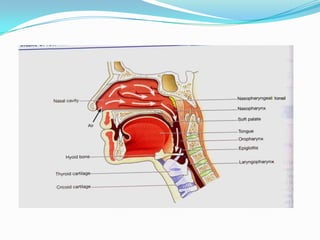
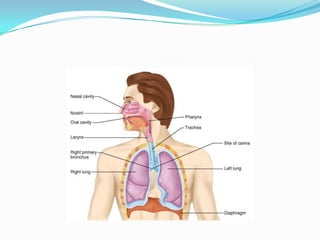
1 – Airways:
A) Upper airway: nose & mouth, pharynx, larynx.
B) Lower airway: trachea, bronchi, bronchioles.
2 – Neuromuscular system:
A) Respiratory center in the brain.
B) Nerves.
C) Muscles of respiration.( Diaphragm , intercostal
muscles)
D) Chest cage
Cont…
3 – Alveoli:
Millions of minute air sacs made of very delicate thin
membrane of one cell layer. Capillaries are on outer side
(exchange of gases).
4 – Pulmonary vessels:
Heart (Rt ventricle)→pulmonary arteries –dark blood→ fine
capillary network – pick up O2 & expel CO2 in alveoli→
pulmonary veins → heart (Lt ventricle).
Physiology of respiration
- Inspiration is an active process.
- Expiration is a passive process.
- Function is to pick up oxygen and expel
CO2.
Cont.
 ↑CO2 in arterial blood →Brain
 →respiratory center→ signals
 →respiratory nerves → respiratory
 muscles → ↑respiratory rate and depth
 till normal CO2 →normal respiration.
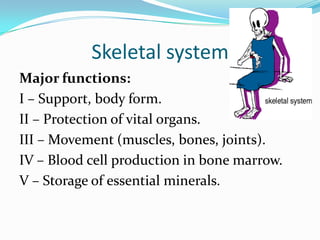
Skeletal system
Major functions:
I – Support, body form.
II – Protection of vital organs.
III – Movement (muscles, bones, joints).
IV – Blood cell production in bone marrow.
V – Storage of essential minerals.
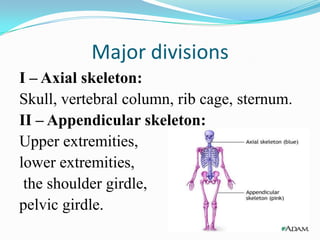
Major divisions
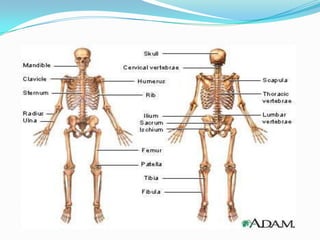
I – Axial skeleton:
Skull, vertebral column, rib cage, sternum.
II – Appendicular skeleton:
Upper extremities,
lower extremities,
 the shoulder girdle,
pelvic girdle.
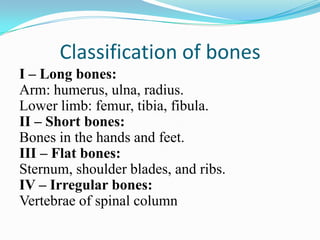
Classification of bones
I – Long bones:
Arm: humerus, ulna, radius.
Lower limb: femur, tibia, fibula.
II – Short bones:
Bones in the hands and feet.
III – Flat bones:
Sternum, shoulder blades, and ribs.
IV – Irregular bones:
Vertebrae of spinal column
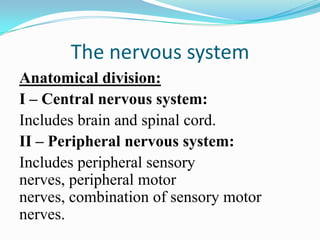
The nervous system
Anatomical division:
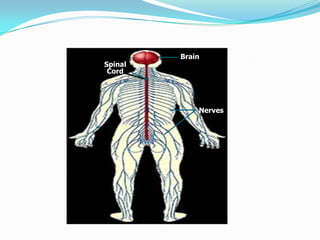
I – Central nervous system:
Includes brain and spinal cord.
II – Peripheral nervous system:
Includes peripheral sensory
nerves, peripheral motor
nerves, combination of sensory motor
nerves.
Brain
Spinal
 Cord


             Nerves
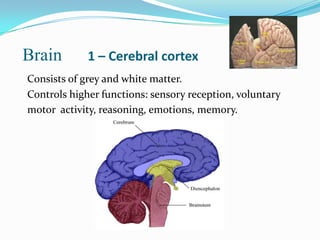
Brain        1 – Cerebral cortex
Consists of grey and white matter.
Controls higher functions: sensory reception, voluntary
motor activity, reasoning, emotions, memory.
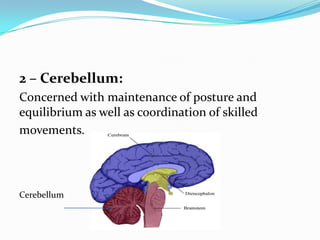
2 – Cerebellum:
Concerned with maintenance of posture and
equilibrium as well as coordination of skilled
movements.


Cerebellum
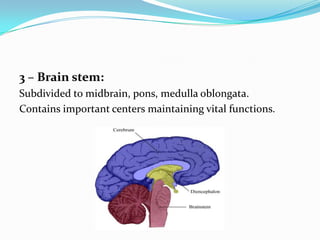
3 – Brain stem:
Subdivided to midbrain, pons, medulla oblongata.
Contains important centers maintaining vital functions.
Functional divisions of nervous system
I – Autonomic nervous system (involuntary):
A – Parasympathetic:
Causes dilatation of blood vessels, increases tone and
contractility of smooth muscles, and induces secretions.

B – Sympathetic:
Controls many automatic functions: constriction of blood
vessels, and increases heart rate.

II – Voluntary:
Under direct control of the brain.
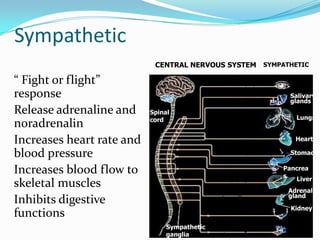
Sympathetic
                            CENTRAL NERVOUS SYSTEM SYMPATHETIC
                                Brain
“ Fight or flight”                               Dilates pupil
response                                     Stimulates salivation      Salivary
                                                                        glands
                                               Relaxes bronchi
Release adrenaline and     Spinal
                                                                          Lungs
                           cord
noradrenalin
                                             Accelerates heartbeat
Increases heart rate and                                                  Heart

blood pressure                                   Inhibits activity       Stomach

Increases blood flow to                                                Pancrea
                                                                       s
                                             Stimulates glucose           Liver
skeletal muscles                                                        Adrenal
                                            Secretion of adrenaline,
                                                                        gland
Inhibits digestive                          no adrenaline
                                                                         Kidney
functions                                      Relaxes bladder

                                Sympathetic Stimulates ejaculation
                                ganglia     in male
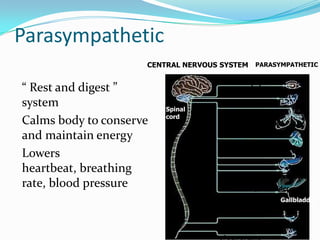
Parasympathetic
                     CENTRAL NERVOUS SYSTEM PARASYMPATHETIC
                             Brain
                                     Contracts pupil
“ Rest and digest ”                  Stimulates salivation
system                   Spinal
                                     Constricts bronchi
                         cord
Calms body to conserve
and maintain energy                  Slows heartbeat


Lowers                               Stimulates activity

heartbeat, breathing
rate, blood pressure                 Stimulates gallbladder
                                                           Gallbladder

                                     Contracts bladder

                                     Stimulates erection
                                     of sex organs
Cranial nerves
I – Olfactory: smell
II – Optic: vision
III – Oculomotor: eye lid, pupil, eyeball.
IV – Trochlear: turn the eye down and laterally.
V – Trigeminal: ophthalmic, maxillary, mandibular.
VI – Abducens: turns the eye laterally.
VII – Facial: muscles of expression.
VIII – Vestibulocochlear: hearing and equilibrium.
IX – Glosso-pharyngeal: taste
X – Vagus: parasympathetic for viscera.
XI – Spinal accessory: trapezious and sternomastoid
muscles.
XII – Hypoglossal: motor fibers to the tongue.
1-anatomy_and_physiology

1-anatomy_and_physiology

  • 2.
    Outlines -Introduction -Anatomy and physiologyof: Cardiovascular system. Respiratory system. The skeletal system. The nervous system.
  • 3.
    FIRST AID: Isthe immediate care or treatment that is given to an injured or ill person before professional medical aid can be obtained.
  • 4.
  • 5.
    Cardiovascular system Anatomy: I- Heart: - Fist sized organ situated in the center of the chest, between the sternum and the spine and above the diaphragm. Surrounded by the lungs except in a small area in front. (bare area) and the area against the spine.
  • 8.
    - Has ahollow tough muscular wall surrounded by the pericardium. - It is divided into right and left sides, each has an atrium & a ventricle.
  • 9.
    II - Vascularsystem Arteries: Thick walled, carrying blood from the heart under high pressure. Capillaries: Thin walled network of one cell layer. Veins: Thin walled vessels carrying blood under low pressure back to the heart. Two coronary arteries originate from the aorta encircling the heart to supply the myocardium.
  • 11.
    Physiology of theheart Right ventricle Left ventricle ↓ ↓ Pulmonary artery Aortic artery ↓ ↓ Lungs all the body ↓ ↓ Lt atrium Rt atrium
  • 14.
    Functions of cardiovascular system 1 – purify the blood through the pulmonary capillary system. 2 – provide oxygenated blood to all tissues through the systemic capillary system. THE HEART beats 60-90 beats per minute during rest .
  • 15.
    Respiratory system 4 components: 1– Airways: A) Upper airway: nose & mouth, pharynx, larynx. B) Lower airway: trachea, bronchi, bronchioles.
  • 18.
    2 – Neuromuscularsystem: A) Respiratory center in the brain. B) Nerves. C) Muscles of respiration.( Diaphragm , intercostal muscles) D) Chest cage
  • 20.
    Cont… 3 – Alveoli: Millionsof minute air sacs made of very delicate thin membrane of one cell layer. Capillaries are on outer side (exchange of gases). 4 – Pulmonary vessels: Heart (Rt ventricle)→pulmonary arteries –dark blood→ fine capillary network – pick up O2 & expel CO2 in alveoli→ pulmonary veins → heart (Lt ventricle).
  • 21.
    Physiology of respiration -Inspiration is an active process. - Expiration is a passive process. - Function is to pick up oxygen and expel CO2.
  • 22.
    Cont. ↑CO2 inarterial blood →Brain →respiratory center→ signals →respiratory nerves → respiratory muscles → ↑respiratory rate and depth till normal CO2 →normal respiration.
  • 23.
    Skeletal system Major functions: I– Support, body form. II – Protection of vital organs. III – Movement (muscles, bones, joints). IV – Blood cell production in bone marrow. V – Storage of essential minerals.
  • 24.
    Major divisions I –Axial skeleton: Skull, vertebral column, rib cage, sternum. II – Appendicular skeleton: Upper extremities, lower extremities, the shoulder girdle, pelvic girdle.
  • 25.
    Classification of bones I– Long bones: Arm: humerus, ulna, radius. Lower limb: femur, tibia, fibula. II – Short bones: Bones in the hands and feet. III – Flat bones: Sternum, shoulder blades, and ribs. IV – Irregular bones: Vertebrae of spinal column
  • 27.
    The nervous system Anatomicaldivision: I – Central nervous system: Includes brain and spinal cord. II – Peripheral nervous system: Includes peripheral sensory nerves, peripheral motor nerves, combination of sensory motor nerves.
  • 28.
  • 29.
    Brain 1 – Cerebral cortex Consists of grey and white matter. Controls higher functions: sensory reception, voluntary motor activity, reasoning, emotions, memory.
  • 30.
    2 – Cerebellum: Concernedwith maintenance of posture and equilibrium as well as coordination of skilled movements. Cerebellum
  • 31.
    3 – Brainstem: Subdivided to midbrain, pons, medulla oblongata. Contains important centers maintaining vital functions.
  • 32.
    Functional divisions ofnervous system I – Autonomic nervous system (involuntary): A – Parasympathetic: Causes dilatation of blood vessels, increases tone and contractility of smooth muscles, and induces secretions. B – Sympathetic: Controls many automatic functions: constriction of blood vessels, and increases heart rate. II – Voluntary: Under direct control of the brain.
  • 33.
    Sympathetic CENTRAL NERVOUS SYSTEM SYMPATHETIC Brain “ Fight or flight” Dilates pupil response Stimulates salivation Salivary glands Relaxes bronchi Release adrenaline and Spinal Lungs cord noradrenalin Accelerates heartbeat Increases heart rate and Heart blood pressure Inhibits activity Stomach Increases blood flow to Pancrea s Stimulates glucose Liver skeletal muscles Adrenal Secretion of adrenaline, gland Inhibits digestive no adrenaline Kidney functions Relaxes bladder Sympathetic Stimulates ejaculation ganglia in male
  • 34.
    Parasympathetic CENTRAL NERVOUS SYSTEM PARASYMPATHETIC Brain Contracts pupil “ Rest and digest ” Stimulates salivation system Spinal Constricts bronchi cord Calms body to conserve and maintain energy Slows heartbeat Lowers Stimulates activity heartbeat, breathing rate, blood pressure Stimulates gallbladder Gallbladder Contracts bladder Stimulates erection of sex organs
  • 35.
    Cranial nerves I –Olfactory: smell II – Optic: vision III – Oculomotor: eye lid, pupil, eyeball. IV – Trochlear: turn the eye down and laterally. V – Trigeminal: ophthalmic, maxillary, mandibular. VI – Abducens: turns the eye laterally. VII – Facial: muscles of expression. VIII – Vestibulocochlear: hearing and equilibrium. IX – Glosso-pharyngeal: taste X – Vagus: parasympathetic for viscera. XI – Spinal accessory: trapezious and sternomastoid muscles. XII – Hypoglossal: motor fibers to the tongue.